First National Bank (Milwaukee, WI)

Episode Information

Episode UID
6401123
Episode Type
Run Only
Bank Type
national
Bank ID
640 national
Charter Number
64
Start Date
July 25, 1893
Location
Milwaukee, Wisconsin (43.039, -87.906)

Metadata

Model
gpt-5-mini (chosen from majority vote of a three-model LLM ensemble)
Short Digest
99a9966fe920d29d

Response Measures

Accommodated withdrawals

Events (3)

1. August 15, 1863 Chartered
Source
historical_nic
2. June 1, 1882 Chartered
Source
historical_nic
3. July 25, 1893 Run
Cause
Local Banks
Cause Details
Crowds and withdrawals followed news of the Mitchell bank closing/receiver appointment and other local bank failures, triggering runs or heavy withdrawals at Milwaukee banks.
Measures
No formal suspension reported; banks met many demands and accepted deposits while some withdrawals occurred.
Newspaper Excerpt
Within five minutes after the news of the Mitchell bank considerable crowds gathered at the Merchants' Exchange. First National and Marshal banks and more or less of a crowd at the Wisconsin National Bank. Notwithstanding this fact ... while considerable money was hastily withdrawn, even larger amounts were placed on the inside of the counters.
Source
newspapers

Newspaper Articles (4)

Article from Vermont Phล“nix, June 9, 1893

Click image to open full size in new tab

Article Text

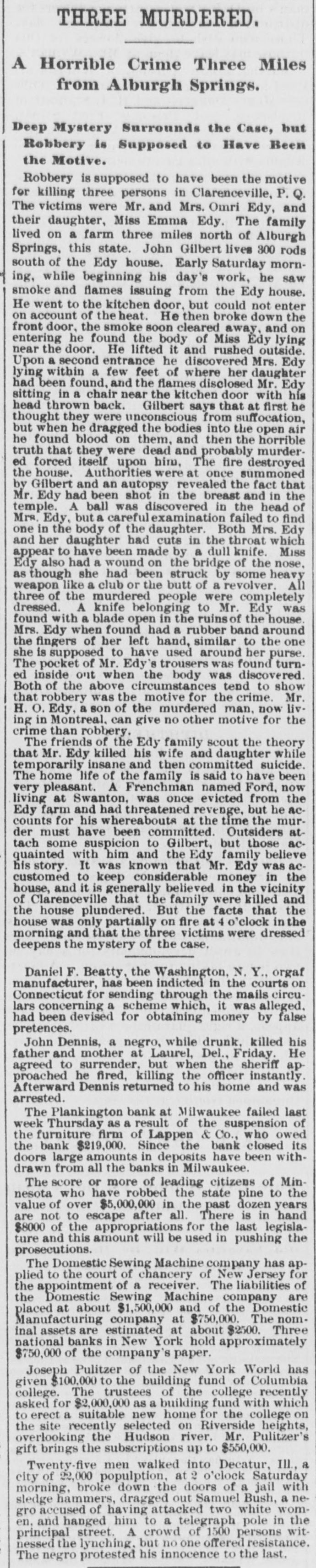
THREE MURDERED. A Horrible Crime Three Miles from Alburgh Springs. Deep Mystery Surrounds the Case, but Robbery is Supposed to Have Been the Motive. Robbery is supposed to have been the motive for killing three persons in Clarenceville, P. The victims were Mr. and Mrs. Omri Edy, and their daughter, Miss Emma Edy. The family lived on a farm three miles north of Alburgh Springs, this state. John Gilbert lives 300 rods south of the Edy house. Early Saturday morning, while beginning his day's work, he saw smoke and flames issuing from the Edy house. He went to the kitchen door, but could not enter on account of the heat. He then broke down the front door, the smoke soon cleared away, and on entering he found the body of Miss Edy lying near the door. He lifted it and rushed outside. Upon a second entrance he discovered Mrs. Edy lying within a few feet of where her daughter had been found, and the flames disclosed Mr. Edy sitting in a chair near the kitchen door with his head thrown back. Gilbert says that at first he thought they were unconscious from suffocation, but when he dragged the bodies into the open air he found blood on them, and then the horrible truth that they were dead and probably murdered forced itself upon him. The fire destroyed the house. Authorities were at once summoned by Gilbert and an autopsy revealed the fact that Mr. Edy had been shot in the breast and in the temple. A ball was discovered in the head of Mrs. Edy. but a carefulexamination failed to find one in the body of the daughter. Both Mrs. Edy and her daughter had cuts in the throat which appear to have been made by a dull knife. Miss Edy also had a wound on the bridge of the nose, as though she had been struck by some heavy weapon like a club or the butt of a revolver. All three of the murdered people were completely dressed. A knife belonging to Mr. Edy was found with a blade open in the ruins of the house. Mrs. Edy when found had a rubber band around the fingers of her left hand, similar to the one she is supposed to have used around her purse. The pocket of Mr. Edy's trousers was found turned inside out when the body was discovered. Both of the above circumstances tend to show that robbery was the motive for the crime. Mr. H. O. Edy, a son of the murdered man, now living in Montreal. can give no other motive for the crime than robbery. The friends of the Edy family scout the theory that Mr. Edy killed his wife and daughter while temporarily insane and then committed suicide. The home life of the family is said to have been very pleasant. A Frenchman named Ford, now living at Swanton, was once evicted from the Edy farm and had threatened revenge, but he accounts for his whereabouts at the time the murder must have been committed. Outsiders attach some suspicion to Gilbert, but those acquainted with him and the Edy family believe his story. It was known that Mr. Edy was accustomed to keep considerable money in the house, and it is generally believed in the vicinity of Clarenceville that the family were killed and the house plundered. But the facts that the house was only partially on fire o'clock in the morning and that the three victims were dressed deepens the mystery of the case. Daniel F. Beatty, the Washington. N. Y., orgaf manufacturer, has been indicted in the courts on Connecticut for sending through the mails circulars concerning a scheme which, it was alleged. had been devised for obtaining money by false pretences. John Dennis, a negro, while drunk. killed his father and mother at Laurel, Del., Friday. He agreed to surrender, but when the sheriff approached he fired, killing the officer instantly Afterward Dennis returned to his home and was arrested. The Plankington bank at Milwaukee failed last week Thursday as a result of the suspension of the furniture firm of Lappen & Co., who owed the bank $219,000. Since the bank closed its doors large amounts in deposits have been withdrawn from all the banks in Milwaukee. The score or more of leading citizens of Minnesota who have robbed the state pine to the value of over $5,000,000 in the past dozen years are not to escape after all. There is in hand $8000 of the appropriations for the last legislature and this amount will be used in pushing the prosecutions. The Domestic Sewing Machine company has applied to the court of chancery of New Jersey for the appointment of a receiver. The liabilities of the Domestic Sewing Machine company are placed at about $1,500,000 and of the Domestic Manufacturing company at $750,000. The nominal assets are estimated at about $2500. Three national banks in New York hold approximately $750,000 of the company's paper. Joseph Pulitzer of the New York World has given $100,000 to the building fund of Columbia college. The trustees of the college recently asked for $2,000,000 as a building fund with which to erect a suitable new home for the college on the site recently selected on Riverside heights, overlooking the Hudson river. Mr. Pulitzer's gift brings the subscriptions up to $550,000. Twenty-five men walked into Decatur, Ill., a city of 22,000 populption. at 2 o'clock Saturday morning, broke down the doors of a jail with sledge hammers, dragged out Samuel Bush, a negro accused of having attacked two white women. and hanged him to a telegraph pole in the principal street. A crowd of 1500 persons witnessed the lynching. but no one offered resistance. The negro protested his innocence to the last.

Article from The Providence News, July 25, 1893

Click image to open full size in new tab

Article Text

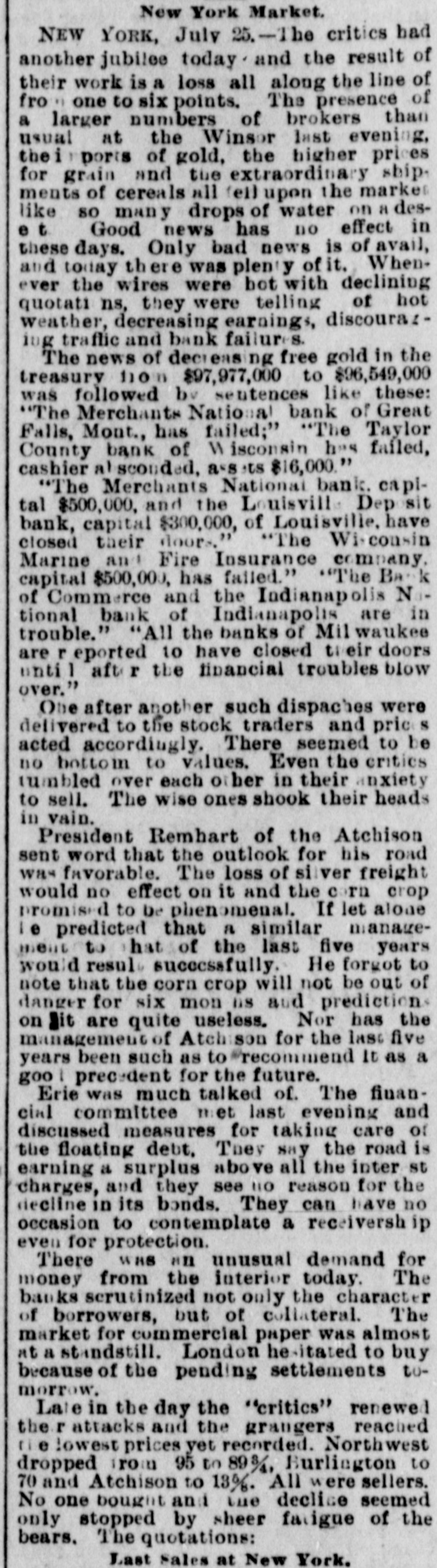
New York Market. NEW YORK, July 25.-The critics had another jubilee today and the result of their work is a loss all along the line of fro one to six points. The presence of a larger numbers of brokers than usual at the Winsor last evening, thei ports of gold, the higher prices for grain and the extraordinary shipments of cereals all (ell upon the market like so many drops of water on a deset Good news has no effect in these days. Only bad news is of avail, and today there was plenty of it. Whenever the wires were bot with declining quotati ns, they were telling of hot weather, decreasing earnings, discouraziug traffic and bank failures. The news of decreasir free gold in the treasury non $97,977,000 to $96,549,000 was followed bv sentences like these: "The Merchants National bank of Great Falls, Mont., has failed;" "The Taylor County bank of isconsin has failed, cashier sconded, assets $16,000." "The Merchants National bank. capital $500,000, and the Louisville Dep sit bank, capital $300,000, of Louisville, have closed their doors." "The Wi-consin Marine and Fire Insurance company. capital $500,000, has failed." "The Bank of Commerce and the Indianapolis Notional bank of Indianapolis are in trouble." "All the banks of Mil waukee are r eported to have closed tweir doors until aft. r the financial troubles blow over." One after another such dispaches were delivered to the stock traders and price S acted accordingly. There seemed to be no bottom to values. Even the critics tumbled over each other in their anxiety to sell. The wise ones shook their heads in vain. President Rembart of the Atchison sent word that the outlook for his road was favorable. The loss of silver freight would no effect on it and the corn crop promised to be phenomenal. If let alone le predicted that a similar management to shat of the last five years would resule successfully. He forgot to note that the corn crop will not be out of danger for six mon ns and predictions on Bit are quite useless. Nor has the management of Atchison for the last five years been such as to Precommend It as a goo I precedent for the future. Erie was much talked of. The financial committee met last evening and discussed measures for taking care of the floating debt. They say the road is earning a surplus above all the inter st charges, and they see no reason for the decline in its bonds. They can have no occasion to contemplate a receiversh ip even for protection. There WHS an unusual demand for money from the interior today. The banks scrutinized not only the character of borrowers, but of collateral. The market for commercial paper was almost at a standstill. London he-itated to buy because of the pending settlements tomorrow. Late in the day the "critics" renewed the r attacks and the grangers reached rie lowest prices yet recorded. Northwest dropped from 95 to 89 3/4, Burlington to 70 and Atchison to 13%. All were sellers. No one bought and tue declise seemed only stopped by sheer fatigue of the bears. The quotations: Last Sales at New York.


Article from The Wheeling Daily Intelligencer, July 26, 1893

Click image to open full size in new tab

Article Text

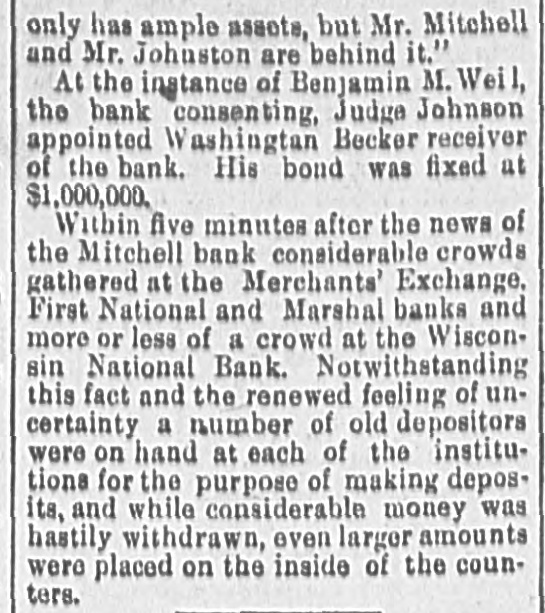
only has ample assets, but Mr. Mitchell and Mr. Johnston are behind it." At the instance of Benjamin M. Weil, the bank consenting, Judge Johnson appointed Washingtan Becker receiver of the bank. His bond was fixed at $1,000,000. Within five minutes after the news of the Mitchell bank considerable crowds gathered at the Merchants' Exchange. First National and Marshal banks and more or less of a crowd at the Wisconsin National Bank. Notwithstanding this fact and the renewed feeling of uncertainty a number of old depositors were on hand at each of the institutions for the purpose of making depos. its, and while considerable money was hastily withdrawn, even larger amounts were placed on the inside of the counters.


Article from Wood County Reporter, August 3, 1893

Click image to open full size in new tab

Article Text

a special act of the legislature obtained by Alexander Mitchell the stockholders are liable without limit for all debts of the bank. John L. Mitchell is president, David Ferguson vice-president, John Johnston cashier and Robert L. Jennings assistant cashier. The bank was closed up on an action brought by Benjamin Weil, a real estate man, who alleged that the bank owed him $3,341.7 which it was unable to pay. On motion of B. K. Miller, Judge Johnson appointed Washington Becker receiver under bonds of $1,000,000. This bank is the city depository, and at the present time holds $1,635,000 of the city's money. Rumor has it that the city treasurer this morning demanded the whole sum and the bank, in justice to all depositors, closed rather than pay it. The city has only $8,000 in cash on hand and will be forced to suspend payments. The Mitchell bank was the depository of the Chicago, Milwaukee and St. Paul road and paymasters checks are drawn on it. They will be cashed at the station here. The treasurer's checks will be paid by the Wisconsin National bank. The semi-annual statement of the bank, issued July 1, was as follows: Resources-Loans and discounts $6,485,673.39. overdrafts $29,233.12, stocks, bonds and mortgages $567,412.82, loss and expense account $683.88, due from banks and bankers $1,038,472.41, cash-currency $532,361.00, gold and silver $124,226.17. checks on clearing house $168,281.82. total resources $8,946,344.61. Liabilities-Capital $500,000.00, undivided profits $65,840.67. due depositors $7,870,503.94, due to others not included under either of above heads $500,000.00, total liabilities $8,946,344.61 Cashier Murphy says: "The bank is not insolvent by any means, and only time was needed to realize enough to meet every liability. It not only has ample assets. but Mr. Mitchell and Mr. Johnson are behind it." Washington Becker, the temporary receiver, said: "I have every reason to hope that our depositors will receive their money in a reasonable short time. I can't say how soon, of course, but I hope it will be at an early day." Within five miutes after the news of the closing of the Wisconsin Marine and Fire Insurance company bank considerable crowds gathered at the First National. Marshall & Ilsley and Wisconsin National banks. Notwithstanding this fact and the renewed feeling of uncertainty a number of old depositors were on hand at each of these institutions for the puropse of making deposits, and while money was hastily withdrawn even larger amounts were placed on the inside of the counters. The bank was incorporated by the territorial legislature of Wisconsin in 1839, the charter being granted to Alexander Mitchell and George Smith, young Scotchmen just arrived from Aberdeen. The charter of the company was repealed in 1844, as it was discovered that the company was doing a banking business, contrary to the proviso in its charter prohibiting it although in strict accordance with the specific business it had been authorized to do. Alexander Mitchell ran the bank until his death d few years ago. The stockholders of the bank are: John L. Mitchell, $313,300; David Ferguson, $166,600; Washington Becker, $20,000; John P. Murphy, $1,000; total, $500,000. John Johnston sold all his stock to John L. Mitchell about six months ago, but Johnston was still cashier and it is popularly thought that the deal was not SO fully consummated as to relieve him of liability. Mitchell alone is estimated to be worth from $5,000,000 to $10,000,000' while all others connected with the bank are also wealthy. Mr. Ferguson was completely prostrated and a little while after the suspension his condition became such that medical attention was considered necessary and Dr. Fox was summoned. Soon afterward Mr. Fergusor was taken home in Dr. Fox's ca riage. Every man in the crowd of bystanders had words of sympathy for the white-haired old man who went into the bank with Alexander Mitchell over fifty years ago. Other local banks were somewhat run upon but easily met all demands. The trouble is thought to be over.Bankers have long deemed the Marine bank shaky, because of the close margin business it did. A speedy resumption is expected. LATEST NEWS. Milwaukee, July 25.-The feeling here is that the situation is now at its worst and that tomorrow will show a brighter aspect to affairs. Business houses which have had banking relations with the Wisconsin Marine & Fire Insurance Company bank have nearly all effected new banking relations and while a large amount of money is tied up in the failure. if eastern creditors will give extension to business houses there is not likely to be any more failures