First National Bank (Miami, FL)

Episode Information

Episode Type
Suspension โ†’ Reopening
Start Date
June 11, 1930
Location
Miami, Florida (25.774, -80.194)
Bank Type
national
Charter Number
6370

Metadata

Notes

Bank faced multiple runs in 1930 but only closed under the 1933 federal banking holiday and then reopened.

Events (5)

1. August 8, 1902 Chartered
Source
historical_nic
2. June 11, 1930 Run
Cause
Local Banks
Cause Details
Runs triggered by the failure/closure of the Bank of Bay Biscayne and its subsidiaries causing heavy withdrawals from other Miami banks.
Measures
Received large shipments of cash by airplane from Federal depository; paid out large withdrawals.
Newspaper Excerpt
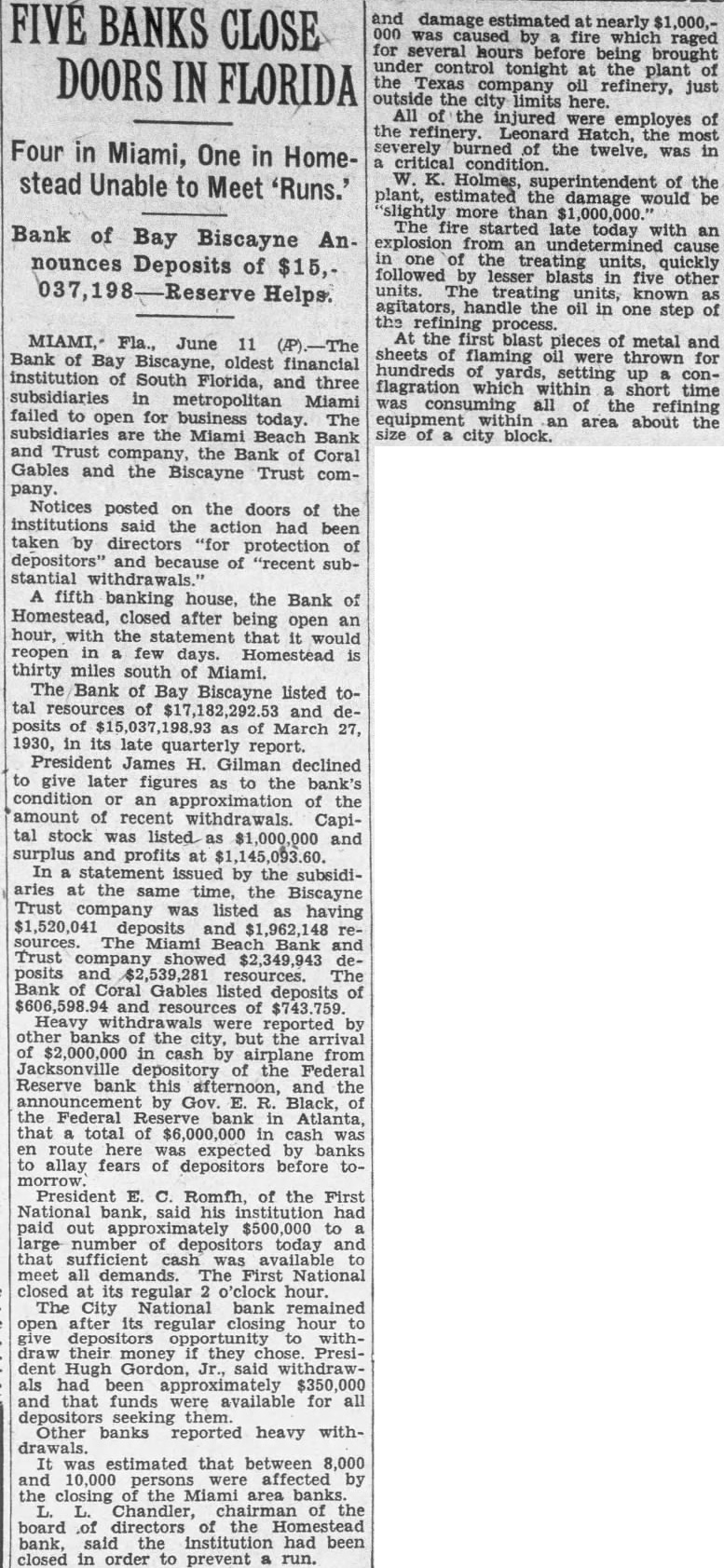
President E. C. Romfh of the First National bank said his institution had paid out $500,000 to a large number of depositors today and that sufficient cash was available to meet all demands.
Source
newspapers
3. December 22, 1930 Run
Cause
Local Banks
Cause Details
Run agitation followed the failure/closing of the City National Bank, prompting depositors to seek funds at First National.
Measures
Public statements reassuring depositors; maintained cash on hand and paid depositors (reported about $5,000,000 available).
Newspaper Excerpt
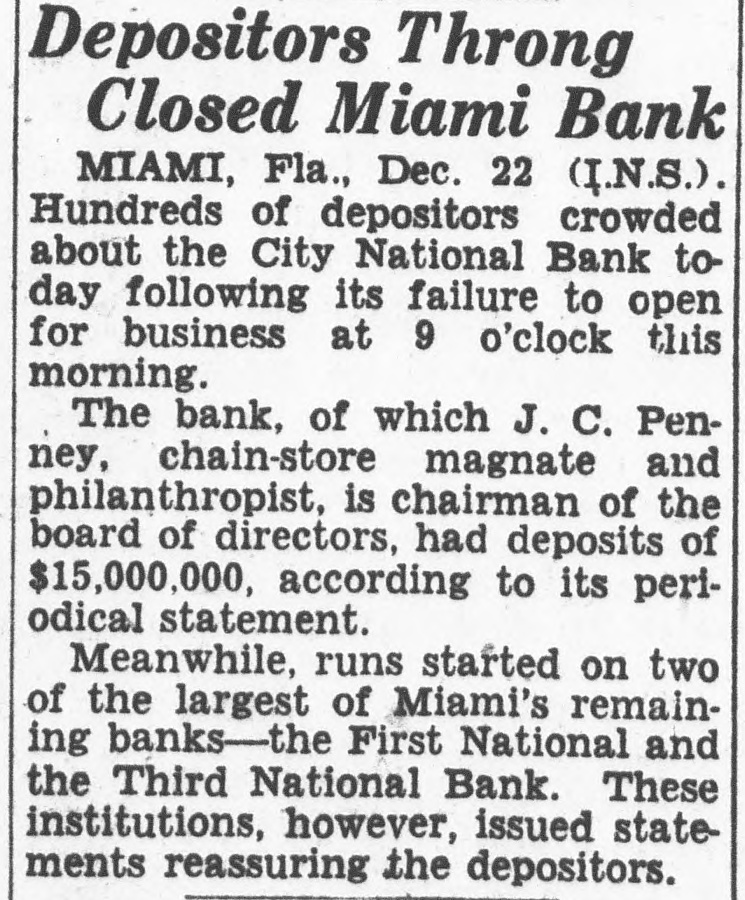
Runs started on two of the largest of Miami's remaining banks--the First National and the Third National Bank. These institutions, however, issued statements reassuring the depositors.
Source
newspapers
4. March 6, 1933 Suspension
Cause
Government Action
Cause Details
Closed under the federal/state banking holiday proclamation in March 1933 (national banking holiday).
Newspaper Excerpt
Nevertheless, Mr. Romfh's bank and the other banks here will remain closed.
Source
newspapers
5. March 16, 1933 Reopening
Newspaper Excerpt
The First National reported $2,000,000 deposits resumed business Tuesday morning.
Source
newspapers

Newspaper Articles (14)

Article from St. Louis Post-Dispatch, June 11, 1930

Click image to open full size in new tab

Article Text

HEAVY ON Bay of Biscayne, Oldest pository in City, Fails to Open Forcing Affiliated Group Shut. $2,000,000 IN CASH SENT BY AIRPLANE Reserve Governor More Is Being Totals Announced. By the Associated Press. MIAMI, Fla., June The Bank of Bay Biscayne, with deposits of $15,037,198. as of March 27 statement, and three affiliated depositoories, failed to open for business today. statement by directors of the bank attributed closing to "recent substantial The affiliated banks the Biscayne Trust the Miami Beach Bank Trust and the Bank of Coral Gables. The Bank of Bay Biscayne in its quarterly statement showed posits and total sources man is president of the bank. The Bank of Bay Biscayne is Miami's oldest bank. It has one of the finest buildings in the structure. Resources of Other Banks. The Biscayne Trust Co. had deposits and The Miami Beach Bank Trust Co. had deposits of 943 and resources of The Bank of Coral Gables, the third of the affiliated had deposits of and sources of Romfh, president of the First National Bank, said that left by plane today from the Federal depository He said the First National Bank and its has on hand to pay all depositors, if necessary. Depositors were orderly as they made during the morning from other banks of the and suburbs. from other banks here up to the closing time were made orderly fashion. Bank of. ficials and available funds not by Plane. E. president of the First National Bank, said Laurie Yonce, Jacksonville pilot, had landhere shortly after with in cash which he brought from the Federal depository in Hugh H. Gordon president the City Bank, said that approximately $350,000 had been withdrawn from his bank up m. and that the doors of the depository would be kept open as long depositors Romfh said 000 had been withdrawn from the First National Bank today. telegram signed by Black, governor of the Federal District in was postin the window of the Third National Bank which shid was route to Miami banks. 10,000 Depositors Affected. depositors in Miami, Miami Beach and Coral Gables were affected by the bank closings. President Gilman of the Bank of Bay Biscayne said: of the directors this after consultation with the State Comptroller, decided not open this bank and tions, the Biscayne Trust Co., Beach Bank Trust Co. and the Bank Coral order to protect all of our depositors to the fullest extent. decision was made after due consideration was due to substantial Arthur Saarinen, bank iner, charge the bank. The bank's include loans and discounts amounting to and securities and commercial and bonds valued at June The Bank of Homestead closed doors this morning today after opening short time. AssistCashier H. Grady Smith said the bank was in condition good and that of business suspension but temporary, avoid account of bank failures today Miami. He said the bank pects to open few days. Reserve Governor Is Being Sent Miami. June Black, of district the Bank, said today that being Continued on Column

Article from Austin American-Statesman, June 11, 1930

Click image to open full size in new tab

Article Text

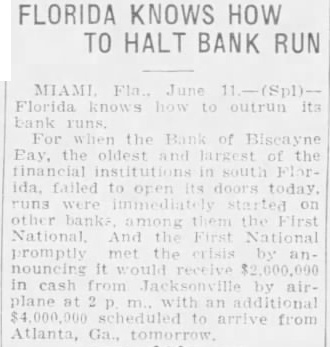
FLORIDA KNOWS HOW TO HALT BANK RUN MIAMI For Bank Biscayne the oldest the ida, failed to Its today. runs on other National And the First National promptly met the in cash airplane at scheduled to arrive from Atlanta, Ga.,


Article from Tampa Bay Times, June 12, 1930

Click image to open full size in new tab

Article Text

Millions Sent To Miami Banks from Page clined to give later figures as to the bank's approximation of the amount of recent withdrawals. Capital stock was listed surplus profits at statement issued by the subsidiaries same time, the Biscayne Trust company was listed having $1,520,041 deposits and resources. Miami Beach Bank Trust company showed $2,349,943 deposits and $2, The Bank Coral Gables listed deposits of $606,of Withdrawals Are Heavy Heavy withdrawals reported by other banks of the city, but the arrival of in cash by airplane from Jacksonville depository Reserve bank this by Gov. R. Black of the Federal Reserve bank that total $6,000,000 in route banks to allay fears of depositors before President E. C. Romfh of the First National bank, said his had paid out $500,000 large today, and that cash was available meet all demands. The First closed at its regular o'clock The City National bank open after its reqular closing hour give depositors money they chose. President Hugh Gordon, withdrawals had and that funds were for all Flies To Miami Creed of the Federal bank this district here today by airplane from Tampa. went conferthe of Bay the Arthur W. Saarinen, banking took affairs of the closed bank formal from President Gilman the of the this with the was not the open this bank and its affiliated the pany, Miami and Trust comthe Bank of all order of our deposthe fullest extent. "This made after due consideration, was due to recent substantial withdrawals.' It was estimated that between 8,000 and affected of the Miami area banks. L. Chandler, chairman of the of the bank, said the had been closed measure in order to prevent run. APPOINTED Appointment Duncan of Miami, for Dade Broward the five banks which failed Dade county today was by Comptroller ErAmos Four of the banks-the Bank of Bay Biscayne Trust company, Miami Beach Bank and Trust company, Bank Coral Gables -suspended during forenoon. later department the the Fla., which capitalized $35,000.


Article from Chattanooga Daily Times, June 12, 1930

Click image to open full size in new tab

Article Text

FIVE BANKS CLOSE DOORS IN FLORIDA Four in Miami, One in Homea stead Unable to Meet 'Runs.' Bank of Bay Biscayne Announces Deposits of $15,Helps. MIAMI, Fla., June 11 (A).-The Bank of Bay Biscayne, oldest financial institution of South Florida, and three subsidiaries in metropolitan Miami failed to open for business today. The subsidiaries are the Miami Beach Bank and Trust company, the Bank of Coral Gables and the Biscayne Trust company. Notices posted on the doors of the institutions said the action had been taken by directors "for protection of depositors" and because of "recent substantial withdrawals. fifth banking house, the Bank of Homestead, closed after being open an hour, with the statement that it would reopen in few days. Homestead is thirty miles south of Miami. The Bank of Bay Biscayne listed total resources of and deposits of as of March 27, 1930, in its late quarterly report. President James H. Gilman declined to give later figures as to the bank's condition or of the amount of recent withdrawals Capital stock was listed as $1,000,000 and surplus and profits at In issued by the subsidiaries at the same time, the Biscayne Trust was listed as having $1,520,041 and resources. The Miami Bank and Trust $2,349,943 deposits and $2,539,281 resources. The Bank of Coral Gables listed deposits of $606,598 and resources of Heavy withdrawals were reported by other banks of the city, but the arrival of $2,000,000 in cash by from Jacksonville of the Federal Reserve bank this and the announcement by Gov. E. R. Black, the Federal bank in Atlanta, that total of $6,000,000 in cash was en route here was expected by banks to allay fears of depositors before tomorrow. President E. C. Romfh, of the First National bank, said his institution had paid out $500,000 to large number of depositors today and that sufficient cash was available to meet all demands. The First National closed at its regular 2 o'clock hour. The City National bank remained open after its regular closing hour to give withdraw their money if they chose President Hugh Gordon, Jr., said withdrawals had been approximately $350,000 and that funds were available for all depositors seeking them. Other banks reported heavy withdrawals. It was estimated that between 8,000 and 10,000 affected by the closing of the Miami area banks. L. Chandler, chairman of the board of directors of the Homestead bank, said the institution had been closed in order to prevent a run. and damage estimated at nearly $1,000,000 was caused by a fire which raged for several hours before being brought under control tonight at the plant of the company oil refinery, just outside the city limits here. All of the injured were employes of the refinery. Leonard Hatch, the most severely burned of the twelve, was in critical condition. W. K. Holmes, superintendent of the plant, estimated the damage would be "slightly more than 1,000,000. The fire started late today with an explosion from an undetermined one of the treating units, quickly followed by lesser blasts in five other units. The treating units, known agitators, the handle the oil in one step of refining process. At the first blast pieces of metal and sheets of flaming oil were thrown for hundreds of yards, setting conflagration which within short time was consuming all of the refining equipment within an area about the size of a city block.


Article from The Morning Press, June 13, 1930

Click image to open full size in new tab

Article Text

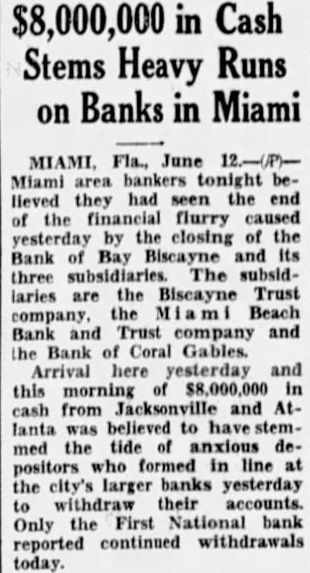
$8,000,000 in Cash Stems Heavy Runs on Banks in Miami Miami area bankers tonight believed they seen the end of the financial flurry caused yesterday by the closing of the Bank Bay Biscayne and its three subsidiaries. The subsidlaries are the Biscayne Trust company, the Miami Beach Bank and Trust company and the Bank of Coral Gables. Arrival here yesterday and this morning of $8,000,000 in cash from Jacksonville and Atlanta was believed to have stemmed the tide of anxious depositors who formed in line at the city's larger banks yesterday to withdraw their accounts. Only the First National bank reported continued withdrawals today.


Article from The Courier News, December 22, 1930

Click image to open full size in new tab

Article Text

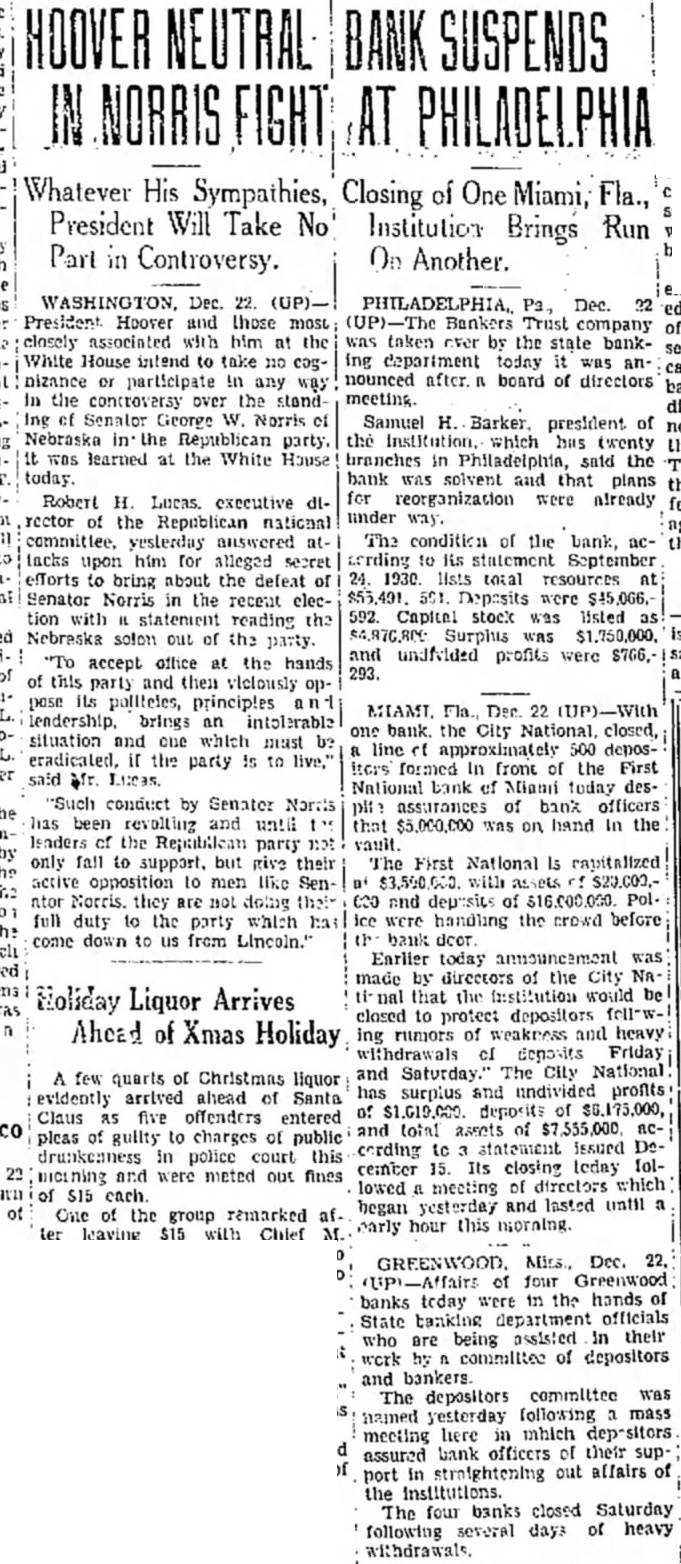
Whatever His Sympathies, President Will Take No Part in Controversy. WASHINGTON Dec. 22. President Hoover and those most closely associated with him at the White House intend to take no cognizance participate in any the controversy over the stand Ing of Senator George W. Norris Nebraska in* the Republican party. was learned at the White House today. Robert Lucas. executive dlrector of the Republican national committee, yesterday answered tacks upon him alleged secret efforts to bring about the defeat of Senator Norris in the recent election with statement reading the Nebreska solon out of the party. accept office at the hands of this party and then viclously opits politeies, principles brings an situation and one which must be eradicated, the party Is to said "Such conduct by Senater Norms been revolting and until leaders of the Republican party only fall to support, but give their active opposition to men like Norris. they are not doing full duty the party which come down to us from Lincoln." Closing of One Miami, Institution Run Brings On Another. Dec. Bankers Trust company of taken by the state banking department today nounced after board of directors meeting. Samuel H. president of the which twenty branches in Philadelphia, said the bank solvent and that plans for reorganization were already under way. The condition of the bank, accarding to lis statement September lists total resources 501. Deposits were 592. Capital stock was listed was and profits were 293. Dec one bank. the City National closed, line approximately 500 deposformed In front of the First National bank of Miami today desassurances of bank officers that $5,000,000 was on hand In the The First National Is capitalized were handling the crowd before bank Earlier today announcement made by directors of the City that the institution would be closed to protect depositors ing rumors of weakness and heavy withdrawals deposits Friday and The City National has surplus and undivided profits deposits of and total assets statement issued 15. Its closing folof directors which lowed meeting and lasted until began yesterday hour this morning. Dec. of four Greenwood were in the hands of banks today banking officials State assisted their who are being work by committee of depositors and bankers. depositors committee was The named yesterday following mass meeting here mhich bank officers of their assured in straightening out affairs of port the institutions. The four banks closed Saturday following several days heavy withdrawals.


Article from The Washington Times, December 22, 1930

Click image to open full size in new tab

Article Text

Depositors Throng Closed Miami Bank MIAMI, Fla., Dec. 22 (I.N.S.). Hundreds of depositors crowded about the City National Bank today following its failure to open for business at 9 o'clock this morning. The bank, of which J. C. Penney, chain-store magnate and philanthropist, is chairman of the board of directors, had deposits of $15,000,000, according to its periodical statement. Meanwhile, runs started on two of the largest of Miami's remaining banks-the First National and the Third National Bank. These institutions, however, issued statements reassuring the depositors.


Article from The Miami News, December 22, 1930

Click image to open full size in new tab

Article Text

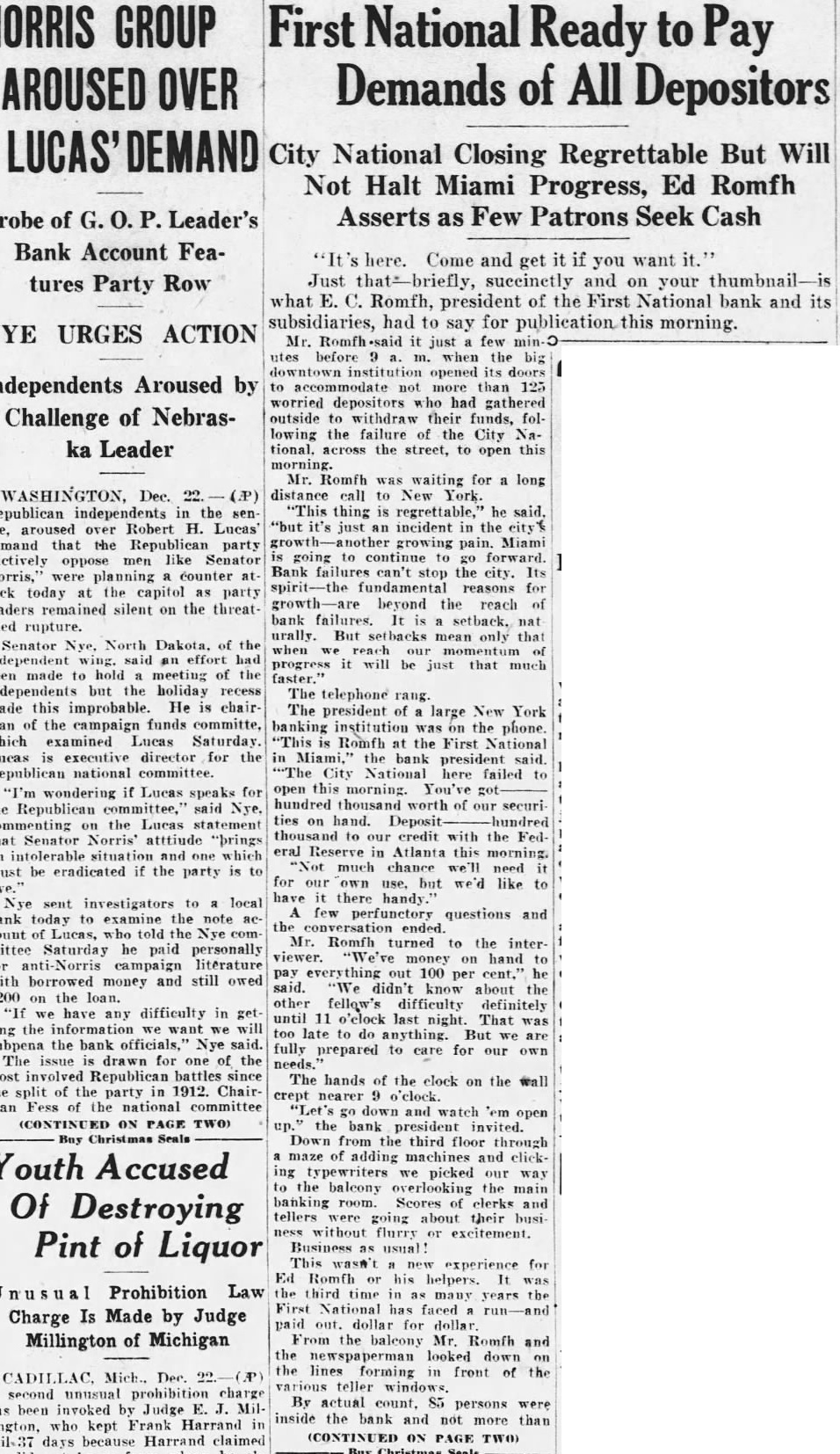
First National Ready to Pay Demands of All Depositors City National Closing Regrettable But Will Not Halt Miami Progress, Ed Romfh Asserts Few Patrons Seek Cash as here. Come and get it if you want Just that-briefly, succinetly and on your thumbnail-is what E. C. Romfh, president of the First National bank and its subsidiaries, had to say for publication this morning. Mr. just few before when the to than 125 worried depositors had gathered outside withdraw their funds, following the failure the City National. the street, to open this morning. Mr. Romfh was waiting for long distance to New York. "This thing is regrettable," he said. "but it's incident the pain. Miami going Bank can't stop city. beyond the reach bank failures. nat urally. only that when progress will be just that faster." The telephone rang. The president of large New York banking institution was the phone. Romfh the First National Miami," president National failed to open this morning. of our securities on credit with the Federal Atlanta this "Not much chance need for our use, but like to handy.' few perfunctory questions and the Mr. Romfh turned to the interviewer. hand pay 100 per said. didn't other fellow's definitely until last night. That too late to fully prepared to care for our own The hands of the clock on the wall crept nearer down and watch 'em open the bank president invited. Down from third floor through maze machines and clicking typewriters picked way the banking tellers going about their busiflurry excitement. Business This wasn't experience for Ed Romfh helpers. third time years the National has faced dollar dollar. From the balcony Mr. Romfh and the newspaperman down the lines forming front By count, persons the bank and not more than ON TWO)


Article from The Miami News, December 22, 1930

Click image to open full size in new tab

Article Text

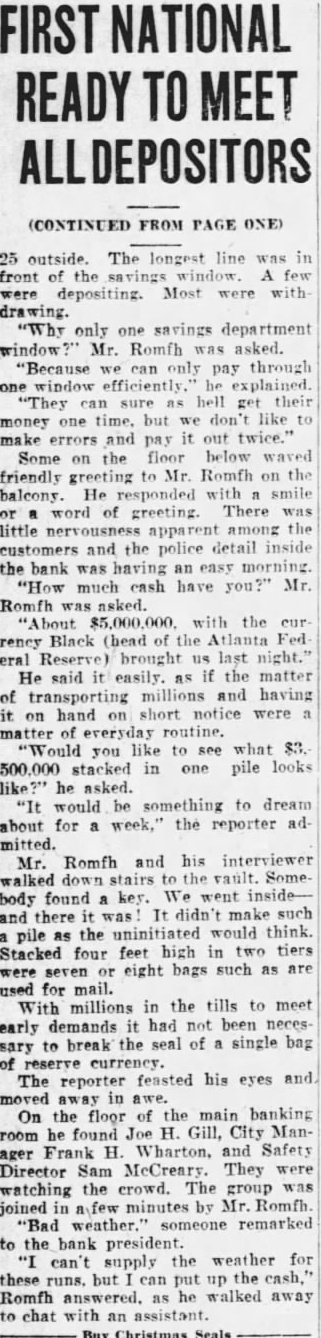
FIRST NATIONAL READY TO MEET ALLDEPOSITORS (CONTINUED FROM PAGE ONE) 25 outside. The longest in front of the savings window. A few were depositing. Most were with drawing. "Why only one savings department window Mr. Romfh was asked. "Because can only pay through one window efficiently. he explained. "They can sure as hell get their money one but we don't like to make errors and pay it out twice." Some the floor below waved on friendly greeting to Mr. Romfh on the He responded with smile or word of There was little nervousness apparent among the customers and the police detail inside the bank was having an easy morning "How much cash have you?" Mr Romfh was asked. "About $5,000,000. with the cur rency Black (head of the Atlanta Fed eral Reserve) brought us last night." He said it easily. as if the matter of transporting millions and having it on hand on short notice were matter of everyday routine. "Would you like to see what $3. 500.000 stacked in one pile looks he asked. "It would be something to dream about for week,' the reporter admitted. Mr. Romfh and his interviewer walked down stairs to the vault Somebody found key. We went insideand there was It didn't make such pile as the uninitiated would think. Stacked four feet high in two tiers were seven or eight bags such as are used for mail. With millions in the tills to meet early demands it had not been neces sary to break the seal of a single bag of reserve currency. The reporter feasted his eyes and moved away in awe. On the floor of the main banking room he found Joe H. Gill, City Manager Frank H. Wharton. and Safety Director Sam McCreary. They were watching the crowd. The group was joined in few minutes by Mr. Romfh. "Bad weather.' someone remarked to the bank president. "I can't supply the weather for these runs. but can put up the cash, Romfh answered. as he walked away to chat with an assistant. Buy Christmas Seals


Article from The Indianapolis Times, March 7, 1933

Click image to open full size in new tab

Article Text

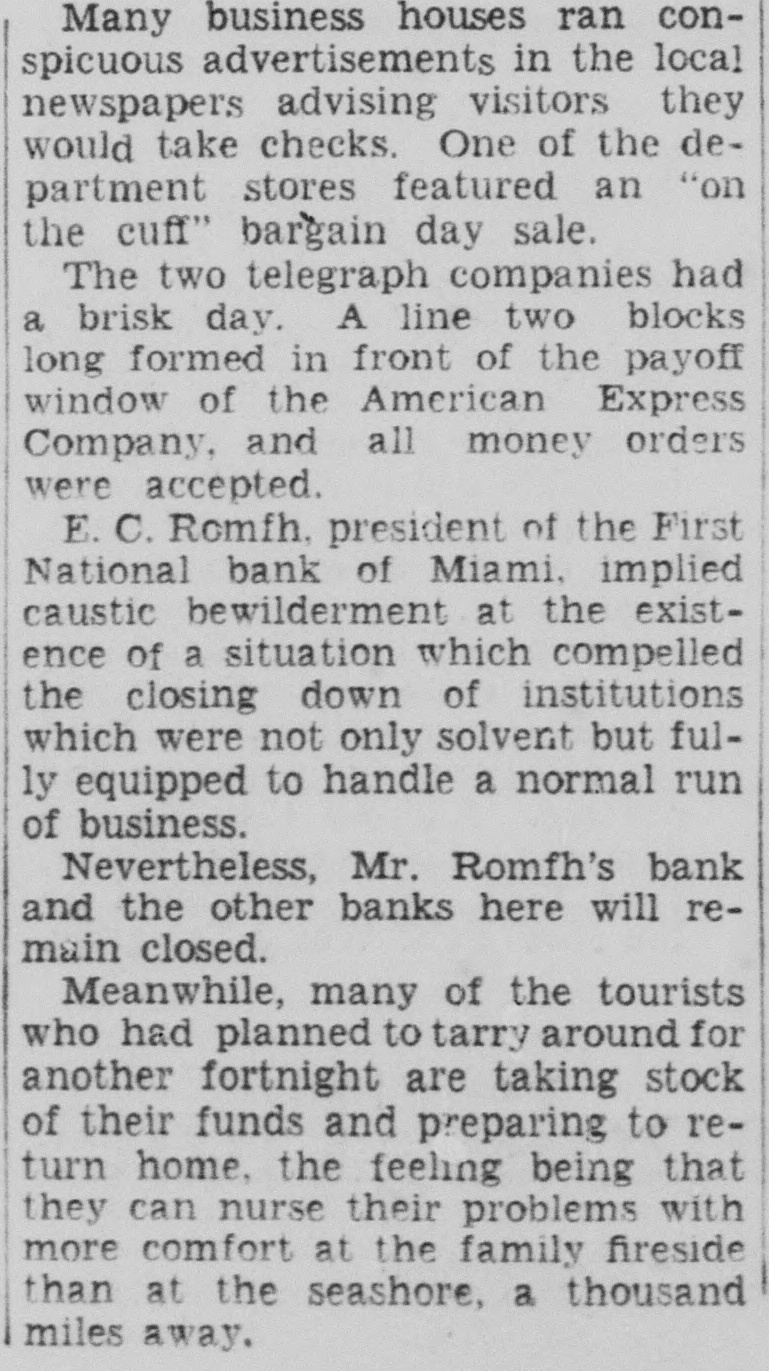
Many business houses ran conspicuous advertisements in the local newspapers advising visitors they would take checks. One of the department stores featured an "on the cuff" bargain day sale. The two telegraph companies had a brisk day. A line two blocks long formed in front of the payoff window of the American Express Company, and all money orders were accepted. E. C. Romfh, president of the First National bank of Miami, implied caustic bewilderment at the existence of a situation which compelled the closing down of institutions which were not only solvent but fully equipped to handle a normal run of business. Nevertheless, Mr. Romfh's bank and the other banks here will remain closed. Meanwhile, many of the tourists who had planned to tarry around for another fortnight are taking stock of their funds and preparing to return home, the feeling being that they can nurse their problems with more comfort at the family fireside than at the seashore, a thousand miles away.


Article Text

Deposits Mount Fast As Miamians Evidence Faith in Banks of City Money pouring into Greater Miami banks much fasttoday than accumulated demands the banking holiday. The First National reported $2,000,000 deposits resumed business Tuesday morning. The Florida National, the othlarge depository, said its were over their total before the ing holiday declared.


Article Text

Just Things And People The Florida senate has started ball rolling towards legalizing use arsenic spray permit the earlier shipping grapefruit. seems like the majority those grow are for the use the spray, though there many growers against its use. question one find loads arguments on sides, therefore seems bring out narrow streak, or haps correctly an intolerant streak, in those who see only side the question and bitter with those who the opposite view. My personal views are that react against, not only our grapefruit citrus industry general. gives our competitors too great weapon to fight keen and folly to think they will not use arsenic argument against Therefore question whether extra weeks which we will gain in marketing will, from financial crop point, better On the other hand there are ways those who will abuse the the spray privilege. Many through ignorance ruin their their crops, but their groves. There will parative few who will apply spray scientifically. Permission for its use fruit means also will be used other citrus crops, not general, but many however cause the industry suffer. Nature 80 far been pretty generous the quality fruit given have best fruit this of the Atlantic. might wise to give nature free hand. looks as Will Rogers runSmith for the oil dictator wanted be president but he disappointed his looks as the people of New York want him mayor, has definitely said he would consider the can't blame him much. If making $100,000 year wouldn't want $25,000 either, receive all the cussing that with the But being dictator may different. might pay $100,000 year. Certainly they could not find better man the job. Smith honest has the courage his convictions. respected by oppose fair. Maybe get Al yet. In this week's issue of the Saturday Evening Post story Some Banks and Others by Garet Garrett. the first story the magazine, and on the first appears First National bank Miami, shows the bank March are front the for block the line four and five wide. Beneath this caption: the runs on the First National bank of Miami, Dessuch pressure from depositors never And tells how Romfh his bank and has been able runs president has formany gotten their number. Such an vertisement could have been purchased for many hundreds thousands of dollars. The Romfhs are conservative people. our graduating class the Miami high school was smart and wonderful arithmeAfter she she the bank used to talk over real estate


Article Text

The Orlando Morning Sentinel NUMBER 4161 matter Morning Sunday). per MAY during the administration of dore Roosevelt, the House of gan will suffer little from this public inquiry. There are many angles to the Morgan There story that Morgan opposed Roosevelt for president; that Morgan's utility companies declared war Roosevelt when he successfully pired for the governorship of New York; that at that time there was an open break between the counboss banker and the coming statesman from New York. Morgan, of course, heavily terested in utilities. The fortune, built in railroads, must have suffered considerably during recent years. And his private bank sup ported other banking enterprises, they too, probably have been profitable. And with the ernment stepping into this huge Muscle Shoals project, which will directly compete with the Morgan Alabama Power Light Co., would seem that the House of gan not great once The final blow this inquiry into what Morgan and his partners probably would term the private business the banking concern. Just where will lead, no one can say this early stage. There basic fact that shadows all else in this investigation, however, and that this: Mr. Roosevelt wanted amine banking conditions and banking business in this country, he did not start with the He went to the top of the heap, the head of the financial hold of the country and asked the boss banker of the world to come down Washington and swer some questions. When you consider the influence that such man with such must possess, you must mit that the president picked tough for himself. As usual date, he delivered his man and now he to tell the world whether he good banker or one whose record should be criticized. Banks New Orleans jubilant over banks, which this week leased 32 millions of dollars frozen accounts. Orlando, still patiently waiting for some definite information an optimistic nature concerning banking problem, will likewise jubilant when our situation cleared up. Insofar The Sentinel to learn, there no definite news other than the same note of mism that was given out early March. Those in charge of the bank continue to move heaven and earth to reopen and The nel's prayer that they are cessful before the end of another month. Florida came into the national eye for some very favorable nancial publicity last week when Garet Garrett, economist for The Saturday Evening Post, paid high tribute to Romfh of the First National Bank Miami. Declaring that "there are only two reasons why bank fails: judgment and character." Mr. Garrett also said: "There are only two reasons bank does not fail: again, judgment and character." But read Mr. Garrett's story Miami's Banker Romfh and how he operates bank for the benefit the depositor, told in The Saturday Evening Post: the case of an exceptionbank. Take in the unlikeliest place you might think Florida. Florida bank to have been still 100 per cent solvent and paying its depositors in full demand must have survived, first, one of the most disastrous real estate booms of this generation, and then immediately the worst depression in the life of the country. The First National of ami did. The head of it Romfh, of North Carolina ancestry, born common sense in Arkansas. During the Florida land boom throughout the state because he refused to lend his positors' money inflated real He had seen booms before. He had seen groves torn orange the roots to make room pineapples, and then the pineapple groves torn out to make room for oranges again, indicating to him that human beings were mercurial and expectant; besides, he never forgot how much land there Florida. "There have been so many runs his bank that he cannot remember all of them. When one bad enough to be interesting, he has photographed from the street and hangs the picture in the bank souvenir, for his depositors at. Once the Comptroller of the Currency and some friends to Miami to swordfishing him. When they went around the bank to pick him up, they found going They backed of and then telephoned to say they were sorry have to go fishing without him. be down right said; went fishing and was gone two weeks. From the top of the boom the slough of depression, his deposits fell from million dollars to twelve million dollars, during all that process of liquidation his bank was never less than per cent that against of deposits there less than $73 in cash and current securities. As the deposits fell, this percentage of liquidity steadily rose until 95. On Saturday, March fourth, the declared bank holiday the state of Florida to save its banks. The First National of Miami refused to close, and that day out half million dollars more demand. The president said: stay open and keep paying long the Government Washington does not fail me, or until makes me shut On Monday, March sixth, under the Federal proclamation, he was obliged shut up. Thereupon he took page space in the Miami newspapers and printed in full detail the ing assets of the bank, that every depositor might his money was safe. was representup to 90 per cent by three items -namely, in the vault, (2) Government bonds, and, (3) state bonds such as the United States Government accepts at par security for postal savings. for the remaining 10 per cent, any depositor would have been glad to take his share of such other assets loans and discounts, railroad bonds, utility bonds, mortgage loans and real estate. you ask him how he does will make no mystery of begin with, the depositor first concern. He makes no reservation in his mind about the contract, such as some bankers of late have been saying what bank deposit sents really is not much actual money payable on demand, but participation in the assets of the bank. He says that what deposibrings to the bank what entitled to receive the unequivocal money. the moral contract between banker and depositor. As to how bank shall keep itself able to perform the contract, he has formula that he found for himself. It is this: The total resources of to say, its total its power to pay back its depositors. From this total deduct cash and Government bonds. The mainder represents risk, or what the bank has done with its depositors' money in the way of loans, discounts and investments. And the total of this risk should never be more than four times the capital and surplus of the bank in good weather, not more than two and half times in bad weather. This what he calls the ratio of loans and investments to the capital structure of bank. "Does banking pay on that basHe says did not pay business, he would not be business. It has paid as much 20 per cent year.


Article Text

Sunshine and Races Mr. Romfh's Old Chinese Mighty Is the Automatic (Copyright. 1935) MIAMI, Fla., Feb. 4. ONE night in Miami, involving nearly 2,000 miles of travel to and fro, then back to New York, with a stop-over in Washington. Such is life when you work for modern newspapers. There is plenty of leisure apparently in Florida's brilliant sunshine. Tens of thousands of automobiles from all over the United States blocking traffic, parked the length of every street on both sides, horse races by day, attracting crowds that the depression has not impoverished, dog races at night, if the day is not long enough for gambling. E. C. ROMFH, head of the First National bank, whose bank has never closed except under government compulsion during the "bank holiday," takes a cheerful view of life and conditions for the long pull. That is easy when your bank has never closed. He tells of an aged Chinese of Miami who had $300 in the bank during the panic of 1907, when deposits were paid in instalments. The old Chinese, told he could get $25 each day until he had drawn out his $300, expressed no concern. "Velly vell," said he. "Amelica too big go broke." Mr. Romfh, who came here from Arkansas when four years old, has known every brand of honest poverty and liked none of them. He started banking and raised his bank from $10,000,000 to $72,000,000 of deposits. One of our troubles, he says, is "the rich have no sense and the poor have no money." Also, in the worst of times, when values dropped, salaries dropped, profits vanished, government expenses went on, always increasing. He thinks the American people have got to cease letting politics spend all the people earn. Asked if he expects inflation, Mr. Romfh says: "We have inflation now, piled up in the banks, billions of it. Only it is not used. It does no good to have money accumulate if it lies idle. The government has spent enough money already to buy three recoveries, but it does not go in the right direction." YOU know, of course, how the money piles up. This is not Mr. Romfh talking. The government, instead of printing money and paying its bills, prints silly inflation bonds that bear interest which doubles the government's debt. It nominally sells those bonds to financial institutions. In reality the banker pays $500,000 on $5,000,000 worth of bonds. The government nominally deposits the balance, $4,500,000, in his bank. He can go to the Federal Reserve and get $5,000,000 in new cash on his bonds, on which he has only 10 percent. Then, paying only 2 percent interest on the $5,000,000, he can lend the money at "legal rates," ranging from 6 to 10 percent. In different states, the trouble is now that nobody wants to borrow money on collateral that bankers call "safe." Not much of anything is considered safe, except gold, which nobody is allowed to have. Some of President Roosevelt's educated gentlemen that have undergone no greater hardships than being initiated in university secret societies might learn a good deal talking for half an hour with E. C. Romfh, of Miami. He knows what