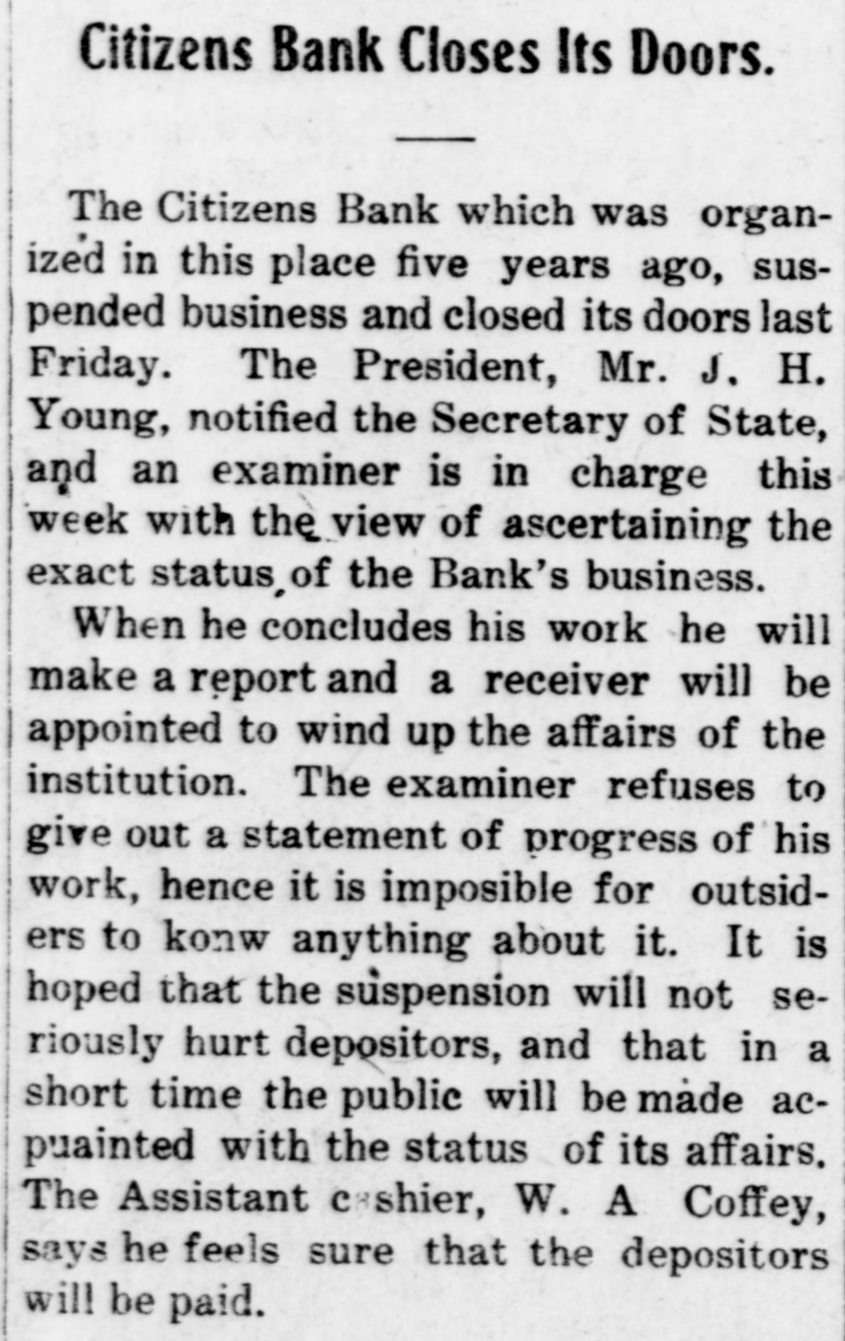
6333. Citizens Bank (Union City, IN)

Bank Information

Episode Type
Suspension → Closure
Bank Type
state
Start Date
September 1, 1898*
Location
Union City, Indiana (40.202, -84.809)

Metadata

Model
gpt-5-mini
Short Digest
ed87fc05

Response Measures

None

Description

The articles describe the Citizens Bank of Union City as already 'defunct' and refer to its failure and a receiver who brought suit. There is no description of a depositor run; testimony points to embezzlement by the cashier (Cadwallader) and a correspondent (Irvin National) refusing to honor paper shortly before the bank closed. Thus this is a suspension leading to permanent closure with receivership.

Events (3)

1. September 1, 1898* Receivership
Newspaper Excerpt
This suit was brought by the receiver and tried at Muncie, resulting in a verdict in favor of the receiver and judgment for $50,000.
Source
newspapers
2. September 1, 1898* Suspension
Cause
Correspondent
Cause Details
Irvin National Bank in New York refused to honor the Citizens Bank's paper after discovery of false entries/embezzlement by the cashier, triggering the bank's failure.
Newspaper Excerpt
the defunct Citizens' Bank...served as cashier of the defunct bank for some days before it closed its doors and was in charge at the time of its failure.
Source
newspapers
3. September 21, 1898 Other
Newspaper Excerpt
The charge confronting young Cadwallader is that of embezzlement...This money was taken by him while serving in the capacity of cashier of the late Citizens' Bank, of Union City.
Source
newspapers

Newspaper Articles (2)

Article from The Indianapolis Journal, September 21, 1898

Click image to open full size in new tab

Article Text

# CLEVER SHERIFF SIMMONS. Winchester Is Proud of His Work in Catching the Criminal. Special to the Indianapolis Journal. WINCHESTER, Sept. 20. -Great interest is manifested in this city over the special from Stockton, Cal., in to-day's Journal, giving an account of the clever manner in which young Sheriff Simmons, of this county, outwitted Charles Cadwallader's attorney and gave the California writ of habeas corpus the slip. Sheriff Simmons has been untiring in his efforts to locate Cadwallader and has spent considerable money in following up different false clues, but his perseverance was finally rewarded, when on Friday, Sept. 9, he received a telegram from the sheriff of San Joaquin county advising him of the arrest of a man there answering to the description of Cadwallader. On the following evening young Simmons left for Stockton, accompanied by Col. James Patchell, of Union City, who was sent by the depositors of the defunct Citizens Bank to identify Cadwallader. Cadwallader had been located in California since last summer sometime, perhaps longer, where he worked for the California Navigation and Improvement Company, of Stockton, as one of its bookkeepers, under the assumed name of E. H. Wilber. Had Simmons been a few days later he would have missed his man as Cadwallader had planned to leave for Honolulu on the next steamer due to leave for that place in a few days. Just how Sheriff Simmons finally succeeded in putting the California authorities on to his man (for he it was who did this) will not be known until he chooses to make known the fact himself. He has an older brother who had been in California for some time up to a month or two since, when he came here and has since been serving as a riding bailiff for the sheriff. Before coming here he was located at or near Stockton, and it is said he knew Cadwallader while there, and, it is believed by many, betrayed his presence. This Mr. Simmons stoutly denies, and says that at the proper time he will explain. The charge confronting young Cadwallader is that of embezzlement. Eignteen indictments were returned against him in different cases. This money was taken by him while serving in the capacity of cashier of the late Citizens' Bank, of Union City. Charles Cadwallader's connection with the bank as an alleged criminal would, most probably, never have come out but for the fact that Ed Reeves, a teller in the bank, under a promise of immunity from the prosecution, turned State's evidence against him. This evidence first came out in a suit brought by the receiver of the bank against the stockholders. In this case Reeves took the stand and recounted from beginning to end the various acts of crookedness perpetrated by himself and Cadwallader. Among other things he told about Cadwallader raising a $2 draft to $2,000. Reeves is now a resident of Union City, and will be one of the principal witnesses against his old associate.


Article from The Indianapolis Journal, December 6, 1898

Click image to open full size in new tab

Article Text

THE CADWALLADER TRIAL. Testimony of Teller Reeves and Mr. Edger, of the Redkey Bank. Special to the Indianapolis Journal. WINCHESTER, Ind., Dec. 5.-The second witness introduced by the State in the Cadwallader trial was Ed Reeves, teller and assistant bookkeeper in the bank. He is the man who gave so much valuable information in the civil suit against the directors of the bank to recover $50,000. This suit was brought by the receiver and tried at Muncie, resulting in a verdict in favor of the receiver and judgment for $50,000. Mr. Reeves proved a somewhat reluctant witness for the State, but was finally prevailed upon to tell that the peculations by himself and Cadwallader, the defendant, had been carried on for years, and had been covered up and concealed in the accounts with correspondent banks. He also gave further particulars of the false entry of the $2,000 draft in favor of R. Kirchbaum & Co. upon the Irvin National Bank of New York. He claims to have made full restitution to the bank of his shortage, by deeding to it the real estate of himself and mother. He stated that at the suggestion of Charles Cadwallader, when they saw that disaster would soon overtake them, he left Union City, going first to Indianapolis, thence to St. Louis, and finally to Joplin, Mo., where he remained till after the failure of the bank, when he returned, after which Charles Cadwallader very suddenly disappeared and remained away until he returned in company with Sheriff Simmons. Mr. Reeves claims that he overdrew his account with the knowledge and approval of Charles Cadwallader. Following Reeves the next witness was George N. Edger, president of the Bank of Redkey. Mr. Edger is the gentleman who was called to Union City and served as cashier of the defunct bank for some days before. it closed its doors and was in charge at the time of its failure. He testitied to notifying Cadwallader that he, Edger, had been notified by his correspondent in New York that the Irvin National Bank was refusing to honor the paper of the Citizens' Bank. In his testimony he admitted that he went to Union City to examine the accounts between the defunct bank and the Irvin National, but he claimed he got all his information from Charles Cadwallader, who called the accounts from the books and at the time informed him that the balance due the Irvin National Bank was $7,700. As the amount of Reeves's shortage was only claimed to be $5,000. this, on Cadwallader's statement, left $2,700 unaccounted for. William K. Smith, one of the trustees of the bank, was next called, and testified that no order was ever made by the trustees permitting the defendant to overdraw his accounts with the bank or to borrow on his own paper. The trial will probably continue for ten days yet.