6308. American State Bank (Terre Haute, IN)

Bank Information

Episode Type
Run → Suspension → Closure
Bank Type
state
Start Date
January 4, 1912
Location
Terre Haute, Indiana (39.467, -87.414)

Metadata

Model
gpt-5-mini
Short Digest
ddf2a470

Response Measures

Full suspension, Books examined

Other: Bank closed by state banking department and receiver appointed; embezzlement by president alleged.

Description

Multiple dispatches (Jan 4–5, 1912) report that the state banking department closed the American State Bank of Terre Haute, a receiver was appointed, and the president W. H. Taber was found short and later arrested for embezzlement. One article states a trustee's attempt to get a passbook and subsequent withdrawal resulted in the run on the bank, so sequence is run → suspension/closure → receivership.

Events (3)

1. January 4, 1912 Receivership
Newspaper Excerpt
the state banking department today closed the institution. A receiver will be appointed. ... W. H. Taber, president ... was arrested ... The bank is in the hands of a receiver and Taber's shortage is reported by state examiners at $25,000.
Source
newspapers
2. January 4, 1912 Run
Cause
Bank Specific Adverse Info
Cause Details
Discovery that President W. H. Taber was short in his accounts and loans on worthless securities; trustee withdrew after being refused passbook leading to withdrawals.
Newspaper Excerpt
the failure of the bank to turn over Phillips' pass book that led the trustee in take action which resulted on the run on the bank, and the closing of its doors.
Source
newspapers
3. January 4, 1912 Suspension
Cause
Government Action
Cause Details
State banking department closed the bank after examiners found Taber short $25,000 and additional bad loans; receiver to be appointed.
Newspaper Excerpt
the state banking department today closed their institution. A receiver will be appointed.
Source
newspapers

Newspaper Articles (15)

Article from The Topeka State Journal, January 4, 1912

Click image to open full size in new tab

Article Text

Their Bank Is Closed. Terre Haute. Ind., Jan. 4.-With the statement W. H. Taber, president of the American State bank. is short in his accounts $25,000 and that the bank has made loans on worthless securities amounting to $20,000 more, the state banking department today closed their institution. A receiver will be appointed.


Article from Evening Star, January 4, 1912

Click image to open full size in new tab

Article Text

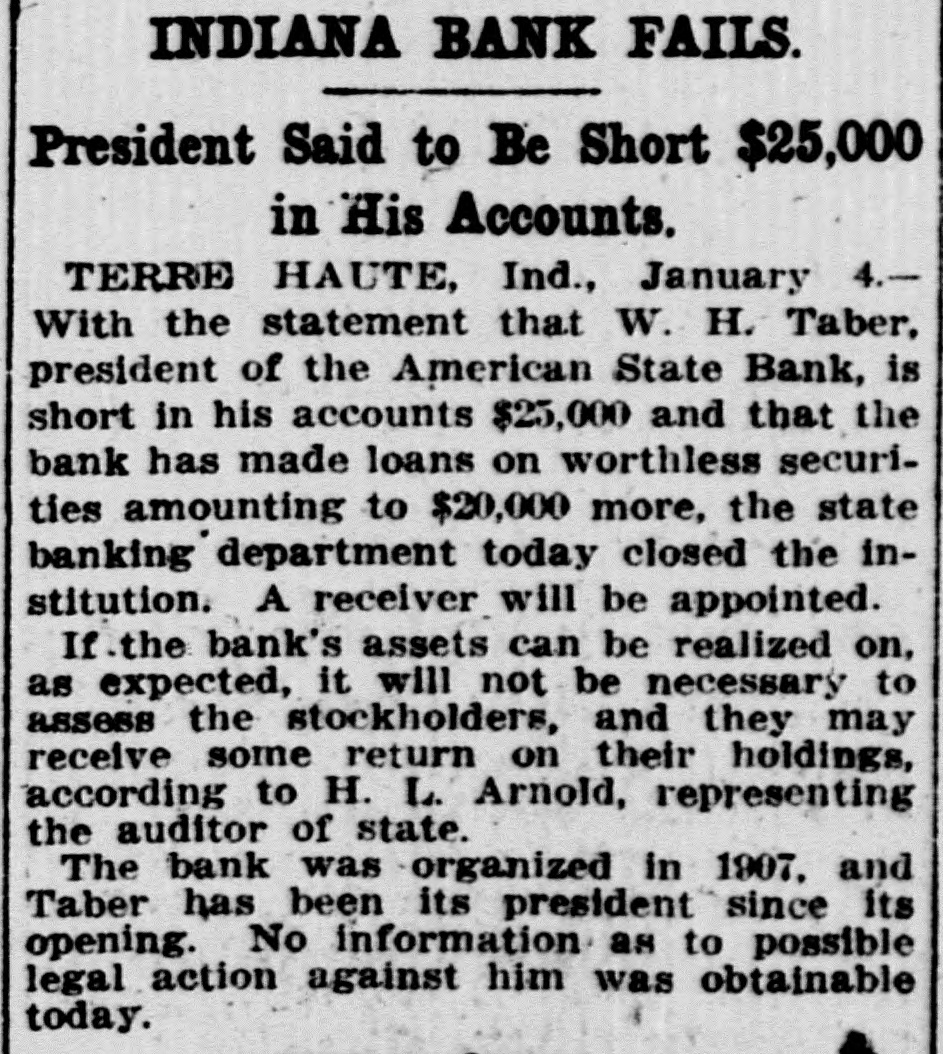
INDIANA BANK FAILS. President Said to Be Short $25,000 in His Accounts. TERRE HAUTE, Ind., January 4.With the statement that W. H. Taber, president of the American State Bank, is short in his accounts $25,000 and that the bank has made loans on worthless securities amounting to $20,000 more, the state banking department today closed the institution. A receiver will be appointed. If. the bank's assets can be realized on, as expected, it will not be necessary to assess the stockholders, and they may receive some return on their holdings, according to H. L. Arnold, representing the auditor of state. The bank was organized in 1907. and Taber has been its president since its opening. No information as to possible legal action against him was obtainable today.


Article from The Richmond Palladium and Sun-Telegram, January 4, 1912

Click image to open full size in new tab

Article Text

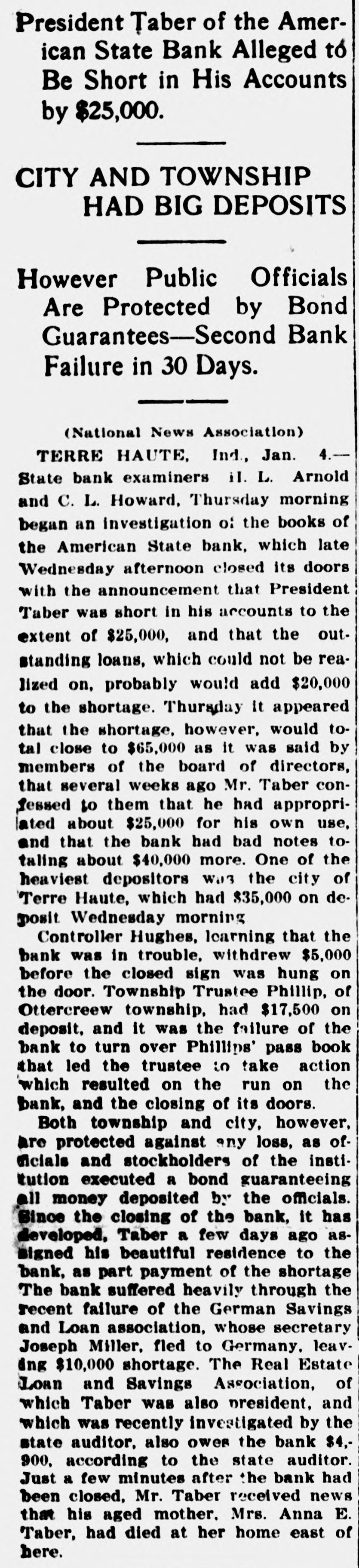
President Taber of the American State Bank Alleged to Be Short in His Accounts by $25,000. CITY AND TOWNSHIP HAD BIG DEPOSITS However Public Officials Are Protected by Bond Guarantees-Second Bank Failure in 30 Days. (National News Association) TERRE HAUTE, Ind., Jan. 4.State bank examiners il. L. Arnold and C. L. Howard, Thursday morning began an Investigation of the books of the American State bank, which late Wednesday afternoon closed its doors with the announcement that President Taber was short in his accounts to the extent of $25,000, and that the outstanding loans, which could not be realized on, probably would add $20,000 to the shortage. Thursday it appeared that the shortage, however, would total close to $65,000 as it was said by members of the board of directors, that several weeks ago Mr. Taber conlessed to them that he had approprilated about $25,000 for his own use, and that the bank had bad notes totaling about $40,000 more. One of the heaviest depositors Wa3 the city of Terre Haute, which had $35,000 on deposit Wednesday morning Controller Hughes, learning that the bank was in trouble, withdrew $5,000 before the closed sign was hung on the door. Township Trustee Phillip, of Ottercreew township, had $17,500 on deposit, and it was the failure of the bank to turn over Phillips' pass book that led the trustee in take action which resulted on the run on the bank, and the closing of its doors. Both township and city, however, are protected against any loss, as officials and stockholders of the institution executed a bond guaranteeing all money deposited by the officials. Since the closing of the bank, it has developed, Taber a few days ago assigned his beautiful residence to the bank, as part payment of the shortage The bank suffered heavily through the recent failure of the German Savings and Loan association, whose secretary Joseph Miller, fled to Germany. leavdng $10,000 shortage. The Real Estate Loan and Savings Association, of which Taber was also president, and which was recently investigated by the state auditor, also owes the bank $4,900, according to the state auditor. Just a few minutes after the bank had been closed, Mr. Taber received news that his aged mother. Mrs. Anna E. Taber, had died at her home east of here.


Article from The Norfolk Weekly News-Journal, January 5, 1912

Click image to open full size in new tab

Article Text

THIS BANKER SHORT $25,000 W. H. TABER OF TERRE HAUTE, IND., A DEFAULTER. STATE CLOSES BANK'S DOORS American State Bank of Terre Haute Is Short $25,000 and Has Issued Loans on Worthless Securities to the Extent of $20,000. Terre Haute, Ind., Jan. 4.-With the statement that W. H. Taber, president of the American State bank is short in his accounts $25,000 and that the bank has made loans on worthless securities amounting to $20,000 more, the state banking department today closed the institution. A receiver will be appointed. The bank was organized in 1907, and Taber has been its president since its opening. No information as to possible legal action against him was obtainable today.


Article from The Fargo Forum and Daily Republican, January 5, 1912

Click image to open full size in new tab

Article Text

TERRE HAUTE BANKER SHORT STATE INSTITUTION IS CLOSED AND RECEIVER WILL BE NAMED. Terre Haute, Ind., Jan. 5.-With the statement that W. H. Taber, president of the American State bank, is short in his accounts $25,000 and that the bank has made loans on worthless securities amounting to $20,000 or more, the state banking department yesterday closed the institution. A receiver will be appointed.


Article from Daily Kennebec Journal, January 5, 1912

Click image to open full size in new tab

Article Text

CONDENSED DISPATCHES. Charles H. Spear, who had served as private secretary to every mayor of Lynn, during the past 20 years, died there, Thursday. Brain trouble, aggravated by the loss of his position, which was abolished, Dec. 31, last, under a new city charter, is said to have caused death. Mr. Spear was 57 years of age and had held various city offices. He was a bachelor. 'James L. Gillingham of Boston was appointed receiver, Thursday, for the Kissel Kar Co., an automobile concern of that city. The petition for a receivership was filed in the superior court by the Goodyear Tire and Rubber Co. George W. Coleman, formerly bookkeeper of the National City Bank, and now serving sentence for assisting in wrecking that institution, was formerly president of the Kissell Kar Co. The company has maintained a sales room in Boston, for three years. With the statement that W. H. Taber, president of the American State Bank at Terre Haute, Ind., is short in his accounts $25,000 and that the bank has made loans on worthless securities amounting to $200,000 more, the State, banking department, Thursday, closed the institution. A receiver will be appointed. The bank was organized in 1907 and Tabor has been its president since its opening. No information as to possible legal action against him was obtainable, Thursday. Ralph Jasdine, the Worcester cigar maker, who went joy riding in a locomotive, Wednesday night, pleaded guilty to a charge of endangering lives of people on railroad property, when given a hearing in the district court at Webster, Thursday. He was held in $2000 bail for the grand jury. He made no statement as to his reason for taking the locomotive. He got into the cab of an unguarded engine and after a wild ride collided with a locomotive attached to a passenger train. The two engines were badly damaged and nearly a dozen passengers were hurt. Refused two days' holiday for Christmas by S. E. Eldelman, the white president of Clark University, who went to Atlanta, Ga., from Ohio, 600 Negro students have been in rebellion against the college authorities, for a week. The boys stole the bell clapper and thus put a stop to lessons. The president threatened them with the loss of meals until the bell was working, but after starving them for two hours relented. The students retaliated by corralling the calves in the barns and driving them into the study halls, Wednesday. Two animals were herded into the president's study. Since that time the tension has increased. Negroes believe that if the president had taken counsel with the faculty and let the clapper theft pass unnoticed all would have gone well. "The students are angry," said one student. Wednesday night, "because Mr. Eidelman has been unfriendly to the industrial department, which by paying the boys for work in the dairy department and on the farm has helped them to pay their way through college."


Article from The Madison Daily Leader, January 6, 1912

Click image to open full size in new tab

Article Text

Indiana Bank Closed. Terre Haute, Ind., Jan. 5.-With the statement that W. H. Taber, president of the American State bank, is short in his accounts $25,000 and that the bank has made loans on worthless securities amounting to $20,000 more, the state banking department closed the institution. A receiver will be appointed.


Article from The Times Dispatch, January 6, 1912

Click image to open full size in new tab

Article Text

INDIANA BANK FAILS President Said to Be Short $25,000 in His Accounts. Terre Haute, Ind., January 5.-With the statement that W. H. Taber, president of the American State Bank, is short in his accounts $25,000 and that the bank has made loans on worthless securities amounting to $20,000 more, the State Banking Department to-day closed the institution. A receiver will be appointed. If the bank's assets can be realized on, as expected, it will not be necessary to assess the stockholders, and they may receive some return on their holdings. according to H. L. Arnold, representing the Auditor of State. The bank was organized in 1907, and Taber has been its president since its opening. No information as to possible legal action against him was obtainable to-day.


Article from Daily Kennebec Journal, January 8, 1912

Click image to open full size in new tab

Article Text

# CONDENSED DISPATCHES. John B. Gogain, one of the best known French Acadians of New Brunswick, died, Saturday, at his home in Cocagne, N. B., through a carriage accident. Gogain was a leading politician and for several years was a member of the provincial Parliament. He was 53 years of age. The British exports for the year 1911, as shown by the board of trade returns at London, reached a record total of $2,271,412,300, or an increase of $119,488,440 over 1910. Manufactures and food account for almost the whole of the increase, cotton textiles alone being $70,000,000. Imports for the year totalled $3,402,795,875, which is $11,510,755 over 1910. Four men walked into the Central Hotel in New York, early Saturday, poked their revolvers in the faces of Henry Douglas, night clerk, and his assistant, looted the safe of $75, tied Douglas and his fellow clerk back to back with stout ropes, and fled. One of the holdup men made off with a quantity of solid silver. This is the second holdup within a week south of Fulton street, the "dead line" below which crooks are warned not to go under paril of arrest. The discharge of 1100 temporary clerks in the census office at Washington and the addition of a half-hour to the working day of all other employes was announced, Saturday, by Director Durand. The new order becomes effective, Jan. 10, and is made necessary by the shortage of funds for the completion of the census compilations. All privileges of leave have been withdrawn and it is said that several branches of the census work will have to be dropped. Harry N. Atwood, who made a flight across the country from St. Louis to the Atlantic coast and several days ago had a fall in the East, is to quit flying. On his arrival at Akron, O., Friday, it was announced that the aviator was to engage in the manufacturing business. A company, with a capital of $200,000, is now being organized at Akron, and, although secrecy is being kept, it is understood that the concern will manufacture a new machine to be patented by Atwood. W. H. Taber, president of the American State Bank, was arrested at Terre Haute, Ind., Saturday, on a warrant charging him with embezzlement of the bank's funds. He was unable to give bond in $10,000 and was taken to jail. The bank is in the hands of a receiver and Taber's shortage is reported by state examiners at $25,000. Loans on valueless securities, alleged to have been authorized by Taber, will make the bank's total loss $50,000. The depositors will be protected, it is understood, but the stockholders will be assessed the full amount of their holdings. The United States submarine boat F-3 was launched, Saturday, from a Seattle shipyard, where three other craft of the same class are to be constructed. Extraordinary secrecy has been maintained. Construction work has been done in an enclosed space and photographers have been barred. The equipment and batteries of the F-3 are not to be divulged. By the use of kerosene to generate power for heavy oil engines, the F-3 will have a radius of action of 3300 miles, which is greater than that traveled by any other submarine in existence. She will carry 18 men. A statement was issued from the national headquarters of the United Shoe Workers of America at Lynn, Saturday, by General Sec. Michael Tracy, to the effect that documentary evidence has been secured proving, in their opinion, that the Boot and Shoe Workers' Union sent strikebreakers to Cincinnati to take the places of the Goodyear operatives who have been out there since last November. Mr. Tracy claims that this interference would justify the United Shoe Workers in invading the territory of the Boot and Shoe Workers' Union. Some 50 operatives of Goodyear machines struck in Cincinnati, last November. In sympathy, 300 other employes went out. Wholesale registration irregularities involving probably 20 per cent. of the Democratic voters of Acadia parish are alleged in a series of 800 suits, the filing of which is under way in the circuit court at Crowley, La. The suits pray for a mandamus writ directing Registrar of Voters Lormand to strike the names of the alleged illegal voters from the rolls. The suits were filed by H. L. Bowden, a citizen. The charges in almost every instance are based on an alleged failure to comply with the educational clause of the state registration law, which requires every applicant for suffrage to fill in his town application blanks. No criminal charges is involved. Efforts were made by Councilman Ernest Lothrop of Somersworth, N. H., Saturday, on receiving a telephone message from Wolfboro that Charles H. Ballard, president and general manager of the W. R. Manufacturing Co. of that city, had been drowned in Lake Winnipesaukee, to verify the report, but meagre information was obtainable. Mr. Lothrop, who was to join Mr. Ballard, Saturday morning, at a camp at Wolfboro for a day at cusk fishing, is convinced that drowning was his friend's fate. Mr. Ballard was a citizen of Portland, Me., but since his manufacturing enterprise was started at Somersworth, last year, he had been spending most of the time in that city. He has a wife in Portland. Dr. J. H. Theriault of Claremont, N. H., whose trial was held at Woodstock, Vt., during the week, and who was convicted of a criminal operation by the jury, which returned, late Friday evening, after being out 24 hours, will not be given a sentence until sometime next week. In the meantime Dr. Theriault will remain in the county jail at Woods
Article from The Greenville Journal, January 11, 1912

Click image to open full size in new tab

Article Text

Banker Assigns Home in Shortage. Terre Haute, Ind.-W. H. Taber, president of the American State bank, who was alleged to be short $45,000, assigned to the bank property valued at about $18,000. The property included his home.


Article from The Watertown Weekly Leader, January 12, 1912

Click image to open full size in new tab

Article Text

Banker Assigns Home in Shortage. Terre Haute, Ind.-W. H. Taber, president of the American State bank, who was alleged to be short $45,000, assigned to the bank property valued at about $18,000. The property included his home.


Article from Wausau Pilot, January 16, 1912

Click image to open full size in new tab

Article Text

Banker Assigns Home in Shortage. Terre Haute, Ind.-W. H. Taber, president of the American State bank, who was alleged to be short $45,000. assigned to the bank property valued at about $18,000. The property included his home.


Article from Manchester Democrat, January 17, 1912

Click image to open full size in new tab

Article Text

Banker Assigns Home in Shortage. Terre Haute, Ind.-W. H. Taber, president of the American State bank, who was alleged to be short $45,000, assigned to the bank property valued at about $18,000. The property included his home.


Article from The Lake County Times, January 18, 1912

Click image to open full size in new tab

Article Text

Upand Down in INDIANA RECORD ICE CROP. Ice dealers, farmers and butchers at Lawrenceburg have completed the work of filling their ice houses with Ice Afteen to eighteen inches thick, which is the first harvest they have reaped in many winters. The thermometers of business houses and citizens have registered from 15 to 21 degrees below zero during the last few nights, yet there is little if any complaint of suffering from the cold. Trappers and hunters are well pleased with the deep snow, as it assists them in capturing wild animals for food and for their pelts. More than three thousand rabbits have been trapped and caught with ferrets during thse last week and hundreds of frozen qualls have been picked up by hunters and are used as food. A number of farmers have been scattering grain in their fields for the quails to fed on during the snow. OWED TABER'S BANK $9,000. Judge C. M. Fortune, at the circuit court, has appointed George Knierem receiver of the Matheny Grease Cup Company, of Terre Haute, which owes the American State Bank, now in the hands of receiver J. C. Kolsem, $9,000. Fred Godman, who was a teller in the bank, was placed in charge of the grease company some time ago, and he quit manufacturing the patent device for automobiles because he found that 1 it cost $3 and was being sold for $1.50. 1 Three notes signed by Goodman, ag gregating $3,000, were found in the bank unindorsed. Another note for $6.000 bears the name of Dr. Frank Taber. brother of the president, and is not indorsed. When asked about it he said he "didn't know anything about such a note," and that he "didn't remember" if he signed It, Dr. Taber served as coroner a few years ago. is FARMER BOY SHOOTS FATHER. Robert Simmons, of near Washington, 50, farmer. was shot and probably fatald ly wounded by a young son late yester-


Article from Rock Island Argus, April 5, 1912

Click image to open full size in new tab

Article Text

Court Orders Bank Suit. Terre Haute, Ind., April 5.-J. C. Kolsem, receiver of the American State bank, was instructed by the court to bring suit against members of the board of directors for $75,000 alleged to have been lost because of embezzlement by President W. H. Taber and through bad loans due to neglect of duty by directors.