6269. American State Bank (Wichita, KS)

Bank Information

Episode Type
Suspension β†’ Closure
Bank Type
state
Start Date
June 1, 1923*
Location
Wichita, Kansas (37.692, -97.338)

Metadata

Model
gpt-5-mini
Short Digest
b106257dc3bd3559

Response Measures

None

Description

The articles consistently describe the American State Bank of Wichita as having been wrecked/failed (closure) in June 1923 due to large defalcations by cashier Philip A. Drumm and related insolvency. The bank was closed and placed in receivership; a successor Wichita bank was later organized under the state guaranty fund, but the original American State Bank did not resume operations. Loss estimates range from $1.5M to over $2M. OCR errors corrected (e.g., 'Drumm' and 'Richardson' spellings standardized).

Events (3)

1. June 1, 1923* Receivership
Newspaper Excerpt
The American State bank failed in June, 1923, and the losses amounted to more than $2,000,000. ... Ray Foley, receiver the American State bank of Wichita. (court case reference). Ray Foley, receiver is mentioned in later litigation describing the receivership and suit to collect assets.)
Source
newspapers
2. June 21, 1923 Suspension
Cause
Bank Specific Adverse Info
Cause Details
Large embezzlement/defalcations by cashier Philip A. Drumm extending back several years (since ~1918), producing losses in excess of $1.5M–$2M and wrecking the bank.
Newspaper Excerpt
WICHITA, Kan., June 21.-Five an even longer period of time than years ago Philip A. Drumm, trusted officer of the American State Bank here, began a series of defalcations, which ended with the wrecking of the bank
Source
newspapers
3. January 8, 1925 Other
Newspaper Excerpt
The most extensive undertaking of this kind was the organization of the Wichita bank which succeeded the defunct American State bank. By this plan a loss of more than $2,000,000 to the guaranty fund was avoided The situation at Wichita was a striking example of the efficacy of the guaranty law. The American State bank failed and consternation reigned supreme. (coverage of guaranty fund and reorganization).
Source
newspapers

Newspaper Articles (14)

Article from The Washington Times, June 21, 1923

Click image to open full size in new tab

Article Text

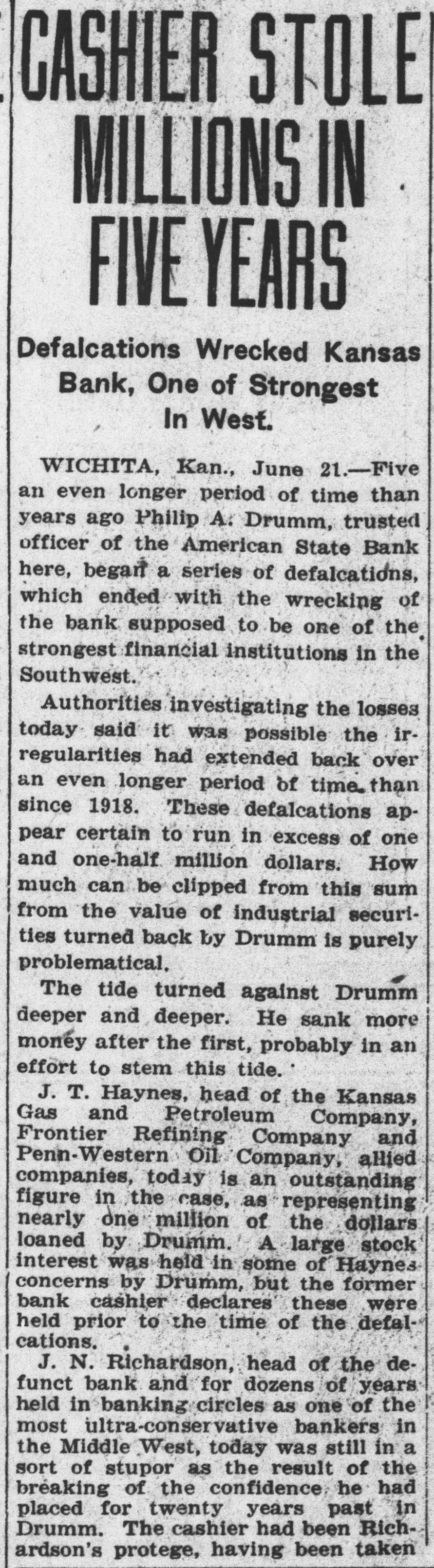
CASHIER STOLE MILLIONS IN FIVE YEARS Defalcations Wrecked Kansas Bank, One of Strongest In West. WICHITA, Kan., June 21.-Five an even longer period of time than years ago Philip A. Drumm, trusted officer of the American State Bank here, began a series of defalcations, which ended with the wrecking of the bank supposed to be one of the strongest financial institutions in the Southwest. Authorities investigating the losses today said it was possible the irregularities had extended back over an even longer period of time. than since 1918. These defalcations appear certain to run in excess of one and one-half million dollars. How much can be clipped from this sum from the value of industrial securities turned back by Drumm is purely problematical. The tide turned against Drumm deeper and deeper. He sank more money after the first, probably in an effort to stem this tide. J. T. Haynes, head of the Kansas Gas and Petroleum Company, Frontier Refining Company and Penn-Western Oil Company, allied companies, today is an outstanding figure in the case, as representing nearly one million of the dollars loaned by Drumm. A large stock interest was held in some of Haynes concerns by Drumm, but the former bank cashier declares these were held prior to the time of the defalcations. J. N. Richardson, head of the defunct bank and for dozens of years held in banking circles as one of the most ultra-conservative bankers in the Middle West, today was still in a sort of stupor as the result of the breaking of the confidence he had placed for twenty years past in Drumm. The cashier had been Richardson's protege, having been taken


Article from The Freedom Call, January 8, 1925

Click image to open full size in new tab

Article Text

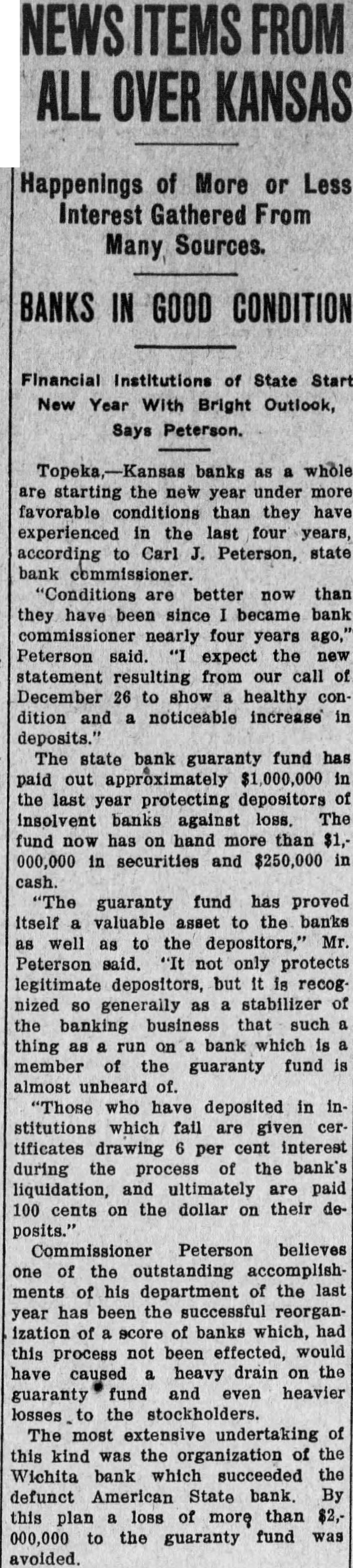
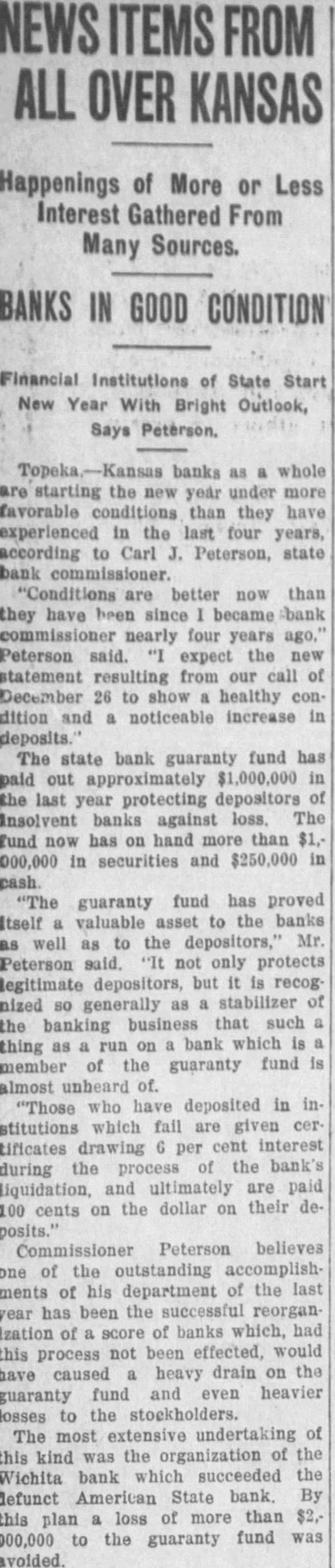
NEWS ITEMS FROM ALL OVER KANSAS Happenings of More or Less Interest Gathered From Many Sources. BANKS IN GOOD CONDITION Financial Institutions of State Start New Year With Bright Outlook, Says Peterson. Topeka,-Kansas banks as a whole are starting the new year under more favorable conditions than they have experienced in the last four years, according to Carl J. Peterson, state bank commissioner. "Conditions are better now than they have been since I became bank commissioner nearly four years ago," Peterson said. "I expect the new statement resulting from our call of December 26 to show a healthy condition and a noticeable increase in The state bank guaranty fund has paid out approximately $1,000,000 in the last year protecting depositors of insolvent banks against loss. The fund now has on hand more than $1,000,000 in securities and $250,000 in cash. "The guaranty fund has proved itself a valuable asset to the banks as well as to the depositors," Mr. Peterson said. "It not only protects legitimate depositors, but it is recog nized so generally as a stabilizer of the banking business that such a thing as a run on a bank which is a member of the guaranty fund is almost unheard of. "Those who have deposited in institutions which fail are given certificates drawing 6 per cent interest during the process of the bank's liquidation, and ultimately are paid 100 cents on the dollar on their deposits." Commissioner Peterson believes one of the outstanding accomplish ments of his department of the last year has been the successful reorganization of a score of banks which, had this process not been effected, would have caused a heavy drain on the guaranty fund and even heavier losses to the stockholders. The most extensive undertaking of this kind was the organization of the Wichita bank which succeeded the defunct American State bank. By this plan a loss of more than $2,000,000 to the guaranty fund was avoided.


Article from The Hartford Times, January 9, 1925

Click image to open full size in new tab

Article Text

ALL OVER KANSAS Happenings of More or Less Interest Gathered From Many Sources. BANKS GOOD CONDITION Financial Institutions of State Start New Year With Bright Outlook, Says Peterson. banks as whole are starting the new year under more favorable conditions than they have experienced in the last four years, according to Carl Peterson, state bank commissioner. "Conditions are better now than they have been since became bank commissioner nearly four years ago, Peterson said. expect the new statement resulting from our call of December 26 to show healthy con dition and noticeable increase in deposits. The state bank guaranty fund has paid out approximately in the last year protecting depositors of Insolvent banks against loss. The Fund now has on hand more than $1,in securities and in cash. "The guaranty fund has proved Itself valuable asset to the banks well to the depositors," Mr. as as Peterson said. "It not only protects legitimate depositors, but is recog. nized so generally as stabilizer of the banking business that such thing as run on bank which is member of the guaranty fund almost unheard of. "Those who have deposited in institutions which fail are given cer Lificates drawing per cent interest of the bank's during the process Liquidation, and ultimately are paid 100 cents on the dollar on their deposits.' Commissioner Peterson believes one of the outstanding accomplishments of his department of the last year has been the successful reorgan Ization of score of banks which, had this process not been effected, would have caused heavy drain on the guaranty fund and even heavier losses to the stockholders. The most extensive undertaking of this kind was the organization of the Wichita bank which succeeded the defunct American State bank. By this plan loss of more than $2,000,000 to the guaranty fund was avoided.


Article from Waterville Telegraph, January 9, 1925

Click image to open full size in new tab

Article Text

NEWS ITEMS FROM ALL OVER KANSAS Happenings of More or Less Interest Gathered From Many Sources. BANKS IN GOOD CONDITION Financial Institutions of State Start New Year With Bright Outlook, Says Peterson. Topeka,-Kansas banks as a whole are starting the new year under more favorable conditions than they have experienced in the last four years, according to Carl J. Peterson, state bank commissioner. "Conditions are better now than they have been since I became bank commissioner nearly four years ago," Peterson said. "I expect the new statement resulting from our call of December 26 to show a healthy condition and a noticeable increase in deposits." The state bank guaranty fund has paid out approximately $1,000,000 in the last year protecting depositors of insolvent banks against loss, The fund now has on hand more than $1,000,000 in securities and $250,000 in cash. "The guaranty fund has proved Itself a valuable asset to the banks as well as to the depositors," Mr. Peterson said. "It not only protects legitimate depositors, but it is recog nized so generally as a stabilizer of the banking business that such a thing as a run on a bank which is a member of the guaranty fund is almost unheard of. "Those who have deposited in in stitutions which fail are given cer tificates drawing 6 per cent interest during the process of the bank's liquidation, and ultimately are paid 100 cents on the dollar on their de posits." Commissioner Peterson believes one of the outstanding accomplishments of his department of the last year has been the successful reorganization of a score of banks which, had this process not been effected, would have caused a heavy drain on the guaranty fund and even heavier losses to the stockholders. The most extensive undertaking of this kind was the organization of the Wichita bank which succeeded the defunct American State bank. By this plan a loss of more than $2,000,000 to the guaranty fund was avoided.


Article from The Hanover Herald, January 9, 1925

Click image to open full size in new tab

Article Text

NEWS ITEMS FROM ALL OVER KANSAS Happenings of More or Less Interest Gathered From Many Sources. BANKS IN GOOD CONDITION Financial Institutions of State Start New Year With Bright Outlook, Says Peterson. Topeka,-Kansas banks as a whole are starting the new year under more favorable conditions than they have experienced in the last four years, according to Carl J. Peterson, state bank commissioner. "Conditions are better now than they have been since I became bank commissioner nearly four years ago," Peterson said. "I expect the new statement resulting from our call of December 26 to show a healthy condition and a noticeable increase in deposits." The state bank guaranty fund has paid out approximately $1,000,000 in the last year protecting depositors of insolvent banks against loss. The fund now has on hand more than $1,000,000 in securities and $250,000 in "The guaranty fund has proved itself a valuable asset to the banks as well as to the depositors," Mr. Peterson said. "It not only protects legitimate depositors, but it is recog nized so generally as a stabilizer of the banking business that such a thing as a run on a bank which is a member of the guaranty fund is almost unheard of. "Those who have deposited in institutions which fail are given certificates drawing 6 per cent interest during the process of the bank's liquidation, and ultimately are paid 100 cents on the dollar on their deposits." Commissioner Peterson believes one of the outstanding accomplishments of his department of the last year has been the successful reorganization of a score of banks which, had this process not been effected, would have caused a heavy drain on the guaranty fund and even heavier losses to the stockholders. The most extensive undertaking of this kind was the organization of the Wichita bank which succeeded the defunct American State bank. By this plan a loss of more than $2,000,000 to the guaranty fund was avoided.


Article from The Mooreland Leader, January 9, 1925

Click image to open full size in new tab

Article Text

FROM ALL KANSAS OVER Happenings of More or Less Interest Gathered From Many Sources. BANKS IN GOOD CONDITION Financial Institutions of State Start New Year With Bright Outlook, Says Paterson. banks as whole starting the new year under more favorable conditions than they have experienced in the last four years, according to Carl J. Peterson, state bank commissioner. "Conditions are better now than they have been since became bank commissioner nearly four years ago, Peterson said. expect the new statement resulting from our call of December 26 to show healthy con dition and noticeable increase in deposits.' The state bank guaranty fund has paid cut approximately 000,000 in the last year protecting depositors of insolvent banks against loss. The fund now has on hand more than $1, in secur.ties and $250,000 in "The guaranty fund has proved itself valuable asset to the banks as well as to the depositors. Mr. Peterson said. "It not only protects legitimate depositors, but it is recog nized so generally as stabilizer of the banking business that such thing as run on bank which is member of the guaranty fund almost unheard "Those who have deposited in in stitutions which fail are given certificates drawing per cent interest during process of the bank's liquidation, and ult.mately are pa.d 100 cents on the dollar on their deposits. Commissioner Peterson believes one of the outstanding accomplish- Mr ments of his department of the last year has been the successful reorganization of score of banks which, had this process not been effected would have caused heavy drain on the guaranty fund and even heavier losses to the stockholders. The most extensive undertaking of this kind was the organization of the Wichita bank which succeeded the defunct American State bank By this plan loss of more than $2,000,000 to the guaranty fund was


Article from The Soldier Clipper, January 14, 1925

Click image to open full size in new tab

Article Text

DANKS IN GOOD CONDITION Financial Institutions of State Start New Year With Bright Outlook, Says Peterson. Topeka,-Kansas banks as a whole are starting the new year under more favorable conditions than they have experienced in the last four years, according to Carl J. Peterson, state bank commissioner. "Conditions are better now than they have been since I became bank commissioner nearly four years ago,' Peterson said. "I expect the new statement resulting from our call of December 26 to show a healthy condition and a noticeable increase in deposits.' The state bank guaranty fund has paid out approximately $1,000,000 in the last year protecting depositors of insolvent banks against loss. The fund now has on hand more than $1,000,000 in securities and $250,000 in cash. "The guaranty fund has proved itself a valuable asset to the banks as well as to the depositors," Mr. Peterson said. "It not only protects legitimate depositors, but it is recog nized 80 generally as a stabilizer of the banking business that such a thing as a run on a bank which is a member of the guaranty fund is almost unheard of. "Those who have deposited in in stitutions which fail are given certificates drawing 6 per cent interest during the process of the bank's liquidation, and ultimately are paid 100 cents on the dollar on their deposits." Commissioner Peterson believes one of the outstanding accomplishments of his department of the last year has been the successful reorgan ization of score of banks which, had this process not been effected, would have caused a heavy drain on the guaranty fund and even heavier losses to the stockholders. The most extensive undertaking of this kind was the organization of the Wichita bank which succeeded the defunct American State bank. By this plan a loss of more than $2,000,000 to the guaranty fund was


Article from The Neosho Falls Post, January 15, 1925

Click image to open full size in new tab

Article Text

Financial Institutions State Start New Year With Bright Outlook, Says Peterson. banks as whole are starting the new year under more favorable conditions than they have experienced the last four years, according Carl Peterson, state bank commissioner. better now than they have been since became bank commissioner nearly four years Peterson said. expect the new statement resulting from our call of December 26 show healthy dition and noticeable increase The state bank guaranty fund has paid out the last year protecting depositors banks against The fund now has on hand more than in and cash. guaranty fund has proved itself valuable asset to the banks well the depositors, Mr Peterson not only protects legitimate depositors, recog nized so generally stabilizer the banking business that thing bank which member the guaranty fund almost unheard have deposited in stitutions which fail tificates drawing cent interest during process the bank's liquidation. and ultimately are paid 100 cents on the dollar on their posits. Commissioner Peterson believes one of the outstanding accomplish ments of his department of the last has been the successful reorgan ization of banks which, had this process not been effected. would have caused heavy drain guaranty fund and losses the stockholders. The most extensive this kind the organization of the Wichita bank which succeeded the defunct American State bank By this plan loss of more than $2, 000,000 to the guaranty fund avoided Sam Amidon of Wichita, national Democratic for Kanadmitted he virtually had been tendered the position of national party chairman. have been advised that the appointment mine but haven't yet made mind whether want meeting would be Chicago the latter part next month he said, which the matter appointing national chairman would be taken That old about the farmer "threshing his pumpkins" not imaginary unacquainted with agricultural in southwest Kansas might Thresh suppose. muskmelons and canteloupes has been developed into one of the mos' important industries that part the has enabled melon growers to build business, unique American of supplying melon seed most of prominent seed firms of the United States. The extent of this particular enterprise may be visualized the fact cantaloupe and muskmelon seed are shipped to the seed houses Lakin by the car load.


Article from Herndon Nonpareil, January 15, 1925

Click image to open full size in new tab

Article Text

BANKS IN GOOD CONDITION Financial Institutions of State Start New Year With Bright Outlook, Says Peterson. Topeka,-Kansas banks as a whole are starting the new year under more favorable conditions than they have experienced in the last four years, according to Carl J. Peterson, state bank commissioner. "Conditions are better now than they have been since I became bank commissioner nearly four years ago," Peterson said. "I expect the new statement resulting from our call of December 26 to show a healthy condition and a noticeable increase in deposits." The state bank guaranty fund has paid cut approximately $1 000,000 in the last year protecting depositors of insolvent banks against loss: The fund now has on hand more than $1,000,000 in securities and $250,000 in cash. "The guaranty fund has proved itself a valuable asset to the banks as well as to the depositors," Mr. Peterson said: "It not only. protects legitimate depositors, but it is recog. nized so generally as a stabilizer of the banking business that such a thing as a run on a bank which is a member of the guaranty fund is almost unheard of "Those who have deposited in institutions which fall are given cer tificates drawing C per cent interest during the process of the bank's liquidation, and ultimately are paid 100 cents on the dollar on their deposits." Commissioner Peterson believes one of the outstanding accomplish ments of his department of the last year has been the successful reorgan ization of a score of banks which, had this process not been effected, would have caused a heavy drain on the guaranty fund and even heavier losses to the stockholders. The most extensive undertaking of this kind was the organization of the Wichita bank which succeeded the defunct American State bank. By this plan a loss of more than $2. 000,000 to the guaranty fund was


Article from Chetopa Advance, March 5, 1925

Click image to open full size in new tab

Article Text

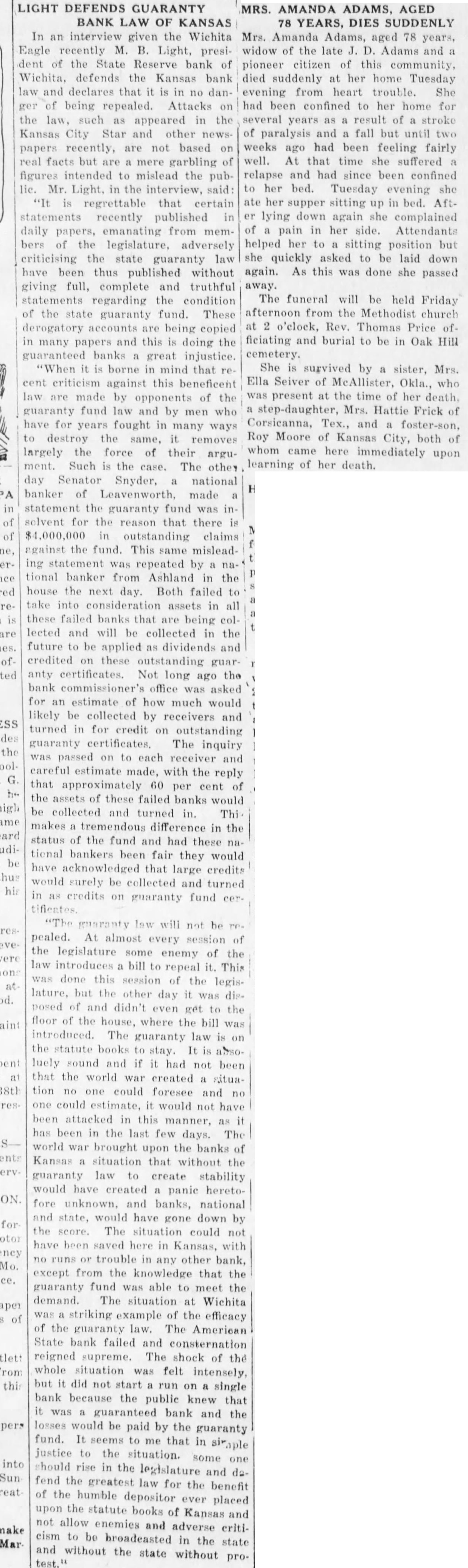
LIGHT DEFENDS GUARANTY BANK LAW OF KANSAS In an interview given the Wichita Eagle recently M. B. Light, president of the State Reserve bank of Wichita, defends the Kansas bank law and declares that it is in no danger of being repealed. Attacks on the law, such as appeared in the Kansas City Star and other newspapers recently, are not based on real facts but are mere garbling of figures intended to mislead the public. Mr. Light, in the interview, said: "It is regrettable that certain statements recently published in daily papers, emanating from members of the legislature, adversely criticising the state guaranty law have been thus published without giving full, complete and truthful statements regarding the condition of the state guaranty fund. These derogatory accounts are being copied in many papers and this is doing the guaranteed banks great injustice. "When it is borne in mind that criticism against this beneficent are made by opponents of the guaranty fund law and by men who have for years fought in many ways to destroy the same, it removes largely the force of their argument. Such is the case. The other day Senator Snyder, national banker of Leavenworth, made statement the guaranty fund was insolvent for the reason that there is $4,000,000 in outstanding claims against the fund. This same misleading statement was repeated by tional banker from Ashland in the house the next day. Both failed to take into consideration assets in all these failed banks that are being collected and will be collected in the future to be applied as dividends and credited on these outstanding guaranty certificates. Not long ago the bank commissioner's office was asked for an estimate of how much would likely be collected by receivers and turned in for credit on outstanding guaranty The inquiry was passed on to each receiver and careful estimate made, with the reply that approximately 60 per cent of the assets of these failed banks would be collected and turned in. Thi makes tremendous difference in the status of the fund and had these natienal bankers been fair they would have acknowledged that large credits would surely be collected and turned in credits on guaranty fund guaranty law will not be pealed. At almost every session of the legislature some enemy of the law introduces bill to repeal it. This was done this session of the legislature. but the other day it was disposed of and didn't even get to the floor of the house, where the bill was introduced. The guaranty law the statute books to stay. It is abso luely sound and if it had not been that the world war created situation no one could foresee and no one could estimate, it would not have been attacked in this manner, as it has been in the last few days. The world war brought upon the banks of Kansas situation that without the guaranty law to create stability would have created panic heretofore unknown, and banks, national and state, would have gone down by the score. The situation could not have been saved here in Kansas, with no runs or trouble in any other bank, except from the knowledge that the guaranty fund was able to meet the demand. The situation at Wichita was striking example of the efficacy of the guaranty law. The American State bank failed and consternation reigned supreme. The shock of the whole situation was felt intensely, but it did not start run on single bank because the public knew that it was guaranteed bank and the losses would be paid by the guaranty fund. It seems to me that in justice to the situation. some one should rise in the legislature and dafend the greatest law for the benefit of the humble depositor ever placed upon the statute books of Kansas and not allow enemies and adverse criticism to be broadeasted in the state test." and without the state without pro- MRS. AMANDA ADAMS, AGED 78 YEARS, DIES SUDDENLY Mrs. Amanda Adams, aged 78 years, widow of the late J. Adams and pioneer citizen of this community, died suddenly at her home Tuesday evening from heart trouble. She had been confined to her home for several years as a result of stroke of paralysis and fall but until two weeks ago had been feeling fairly well. At that time she suffered relapse and had since been confined to her bed. Tuesday evening she ate her supper sitting up in bed. After lying down again she complained of pain in her side. Attendants helped her to sitting position but she quickly asked to be laid down again. As this was done she passed away. The funeral will be held Friday afternoon from the Methodist church at 2 o'clock, Rev. Thomas Price officiating and burial to be in Oak Hill cemetery. She is survived by a sister, Ella Seiver of McAllister, Okla., who was present at the time of her death. step-daughter, Mrs. Hattie Frick of Corsicanna, Tex., and foster-son, Roy Moore of Kansas City, both of whom came here immediately upon learning of her death.
Article from The Hanover Herald, March 13, 1925

Click image to open full size in new tab

Article Text

ALWAYS HAVE KICKERS The bank guaranty law will not be repealed. While badly maligned by certain bankers in the state who are connected with it in no way, it will continue to function and protect individual depositors as it has in the past, according to M. B. Light, president of the State Reserve bank in Wichita, who says that attacks on the law did not drop out of the clear sky. Every time the state legislalature meets a few senators and Ξ“epresentatives attempt to prove it obsolete and worthless. They are the same men, he says, who fought the law when it was passed 15 years ago and their statements should be taken with several grains of salt. In an interview given The Eagle, Mr. Light said the kickers on the guaranty law were not depositors in guaranteed state banks or officers of such institutions. If the law did fail, it would not be a cent out of their pockets, and if the present losses are as heavy as they claim, it is not up to them to worry. They will not have to put up any money to make good the losses. In part Mr. Light said: "At one time a number of national banks in the state set out to defeat the guaranty law in the courts. The courts held the law constitutional and binding. Although defeated, these same bankers have continued their fight on the lawAnd yet, should their banks fail, as have many guaranteed state banks in the state, their depositors would have no guaranty fund to fall back on and get their deposits, with interest during the time they are held up pending liquidation. 'It is regretible that certain statements recently published in daily papers, emanated from members of the legislature, adversely criticising the state guaranty law have been thus published without giving full complete and truthful statements regarding the condition of the state guaranty fund. These derogatory accounts are being copied in many papers and this is doing the guaranteed banks a great injustice. "When it is borne in mind that recent criticisms against this beneficent law are made by appointments of the guaranty fund law and by men who have for years fought in many years to destroy the same, it removes largely the source of their argument. Such is the case. The other day Senator Snyder, a national banker of Leavenworth, made a statement the guaranty fund was insolvent for the reason that there is $4,000,000 in outstanding claims against the fund. This same misleading statement was repeated by a national banker from Ashland in the house-yesterday. Both failed to take into consideration assets in all these failed banks that are being collected and will be collected in the future to be applied as dividends and credited on these outstanding guaranty certificates. Not long ago the bank commissioner's office was asked for an estimate of how much would likely be collected by receivers and turned in for credit on outstanding guaranty certificates. The inquiry was passed on to each receiver and careful estimate made, with the reply that approximately 60 per cent of the assets of these failed banks would be collected and turned in. This makes a tremendous difference in the status of the fund and had these national bankers been fair they would have acknowledged that large credits would surely be collected and turned in as credits on guaranty fund certificates. "It is also regrettable that state banks putting up money to make good net loss in guaranteed banks to widows, orphans and poor people who need the money should be thus attacked and ridiculed by bankers who do not contribute a cent and who in case their banks should fail and go into the hands of receivers would see the net loss borne by depositors themselves and not by the guaranty fund. It is unfortunate that there is a class of bankers in Kansas who are not fair enough to give just credIt to the huge sums of money that have been paid and will continue to be paid under the guaranty law to make good the shortage in failed guaranteed banks. But this animosity and enmity to the guaranty fund has existed ever since the law was passed and probably will continue SO long as the present generation of opponents lives. "The guaranty law will not be repealed. At almost every session of the legisla ure, some enemy of the law introduces a bill to repeal it. This was done this session of the legislature, but the other day it was disposed of and didn't even get to the floor of the house, when the bill was introduced. The guaranty law, is on the statute books to stay. It is absolutely sound and if it had not been that World War created a situation no one could foresee and no one could estimate, it would not have been attacked in this manner as it has been the last few days. The World war brought upon the banks of Kansas a situation that without the guaranty law to create stability would have created a panic heretofore unknown, and banks national and state, would have gone down by the score. The situation could not have been saved here in Kansas, with no runs or trouble in any other bank, except from the knowledge that the guaranty fund was able to meet the demand. The situation at Wichita was a striking example of the efficacy of the guaranty law. The American State bank failed and consternation reigned supreme. The shock of the whole situation was felt intensely, but it did not start a run on a single bank because the public knew that it was alguaranteed bank and the losses would be paid by the guaranty fund. It seems to me that in simplejustice to the situation, some one should rise in legislature and defend the greatest law for the benefit of the humble depositor ever placed upon the statute books of Kansas and not allow enemies and adverse criticism to be broadcast in the state and without the state without protest."Wichita Eagle of Sunday, February 22nd. Adv


Article from The Emporia Gazette, September 25, 1925

Click image to open full size in new tab

Article Text

DRUMM JURY STILL OUT. Can't Agree As Guilt of Back Wichita, Sept. today the in the case Phil Drumm. charged conspiracy the funds the failed American State bank. had been for hours. stood to Jacques, foreman, said yesterday there little hope of agreeJudge Grover Pierpont indicatthat would the had not come an agreement late this afternoon.


Article from The Wichita Eagle, April 13, 1927

Click image to open full size in new tab

Article Text

WORTH RULING OF COURT Bank Receiver Loses Suit Through Omission of "Or Order" in Note CASE BITTERLY FOUGHT The Kansas supreme court has ruled that two little words. der". make all the difference in the world in check, promissory note or similar instrument. The decision was forthcoming in the case of Ray Foley, receiver the American State bank of Wichita. against John Hardy Little River. Judgment of the district was affirmed and the bank in its attempt col$2.500 on note because lacked being negotiable only because the two little words not present. The note was obtained by the bank through third party. stock salesdisposed of some stock to Hardy. Foley ran in the the bank started suit to collect. 'Six months after date promise to pay to myself with interest" That how the note read. The district court of Rice county held that Hardy promised to pay himself and only himself. as the note read no could hold him to an accounting. Had the note read "to myself or order", another party could have collected on Hardy's endorsement. The case was bitterly fought and held great deal interest for local legal talent. point those who handle checks. form of checks more important than most people realize. they say. If one wants keep passing through hands. he need only scratch out the words "bearer" "order" and only the payee whose name appears may collect on from the bank. If the pertinent little words left in the form, the check negotiable, its limit of cirbeing curtailed by the culation only of faith placed in the bank amount account of the one who writes it.


Article from The Wichita Beacon, December 16, 1927

Click image to open full size in new tab

Article Text

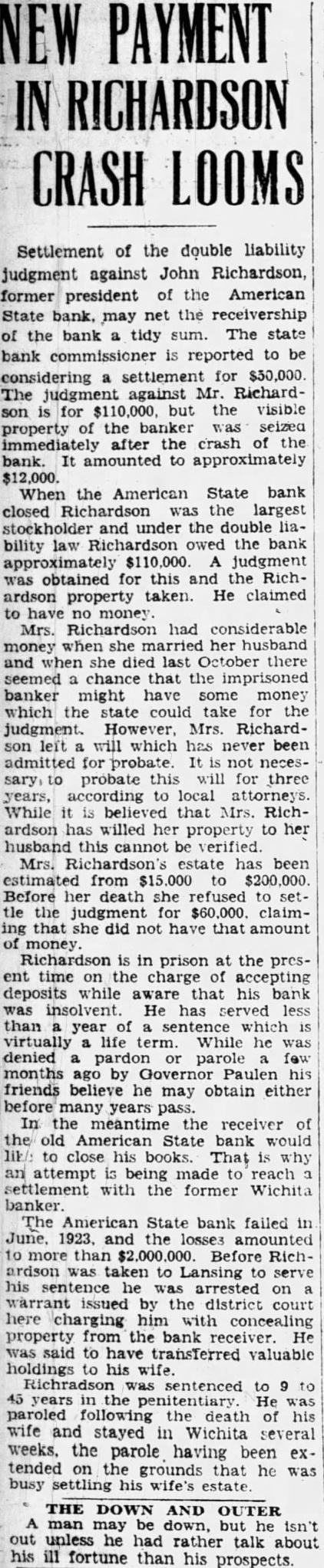
NEW PAYMENT IN RICHARDSON CRASH LOOMS Settlement of the double liability judgment against John Richardson, former president of the American State bank, may net the receivership of the bank a tidy sum. The state bank commissioner is reported to be considering a settlement for $50,000. The judgment against Mr. Richardson is for $110,000, but the visible property of the banker was seized immediately after the crash of the bank. It amounted to approximately $12,000. When the American State bank closed Richardson was the largest stockholder and under the double liability law Richardson owed the bank approximately $110,000 A judgment was obtained for this and the Richardson property taken. He claimed to have no money Mrs. Richardson had considerable money when she married her husband and when she died last October there seemed a chance that the imprisoned banker might have some money which the state could take for the judgment. However, Mrs. Richardson left a will which has never been admitted for probate. It is not necessary, to probate this will for three years, according to local attorneys. While it is believed that Mrs. Richardson has willed her property to her husband this cannot be verified. Mrs. Richardson's estate has been estimated from $15,000 to $200,000. Before her death she refused to settle the judgment for $60,000. claiming that she did not have that amount of money. Richardson is in prison at the present time on the charge of accepting deposits while aware that his bank was insolvent. He has served less than a year of a sentence which is virtually a life term. While he was denied a pardon or parole few months ago by Governor Paulen his friends believe he may obtain either before many years pass. In the meantime the receiver of the old American State bank would lik/: to close his books. That is why an attempt is being made to reach a settlement with the former Wichita banker. The American State bank failed in June, 1923, and the losses amounted to more than $2,000,000. Before Richardson was taken to Lansing to serve his sentence he was arrested on a warrant issued by the district court here charging him with concealing property from the bank receiver. He was said to have transferred valuable holdings to his wife. Richradson was sentenced to 9 to 45 years in the penitentiary. He was paroled following the death of his wife and stayed in Wichita several weeks. the parole having been extended on the grounds that he was busy settling his wife's estate THE DOWN AND OUTER A man may be down, but he isn't out unless he had rather talk about his ill fortune than his prospects