Exchange Bank (Dow City, IA)

Episode Information

Episode UID
6263896691252
Episode Type
Suspension โ†’ Closure
Bank Type
private
Bank ID
626389669 hash
Start Date
April 6, 1904
Location
Dow City, Iowa (41.929, -95.494)

Metadata

Model
gpt-5-mini (chosen from majority vote of a three-model LLM ensemble)
Short Digest
718bb5a8ca121979

Response Measures

None

Events (2)

1. April 6, 1904 Receivership
Newspaper Excerpt
N. Wilder has been made receiver for both banks.
Source
newspapers
2. April 6, 1904 Suspension
Cause
Bank Specific Adverse Info
Cause Details
Speculation in western cattle and excessive cattle paper/loans led to insolvency and forced closure.
Newspaper Excerpt
The Exchange Bank of Dow City ... have falled ... and are in the hands of a receiver.
Source
newspapers

Newspaper Articles (14)

Article from Evening Times-Republican, April 6, 1904

Click image to open full size in new tab

Article Text

TWO BANKS FAIL IN CRAWFORD COUNTY H. S. Greene's Private Banks at Dow City and Buck Grove Collapse CATTLE SPECULATION DID IT Proprietor Interested in a Big Colo. rado Cattle Ranch Near Rawlins, Wyo., and Carried Too Much Paper -Says All Depositors Will be Paid in Full. Special to Times-Republican. Dow City, April 6.-The Exchange Bank of Dow City and the bank at Buck Grove have falled with reported liabilities of a half million and assets of about $150,000. Both banks were private institutions and owned by H. S. Greene of this place. The banks were used largely by farmers and others as de positaries and it is thought the liabilities in this direction will foot up between $30,000 and $50,000. N. Wilder has been made receiver for both banks. The failure ds directly connected with the cattle busness in which Mr. Greene has been engaged. He had a large ranch in northwestern Colorado stocked with 8,000 cattle and did a general mercantile business here in Dow City. The fadlure is attributable directly to the cattle speculation as the banks and the mercantile venture were all doing a good business. The general impression here is that depositors will realize something on their claims. Mr. Greene this afternoon said to a Times-Republican representative that the assets of the banks were between $75,000 and $100,000, more than their direct liabilities, and that depositors would be paid in full. He stated that his direct liabilities would total about $200,000 all told and that his assets are at least $300,000. What the contingent liabilities are he failed to make clear in his statement. The deposits in both banks he said would not exceed $40,000 and might run as low as $30,000. The direct causes of his failure he attributed to the cattle speculation and the carrying of too much cattle paper. The banks had loaned too much and when forced to a settlement failed. However he felt certain that all direct liabilities would be met and paid in full. He has about 3,000 acres of real estate located largely in eastern Nebraska.


Article from The Minneapolis Journal, April 7, 1904

Click image to open full size in new tab

Article Text

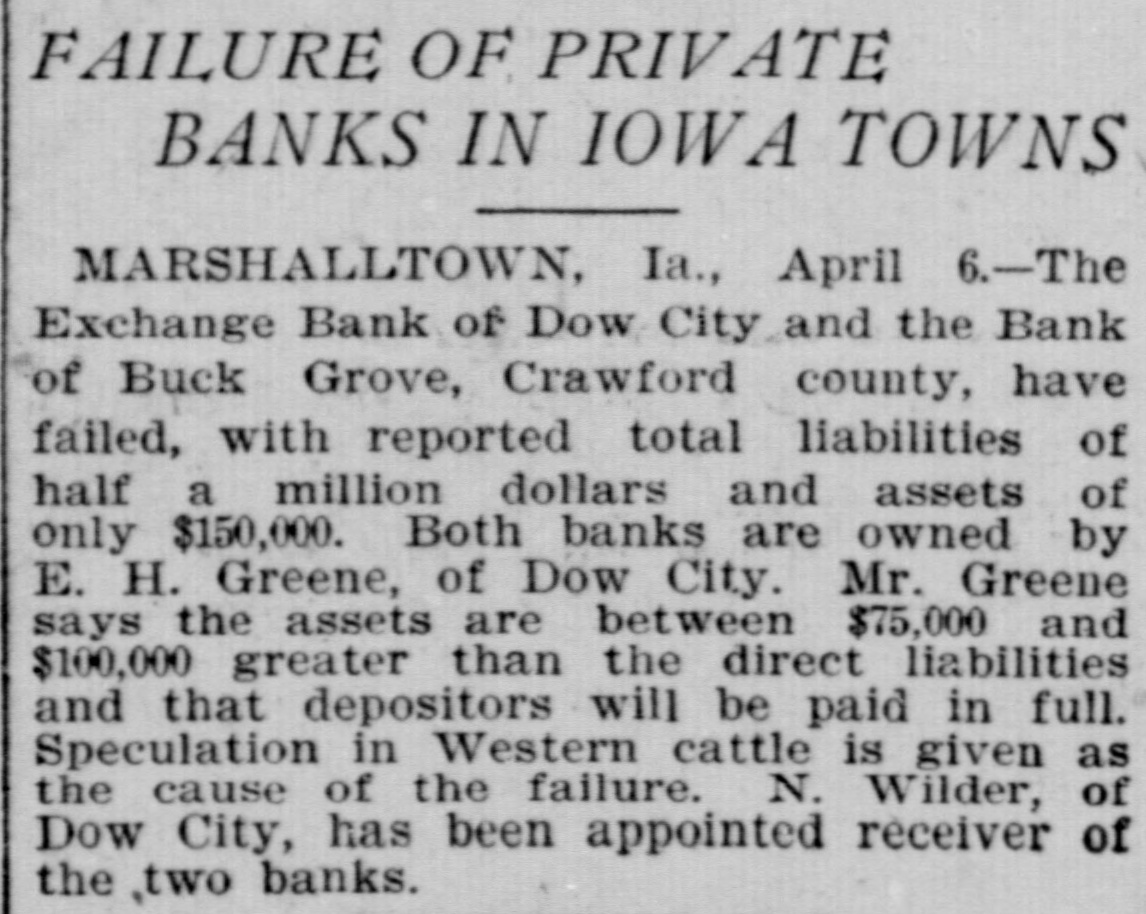
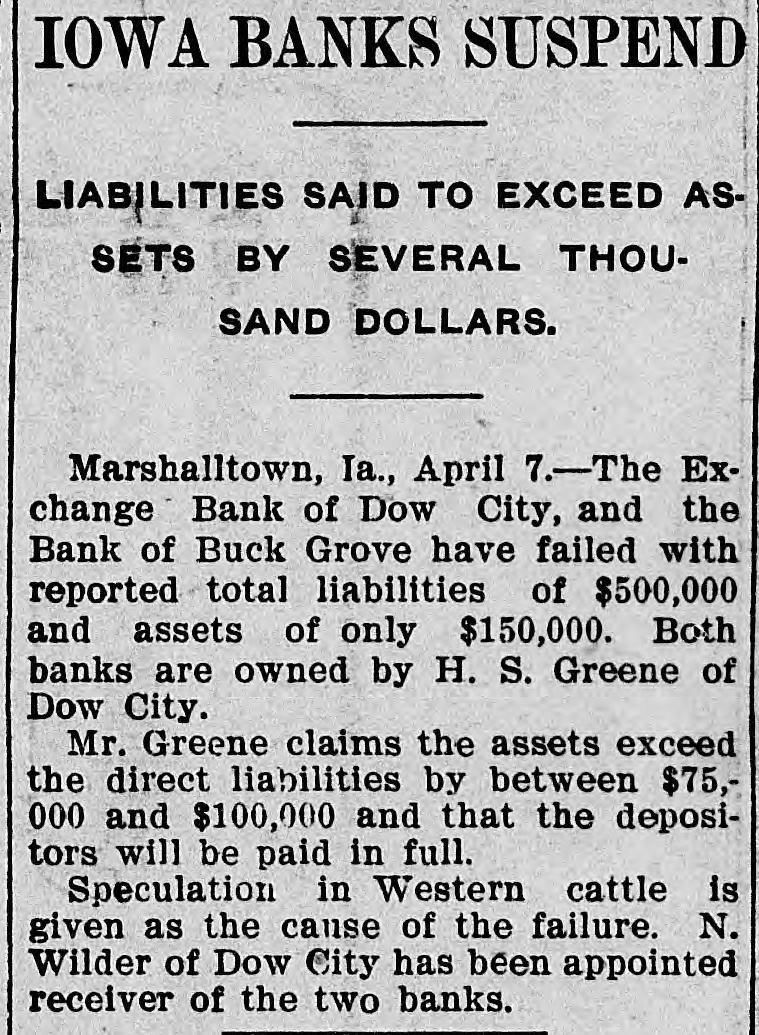
SPECULATED IN CATTLE Banks of H. S. Greene of Dow City Make an Assignment. MARSHALLTOWN. IOWA-The Exchange bank of Dow City and the Bank of Buck Grove have failed, with reported total liabilities of half a million dollars and assets of only $150,000. Both banks are owned by H. S. Greene of Dow City. The assets exceed the direct liabilities by between $75,000 and $100,000, and the depositors will be paid in full. Speculation in western cattle is given as the cause of the failure. N. Wilder of Dow City has been appointed receiver of the two banks.


Article from The Topeka State Journal, April 7, 1904

Click image to open full size in new tab

Article Text

TWO BANKS CLOSE, Failure Due to Speculation in Western Cattle. Marshalltown, Iowa, April -The Exchange bank of Dow City and the Bank of Buck Grove, Crawford county, have failed with reported total liabilities half a million dollars, and assets of only a hundred and fifty thousand dollars and are in the hands of a receiver. Both are owned by H. S. Greene of Dow City. Mr. Greene says the assets are between $75,000 and $100,000 greater than the direct liabilities and depositors will be paid in full. He says the direct liabilities aggregate only $200,000 dollars. Speculation in western cattle is the cause of the failure.


Article from Rock Island Argus, April 7, 1904

Click image to open full size in new tab

Article Text

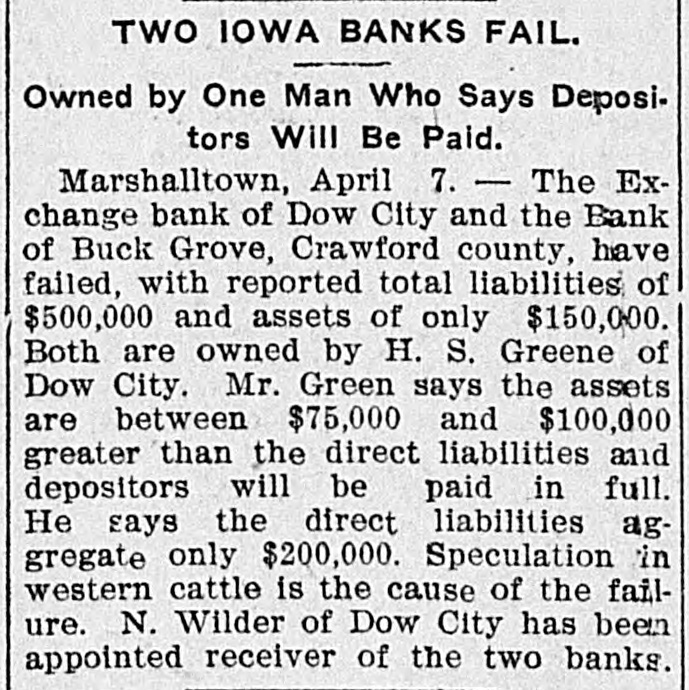
TWO IOWA BANKS FORCED TO CLOSE Both Belong to H. S. Green, of Dow City, Who Says All Debts Will be Paid. Marshalltown, Ia., April 7.-The Exchange bank. of Dow City, and the Bank of Buck Grove, Crawford, county, have failed with reported total liabilities of half a million dollars and assets of only$150,000. Both are owned by H. S. Greene, of Dow City. Greene says the assets are between $75,000 and $100,000 greater than the direct liabilities. and depositors will be paid in full. He says the direct liabilities aggregate only $200,000. Speculation in western cattle is the cause of the failure. N. Wilder, of Dow City, has been appointed receiver of the two banks.


Article from The Cairo Bulletin, April 7, 1904

Click image to open full size in new tab

Article Text

TWO BANKS HAVE FAILED. ly the Associated Press. Marshalltown. April 6.-The ex change bank of Dow City, and the bank of Buck-Grove, Crawford county ave failed with a reported total lia ilities of half a million; the assets re a hundred and fifty thousand. Both re owned by H. S. Green, of Dow 'ity. Green says the assets are be. ween seventy-five and a hundred housand greater than the direct lia bilities, and depositors will be paid in ull. He says the direct liabilities and ggregate only two hundred thousand ollars. Speculation in western cat le caused the failure. N. Wilder, of Dow City was appointed receiver of he bank.


Article from The Salt Lake Herald, April 7, 1904

Click image to open full size in new tab

Article Text

IOWA BANKS GO UNDER, Total Liabilities Are Half a Million Dollars. Marshalltown, Ia., April 6.-The Exchange bank of Dow City and the Bank of Buck Grove, Cramford county, have failed with reported total Habilities of half a million dollars and assets of only $150,000, and are in the hands of a receiver. Both are owned by O. A. Green of Dow City, Mr. Green says the assets are between $75,000 and $100,000 greater than the direct liabilities, and depositors will be paid in full. He says the direct liabilities aggregate only $200,000. Speculation in western cattle is the cause of the failure. 1


Article from The Salt Lake Herald, April 7, 1904

Click image to open full size in new tab

Article Text

IOWA BANKS GO UNDER, Total Liabilities Are Half a Million Dollars. Marshalltown, Ia., April 6.-The Exchange bank of Dow City and the Bank of Buck Grove, Cramford county, have failed with reported total liabilities of half a million dollars and assets of only $150,000. and are in the hands of a receiver. Both are owned by O. A. Green of Dow City, Mr. Green says the assess are between $75,000 and $100,000 greater than the direct liabilities, and depositors will be paid in full, He says the direct liabilities aggregate only $200,000. Speculation in western cattle is the cause of the failure.


Article from Morris Tribune, April 9, 1904

Click image to open full size in new tab

Article Text

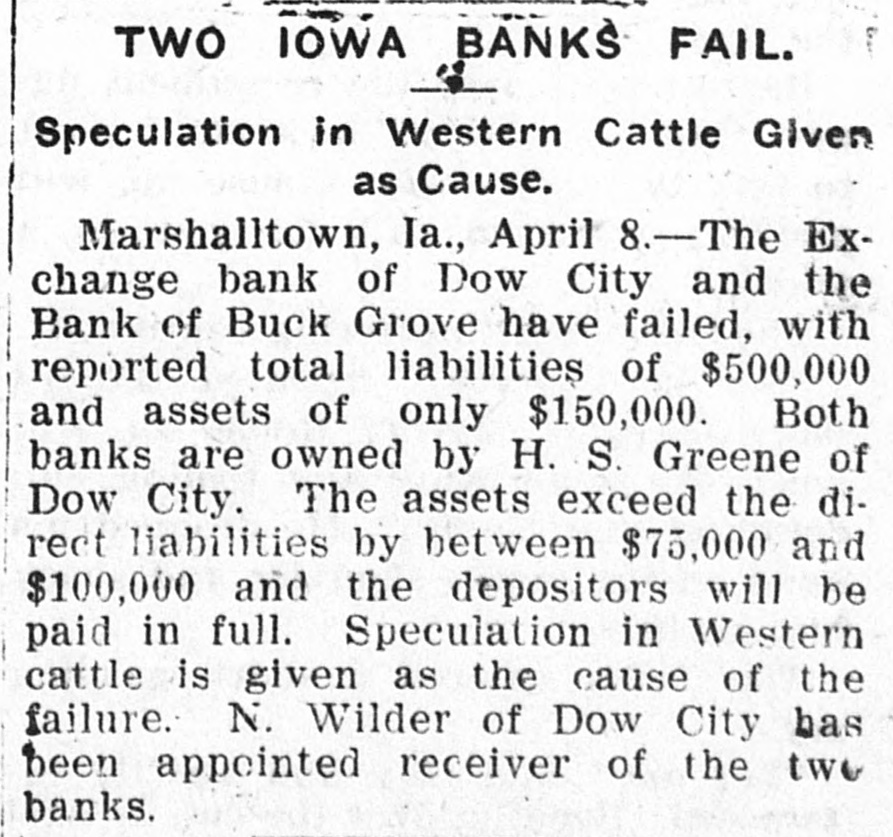
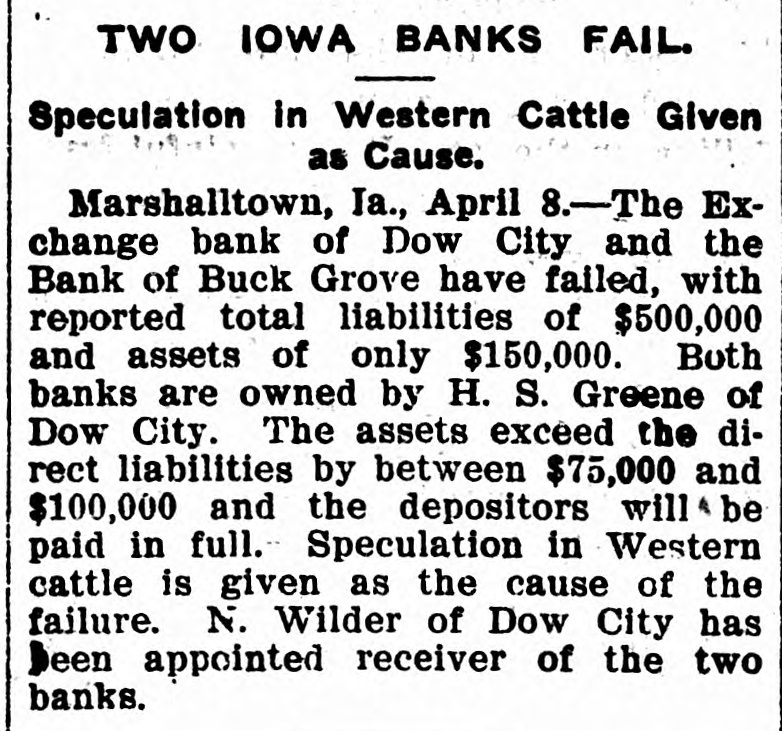
TWO IOWA BANKS FAIL. Speculation in Western Cattle Given as Cause. Marshalltown, Ia., April 8.-The Exchange bank of Dow City and the Bank of Buck Grove have failed, with reported total liabilities of $500,000 and assets of only $150,000. Both banks are owned by H. S. Greene of Dow City. The assets exceed the direct liabilities by between $75,000 and $100,000 and the depositors will be paid in full. Speculation in Western cattle is given as the cause of the failure. N. Wilder of Dow City has been appointed receiver of the two banks.


Article from Highland Recorder, April 15, 1904

Click image to open full size in new tab

Article Text

NEWS IN SHORT ORDER. The Latest Happenings Condensed for Rapid Reading. Domestic. Vice Chancellor Bargen signed an order in New Jersey to show cause why an injunction should not issue tc restrain the Northern Securities Company from holding a stockholders' meeting. Work at the Bay State Mills of the American Woolen Company, in Lowell, Mass., was suspended, the company ordering a shutdown for an indefinite period. This effects 700 hands. Miss Jennie Gray, daughter of Col James R. Gray, editor of the Atlanta Journal, was married in Atlanta, Ga., to Capt. Earle D'Arcy Pearce, of the United States Army. A quarrel over a girl, their companion at school, culminated in the killing of a 16-year-old boy by another in Chicago. For half an hour traffic on Lowet Broadway was blocked by a small fire in the new subway in New York John Cleves Short Harrison, grand. son of President William Henry Harrison, died at Los Angelese, Cal. Edward and Jacob Hammond, brothers, and Oscar Sigertsen were asphyxiated by gas in Philadelphia. Five persons are dead and another is dying as the result of a fire in Mount Vernon, N. Y. The Exchange Bank of Dow City and the Bank of Buck Grove, Ia. have failed. The police raided the offices of the Pacific Underwriting and Trust Company and the Imperial Trust Company, in Chicago, and arrested those in charge on the charge of swindling Sixty-three Indians were wrecked in a train east-bound near Maywood I11. Three were instantly killed, 3 were fatally injured and 20 others were more or less seriously hurt. I The National Cotton Spinners As. sociation at Boston adopted resolu$ tions favoring an eight-hour day, antiinjunction laws and a better system of s factory inspection. In an amended bill in the United $ States Circuit Court at St. Louis an . insurance company which is resisting the payment of policies for $200,00C , on the life of James L. Blair, who was vice general counsel of the World's e Fair, charges that Blair obtained the policies by fraud. n Advices from Nome, Alaska, say ) that the spring cleanup of gold on the g Nome Peninsula will be greatly in exI cess of any previous season. Conservative estimates place the cleanup at $1,250,000. Smuel W. McCall and Charles F. Choate, Jr., were appointed receivers $ for the Union Trust Company in Bos. ton. The company's liabilities are n placed at $1,600,000. Albert Robbins and Edward L / Robbins, president and cashier, respectively, of the defunct Farmers' Bank at Auburn, Ind., were arrested for embezzlement. r The retention of 35 Greek strike. breakers at the plant of the American e Car Company, in Chicago, caused a e rumpus there and the Greeks were L driven out. The nail department of the American Steel and Wire Company's plant S at Rankin, near Pittsburg, was burned down, causing a loss of $175,000. As the result of playing with powt der, three boys were fatally injured in 1 Salt Lake, Utah, and one crippled for , life. Coal has advanced $1.20 a ton in n Iowa on account of the scarcity caused by the strike.


Article from The Midland Journal, April 15, 1904

Click image to open full size in new tab

Article Text

NEWS IN SHORT ORDER. The Latest Happenings Condensed for Rapid Reading. Domestic. John Thomas, aged 69 years, night watchman at the Houston Club of the University of Pennsylvania, Philadelphia, was found murdered on the bowling alleys. A negro was arrested on suspicion. Robbery is believed to have been the motive. W. W. Millikin, in jail at Abbeville, Ala., charged with criminal assault upon his sister-in-law, committed suicide by shooting himself through the head. The New York State Commissioner of Health reports that many people die from preventable diseases. Mrs. William Hazzard, of Brooklyn, committed suicide in the Hotel St. Denis, New York. Col. Charles H. Page, a noted turfman, died in Philadelphia at the age of 70. Members of Congress expects the congressional session to end about April 20. Vice Chancellor Bargen signed an order in New Jersey to show cause why an injunction should not issue to restrain the Northern Securities Company from holding a stockholders' meeting. Work at the Bay State Mills of the American Woolen Company, in Lowell, Mass., was suspended, the company ordering a shutdown for an indefinite period. This effects 700 hands. Miss Jennie Gray, daughter of Col. James R. Gray, editor of the Atlanta Journal, was married in Atlanta, Ga., to Capt. Earle D'Arcy Pearce, of the United States Army. A quarrel over a girl, their companion at school, culminated in the killing of a 16-year-old boy by another in Chicago. For half an hour traffic on Lower Broadway was blocked by a small fire in the new subway in New York. John Cleves Short Harrison, grandson of President William Henry Harrison, died at Los Angelese, Cal. Edward and Jacob Hammond, brothers, and Oscar Sigertsen were asphyxiated by gas in Philadelphia. Five persons are dead and another is dying as the result of a fire in Mount Vernon, N. Y. The Exchange Bank of Dow City and the Bank of Buck Grove, Ia., have failed. The police raided the offices of the Pacific Underwriting and Trust Company and the Imperial Trust Company, in Chicago, and arrested those in charge on the charge of swindling. Sixty-three Indians were wrecked in a train east-bound near Maywood, III. Three were instantly killed, 3 were fatally injured and 20 others were more or less seriously hurt. The National Cotton Spinners Association at Boston adopted resolutions favoring an eight-hour day, antiinjunction laws and a better system of factory inspection. In an amended bill in the United States Circuit Court at St. Louis an insurance company which is resisting the payment of policies for $200,000 on the life of James L. Blair, who was vice general counsel of the World's Fair, charges that Blair obtained the policies by fraud. Advices from Nome, Alaska, say that the spring cleanup of gold on the Nome Peninsula will be greatly in excess of any previous season. Conservative estimates place the cleanup at $1,250,000.


Article from Manchester Democrat, April 20, 1904

Click image to open full size in new tab

Article Text

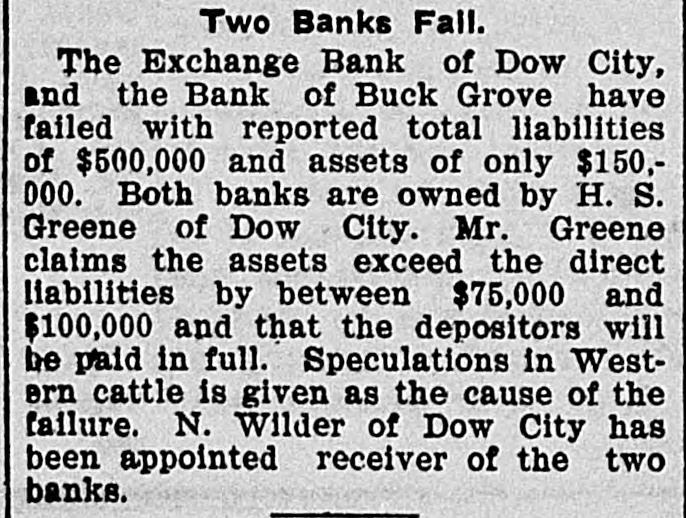
where he was ground to death. The Exchange Bank of Dow City and the Bank of Buck Grove have failed, with reported total liabilities of $500,000 and assets of only $150,000. Both are owned by H. S. Greene of Dow City. Mr. Greene says the assets are between $75,000 and $100,000 greater than the direct liabilities and depositors will be paid in full. Speculation in western cattle is the cause of the failure. N. Wilder of Dow City has been appointed receiver of the two banks. Charles Page, cashier of the Muscatine Savings Bank, is dead at Dallas, Texas, where he went in search of health. He was a prominent Muscatine business man for fifty years. Accused by his wife of assault with intent to commit murder, made a defendant in a divorce case and wanted by the county authorities for violating an injunction issued by the District Court, Andrew Loeffler, a Des Moines florist, took a dose of carbolic acid after he was held to answer to the grand jury. and died on the lawyers' table in the court 100m. As the result of differences between the coal dealers at Stanhope and a number of farmers an elevator company for the purpose of handling all their own grain and coal has been organized and an elevator and store house of a large capacity will be built the coming summer. On account of the coal strike the railroads have announced that at least 600 men will be laid off at once. Thirty six crews running out of Des Moines and Valley Junction have quit work. Similar action by railways centering at Boone, Belle Plain. Oskaloosa, Ottumwa and Albia will mean the loss of work to about 1,000 men. Although accused of murder in the first degree and awaiting trial with an array of evidence against him that seems impregnable, Charles W. Graves, under indictment charged with murdering his wife and burning her body, refused to leave his cell in Des Moines and escape with his fellows. Graves was walking up and down his narrow cell with the door wide open when the turnkey discovered the delivery. Charles Cackley, murderer of Constable Reuben Fenstemaker in 1806 at Farmington, who was arrested after thirty-six years, entered a plea of guilty and was sentenced at Keokuk to ten years in prison nt Fort Madison.


Article from Evening Times-Republican, July 31, 1905

Click image to open full size in new tab

Article Text

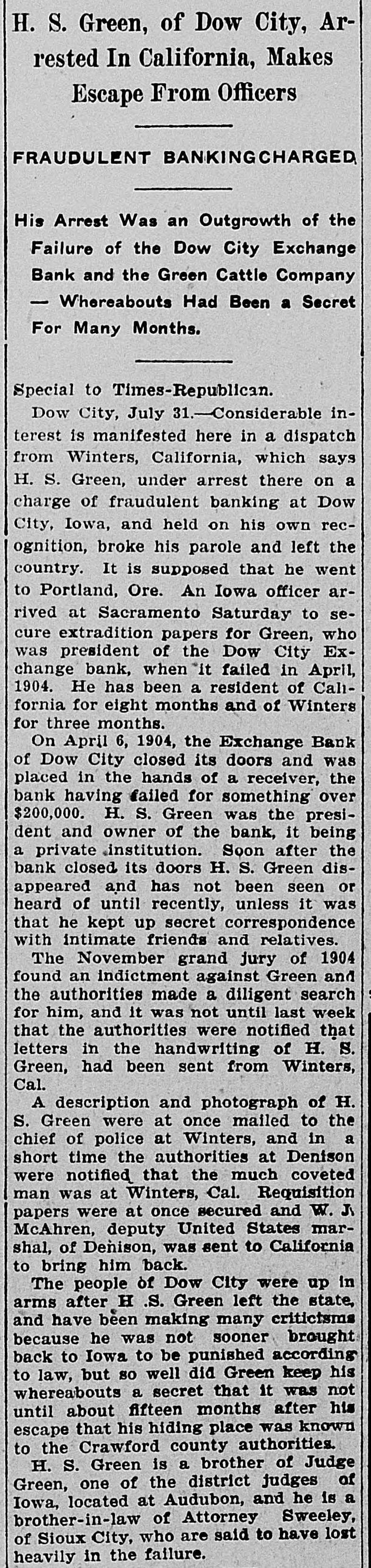
H. S. Green, of Dow City, Arrested In California, Makes Escape From Officers FRAUDULENT BANKINGCHARGED His Arrest Was an Outgrowth of the Failure of the Dow City Exchange Bank and the Green Cattle Company - Whereabouts Had Been a Secret For Many Months. Special to Times-Republican. Dow City, July 31.-Considerable interest is manifested here in a dispatch from Winters, California, which says H. S. Green, under arrest there on a charge of fraudulent banking at Dow City, Iowa, and held on his own recognition, broke his parole and left the country. It is supposed that he went to Portland, Ore. An Iowa officer arrived at Sacramento Saturday to secure extradition papers for Green, who was president of the Dow City Exchange bank, when "it failed in April, 1904. He has been a resident of California for eight months and of Winters for three months. On April 6, 1904, the Exchange Bank of Dow City closed its doors and was placed in the hands of a receiver, the bank having failed for something over $200,000. H. S. Green was the president and owner of the bank, it being a private institution. Soon after the bank closed its doors H. S. Green disappeared and has not been seen or heard of until recently, unless it was that he kept up secret correspondence with intimate friends and relatives. The November grand jury of 1904 found an indictment against Green and the authorities made a diligent search for him, and it was not until last week that the authorities were notified that letters in the handwriting of H. S. Green, had been sent from Winters, Cal. A description and photograph of H. S. Green were at once mailed to the chief of police at Winters, and in a short time the authorities at Denison were notified that the much coveted man was at Winters, Cal. Requisition papers were at once secured and W. J McAhren, deputy United States marshal, of Denison, was sent to California to bring him back. The people of Dow City were up in arms after H .S. Green left the state, and have been making many critictsms because he was not sooner brought back to Iowa to be punished according to law, but so well did Green keep his whereabouts a secret that it was not until about fifteen months after his escape that his hiding place was known to the Crawford county authorities. H. S. Green is a brother of Judge Green, one of the district judges of Iowa, located at Audubon, and he is a brother-in-law of Attorney Sweeley, of Sioux City, who are said to have lost heavily in the failure.


Article from Evening Times-Republican, August 18, 1905

Click image to open full size in new tab

Article Text

Missing Iowa Banker Writes County Attorney at Dennison Asking For Leniency IS A FUGUTIVE FROM JUSTICE Prefers. to Have the Law Kill Rather Than Hound Him--Wants Chance to Pay All His CreditorsHas Had All the Punishment Can Bear. Special to Times-Republican. Denison, Aug 18.-H. S. Green, the missing banker, wanted at Dow City on a charge of fraudulent banking, has written a letter to the county attorney of Crawford county from Vancouver, British Columbia, in which he declares that he will endeavor to rep his depositors if not placed in jail. Green gloomily declares that the law should be changed SO that "when a man failed he would be shot or killed by officers of the law Green, who had been missing since his bank, the Exchange bank of Dow City, was closed April 4, 1904, was apprehended and arrested at Winters, Cal., in July. He had been engaged in the hotel business there for eight months and had secured such a good standing in the community that was released on his own re cognizance pending the arrival of an Iowa officer Before the officer could get to Winters Green had disappeared again. He thought to have gone to Portland, no trace could be found until this ter was received by County Attorney Klinker at Dennison. Green dates at Portland, August 5, but says mails the letter from Vancouver, British Columbia, and intimates that he on his road to Alaska. The letter is in full as follows: "Portland, Ore., Aug. 5. Dear You will no doubt be surprised to from me, but I wished to write you few lines. First, in regard to the of ficer at Winters that let me go; it no fault of his, it was all of the people of the town that insisted that I should have liberty to go where pleased, and no compensation of any kind was ever offered him. "Second-1 had about come to the conclusion that there were no indictments against me and I was getting started in a hotel and was making secret of where.) was and thought with hard work of myself and family I would be able in time at least to pay all the poorer depositors and one AEW I that si ILVING JO objects the sometime get enough money together that I can pay every cent that I justly owe; and how can I possibly do anything in that line if I am on trial and locked up? God only knows what the verdict of a jury would be, but I know that I did all mortal man could do, I thought to protect everyone that any u! thought I put 01 SUM case of failure, my assets would more than pay all liabilities, but I had idea of how things would shrink value in a receiver's hands: For instance a thousand acres of land western Nebraska that I could have sold for twenty-five thousand dollars, and I do not think could be bought that today, sold by the receiver for fifteen thousand dollars, and other pieces of property in proportion, only worse. I suppose the receiver did as well he could for everybody tries to buy property forced on the market at half price. "One more thought and I am thru: I do not see any reason in justice why the law should pursue me. (Remember I am not finding any fault your actions to have me arrested you are only fulfilling the duties of your office in accordance with the law.) The only thing I contend why anyone should want me locked if they could have me. Do they think I am dangerous, or do they want to punish me? "I have had all the punishment that mortal man could bear without committing suicide and my wife and family have gone thru untold mental agony Now I am separated from wife and family and no one knows when I will see them again. I would not care for myself, but all efforts punish me react on my wife and children. I have often wished that the law was changed so that when a man failed he would be shot or killed by the cers of the law. For that is one thing I am not afraid of and that is to die. for then a person will go before the Supreme God who will judge our in accordance with the spirit in which they were done. "I suppose the best thing for me to do now is to go to some country like Alaska and see if I can retrieve financial strength so that I will be to support my family and if possible make enough so that I can commence paying up on my old indebtedness to


Article from Evening Times-Republican, August 24, 1905

Click image to open full size in new tab

Article Text

# Wyoming Man Buys the Assets of the Cattle Company Which Failed at Dow City SOME DIVIDENDS TO BE PAID Failure of the Dow City Exchange Bank and Green Cattle Company Was Sensational One-The Property Brought $71,000 and Included Ranch and Cattle. Special to Times-Republican. Council Bluffs, Aug. 24,-ะœ. K. Parsons, receiver for the Green Catle company, yesterday morning sold the remalning assets of the company, including several thousand head of stock and the ranch property, located at Dixon, Wyo., to Ora Haley, of Laramie, Wyo., for $71,000. The sale took place in the office of the clerk of the United States court in the federal building and was approved by W. S. Mayne, who was some time ago appointed by Judge Smith McPherson as special master for the sale. There were but two bids presented for the property, that of Mr. Haley and another from E. G. Gould. a ranchman of western Nebraska, offering $70,200. According to the order approving the sale, the money must be paid within ten days, and upon payment Mr. Parsons is instructed to turn the ranch, its equipment and its stock over to Mr. Haley. Filed Objections. Immediately following the sale Lois G. Stuart of Audubon and the State bank of Chicago filed objections to the aproval of the sale. Louis G. Stuart is a creditor of the defunct company to the extent of $42,964.08, while the State bank of Chicago, which first instituted the suit, is creditor for $10,539.43. The grounds for the objection are practically the same in each case and are based upon the alleged fact that the receiver, previous to making the sale, did not take an accurate inventory of the assets of the company. There being no inventory, each party alleges that it will be impossible to apportion to the creditors of the company generally and to themselves in particular their just proportion of the proceeds of the sale. The parties making objections, however, state that they are satisfied with the result of the sale and that their objections are presented simply to guard their own interests, in case legal complications should arise later in connection with the disposal of the property. Failure in 1904. The failure of the Green Cattle Company was brought about by the failure of H. S. Green, a banker of Dow City, This failure took place during the latter part of January, 1904. With Mr. Green in the cattle venture were Judge W. R. Green of Audubon, brother of H. S., and several others. Practically all of the paper of the Green Cattle Company was made payable to H. S. Green and in the course of his banking business this had been put up as collateral security with many creditors. The question as to whether or not the assets of the Green Cattle Company should be used to help pay the indebtedness of H. S. Green was settled in the feedral court by Judge Smith McPherson several months ago. The order for the sale and application of the proceeds to the payment of Green's personal debts was made at that time. The affairs of the Green estate are in such condition, it is stated, that there is little likelihood of the shareholders in the cattle company realizing any part of the proceeds of the sale for the entire amount to be used in settlement of the Green estate first and the balance, If there is anything left is to be turned back to the shareholders of the company. The total indebtedness of the Green Cattle Company is estimated to be between $250,000 and $300,000, while the proceeds from the previous sales of stock and the final disposition of the ranch and the remaining stock yesterday will be approximately $175,000.