Jenkins Trust Company (New York, NY)

Episode Information

Episode UID
6243337991294
Episode Type
Suspension โ†’ Reopening
Bank Type
trust
Bank ID
624333799 hash
Start Date
October 25, 1907
Location
New York, New York (40.714, -74.006)

Metadata

Model
gpt-5-mini (chosen from majority vote of a three-model LLM ensemble)
Short Digest
10407e9cf560e4ff

Response Measures

None

Events (4)

1. October 25, 1907 Suspension
Cause
Bank Specific Adverse Info
Cause Details
Institution suspended during the 1907 panic amid discoveries of illegal overloans and insolvency concerns (checks presented through clearing house risk).
Newspaper Excerpt
The Jenkins Trust company of Brooklyn, both of which failed today.
Source
newspapers
2. November 16, 1907 Receivership
Newspaper Excerpt
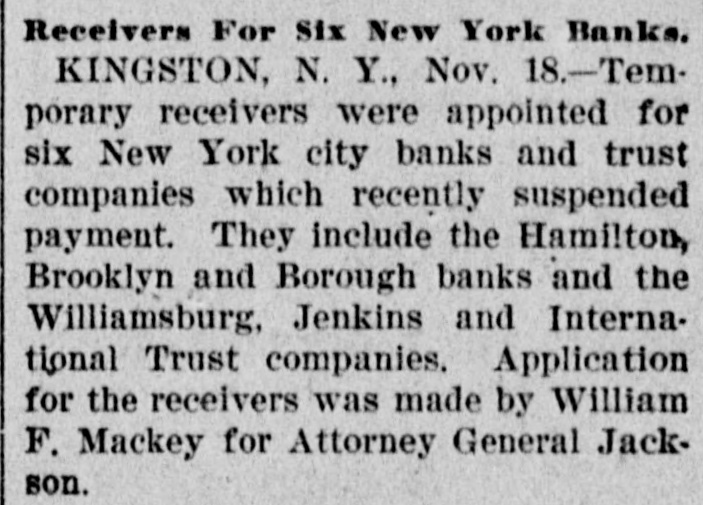
Temporary receivers were appointed today for six New York banks ... Jenkins of Brooklyn ... John Mulhall was appointed temporary receiver upon representations by the Attorney General's office that the bank was insolvent.
Source
newspapers
3. November 29, 1907 Other
Newspaper Excerpt
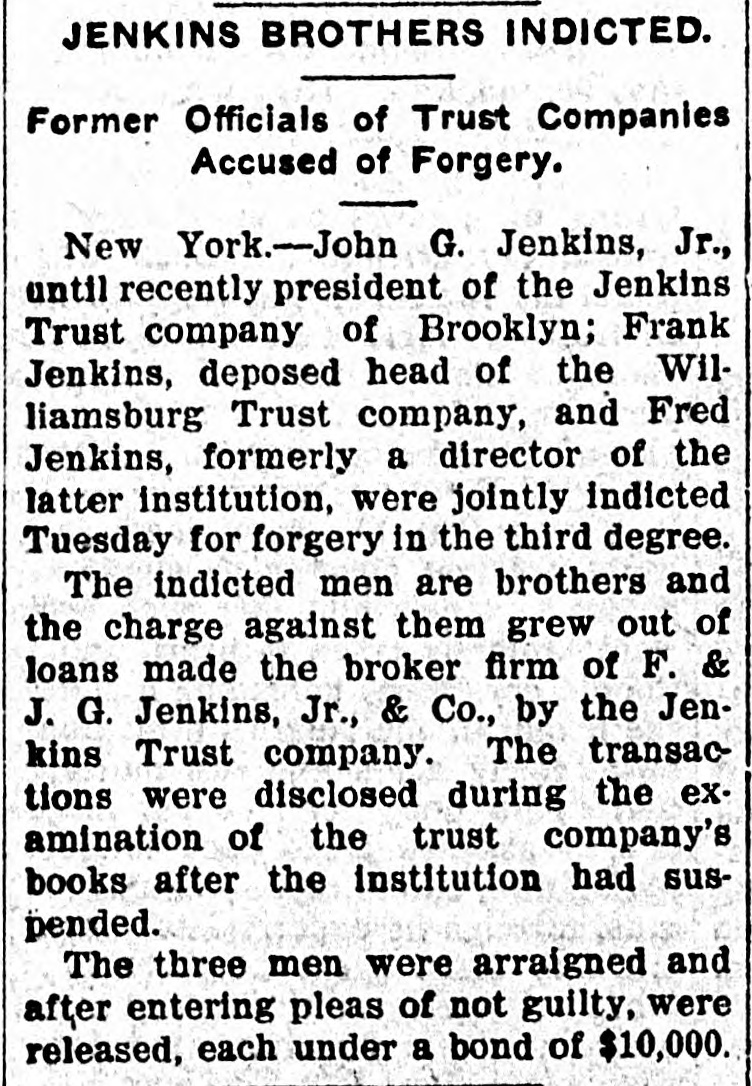
JENKINS BROTHERS INDICTED. ... indicted Tuesday for forgery ... grew out of loans made ... by the Jenkins Trust company of Brooklyn.
Source
newspapers
4. April 15, 1908 Reopening
Newspaper Excerpt
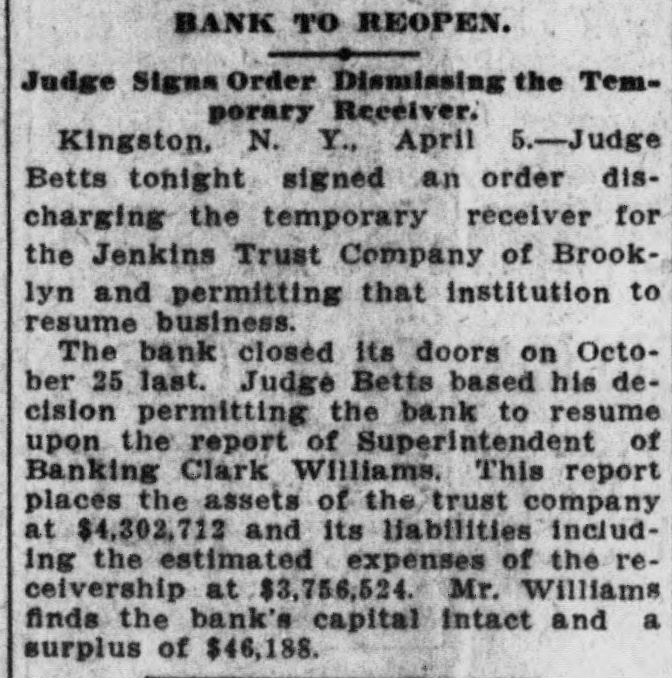
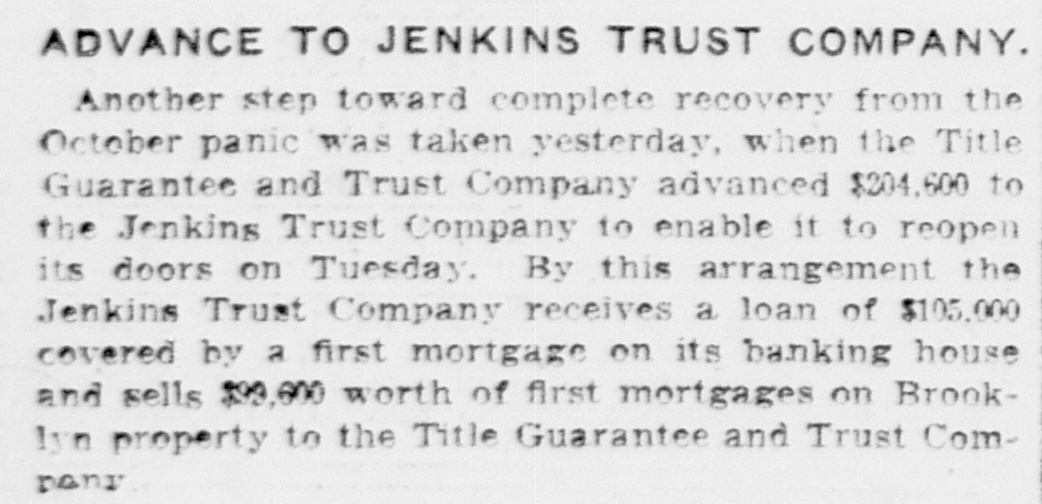
Justice Betts ... signed an order discharging the temporary receiver for the Jenkins Trust Company, of Brooklyn, and permitting that institution to resume business. ... The banking company is instructed to open for business on or before April 22. ... Title Guarantee and Trust Company advanced $204,600 to the Jenkins Trust Company to enable it to reopen its doors on Tuesday.
Source
newspapers

Newspaper Articles (22)

Article from Deseret Evening News, October 26, 1907

Click image to open full size in new tab

Article Text

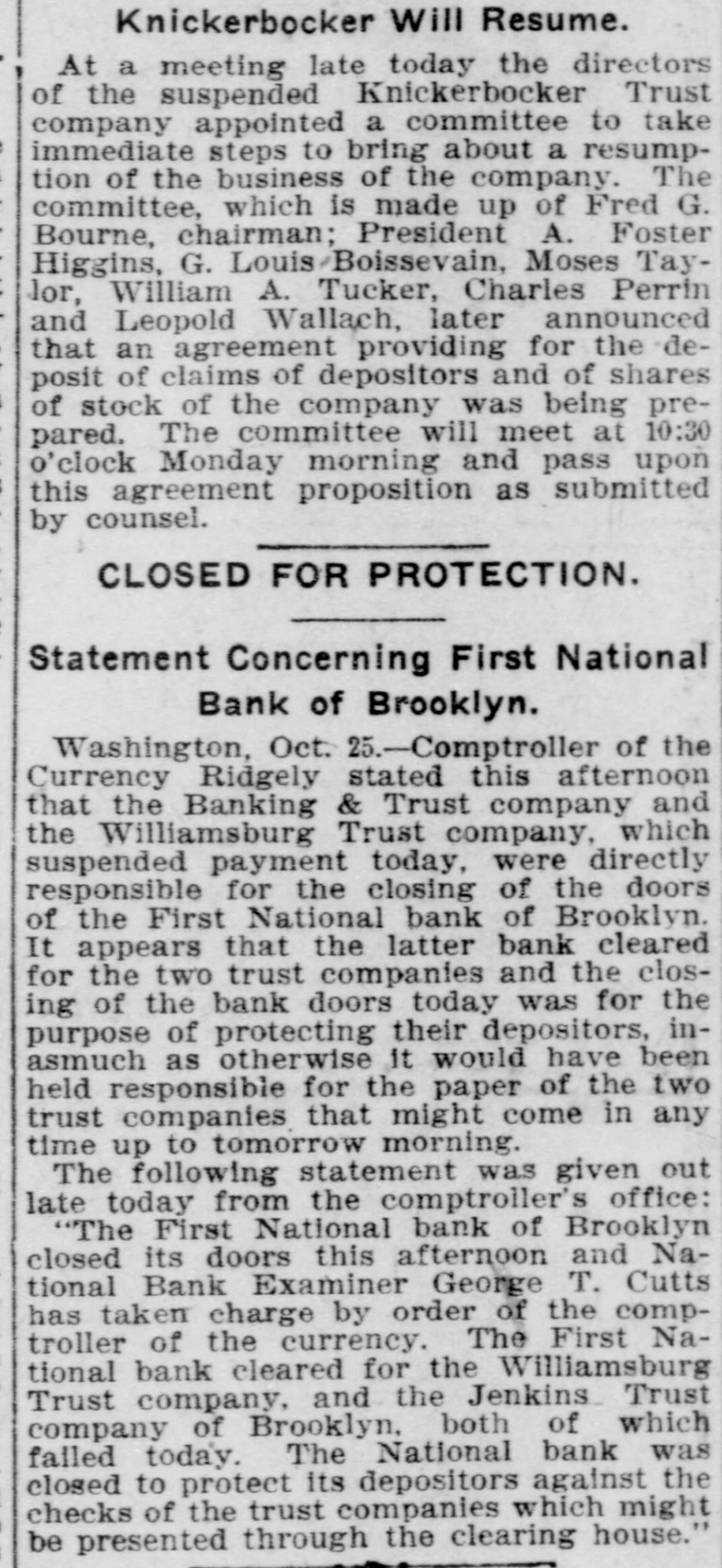
BANK WAS CLOSED TO PROTECT ITS DEPOSITORS. Washington, Oct. 25.-Comptroller of the Currency Ridgely stated this afternoon that the Banking & Trust company and the Williamsburg Trust company, which suspended payment today, were directly responsible for the closing of the doors of the First National bank of Brooklyn. It appears that the latter bank cleared for the two trust companies and the closing of the bank doors today was for the pui. pose of protecting their depositors, inasmuch as otherwise it would have been held responsible for the paper of the two trust companies that might come in any time up to tomorrow morning. The following statement was given out late today from the comptroller's office: "The First National bank of Brooklyn closed its doors this afternoon and National Bank Examiner George T. Cutts has taken charge by order of the comptroller of the currency. The First National bank cleared for the WilHamsburg Trust company, and the Jenkins Trust company of Brooklyn, both of which failed today. The national bank was closed to protect its depositors against the checks of the trust companies which might be presented through the elearing house."


Article from The Montgomery Advertiser, October 26, 1907

Click image to open full size in new tab

Article Text

NEW YORK PASSES TRYING DAY (Continued from Page One.) issues occurred in 1873 and 1884. The last occasion on which they were used was in 1893. The clearing house certificate is practically a guarantee byal banks in the clearing house that the certificates shall be redeemed at par, but the clearing house banks are protected against loss by the fact that first class securities, either commercial -paper or stocks and bonds, are required before the certificates are issued. The certificates are used only be tween banks. They do not appear in general circulation, but by relieving the banks of the strain of large debit balances, they enable them to keep their cash reserves comparatively in. tact It is believed by competent bankers that an issue of $50,000,000 will be the outside requirement at present. It is believed also that the mere fact that they are to be issued will so far re store confidence that runs upon banks win cease, so that it will not be necessary to keep certificates outstanding for any considerable time. Already the strong city banks are receiving large deposits from persons who have withdrawn their money from institutions which have fallen under suspicion. This does not preclude the fact that considerable amounts have been put in safe deposit boxes and thereby withdrawn from circulation, but it is believed that renewed confidence will cause the return of this money to the banks within a short time Imports of Gold. Late in the afternoon a favorable light was cast upon the prospects of imports of gold by a sudden fall in foreign exchange. The market has been practically at standstill for several days with large offerings of bills and few takers This afternoon, how ever, the rate dropped to 4.85. which practically makes imports of gold possible at a profit. Leading bankers and foreign exchange houses have been looking for this development but hardly expected that it would come so soon. The tide of gold, once it sets on. the way, will undoubtedly reach a large volume, in view of the considerable amounts due this country for the outgoing crops and for securities. While the present market is one to encourage the general public to buy American securities, there are always shrewd observers in Europe who are disposed to buy at times like the present and some of them have been in the market during the past few days. It will be possible even by the process of Joans to transfer a part of the burden of carrying stocks from New York to London and Paris, but this has been tone thus far to only a limited extent The fact that the banks and the stock exchanges will be open for business but two hours tomorrow and that Sunday with all its opportunities of calming public sentiment will intervene, added to the more hopeful view taken by leading financiers tonight will do much toward clearing the financial skies before next week. At a meeting of the directors of the Lincoln Trust Company tonight, Louis Stern, a director, was authorized to make the following statement: (The directors of the Lincoln Trust Company are justified in stating that the company is in a position to meet every demand that may be made upon it and that the company is In a strong. et position tonight than any day this week. Furthermore, the withdrawal of funds has been less day by day At a meeting late today the direc. tors, of the Knickerbocker Trust Com. pany appointed a committee to take steps to bring about a resumption of business The committee later announced that an agreement providing for the deposit of claims of depositors and of shares of stock of the company was being prepared The committee will meat Monday to pass on this agreement Run Continues Baltimore. Oct. 25. The run on the East Branch of the Home Bank, continued today and shortly before noon, the depositors who were in line waiting for their money were notified that the bank would take advantage of a chare ter provision which permits the institution to demand sixty days notice of a positor's intention to withdraw his or her account A member of the firm of Bernstein, Cohen and Company, owners of the bank, today admitted that the run has been of much larger proportions than had been reported. Runs on Pawtucket Banks. Pawtucket R. I. Oct. -Follow ing the posting of the ninety day notice to depositors by the local branch of the New England Trust Company, of Providence runs were started today on all banks in Pawtucket. With the exception of the New England Trust Company all the banks met the demand without difficulty GOVERNOR APPEALED TO. A Legal Holiday to Relieve Financial Situation Asked For. Albany, N. Y., Oct. 25 -Governor Hughes today received a number of telegrams suggesting that he proclaim a legal holiday during which the financial situation might be relieved. The Governor acknowledged the receipt of all of these messages without indicat ing his intentions. He would not dis. cuss the question tonight, but there is a good reason to believe there is no immediate probability of his taking this step. COMPTROLLER OF CURRENCY GIVES OUT A STATEMENT. Washington, Oct. 25.- The following statement was given out today by the Comptroller's office: The First National Bank of Brook lyn. N. Y., closed its doors this afternoon and National Bank Examiner George T. Cutts has taken charge by order of the Comptroller of the Currency. The First National Bank cleared for the Williamsburg Trust Com pany and the Jenkins Trust Company of Brooklyn, both of which failed to. day The National Bank was closed to protect its depositors against the checks of the Trust Companies, which might be presented through the Clear ing House.


Article from New-York Tribune, October 26, 1907

Click image to open full size in new tab

Article Text

THE NEWS THIS MORNING. FOREIGN.-China has begun a grain rate war directed against the Japanese lines in Manchuria, has cancelled the foreign concessions on the Imperial railways and has sent Chinese troops into the disputed boundary zone. Leading English weekly newspapers say that opportunities for successful dishonesty and apathy of the respectable classes regarding politics are responsible for the financial situation in America. The Registrar in the Bankruptcy Court at the examination of the firms of Arbuthnot & Co., bankers of Madras and London, said that the liabilities exceeded the assets The loss of life in by nearly $9,000,000. the earth shocks in Calabria is estimated at six Advices from Madrid say that hundred. King Alfonso will go to London under strict incognito to be examined by a specialist in Riddell, at Toronto, a fine of $25,000 on the imposed tuberculosis. Justice, Michigan dynamite Centrai for the explosion of a car of listed as powder. The crew of the British steamer Tampico and five men of the Dutch schooner Anna, abandoned at sea, were landed Testimony in the libel action in England. of General Count Kuno von Moltke against Herr Harden was closed at Berlin. DOMESTIC.-Naval matters took up much of the time at the first formal meeting of the Cabinet in Washington since June; either two or three new battleships probably will be asked for Among at the coming session of Congress. the White House visitors were Senator Long, of Kansas, and Representative Kennedy, of Ohio, who boomed Mr. Taft for President, and Senator Hemenway and Representative Watson, of Indiana, who did likewise for Mr. Fairbanks. Senator Elkins, of West Virginia, said in Washington that the present money troubles would have been avoided if the currency law had been more elastic. Franklin K. Lane, Interstate Commerce Commissioner, told the President that, while car shortage existed in the Northwest, there was no fear of an immediate crisis. The National Civic Federation ended its trust conference at Chicago with a recommendation for immediate general regulation by Congress to give the federal government full power to reguIn a statelate trusts and corporations. ment given out at the Executive Chamber at Albany it was said that Governor Hughes believed that there was a decided improvement in the financial situation and that he looked for an After an early restoration of confidence. eventful day banking circles in Providence, R. I., believed that the crisis had been met. Judges Edward T. Bartlett and Willard Bartlett were informed of their nomination by the Democrats at Albany. The annual autumn ball was held at Tuxedo Park, N. Y. CITY.-Stocks advanced rapidly toward the close. The savings banks of this city decided to require of depositors the usual legal notice of from thirty to ninety days before making withdrawals. Ernst Thalmann, Otto T. Bannard and Henry C. Ide, all of New York City, were appointed temporary receivers of the Knickerbocker Trust Company and its branches, by Justice Clark, in the Supreme Court, at St. George, Staten Island, on the application of Attorney General Jackson. Bank suspensions in Brooklyn included the First National, Williamsburg Trust Company, Jenkins Trust Company, Borough Bank, Brooklyn Bank and the Guardian Savings Bank. The United States Exchange Bank, of Harlem, The Consolidated suspended payment. Steamship Lines were partially reorganized. Further reductions in the city's budget for 1908 were made. Captain Weigand was deposed from the Tenderloin command; he was succeeded by Lieutenant Kelleher. The Kaiser Wilhelm der Grosse reported that her rudder had broken at sea, and that she was steaming slowly and using her propellers to steer with. Vain attempts to run Yonkers streetcars were attended by rioting. THE WEATHER.4Indications for to-day: Fair and colder. The temperature yesterday: Highest, 58 degrees; lowest, 39.


Article from The Salt Lake Herald, October 26, 1907

Click image to open full size in new tab

Article Text

Knickerbocker Will Resume. At a meeting late today the directors of the suspended Knickerbocker Trust company appointed a committee to take immediate steps to bring about a resumption of the business of the company. The committee, which is made up of Fred G. Bourne, chairman; President A. Foster Higgins, G. Louis/Boissevain Moses Taylor, William A. Tucker, Charles Perrin and Leopold Wallach, later announced that an agreement providing for the -deposit of claims of depositors and of shares of stock of the company was being prepared. The committee will meet at 10:30 o'clock Monday morning and pass upon this agreement proposition as submitted by counsel. CLOSED FOR PROTECTION. Statement Concerning First National Bank of Brooklyn. Washington, Oct. 25.-Comptroller of the Currency Ridgely stated this afternoon that the Banking & Trust company and the Williamsburg Trust company, which suspended payment today, were directly responsible for the closing of the doors of the First National bank of Brooklyn. It appears that the latter bank cleared for the two trust companies and the closing of the bank doors today was for the purpose of protecting their depositors, inasmuch as otherwise It would have been held responsible for the paper of the two trust companies that might come in any time up to tomorrow morning. The following statement was given out late today from the comptroller's office: "The First National bank of Brooklyn closed its doors this afternoon and National Bank Examiner George T. Cutts has taken charge by order of the comptroller of the currency. The First National bank cleared for the Williamsburg Trust company, and the Jenkins Trust company of Brooklyn, both of which failed today. The National bank was closed to protect its depositors against the checks of the trust companies which might be presented through the clearing house."


Article from Rock Island Argus, November 16, 1907

Click image to open full size in new tab

Article Text

Receivers for Six Failed Banks. Kingston, N. Y., Nov. 16.-Temporary receivers were appointed today for six New York banks which recently suspended payment. They are: The Hamilton, New York and Brooklyn banks, Borough Bank of Brooklyn. Jenkins of Brooklyn, and International of New York, Application was made in behalf of the attorney general of the state.


Article from New-York Tribune, November 17, 1907

Click image to open full size in new tab

Article Text

RECEIVERS FOR 6 BANKS . ATTORNEY GENERAL'S ACT ! Sees Crime in Two Brooklyn Institutions-All Closed Before. Justice Betts of the Supreme Court, sitting all Kingston. on the application of Attorney General Jackson. appointed receivers yesterday for the Hamilton Bank and the International Trust Company, of Manhattan. and the Jenkins Trust Company, the Williamsburg Trust Company. the Brooklvn Bank and the Borough Bank. of Brooklyn, all of which were closed by the State Banking Department in the recent financial flurry. Evidences of criminality were found in the Borough Bank. the Attorney General said. consisting of forged paper, overloans and overdrafts, all of which would be laid before the grand jury. In the Jenkins Trust Company, Mr. Jackson said, there were evidences of illegal overloans. one to John G. Jenkins, jr., the president. being for $557,000. William R. Montgomery, president of the Hamilton Bank. denounced at his home last night the action of the Attorney General in asking for a receiver for the Hamilton Bank He said that Mr. Jackson knew that a plan had been partly arranged for strong banking interests to take over the institution. advancing at once $1,500,000 In the case of the Williamsburg Trust Company the application for a receiver was no Sure prise to the officers, as a committee of directors, headed by Charles Jerome Edwards, had made application on Friday to the local office of the Attorney General for such a proceeding. A.C. Scharmann, a director of the Jenking Trust Company, said that he knew nothing et the contemplated appointment of a receiver in the company when he left the offices of the company at noon He said also that he was unaware of the existence of any irregularities in the affairs of the institution. as charged by the Attorney General. William Gow. who was one of the organizer> of the International Trust Company and is a director of the Borough Bank, said of the latter institution that he was sure none of the things charged against the institution were true. The directors of the Borough Bank of Brooklyn issued the following statement last night: The result of the Borough Bank directors' investigation was given to the State Banking Department yesterday morning. This investigation developed the fact of irregularities so eleverly conceived and manipulated that the books of the institution failed to disclose them. As a result of this the directors were enabled to recover the whole of the discrepancies and through this directors' investigation the entire facts are now in possession of both the State Banking Department and Attorney General Jackson. The directors of the Borough Bank decline to make any statement further than to say that a thorough examination of the institution's affairs has been made by expert bank accountants of highest standing, with the result that the bank was found to be perfectly solvent and its capital unimpaired. The bank examiner in his report says: "Since the beginning of this examination the directors have secured from Mr. Gow, of Ward & Gow. and others an assignment of all their equities in real estate and other properties worth at least $700,000. and, if this additional collateral is allowed, all loans by this bank to Mr. Gow, either directly or indirectly. are amply secured, and instead of a surplus of $11,935 ; *303 my asset and liability sheet will show a surplus of $137,080 74." MR. JACKSON'S +STATEMENT. The application of the Attorney General for the appointment of the receivers was based on affidavits made by Clark Williams, the State Superintendent of Banks. The following statement in explanation of Mr. Jackson's step was issued at the office of the Attorney General here: Attorney General Jackson appeared before Justice Betts in Special Term of the Supreme Court at Kingston this morning and made application for the appointment of receivers for the Williamsburg Trust Company, the Hamilton Bank, the Borough Bank of Brooklyn, the


Article from The Barre Daily Times, November 18, 1907

Click image to open full size in new tab

Article Text

ILLEGAL OVERLOANS CHARGED. Receivers for Six New York City Banks and Trust Companies. New York, Nov. 18.-Temporary recelvers were appointed Saturday for six New York City banks and trust companies which recently suspended pay. ment. They include the Hamilton, Brooklyn and Borough banks, and the Williamsburg, Jenkins and cernational trust companies. Application for the receivers was made by William F. Mackey for the attorney-general. AttorneyGeneral Jackson gave ont a statement Saturday afternoon, to the effect that in his opinion evidence of both criminal and civil liability has been unearthed in the investigation of the Borough bank of Brooklyn and the Jenkins Trust company of Brooklyn. In a formal statement issued Saturday, the attorney-general said that in the Borough bank of Brooklyn there has been found evidence of illegal over-loans, over-drafts, forged paper and other crimInal transactions, all of which will be presented to the grand jury. In the Jenkins Trust company the attorney. general says there has been found evidence of illegal over-loans. It is claimed by the trustees, the attorney-general adds, that they know nothing about these illegal loans to the president of the company. The attorney-general's announcement states that the investigation thus far has been confined to the Borough bank of Brooklyn and the Jenkins Trust company.


Article from The Wahpeton Times, November 21, 1907

Click image to open full size in new tab

Article Text

CRIMES LAID TO BANKERS. Attorney General of New York AIleges Criminal Transactions. New York, Nov. 19.-In securing the appointment of receivers for three banks and three trust companies in New York and Brooklyn which recently suspended payment, State Attorney General Jackson declared that in the Borough Bank of Brooklyn and in the Jenkins Trust company evidence has been found of illegal overloans and possible warrant for both civil and criminal action and for enforcement of liability.


Article from Troy Weekly News, November 22, 1907

Click image to open full size in new tab

Article Text

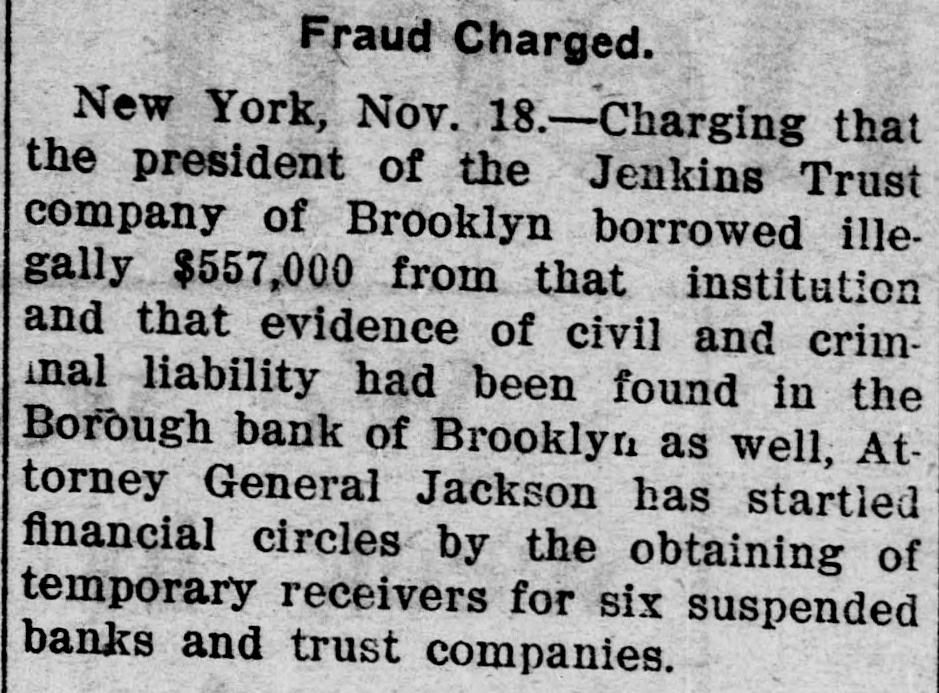
Fraud Charged. New York, Nov. 18.-Charging that the president of the Jenkins Trust company of Brooklyn borrowed illegally $557,000 from that institution and that evidence of civil and crimnal liability had been found in the Borough bank of Brooklyn as well, Attorney General Jackson has startled financial circles by the obtaining of temporary receivers for six suspended banks and trust companies.


Article from Iowa State Bystander, November 29, 1907

Click image to open full size in new tab

Article Text

# JENKINS BROTHERS INDICTED. Former Officials of Trust Companies Accused of Forgery. New York.--John G. Jenkins, Jr., until recently president of the Jenkins Trust company of Brooklyn; Frank Jenkins, deposed head of the Williamsburg Trust company, and Fred Jenkins, formerly a director of the latter institution, were jointly indicted Tuesday for forgery in the third degree. The indicted men are brothers and the charge against them grew out of loans made the broker firm of F. & J. G. Jenkins, Jr., & Co., by the Jenkins Trust company. The transactions were disclosed during the examination of the trust company's books after the institution had suspended. The three men were arraigned and after entering pleas of not guilty, were released, each under a bond of $10,000.


Article from The Sun, December 5, 1907

Click image to open full size in new tab

Article Text

Institutions-Receiver Bapst Says He Isn't Here From Buffalo to Get Loot. Several indictments have been voted by the Brooklyn Grand Jury in the Jenkins and Williamsburg Trust Company cases. They will probably be handed down this week. It is understood that the indictments will be for felonies and that they will bring some new names into the Brooklyn bank scandal. Fifteen witnesses from the two trust companies were examined by the Grand Jury yesterday. They included these directors of the Williamsburg Trust Company: Marshall L. Driggs, John W. Webber, J. H. Schief. T. F. Jackson, R. T. Whalen, Charles J. Edwards and F. J. Lemmermann. Several clerks from the brokerage firm of F. + J. G. Jenkins. Jr., also were examined. These clerks have loans in their names "amounting to about $250,000. Albert Schaible. one of the clerks, borrowed $42,700; Fred C. Young $48,000, Fred Kaiser $53,000 and Waldo Hunter $49,000. All of these clerks had also borrowed from the Jenkins Trust Company. It was in connection with their loans amounting to $557,000 that the three Jenkins brothers were indicted for forgery in the affairs of the Jenkins Trust Company. Fred Jenkins, one of the brothers, also has a loan of $50,000 from the Williamsburg Trust Company, and C. H. Reuter, another Jenkins employee, is indebted to it to the extent of $171,000. It is said that the collateral on the Reuter loan amounts to only $73,000. James L. Hart, John G. Jenkins's son-in-:aw, also nas a loan from the Williamsburg Trust Company for $35,000, the collateral for which is said to be worth only $12,400. Steps have been taken by responsible bankers in Manhattan to organize a syndicate to furnish to the Jenkins and Williamsburg Trust companies and to the First National Bank of Brooklyn sufficient cash to enable them to resume business. The plan contemplates the taking over of these banks by the syndicate. The Jenkinses are the heaviest stockholders in all of these institutions, and it is understood that they are negotiating with the syndicate. Just how much cash would be required to put through this plan has not been made public. Receiver Mulhall of the Jenkins Trust Company has given it as his opinion that at least $1,250,000 would be necessary to enable that company to resume. At the same time he estimates that the resources which could be readily converted into cash amounted to only $835,000. The directors have disputed these figures, and the State Banking Examiner has certified that the company in his opinion, has a surplus of $197 000, with its capital intact. In the case of the illiamsourg Trust Company the receiver said yesterday that the company had only $400,000 in cash and that more than this amount was required to pay off the overdrafts in the First National Bank. which was the trust company's clearing agent. Mr. Bapst said that he had Received word from State Superintendent of Banks Williams that this claim of the First National Bank must be one of the first paid. The affairs of the First National Bank are in the hands of a representative of the Treasury Department, and its condition has not been made public. Any proposition by a syndicate will have to be made before December 12, which is the date set by Justice Betts for the arguments on making the receiverships permanent. Neither the directors of the Williamsburg nor of the Jenkins Trust Company have been consulted in regard to this syndicate plan. They are going ahead with their plans for resuming, and declared yesterday that they would be able to make a satisfactory show ing before December 12. Receiver Bapst of the Williamsburg Trust Company took exception yesterday to some of the criticisms that have been made of the Attorney-General's receivers "Some people seem to think." said Mr. Bapst, "that Ishave come down here from Buffalo to loot this company. I probably have as much money as some of the directors of this bank. I am not here to do any looting. The sooner I get through with this job the better it will please me." Mr. Bapst added that he believed there were some very competent men in the Williamsburg's board of directors. The trouble with them, though, was that they relied altogether on the Jenkinses. Mr. Bapst said he couldn't find that the board even had a loan committee. In regard to the $25,000 which the court had allowed him for receivership expenses, Mr. Bapst said it was all to be used in paying the expenses of keeping the trust company buildings going. Nothing would be paid out by him except under court orders, and not a cent of this money was going for personal expenses or legal fees.


Article from The Abbeville Press and Banner, December 11, 1907

Click image to open full size in new tab

Article Text

RECEIVERS NAMED FOR SIX BANKS Criminal Proceedings Likely Against Officers of Two Brooklyn Institutions. New York City.-On application of Attorney-General Jackson temporary receivers were appointed for three banks and three trust companies in Manhattan and Brooklyn, and the Attorney-General, in making the announcement, stated that criminal proceedings would be begun in connection with the affairs of two of the Brooklyn concerns, the Borough Bank and the Jenkins Trust Company. In the Jenkins Trust Company, Mr. Jackson said, there were evidences of illegal overloans, one to John G. Jenkins, Jr., the president, being for $557,000. The Attorney-General made his application for the appointment of receivers to Supreme Court Justice Betts, in Kingston, N. Y. The banks and trust companies, with the receiver for each and the amounts of the bonds, are as follows: Williamsburg Trust CompanyFrank L. Bapst, $300,000. Hamilton Bank-Frank White, $200,000. Borough Bank, of BrooklynHenry A. Powell and Isaac Cox, $100,000 each. Jenkins Trust Company-John Mulhall, $200,000. Brooklyn Bank - Bruyn Hasbrouck, $150,000. International Trust CompanyGoodwin Brown, $100,000. It is asserted by the trustees of the Jenkins Trust Company that they were ignorant of the loans to Mr. Jenkins, which were in the category of brokers' loans to Jenkins Brothers, stockbrokers.


Article from The Washington Times, March 8, 1908

Click image to open full size in new tab

Article Text

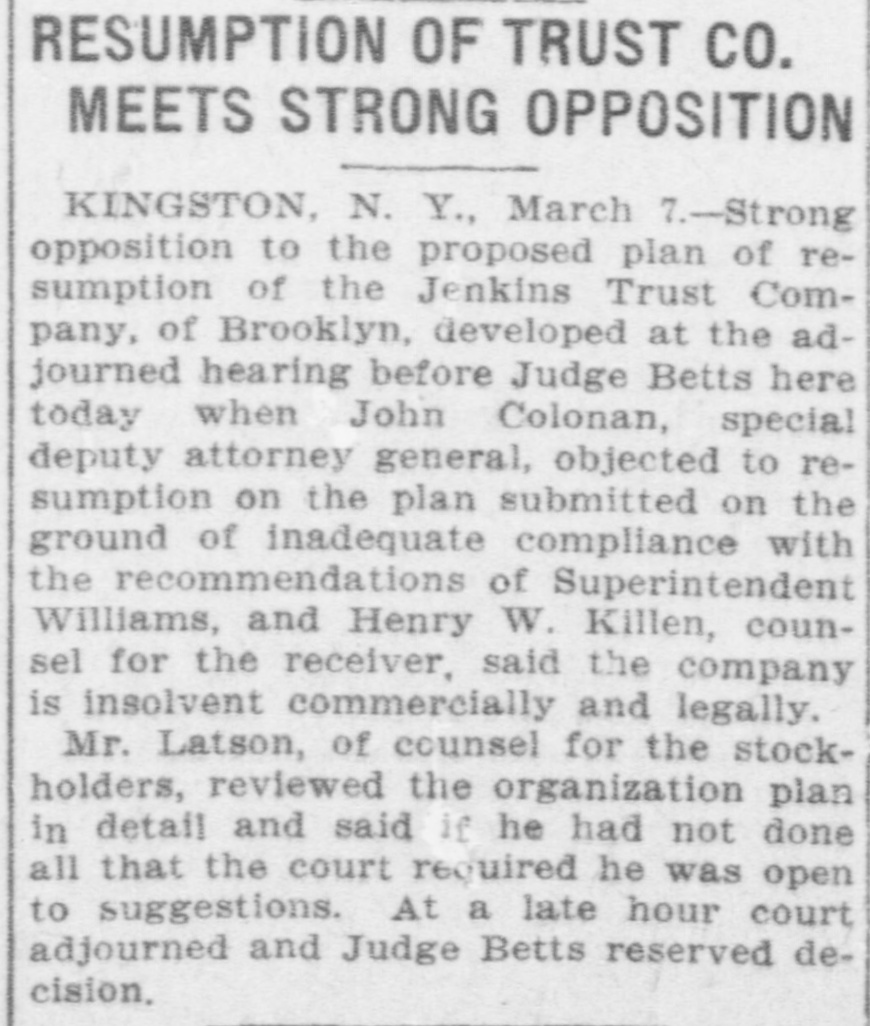
RESUMPTION OF TRUST CO. MEETS STRONG OPPOSITION KINGSTON, N. Y., March 7.-Strong opposition to the proposed plan of resumption of the Jenkins Trust Company, of Brooklyn, developed at the adjourned hearing before Judge Betts here today when John Colonan, special deputy attorney general, objected to resumption on the plan submitted on the ground of inadequate compliance with the recommendations of Superintendent Williams, and Henry W. Killen, counsel for the receiver, said the company is insolvent commercially and legally. Mr. Latson, of counsel for the stockholders, reviewed the organization plan in detail and said if he had not done all that the court required he was open to suggestions. At a late hour court adjourned and Judge Betts reserved decision.


Article from New-York Tribune, March 8, 1908

Click image to open full size in new tab

Article Text

THE NEWS THIS MORNING. FOREIGN.-A dispatch to The Tribune from London said that the retirement of Sir Henry Campbell-Bannerman from the Premiership in May or June was regarded certain: there are rumors that John Morley may become Chancellor of the Exchequer under Mr. Asquith. The English press continues its conjectures regarding the promised statement of Lord Tweedmouth on Monday; conservative circles Adconsider the incident exaggerated. vices from Peking represent Japan's attitude regarding the seizure of the Tatsu as minatory and uncompromising; a dispatch from Tokio, however, says that additional time for consideration has been granted to China, and that nr A dangerous hasty action will be taken. movement is reported among the Moorish tribes on the western frontier of Algeria, and an extension of the movement in Southern AlThe first of the big new geria is feared. battleships for the German navy, the Nassau, of 18,000 tons, was launched at Wilhelmshaven Queen in the presence of the Emperor. Alexandra, the Empress Dowager of Russia and Princess Victoria paid a visit to the art treasures of J. Pierpont Morgan in London, and the owner explained the history of many objects in M. D. Pokotiloff, Russian the collection. Minister to China, who was in this country in 1905 to aid in the negotiation of the treaty of Portsmouth, which ended the Russo-Japanese War, died at Peking. DOMESTIC.-The committee to investigate Representative Lilley's charges of corruption in connection with contracts for submarine boats decided to hold public sessions. beginning toWu Ting-fang, the new Chinese morrow. The InMinister, arrived in Washington. terstate Commerce Commission gave its reasons for refusing to extend the, time at which Gullthe nine-hour law went into effect. ford County, N. C., Speaker Cannon's birthplace, indorsed Secretary Taft for the PresiIt was announced at Newport, R. dency. I that Aurel Batonyi and several business men of that city had purchased the Paran Stevens estate on which to erect a summer hotel. Eight Chinese were found guilty of murder in the first degree in Boston on four counts chargdng the killing of four Chinese last August. An attempt to kill a policeman in the crowded n ading room of the Boston Public Arguments on Library caused a panic. the question of the resumption of business by the Jenkins Trust Company of Brooklyn were heard by Justice Betts in Kingston, the reprefentative of the Attorney General stating that it was insolvent. The CITY-Stocks: advanced sharply. Public Service Commission suspected the Brooklyn Rapid Transit of being interested in the bill that Senator McCarren had passed givdng additional powers to the Bridge Commisfisioner to arrange preliminaries for a new span Attorney General over the East River. Jackson decided to appeal from Justice O'Gorman's order approving the liquidation plan of There was' still no the Oriental Bank. prospect of a hearing on the appeal of BenjaThe Republican State min E. Valentine. Committee adopted resolutions yesterday indorsing Governor Hughes for the Presidency. Justice Clark, of the Supreme Court, entered an order permitting the Knickerbocker Italian banker Trust Company to reopen. fatally shot a supposed Black Hand agent. The Lucania went aground on the Lower Bay. THE WEATHHER-Indications for to-day: Fair, light west winds. The temperature yesMerday: Highest, 47 degrees; lowest, 34.


Article from Perth Amboy Evening News, March 12, 1908

Click image to open full size in new tab

Article Text

INDICTED BANKER DEAD AFTER SHORT ILLNESS Special by United Press Wire: NEW YORK, Mar. 12:- John G. Jenkins Sr., the Brooklyn banker who, with his son, was indicted for his connection with the suspension of the Jenkins and Williamsburg Trust companies, of Brooklyn, died today following an illness of several days.


Article from The Evening World, March 12, 1908

Click image to open full size in new tab

Article Text

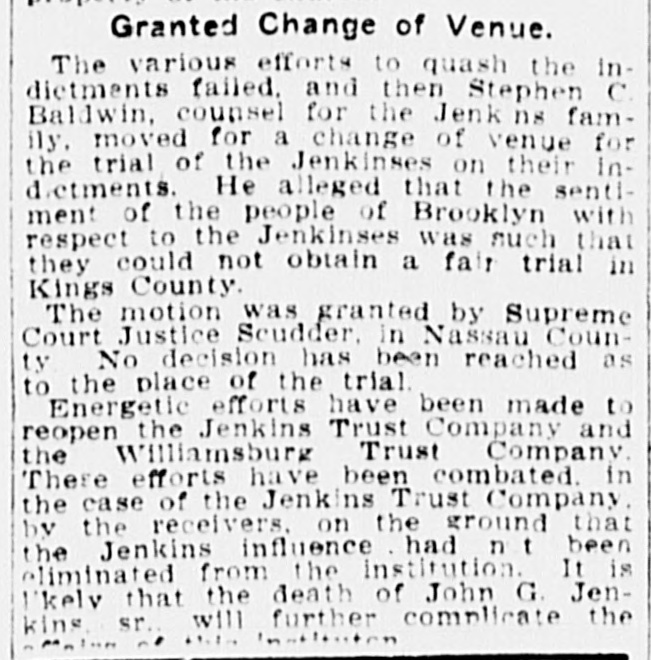
Granted Change of Venue. The various efforts to quash the indietments failed. and then Stephen C. Baldwin, counsel for the Jenk ns family, moved for a change of venue for the trial of the Jenkinses on their Indictments. He alleged that the sentiment of the people of Brooklyn with respect to the Jenkinses was such that they could not obtain a fair trial in Kings County. The motion was granted by Supreme Court Justice Scudder, in Nassau County No decision has been reached as to the place of the trial. Energetic efforts have been made to reopen the Jenkins Trust Company and the Williamsburg Trust Company. There efforts have been combated. in the case of the Jenkins Trust Company. by the receivers. on the ground that the Jenkins influence had n t been eliminated from the institution. It is l'kelv that the death of John G. Jenkins. sr. will further complicate the His institution


Article from New-York Tribune, April 6, 1908

Click image to open full size in new tab

Article Text

JENKINS TRUST MAY OPEN Justice Betts Signs Order Discharging Temporary Receiver. Kingston, N. Y., April 5.-Justice Betts last night signed an order discharging the temporary receiver for the Jenkins Trust Company, of Brooklyn, and permitting that institution to resume business. The bank closed its doors on October 25 last, and on November 14 John Mulhall was appointed temporary receiver upon representations by the Attorney General's office that the bank was insolvent. Justice Betts, before whom, in the Supreme Court, arguments have been made looking to relief from the receivership, based his decision permitting the bank to resume on the report of Clark Williams, Superintendent of Banking. This report places the assets of the trust company at $4,302,712 and its liabilities, including the estimated expenses of the receivership, at $3,756,524. Mr. Williams finds that the bank's capital is intact and that it has a surplus of $46,188. In addition to this, the directors will deposit $100,000 with the institution prior to the date of resumption. By the order of Justice Betts, Receiver Mulhall is directed to turn over the property in his hands to the proper officials on or before April 7. The banking company is instructed to open for business on or before April 22. The receiver's fees are to be fixed at Albany on Thursday of the present week. By the plan of resumption all depositors of sums not exceeding $50 will be paid on demand. Other depositors will be paid in ten monthly instalments. Banks which are creditors will be paid a portion of their claims immediately on resumption and the test in instalments at thirty, sixty and ninety days.


Article from New-York Tribune, April 12, 1908

Click image to open full size in new tab

Article Text

ADVANCE TO JENKINS TRUST COMPANY. Another step toward complete recovery from the October panic was taken yesterday, when the Title Guarantee and Trust Company advanced $204,600 to the Jenkins Trust Company to enable it to reopen its doors on Tuesday. By this arrangement the Jenkins Trust Company receives a loan of $105,000 covered by a first mortgage on its banking house and sells $99,600 worth of first mortgages on Brooklyn property to the Title Guarantee and Trust Company


Article from Lewiston Evening Teller, July 2, 1908

Click image to open full size in new tab

Article Text

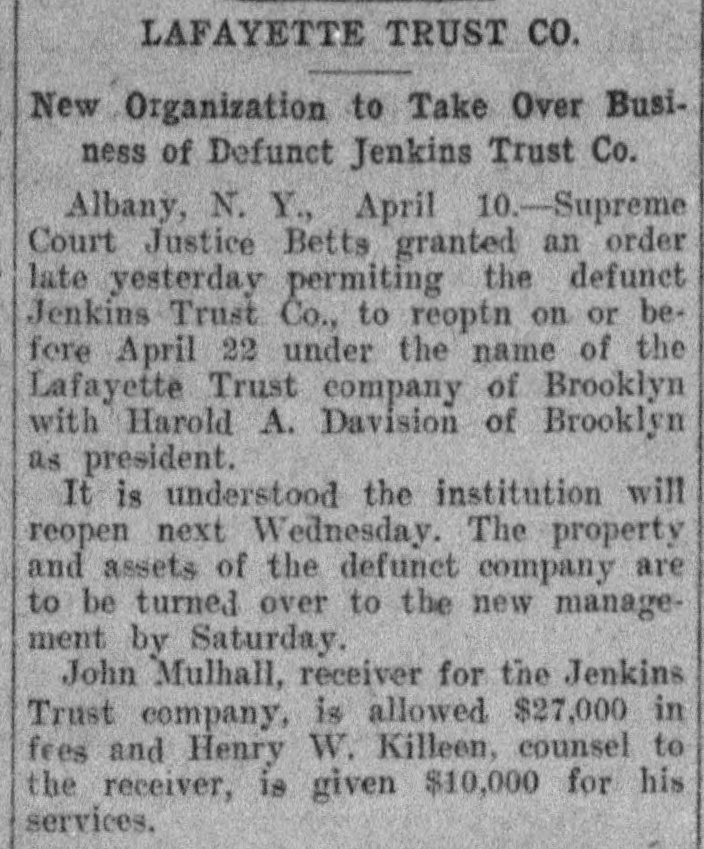
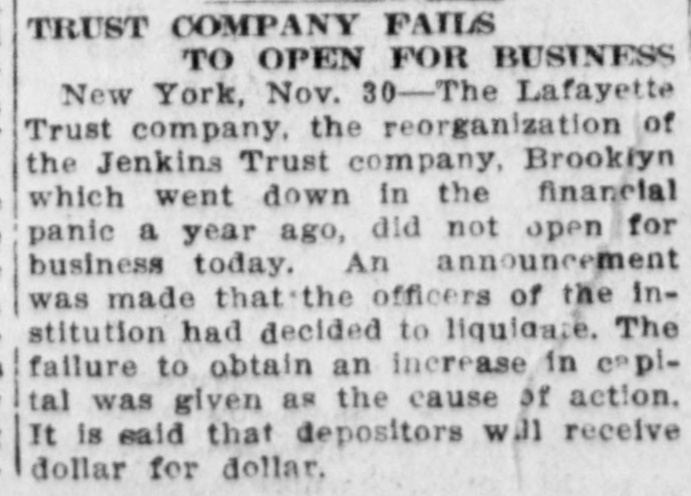
BANKS REGAIN THEIR STANDING NEW YORK, July 2.-Eight months after the passing of the financial troubles of last fall, the depositors of the dozen banks and trust companies which closed their doors have received their money, at least in part, or in the case of a few which have not reopened or have gone into liquidation, are about to receive it. The Hamilton bank, which was one of the first institutions in which the attorney general's department Intervened to reopen, has already anticipated all of its deferred payments, which, under the original plan, were to have extended into November. The Knickerbocker Trust company, which was one of the largest of the suspended institutions that reopened, like most of the others, under in deferred payment plan, anticipated the first two deferred payments oh June 1, paying then 10 per cent, of which one-half, under the original plan, would not have been paid until September. The Oriental bank, which was one of the four to close its doors in February, paid its de-: positors on the full preliminary to liquidation. One of the other three which then suspended, the receiver of the National Bank of North America has paid depositors 50 per cent in dividends, and the receiver to: the New Amsterdam National has paid 25 per cent: The Mechanics' and Traders' depositors have practically agreed to R. deferred payment plan, which will be put in force when the percentage of assenting depositors is brought up to 90. Of the Brooklyn banks which closed. the Jenkins Trust company, reorganized under the name of the T.afavette Trust company. has anticinated payments: the Borough bank and the Home bank have reonened. and the Brooklyn bank and the International Trust company have reorganized.


Article from Bisbee Daily Review, October 24, 1908

Click image to open full size in new tab

Article Text

permanently and has since paid off all depositors. Borough Bank of Brooklyn, closed Oct. 25 with about $3,000,000 deposits, reopened April 14 under deferred payment plan. Has anticpiated payments and has now $2,850,000 deposits. Mechanics & Traders Bank closed Jan. 27, with $7,800,000 deposits and reopened Aug. 17, under deferred payment plan. After liquidating about $1-550,000 deposits of its own and the Union Bank of Brooklyn, with which it was allied, it now has deposits of $7,400,000. Has gained 613 new accounts since reopening, and anticlpates Nov. 2 the second instalment of 15 pรฉr cent due Nov. 17. Oriental Bank closed Jan. 31 with $5,000,000 deposits and $1,500,000 clearing house certificates. Has been liquidated through Metropolitan Trust Co. and all deposits paid. Loan from Metropolitan Trust has been repaid all but $1,250,000. Knickerbocker Trust Co., closed Oct. 22 with $49,000,000 owing depositors. Reopened March 26 under deferred payment plan. Has since anticipated up to the fifth instalment and deposits now total $35,736,000 besides $12,766,000 surplus certicicates. Williamsburg Trust Co. closed Oct. 25 with $6,500,000 deposits, reopened June 8, under full payment plan and paying interest during suspension. Deposits now $4,000,000. Jenkins Trust Co. closed Oct. 25 with deposits of $6,000,000 and reopened April 15 as Lafayette Trust Co. on the deferred payment plan. Has already paid six 10 per cent payments, and the rest will be paid shortly. Deposits now $2,300,000. International Trust Co. closed Oct. 25 and since liquidated, having paid off its $450,000 deposits. Affiliated with the Brooklyn Bank, and now holds stock of that bank in a voting d trust for two years. Total deposits of these 15 institutions at time of suspensions $95,150,000, and none of the depositors will lose a dolar. d The Interboro Bank, wound up a few months ago, is not incuded in the d above, as its failure was not directly attributed to the panic. It was a d small institution which vainly tried to have an existence in the Wall n street district, but could not /compete d with the larger banks.


Article from The Salt Lake Herald, November 24, 1908

Click image to open full size in new tab

Article Text

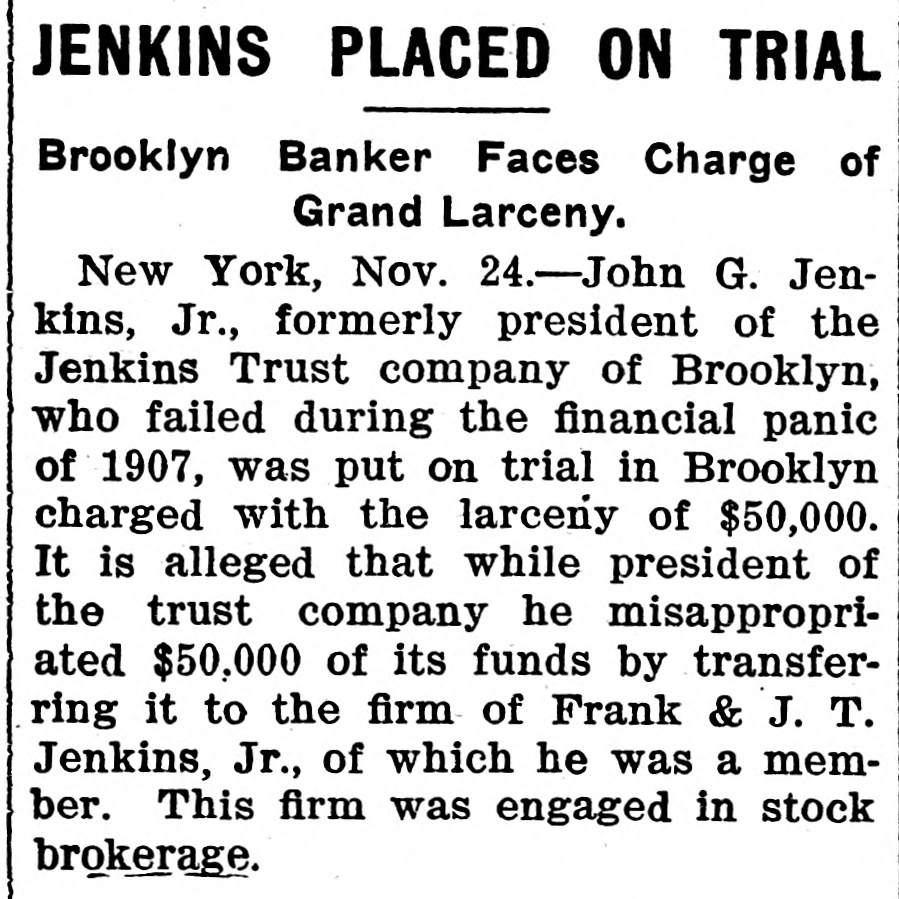
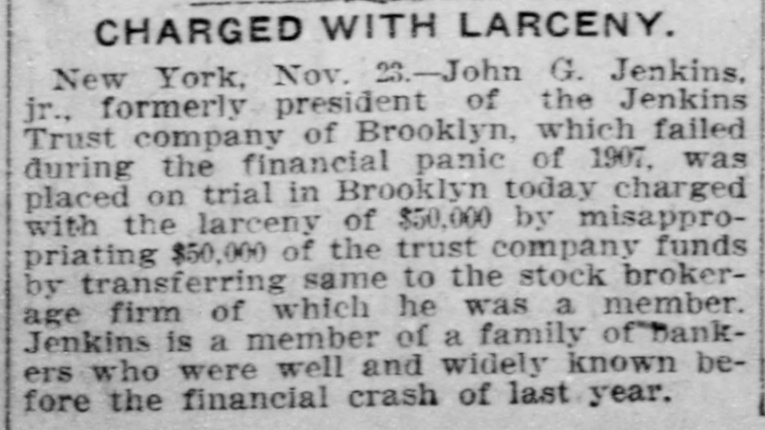
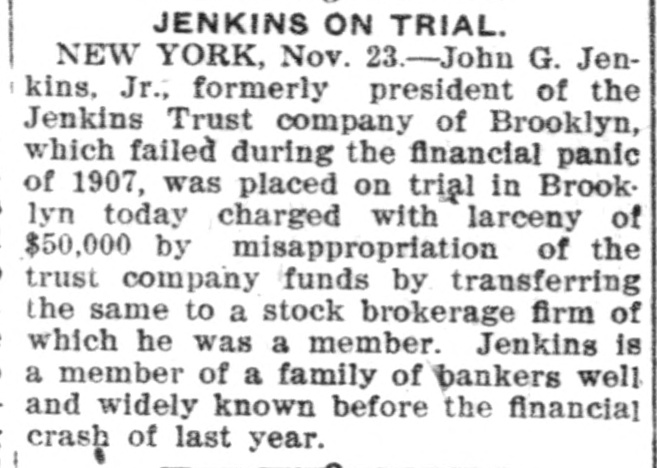
CHARGED WITH LARCENY. New York, Nov. 23.-John G. Jenkins, jr., formerly president of the Jenkins Trust company of Brooklyn, which failed during the financial panic of 1907, was placed on trial in Brooklyn today charged with the larceny of $50,000 by misappropriating $50,000 of the trust company funds by transferring same to the stock brokerage firm of which he was a member. Jenkins is a member of a family of bankers who were well and widely known before the financial crash of last year.


Article from Burlington Weekly Free Press, November 26, 1908

Click image to open full size in new tab

Article Text

Will Show He Took More Than Bank's Capital Stock. USED CLERKS AS DUMMIES Secretary and Cashier of the Jenkins Trust Co. Testified That He Made Illegal Loans on the Order of J. E. Jenkins, Defendant In the Trial. New York, Nov. 24-District Attorney Clarke startled an interested crowd before Judge Kelly in the supreme court Brooklyn to-day when in closing his opening charge against John G. Jenkins, president of the now defunct Jenkins Trust company, who is charged with the larceny of $50,000. he stated that he would produce proof to show that Jenkins took unlawfully from the bank, altogether $557,000 or $57,000 more than the actual capitalization of the bank itself. Mr. Clarke said that this money was entered in the books AS loans to Kaiser. Hart. Hunter and Young, all clerks in the bank. who however, knew nothing whatever of the loans. The specific charge on which Jenkins is being tried is that of grand larceny in that he turned over to Frank and J. G. Jenkins. Jr., a brokerage concern to which he belonged the sum of $50,000 on a demand note two days before the trust company went under. This $50,000 Mr. Clarke charged. amounted to one-half of what was necessary to keep the bank reserve up to the sum required by law. One hundred thousand dollars had been obtained bu a few days before, the prosecutor said by discounting the paper of customers of the Jenkins Trust company. The money could not be spared, the attorney declared. but Mr. Jenkins ordered that be loaned. Wm. A. Conklin, who was secretary and cashier of the Jenkins Trust company, until It suspended, testified that on October 23, 1907. he gave credit to the Arm of Frank and J. G. Jenkins for the sum of $50,000 under the direction of the defendant He had refused to make the loan in view of the condition of the finances of the trust company, but was ordered to do so by Mr. Jenkins and credited the concern with the sum. A check for the amount was paid by the trust company. Mr. Conklin also testified that he had made all of the loans to the dummies before this and that they had not reaped any profit, but that the full amount of each loan was credited to the brokerage firm. All of these loans he said. were made under the direction of John G. Jenkins. Jr.