Salmon & Salmon (Clinton, MO)

Episode Information

Episode UID
6235760491266
Episode Type
Suspension โ†’ Closure
Bank Type
private
Bank ID
623576049 hash
Start Date
June 21, 1905
Location
Clinton, Missouri (38.371, -93.768)

Metadata

Model
gpt-5-mini (chosen from majority vote of a three-model LLM ensemble)
Short Digest
a86f9b9968ed6bc1

Response Measures

None

Events (4)

1. June 21, 1905 Suspension
Cause
Bank Specific Adverse Info
Cause Details
Bank was insolvent and had extensive forged/straw notes and concealed deficits revealed by examination.
Newspaper Excerpt
The Salmon & Salmon private bank closed its doors June 21, 1905.
Source
newspapers
2. June 28, 1905 Receivership
Newspaper Excerpt
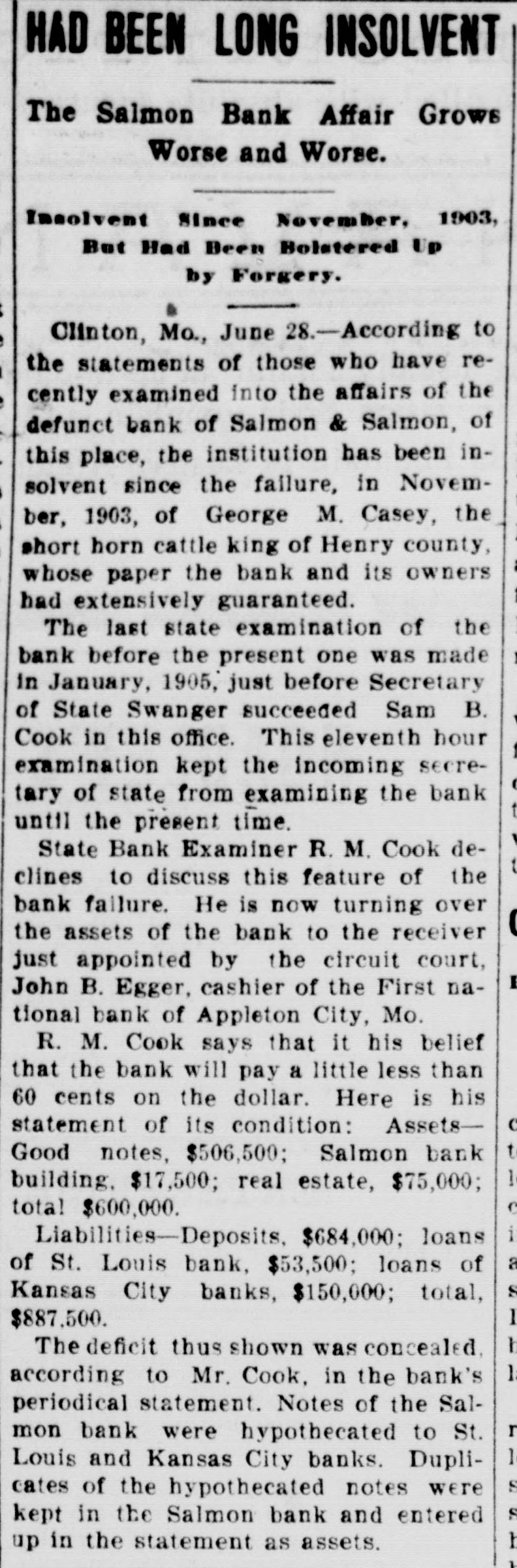
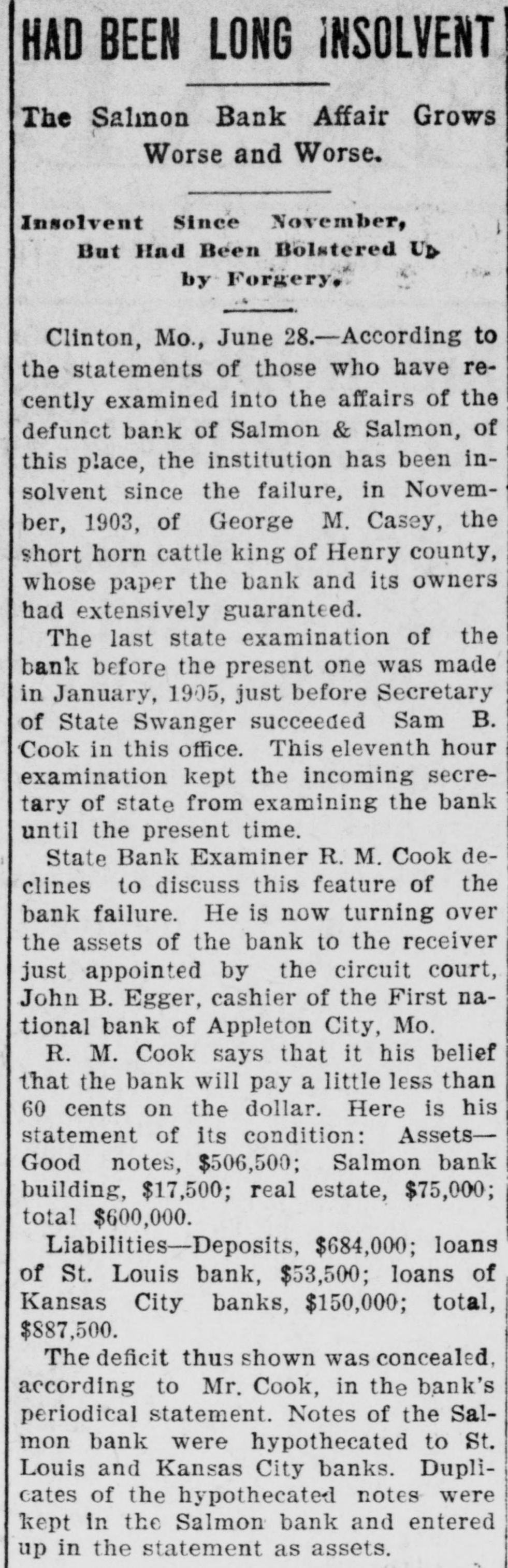
State Bank Examiner R. M. Cook ... turning over the assets of the bank to the receiver just appointed by the circuit court, John B. Egger, cashier of the First national bank of Appleton City, Mo.
Source
newspapers
3. January 20, 1906 Other
Newspaper Excerpt
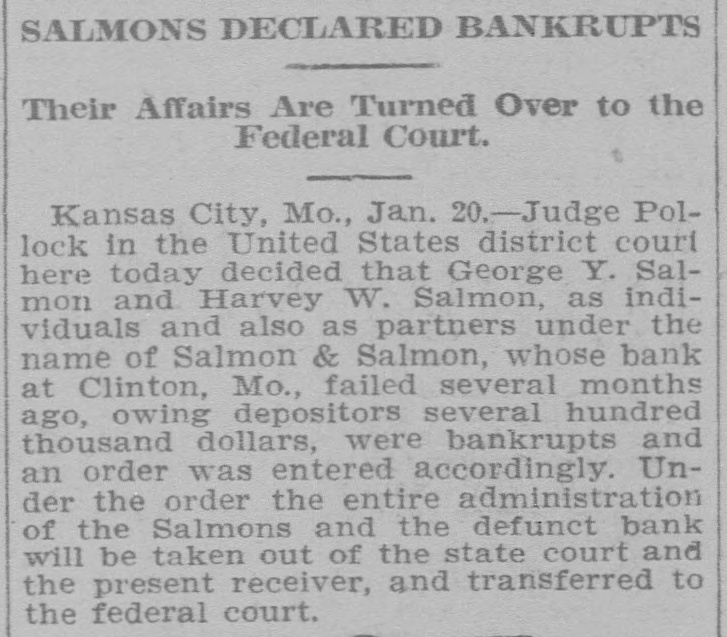
George Y. Salmon and Harvey W. Salmon ... were bankrupts and an order was entered accordingly.
Source
newspapers
4. March 30, 1906 Other
Newspaper Excerpt
Thomas M. Casey, former manager of the bank of Salmon & Salmon, ... was sentenced to five years in the penitentiary for forgery.
Source
newspapers

Newspaper Articles (10)

Article from Evening Times-Republican, June 28, 1905

Click image to open full size in new tab

Article Text

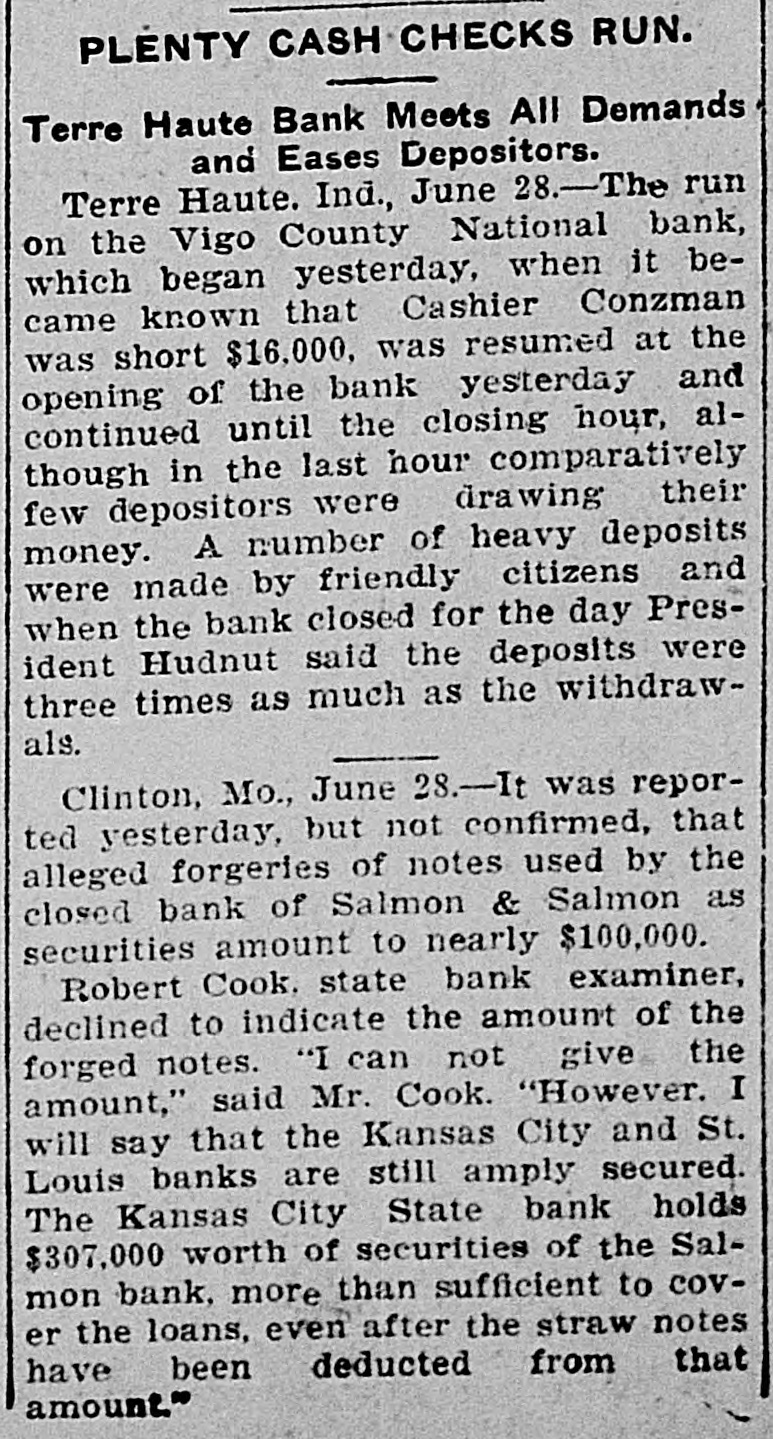
PLENTY CASH CHECKS RUN. Terre Haute Bank Meets All Demands and Eases Depositors. Terre Haute. Ind., June 28.-The run on the Vigo County National bank, which began yesterday, when it became known that Cashier Conzman was short $16,000, was resumed at the opening of the bank yesterday and continued until the closing hour, although in the last hour comparatively few depositors were drawing their money. A number of heavy deposits were made by friendly citizens and when the bank closed for the day President Hudnut said the deposits were three times as much as the withdrawals. Clinton, Mo., June 28.-It was reported yesterday, but not confirmed, that alleged forgeries of notes used by the closed bank of Salmon & Salmon as securities amount to nearly $100,000. Robert Cook. state bank examiner, declined to indicate the amount of the forged notes. "I can not give the amount," said Mr. Cook. "However. I will say that the Kansas City and St. Louis banks are still amply secured. The Kansas City State bank holds $307,000 worth of securities of the Salmon bank. more than sufficient to cover the loans, even after the straw notes have been deducted from that amount"


Article from The San Francisco Call, June 28, 1905

Click image to open full size in new tab

Article Text

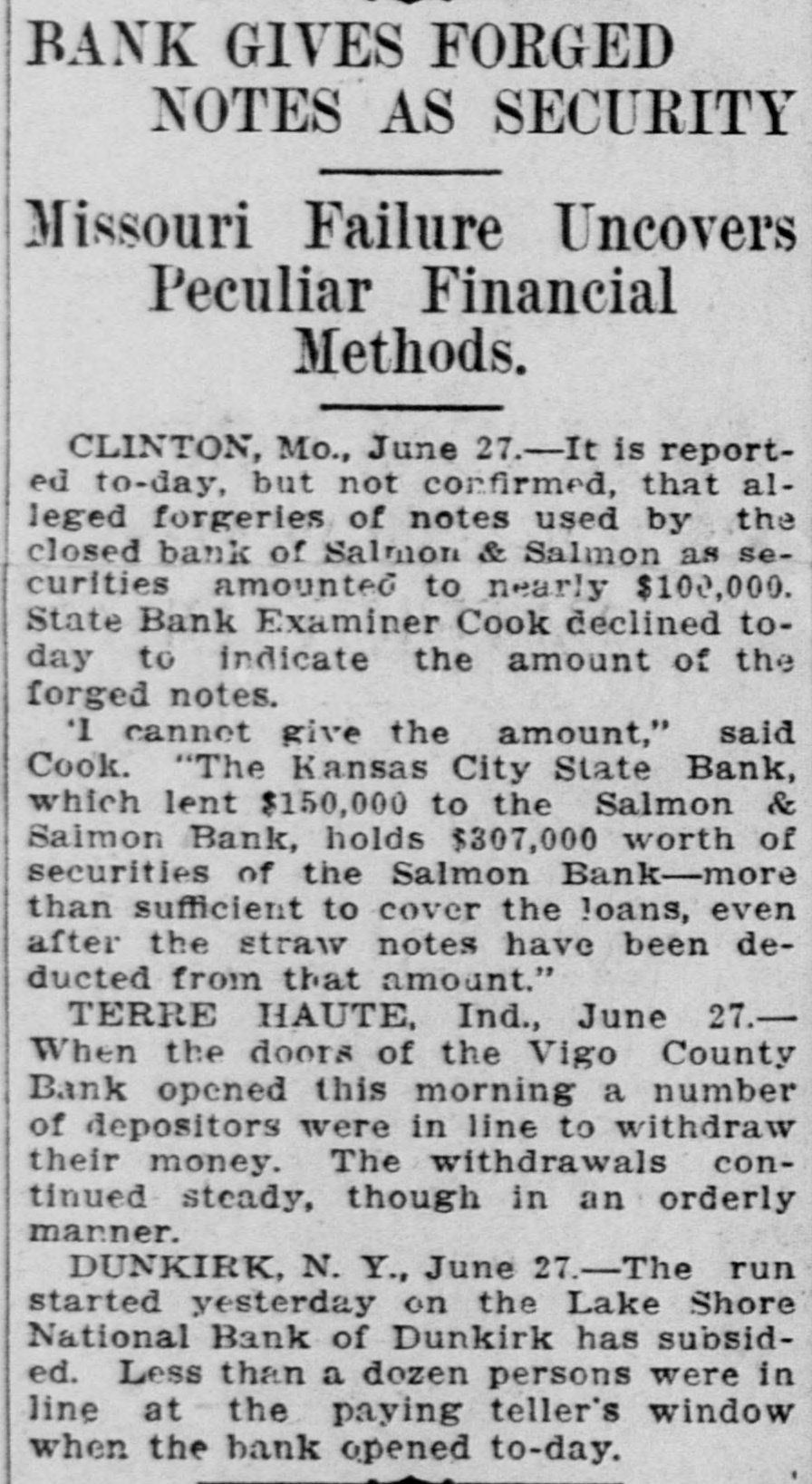
BANK GIVES FORGED NOTES AS SECURITY Missouri Failure Uncovers Peculiar Financial Methods. CLINTON, Mo., June 27.-It is reported to-day, but not confirmed, that alleged forgeries of notes used by the closed bank of Salmon & Salmon as securities amounted to nearly $100,000. State Bank Examiner Cook declined today to indicate the amount of the forged notes. 'I cannot give the amount," said Cook. "The Kansas City State Bank, which lent $150,000 to the Salmon & Saimon Bank, holds $307,000 worth of securities of the Salmon Bank-more than sufficient to cover the loans, even after the straw notes have been deducted from that amount." TERRE HAUTE, Ind., June 27.When the doors of the Vigo County Bank opened this morning a number of depositors were in line to withdraw their money. The withdrawals continued steady, though in an orderly manner. DUNKIRK, N. Y., June 27.-The run started yesterday on the Lake Shore National Bank of Dunkirk has subsided. Less than a dozen persons were in line at the paying teller's window when the bank opened to-day.


Article from The Rich Hill Tribune, June 29, 1905

Click image to open full size in new tab

Article Text

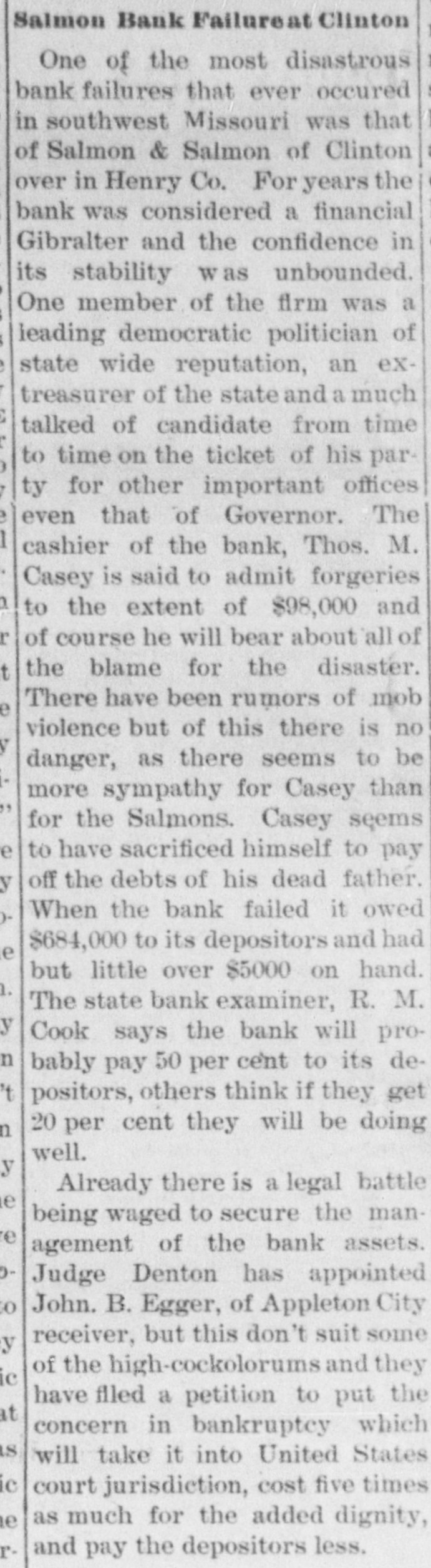
Salmon Bank Failureat Clinton One of the most disastrous bank failures that ever occured in southwest Missouri was that of Salmon & Salmon of Clinton over in Henry Co. For years the bank was considered a financial Gibralter and the confidence in its stability was unbounded. One member of the firm was a leading democratic politician of state wide reputation, an extreasurer of the state and a much talked of candidate from time to time on the ticket of his party for other important offices even that of Governor. The cashier of the bank, Thos. M. Casey is said to admit forgeries to the extent of $98,000 and of course he will bear about all of the blame for the disaster. There have been rumors of mob violence but of this there is no danger, as there seems to be more sympathy for Casey than for the Salmons. Casey seems to have sacrificed himself to pay off the debts of his dead father. When the bank failed it owed $684,000 to its depositors and had but little over $5000 on hand. The state bank examiner, R. M. y Cook says the bank will pron bably pay 50 per cent to its det positors, others think if they get 20 per cent they will be doing n well. y Already there is a legal battle e being waged to secure the mane agement of the bank assets. Judge Denton has appointed O John. B. Egger, of Appleton City receiver, but this don't suit some y of the high-cockolorums and they ic have filed a petition to put the concern in bankruptcy which is will take it into United States c court jurisdiction, cost five times e as much for the added dignity, in and pay the depositors less.


Article from The Forrest City Times, June 30, 1905

Click image to open full size in new tab

Article Text

HAD BEEN LONG INSOLVENT The Salmon Bank Affair Grows Worse and Worse. Insolvent Since November, 1903, But Had Been Holstered Up by Forgery. Clinton, Mo., June 28.-According to the statements of those who have recently examined into the affairs of the defunct bank of Salmon & Salmon, of this place, the institution has been insolvent since the failure, in November, 1903, of George M. Casey, the short horn cattle king of Henry county, whose paper the bank and its owners had extensively guaranteed. The last state examination of the bank before the present one was made in January, 1905, just before Secretary of State Swanger succeeded Sam B. Cook in this office. This eleventh hour examination kept the incoming secretary of state from examining the bank until the present time. State Bank Examiner R. M. Cook declines to discuss this feature of the bank failure. He is now turning over the assets of the bank to the receiver just appointed by the circuit court, John B. Egger, cashier of the First national bank of Appleton City, Mo. R. M. Cook says that it his belief that the bank will pay a little less than 60 cents on the dollar. Here is his statement of its condition: AssetsGood notes, $506,500; Salmon bank building, $17,500; real estate, $75,000; total $600,000. Liabilities-Deposits $684,000; loans of St. Louis bank, $53,500; loans of Kansas City banks, $150,000; total, $887.500. The deficit thus shown was concealed according to Mr. Cook. in the bank's periodical statement. Notes of the Salmon bank were hypothecated to St. Louis and Kansas City banks. Duplicates of the hypothecated notes were kept in the Salmon bank and entered up in the statement as assets.


Article from The Grenada Sentinel, July 1, 1905

Click image to open full size in new tab

Article Text

HAD BEEN LONG INSOLVENT The Salmon Bank Affair Grows Worse and Worse. Insolvent Since November, But Had Been Bolstered UA by Forgery, Clinton, Mo., June 28.-According to the statements of those who have recently examined into the affairs of the defunct bank of Salmon & Salmon, of this place, the institution has been insolvent since the failure, in November, 1903, of George M. Casey, the short horn cattle king of Henry county, whose paper the bank and its owners had extensively guaranteed. The last state examination of the bank before the present one was made in January, 1905, just before Secretary of State Swanger succeeded Sam B. Cook in this office. This eleventh hour examination kept the incoming secretary of state from examining the bank until the present time. State Bank Examiner R. M. Cook declines to discuss this feature of the bank failure. He is now turning over the assets of the bank to the receiver just appointed by the circuit court, John B. Egger, cashier of the First national bank of Appleton City, Mo. R. M. Cook says that it his belief that the bank will pay a little less than 60 cents on the dollar. Here is his statement of its condition: AssetsGood notes, $506,500; Salmon bank building, $17,500; real estate, $75,000; total $600,000. Liabilities-Deposits, $684,000; loans of St. Louis bank, $53,500; loans of Kansas City banks, $150,000; total, $887,500. The deficit thus shown was concealed, according to Mr. Cook, in the bank's periodical statement. Notes of the Salmon bank were hypothecated to St. Louis and Kansas City banks. Duplicates of the hypothecated notes were kept in the Salmon bank and entered up in the statement as assets.


Article from Omaha Daily Bee, September 26, 1905

Click image to open full size in new tab

Article Text

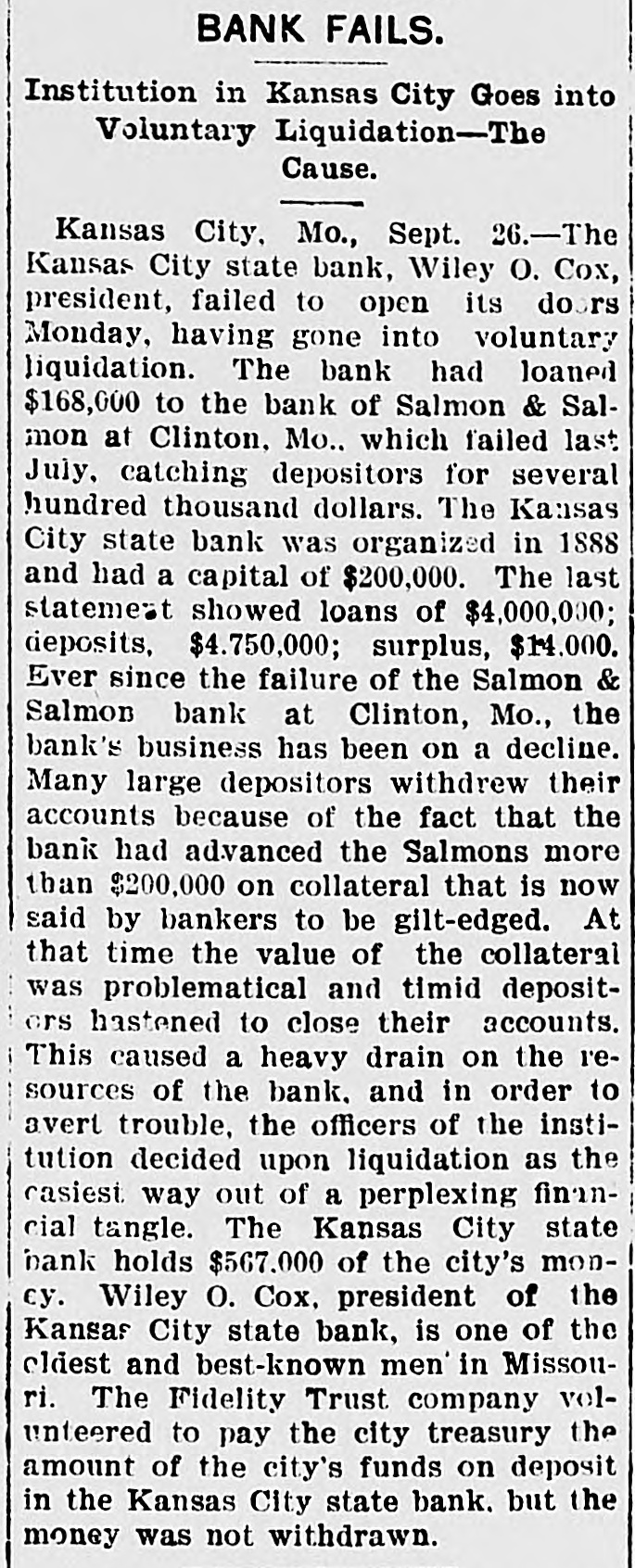
Large Advances to Insolvent Salmon Bank Frightens Depositors. RUN STEADY FOR SEVERAL WEEKS Trust Company Takes Over All Assets of the Bank. DEPOSITORS TO BE PAID ON DEMAND Collateral from Salmon Bank that Caused Trouble Now Said to Be of the Highest Grade. KANSAS CITY, Sept. 25. -The Kansas bank. Wiley O. Cox. president, to its doors today, gone liquidation. The City into failed voluntary State open having bank had $168,000 to the bank of Salmon & at Clinton, Mo., which July, depositors for Salmon loaned catching several failed hun- last dred thousand dollars The Kansas City State bank was organized in 1888 and had a capital of $200,000. $4,000,The last statement showed loans of 000; deposits, $4,750,000; surplus, $14,000. The following notice was posted on the door at the opening hour today: This bank has gone into voluntary company. liquidthrough the Fidelity Trust ation Checks drawn against the bank will be com- paid and on presentation by the Fidelity streets. Trust pany O. COX, at Ninth WILEY Walnut President. which The Fidelity Trust company, of is capitalized at $1,000,000, is considered one the the strongest banking institutions in southwest. The Kansas City State bank holds $567,000 of the city's money. Wiley O. Cox, president of the Kansas State bank, is one of the oldest and has best City known men in Missouri. He lived in Missouri since 1868. In 1872 he was at clerk in the First National bank in a Springfield, Mo., coming to Kansas City in 1881. From 1884 to 1888 he was engaged general financial and brokerage business. bank a He organized the Kansas City State in 1888, and has always served as its president. In 1896 he bought the Kansas City sucTimes, a venture that did not prove cessful, and in 1899 he sold the paper. At the Fidelity Trust company's bank bank checks on the Kansas City State There were honored as fast as presented. Charles was no show of commotion and Campbell, vice president of the Fidelity Trust company, stated that all checks drawn on the closed bank would be paid upon demand. Mr. Campbell declined to talk of the the causes leading up to the closing of Kansas City State bank. Statement of President. O. Cox. president of the Kansas Wiley State bank, made the following state= ment City to the Associated Press: retirement of the Kansas City State The active business is voluntary. has not been growing for our son.e own Our we found it hard to hold time and the larger Institutions. In fact. bank business from well it with If the banking business, as the as looks all other as lines, is concentrating into 1 larger condition ones. of the business was directors thory The gone over by the board of it was n oughly conclusion was reached that to and prospering the as it ought to do in order to go not and it was determined be profitable, voluntary liquidation. One plan which our < into have been adopted was to do on deown liquidation. new business This it f might mand and taking proved on paying no very depositors expensive, as would have involved borrowing a large y would have money on the bank's paper force in order of sum to pay of depositors at once, continuing the pracclerks, the office same rent, as If etc., the bank were running Accordtically usual and ordinary way, liquidation in the negotiations looking to the banking inS ingly business through other reof the were begun, and hav finally entirely d arrangement sulted stitutions in the consummation of whereby an the d satisfactory Fidelity Trust company. one taken of our over strong- the 8. est banking the houses, bank and has is paying its dey business in of the ordinary way on demand, If still positors the same as we would be doing in r running. retiring from the banking career business. of in On present, after an active extremely It for the I cannot help feeling failed to many years, that no depositor has ever pred proud checks honored and paid on I have sentation have his at any bank with which been connected Fidelity Trust company volunteered the N The the city treasurer the amount of City to pay funds on deposits in the Kansha with0 city's State bank, but the money was not drawn. Meeting of Directors. decision to liquidate was reached fol- the The a meeting of representatives Investi- of clearing lowing house banks. A thorough of the accounts of the bank had gation made, a carefully prepared statement in 8 been the resources and liabilities, checked for of detail and the collaterals held g every loans appraised by financial experts. This offdone at the request of the bank's the be was who were seeking a way to close dolcials, without placing in jeopardy one since bank of the depositors' money. Ever lar failure of the Salmon & Salmon bank been at the Mo., the bank's business had Cliniton. decline. Many large depositors with- fact on a their accounts because of the d drew the bank had advanced the Salmons that than $200,000 on collateral that is now the more by bankers to be gilt-edged. At 0 said the value of the collateral was problematical time and timid depositors hastened to n their accounts. This caused a heavy in close the resources of the bank, and the avert trouble the the decided upon as drain institution order on to liquidation officers financial of easiest way out of a perplexing
Article from The Irish Standard, September 30, 1905

Click image to open full size in new tab

Article Text

BANK FAILS. Institution in Kansas City Goes into Voluntary Liquidation-The Cause. Kansas City, Mo., Sept. 26.-The Kansas City state bank, Wiley O. Cox, president, failed to open its doors Monday, having gone into voluntary liquidation. The bank had loaned $168,000 to the bank of Salmon & Salmon at Clinton, Mo., which failed last July, catching depositors for several hundred thousand dollars. The Kansas City state bank was organized in 1888 and had a capital of $200,000. The last statement showed loans of $4,000,000; deposits, $4.750,000; surplus, $14.000. Ever since the failure of the Salmon & Salmon bank at Clinton, Mo., the bank's business has been on a decline. Many large depositors withdrew their accounts because of the fact that the bank had advanced the Salmons more than $200,000 on collateral that is now said by bankers to be gilt-edged. At that time the value of the collateral was problematical and timid depositors hastened to close their accounts. This caused a heavy drain on the resources of the bank. and in order to avert trouble, the officers of the institution decided upon liquidation as the casiest way out of a perplexing financial tangle. The Kansas City state bank holds $567.000 of the city's money. Wiley O. Cox, president of the Kansas City state bank, is one of the cldest and best-known men' in Missouri. The Fidelity Trust company volunteered to pay the city treasury the amount of the city's funds on deposit in the Kansas City state bank. but the money was not withdrawn.


Article from The Topeka State Journal, January 20, 1906

Click image to open full size in new tab

Article Text

SALMONS DECLARED BANKRUPTS Their Affairs Are Turned Over to the Federal Court. Kansas City, Mo., Jan. 20.-Judge Pollock in the United States district court here today decided that George Y. Salmon and Harvey W. Salmon, as individuals and also as partners under the name of Salmon & Salmon, whose bank at Clinton, Mo., failed several months ago, owing depositors several hundred thousand dollars, were bankrupts and an order was entered accordingly. Under the order the entire administration of the Salmons and the defunct bank will be taken out of the state court and the present receiver, and transferred to the federal court.


Article from Morgan County Democrat, March 30, 1906

Click image to open full size in new tab

Article Text

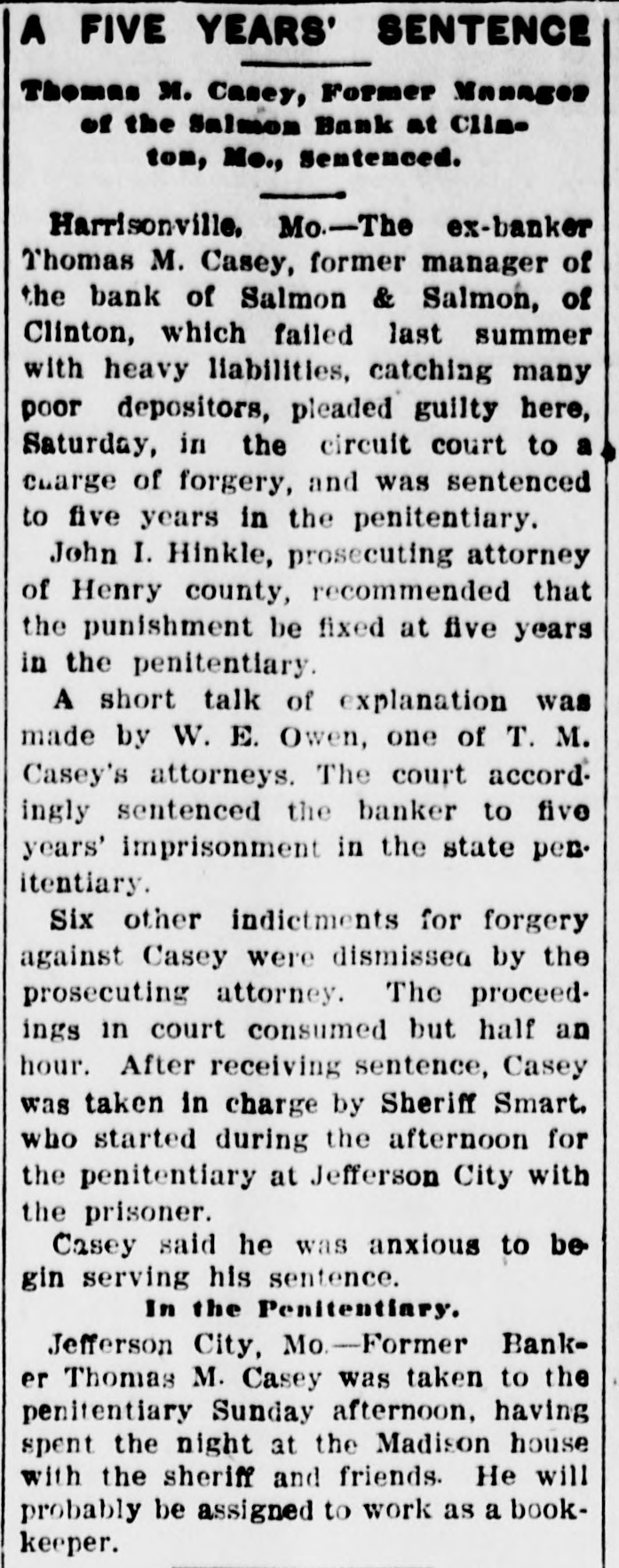
FIVE YEARS' SENTENCE Thomas M. Casey, Former Manages of the Salmon Bank at Clim. tom, Mo., Sentenced. / Harrisonville, Mo-The ex-banker Thomas M. Casey, former manager of the bank of Salmon & Salmon, of Clinton, which failed last summer with heavy liabilities, catching many poor depositors, pleaded guilty here, Saturday, in the circuit court to a cuarge of forgery, and was sentenced to five years in the penitentiary. John I. Hinkle, prosecuting attorney of Henry county, recommended that the punishment be fixed at five years in the penitentlary. A short talk of explanation was made by W. E. Owen, one of T. M. Casey's attorneys. The court accordingly sentenced the banker to five years' imprisonment in the state pen. itentiary. Six other indictments for forgery against Casey were dismissed by the prosecuting attorney. The proceedings in court consumed but half an hour. After receiving sentence, Casey was taken in charge by Sheriff Smart. who started during the afternoon for the penitentiary at Jefferson City with the prisoner. Casey said he was anxious to be gin serving his sentence. In the Penitentiary. Jefferson City, Mo.-Former Banker Thomas M. Casey was taken to the penitentiary Sunday afternoon, having spent the night at the Madison house with the sheriff and friends. He will probably be assigned to work as a bookkeeper.


Article from The Rich Hill Tribune, April 11, 1907

Click image to open full size in new tab

Article Text

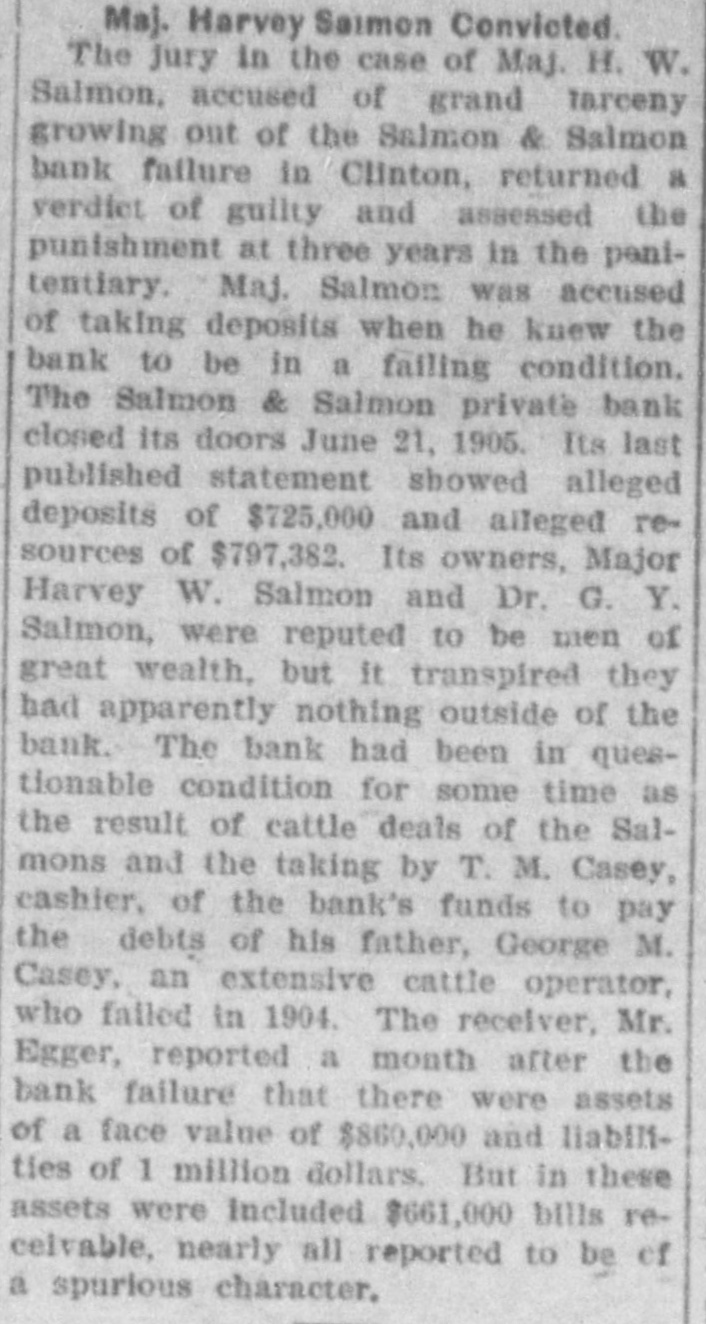
Maj. Harvey Saimon Convicted. The jury in the case of Maj. H. W. Salmon, accused of grand tarceny growing out of the Salmon & Salmon bank failure in Clinton, returned a verdict of guilty and assessed the punishment at three years in the penitentiary. Maj. Salmon was accused of taking deposits when he knew the bank to be in a failing condition. The Salmon & Salmon private bank closed its doors June 21, 1905. Its last published statement showed alleged deposits of $725,000 and alleged resources of $797,382. Its owners, Major Harvey W. Salmon and Dr. G. Y. Salmon, were reputed to be men of great wealth, but it transpired they had apparently nothing outside of the bank. The bank had been in questionable condition for some time as the result of cattle deals of the Salmons and the taking by T. M. Casey, cashier, of the bank's funds to pay the debts of his father, George M. Casey, an extensive cattle operator, who failed in 1904. The receiver, Mr. Egger, reported a month after the bank failure that there were assets of a face value of $860,000 and liabilities of 1 million dollars. But in these assets were Included $661,000 bills recelvable, nearly all reported to be of a spurious character.