6191. Central National Bank (Topeka, KS)

Bank Information

Episode Type
Run Only
Bank Type
national
Bank ID
3078
Charter Number
3078
Start Date
July 3, 1905
Location
Topeka, Kansas (39.048, -95.678)

Metadata

Model
gpt-5-mini
Short Digest
e6957260219ff2db

Response Measures

Accommodated withdrawals, Public signal of financial health, Capital injected

Description

The articles report the failure/closure of the First National Bank (Topeka) on July 3, 1905, which triggered a slight run on the Central National Bank. Central National remained open; officers deposited cash and displayed large cash reserves to meet withdrawals and the run subsided.

Events (2)

1. November 19, 1883 Chartered
Source
historical_nic
2. July 3, 1905 Run
Cause
Local Banks
Cause Details
Run was triggered by the failure/closure of the First National Bank of Topeka (a local bank) whose troubles involved major stockholder C.J. Devlin; news of that failure prompted withdrawals from Central National.
Measures
Deposited $300,000 in cash to offset withdrawals; officers displayed large cash reserves (reported $700,000) and paid depositors promptly to calm the panic.
Newspaper Excerpt
Following the closing of the First National, there was a slight run on the Central National. Cash to the amount of $300,000 was deposited in the Central National to offset the run.
Source
newspapers

Newspaper Articles (11)

Article from The Fargo Forum and Daily Republican, July 3, 1905

Click image to open full size in new tab

Article Text

KANSAS BANK WENT BUMP FIRST NATIONAL CLOSED BY GOVERNMENT OFFICIALS The Big Institution Could Not Stand the Pressure and Its Books Are Being Investigated-The State Is a Big Loser. Topeka, July 3.-The First National Bank has been closed by order of the comptroller of the treasury and the government officials are making an examination. Three or four hundred depositors were in line this morning. There was a slight run on the Central National. Three hundred thousand in cash has been deposited in the Central National to offset the run. The state had $500,000 on deposit in the closed First National. The total deposits amounted to $1,390,000.


Article from East Oregonian : E.O, July 3, 1905

Click image to open full size in new tab

Article Text

Topeka, July 3.-The First National bank, the biggest financial institution in the city, failed to open its doors this morning. A notice, signed by Vice-President Rossington, is posted on the doors: "This bank is closed by my orders. The comptroller has been notified and an examiner will be sent." The closing of the bank is the result of complications in the affairs of C. H. Devlin, one of the chief stockholders, and reputed to be the richest man in Kansas. His affairs have been placed in the hands of a $1,000,000 corporation chartered Saturday in Missouri. The bank's liabilities and assets May 1 amounted to $2,351,304. A large number of depositors were lined up in front of the bank this morning. Following the announcement of the above failure, a run started on the Central National, (in which Devlin is also a stockholder. In the other S banks in which Devlin is interested. many deposits were withdrawn It is announced that Devlin has turned over to the National banks his real estate, and securities worth $700,000, and insurance policies valued at $667,000. Devlin's assets are estimated at $7,000.000, and liabilities at $2,000,000. His interests in the Topeka banks is said to amount to $1,000,000. He also owns 11 coal companies. Owes Over $2,000,000. Devlin's attorney announced that he owes the First National $1,000,000, Kansas City banks $400,000, banks in New York $250,000, in Chicago $150.000, and in St. Louis $250,000.


Article from The Daily Ardmoreite, July 3, 1905

Click image to open full size in new tab

Article Text

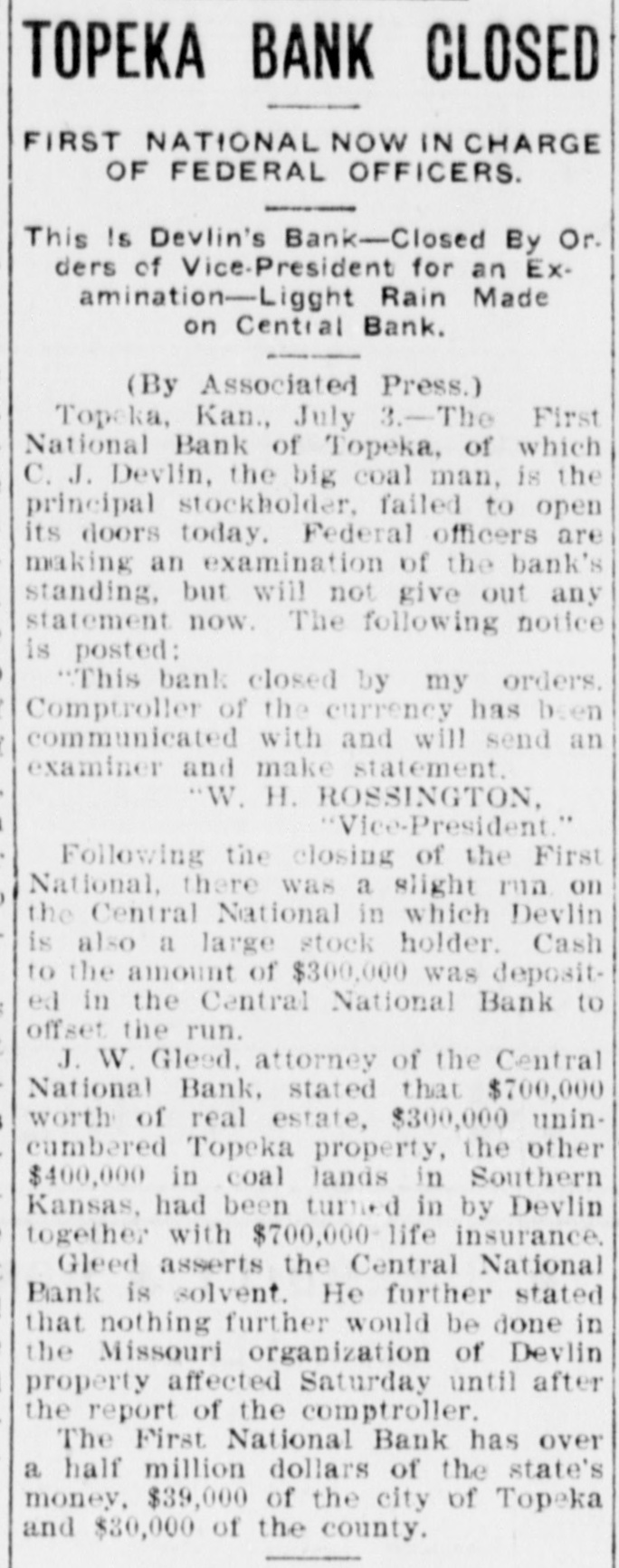
TOPEKA BANK CLOSED FIRST NATIONAL NOW IN CHARGE OF FEDERAL OFFICERS. This Is Devlin's Bank-Closed By Or. ders of Vice-President for an Examination-Ligght Rain Made on Central Bank. (By Associated Press.) Topeka, Kan., July 3.-The First National Bank of Topeka, of which C. J. Devlin, the big coal man, is the principal stockholder, failed to open its doors today. Federal officers are making an examination of the bank's standing, but will not give out any statement now. The following notice is posted: "This bank closed by my orders. Comptroller of the currency has been communicated with and will send an examiner and make statement. "W. H. ROSSINGTON, "Vice-President." Following the closing of the First National, there was a slight run on the Central National in which Devlin is also a large stock holder. Cash to the amount of $300,000 was deposited in the Central National Bank to offset the run. J. W. Gleed. attorney of the Central National Bank, stated that $700,000 worth of real estate, $300,000 unincumbered Topeka property, the other $400,000 in coal lands in Southern Kansas, had been turned in by Devlin together with $700,000-life insurance. Gleed asserts the Central National Bank is solvent. He further stated that nothing further would be done in the Missouri organization of Devlin property affected Saturday until after the report of the comptroller. The First National Bank has over a half million dollars of the state's money, $39,000 of the city of Topeka and $30,000 of the county.


Article from Deseret Evening News, July 3, 1905

Click image to open full size in new tab

Article Text

BIG BANK FAILURE IN TOPEKA, KANSAS The First National, of Which C.J. Devlin Owns Majority of Stock, Closes Its Doors. DEPOSITORS STANDING IN LINE. Chief Steckholder Was Considered One Of the Richest Men in Sunflower State. Topeka, Kans. July 3.-The first Na. tional bank of Topeka, of which C. J. Devlin held the major part of the stock. failed to open its doors this morning. The government officials are making an examination of the bank's affairs today, but will give out no statement. Three or four hundred depositors were in line at 9 o'clock. There has also been a slight run on the Central Na. tional bank, of which Mr. Devlin owns a large number of shares. On the door of the First National bank appears this notice: "This bank is closed by my order. The comptroller of the currency has been comunicated with and will send examiner who will make statement. (Signed.) "W. H. ROSSINGTON, "Vice President. Cash to the amount of $300,000 was de. posited in the Central National to offset the run. J. W. Gleed stated today that $700,000 worth of real estate. $300.000 in Topeka property and $500,000 in coal lands in southeast Kansas had been turned in by Mr. Devlin: also $700,000 in life insurance, Mr. Gleeo save the Central National IN perfectly solvent. In the closed bank the state of Kansas has over $500.000 in deposits, the city of Topeka $39,000, and the county of Shawnee about $30,000. RECEIVER APPOINTED Washington. July 3.-The comptroller of the currency has apointed National Bank Examiner J. T. Bradley, receiver of the First National bank. Topeka, Kans, upon receipt of advices from the vice president or the bank that its


Article from The Topeka State Journal, July 3, 1905

Click image to open full size in new tab

Article Text

The Wiley Coal company. The Marceline Coal company. Mr. Devlin also owns a number of large yards in Kansas City. He is a stockholder in twenty-five banks, his bank stock it is estimated, amounting probably to one million dollars. Another property owned by Mr. Devlin is the Toluca, Marquette and Northern railway, a coal carrying line forty-two miles long, which connects with the larger roads in Illinois. Chas. S. Gleed, general manager at Kansas City of the Missouri and Kansas Telephone company, is perhaps as familiar with the affairs of the Devlin properties as any one man. Mr. Gleed is not Mr. Devlin's attorney, but is one of the attorneys of the Central National bank and as a director of the Atchison, Topeka & Santa Fe railway he has had opportunity to be a close observer of much of Mr. Devlin's business. To the Associated Press Mr. Gleed stated today that SO far as can be ascertained by hasty appraisements the value of the Devlin estate is between six and seven millions of dollars. Mr. Gleed said: "This property consists in round figures of a million dollars' worth of clear real estate, a quarter of a million dollars paid-up value of life insurance, $800,000 of bank stock, and the remainder in stocks and bonds of twenty-six mining, mercantile and railway companies, wholly or largely under his control. Against this property is an indebtedness of from two and one-half million dollars to four million dollars, principally all due to fourteen banks. "The indebtedness is secured by the stocks and bonds of the twenty-six mining, mercantile and railway companies. The debts probably are all known. The value of the stocks and bonds put up as collateral is not known. If they are as valuable as seems likely and if they are wisely managed all debts will be paid. If their value is small or if it greatly depreciates by mismanagement then the creditors will lose accordingly. No formal inventory of either debts or assets has been found. "One of the banks controlled by Mr. Devlin was the First National of Topeka. Up to about the time of Mr. Devlin's illness the bank had loaned Mr. Devlin's companies about $500,000, for which there was much collateral. After Mr. Devlin fell ill drafts came in from the various companies and were paid by the bank, so that the Devlin indebtedness ran up to about one million dollars. This crippled the bank, and this morning it did not open. It was hoped that the parties most deeply interested would advance money to the consolidated 1 properties so that the Devlin paper in the bank could be taken up and the 1 bank saved, but co-operation could not be secured. I do not see why any 1 other Topeka or Kansas City banks should be disturbed. The Central in Topeka and presumably the other banks there fortified themselves for the run which they are having today." r First National's Last Statement.


Article from The Montgomery Advertiser, July 4, 1905

Click image to open full size in new tab

Article Text

IT LOANED TOO MUCH BIG BANK FAILURE OCCURS AT TOPEKA, KAS. The First National Holds Papers of C. J. Devlin, Principal Stockholder, for $1,000,000-WIII Probably Pay Out. Topeka, July 3.-No definite statement was obtained up to a late hour today regarding the condition of the First National Bank, controlled by C. J. Devlin, the big coal mine owner, which closed its doors this morning. Colonel W. H. Rossington, vice-president of the bank, locked the institution's books in the vault to await the arrival of J. T Bradley, the national bank examiner, whom the comptroller had appointed receiver of the failed bank, and he would only say: "The bank's trouble has not been caused by dishonesty on the part of any one, but by lending too largely to one borrower. There has been no stealing." This borrower is, of course, Mr. Devlin, and the bank is said to hold the capitalist's paper to the amount of a million dollars. Mr. Devlin, whose sudden illness brought about the tangle in the big coal mining and railroad properties, valued, It is estimated, at close to seven millions of dolars, is still under the care of a physician and no statement could be secured from him. All that came from his home during the day or could be secured from other sources, was that the stricken coal operator had turned over to the bank nearly $700,000 in life insurance and about the same amount in Topeka real estate. Business assistants of Mr. Devlin gave it as their opinion that, if properly handled, this would allow the bank to pay out. Elmer Ames, bank examiner for the northern district of Kansas, who took charge pending the arrival of Receiver Bradley, would say nothing additional that would throw any light on the subject. Aside from the temporary flurry that the failure of the First National Bank caused upon the other banks of the city, probably the most interesting phase of the situation was the statement of State Treasurer Kelly that the bank held $547,000 of the State's funds and the knowledge that Mr. Devlin was one of three of Mr. Kelly's bondsmen. The statement was made that Treasurer Kelly had exceeded his authority in placing more of the State's money in the bank than the law allowed, but Mr. Kelly declined to discuss the matter at this time. Following the announcement of the failure a lively run was started on the Central National Bank and before closing time today it was known that something more than $100,000 had been withdrawn from this institution. The Central National also held some of Devlin's paper, but he likewise owns fifteen twenty-eighths of the capital stock of $250,000 of this institution. But it developed that the Central National Bank held but little of Devlin's paper and when its officers displayed $700,000 in cash and made every effort to pay the depositors as fast as they made demands, the excitement died down and at closing time only a few small depositors remained at the teller's window. Other runs of a lesser degree were started on the State Savings Bank, the Bank of Topeka and on the Merchants' National Bank. At none of the banks, however, was the demand for withdrawal great, only the small depositors taking their money and there was little excitement during the day.


Article from The Times Dispatch, July 4, 1905

Click image to open full size in new tab

Article Text

TOPEKA BANK CLOSES DΓ“ORS Failure Due to Too Extensive Loans to Charles J. Devlin, Millionaire Mine Owner. CRASH HITS MANY PLACES Liabilities of Bankrupt Estimated at $2,500,000 to $4,000,000. Run on Banks. (By Associated Press.) TOPEKA, KAS., July 3.-No definite statement was obtainable to-day regardIng the condition of the First National Bank, controlled by Charles J. Devlin, a wealthy coal mine owner, which closed Its doors this morning. Col. W. H. Rossington, Vice-president of the bank, locked the institution's books in the vault to await the arrival of J. T. Bradley, National Bank Examiner, whom the comptroller had appointed receiver of the failed bank, and the Colonel would only say: "The bank's trouble has not been caused by dishonesty on the part of anyone, but by lending too largely to one borrower. There has been no stealing.' The borrower. it is said, is Mr. Devlin, and the bank is said to hold the capitalist's paper to the amount of $1,000,000. Mr. Devlin, whose sudden Illness brought about the tangle in the big coal mining and milroad properties valued, It is estimated at close to $7,000,000. is still under the care of a physician, and no statement could be secured from him, All that came from his home during the day or could be secured from other sources was that the stricken coal operator had turned over to the bank nearly $700,000 in life insurance and about the same amount In Topeka real estate. Business associates of Mr. Devlin gave It as their opinion that If properly handled this would allow the bank to pay. Aside from the flurry that the failure of the First National Bank caused on the other banks of the city, the most interesting phase of the situation was the statement of State Treasurer T. T. Kelly that the bank held $547,000 of the State funds, and the knowledge that Mr. Devlin was one of Treasurer Kelly's bondsmen. Following the announcement of the failure a lively but not disastrous run was started on the Central National Bank. Other runs of a lesser degree were started on the State Savings Bank, the Bank of Topeka and on the Merchants National Bank. At none of these banks, however, was the demand for withdrawals great. Devlin was generally credited as being one of the wealthiest men in Kansas City. He was at the head of twentysix different companies, coal mining enterprises and mercantile establishments, and owned stock in twenty-five banks. His liabilities are stated to be from two and a half to four millions, principally due to fourteen banks. The First National has a capital of $300,000 and owes depositors a million and a half.


Article from The Topeka State Journal, July 5, 1905

Click image to open full size in new tab

Article Text

END OF THE RUN. Over $300,000 Taken Out of Banks. This Was During the All Day Excitement Monday. FEW LARGE DEPOSITS People With Small Savings Got Their Money. Devlin Liabilities Believed to Be Under $3,000,000. Estimates secured from the officials of the Bank of Topeka, Central National, Merchants National and State Savings bank make the amount of funds withdrawn from those four institutions during Monday's run at $346,000, divided as follows: Bank of Topeka, $111,000. Central National, $150,000. State Savings, $60,000. Merchants National, $25,000. "Ninety per cent of the deposits withdrawn from our bank were in checks of less than $100," said John R. Mulvane of the Bank of Topeka. "Our depositors who withdrew were people who had but small amounts. But two broke over in the thousands and quite a number of them took out but $2 to $6," this is the statement of William Macferran, cashier of the State Savings. These are the statements which are also made by the Central National and Merchants National. This amount of $346,000 was distributed among some 1,800 depositors. A great many of these same people today returned to the bank where they had withdrawn their savings and redeposited. Sam Radges, who is endeavoring to secure an organization of the creditors of the bank stated this noon that a preliminary meeting looking to an organization will be held in a few days. In the meantime he is soliciting names of the depositors and those who are desirous of forming such an organization. "I understand,' said Mr. Radges, "that the insurance policy which Mr. Devlin has turned over as security is not worth anything whatever unless he dies within a few months. In other words, and I have this from good authority, that it is not a paid up policy. It just like fire insurance on a house." Radges has his entire fortune of $20,000 tied up by the failure. Cuts Down Liabilities. Later information revises the list of liabilities which the estate of Chas. J. Devlin will be responsible for on settlement. The revision reduces the amount by $179,000, making the total $2,631,000 instead of $2,810,000 as published Tuesday. Chas. S. Gleed, who is president of the holding corporation, said this noon: "It must be remembered that these liabilities are against the companies in which Mr. Devlin is interested and not personal liabilities. The personal notes which Mr. Devlin may have out can be covered by a few thousand dollars Mr. Devlin may be personally broke but it does not follow that the companies will fail to pay out. This is a point which has not been clearly brought out. The companies are good and it is against them that the liabilities hold and not against Mr. Devlin personally. Mr. Chas. S. Gleed stated that he was unable to determine whether the bank would pay out or not. Mr. J. W Gleed expressed his opinion in this manner: "I believe that the bank will pay its depositors in full if the men who are put in charge of the property manage it wisely.' Opinions still vary with reference to the status of the state as a creditor. John R. Mulvane gave it out as his opinion that in a national bank, the United States is the first preferred creditor, the state the second, the county the third and the city the fourth preferred creditor, the depositors coming last. "If this is true, said Sam Radges, "the depositors won't get a thing. For I have looked into this matter and a great deal of this collateral security is not worth its face value." Another prominent banker who did not wish his name to appear in print stated that the stand taken by State Treasurer Kelly is absolutely ridiculous. "If those in charge or the judge who makes the decision hands down an opinion of that character he should be impeached. It's the most ridiculous statement I have ever seen in print. That money had been collected by the bank and was lying there. It should have been taken out by Mr. Kelly. If such an interpretation is to be given to it, what is to prevent every one that wants to having money on deposit and simply writing across the back, 'these are collections to, be held in trust. It would be entirely possible for any one to have money on deposit for seventeen years at that rate and simply call it collections. If this does not put Mr. Kelly in a tight fix I don't see what can. Mrs. Devlin Won't Leave. Mrs. C. J. Devlin denied emphatically this afternoon that there was any foundation to the rumor that she was going east to raise funds to aid in securing the bank's creditors. She said: "I wish you would state for me that there is nothing whatever in that rumor. Of course I don't know what I am going to do next." Both Mr. Devlin and Mr. Hawley were reported as improving, this morning. Mrs. Devlin said: "Mr. Devlin is doing very nicely and is still improving. His physician forbids him to go out yet." It is stated that Mr. Deviin will not go away for a rest trip until the tangle which has taken place is entirely
Article from Baxter Springs News, July 6, 1905

Click image to open full size in new tab

Article Text

DID NOT OPEN DOORS. First National Bank of Topeka,Kan, Crippled by the C. J. Devlin Embarrassment. Topeka, Kan., July 4.-The First National Bank of Topeka, of which C. J. Devlin held the major portion of the stock, failed to open its doors Monday morning, being closed by order of the comptroller of currency. The govcrnment officials are making an examination of the bank's affairs but will give out no statement. A crowd of 300 or 400 depositors were in line at 9 o'clock. There has also been a slight run on the Central National Bank, of which Mr. Devlin owns a large number of shares. On the door of the bank appears this notice: "This bank is closed by my orders. The comptroller of the currency has been communicated with, and will send examiner who will make statement." Cash to the amount of $300,000 was deposited in the Central National to offset the run. J. W. Gleed stated that $700,000 worth of real estate, $300,000 unincumbered Topeka property, the other $400,000 in coal lands in southeast Kansas had been turned in by Mr. Devlin. Also $700,000 in life insurance. Mr. Gleed says the Central National is in a perfectly solvent condition. He further stated that nothing further would be done with the Missouri organization of the Devlin property until after the report of the comptroller here. In the closed bank the state of Kansas has over $500.000 in deposits, the city of Topeka $39,000 and the county of Shawnee about $30,000.


Article from Washington Standard, July 7, 1905

Click image to open full size in new tab

Article Text

THE First National Bank at Topeka, Ks., has failed, and it has started a run on another National bank, the Central, and it may likewise close its doors.


Article from The Topeka State Journal, August 14, 1905

Click image to open full size in new tab

Article Text

der before November 1. There has been no squabble. Mr. Davis wanted to be president of the new bank, but some of us thought that the office should seek the man rather than the man the office. We preferred to take some man who could give the bank his entire time. We felt that Mr. Davis as mayor and as the head of that big business of his could not give the bank all of his time. This is just the thing that we wished to avoid. That was the trouble with the old bank. We wanted to avoid getting into any difficulties and therefore thought that we should have a man in charge who could be at the bank from the first thing in the morning until closing time. We had nothing against Mr. Davis; in fact, we were only too glad to have him associated with us. However, he did not care to take an interest unless he was given some position far up as president, and we broke. We have full confidence in Mr. Kno wles and consider him one of the best bankers in the state." No Fight, Says Davis. Mayor W. H. Davis in his office this morning said: "There has been no fight between the two factions. There was some difference of opinion but there was no ill feeling mixed up in it. I believe that the new bank will be a success. There is no doubt that it will stand, for it has a very good man at the head. Mr. Knowles is a shrewd, careful, conservative banker and will bring with him to the new bank the esteem and confidence of every one." Mr. Edwin Knowles was at his duties as usual this morning. "I have not resigned yet," he remarked, "I presume that I will take the position though. In leaving it is not because of any dissatisfaction with the management of the Central National for there has been always the kindest of feelings existing. It is simply a case of less work and more pay. I cannot but help think that with the location and the men that are behind of the institution the bank is going to start out and remain a success." Receiver Bradley expressed his satisfaction at the way things had turned out. "I am completely satisfied with the bargain we made for the sale of the bank fixtures and the lease. It is the highest lease as regards terms, that has been made. The fixtures are worth every cent of the money for them and could not be duplicated for less than $4,000. I am also well pleased with the set of men who are going to start the