Manufacturers & Traders National Bank (Buffalo, NY)

Episode Information

Episode UID
618601295
Episode Type
Suspension โ†’ Reopening
Bank Type
national
Bank ID
61860 national
Charter Number
6186
Start Date
November 6, 1907
Location
Buffalo, New York

Metadata

Model
gpt-5-mini (chosen from majority vote of a three-model LLM ensemble)
Short Digest
47958205be630845

Response Measures

None

Description

Articles describe a jurisdiction-wide application of the 60-day rule in Buffalo rather than this bank by name; reopening is implied but not explicitly documented here.

Events (3)

1. April 2, 1902 Chartered
Source
historical_nic
2. November 6, 1907 Suspension
Cause
Macro News
Cause Details
Banks in Buffalo applied the 60-day withdrawal rule as part of the nationwide financial disturbance originating in New York (the Panic of 1907).
Newspaper Excerpt
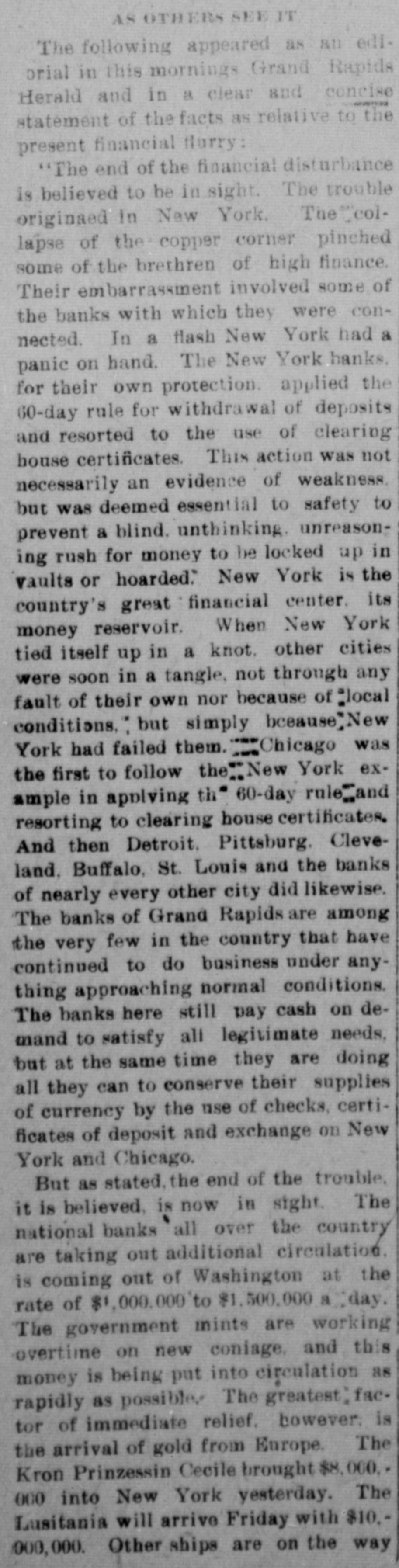
And then Detroit. Pittsburg. Cleveland. Buffalo, St. Louis and the banks of nearly every other city did likewise ... applied the 60-day rule and resorting to clearing house certificates.
Source
newspapers
3. November 25, 1925 Voluntary Liquidation
Source
historical_nic

Newspaper Articles (2)

Article from Alma Record, November 6, 1907

Click image to open full size in new tab

Article Text

AS OTHERS SEE IT The following appeared as an ediorial in this mornings Grand Rapids Herald and in a clear and concise statement of the facts as relative to the present financial Hurry: "The end of the financial disturbance is believed to be in sight. The trouble originaed in New York. The "collapse of the copper corner pinched some of the brethren of high finance. Their embarrassment involved some of the banks with which they were connected. In a flash New York had a panic on hand. The New York banks. for their own protection. applied the 60-day rule for withdrawal of deposits and resorted to the use of clearing house certificates. This action was not necessarily an evidence of weakness. but was deemed essential to safety to prevent a blind. unthinking. unreasoning rush for money to be locked up in vaults or hoarded." New York is the country's great financial center. its money reservoir. When New York tied itself up in a knot. other cities were soon in a tangle, not through any fault of their own nor because of "local conditions.", but simply bceause New York had failed them. Chicago was the first to follow the New York example in applving th* 60-day rule_and resorting to clearing house certificates. And then Detroit. Pittsburg. Cleveland. Buffalo, St. Louis and the banks of nearly every other city did likewise. The banks of Grand Rapids are among the very few in the country that have continued to do business under anything approaching normal conditions. The banks here still pay cash on demand to satisfy all legitimate needs, but at the same time they are doing all they can to conserve their supplies of currency by the use of checks, certificates of deposit and exchange on New York and Chicago. But as stated, the end of the trouble. it is believed, is now in sight. The national banks all over the country are taking out additional circulation. is coming out of Washington at the rate of $1,000.000 to $1,500,000 a day. The government mints are working overtime on new coniage. and this money is being put into circulation as rapidly as possible. The greatest, factor of immediate relief. however. is the arrival of gold from Europe. The Kron Prinzessin Cecile brought $8,000,000 into New York yesterday. The Lusitania will arrive Friday with $10.000,000. Other ships are on the way


Article from The Birmingham Age-Herald, March 12, 1908

Click image to open full size in new tab

Article Text

FINANCIAL BILL HOTLY DENOUNCED Senator Clarke of Arkansas Hits Several Fierce Blows ALDRICH ATTEMPTS REPLY Investigation of Causes of the Panic Is Demanded by Senator Clarke, Who Also Denounces New York Stock Exchange. Washington, March 11.-Senator Clarke of Arkansas denounced the pending currency bill in a speech in the Senate today, declaring that no currency legislation should be enacted until an investigation is held as to the causes of the panic. "No such legislation is necessary now, said Mr. Clarke. "It is not only not necesI sary, but it may become dangerous. am not disposed to tolerate the idea of giving any support to the committee bill, nor the substitute proposed by the minority members of the Senate." If emergency currency is to be provided, Mr. Clarke said, the benefits should be extended all persons whose legitimate business demands cause them to need it. Mr. Clarke denounced the operations of stock exchanges and said the American people would not be satisfied with the proposed currency legislation without a complete knowledge of causes of the panic. "The time has arrived," he said, "when the affairs of the New .York stock exchange and other stock exchanges must be looked into." Mr. Clarke's reference to the stoppage of the payments by the New York banks called Mr. Aldrich to his feet with the remark that he did not believe the people would permit that course again to be pursued. "I trust the senator from Rhode Island as a historian," retorted Mr. Clarke, "but I do not trust him as a prophet." Mr. Clarke expressed the opinion that the majority would not pass the bill allowing the emergency circulation to be retired without limitation. Mr. Clarke said he would not only require a restriction of reserves, but he would deny to a national bank the right to pay interest on checking accounts. Senator Nelson suggested that the national banks should pay interest on the $250,000,000 of government deposits. Mr. Aldrich said that five years ago he had introduced a bill providing for the payment of interest on such deposits at the rate of 1 1/2 per cent, but, he added, senators had opposed that bill on the ground that it changed the nature of the loan. Former Senator Spooner and the late Senator Morgan, he said, opposed the bill. If that objection could be overcome he declared his willingness to again bring in such a measure. He did not know any reason unless it should be a legal one, of the kind suggested, why interest should not be charged on these deposits. Mr. Culberson, he said, had introduced a bill to require payment of interest on government deposits and it was now before the committee on finance. Mr. Bailey spoke at some length suggesting that the main purpose of his substitute was to favor the principle of government money instead of bank money He explained that he had provided for a distribution of the emergency currency in accordance with population, although he realized that business necessity was a greater measure of the amount they should have. But it was not possible to make sure of the business needs of the several sections and it was a simple matter to ascertain the population. An extended argument was made by Mr. Newlands of Nevada in favor of his view that the sending of a check from one state to another makes the business of banking interstate commerce.