The Kansas State Bank at Salina was closed by the Kansas state bank commissioner in late May 1919 and a receiver (Col. Fred R. Fitzpatrick) was appointed. There is no description of a depositor run; closures resulted from bad paper/insolvency and alleged fraudulent issuance of credits. The institution remained defunct with receivership and subsequent litigation.
Events (2)
1.May 27, 1919Suspension
Cause
Government Action
Cause Details
Closed by order of State Bank Commissioner Walter E. Wilson because of large amount of bad paper/insolvency (estimated $250,000-$400,000) and alleged improper issuance of drafts and certificates by officers.
Newspaper Excerpt
Kansas State bank ... was closed by order of Walter E. Wilson, state bank commissioner.
Source
newspapers
2.May 29, 1919Receivership
Newspaper Excerpt
Colonel Fitzpatrick Appointed Receiver of Salina Bank. Col. Fred Fitzpatrick of Salina was today appointed receiver of the defunct Kansas State bank.
Source
newspapers
Newspaper Articles (16)
1.May 28, 1919The Topeka State JournalTopeka, KS
Click image to open full size in new tab
Article Text
Bank Guarantee Fund To Suffer by Salina Crash. Large Part of Reserve May Be Used in Payments. ACCOUNTS ARE BEING CHECKED Bad Paper May Amount to as Much as $400,000. New Bank Using Equipment of Defunct Institution. Kansas state banks which for ten years have zealously built up the state bank guaranty fund, may now apportion a large slice of their funds to the defunct Kansas State bank of Salina. Closing of the doors of the Salina institution has occasioned no excitement. Depositors know they will get dollar for dollar. What is more, certificates on the state guaranty fund draw 6 per cent interest from date of issue. John Hunt, representing the state banking department in handling the legal tangle, returned today from Salina. He said that of the 400 depositors of the bank, fewer than thirty Of called for their money Tuesday. the $13,000 worth of certificates issued by Frank J. Harper, examiner in chargè of the bank, practically all of the money was redeposited with the Reserve State bank at Salina. This bank received a charter several days W. ago, was incorporated by Fred Knapp, state auditor; Walter L. Payne, state treasurer: Guy T. Helvering, former congressman, and their associates. New Bank in Same Building. Tuesday morning when the Kansas State was closed by order of Walter E. Wilson, state bank commissioner. the Reserve State opened for business in the same building and with the same fixtures. No bank failure in Kansas since the enactment of the bank guaranty act has threatened such a heavy jolt for the fund The exact amount of bad paper in the bank is unknown. It is estimated at from $250,000 to $400.000. To meet this paper Commissioner Wilson expects to reduce losses from sale of considerable valuable property owned by officers of the institution. A total of $1,202,000 worth of assets are in the bank guaranty fund. This includes $402,000 in cash and $800,000 worth of bonds deposited by banks operating under the law. The fund will easily absorb the Kansas state bank losses without the necessity of an extra assessment on the banks. None the less there is every prospect that losses of the Salina bank will eat a big hole in the cash reserve of the fund. The cash and bond fund has been steadily growing since the legislature passed the law in 1909. Had the state banks of Kansas been able to weather the present year without losses, further assessments of participating guaranty banks might have been evaded. The law provides that each bank participating under the fund shali make a cash payment to the fund in an amount equal to onetwentieth of their total deposits. They shall also deposit with the state treasury bonds equal to $500 for each It $100,000 or fraction in deposits. has been under this system of assessment that cash and securities amounting to more than $1,200,000 have been accumulated. Under the law further cash assessments would have ceased when the cash reserve reached a half million dollars. This figure might have been reached this year without failures of participating banks. L. A. Johnson, assistant state bank commissioner, is in Salina checking the accounts of the Kansas State bank. Frank J. Harper. an examiner, is in charge of the business affairs pending appointment of a receiver. John Hunt, former assistant attorney general, will direct the legal fight connected with the settlement of the bank's affairs. Hunt was in charge of the affairs of the institution when the Felix Broeker smash came some months ago and the bank was reorganized. Broeker is interested in the present tangle of the Salina bank. He is said to be in New York, where he is seeking to raise funds with which to clean up some of the objectionable paper in the hands of the banking department. H. J. Lefferdink, cashier of the closed bank, left Salina Monday morning. It was reported that he had gone to Kansas City. Commissioner Wilson said today that the department had been unable to find the bank cashier. No arrests have been made in connection with the failure.
2.May 29, 1919The Topeka State JournalTopeka, KS
Click image to open full size in new tab
Article Text
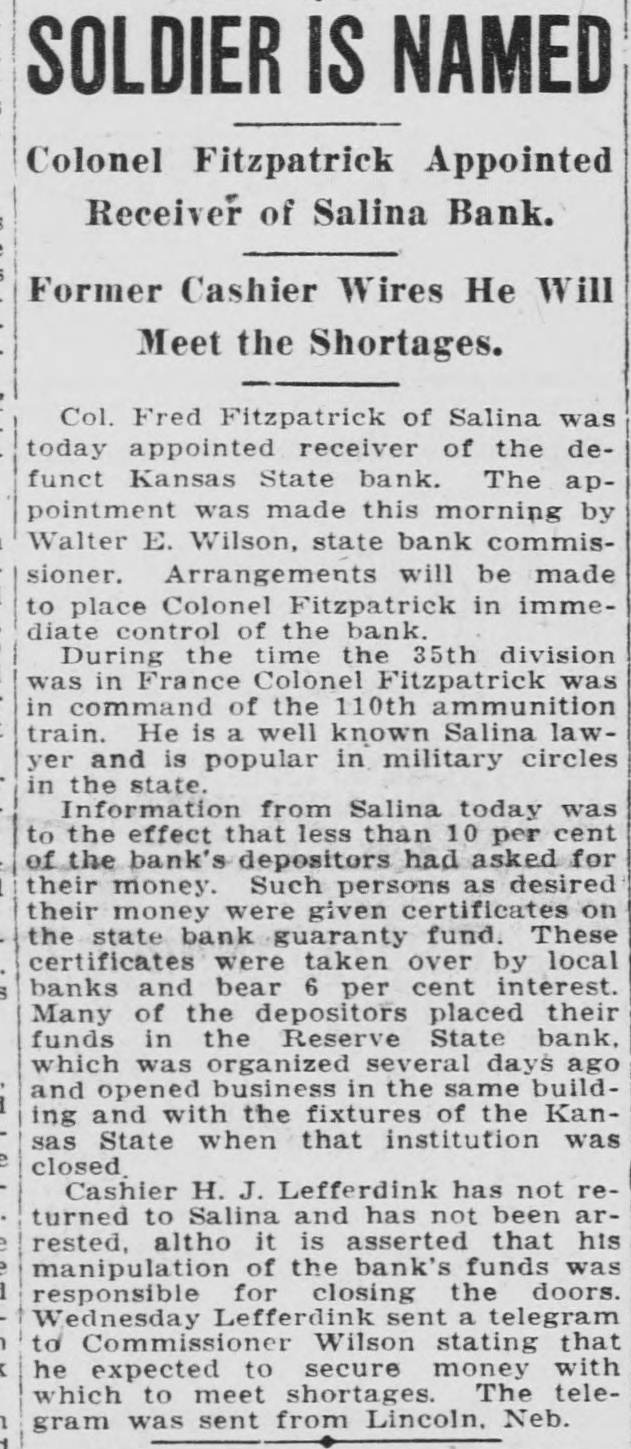
SOLDIER IS NAMED Colonel Fitzpatrick Appointed Receiver of Salina Bank. Former Cashier Wires He Will Meet the Shortages. Col. Fred Fitzpatrick of Salina was today appointed receiver of the defunct Kansas State bank. The appointment was made this morning by Walter E. Wilson, state bank commissioner. Arrangements will be made to place Colonel Fitzpatrick in immediate control of the bank. During the time the 35th division was in France Colonel Fitzpatrick was in command of the 110th ammunition train. He is a well known Salina lawyer and is popular in military circles in the state. Information from Salina today was to the effect that less than 10 per cent of the bank's depositors had asked for their money. Such persons as desired their money were given certificates on the state bank guaranty fund. These certificates were taken over by local banks and bear 6 per cent interest. Many of the depositors placed their funds in the Reserve State bank, which was organized several days ago and opened business in the same building and with the fixtures of the Kansas State when that institution was closed Cashier H. J. Lefferdink has not returned to Salina and has not been arrested, altho it is asserted that his manipulation of the bank's funds was responsible for closing the doors. Wednesday Lefferdink sent a telegram to Commissioner Wilson stating that he expected to secure money with which to meet shortages. The telegram was sent from Lincoln. Neb.
3.June 2, 1919The Topeka State JournalTopeka, KS
Click image to open full size in new tab
Article Text
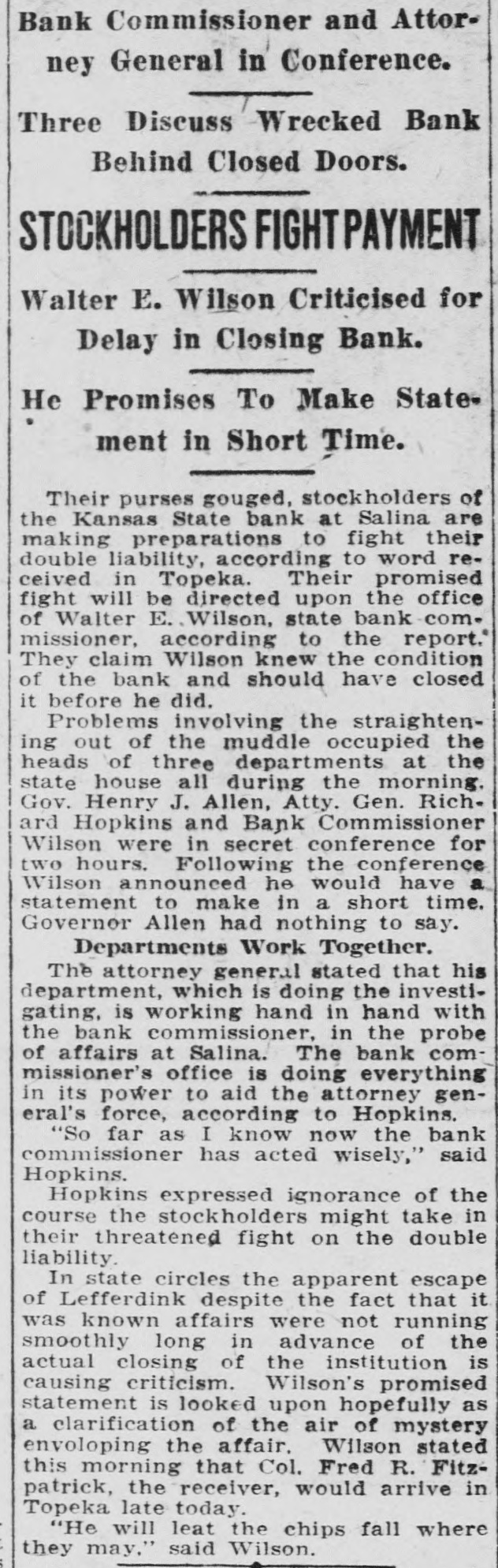
Bank Commissioner and Attorney General in Conference. Three Discuss Wrecked Bank Behind Closed Doors. STOCKHOLDERS FIGHT PAYMENT Walter E. Wilson Criticised for Delay in Closing Bank. He Promises To Make Statement in Short Time. Their purses gouged, stockholders of the Kansas State bank at Salina are making preparations to fight their double liability, according to word received in Topeka. Their promised fight will be directed upon the office of Walter E. Wilson, state bank commissioner, according to the report." They claim Wilson knew the condition of the bank and should have closed it before he did. Problems involving the straightening out of the muddle occupied the heads of three departments at the state house all during the morning. Gov. Henry J. Allen, Atty. Gen. Richard Hopkins and Bank Commissioner Wilson were in secret conference for two hours. Following the conference Wilson announced he would have a statement to make in a short time. Governor Allen had nothing to say. Departments Work Together. The attorney general stated that his department, which is doing the investigating, is working hand in hand with the bank commissioner, in the probe of affairs at Salina. The bank commissioner's office is doing everything in its power to aid the attorney general's force, according to Hopkins. "So far as I know now the bank commissioner has acted wisely," said Hopkins. Hopkins expressed ignorance of the course the stockholders might take in their threatened fight on the double liability. In state circles the apparent escape of Lefferdink despite the fact that it was known affairs were not running smoothly long in advance of the actual closing of the institution is causing criticism. Wilson's promised statement is looked upon hopefully as a clarification of the air of mystery envoloping the affair. Wilson stated this morning that Col. Fred R. Fitzpatrick, the receiver, would arrive in Topeka late today. "He will leat the chips fall where they may." said Wilson.
4.June 5, 1919The Topeka State JournalTopeka, KS
Click image to open full size in new tab
Article Text
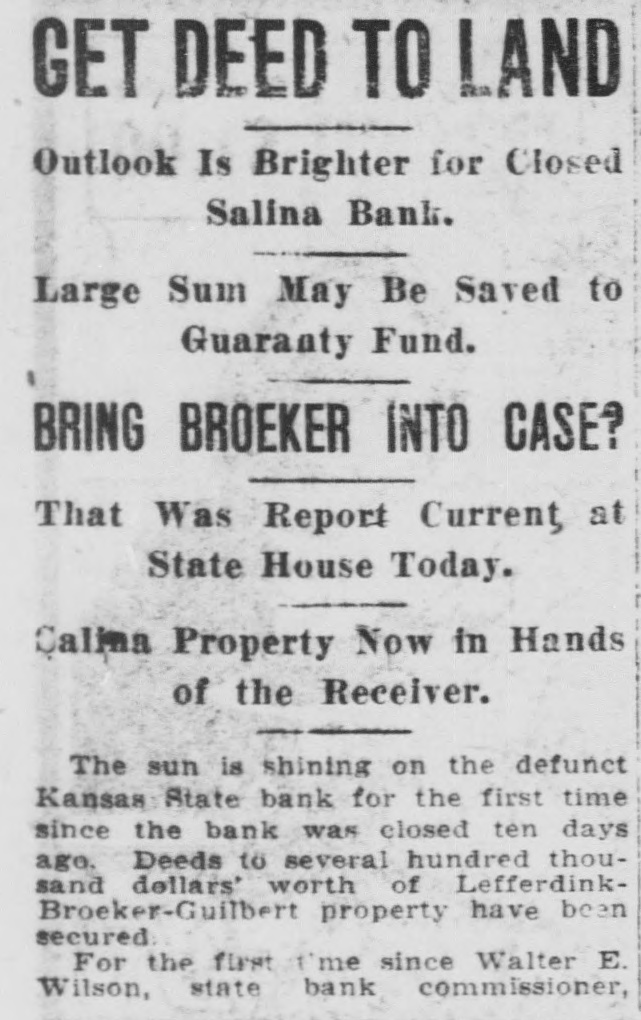
GET DEED TO LAND Outlook Is Brighter for Closed Salina Bank. Large Sum May Be Saved to Guaranty Fund. BRING BROEKER INTO CASE? That Was Report Current at State House Today. Calima Property Now in Hands of the Receiver. The sun is shining on the defunct Kansas State bank for the first time since the bank was closed ten days ago. Deeds to several hundred thousand dollars' worth of LefferdinkBroeker-Guilbert property have been secured For the first time since Walter E. Wilson, state bank commissioner,
5.June 7, 1919The Topeka State JournalTopeka, KS
Click image to open full size in new tab
Article Text
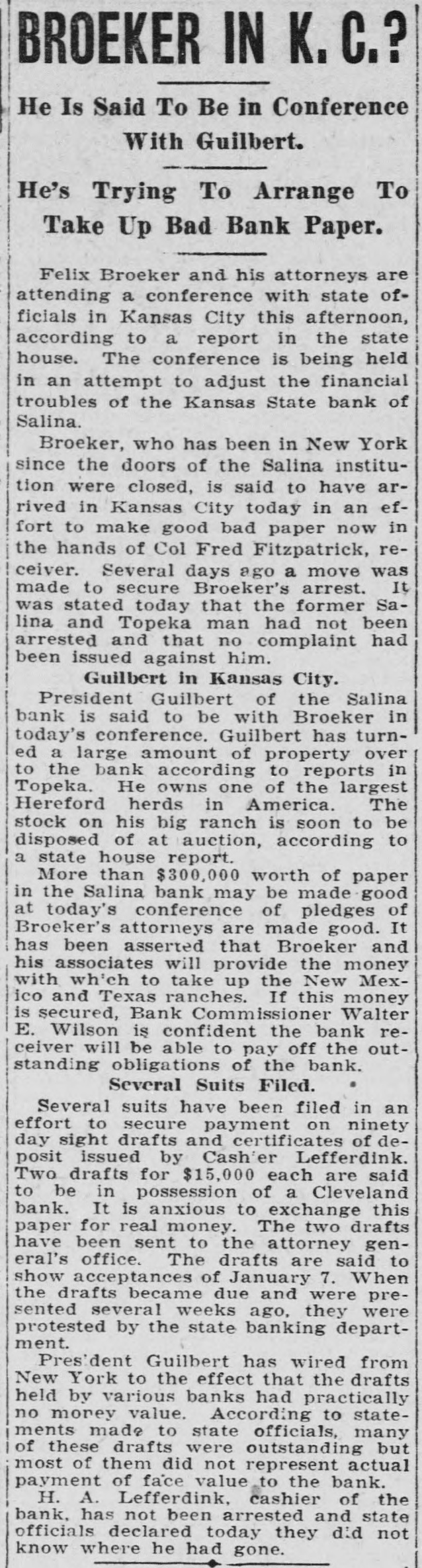
BROEKER IN K.C.? He Is Said To Be in Conference With Guilbert. He's Trying To Arrange To Take Up Bad Bank Paper. Felix Broeker and his attorneys are attending a conference with state officials in Kansas City this afternoon, according to a report in the state house. The conference is being held in an attempt to adjust the financial troubles of the Kansas State bank of Salina. Broeker, who has been in New York since the doors of the Salina institution were closed, is said to have arrived in Kansas City today in an effort to make good bad paper now in the hands of Col Fred Fitzpatrick, receiver. Several days ago a move was made to secure Broeker's arrest. It was stated today that the former Salina and Topeka man had not been arrested and that no complaint had been issued against him. Guilbert in Kansas City. President Guilbert of the Salina bank is said to be with Broeker in today's conference. Guilbert has turned a large amount of property over to the bank according to reports in Topeka. He owns one of the largest Hereford herds in America. The stock on his big ranch is soon to be disposed of at auction, according to a state house report. More than $300,000 worth of paper in the Salina bank may be made good at today's conference of pledges of Broeker's attorneys are made good. It has been asserted that Broeker and his associates will provide the money with which to take up the New Mexico and Texas ranches. If this money is secured, Bank Commissioner Walter E. Wilson is confident the bank receiver will be able to pay off the outstanding obligations of the bank. # Several Suits Filed. Several suits have been filed in an effort to secure payment on ninety day sight drafts and certificates of deposit issued by Cash'er Lefferdink. Two drafts for $15,000 each are said to be in possession of a Cleveland bank. It is anxious to exchange this paper for real money. The two drafts have been sent to the attorney general's office. The drafts are said to show acceptances of January 7. When the drafts became due and were presented several weeks ago, they were protested by the state banking department. President Guilbert has wired from New York to the effect that the drafts held by various banks had practically no money value. According to statements made to state officials, many of these drafts were outstanding but most of them did not represent actual payment of face value to the bank. H. A. Lefferdink, cashier of the bank, has not been arrested and state officials declared today they did not know where he had gone.
6.June 10, 1919The Topeka State JournalTopeka, KS
Click image to open full size in new tab
Article Text
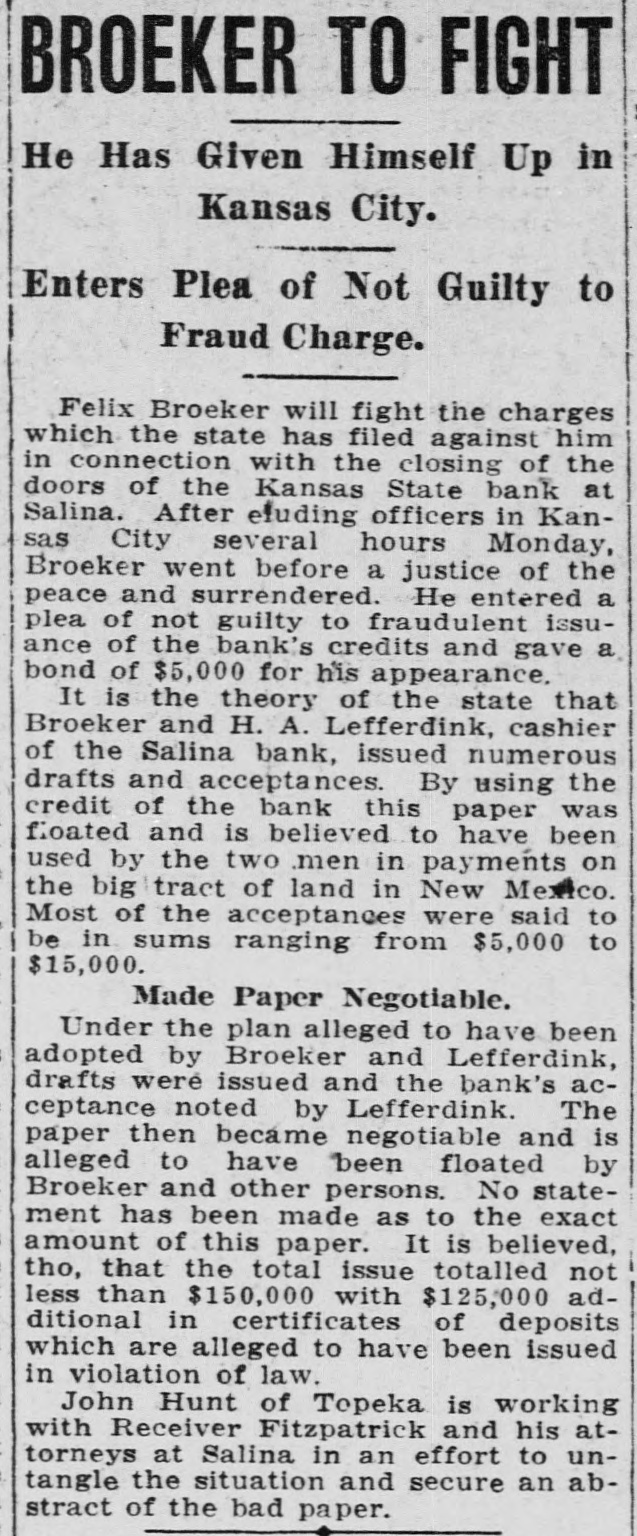
BROEKER TO FIGHT He Has Given Himself Up in Kansas City. Enters Plea of Not Guilty to Fraud Charge. Felix Broeker will fight the charges which the state has filed against him in connection with the closing of the doors of the Kansas State bank at Salina. After eluding officers in Kansas City several hours Monday, Broeker went before a justice of the peace and surrendered. He entered a plea of not guilty to fraudulent issuance of the bank's credits and gave a bond of $5,000 for his appearance. It is the theory of the state that Broeker and H. A. Lefferdink, cashier of the Salina bank, issued numerous drafts and acceptances. By using the credit of the bank this paper was floated and is believed to have been used by the two men in payments on the big tract of land in New Mexico. Most of the acceptances were said to be in sums ranging from $5,000 to $15,000. Made Paper Negotiable. Under the plan alleged to have been adopted by Broeker and Lefferdink, drafts were issued and the bank's acceptance noted by Lefferdink. The paper then became negotiable and is alleged to have been floated by Broeker and other persons. No statement has been made as to the exact amount of this paper. It is believed, tho, that the total issue totalled not less than $150,000 with $125,000 additional in certificates of deposits which are alleged to have been issued in violation of law. John Hunt of Topeka is working with Receiver Fitzpatrick and his attorneys at Salina in an effort to untangle the situation and secure an abstract of the bad paper.
7.June 10, 1919The Topeka State JournalTopeka, KS
Click image to open full size in new tab
Article Text
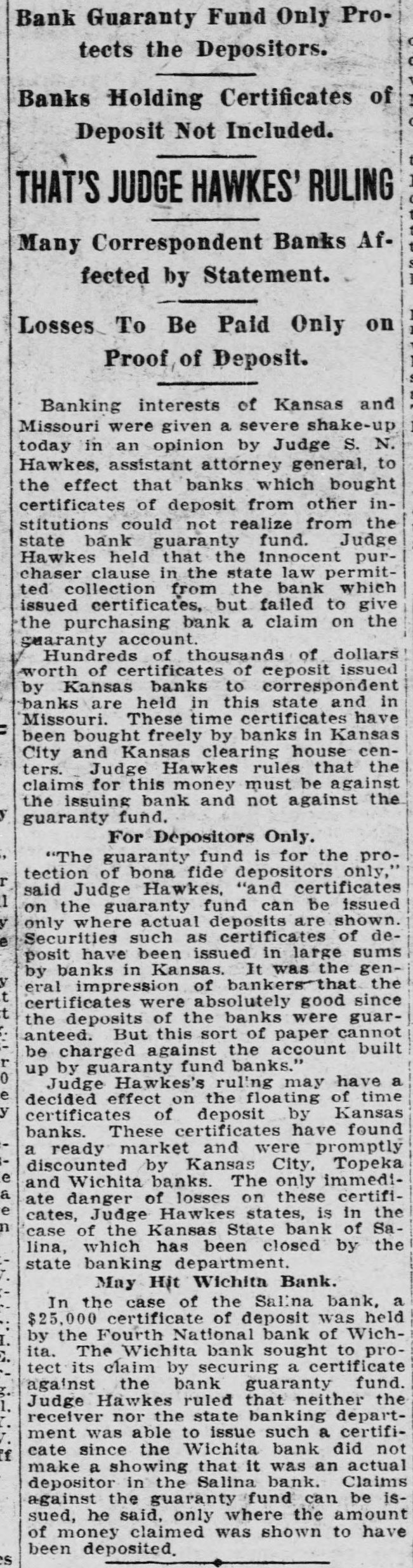
Bank Guaranty Fund Only Protects the Depositors.
Banks Holding Certificates of Deposit Not Included.
# THAT'S JUDGE HAWKES' RULING
Many Correspondent Banks Affected by Statement.
Losses To Be Paid Only on Proof of Deposit.
Banking interests of Kansas and Missouri were given a severe shake-up today in an opinion by Judge S. N. Hawkes, assistant attorney general, to the effect that banks which bought certificates of deposit from other institutions could not realize from the state bank guaranty fund. Judge Hawkes held that the innocent purchaser clause in the state law permitted collection from the bank which issued certificates, but failed to give the purchasing bank a claim on the guaranty account.
Hundreds of thousands of dollars worth of certificates of ceposit issued by Kansas banks to correspondent banks are held in this state and in Missouri. These time certificates have been bought freely by banks in Kansas City and Kansas clearing house centers. Judge Hawkes rules that the claims for this money must be against the issuing bank and not against the guaranty fund.
For Depositors Only.
"The guaranty fund is for the protection of bona fide depositors only," said Judge Hawkes, "and certificates on the guaranty fund can be issued only where actual deposits are shown. Securities such as certificates of deposit have been issued in large sums by banks in Kansas. It was the general impression of bankers that the certificates were absolutely good since the deposits of the banks were guaranteed. But this sort of paper cannot be charged against the account built up by guaranty fund banks."
Judge Hawkes's ruling may have a decided effect on the floating of time certificates of deposit by Kansas banks. These certificates have found a ready market and were promptly discounted by Kansas City, Topeka and Wichita banks. The only immediate danger of losses on these certificates, Judge Hawkes states, is in the case of the Kansas State bank of Salina, which has been closed by the state banking department.
May Hit Wichita Bank.
In the case of the Salina bank, a $25,000 certificate of deposit was held by the Fourth National bank of Wichita. The Wichita bank sought to protect its claim by securing a certificate against the bank guaranty fund. Judge Hawkes ruled that neither the receiver nor the state banking department was able to issue such a certificate since the Wichita bank did not make a showing that it was an actual depositor in the Salina bank. Claims against the guaranty fund can be issued, he said, only where the amount of money claimed was shown to have been deposited.
8.November 12, 1919The Topeka State JournalTopeka, KS
Click image to open full size in new tab
Article Text
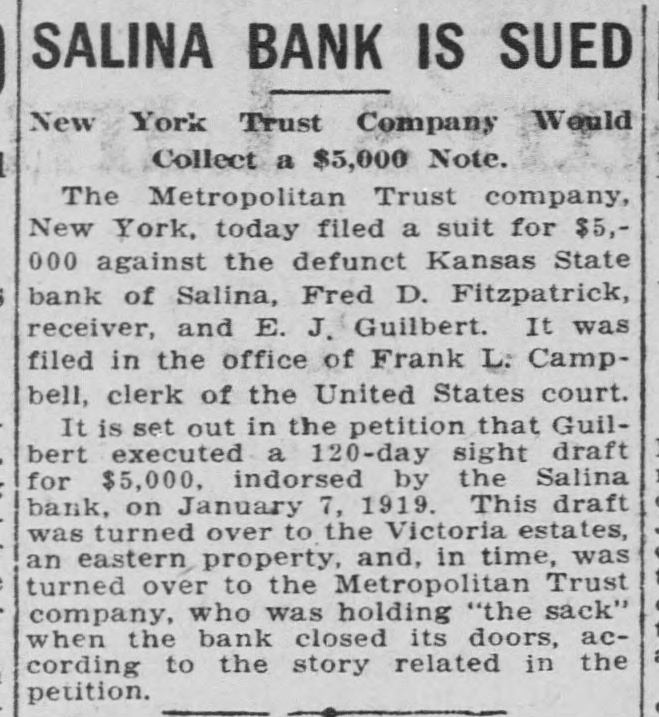
SALINA BANK IS SUED New York Trust Company Would Collect a $5,000 Note. The Metropolitan Trust company, New York, today filed a suit for $5,000 against the defunct Kansas State bank of Salina, Fred D. Fitzpatrick, receiver, and E. J. Guilbert. It was filed in the office of Frank L: Campbell, clerk of the United States court. It is set out in the petition that Guilbert executed a 120-day sight draft for $5,000, indorsed by the Salina bank, on January 7, 1919. This draft was turned over to the Victoria estates, an eastern property, and, in time, was turned over to the Metropolitan Trust company, who was holding "the sack" when the bank closed its doors, according to the story related in the petition.
9.December 11, 1919The Hays Free PressHays, KS
Click image to open full size in new tab
Article Text
ORDER BROEKER ESTATE SOLD Defunct Salina Bank Will be Aided by Sale of Holdings Valued at $125,000. Fred R. Fitzpatrick, receiver for the defunct Kansas State Bank, has received permission from the district court to sell certain business and residence property belonging to Felix Broeker. The property is valued at approximately $125,000. It will be sold at auction and the proceeds used to relieve the deficiencies of the broken bank. Broeker is charged with assisting the cashier, H. J. Lefferdink, in causing the bank's trouble. The permit to sell the property came when the receiver for the bank obtained a journal entry setting aside the temporary order granted some time ago restraining him from selling the property. The restraining order was obtained by Lincoln County men who had claims against Broeker, and were trying to hold the property to secure their claims. Receiver Fitzpatrick gained another victory in the district court when he obtained judgment for $10,000 against F. E. Lefferdink, brother of the defunct bank's cashier. With the judgment came the right to sell certain Salina real estate owned by the defendant. The property formerly belonged for the cashier, who turned it over to his brother. It will be sold at sheriff's sale, but it is believed it is not sufficient to satisfy the judgment. The City of Atchison has gone into the coal and wood business. Coal is being mined from a 12-inch vein four miles south of town. The vein is manned by volunteer miners with experience, and from ten to twenty tons a day are being taken from the vein, which will last several weeks. Wood is being purchased by the city and sold at cost. Both wood and coal are being parceled out in small lots not more than a load of wood being sold to one person or more than five hundred pounds of coal. The local emergency fuel committee placed a ban on all public gatherings and ordered the stores and business houses to open not earlier than 9 o'clock and close not later than 4:30 o'clock. The water supply has only a twoweek supply of coal and the emergency committee appealed to the fuel agent of the Missouri Pacific at St. Louis for one hundred tons of slack at once. Unless it can be obtained Atchison will be without water and fire protection. Street cars have been discontinued and street and display lighting curtailed. Word has been received by Richard Hopkins, attorney general, from Salina that Judge Dallas Grover had set December 29 as the date for the trial of Felix Broeker, who has been charged with wrecking the Kansas State Bank at Salina. Broeker will be tried on three separate charges unless developments after the first charge is tried change the plans of the prosecution. The three specific charges against Broeker are "embezzlement of funds belonging to the old Globe Life Insurance Company and suits evolving out of the issuance of $100,000 worth of certificates of credit by the bank and the $50,000 in acceptances by the same institution." A vigilance committee of American Legion members has been appointed at Concordia to watch for un-American remarks or actions. It will serve as a local gum-shoe bomb squad. Men found guilty of un-Americanism will be brought before the legion. The $15,000 bond issue recently voted for an electric light and power line at Lane was sold to Brown & Crumer, Wichita bankers. Contracts also were let for equipment approximating $9,000. Charles Wahle, a wealthy Geary County farmer is dead at his home near Junction City. He had been in poor health for some time. Coming here with his father in 1866, Mr. Wahle added steadily to his holdings, until at the time of his death he owned two thousand acres of Geary County land. He was 60 years old. His wife and five children survive him. From thirty to forty tourist parties from the West are marooned along the. Pike's Peak Highway by snow, it was learned recently James Corbett and William Asken of Trenton, N. J., who have been on a hunting trip in Wyoming, arrived at Concordia after
10.April 8, 1920The Topeka State JournalTopeka, KS
Click image to open full size in new tab
Article Text
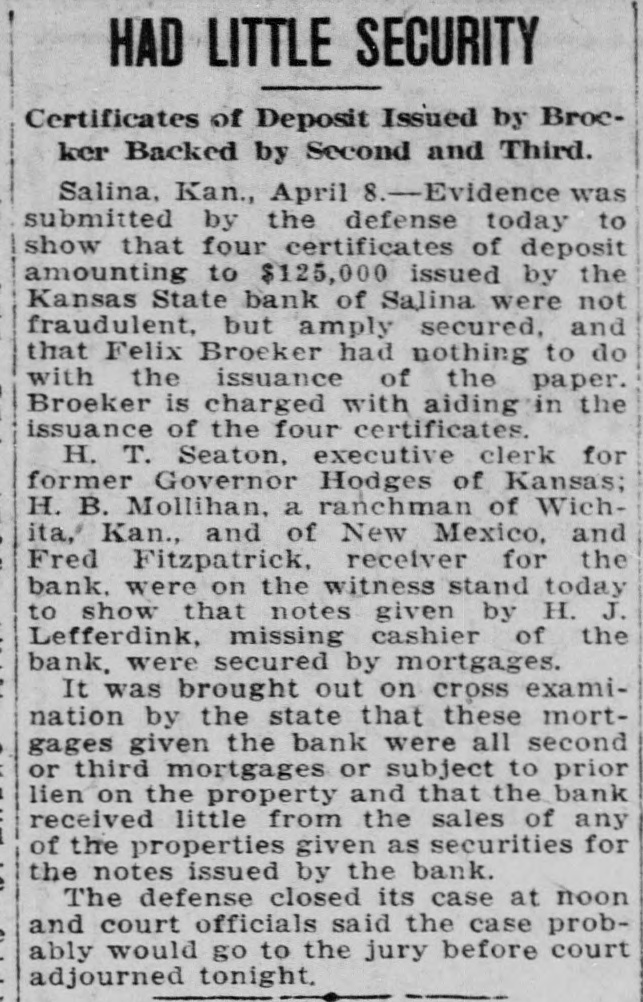
HAD LITTLE SECURITY Certificates of Deposit Issued by Brocker Backed by Second and Third. Salina, Kan., April 8.-Evidence was submitted by the defense today to show that four certificates of deposit amounting to $125,000 issued by the Kansas State bank of Salina were not fraudulent, but amply secured, and that Felix Broeker had nothing to do with the issuance of the paper. Broeker is charged with aiding in the issuance of the four certificates. H. T. Seaton, executive clerk for former Governor Hodges of Kansas; H. B. Mollihan, a ranchman of Wichita,' Kan., and of New Mexico, and Fred Fitzpatrick, receiver for the bank. were on the witness stand today to show that notes given by H. J. Lefferdink, missing cashier of the bank, were secured by mortgages. It was brought out on cross examination by the state that these mortgages given the bank were all second or third mortgages or subject to prior lien on the property and that the bank received little from the sales of any of the properties given as securities for the notes issued by the bank. The defense closed its case at noon and court officials said the case probably would go to the jury before court adjourned tonight.
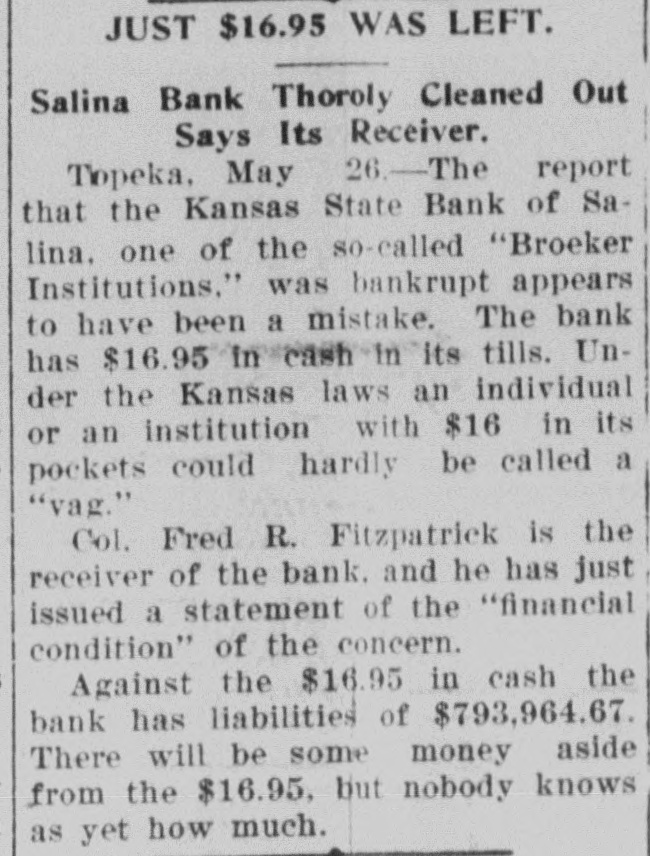
JUST $16.95 WAS LEFT. Salina Bank Thoroly Cleaned Out Says Its Receiver. Topeka, May 26.-The report that the Kansas State Bank of Salina. one of the so-called "Broeker Institutions." was bankrupt appears to have been a mistake. The bank has $16.95 in cash in its tills. Under the Kansas laws an individual or an institution with $16 in its pockets could hardly be called a "vag." Col. Fred R. Fitzpatrick is the receiver of the bank. and he has just issued a statement of the "financial condition" of the concern. Against the $16.95 in cash the bank has liabilities of $793,964.67. There will be some money aside from the $16.95. but nobody knows as yet how much.
12.November 26, 1920The Topeka State JournalTopeka, KS
Click image to open full size in new tab
Article Text
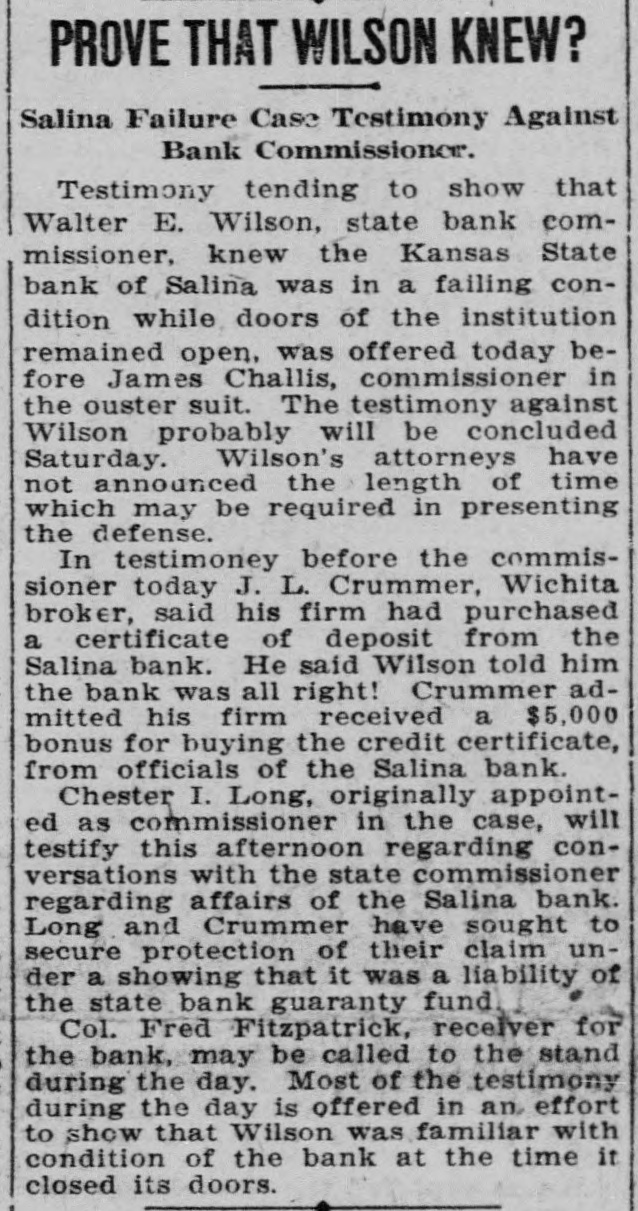
PROVE THAT WILSON KNEW? / Salina Failure Case Testimony Against Bank Commissioner. Testimony tending to show that Walter E. Wilson, state bank commissioner, knew the Kansas State bank of Salina was in a failing condition while doors of the institution remained open, was offered today before James Challis, commissioner in the ouster suit. The testimony against Wilson probably will be concluded Saturday. Wilson's attorneys have not announced the length of time which may be required in presenting the defense. In testimoney before the commissioner today J. L. Crummer, Wichita broker, said his firm had purchased a certificate of deposit from the Salina bank. He said Wilson told him the bank was all right! Crummer admitted his firm received a $5,000 bonus for buying the credit certificate, from officials of the Salina bank. Chester I. Long, originally appointed as commissioner in the case, will testify this afternoon regarding conversations with the state commissioner regarding affairs of the Salina bank. Long and Crummer have sought to secure protection of their claim under a showing that it was a liability of the state bank guaranty fund Col. Fred Fitzpatrick, receiver for the bank, may be called to the stand during the day. Most of the testimony during the day is offered in an effort to show that Wilson was familiar with condition of the bank at the time it closed its doors.
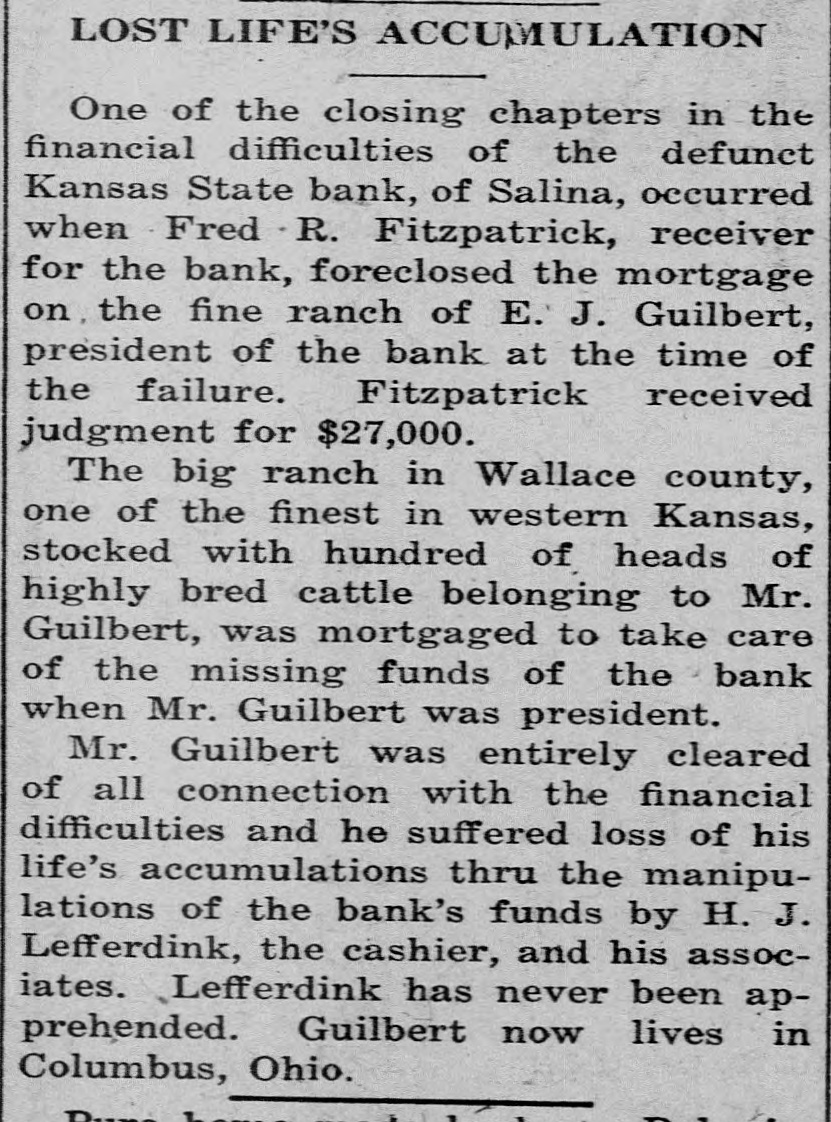
# LOST LIFE'S ACCUMULATION
One of the closing chapters in the financial difficulties of the defunct Kansas State bank, of Salina, occurred when Fred R. Fitzpatrick, receiver for the bank, foreclosed the mortgage on the fine ranch of E. J. Guilbert, president of the bank at the time of the failure. Fitzpatrick received judgment for $27,000.
The big ranch in Wallace county, one of the finest in western Kansas, stocked with hundred of heads of highly bred cattle belonging to Mr. Guilbert, was mortgaged to take care of the missing funds of the bank when Mr. Guilbert was president.
Mr. Guilbert was entirely cleared of all connection with the financial difficulties and he suffered loss of his life's accumulations thru the manipulations of the bank's funds by H. J. Lefferdink, the cashier, and his associates. Lefferdink has never been apprehended. Guilbert now lives in Columbus, Ohio.
14.February 12, 1921The Topeka State JournalTopeka, KS
Click image to open full size in new tab
Article Text
WILSON OUSTER re(Continued from reference Page One.) to with not con- a storing or public honestly acshall be such taken law reserve. to It policy is for been trary bank to immissioner in banks which term have of office by quire stock during his were granted and chartered charter whose charters board while he was sitting the as a member." Bank Commissioner. the Rights further of discussed while serving rights deChallis bank commission board and inof a the state charter no statute against buy, sell on there was a company to that such of banks a violation of and hold was not purchase clared corporation course of "The and com- the of anti-trust a stocks laws. by an investment by Chapter com- 151, bank is authorized 1919," says the missioner. session pany laws of report Challis held 01 his formal "even a scintilla prove that In there which was not would tend sordid to or disevidence was or the that honest there in the actions anything his defend- concluChallis in evidence preCommission after a of the long drawn sented sions to him during out hearing Records said: Carefully Examined. consciention "The examined record and has re-examined been evidence for which plain- the ly of finding elaims of the support has been as it The as far by your possible from the purpose tiff. would commissioner matter the the considered defendant viewpoint 19 humanly was presented or to failed to charged. do the at which the time he with did which he is required various commissioner acts the has commissioner law not requires of upon Your nor does the part he think of perfect a bank prescience nor the infallibility "The powers record without in judgement. has finding been evidence, any very evidence, closely which scanned scintilla of that there was the even a tend to prove or dishonest and in your would sordid the defendant, report of pleased to unable to have anything actions commissioner is find wherein been that he has been of the defendant other than the actions by anything banking interests That prompted to promote the into his charge. light have which were of done desire events, some have not the defendant failed to should may things in the he some might acts he do, or which did the perform is a conclusion depending on connow performed. be easily viewpoint drawn, of the one sidering Individual 'It is the hard, your situation. and commissionew in fact date it is to impos- defi- the the sible, nitely commissioner for designate should bank any at have Salina. closed interested There Kansas State other banks that the dewere so Broeker many enterprises properly so, that cards the in the felt, and a house of the dewhole fendant collapse structure of was one Even meaning after Lefferdink the funds -a struction of all. had abstracted they still and Broeker Kansas State plausible bank, scheme imthe and could be a all were mediately whereby of had reasonable and that funds end in the replaced. bank con- it Negotiations to interested While tinued by those the bank closed. that the receiver even enough a demonstrated after in fact charge collect of the bank is was put able to bilities, who been pay its bank from has not its assets insolvency to cash of the market and still the actual of the possible which it held, upon value in view of securities of the negotiation properly be was stated, the the New possibility Mexico far ranch, from a Faith. truth. Acted in Good the law, in the the He defendant is, by and his in ofopinion "The of your his duties the preperformance acts carry of with faith. them I act have which not anything or defendant. performed he failed the found sumption ficial was that which of good by other the any than to perform. best or any act prompted and by were not which character would of was motives, wilfulness office. ized by a from a the his his present justify ouster defendant candidate post ex- for for official his to may be "Were reappointment his determine career to might possible fitness be that position. of the he did, tion, amined the others in place taken It the action defendant that might the or have something such misnot might have failed done to do, but if they bank were defendant and judgments made by the takes mistakes-as as were do not, constitute in the opinion willful of your acts justifying removal from in office. Purpose Was the Legitimate. defendant in ties The to action permit of the to sell Kansas its securi- Bank he voting Holding the corporation state of Kansas, when
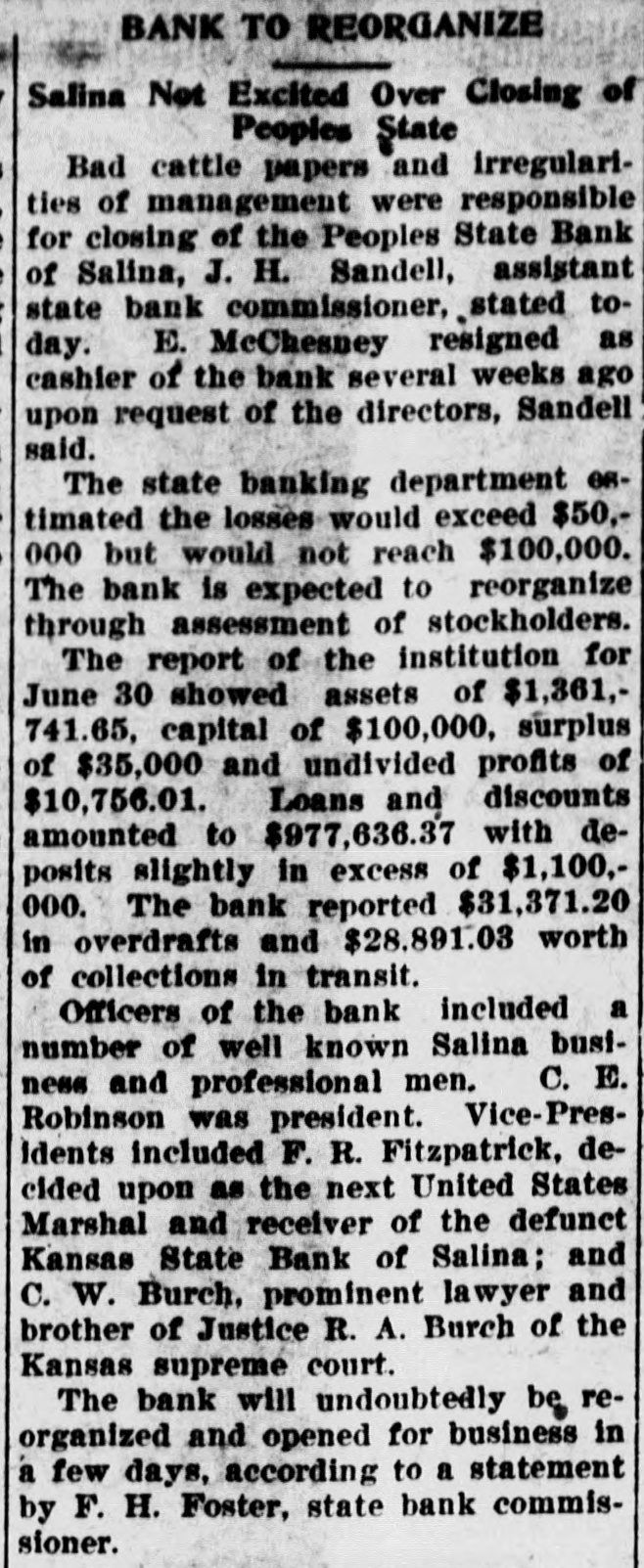
BANK TO REORGANIZE Salina Net Excited Over Closing of Peoples State Bad cattle papers and irregularities of management were responsible for closing of the Peoples State Bank of Salina, J. H. Sandell, assistant state bank commissioner, stated today. E. McChesney resigned as cashier of the bank several weeks ago upon request of the directors, Sandell said. The state banking department ORtimated the losses would exceed $50,000 but would not reach $100,000. The bank is expected to reorganize through assessment of stockholders. The report of the institution for June 30 showed assets of $1,361,741.65, capital of $100,000, surplus of $35,000 and undivided profits of Loans and discounts $10,756.01. amounted to $977,636.37 with deposits slightly in excess of $1,100,000. The bank reported $31,371.20 in overdrafts and $28.891.03 worth of collections in transit. Officers of the bank included a number of well known Salina business and professional men. C. E. Robinson was president. Vice-PresIdents included F. R. Fitzpatrick, decided upon as the next United States Marshal and receiver of the defunct Kansas State Bank of Salina; and C. W. Burch, prominent lawyer and brother of Justice R. A. Burch of the Kansas supreme court. The bank will undoubtedly be reorganized and opened for business in a few days, according to a statement by F. H. Foster, state bank commissioner.
16.August 16, 1921The Topeka State JournalTopeka, KS
Click image to open full size in new tab
Article Text
# U. S. MARSHALL
(Continued from Page One.)
'that Wood's resignation had been asked. Colonel Rahn smiled but expressed only mild surprise. He denied that any official communications had been received from the federal department relative to removal of Wood at this time.
Wood's term officially expired June 1, next year. He was appointed by President Wilson in 1914, and would have served eight years at the expiration of his second term. He was named to succeed "Jack" Harrison, now editor and publisher of the Beloit Gazette. Harrison was campaign manager for Sen. J. L. Bristow, who was defeated by Senator Curtis in 1914. The removal of Harrison was as summary as and with even less notice than the Wood case. The Harrison ouster, tho, was regarded as strictly political. There were no charges.
Appointment of Wood was at the instance of Senator W. H. Thompson, Democrat. Wood came here from Liberal, Seward county, where he had for a number of years been active in local politics. He was a Thompson worker in the Seventh district when the Democrat senator won the nomination in 1912 and defeated W. R. Stubbs in the emocrat landslide that fall.
### Fitzpatrick to Place?
It is probable that the demand for Marshal Wood's resignation will be followed immediately by appointment of Col. Fred Fitzpatrick of Salina as marshal. President Harding may be asked to make this appointment at once.
### No Appeal for Wood.
It isn't necessary for Wood to resign. He is out. Action by the department is final and decisive. There is no appeal.
Pending formal appointment by the president, a marshal may be appointed by Judge John C. Pollock, judge of the United States district court for the district of Kansas. It is assumed that he will name Fitzpatrick. Judge Pollock, however, is on a vacation trip and a new marshal may not be named for several days.
Thru the action of Attorney General Daugherty, Marshal Wood receives exactly the medicine prescribed for his predecessor, Harrison. The removal of Harrison was at the hands of Attorney General McReynolds.
At the time of Harrison's removal Wood's appointment was being held up in the senate, which balked on his confirmation.. As soon as Harrison was removed. Senator Thompson rushed to the attorney general's office and asked that McReynolds request appointment of Wood. It was unique and unusual procedure, but Thompson's request was granted. Judge Pollock appointed Wood and it was this action which broke down opposition to Wood's confirmation.
Colonel Fitzpatrick has been slated as Wood's successor almost since the election. He won distinction and honors in fighting overseas and is one of the most popular and aggressive Republican workers in the Fifth district. He has been active in political affairs in his district for a number of years altho he is identified with the younger crowd in state politics. He was an alternate to the Republican national convention in 1916 and was elected as a delegate from his district last year. He was among the first members of the Kansas delegation to urge casting of a solid state delegation vote for Harding. He helped start the stampede that broke the Leonard Wood control of the delegation and ultimately helped swing the convention to Harding.
In the national committeeman fight Col. Fitzpatrick supported D. W. Mulvane thruout. The political scandal in the state bank commissioner's office grew out of refusal of Fitzpatrick to swing to Fred S. Stanley or Bank Commissioner Wilson to yield to state administration influence to "force" Fitzpatrick. At the time Fitzpatrick was assumed to be under influence of the banking department by virtue of his appointment as receiver of the Kansas State bank at Salina. But neither Fitzpatrick nor Wilson broke and Mulvane won.
During the last campaign Col. Fitzpatrick spent a large portion of his time at Republican state headquarters in Topeka.
CRAVE SOMETHING TART?
We Acid Phosphate