Article Text
NEWS OF THE WEEK.
The East.
The serious results of the panic still continue. The extensive print works of Garner & Co., at Little Falls, Cohoes, Rochester, Pleasant Valley, Newburg, and Haverstraw, have shut down, discharging 10,000 men. The pay-roll of this firm amounted to $500,000 monthly. Other extensive factories, of various kinds, have suspended work, or have reduced wages and time. The prospect looks gloomy for the winter.
The third trial of Edward S. Stokes for the murder of James Fisk, Jr., has been concluded at New York, and resulted in a verdict of manslaughter in the third degree. The prisoner was sentenced to four years' hard labor in the Penitentiary.
Three persons—a man and two women—were recently run over by a train of cars at Frankfort, N. J., while attempting to cross the track in a wagon. They were horribly mangled, and lived but a short time.
The Beecher-Bowen-Tilton scandal is again stinking in the nostrils of the Boooklynites. Tilton has been summoned to appear before a committee of Plymouth church and tell what he knows about the matter, but refuses on the ground that he is not a member of that church.
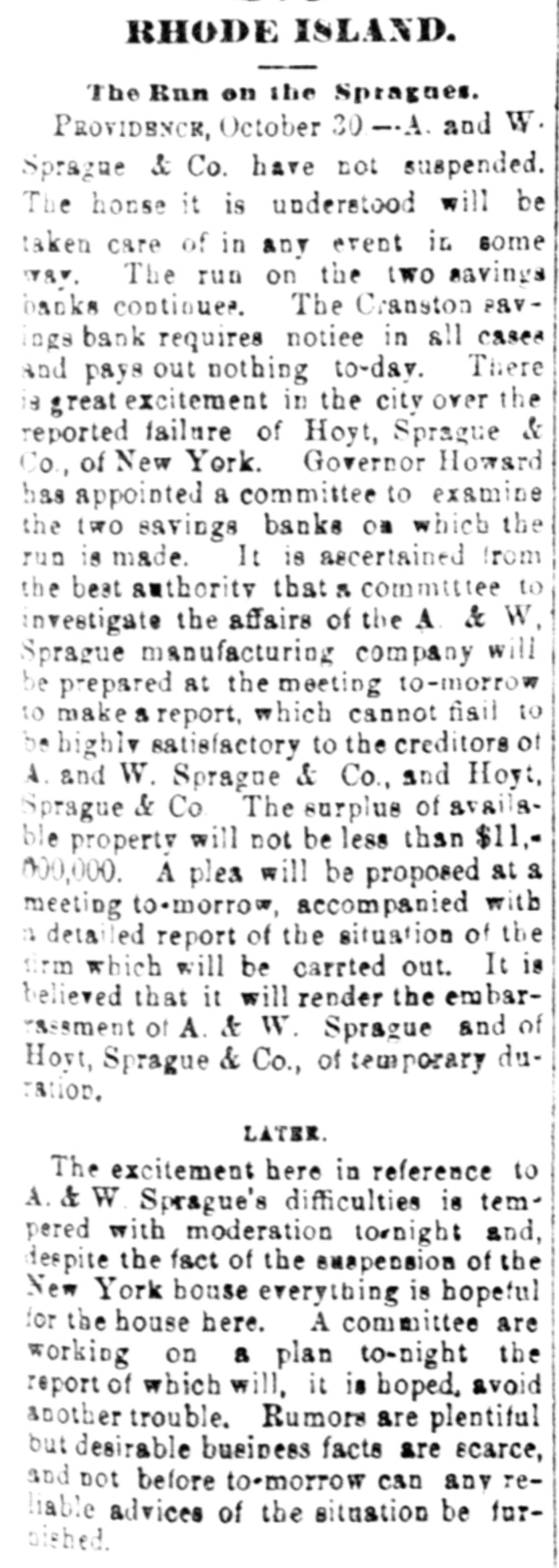
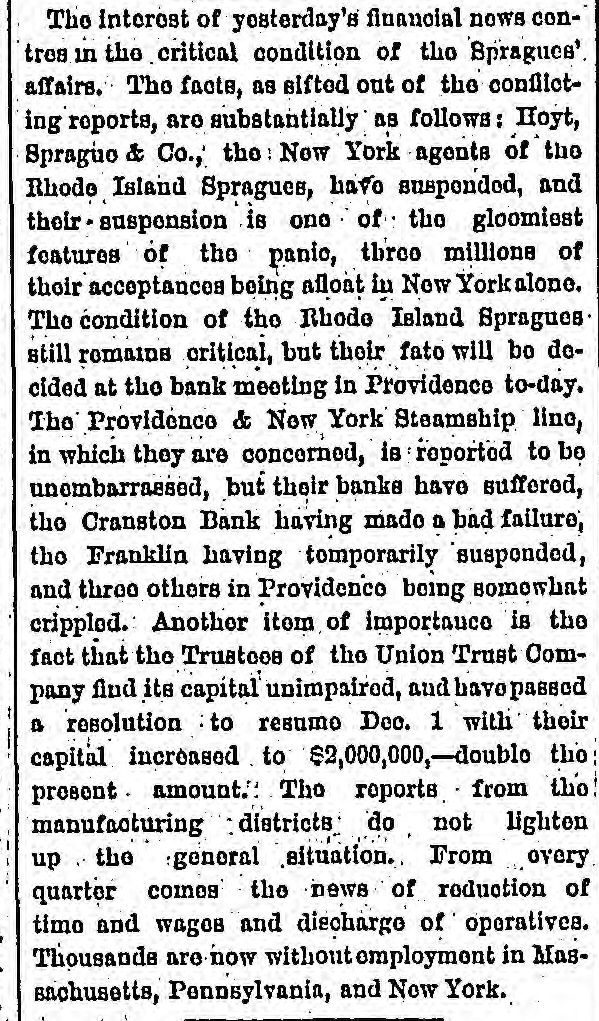
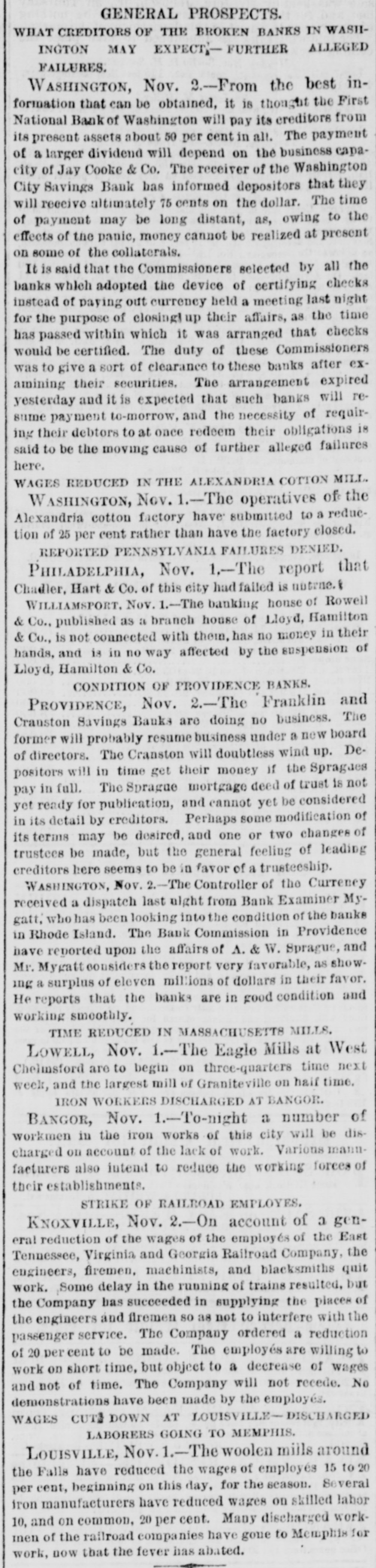
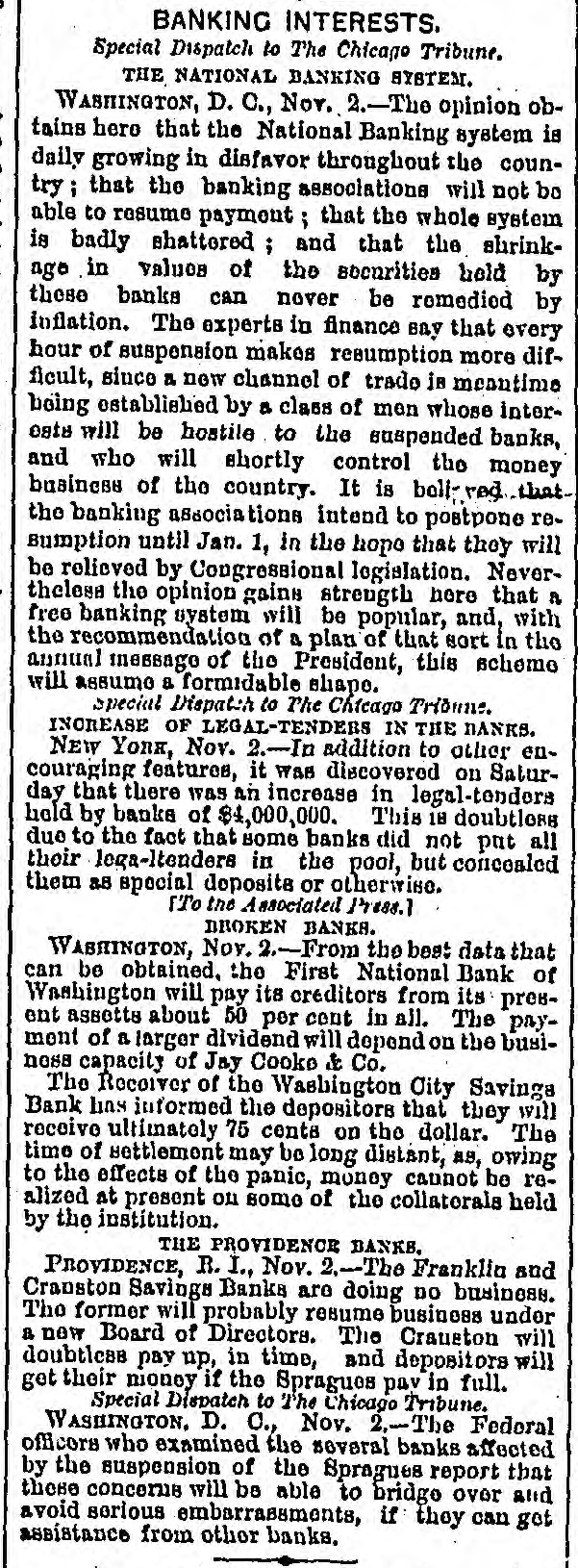
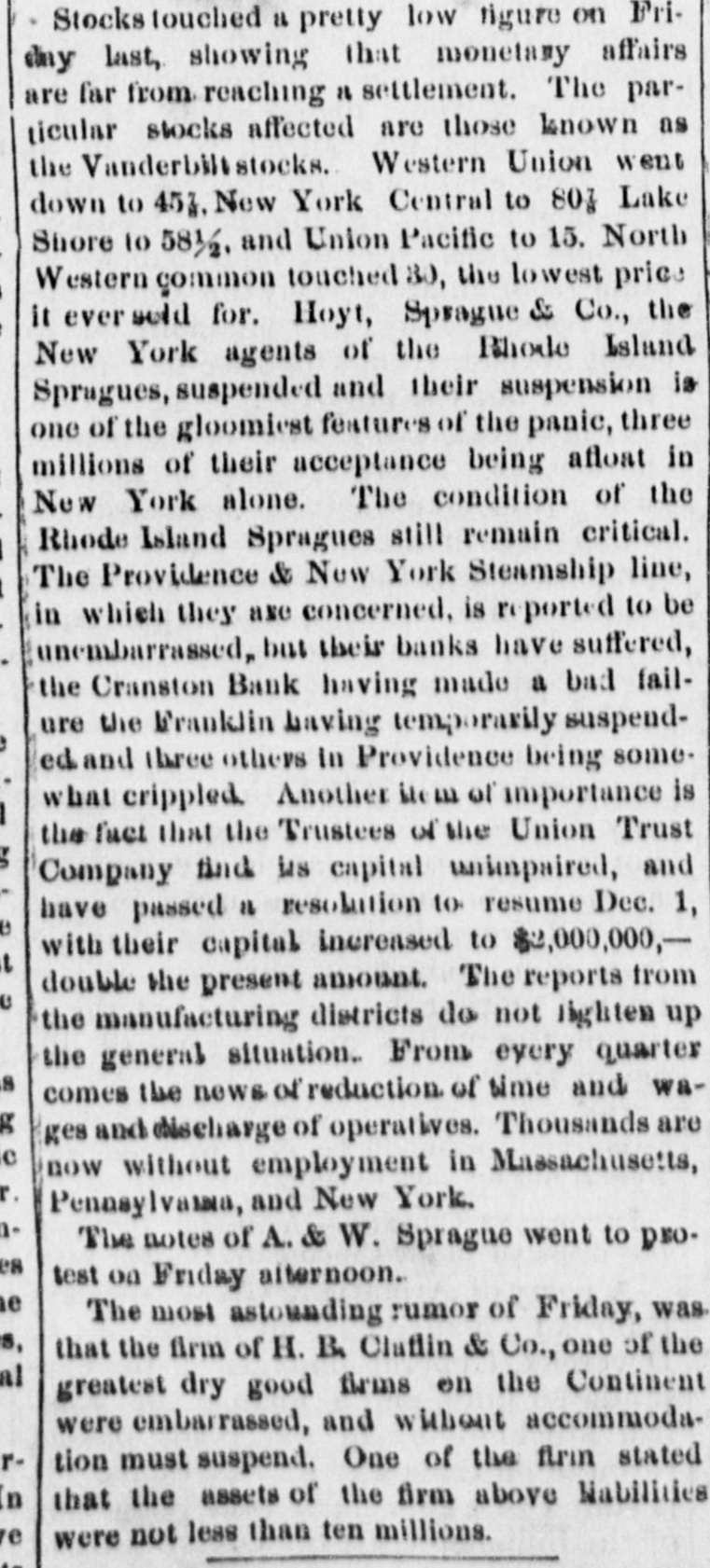
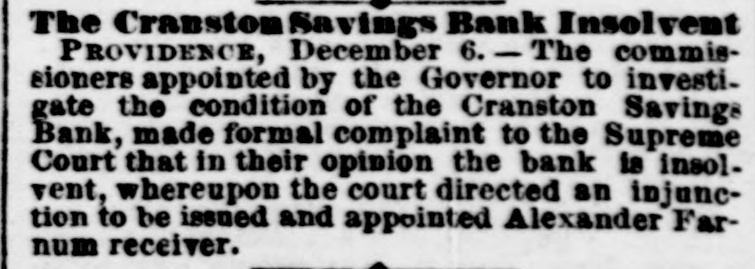
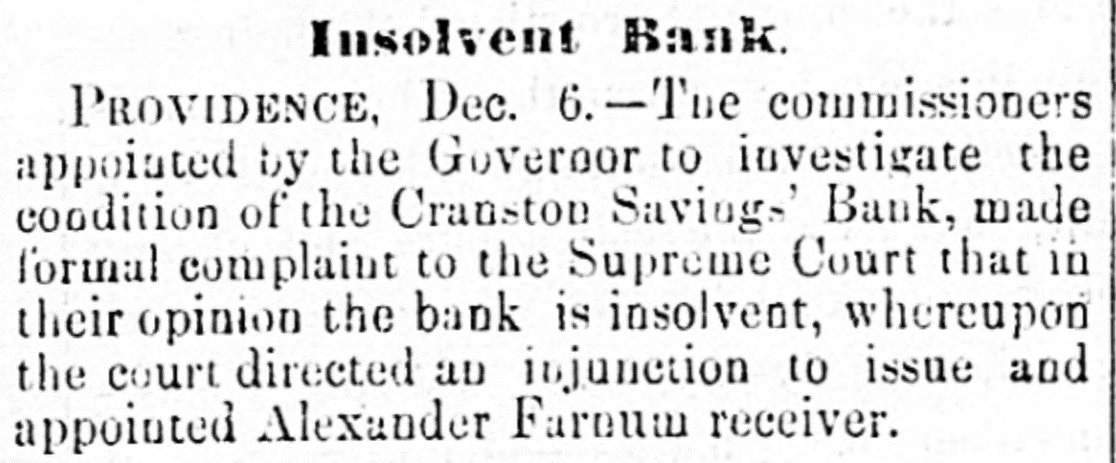
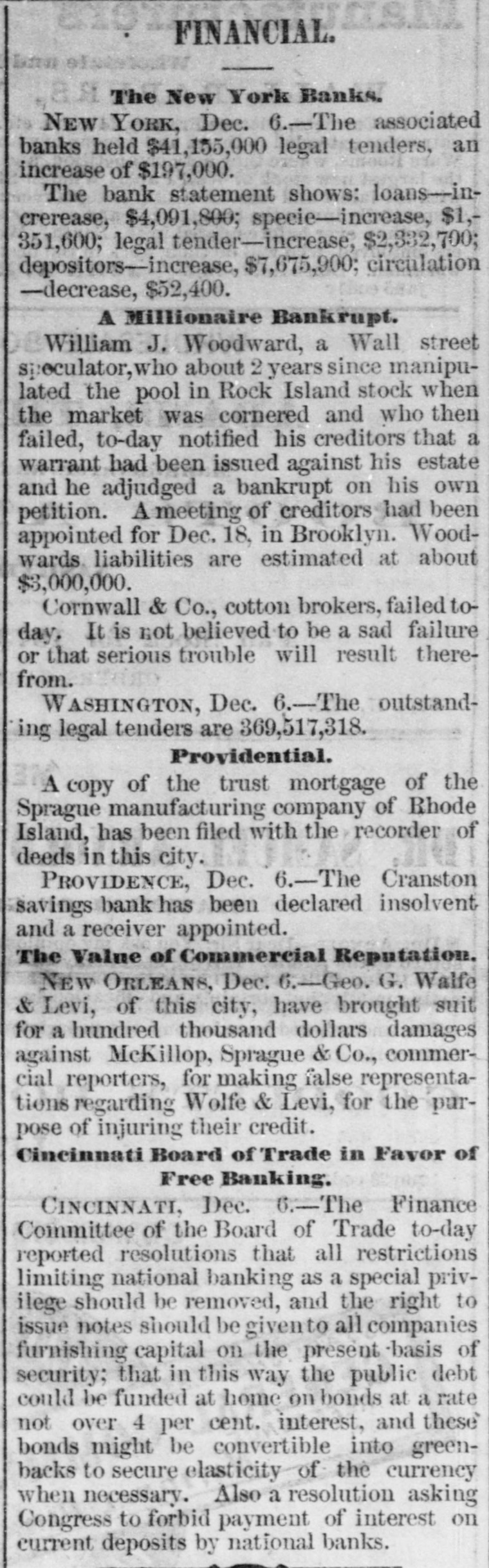
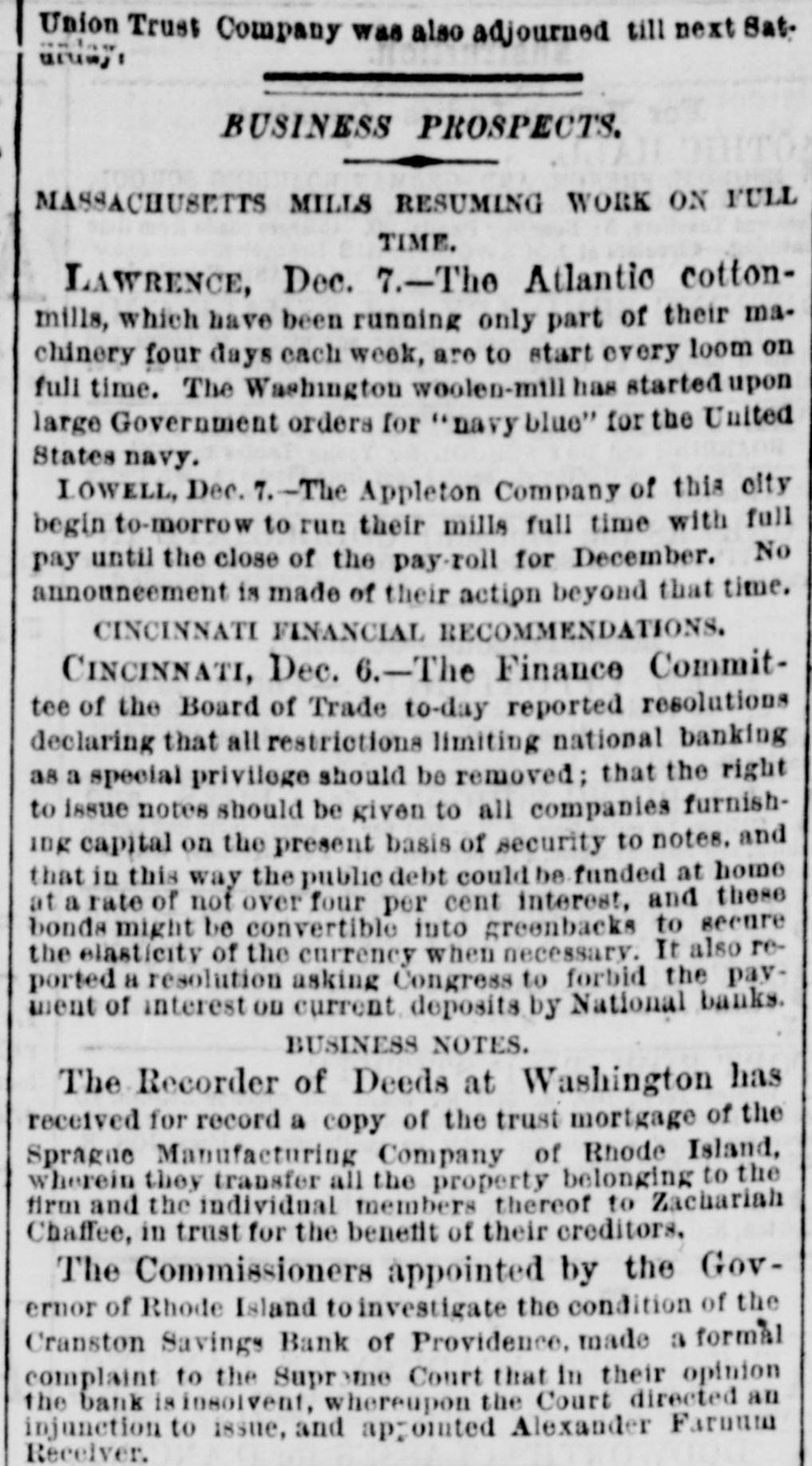
A number of New York firms have failed, including Lloyd, Hamilton & Co.; J. T. & W. H. Daley, C. Mattman, Schmid & Co.; and Hoyt, Sprague & Co. The latter are the agents of the Rhode Island Spragues, the extensive manufacturers, and their suspension is one of the gloomiest features of the panic, $3,000,000 of their acceptances being afloat in New York alone. The failure is also announced of Morgan, Young, Altemus & Co., one of the heaviest Philadelphia dry goods houses. The reports from the Eastern manufacturing districts do not lighten up the general situation. From every quarter comes the news of reduction of time and wages and discharge of operatives. Thousands are now out of employment in Massachusetts, Pennsylvania and New York. The Cranston and Franklin Banks, of Providence, in which the Spragues are largely interested, have suspended. The deposits, amounting in the aggregate to $3,500,000, were made chiefly by working people, who will suffer great privation if they lose their savings. Twenty thousand working girls in Newark, N. J., have been thrown out of employment by the stopping of manufactories. Thirty-seven mills in Fall River are now running on half time. The Merrimac Woolen Mills, of Lowell, will close up in a few days. Over 25,000 working women are reported idle in Philadelphia. It is evident that this will be a hard winter for the classes dependent on daily earnings.
There has been another serious fall in stocks in Wall street. Northwestern common touched 30, the lowest price it ever sold for, being five cents lower than when Henry Keep picked it up, seven years ago. Vanderbilt shares suffered an alarming decline, and it is said the venerable cormorant was taxed to his utmost resources to keep his head above water. Western Union went down to 45¾, New York Central to 80¾, Lake Shore to 58½, and Union to 15.
A New York dispatch states that the great dry goods house of H. B. Claflin & Co. is seriously embarrassed.
The Chesapeake and Ohio railroad has defaulted on its interest.
The reported failure of the great New York dry goods house of H. B. Claflin & Co. was a canard. The firm is perfectly solvent.
The committee of Providence bank representatives appointed to examine the condition of the affairs of the A. & W. Sprague Manufacturing Company report the assets of the corporation to be $19,495,247, and their liabilities $11,475,443. They recommend that the members of the firm mortgage all their property to three trustees, who shall have entire control of it until their affairs are settled, their obligations to run three years.
One of the Stokes jurors is in trouble, being under arrest and indictment for disregarding the obligations of a juror.
During the three months ending Sept. 30 there arrived at New York 68,588 emigrants, of whom 24,381 were Germans.
Jay Cooke & Co. have again issued circulars to their creditors requesting their assent to the proposed agreement. One of their heaviest creditors says if the firm is forced into bankruptcy they cannot pay over 25 cents on the dollar, but if allowed to settle themselves they will pay every dollar, and have a nice sum left.
The gold coinage at the United States Mint in October amounted to $11,010,000 in double eagles. The gold weighed 38 tons.
The freight business of the Eastern railroads is suffering severely from the financial disturbance.
Stokes has entered upon his four years' residence in Sing Sing Prison.
It is believed that the Sprague Manufacturing Company will be able to discharge their obligations and continue business uninterruptedly if their creditors are not too pressing.
Between $700,000 and $800,000 in silver of various denominations will be coined at the Philadelphia Mint this month.
Steps have been taken for the formation in New York of a bank devoted entirely to the grain interests of the interior.
That bale of cotton donated for the benefit of the Memphis sufferers has been again sold in New York for $2,875, or more than $6 a pound.
The consumers of beer in New York having for a long time complained of the quality of their favorite beverage, the brewers have resolved to raise the price from $9 to $10 per barrel, as they claim that it is impossible to make good beer at the former price.
The firm of H. B. Claflin & Co., of New York, has made a statement to its creditors, showing their assets of all kinds to amount to $22,508,000, and their indebtedness, both domestic and foreign, $15,584,000, leaving a surplus of $6,924,000, not counting the personal assets of the members of the firm. Upon this t