6056. Grant Trust & Savings Company (Marion, IN)

Bank Information

Episode Type
Suspension → Closure
Bank Type
state
Start Date
February 1, 1934
Location
Marion, Indiana (40.550, -85.659)

Metadata

Model
gpt-5-mini
Short Digest
8ca3ccf6

Response Measures

None

Description

The articles consistently describe the Grant Trust & Savings Company as a closed institution in receivership (receiver Howard W. Hooper) and discuss litigation, transfers/merger with First National of Marion, and settlement of claims. There is no description of a depositor run; instead the bank was closed/placed in receivership because of mismanagement and bad investments (especially veterans' guardianship funds).

Events (3)

1. February 1, 1934 Suspension
Cause
Bank Specific Adverse Info
Cause Details
Mismanagement and poor investments (defaulted bonds, improper guardianship investments) led to failure and closure; bank described as closed and in receivership in court records and news articles.
Newspaper Excerpt
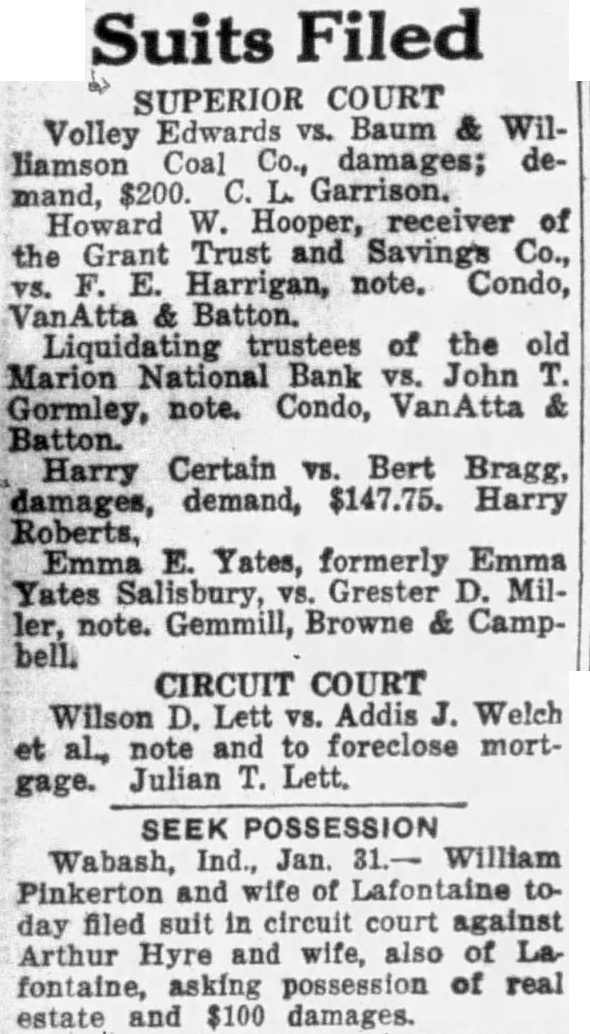
Howard W. Hooper, receiver of the Grant Trust and Savings Co., vs. F. E. Harrigan, note.
Source
newspapers
2. February 27, 1934 Receivership
Newspaper Excerpt
The Grant Trust is in receivership in his court. ... The Grant Trust and Savings Company, a closed institution, bought bonds ... The Grant Trust is in receivership in his court and much of the frozen assets and losses to the estates occurred during the business years of the Grant Trust and up to November, 1930. (Indianapolis Times 1934-02-27).
Source
newspapers
3. November 10, 1934 Other
Newspaper Excerpt
Allowance of claims totaling $209,874 against the receivers of the Grant Trust and Savings Company and the First National Bank, both of Marion, today virtually assured restoration of investments to a large number of incompetent war veterans.
Source
newspapers

Newspaper Articles (10)

Article from Leader-Tribune, February 1, 1934

Click image to open full size in new tab

Article Text

Suits Filed SUPERIOR COURT Volley Edwards vs. Baum & Williamson Coal Co., damages; demand, $200. C. L. Garrison. Howard W. Hooper, receiver of the Grant Trust and Savings Co., vs. F. E. Harrigan, note. Condo, VanAtta & Batton. Liquidating trustees of the old Marion National Bank VS. John T. Gormley, note. Condo, VanAtta & Batton. Harry Certain VS. Bert Bragg, damages, demand, $147.75. Harry Roberts, Emma E. Yates, formerly Emma Yates Salisbury, vs. Grester D. Miller, note. Gemmill, Browne & Campbell. CIRCUIT COURT Wilson D. Lett VS. Addis J. Welch et al., note and to foreclose mortgage. Julian T. Lett. SEEK POSSESSION Wabash, Ind., Jan. 31.- William Pinkerton and wife of Lafontaine today filed suit in circuit court against Arthur Hyre and wife, also of Lafontaine, asking possession of real estate and $100 damages.


Article from The Indianapolis Times, February 27, 1934

Click image to open full size in new tab

Article Text

The Indianapolis Times investigated the guardianship affairs of those veterans, now wards of the court with banks for parents, and found estates dwindling over a period of years from large balances to pin-money. The Times will show in this series on the affairs of patients and former patients of the Marion hospital for veterans that one estate alone dropped from a $5,000 bank balance to FOURTEEN CENTS and several bonds of doubtful value. It will show that it was necessary for one closed bank to lend money to the guardianship it held in trust, in order that court reports might be made to balance without the sale of doubtful holdings. It will show that court reports on the condition of the finances of the veterans' estates were sworn to by banks but that the true values of the securities held in the veterans' estates were not divulged. Change Charged Investments of thousands of dollars were made without court order. In some cases, the securities were purchased two and three years before the circuit court of Grant county knew of the purchase. The series will relate how the Grant Trust and Savings Company, a closed institution, bought bonds in one company when reports of that company showed that it had not paid taxes for two and one-half years and had sustained a net loss the year bonds were purchased, of $14,000. It will show, however, that officers of the Grant Trust in petitioning Grant circuit court for the right to invest. declared the investment "safe and sound and without hazard." Wholesale transfers of mortgages to veterans' estates will be shown to have been made on one day by the Grant Trust Company. One month later, the Grant Trust was merged with the First National bank of Marion (now a closed institution.) The mortgages in some cases still remain unpaid. It will be shown by court records that loans were made to a beer importer of Marion at that time, an official in the bank where the trust was held. Aproval of the purchase of securities for the veterans was given by the court in some cases and some of those securities are never shown again as having been bought or transferred, in the guardianship records of the Grant circuit court. The series will trace operations of one trust officer, who also was listed as secretary, as being in direct contact with these estates of veterans through three banks. Laxity Is Hinted It will charge that he had knowledge of investments from as far back as 1922 and 1923 until the present day. Present state of these investments indicates that the circuit court was lax in investigations before giving approval to the purchase of securities for the estate of the veterans. It will be shown that up to the time of The Times' investigation, Circuit Judge O. D. Clawson never had ordered an audit of the books of the Grant Trust. The Grant Trust is in receivership in his court. Much of the frozen assets and losses to the estates of the incompetent men occurred during the business years of the Grant Trust and up to November, 1930. It will be shown that those anemic investments were taken over in the merger of the Grant Trust and the First National of Marion (now in receivership) It will be shown that records of some estates have come to the attention of the United States district attorney in the guardianship estates, but no action has been taken. While on one hand, the guardianships have been depleted in one closed bank by insecure investments it will be shown that in the Marion National bank (now in liquidation) the securities, or declared main liability, were adequate and safe, but that the wards were permitted seemingly extravagant expenditures. One veteran was permitted to buy eight watches and five watch chains in ten years' time by the


Article from The Indianapolis Times, February 27, 1934

Click image to open full size in new tab

Article Text

circuit court records include a $15 lounging robe and a $9 shirt. One ward was forced to pay for being locked up in a Pennsylvania jail, out of the funds in his estate in Indiana. It will be shown how one ward was permitted to spend $426.45 in clothing in a period of approximately eighteen months. Vouchers on record in the county clerk's office are shown to be inconsistent as to signatures and in turn do not coincide with the checks issued on those vouchers and held in the old Marion National bank and now in the guardianship records of the Marion National of Marion (the new bank and new guardian of the trusts). Procedure Is Studied In one case, a veteran scrawled his name on a voucher at one time on one day and then on the same day could not write his name and merely made a mark "X." Proper bank procedure is to have signatures made with a mark done only above the signature of witnesses. No witness attested to the mark made by the veteran who could not sign his name at one time and then could sign it at another on the same day. In some cases, the court records show unsigned vouchers charged to the estate. Checks in bank accounts of the wards show no indorsements in some cases. Securities in Default In turn, it will be shown that in the regional bureau of the United States veterans' administration in Indianapolis, twelve groups of securities purchased for veterans during the regime of the closed Grant Trust, are listed as defaulted and in some instances on deposit for protection of the bondholders. It will be shown that the succeeding or substitute guardian of the Grant Trust, the First National of Marion (now in receivership). purchased securities without first obtaining a court order for the investment. Early records of the guardianships of the insane veterans show trust officers and other bank officials petitioning to have veterans declared insane and then accepting the guardianship immediately afterward. It will be shown that although one veteran was declared by doctors to be of such ill health that it would be injurious for him to appear in court, that within a short time after the insanity verdict, he was purchasing clothing and spending money in shops of Marion. The Times will show an interiocking of directorships between some of the closed banks and corporations to which purported loans were made out of the veterans' funds. 'Hands Off,' Is Charge The investigation will disclose mortgage loans being made to employes of the Grant Trust out of the guardianships in that bank. According to newspaper reporters of Marion, officers of one of the closed banks asked Marion newspapers to pursue a "hands off" policy. It will be shown attorneys in the regional office of the veterans' bureau in Indianapolis investigated the guardianships in the Grant Trust as far back as the spring of 1933 in an effort to recover alleged losses to the estates. On the other hand, it will be shown that the Veterans of Foreign Wars of Marion took an active interest with Congressman Glenn Griswold in agitating for a true accounting and restoration of the finances of the trusts. (Next-Bonds and Bathrobes.)


Article from The Indianapolis Times, March 3, 1934

Click image to open full size in new tab

Article Text

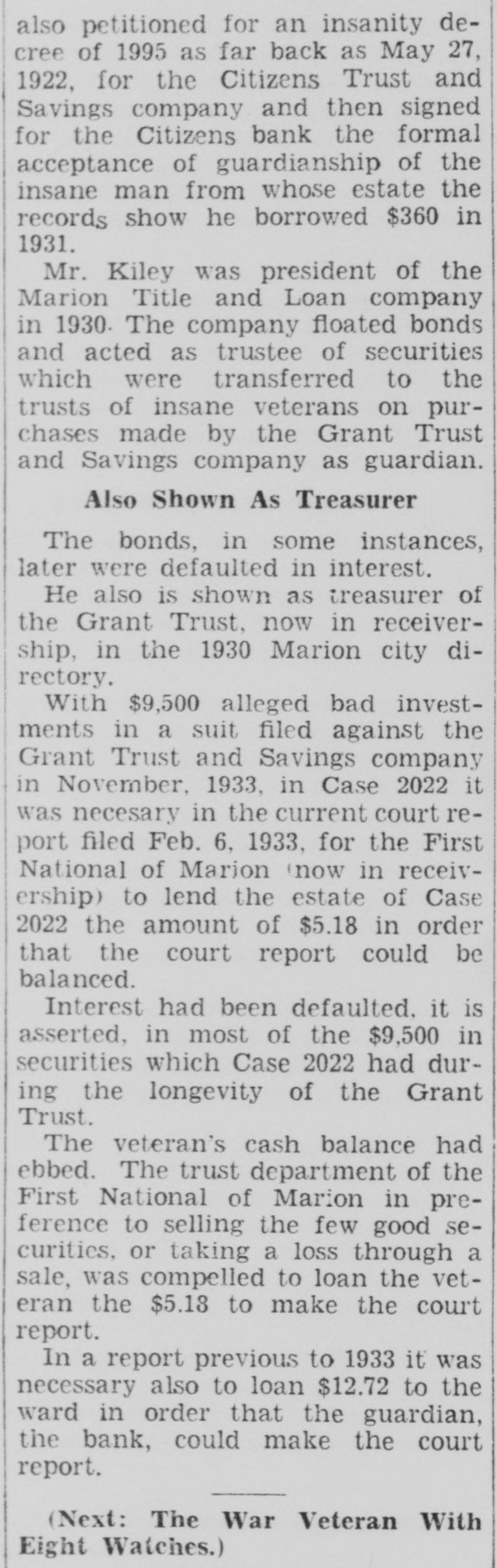
also petitioned for an insanity decree of 1995 as far back as May 27, 1922, for the Citizens Trust and Savings company and then signed for the Citizens bank the formal acceptance of guardianship of the insane man from whose estate the records show he borrowed $360 in 1931. Mr. Kiley was president of the Marion Title and Loan company in 1930. The company floated bonds and acted as trustee of securities which were transferred to the trusts of insane veterans on purchases made by the Grant Trust and Savings company as guardian. Also Shown As Treasurer The bonds, in some instances, later were defaulted in interest. He also is shown as treasurer of the Grant Trust, now in receivership, in the 1930 Marion city directory. With $9,500 alleged bad investments in a suit filed against the Grant Trust and Savings company in November, 1933, in Case 2022 it was necesary in the current court report filed Feb. 6, 1933, for the First National of Marion now in receivership) to lend the estate of Case 2022 the amount of $5.18 in order that the court report could be balanced. Interest had been defaulted. it is asserted, in most of the $9,500 in securities which Case 2022 had during the longevity of the Grant Trust. The veteran's cash balance had ebbed. The trust department of the First National of Marion in preference to selling the few good securities, or taking a loss through a sale, was compelled to loan the veteran the $5.18 to make the court report. In a report previous to 1933 it was necessary also to loan $12.72 to the ward in order that the guardian, the bank, could make the court report. (Next: The War Veteran With Eight Watches.)


Article from The Indianapolis Times, March 3, 1934

Click image to open full size in new tab

Article Text

veteran brought before Grant County Circuit Judge O. D. Clawson, by Marshall Williams, secretary and trust officer of the Grant Trust and Savings company, on Sept. 30, 1930. (Mr. Williams is not the Marshall Williams formerly connected with the Democratic state committee.) The petition was approved for the expenditure of $5,150 of the insane veterans' funds. At the time of the petition, one group of bonds, Harding building, 6½ per cent, for which a $300 investment was asked, had sent out bondholder statements showing a loss of $14,000 for that year and failure to pay taxes on properties two and one-half years prior to 1930. A mortgage loan for $2,500 on the real estate of C. F. Richardson, requested in the investment petition and maturing in Oct. 1930, was foreclosed Jan. 11. 1932, for the estate of the insane veteran and bought by the guardian at a sheriff's sale for $3,124. Cost Was $248.19 It cost the veterans' estate $248.19 in delinquent tax payments, attorney fees, and court costs to obtain the property which on Sept. 30 was termed as a "safe and free from undue hazard and as remunerative to the ward's estate Belmont hotel bonds petitioned for to the extent of $500 in the same court request on Sept. 30. 1930 were later defaulted in interest. and now are said to be in receivership. Harding building bonds too, later were defaulted. On Dec. 12, 1933, losses estimated at $5.150, the exact amount of the so-called safe investments." is sought in a suit against the Grant Trust by the new First National bank in Marion. All Shown As Losses All of the investments cited above are shown as losses to the veteran's estate in the suit. All of the investments had been purchased from six months to three years prior to any court order being obtained for their investment in the ward's estate according to the records. The present receiver of the Grant Trust. Howard W Hooper, refused The Indianapolis Times permission to look at the company's books to establish whether the Richardson mortgage loan was delinquent in either payments of interest or principal when ordered by the court to be placed to the credit of the veterans estate. Mr. Hooper explained that the impending court action. suits. and litigation against the Grant Trust prevented him from clarifying the transactions on Sept. 30. 1930. Bonds presumably purchased in 1926 and petitioned for in that year shrink in value in later reports in guardianship records of the Grant Trust. For instance. in Case 1995, bonds totaling $8,000 in Manghelli Bros.. a Marion corporation in 1926. secured by a mortgage, fade to $4,000 on the final report of the Grant Trust. Purchased in '26, Says Report The bonds. apparently, were petitioned for and purchased in 1926 with the purchase date on the Grant's ledger, according to the veterans' bureau report. as May 25. 1926. but the petition to invest with court approval made for $8,000 of the bonds on Oct. 18, 1926. The earlier alleged purchase of the bonds shows that in May, 1926 only $4,000 of the bonds were bought instead of $8,000 petitioned for five months later. The same variance of amounts credited to estates shows in current court reports of realty mortgages assigned to the incompetent veterans estates. Case 1970 who at preesnt is in a closed ward at the Marion Veteran's hospital, is shown by investment petitions to have had purchased for his estate by the Grant Trust a mortgage loan for $1,300 and $1,000 on property of Lewis F. De Wolf, Marion But in Sept. 30, 1930, a new investment petition is requested for $1,800 mortgage on the De Wolf property. Loan Shown Paid Off In Nov. 25. 1933, the Lewis DeWolf loan is shown paid off in the final report of the First National of Marion (now in receivership) but the amount of the loan is $1,300 not the $1.800 as shown in the investment petition of Sept. 30, 1930 nor $1,000 as shown to be one of the requested purchases on March 6 of the same year The First National of Marion took over the guardianships of the Grant and the records on Case 1907 as well as the assets and liabilities. A loan from an individual to an individual secured by an adjusted compensation certificate (bonus) is not permissible under the United States Veterans administration. The loans may be made by a bank to an individual. In the guardianship court records of Case 1995 is shown a $360 loan secured by a bonus certificate, to Robert Patrick Kiley. The loan notation is in the first


Article from The Indianapolis Times, March 6, 1934

Click image to open full size in new tab

Article Text

trusts of insane ex-soldiers. B. W Breedlove chief attorney of the Indianapolis bureau. says his records show in trusts held at one time by the Grant Trust and Savings Company, now in receivership, that the above amount of investments are shown on the present guardianship records against $167,696 in properly invested funds. Indiana's law on guardianships provides that trusts should be managed "for the best interests of his ward." "The degree of care to be exercised by guardians is the same as prudent persons exercise in their own affairs," cites a case, Wainwright VS. Burroughs, 27 N. E. "It is the duty of a guardian as far as practicable to keep the funds of his wards so invested that they will draw interest. and to use due care in making investments, avers a decision in State VS. Sanders, 62, Ind. 562. In the same case is the citation. "use by a guardian of the funds of the ward in his own business is a conversion of funds." No Bonds Were Needed Up to the passage of an act in 1931 governing specifically war veterans' estates under jurisdiction of a guardian it was not necessary for banks. when acting as trustees, to give bonds. Not only guardianship now in litigation in the Grant circuit court for war veterans was bonded by the depository acting as parent for the ward. Mr. Breedlove says attempts to pass the act in legislatures prior to 1931 met with opposition from bankers of Indiana. "They had lobbyists in the legislatures who watched judiciary committees for bills of that type and were quick to oppose the act," explains Mr. Breedlove. "But we got it through both houses in 1931," he chuckled. "How Did You Do It?" "After it was passed a certain banker came to me and said, Well. you put it over. How did you do it? No bill like that was reported out of the judiciary committee'." "I told him." added Mr. Breedlove, "that it was reported out by the World war memorial committee. "But what has a World war memorial committee to do with the guardianships of insane veterans?" replied the chagrined banker. The new veterans' act prevents overcharge of guardianship fees by trustees by setting a maximum of 5 per cent of the estate's income as a fee unless amended by a special court hearing. It provides that bonds must be made by banks as well as individuals "in an amount not less than the sum then due and estimated to become payable during the ensuing year." Bonds in Full Required Mr. Breedlove now requires the present Marion banks. First National in Marion and Marion National of Marion. to give bonds in full for the funds on hand and due in the estates of World war veterans. The act precludes the investment of a veterans' funds in enterprises in which the guardian may have interest with "Every guardian shall invest the funds of the estate in securities in which the guardian has no interest One of the main points of law proving a bone of contention between attorneys for the First National bank of Marion (now in receivership) and Mr. Breedlove is the extent of the liability of the First National (the old bank) in taking over the veterans' guardianships from the defunct Grant Trust and Savings Company Attorneys for the old First National declare that in accepting the trusts the bank took them as guardian and executor. but only for "safekeeping and accounting Court Records Scanned Mr. Breedlove and attorneys for the new First National. however charge that the liability of the old bank is on a par with that of the Grant Trust and that the old First National had knowledge of the shattered securities in the veterans estate in that Marshall Williams, trust officer in the Grant. became trust officers of the old First Nation. Mr. Williams has sworn to a great number of the court reports on conditions of the estates throughout the past ten years, Grant circuit court records show. Some directors and officers from the old Citizens Trust and Savings Company are followed into the merger with the Grant Trust and thence into the First National of Marion and now into the present institution. First National in Marion. is found in a perusal by The Times of directories and bank statements of officers. It also is revealed that some of these officers and directors were incorporators of companies or officials in firms whose securities were placed in veterans' estates or were purported to have been purchased for their estates by the guardian bank. In other instances some of the bank officials were interested financially in those companies flor ing bond issues. Listed as Secretary-Treasurer Beginning with the original officers of the Citizens Trust and Saving bank it is shown that Willard El kins, president of that bank at one time, later became acting vice president. of the Grant Trust.


Article from The Indianapolis Times, July 26, 1934

Click image to open full size in new tab

Article Text

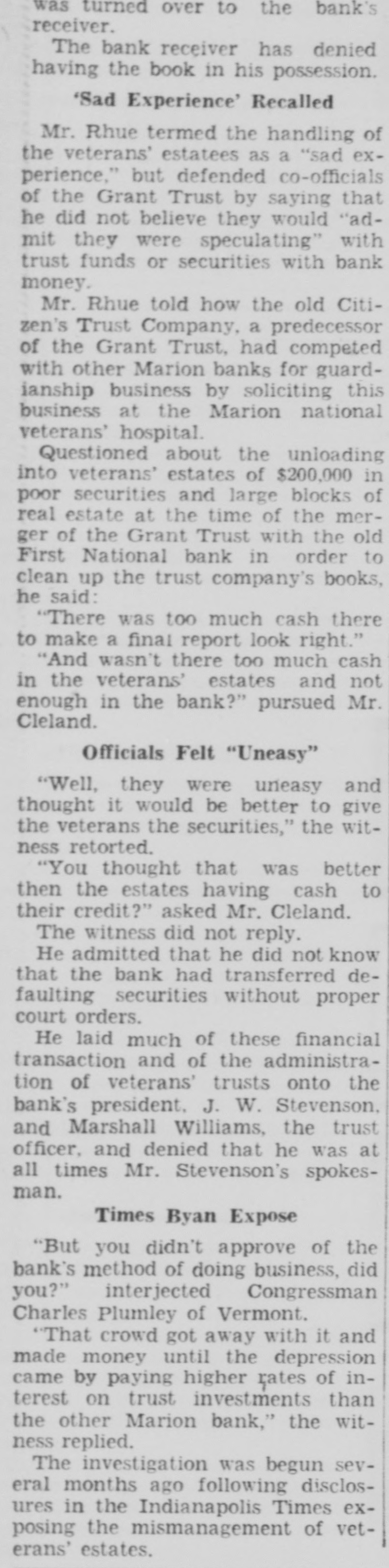
Was turned over to the bank's receiver. The bank receiver has denied having the book in his possession. ### 'Sad Experience' Recalled Mr. Rhue termed the handling of the veterans' estatees as a "sad experience," but defended co-officials of the Grant Trust by saying that he did not believe they would "admit they were speculating" with trust funds or securities with bank money. Mr. Rhue told how the old Citizen's Trust Company, a predecessor of the Grant Trust, had competed with other Marion banks for guardianship business by soliciting this business at the Marion national veterans' hospital. Questioned about the unloading into veterans' estates of $200,000 in poor securities and large blocks of real estate at the time of the merger of the Grant Trust with the old First National bank in order to clean up the trust company's books, he said: "There was too much cash there to make a final report look right." "And wasn't there too much cash in the veterans' estates and not enough in the bank?" pursued Mr. Cleland. ### Officials Felt "Uneasy" "Well, they were uneasy and thought it would be better to give the veterans the securities," the witness retorted. "You thought that was better then the estates having cash to their credit?" asked Mr. Cleland. The witness did not reply. He admitted that he did not know that the bank had transferred defaulting securities without proper court orders. He laid much of these financial transaction and of the administration of veterans' trusts onto the bank's president, J. W. Stevenson, and Marshall Williams, the trust officer, and denied that he was at all times Mr. Stevenson's spokesman. ### Times Byan Expose "But you didn't approve of the bank's method of doing business, did you?" interjected Congressman Charles Plumley of Vermont. "That crowd got away with it and made money until the depression came by paying higher rates of interest on trust investments than the other Marion bank," the witness replied. The investigation was begun several months ago following disclosures in the Indianapolis Times exposing the mismanagement of veterans' estates.


Article from The Indianapolis Times, November 10, 1934

Click image to open full size in new tab

Article Text

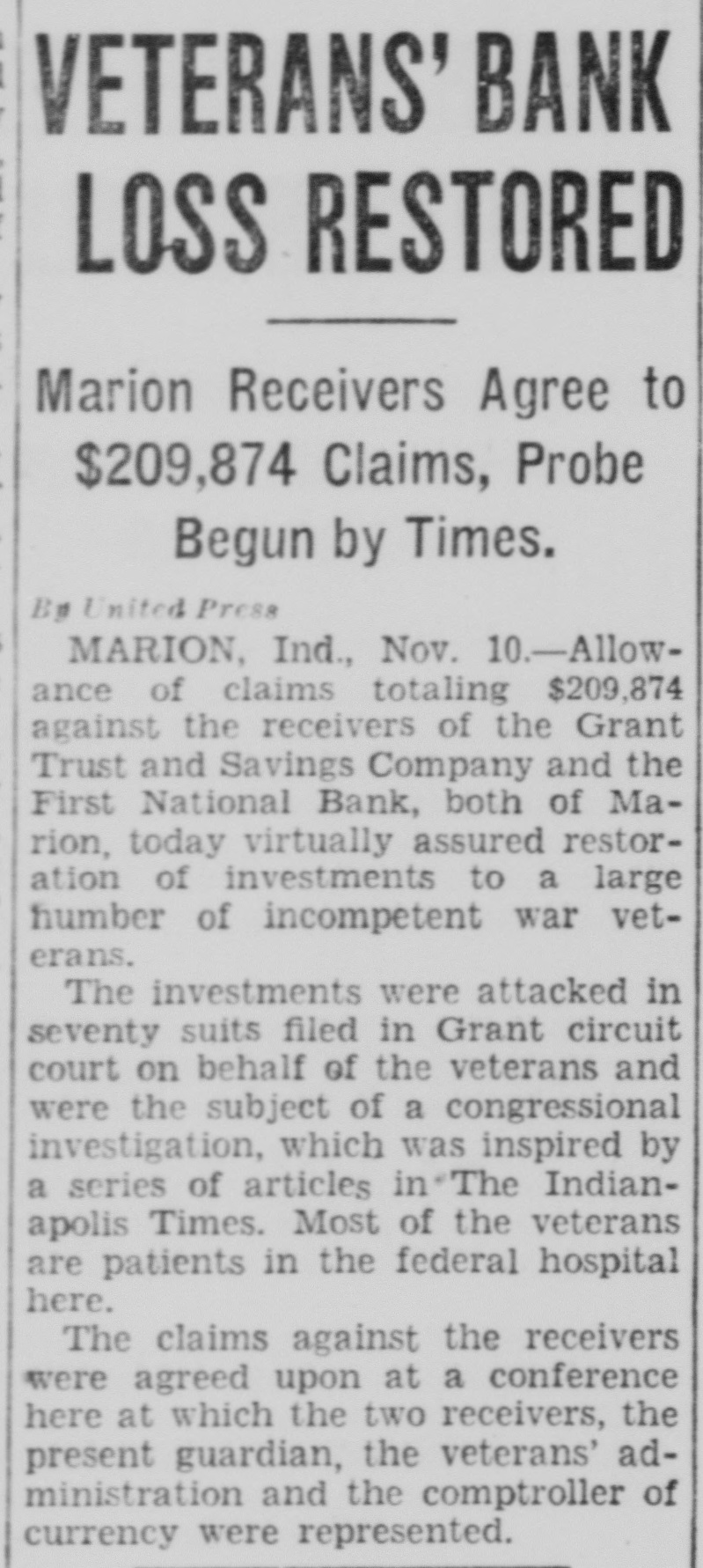
VETERANS' BANK LOSS RESTORED Marion Receivers Agree to $209,874 Claims, Probe Begun by Times. By United Press MARION, Ind., Nov. 10.-Allowance of claims totaling $209,874 against the receivers of the Grant Trust and Savings Company and the First National Bank, both of Marion, today virtually assured restoration of investments to a large humber of incompetent war veterans. The investments were attacked in seventy suits filed in Grant circuit court on behalf of the veterans and were the subject of a congressional investigation, which was inspired by a series of articles in The Indianapolis Times. Most of the veterans are patients in the federal hospital here. The claims against the receivers were agreed upon at a conference here at which the two receivers, the present guardian, the veterans' administration and the comptroller of currency were represented.


Article from Leader-Tribune, December 11, 1934

Click image to open full size in new tab

Article Text

Court Minutes Circuit Court Malinda Pence vs. Ova Renbarger et al. Injunction. Affidavit and motion for change of venue from judge by defendants filed. American National Bank at Indianapolis vs. Estate of J. W. Stephenson, deceased. Appearance of Gemmill, Browne & Campbell for plaintiffs withdrawn. Amendment to amended claim filed by claimant. Notice ordered to J. F. Charles at al., returnable Dec. 26, 1934. In the receivership of the Grant Trust and Savings Co. Petition for order canceling and rescinding former orders authorizing execution of deed to Mabel Johnson and rescinding the approval by the court of said deed and ordering the receiver to destroy said deed by receiver filed, submitted and granted as prayed. In the matter the trust created by Lydia F. Seegar for the benefit of Virginia Heavilin Joint final report of George W. Rauch as receiver of the First National Bank ings Co., and petition ment of substitute trustee filed, submitted and joint final report approved and First National Bank in Marion now appointed substitute trustee. Written acceptance of trust filed and upon showing that balance of funds has been turned over to substitute trustee said original trustees are now discharged. John Walters vs. Sadie Ellen McGuire et al. Partition. Answer in general denial filed. Also crosscomplaint by defendants filed. Merrill Edwards vs. Carl F. Barney et al. Petition for recount. The recount commissioners having filed in the clerk's office their certificate showing the number of votes that each candidate received for the office of mayor of the city of Marion, today, Dec. 10, 1934, as shown by recount, and which candidate as shown by such recount received the highest number of votes and showing what his majority or plurality was, the court now orders the clerk to record said certificate in the order books of this court. The court now fixes Dec. 28, 1934, as date for hearing. Claude H. Allegar vs. Orla H. Sinclair et al. Petition for recount. The recount commissioners having today, Dec. 10. filed in the clerk's office their certificate showing the number of votes that each candidate received for the office of councilman-at-large for the city of Marion, as shown by recount, and which candidates as shown by said recount received the highest number of votes and showing their respective majorities or pluralities, the court now orders the clerk to record said certificate in the order books of the court and fixes Dec. 28. 1934, as date for hearing. SUPERIOR COURT Civil Docket Rome T. Calender as receiver of the Gas City State Bank, and Frank Hundley as receiver of the Citizens Bank, Jonesboro, vs. Seneca W Winder as administrator with the will annexed of the estate of Edward Bloch, deceased, et al. Answer of Willis S. Ellis as executor of Jane Davis, deceased, filed. Marjorie Cross vs. Minard Cross. Divorce. Defendant ordered released from jail until further order of court. Dorothy Jean White VS. Daniel J. White. Divorce. Hearing on attachment had and defendant is discharged on condition that he keep and not dispose or encumber the 26 vending machines now in his possession. In the receivership of the Gas City State Bank. Petition by receiver to settle compromise mortgage indebtedness and accept Home Owners' Loan Corp. bonds and recovery real estate to Meriam F. Jay filed, submitted and granted and ordered as prayed. Petition by receiver for authority to compromise and settle mortgage indebtedness of Berete Spurgeon filed, submitted and ordered. Lilburn M. Keese vs. Florence E. Keese. Application for suit money submitted and plaintiff is ordered to pay to clerk $25 on or before Jan. 20, 1935, for use of defendant with which to pay her attorney Florence E. Keese vs. Lilburn M. Keese. Divorce. The court on its own motion orders this cause submitted with the cause entitled Lilburn M. Keese vs. Florence E. Keese, and this cause is ordered off the docket. Mary Hacker vs. William Hacker. Divorce. Hearing on application for suit money submitted and defendant is ordered to pay to clerk $25 on or before Jan. 15, 1935, for use of plaintiff with which to pay attorney. Elma M. Nelson vs. Roy Nelson. Divorce. Application by plaintiff for suit money filed. Hearing set for Dec. 17, 1934, at 9 a. m. Notice ordered. William Spath VS. Mayme R. Shawle, Jacob H. Huffman. Partition. Death of John W. Duffey, receiver, suggested to court and H. McConnell is appointed receiver. Bond is filed at $100. Charles E. Milner VS. Harry Miller. Foreclosure mechanic's lien. Cause submitted, evidence heard, argument heard and same taken under advisement. Criminal Docket State of Indiana vs. Emory Wilson, Ed Raymond. Petit larceny. Defendants arraigned in open court and each now enters plea of guilty and upon such plea the court finds each defendant guilty as charged, that the true age of Emory Wilson is 38 years, that the true age of Ed Raymond is 77 years, and court fixes their punishment that each be fined $50 and costs and that each be imprisoned in Indiana state farm for nine months. Judgment on finding, and the sheriff is charged with the execution of the judgment. State of Indiana vs. Devonna McCall. Voluntary manslaughter. On motion of prosecuting attorney, the court orders that clerk and jury commissioners draw special venire of 25 names for jurors and summon said jurors to appear on Dec. 17, 1934, for trial of this cause.


Article from Leader-Tribune, December 11, 1934

Click image to open full size in new tab

Article Text

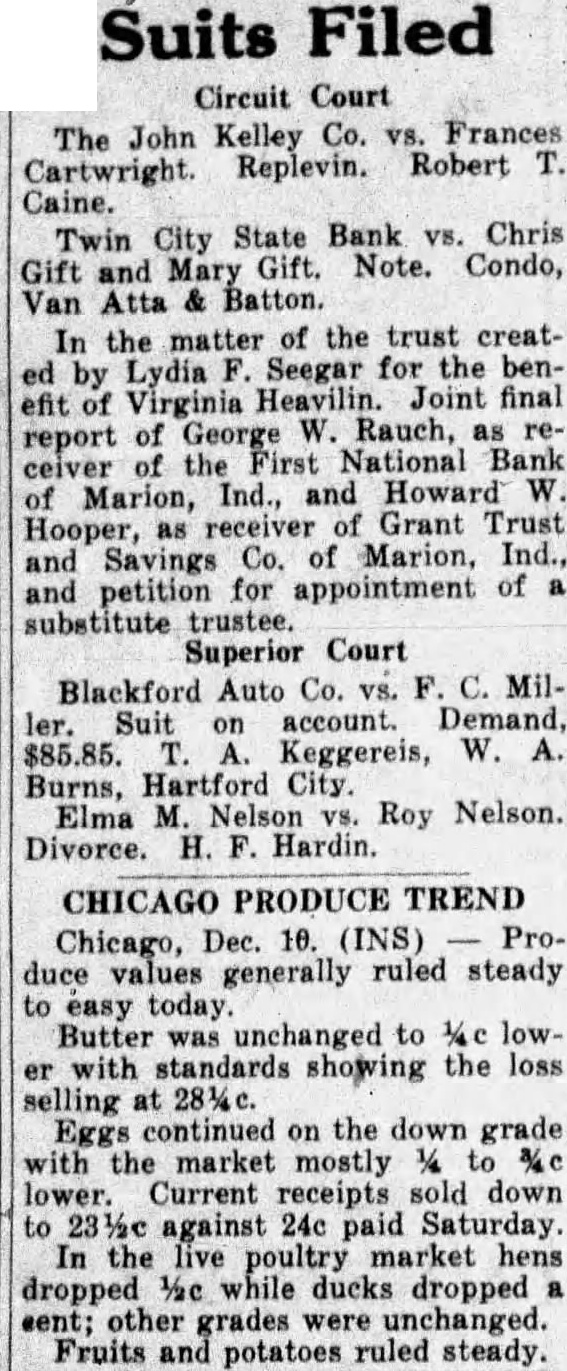
Suits Filed Circuit Court The John Kelley Co. vs. Frances Cartwright. Replevin. Robert T. Caine. Twin City State Bank VS. Chris Gift and Mary Gift. Note. Condo, Van Atta & Batton. In the matter of the trust created by Lydia F. Seegar for the benefit of Virginia Heavilin. Joint final report of George W. Rauch, as receiver the First National Bank of Marion, Ind., and Howard W. Hooper, as receiver of Grant Trust and Savings Co. of Marion, Ind., and petition for appointment of a substitute trustee. Superior Court Blackford Auto Co. vs. F.C. Miller. Suit on account. Demand, $85.85. T. Keggereis, W. A. Burns, Hartford City. Elma M. Nelson vs. Roy Nelson. Divorce. H. F. Hardin. CHICAGO PRODUCE TREND Chicago, Dec. 10. (INS) Produce values generally ruled steady to easy Butter was unchanged to 1/4c lower with standards showing the loss selling at Eggs continued on the down grade with the market mostly 1/4 to %c lower. Current receipts sold down to 231/2 against 24c paid Saturday. In the live poultry market hens dropped 1/2c while ducks dropped other grades were unchanged. Fruits and potatoes ruled steady.