6053. Mulberry State Bank (Mulberry, KS)

Bank Information

Episode Type
Suspension → Closure
Bank Type
state
Start Date
November 1, 1907*
Location
Mulberry, Kansas (37.557, -94.622)

Metadata

Model
gpt-5-mini
Short Digest
699ca638808de954

Response Measures

None

Description

The articles describe multiple episodes for the Mulberry State Bank. In 1907 the bank was put in the hands of a receiver after the Bankers' Trust collapse but was sold and reopened shortly thereafter. Separately, the bank closed again in August (summer) 1926 and was treated as defunct with an assistant receiver paying a dividend in January 1927 and receivers named in March 1927. The 1926–27 closure appears tied to dishonest management/financier John Miller and resulted in receivership; while there was talk of reorganization, the reporting treats the institution as defunct and in receivership. I therefore classify the overall later episode as a suspension followed by closure/receivership. I corrected/combined events across articles from 1907–1908 and 1926–1929; dates are taken from article publication context where explicit dates were not given.

Events (5)

1. November 1, 1907* Reopening
Newspaper Excerpt
The Mulberry State bank closed because its money was tied up in the Bankers' Trust The same day it was sold to Miller Bros. who opened the bank up for business as usual the next day, and it has been doing business ever since.
Source
newspapers
2. November 22, 1907 Receivership
Newspaper Excerpt
Attorney General F. S. Jackson has taken a hand in the effort to save the three little Kansas banks which went to the wall as a result of the collapse of the Bankers' Trust company in Kansas City...the Mulberry bank, which is now in the hands of a receiver.
Source
newspapers
3. August 1, 1926* Suspension
Cause
Bank Specific Adverse Info
Cause Details
Closed in summer 1926; later reporting ties failures of banks in the Miller chain and dishonest management of financier Jonathan (John) Miller as causing closures.
Newspaper Excerpt
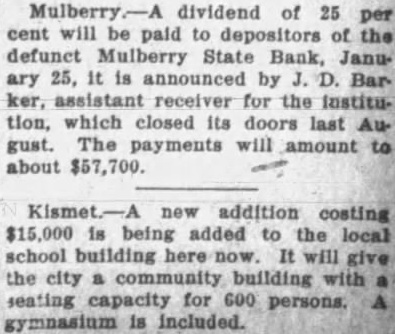
dividend of 25 per cent will be paid to depositors of the defunct Mulberry State Bank, Janu25, it is announced by Barassistant receiver for the Institution, which closed its doors last August.
Source
newspapers
4. March 1, 1927* Receivership
Newspaper Excerpt
ANNOUNCE BANK RECEIVERS ... Mulberry bank plans re-organize and re-open ... named receiver ... Miller, head of the banking chain, personally proved the named, posing their names to the missioner.
Source
newspapers
5. January 3, 1929 Other
Newspaper Excerpt
Crawford County, Kansas, Financier Found Guilty on 25 Counts in Bank Failure. ... Miller of Mulberry, former head of six Kansas banks, all which closed their doors February 1927, was found guilty today ... The bank has since reopened.
Source
newspapers

Newspaper Articles (6)

Article from The Topeka State Journal, November 22, 1907

Click image to open full size in new tab

Article Text

JACKSON TO HELP Attorney General Will Try to Rescue Three Little Banks. Ones Affected by Bankers' Trust Crash. ROYCE A BUSY MAN. Having a Time to Straighten Out Tangles. Situation in Financial Circles Apparently Brightening Up. Attorney General F. S. Jackson has taken a hand in the effort to save the three little Kansas banks which went to the wall as a result of the collapse of the Bankers' Trust company in Kansas City. These three banks are located at Mulberry, Coyville and Garland. Mr. Jackson was in Kansas City Wednesday, and the purpose of his visit was to investigate some of the matters connected with the Mulberry bank, which is now. in the hands of a receiver. There are rumors that the appearance of the attorney general in the case means that criminal prosecutions may be started against some parties who were instrumental in loading up the Mulberry bank with worthless paper. This worthless paper was placed in the bank, and cash was drawn out in its stead, and now the receiver is trying to compel the parties responsible to make good. Bank Commissioner John Q. Royce is also devoting his whole time at pres" ent to his efforts to help the three little banks out of their trouble. The banks at Coyville and Garland are in better shape than the one at Mulberry, and no receivers have been appointed for them. The citizens of the towns are willing to buy the stock of the two banks, and continue the operation of the banks, but the receiver of the Bankers' Trust, who holds the stock, wants too high a price. The Mulberry bank was largely the private enterprise of a man named Brady who was prominent in Bankers' Trust affairs. There are about twenty other banks in Kansas which were tied up more or less with the Bankers' Trust, but these have all secured possession of their stock by purchase from the receiver, and are in as good condition as ever. It was announced today at the state banking department that all reports received from Kansas banks are of an encouraging nature. There are no other banks aside from those involved in the Bankers' Trust affair which have shown signs of distress. "Conditions are steadily improving" said the state banking officials. "The reserve of the Kansas banks is larger today than it ever has been in the history of the state. There is also more cash on hand today than ever before. This is because bankers have limited withdrawals, and have been gradually getting in more and more money from their correspondent banks in the east. The only thing to be guarded against is the panicky withdrawals which might follow a removal of the lid. Money withdrawn in that way is out of circulation and becomes a menace. As long as it stays in the bank it is a safeguard." Bank Commissioner John Q. Royce said: "If I should issue a call for a statement of the condition of Kansas banks today, I am confident that it would show that the reserve is larger than at the time of the last call, when all previous records were broken. The Kansas banks are also gradually accumulating more currency, and business will gradually resume normal conditions. Before people know it, they will find that the 'lid' has been lifted, and that money is circulating as freely as ever." Mr. Royce yesterday received a long distance telephone communication from the southern part of the state from an indignant bank patron. "I have $2,600 in the bank here," he said. "and I am all packed up ready to move to Texas. I want my money and they won't give it to me." "Won't they give you a draft?" asked Mr. Royce. "Oh, yes, they'll give me a draft." "Is it on a good bank?" "Yes, the bank's all right." "Well, then," said Mr. Royce, "if I were you, I'd take the draft." "But I want the cash," said the man. "Why won't they give it to you?" inquired Mr. Royce, innocently. "They haven't got it," was the frank reply. "Well, do you want me to come down and close up the bank?" said Mr. Royce. "Oh, no, I don't want you to do that," said the man hastily. "Well, how can I make the bank pay you your $2,600 in cash if they haven't got it?" inquired Mr. Royce. "Well, I don't know, admitted the man. "But I think they ought to give me three or four hundred dollars in cash, anyway." sold Mr. Poyce

Article from The Topeka State Journal, February 27, 1908

Click image to open full size in new tab

Article Text

Bankers' Panic and Its Effect on Kansas. Only Two Banks That Closed for Good. DUETOOTHER CAUSES. In Both Cases Dishonest Management Did It. Eleven Others That Quit Have Resumed Business. is Now that the "bankers' panic" over, it is interesting to foot up the net results in the state of Kansas. Things looked bad at one time. When the Bankers' Trust company of Kansas City went down, closely followed by the Bank of Commerce, both of which were heavily patronized by Kansas banks, it was expected that the state of Kansas would be lucky if it escaped without most serious difficulties. The reports in the office of State Bank Commissioner John Q. Royce show that during the whole of the 'panic," only 13 state banks in Kansas closed their doors and eleven of these are again doing business. Seven banks closed because of the Bankers' Trust failure, and six of these have resumed business. Three banks closed because of the Bank of Commerce failure and all have resumed business. Three banks became involved by dishonest officials, and one of these resumed business. Another paid out in full and quit. The only banks in the state which closed for keeps during the panic' were the Citizens' State bank of Mulberry (Crawford county) and the Bank of Ellinwood (Barton county) The Citizens' State bank of Mulberry was owned entirely by President Brady of the Bankers' Trust. Brady borrowed all the money of the Mulberry bank, and left it strapped. The Ellinwood bank was robbed blind by Bochemole, who later committed suicide. The history of the eleven banks which closed and then resumed is ina teresting because it shows on what solid basis the banks of Kansas have been doing business. As this history is well known in the localities where the banks are doing business, no harm can be done in making it public In fact, the thing which saved these banks was the fact that they took their stockholders and depositors into their confidence, and showed them exactly where they stood. The public stood by the bankand helped them to continue in business. The Bank of Scottsville was closed because of bad management on the part of its officials. However, the depositors have been paid up in full, and a new bank has been started at Scottsville to take the place of the old one. The Arcadia State bank failed because its president lived too high, and borrowed too much money from the bank. When he came to the finish, his relatives stepped in and made good all in the shortage. The bank continued business with a new president. The seven banks which were thrown into difficulty by the Bankers' Trust failure were these Mulberry State bank, Crawford county Citizens' State bank, of Mulberry. Coyville State bank, Wilson county. Garland State bank, Bourbon county. Fontana State bank. Miami county Peoples State bank of Richmond, Franklin county Heston State bank. Harvey county. The Mulberry State bank closed because its money was tied up in the Bankers' Trust The same day it was sold to Miller Bros. who opened the bank up for business as usual the next day, and it has been doing business ever since. The Coyville bank had $5,700 in the Bankers' Trust, and the Bankers' Trust owned 57 shares of stock in the bank. The bank forfeited its $5,700, and got its stock back. It sold the stock and resumed business today This is the bank of which Senator Robertson is president The Citizens' State Bank of Garland closed and its stockholders at once started a new bank known as the Home State bank. One of the officers of the HomeState bank was appointed receive for the Citizens, and all the assets of the Citizens' are being handled through the new bank. This bank will pay its depositors in full, and it might be said that the Home bank is practically the same as the old Citizens' State bank. When the Fontana State bank found a that it was involved in the Bankers' Trust crash, meeting of the stockholders was quickly called, and it was decided to shut up the bank temporarily and send the cashier to Kansas City to see what could be done. This prompt action enabled the cashier to get hold of all the paper in the Bankers' Trust belonging to the Fontana bank before a receiver was named. The bank was closed from October 29 till November 18, and then resumed business. The People's State Bank of Richmond and the Heston State bank were closed only a few days until the officers could find out "where they were at.' The three failures due to the Bank of Commerce crash were not even as serious as those due to the Bankers' Trust disaster, for the Commerce failure was an honest failure, while the Bankers' Trust trouble was due to dishonest methods on the part of the management. The First State Bank of Argentine, when the news of the Commerce falld ure reached it. remained open until 2 o'clock in the afternoon. Then the cashier became alarmed for fear that e his bank was insolvent, and that he would be liable to punishment for taking deposits, and closed his bank. It was closed for just one business hour. for the next morning it opened up as usual. The State Bank of Admire in Lyon e county and the Pledmont State bank in Greenwood county, both closed for a day or two, and then resumed business as usual. There were hundreds of Kansas banks with large balances in the Bank of k Commerce, and none of them will lose a cent. It is admitted that this bank 0 will pay out dollar for dollar, and the


Article from The Independent, December 10, 1926

Click image to open full size in new tab

Article Text

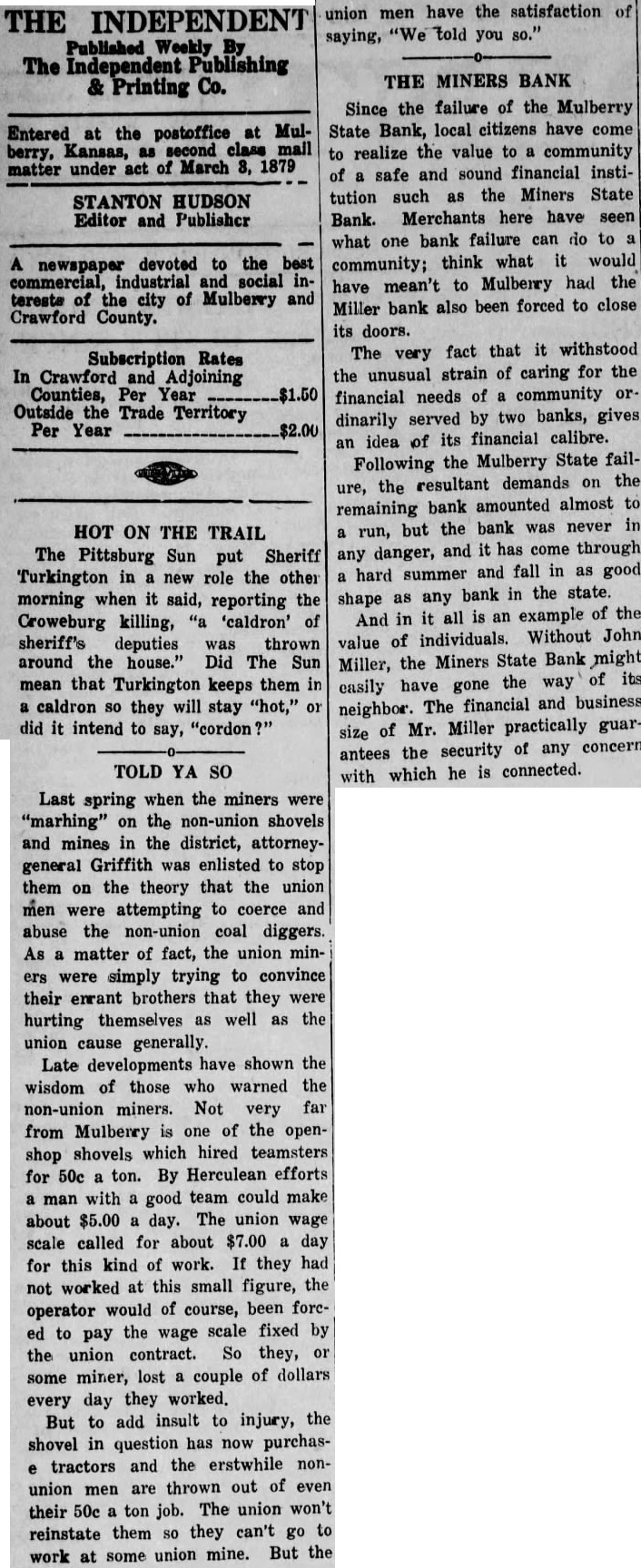
THE INDEPENDENT Published Weekly By The Independent Publishing & Printing Co. A newspaper devoted to the best commercial, industrial and social interests of the city of Mulberry and Crawford County. Subscription Rates In Crawford and Adjoining Counties, Per Year $1.50 Outside the Trade Territory Per Year $2.00 HOT ON THE TRAIL The Pittsburg Sun put Sheriff Turkington in a new role the other morning when it said, reporting the Croweburg killing, "a 'caldron' of sheriff's deputies was thrown around the house." Did The Sun mean that Turkington keeps them in a caldron so they will stay "hot," or did it intend to say, "cordon TOLD YA SO Last spring when the miners were "marhing" on the non-union shovels and mines in the district, attorneygeneral Griffith was enlisted to stop them on the theory that the union men were attempting to coerce and abuse the non-union coal diggers. As a matter of fact, the union miners were simply trying to convince their errant brothers that they were hurting themselves as well as the union cause generally. Late developments have shown the wisdom of those who warned the non-union miners. Not very far from Mulberry is one of the openshop shovels which hired teamsters for 50c a ton. By Herculean efforts a man with a good team could make about $5.00 a day. The union wage scale called for about $7.00 a day for this kind of work. If they had not worked at this small figure, the operator would of course, been foreed to pay the wage scale fixed by the union contract. So they, or some miner, lost a couple of dollars every day they worked. But to add insult to injury, the shovel in question has now purchase tractors and the erstwhile nonunion men are thrown out of even their 50c a ton job. The union won't reinstate them so they can't go to work at some union mine. But the union men have the satisfaction of saying, "We told you so." THE MINERS BANK Since the failure of the Mulberry State Bank, local citizens have come to realize the value to a community of a safe and sound financial institution such as the Miners State Bank. Merchants here have seen what one bank failure can do to a community; think what it would have mean't to Mulberry had the Miller bank also been forced to close its doors. The very fact that it withstood the unusual strain of caring for the financial needs of a community or dinarily served by two banks, gives an idea of its financial calibre. Following the Mulberry State failure, the resultant demands on the remaining bank amounted almost to a run, but the bank was never in any danger, and it has come through a hard summer and fall in as good shape as any bank in the state. And in it all is an example of the value of individuals. Without John Miller, the Miners State Bank might easily have gone the way of its neighbor. The financial and business size of Mr. Miller practically guarantees the security of any concern with which he is connected.


Article from Mcdonald Standard, January 27, 1927

Click image to open full size in new tab

Article Text

dividend of 25 per cent will be paid to depositors of the defunct Mulberry State Bank, Janu25, it is announced by Barassistant receiver for the Institution, which closed its doors last August. The will amount about new addition costing $15,000 is being added to the local school building here will give the city community building seating capacity for 600 persons. included.


Article from The Emporia Gazette, March 7, 1927

Click image to open full size in new tab

Article Text

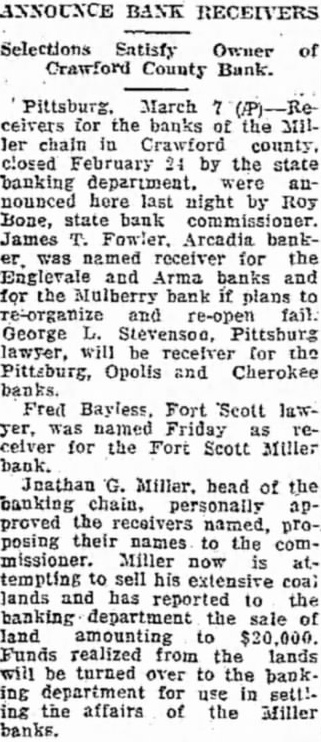
ANNOUNCE BANK RECEIVERS Selections Satisfy Owner of Crawford County Bank. Pittsburg. March ceivers the banks the chain closed by the state banking department. were nounced here last night Roy Bone, bank commissioner. James Fowler. Arcadia named receiver for Englevale and Arma banks and Mulberry bank plans re-organize and re-open fail. George Stevenson, Pittsburg lawyer, be receiver Pittsburg, Opolis and Cherokee Fred Bayless, Fort Scott lawnamed Friday for the Fort Scott Miller bank. Joathan Miller. head of the banking chain, personally proved the named, posing their names to the missioner. Miller now tempting sell extensive lands reported to the banking department the sale land amounting Funds realized from the lands turned the bankdepartment for sett!affairs of the Miller banks.


Article from Joplin Globe, January 3, 1929

Click image to open full size in new tab

Article Text

Crawford County, Kansas, Financier Found Guilty on 25 Counts in Bank Failure. All Banking Institutions of Which President Failed Reopened. Pittsburg, Kan., Jan. than Miller of Mulberry, former head of six Kansas banks, all which closed their doors February 1927, was found guilty today in district court at Fort Scott on counts of deposits the Midwest cepting State bank Fort Scott after he knew the bank was in failing condition, and count of makone false entries the bank ords and sending false reports the state banking department. Miller formerly was president of the Fort Scott bank and banks Pittsburg, Arma, Englevale, Mulberry, Cherokee and Opolis. The bank has since reopened. Jury Out Half Hour. The jury deliberated only thirty minutes before verdict. Trinkle, however, sentence until o'clock Saturday morning Sentence for each count from five may years the state penitentiary. from $1,000 to $5,000 fine, both. event sentence sentences may consecutively. The defense filed motion for trial. In the original petition there seventeen counts charging Miller with but dismissed funds, court had granted the fense motion for particulars. The trial Montee, vice the Midwest bank, president will not be hald until the probably court since several of May attorneys will be the the lature. He faces similar charges. Miller's trial began December delayed by the illness and the counsel. Counsel for the state attempted Miller's connection with show bank. alleging that the value often exceeded the limit the state law. that by companies which not incorporated. Members alleged discrepancies Land Practically Worthless. the defense. the Counsel show other hand, attempted Miller had enough coal that the obligation the lands Value of coal lands bank. placed between the amount owed depositors the bank only State however. $20,000. forward facts show that brought much the coal land was practiworthless. The defense also attempted that Miller, president had little do with the bank, actual management and hence be held responsible. himself, In testifying stand Monday, sald witness that through his Connolly, working co-operation state banking department, had tried sell property his debts, and that Connolly made several trips various effort to dispose of his points He did 280 acres of to Mr. Clemens Fart of this Pittsburg, land to the extent added. Land In Missouri, Too. Warren, attorney for the receiver, declared that the bank's defense had first tried to that his agents had tried to his debts, property pay buldn't sell and then had themselves and tried they were selling lands chiefly Kansas, and county, Barton Missouri. At time regarded one the men this section the because his huge holdcountry coal lands and because industrial enterprises. His conviction followed series actions, and bankruptcy proceedings still pending him federal court. The against actions suits filed by receivers the various banks which falled. and understood that paid practically all the notes. The criminal Fort Scott the only ones that nature filed against rumored that the banks would Pittsburg and Crawford county bankers met to