
Exchange Bank (Barry, IL)

Episode Information

Episode UID
6024798491269
Episode Type
Suspension โ†’ Closure
Bank Type
private
Bank ID
602479849 hash
Start Date
September 19, 1905
Location
Barry, Illinois (39.694, -91.039)

Metadata

Model
gpt-5-mini (chosen from majority vote of a three-model LLM ensemble)
Short Digest
65db5ab9616737c3

Response Measures

None

Description

Articles report the bank closed and insolvent but do not explicitly mention a receiver.

Events (1)

1. September 19, 1905 Suspension
Cause
Bank Specific Adverse Info
Cause Details
Bank insolvent/failed with about $100,000 indebtedness; president left to straighten out affairs and assigned holdings to a stockholder
Newspaper Excerpt
The Barry Exchange bank of Barry... closed its doors to-day and a notice posted on the door announces that it will not reopen until the return of Eugene Smith, the president
Source
newspapers

Newspaper Articles (4)

Article from The St. Louis Republic, September 20, 1905

Click image to open full size in new tab

Article Text

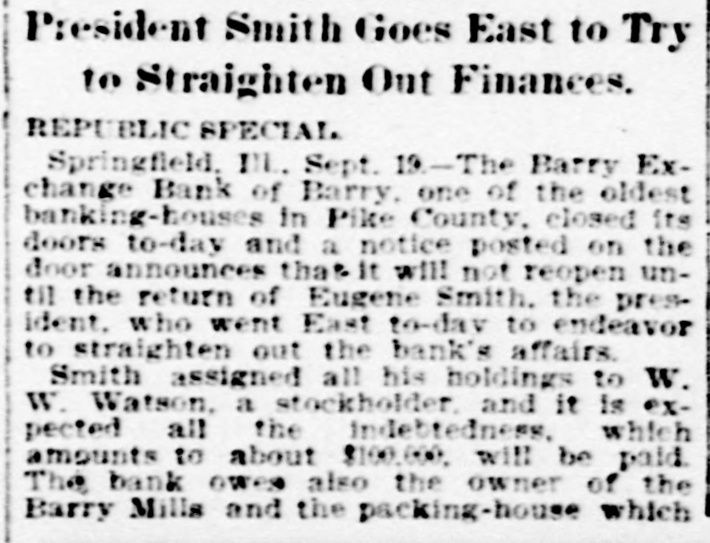
President Smith Goes East to Try to Straighten Out Finances. REPUBLIC SPECIAL Springfield, IIL. Sept. 19-The Barry Exchange Bank of Barry, one of the oldest banking-houses in Pike County, closed its doors to-day and a notice posted on the door announces that It will not reopen until the return of Eugene Smith. the president, who went East to-day to endeavor to straighten out the bank's affairs. Smith assigned all his holdings to W. W. Watson, a stockholder. and it is expected all the indebtedness, which amounts to about $100,000. will be paid. The bank owes also the owner of the Barry Mills and the packing-house which


Article from The Salt Lake Herald, September 20, 1905

Click image to open full size in new tab

Article Text

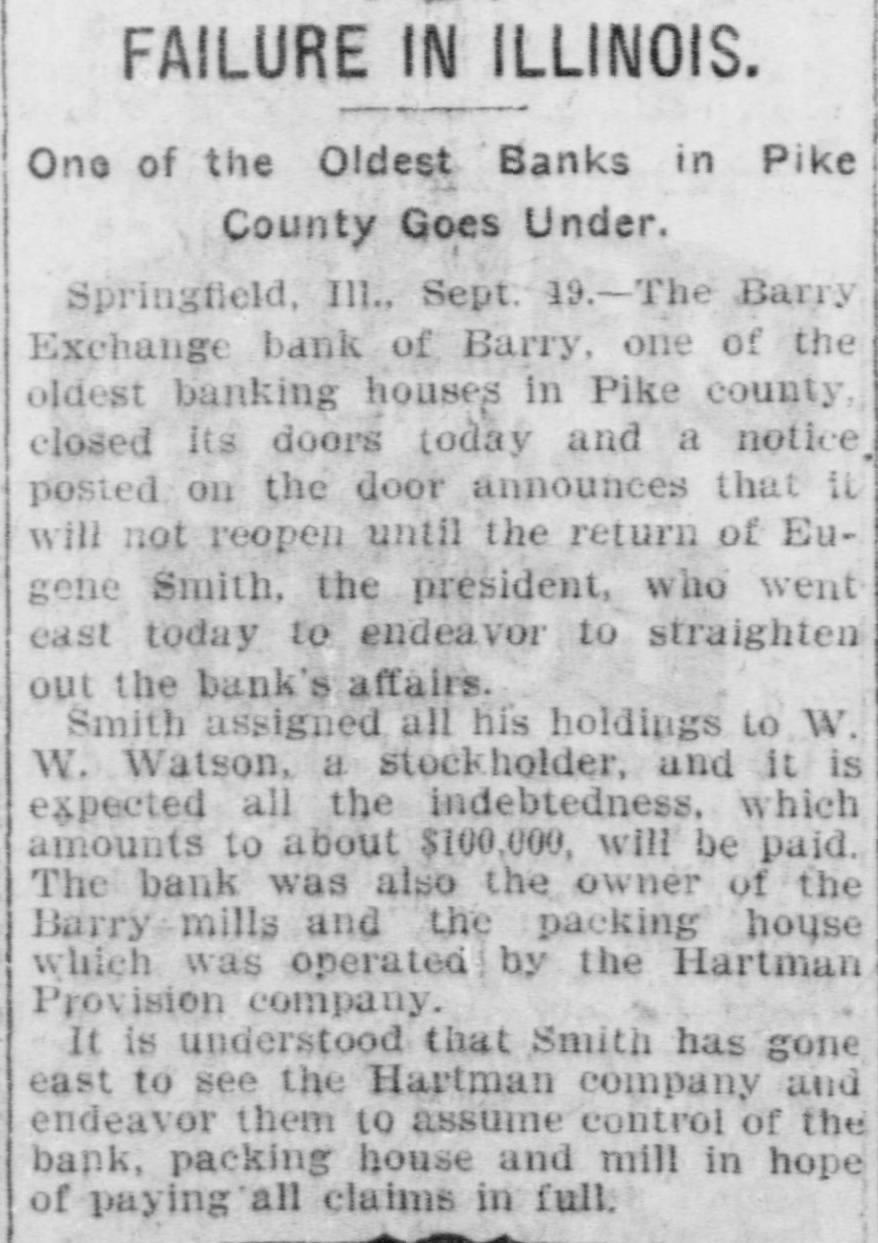
FAILURE IN ILLINOIS. One of the Oldest Banks in Pike County Goes Under. Springfield, Ill., Sept. 19.-The Barry Exchange bank of Barry, one of the oldest banking houses in Pike county, closed Its doors today and a notice posted on the door announces that it will not reopen until the return of Eugene Smith, the president, who went east today to endeavor to straighten out the bank's affairs. Smith assigned all his holdings to W. W. Watson, a stockholder, and it is expected all the indebtedness, which amounts to about $100,000, will be paid. The bank was also the owner of the Barry mills and the packing house which was operated by the Hartman Provision company. It is understood that Smith has gone east to see the Hartman company and endeavor them to assume control of the bank, packing house and mill in hope of paying all claims in full.


Article from East Oregonian : E.O, September 21, 1905

Click image to open full size in new tab

Article Text

Gentlemen, we have just receiv "JACK RABBIT" Pants. You will Patterns Good and Pri # Golden R GENERAL NEWS. The Brazilian government offers $2,000,000 reward for a sure cure for tuberculosis. Adolph Heiden, of Stockholm, is 94 years old and has been a member of the Swedish riksdag 72 years. For the past three weeks 23 cases of yellow fever have developed daily at New Orleans, the death rate and the recoveries about offstting. The Barry Exchange bank of Barry, Pike county, Illinois, has gone insolvent with $100,000 indebtedness. This bank had been doing business 47 years. July 1, 1905, there was $1,259,598,278 cash in the treasury of the United States, an increase of $462,672,839 over the amount therein July 1, 1897, the last previous date of counting. W. P. Appleyard, superintendent of the Pullman company construction department, went to the Illinois Central depot in Chicago, to meet his wife, and was run down and cut in pieces by the engine drawing the train which carried his wife. Thomas Lewis, of San Francisco, drowned himself in Islais creek. Fearing that he might attempt his own rescue once in the water, he fastened his legs and arms so he could not use them in either swimming or in attempts to climb the bank. The Panhandle railroad has been given a verdict for $100,000 damages against the city of Chicago for property destroyed during the strike riots of 1900. The courts hold the city responsible, on account of insufficient police protection against the violence of its own citizens. The hard coal miners of Pennsylvania demand an 8-hour day without decrease of pay. The operators and owners are exjected to refuse the demand, though they will not take official and conclusive action earlier than December 14. Those best conversant with the situation predict a general strike. W. A. Barfield was convicted in Lauderdale county, Tennessee, of manslaughter and sentenced to one year in the penitentiary. He secured the commitment papers himself, bought a railroad ticket and went entirely unguarded to Nashville and gave himself up to the prison authorities, and is now serving time. Springfield, O., is the center of the hardest fight between the Typographical union and the employing printers, and the Crowell Publishing company is the foci of the row. The company has imported 50 non-union printers, none of whom have succeeded in reaching the shops. An injunction has been granted to prevent picketing, and it is expected the strike will be broken by the employment of strike breakers.
Article from The Tupelo Journal, September 29, 1905

Click image to open full size in new tab

Article Text

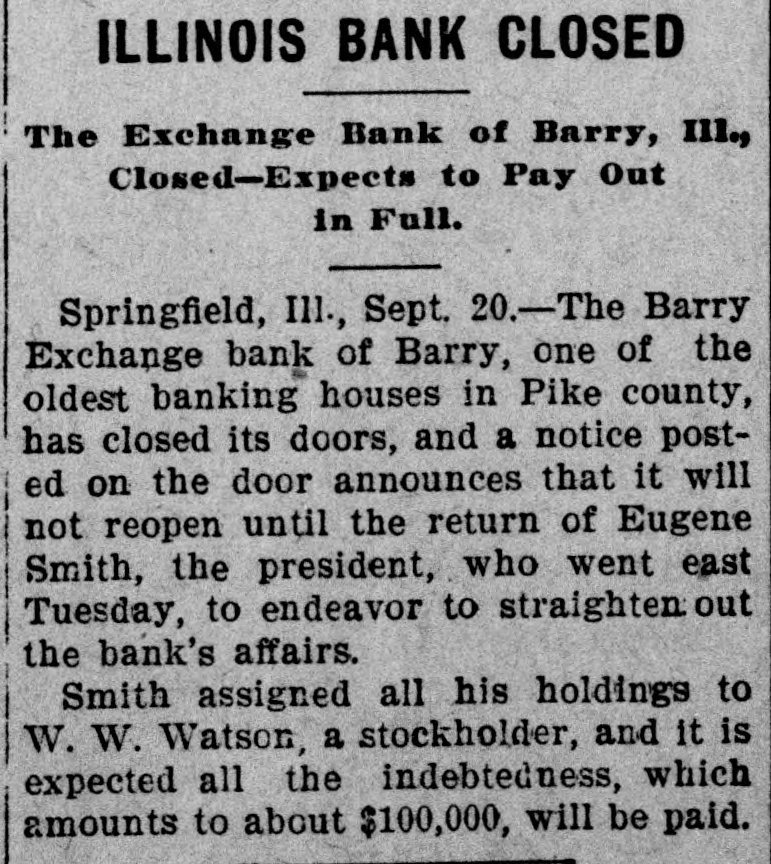
ILLINOIS BANK CLOSED The Exchange Bank of Barry, III., Closed-Expects to Pay Out in Full. Springfield, III., Sept. 20.-The Barry Exchange bank of Barry, one of the oldest banking houses in Pike county, has closed its doors, and a notice posted on the door announces that it will not reopen until the return of Eugene Smith, the president, who went east Tuesday, to endeavor to straighten out the bank's affairs. Smith assigned all his holdings to W. W. Watson, a stockholder, and it is expected all the indebtedness, which amounts to about $100,000, will be paid.