Federal National Bank (Pittsburg, PA)

Episode Information

Episode UID
602301246
Episode Type
Run β†’ Suspension β†’ Reopening
Bank Type
national
Bank ID
60230 national
Charter Number
6023
Start Date
October 20, 1903
Location
Pittsburg, Pennsylvania (40.441, -79.996)

Metadata

Model
gpt-5-mini (chosen from majority vote of a three-model LLM ensemble)
Short Digest
a7ae22ff6ce8e6ec

Response Measures

Accommodated withdrawals, Borrowed from banks or large institutions, Clearinghouse loan, Full suspension, Books examined

Clearinghouse involved: Yes (loan, examination, or other measures)

Receivership Details

Date receivership started
1903-10-21
Date receivership terminated
1903-12-14
OCC cause of failure
Run

Events (7)

1. November 16, 1901 Chartered
Source
historical_nic
2. October 20, 1903 Run
Cause
Bank Specific Adverse Info
Cause Details
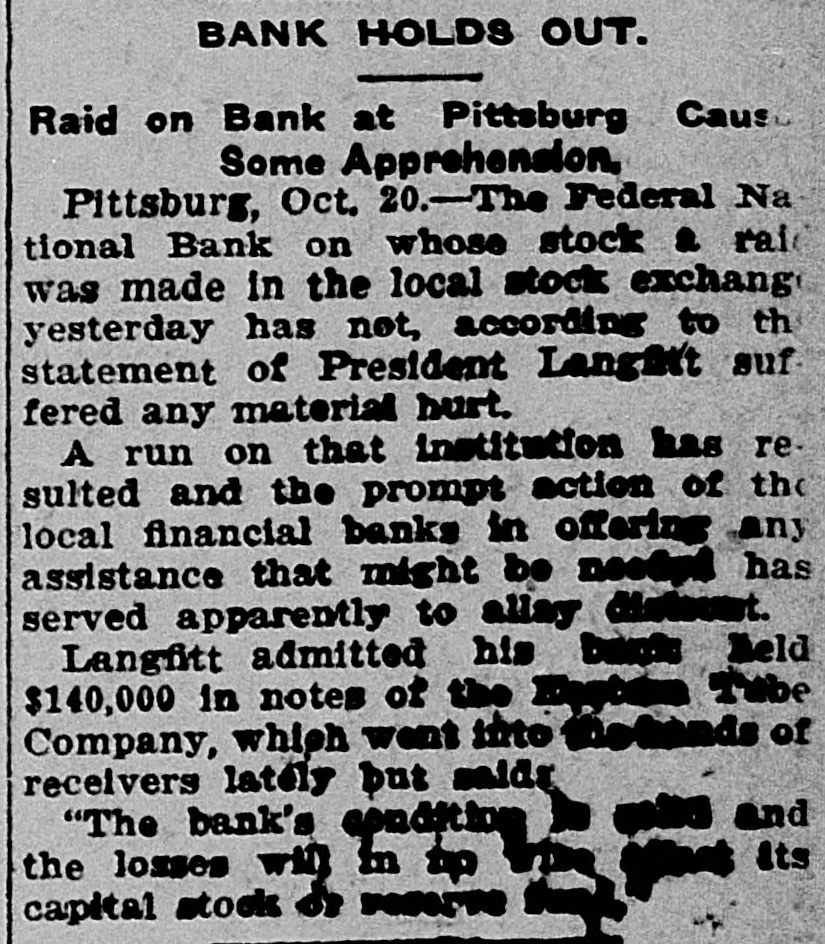
Sharp decline in the bank's stock and heavy losses/claims related to Eastern Tube Company prompted rapid withdrawals; adverse rumors accompanied the stock collapse.
Measures
Associated city banks/clearing house examined affairs and voted to extend financial aid; clearing-house support and assurances made to public.
Newspaper Excerpt
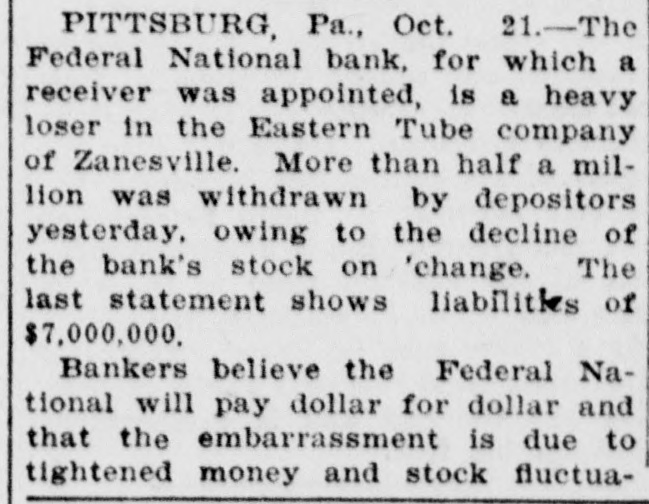
More than half a million dollars was withdrawn by depositors yesterday, owing to the decline of the bank's stock on change.
Source
newspapers
3. October 21, 1903 Receivership
Source
historical_nic
4. October 21, 1903 Suspension
Cause
Government Action
Cause Details
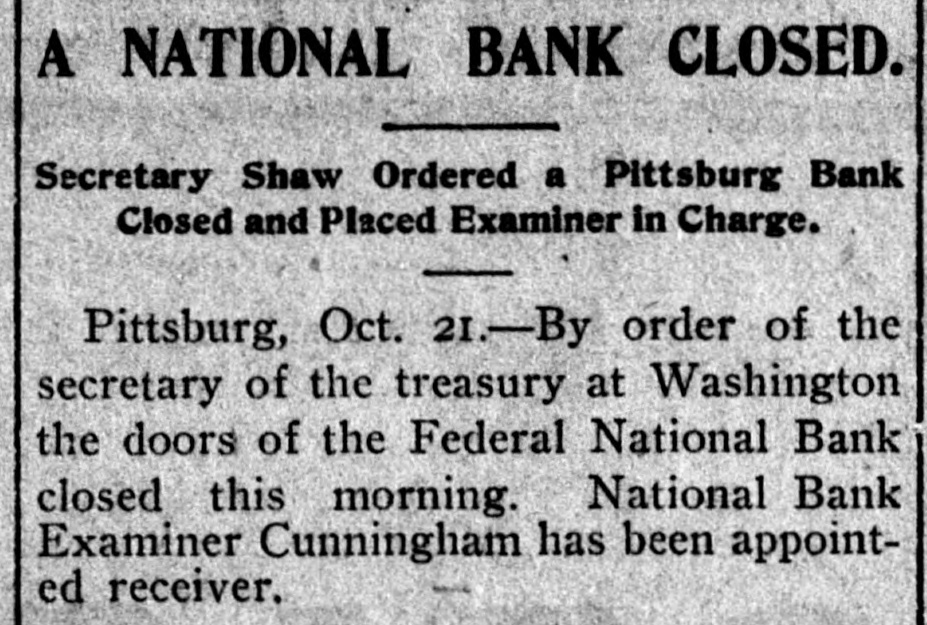
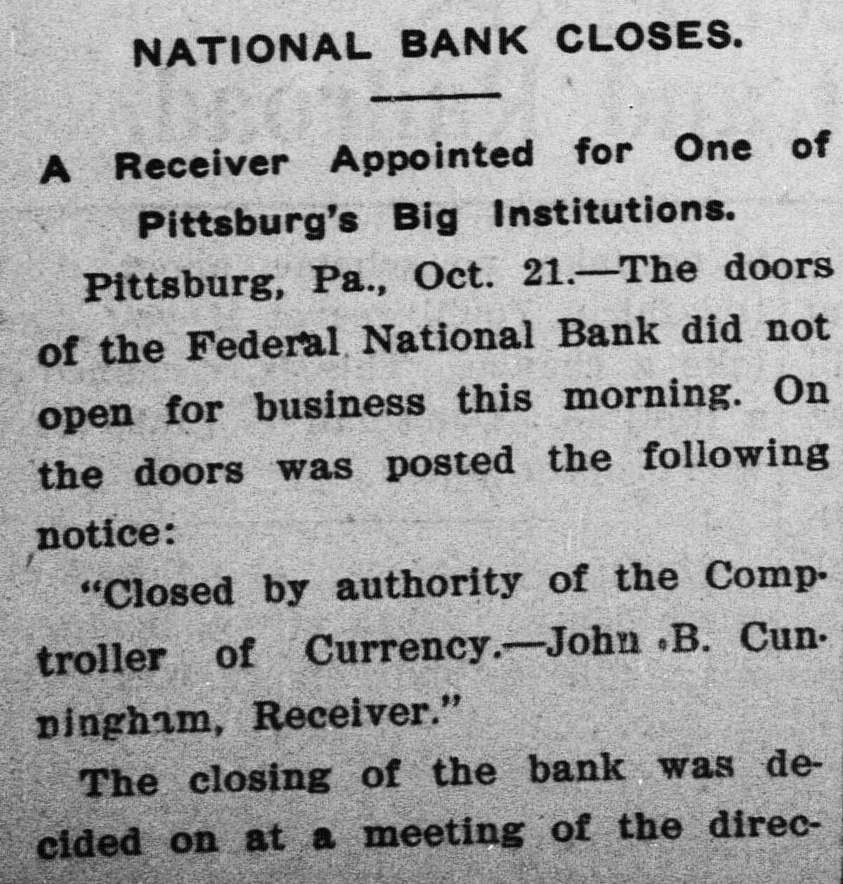
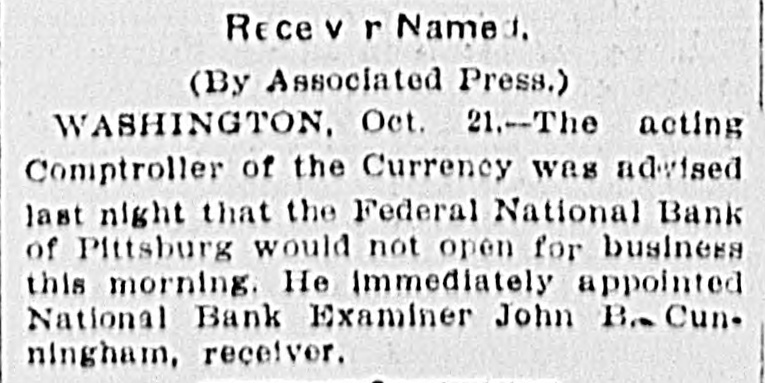
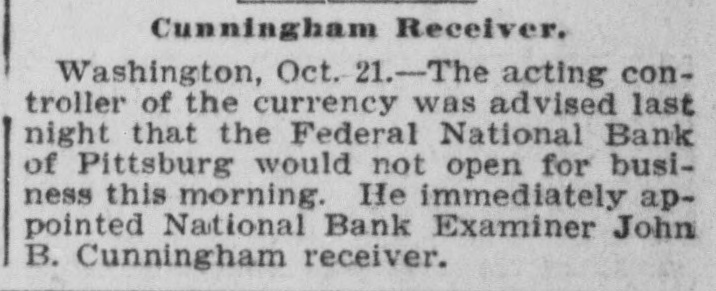
Acting Comptroller of the Currency ordered the bank closed and appointed a receiver (national bank examiner John B. Cunningham).
Newspaper Excerpt
Closed by the authority of the comptroller of the currency. John B. Cunningham, receiver.
Source
newspapers
5. December 7, 1903 Reopening
Newspaper Excerpt
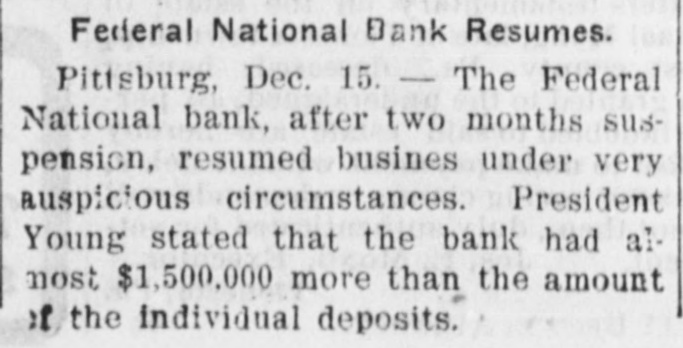
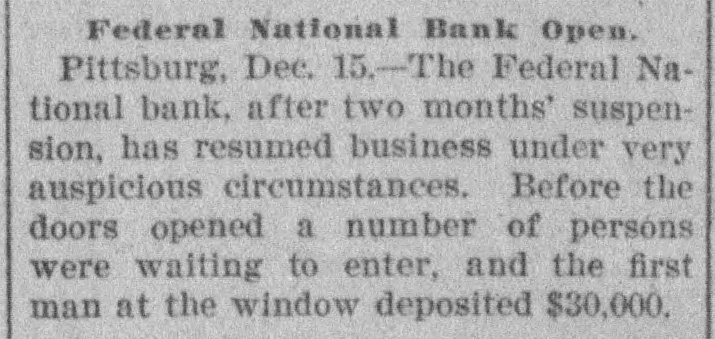
The Federal National bank, which closed its doors on October 21, reopened today under the old management. The reopening follows as a result of the report of the receiver to the controller of the currency, which showed the bank to be perfectly solvent and its capital unimpaired.
Source
newspapers
6. December 14, 1903 Restored To Solvency
Source
historical_nic
7. January 20, 1914 Voluntary Liquidation
Source
historical_nic

Newspaper Articles (21)

Article from The Sun, October 20, 1903

Click image to open full size in new tab

Article Text

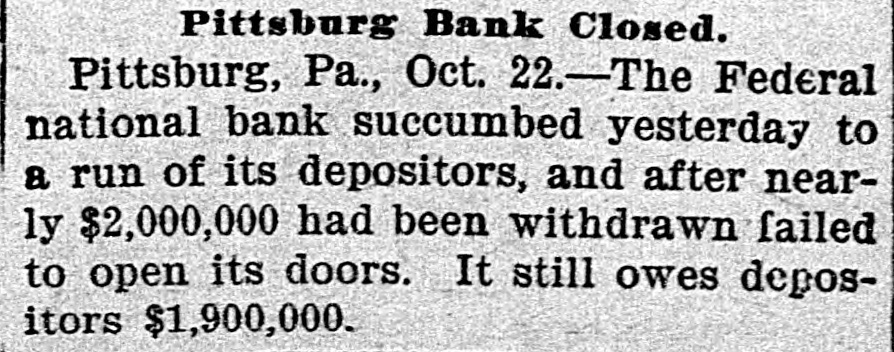
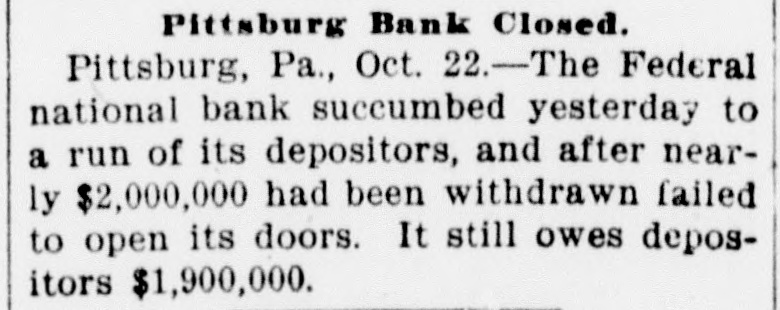
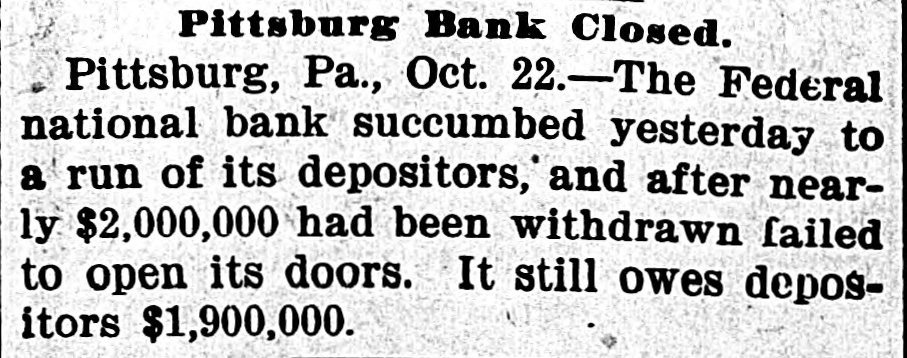
AIDED BY OTHER BANKS. Clearing House Help Given to a Pittsburg Institution. PITTSBURG, Pa., Oct. 19.-The Federal National Bank, capitalized at $2,000,000, will be assisted by the associated banks of the city. President Langfitt of the bank appeared before the clearing house committee this afternoon with a report of the condition of the institution. The bank's affairs showed that it was carrying paper of some concerns that had been associated with the Reese-Hammond Fire Brick Company and the Bolivar, Pa., bank, both of which are in the hands of receivers. The clearing house committee, composed of John B. Jackson, president of the Fidelity Title and Trust Company, James H. Willock of the Second National Bank and John G. Holmes of N. Holmes & Son, examined the bank's affairs and voted to extend to the concern the financial aid necessary to tide it over. The first announcement that something was wrong with the institution was learned from the Pittsburg Stock Exchange. The stock opened at 115. There has been some free selling during the last few days by insiders. As the stock declined there were no buyers, and it declined to 90. It was offered as low as 85, with no takers. As soon as the action of the clearing house became known it advanced to par and closed at 101. Some time ago, when the first signs of the panic became apparent in this city, the banks and trust companies decided to stand by one another and support each other's stocks. To-day local banks that were carrying Federal National Bank certificates ordered them lifted immediately. This was what led to the discovery that the bank was weak.


Article from The Topeka State Journal, October 21, 1903

Click image to open full size in new tab

Article Text

BANK CLUSES. Federal National, of Pittsburg, in Hands of Receiver. Had $50,000 of United States Money on Deposit. BUT THREE YEARS OLD Capital of $2,000,000 and Circulation of $700,000. Deposits Amounted to Nearly Two Million Dollars. Pittsburg, Pa., Oct. 21.-The doors of the Federal National bank were not opened for business this morning. The following notice was posted in explanation: "Closed by the authority of the comptroller of the currency. John B. Cunningham, receiver." Some such action has been within the possibilities for the past two days, forecasted by the determined raid made upon the institution's stock on the Pittsburg stock exchange. The positive statement, however, of the president, J. A. Langfitt, to the effect that the bank was not in need of money, and that its losses would not affect its capital or surplus did much toward allaying the distrust on the part of its depositors thus preventing a run. The closing of the bank was decided upon at a meeting of the directors last night which did not break up until 2 o'clock this morning. At that hour none of the officials would make a statement and locally the ouicome of the meeting was not generally known until the receiver's notice was posted at 9 o'clock. The bank is a United States depository and reported on hand September 9th, $50,000 of United States deposits. The stockofthecompany has been subjected to sharp declines on the Pittsburg exchange this week. On Monday the stock sold down from 115 to 85, but was forced up again to 101. All day yesterday it sagged and the closing quotations were 80 bid and 85 asked, a number of transactions having been made ac 80. The course of the stock has attracted much attention, and numerous adverse reports were in circulation but they were promptly and fully denied by President Langfitt. He stated yesterday evA ening that the bank had suffered only one possible loss. that of $140,000 for which it held notes of the Eastern Tube company of Dayton, O. That company is in the hands of a receiver and a plan of reorganization is being worked out. he said, and the bank's loss on that account may be small. The closing of the Federal National bank had apparently but little effect on the local stock exchange. Trading was light but firm at about yesterday's closing quotations. No dealings in any of the local bank stocks were recorded during the first hour's trading and no unusual action is looked for today. In a general way banking officials of the city feel confident that the Federal National bank's troubles will be confined to itself and will not disturb any other financial institution. Receiver Cunningham thinks it may be two or three days before he can make a statement of the bank's condition. A statement as to the cause of the failure has not vet been made public. Robert S. Smith, president of the Union National bank and president of the Pittsburg clearing house association, said: "I was assured last night by President Langfitt that every depositor would get every dollar due. It is possible that some small country banks which do business through the Federal National may be temporarily embarrassed. but even at that it will be only temporary." J. A. Langfitt, president of the Federal National bank in a signed statement says: 'The Federal National bank has finally yielded to the combined assaults of its stockholders and depositors and has closed its doorsuntilarrangements can be made to discharge all depositors claims. The question of reopening will then be decided. When the business depression came on, the stockholders, from necessity or fear began throwing the stock upon the market. The stock issue was large and the market weak. On groundless rumors our splendid list of depositors took fright and the rapid withdrawal of moneys began and increased until, despite our best efforts, the bank could not longer meet the demands upon it. Last night the directors believing such course to be the proper one under the circumstances ordered the bank to be closed temporarily and requested the


Article from The Evening Statesman, October 21, 1903

Click image to open full size in new tab

Article Text

BIG PITTSBURG BANK GLOSES ITS DOORS Its Capital Stock is Two Millions and Its Liabilities Seven Millions, Washington, Oct. 21.-The acting comptroller of the treasury last night appointed National Book receiver than Na for tional bank of Pittebarg. The only word the comptroller had was a long distance telephone message that the bank would not open today. No de tails were given: The bank is capitalized for $2,000,000. The Federal National bank for which a receiver has been appointed, is a heavy loser on the Eastern Tube company of Zanesville, O. More than half a million dollars was withdrawn by depositors yesterday, owing to the decline of the bank's stock on change. The last statement shows liabilities of $7,000,000. Bankers believe that the Federal National will pay dollar for dollar and that its embarrassment was due to tightened money and stock fluctuations. They don't believe the furry will extend to other banking. institutions. The president of the Federal bank at noon issued a statement saying that at no time was any depositor in danger of losing his money. When the doors closed the bank had nearly $2,000,000 in deposits, to secure which it had on hand in cash and good se curities more than $4,500,000. The president says nobody has defaulted, absconded or been smitten with paresis.


Article from The Spokane Press, October 21, 1903

Click image to open full size in new tab

Article Text

PITTSBURG, Pa., Oct. 21.-The Federal National bank, for which a receiver was appointed, is a heavy loser in the Eastern Tube company of Zanesville. More than half a million was withdrawn by depositors yesterday. owing to the decline of the bank's stock on 'change. The last statement shows liabilities of $7,000,000. Bankers believe the Federal National will pay dollar for dollar and that the embarrassment is due to tightened money and stock fluctua-


Article from Rock Island Argus, October 21, 1903

Click image to open full size in new tab

Article Text

Big Pittsburg Bank Does Not Open Today. CAPITAL $2,000,000 Order Issued by Comp. troller of the Currency. Pittsburg, Oct. 21.-Notice was posted on the doors of the Federal National bank this morning announcing that the institution is closed by order of the comptroller of the currency, who appointed Bank Examiner Cunningham receiver. 1 The closing of the bank has been within the possibilities the past two days, as the institution's stock was subjected to sharp declines and caused a determined raid on the Pittsburg Stock exchange this week.


Article from Alexandria Gazette, October 21, 1903

Click image to open full size in new tab

Article Text

Bank Failures, Pittsburg, Pa., Oct. 21.-The Federal National Bank of Pittsburg did not open for business this morning. A notice on the door stated that by authority of the Comptroller of the Currency, the bank was closed. This was signed by J. B. Cunningham, the national bank examiner, who has been appointed receiver. The Federal National Bank was opened for business on December 2, 1901. The bank was very agressive from the start and interests identified therewith assisted in the organization of a large number of banks in different sections of western Pennsylvania. The Federal acted also as a reserve agent for numerous national banks. It cleared through the First National Bank of Allegheny, control of which was purchased at $125 per share on June 1 last. According to financial interests the bank had been checked on very heavily the past two weeks by country banks and bankers. The amount was not stated but has been estimated at being over $1,500,000. When the announcement of the closing of the Federal National Bank was made on the floor of the local stock exchange this morning a statement was also read from Γ³ther leading banks that they would not call in any loans for which they had collateral security. The opinion prevails that the flurry will not extend to other institutions. It is also believed by many that the embarrassment of the Federad National Bank is only temporary.


Article from The St. Louis Republic, October 22, 1903

Click image to open full size in new tab

Article Text

PITTSBURG BANK FAILURE IS FELT IN WALL STREET. HEAVY OFFERINGS SEND PRICES DOWNWARD. Close Is Near the Lowest of the Day, but Sentiment Is Somewhat More Cheerful. New York, Oct. 21.-The news before the opening of the stock market to-day of the suspension of the Federal National Bank of Pittsburg caused fears of a violent break in the market. There were some heavy offerings just at the opening in some of the leading stocks and declines ran to a point in a few cases. Pressure was severe upon United States Steel preferred, causing a loss of 14. Fears for the result in the market were the more acute owing to the part played in yesterday's considerable recovery by the published assurances that the Federal National Bank was not in need of assistance. It was believed, therefore, that the threatened institution had weathered the storm. The news this morning caused hasty measures for supporting prices. The effectiveness of these became very promptly manifest, but the recovery was viewed with some suspicion owing to the belief in the artificial nature of the demand. TRADERS SURPRISED. Those on the floor were surprised at the ease with which the decline was checked, and It was easy to perceive that offerings of stocks in the market were on a very light scale. The buying was thereupon renewed with vigor and the market carried upward quite comprehensively to the extent of a point or more. Prices retraced their course during the latter part of the day and the closing was rather easy and at net declines for the day, except where the early gains had been above the average. The late downward movement was not fully explained by any published development. The demand from shorts was satisfied to some extent on the advance. thus subtracting from the support of the market. Some fears were entertained that there might be a new factor in the Pittsburg trouble carried over to-day by reason of the decision of the banks not to call maturing loans there and other measures of precaution. The cause asigned for the failure, namely, the withdrawal of deposits by small banks which had been offered a high rate of interest by the failed bank to attract those deposits, was a result from a condition known to have become sufficiently general to be the subject of widespread criticism. TONE CONFIDENT. Notwithstanding the late reaction in the market. its tone was accepted as rather convincing evidence of a measurable restoration of confidence, in view of the factors to be contended with. To these must be added the threatening aspect of labor conditions with the Manhattan Elevated. The market did not take well to the announcement that some of the anthracite collieries will close for about a week owing to the quick succession of holidays within that period. The local money market was quite unaffected by the large shipments of money to Baltimore. Reports were current of further large grain exports and the freer movement of cotton was also viewed with satisfaction. The bond market was very broad and widely varied at generally advancing prices. Bond houses report a notable increase in the investment demand. Total sales of bonds. par value, $3,476,000. United States 2s advanced 1/2. the old 4s % and the 3s and new 4s 1/4 per cent on the last call.


Article from Rock Island Argus, October 22, 1903

Click image to open full size in new tab

Article Text

Second Bank Caught By Pittsburg Failure. A RUMOR THE CAUSE Resources Said to Cover All Obligations. Pittsburg, Oct. 22.-Because of a report connecting the First National bank of Allegheny with the Federal National bank, which was closed yesterday, and which caused a run on the former, its directors today decided to make application to the comptroller of the currency to place the First National in voluntary liquidation.


Article from The Madison Daily Leader, October 22, 1903

Click image to open full size in new tab

Article Text

HASCLOSED ITS DOORS FEDERAL NATIONAL BANK OF PITTSBURG SUSPENDS. President Langfitt Blames Stockhold ers and Depositors for Failure of Institution. Pittsburg, Oct. 22.-The doors of the Federal National bank were not opened for business during the morn ing. The following notice was posted in explanation: "Closed by the authority of the comptroller of the currency." Some such action as this has been within the possibilities during the past two days, forecasted by the de termined raid made upon the institution's stock on the Pittsburg Stock Exchange. The positive statements however, of the president, J. A. Lang fitt, to the effect that the bank was not in need of money and that its losses would not affect its capital or surplus did much toward allaying dis trust on the part of its depositors thus preventing a run. The bank was established in 1901 with a capital of $2,000,000 and the last statement, filed with the comp troller in September, shows resources and liabilities of $7,693,782 each. The closing of the bank was de cided upon at a meeting of the direc tors, which did not break up until 2 o'clock in the morning. At that hour none of the officials would make a statement and locally the outcome of the meeting was not generally known until the receiver's notice was posted at 9 o'clock. Held Government Deposits. The bank is a United States depos 9 itory and reported on hand Sept. $50,000 of United States deposits. The stock of the company has been subjected to sharp declines on the Pittsburg Exchange this week. On Monday the stock sold down from 115 to 85, but was forced up again to 101 All day Monday it sagged and the closing quotations were 80 bid and 85 asked. a number of transactions having been made at 80. The course of the stock had at tracted much attention and numerous adverse reports were in circulation but they were promptly and fully de nied by President J. A. Langfitt. He stated that the bank had suffered only one possible loss-that of $140,000for which it held notes of the Eastern Tube company of Zanesville, O. That company is in the hands of a receiver and a plan of reorganization is being worked out, he said, and the bank's loss on that account may be small. In a signed statement J. A. Langfitt, president of the Federal National bank, said: "The Federal National bank has finally yielded to the combined as saults of its stockholders and depositors and has closed its doors until arrangements can be made to discharge all depositors' claims. The question of reopening will then be de cided."


Article from The Minneapolis Journal, October 22, 1903

Click image to open full size in new tab

Article Text

ALLEGHENY BANK GLOSES Alleghany First National, Affected by the Pittsburg Affair, Will Liquidate. Pittsburg, Oct. 22.-Following the suspension yesterday of the Federal National bank, Pittsburg, the First National bank of Allegheny failed to open its doors for business to-day and its directors have notified the controller of the, currency that the institution has gone into voluntary liquidation and requested him to take the necessary action in such cases. For some time the Allegheny bank has been connected by rumor with the Federal National bank, but it was believed up to late yesterday that it would weather the storm, notwithstanding the heavy run made on it. The Pittsburg stock exchange opening this morning was quiet and trading light. By a vote of the exchange it was decided that for the remainder of the week no bank nor trust stocks will be dealt in. The suspension of the Allegheny bank which has been the representative of the Federal National in the clearing house is looked upon by bankers generally as an almost necessary sequence of the failure of yesterday and it is not believed further trouble will follow.


Article from Daily New Dominion, October 22, 1903

Click image to open full size in new tab

Article Text

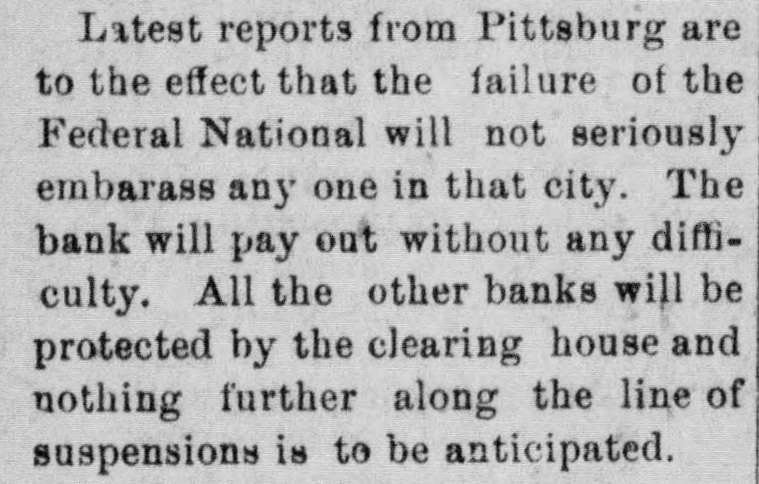
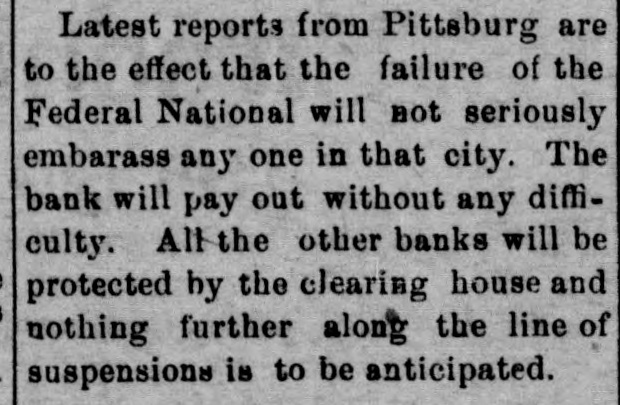
Latest reports from Pittsburg are to the effect that the failure of the Federal National will not seriously embarass any one in that city. The bank will pay out without any difficulty. All the other banks will be protected by the clearing house and nothing further along the line of suspensions is to be anticipated.


Article from New-York Tribune, October 22, 1903

Click image to open full size in new tab

Article Text

PITTSBURG BANK CLOSED THE ACTION EXPECTED. Stock Was Dumped on Market and Started a Run. Pittsburg, Oct. 21.-The doors of the Federal National Bank was not opened for business this morning. The following notice was posted in explanation: Closed by the authority of the Controller of the Currency. John B. Cunningham, Receiver. Some such action as this has been more or less expected for the last two days, forecasted by the determined raid made on the institution's stock on the Pittsburg Stock Exchange. The positive statements, however, of the president. J. A. Langfitt. to the effect that the bank was not in need of money, and that its losses would not affect its capital or surplu, did much toward allaying distrust on the part of its depositors, thus preventing a run. The closing of the bank was decided on at a meeting of the directors last night, which did not break up until two o'clock this morning. The bank is a United States depository and reported on hand September 9 $50,000 of United States deposits. The stock of the company has been subjected to sharp declines on the Pittsburg exchange this week. On Monday it sold down from 115 to 85. but was forced up again to 101. All day yesterday it sagged, and closing quotations were 80 bid and 80 asked, a number of transactions having been made at 80. The course of the stock has attracted much attention, and numerous adverse reports were in circulation. but they were promptly and fully denied by President J. A. Langfitt. He stated yesterday evening that the bank had suffered only one possible loss, that of $140,000. for which it held notes of the Eastern Tube Company, of Zanesville, Ohio. That company was in the hands of a receiver and a plan of reorganization was being worked out, he said, and the bank's loss on that account might be small. The closing of the Federal National had little effect on the local Stock Exchange. Bankers and brokers are of the opinion that the closing of the bank until its affairs can be adjusted was the best thing to do under the circumstances. The talk about the bank's affairs has been a drag on the market, and the belief is that the action of the directors will have a good effect on the general situation rather than an injurious one. Receiver Ounningham thinks it may be two or three days before he can make a statement of the bank's condition. Robert S. Smith, president of the Union National Bank and president of the Pittsburg Clearing House Association, said: There is not the slightest reason for any alarm, and if people will only keep cool there will be no trouble. I was assured last night by President Langfitt that every depositor would get every dollar due, and I believe the statement. The bank has some excellent assets, and there seems to be no reason why depositors should not get all coming to them. It is possible that some small country banks which do business through the Federal National may be temporarily embarrassed, but even at that it will be only temporary. Following is the statement of J. A. Langfitt, president of the bank: The Federal National Bank has finally yielded to the combined assaults of its stockholders and depositors, and has closed its doors until arrangements can be made to discharge all depositors' claims. The question of reopening will then be decided. When the business depression came on the stockholders, from necessity or fear, began throwing the stock upon the market. The stock issue was large and the market weak. Thereupon disquieting rumors sprang into birth, groundless. baseless and perhaps in some cases malicious. These increased the weakness of the stock, and the weakness increased the rumors until our splendid list of depositors took fright. and the rapid withdrawal


Article from The Stark County Democrat, October 23, 1903

Click image to open full size in new tab

Article Text

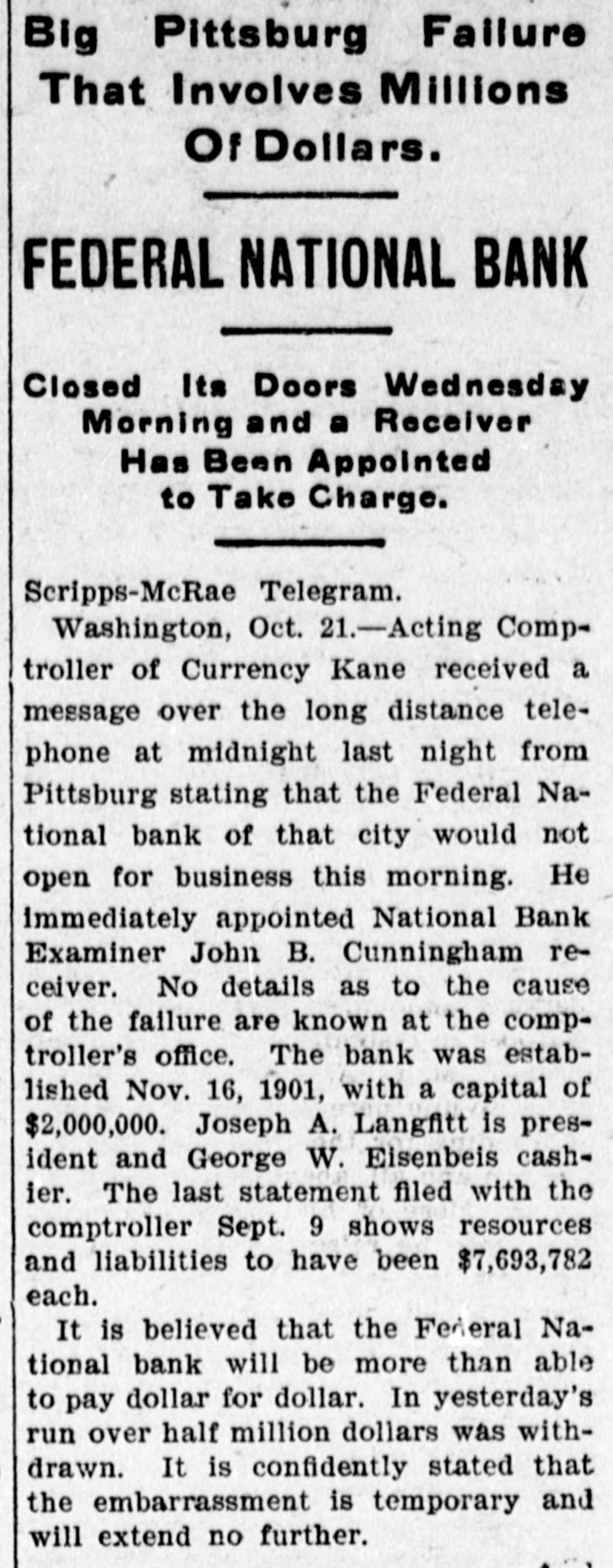
Big Pittsburg Failure That Involves Millions Of Dollars. FEDERAL NATIONAL BANK Closed Its Doors Wednesday Morning and a Receiver Has Been Appointed to Take Charge. Scripps-McRae Telegram. Washington, Oct. 21.-Acting Comptroller of Currency Kane received a message over the long distance telephone at midnight last night from Pittsburg stating that the Federal National bank of that city would not open for business this morning. He immediately appointed National Bank Examiner John B. Cunningham receiver. No details as to the cause of the failure are known at the comptroller's office. The bank was established Nov. 16, 1901, with a capital of $2,000,000. Joseph A. Langfitt is president and George W. Eisenbeis cashier. The last statement filed with the comptroller Sept. 9 shows resources and liabilities to have been $7,693,782 each. It is believed that the Federal National bank will be more than able to pay dollar for dollar. In yesterday's run over half million dollars was withdrawn. It is confidently stated that the embarrassment is temporary and will extend no further.


Article from The Savannah Morning News, October 23, 1903

Click image to open full size in new tab

Article Text

Pittsburg, Pa., Oct. 22.-Following the suspension yesterday of the Federal National Bank, Pittsburg, the First National Bank of Alleghany failed to open its doors for business today, and its directors have notified the controller of the currency that the institution has gone into voluntary liquidation, and requested him to take the necessary action in such cases. For some time the Alleghany Bank has been connected by rumor with the Federal National Bank, but it was believed up to late yesterday that it would weather the storm. notwithstanding the heavy run made on it, brought about by these reports. The directors, however, at a meeting last night, decided that considering the best interests of all concerned, the action noted above should be taken. By a vote of the Stock Exchange it was decided that for the balance of the week no bank or trust stocks will be dealt in. The suspension of the Alleghany Bank, which has been the representative of the Federal National in the clearing house, is looked upon by bankers generally as an almost necessary sequence of the failure yesterday, and believe that no further trouble will follow. At 3:30 o'clock this morning Vice President R. J. Stoney, Jr., of the First National Bank of Alleghenv issued the following statement after a meeting of officers and directors with


Article from The Times Dispatch, October 23, 1903

Click image to open full size in new tab

Article Text

Movement of Stock Prices for Day Inconclusive. LOSS PRE DOMINATE But Market Makes Quite General Advance in Face of Early Unfavorable Developments--Money Continues Easy-Bonds Strong, (By Associated Press.) NEW YORK, Oct. 22.-The movement of prices of stocks to-day was again inconclusive, the net changes being for the most part trivial. Losses predominated at the end of the day. but the market had quite generally advanced in face of the early unfavorable developments. The suspension of an Allegheny bank growing out of the failure vesterday of the Federal National Bank, of Pittsburg, caused scarcely a ripple in the market, although reports showed the continued necessity of precautionary measures at Pittsburg, such as refraining from trading in bank stocks, and the provision of a two million dollar safety fund amongst the banks. London also affected this market unfavorably. owing to a fresh outbreak of fears of war between Russia and Japan. The labor disputes on the Manhattan and Pennsy Railroad system were under discussion in Wall Street, but did not seem to be much regarded in the tradIng. Dissatisfaction was expressed with the conditions in the coal trade growing out of a large accumulation of steam sizes of anthracite and the active competition thereby produced with the large production of bituminous coal for shipping to the seaboard. The latter traffle is reported to be in a semi-demoralized condition, and at the same time the assertion gained currency that the Attorney-General of Virginia contemplated a proceeding to contest the control by the Pennsylvania and the Baltimore and Ohio, Norfolk and Western and Chesapeake and Ohio. The fect of these developments was not more than nominal and did not prevent an advance which included representative stocks in most of the prominent groups. the coalers not excepted. With funds accumulating in reserves and a growing ease in the money market. there is no longer an expectation that high interest rates will be permanent. and on this assumption high grade bonds are attractive at the present level of prices. The special demands upon local monev supplies by reason of the troubles at Baltimore and Pittsburg have not affected the case of the local money market. One reason for the prevailing ease seems to be that the heavy railroad borrowings expected to develop this fall have not come into evidence. Deposits at the sub-Treasury to-day for transfer to New Orleans were $350,000. following the deposit for a similar purpose yesterday of $325,000. This is convincing evidence of a much freer movement of the cotton crop, which the very large port receipts of to-day also testified to. The prozpect of the resulting larger supply of bills in the exchange market is viewed with satisfaction. The market closed steady. The bond market was broad and strong. Total sales of bonds, par value, were $2,632,000. United States 3's and the new 4's advanced 1-4 and the 2's and old 4's 1-8 per cent. on the last call. Total sales of stocks 475,500 shares. MONEY AND EXCHANGE-CLOSE:


Article from The New Dominion, October 28, 1903

Click image to open full size in new tab

Article Text

Latest reports from Pittsburg are to the effect that the failure of the Federal National will not seriously embarass any one in that city. The bank will pay out without any difficulty. All the other banks will be protected by the clearing house and nothing further along the line of suspensions is to be anticipated.


Article from The Indianapolis Journal, October 30, 1903

Click image to open full size in new tab

Article Text

Banks to Reopen. PITTSBURG, Oct. 29.-It is confidently expected that the First National Bank of Allegheny and the Federal National Bank of Pittsburg, the two institutions temporarily embarrassed during the recent financial slump, will be able to reopen as soon as the receivers' reports are filed.


Article from The Barre Daily Times, October 31, 1903

Click image to open full size in new tab

Article Text

Pittsburg Banks to Resume. Pittsburg, Oct. 31.-It is confidently expected that the First National bank of Allegheny and the Federal National bank of Pittsburg, the two institutions temporarily embarrassed during the recent financial slump, will be able to reopen as spon as the receiver# reports are filed.


Article from The Evening Statesman, December 7, 1903

Click image to open full size in new tab

Article Text

Pittsburg Bank Reopens. PITTSBURG, Pa., Dec. 7.-The federal National bank, which closed its doors on October 21, reopened today under the old management. The reopening follows as a result of the report of the receiver to the controller of the currency, which showed the bank to be perfectly solvent and its capital unimpaired.


Article from The Barre Daily Times, December 12, 1903

Click image to open full size in new tab

Article Text

Federal National Will Resume. Pittsburg, Dec. 12.-Authority having been granted by the comptroller of the currency, the Federal National bank, which closed its doors in October, will resume business next Monday with Colonel Hugh Young, for twenty-five years bank examiner of this district, as president. The examination by the receiver showed the bank to be solvent.


Article from The Tomahawk, December 25, 1903

Click image to open full size in new tab

Article Text

plot to kill United States Powell at Santo Domingo was related by a passenger, who carried a letter from a high Dominican official to a friendin New York. The Federal National bank, which was closed by the stock panic early in October, reopened in Pittsburg. William H. Ennis, a former Brooklyn policeman, convicted of having murdered his wife, was put to death in the electric chair in Sing Sing (N. Y.) prison. The secretary of the treasury has asked for an appropriation of $130,000 for additional gas buoys on the upper great lakes. Two hundred St. Louis (Mo.) criminals may be free as the result of a supreme court decision requiring state's attorney's information to be verified. Mrs. J. Messersmith, her daughter, and Frank Smith, a clerk, were burned to death in a fire at Braidwood, III. The Princeton (Wis.) state bank, which was closed October 20, through the alleged embezzlement of the cashier, has reopened its doors. Harry Maine, cashier of the Farmers' and Merchants' bank of Linn Grove, Ia., shot himself because of losses in speculation. The doors of the bank were closed. Gen. Benjamin Viljoen, a Boer commander, has arrived to arrange for an exhibition of Boer life at the St. Louis exposition. The breaking of a dam flooded a large portion of the city of Paterson, N. J., causing immense damage. Francis B. Loomis, assistant secretary of state, says Colombia intended to declare the French concession for the isthmian canal void and then sell it to the United States for $40,000,000. The sum of $27,000 was netted by a bal poudre for St. Luke's hospital annex in Chicago. Dr. Frank B. Mallory, of the Harvard medical school, announced his discovery of the scarlet fever germ. Practically all of the assets of the $117,000,000 Consolidated Lake Superior company were bid in by Speyer & Co. at an auction in New York city for $4,500,000. Arguments in the Northern Securities case were completed before the United States supreme court. A decision is not expected until February. Brig. Gen. Frederick Dent Grant has been assigned to the command of the department of the lakes, with headquarters in Chicago. Jesse Green (colored), who was convicted of the murder of his wife in Chester, Pa., was hanged. William I. Buchanan, of Buffalo, N. Y., the first United States minister to the republic of Panama, sailed for Panama. The steamer City of Washington arrived in New York from Colon bringing the signed copy of the canal treaty with the republic of Panama. Asa C. Bushnell, a New Haven (Conn.) bank cashier, committed suicide because his accounts were $15,000 short. By the sinking of the tugboat Mattie M. at Lake Concordia, Miss., six men were drowned. Capt. Dutton's last voyage to New York on the steamer Umbria ended the worst trip of his career. The craft was three days late and seven persons were injured by heavy seas. PERSONAL AND POLITICAL. Capt. Charles A. P. Talbot, British