Article Text
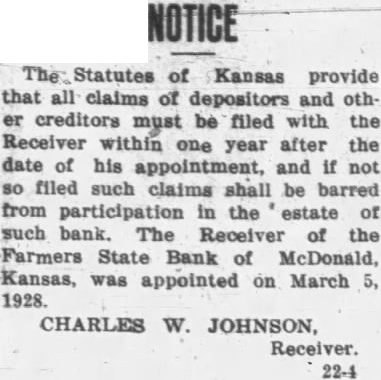
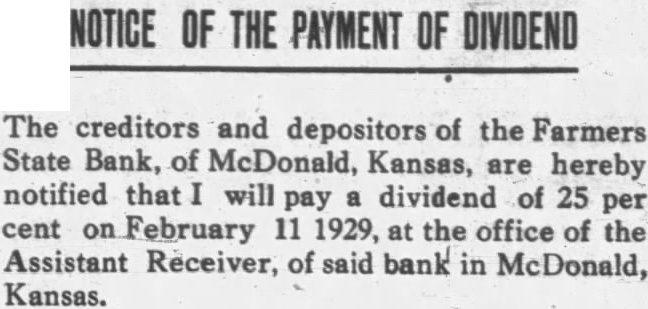
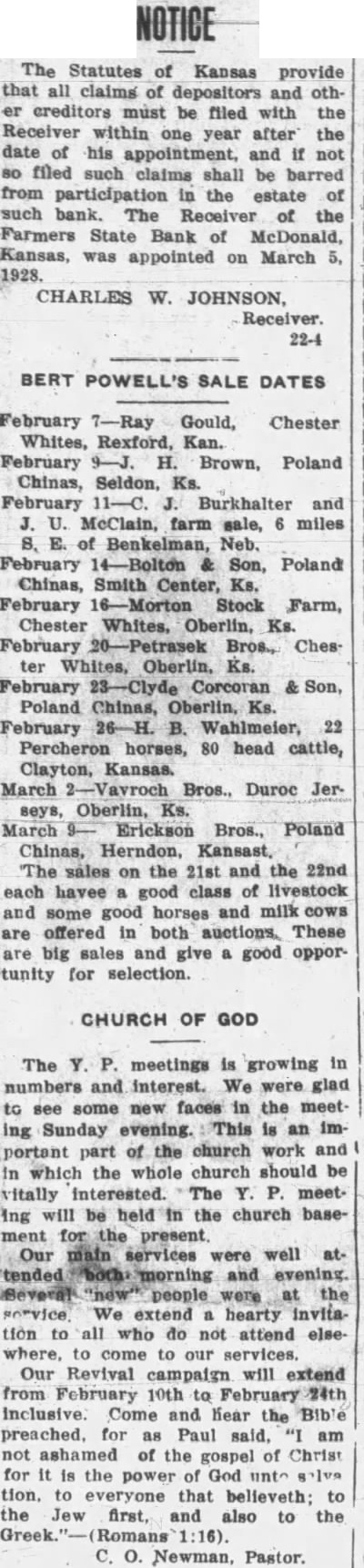
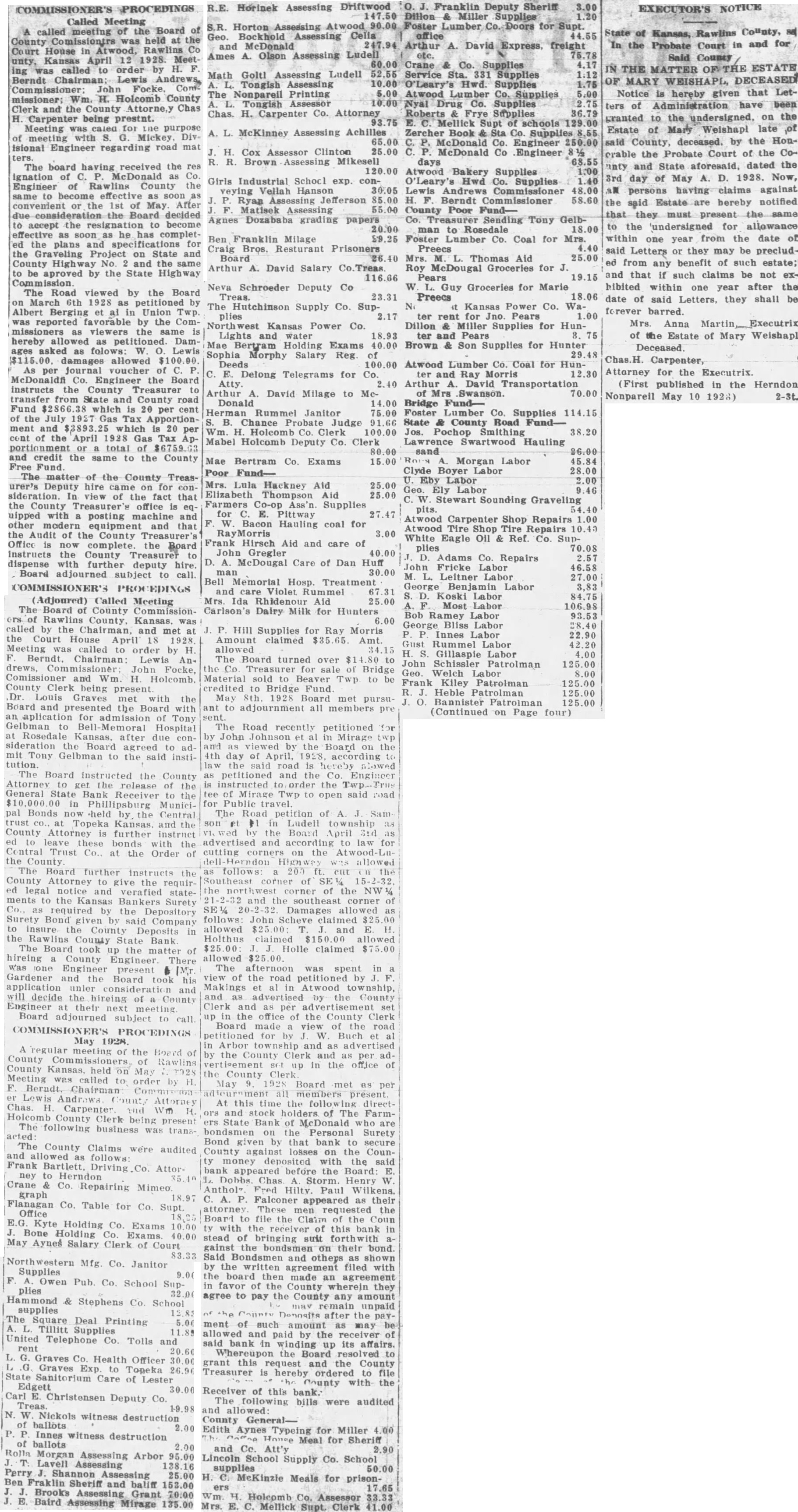
COMMISSIONER'S PROCEDINGS Called Meeting A called meeting of the Board of County Comissiontrs was held at the Court House in Atwood, Rawlins Co unty, Kansas April 12 1928. Meeting was called to order by H. F. Berndt Chairman; Lewis Andrews, Commissioner: John Focke, Commissioner; Wm. H. Holcomb County Clerk and the County Attorne,y Chas H. Carpenter being prestnt. Meeting was caled for the purpose of meeting with S. G. Mickey, Divisional Engineer regarding road mat ters. The board having received the res ignation of C. P. McDonald as Co. Engineer of Rawlins County the same to become effective as soon as convenient or the 1st of May. After due consideration the Board decided to accept the resignation to become effective as soon as he has completed the plans and specifications for the Graveling Project on State and County Highway No. 2 and the same to be aproved by the State Highway The Road viewed by the Board on March 6th 1928 as petitioned by Albert Berging et al in Union Twp. was reported favorable by the Commissioners viewers the same is hereby allowed as petitioned. Damages asked as folows: W. Lewis $115.00. damages allowed $100.00 As per journal voucher of C. P. McDonaldfi Co. Engineer the Board instructs the County Treasurer to transfer from State and County road Fund $2866.38 which is 20 per cent of the July 1927 Gas Tax Apportionment and $3893.25 which is 20 per cont of the April 1928 Gas Tax Apportionment or a total of $6759.03 and credit the same to the County Free Fund. The matter of the County Treasurer's Deputy hire came on for consideration. In view of the fact that the County Treasurer's office is equipped with a posting machine and other modern equipment and that the Audit of the County Treasurer's Office is now complete. the Board instructs the County Treasurer to dispense with further deputy hire. Board adjourned subject to call. COMMISSIONER'S PROCEDINGS (Adjoured) Called Meeting The Board County Commissionors of Rawlins County. Kansas. was called by the Chairman, and met at the Court House April 18 1928. Meeting was called to order by H. F. Berndt. Chairman: Lewis Andrews. Commissioner: John Focke, Comissioner and Wm. H. Holcomb. County Clerk being present Dr. Louis Graves met with the Board and presented the Board with an aplication for admission of Tony Gelbman to Bell-Memoral Hospital at Rosedale Kansas, after due consideration the Board agreed to admit Tony Gelbman to the said institution. The Board instructed the County Attorney to get the release of the General State Bank Receiver to the $10.000. in Phillipsburg Municipal Bonds now held by the Central trust co., at Topeka Kansas. and the County Attorney is further instruct ed to leave bonds with the Contral Trust Co., at the Order of the County The Board further instructs the County Attorney to give the required legal notice and verafied statements to the Kansas Bankers Surety Co. as required by the Depository Surety Bond given by said Company to insure the County Deposits in the Rawlins County State Bank The Board took up the matter of hireing a County Engineer There was one Engineer present & [Mr Gardener and the Board took his application unler consideration and will decide the hireing of a County Engineer at their next meeting Board adjourned subject to call. COMMISSIONER'S PROCEDINGS May 1928. A regular meeting of the Hoard of County Commissioners of Rawlins County Kansas, held on May 1928 Meeting was called to order by H. F. Berndt. Chairman Commission er Lewis Andrews County Attorney Chas. H. Carpenter and Wm H. Holcomb County Clerk being present The following business was transacted: The County Claims were audited and allowed follows: Frank Bartlett. Driving Co. Attorney to Herndon 35.40 Crane & Co. Repairing Mimeo. graph 18.97 Flanagan Co. Table for Co. Supt. Office E.G. Kyte Holding Co. Exams 10.00 18.05 J. Bone Holding Exams 40.00 May Aynes Salary Clerk of Court 83.33 Northwestern Mfg. Co. Janitor Supplies 9.00 F. A. Owen Pub. Co. School Supplies 32.00 Hammond & Stephens Co. School supplies 12.83 The Square Deal Printing A. L. Tillitt Supplies United Telephone Co. Tolls and rent 20.60 L. G. Graves Co. Health Officer 30.00 L G. Graves Exp. to Topeka 26.96 State Sanitorium Care of Lester Edgett 30.00 Carl E. Christensen Deputy Co. N. W Nickols witness destruction of ballots 2.00 P. P. Innes witness destruction of ballots 2.00 Rolla Morgan Assessing Arbor 95.00 J. T: Lavell Assessing 138.16 Perry J. Shannon Assessing 25.00 Ben Fraklin Sheriff and baliff 153.00 J. J. Brooks Assessing Grant 70.00 J. E. Baird Assessing Mirage 135.00 Horinek Assessing Driftwood R.E. 147.50 S.R. Horton Assessing Atwood 90.00 Geo. Bockhold Assessing Cella and McDonald 247.94 Ames A. Olson Assessing Ludell 60.00 Math Goltl Assessing Ludell A. L. Tongish Assessing The Nonpareil Printing A. L. Tongish Assessor Chas. H. Carpenter Co. Attorney 93.75 A. L. McKinney Assessing Achilles 65.00 J. H. Cox Assessor Clinton 25.00 R. R. Brown Assessing Mikesell 120.00 Girls Industrial School exp. conveying Vellah Hanson 30.05 J. P. Ryan Assessing Jefferson 85.00 J. F. Matisek Assessing 55.00 Agnes Dozababa grading papers 20.00 Ben Franklin Milage Craig Bros. Resturant Prisoners Board 26.40 Arthur A. David Salary Co Treas 116.66 2.17 Neva Schroeder Deputy Co 23.31 The Hutchinson Supply Co. Supplies Northwest Kansas Power Co. Lights and water 18.93 Mae Bertram Holding Exams 40.00 Sophia Morphy Salary Reg. of Deeds 100.00 C. E. Delong Telegrams for Co. Atty. 2.40 Arthur A. David Milage to McDonald 14.00 Herman Rummel Janitor 75.00 S. B. Chance Probate Judge 91.66 Wm. H. Holcomb Co. Clerk 100.00 Mabel Holcomb Deputy Co. Clerk 80.00 Mae Bertram Co. Exams 15.00 Poor FundMrs. Lula Hackney Aid 25.00 Elizabeth Thompson Aid 25.00 Farmers Co-op Ass'n. Supplies for C. E. Pittway 27.47 F. W. Bacon Hauling coal for RayMorris 3.00 Frank Hirsch Aid and care of John Gregler 40.00 D. A. McDougal Care of Dan Huff man 30.00 Bell Memorial Hosp. Treatment and care Violet Rummel 67.31 Mrs. Ida Rhidenour Aid 25.00 Carlson's Dairy Milk for Hunters 6.00 J. P. Hill Supplies for Ray Morris Amount claimed $35.65. Amt. allowed 34.15 The Board turned over $14.80 the Co Treasurer for sale of Bridge Material sold Beaver Twp to be credited to Bridge Fund. May 8th. 1928 Board met pursuant to adjournment all members pre sent. The Road recently petitioned for by John Johnson et al in Mirage twp and as viewed by the Board on the 4th day of April, 1928, according to law the said road is hereby alowed as petitioned and the Co. Engineer is instructed to order the Twp-Trus tee of Mirage Twp to open said road for Public travel. The Road petition of A. J. Samson et $1 in Ludell township as V1. wed by the Board April 3rd as advertised and according to law for cutting corners on the Atwood-Ludell-Herndon Highway allowed as follows: 200 ft. cut the Southeast corner of SE 15-2-32. the northwest corner of the NW 1-2-32 and the southeast corner of SE 1/4 20-2-32. Damages allowed as follows: John Scheve claimed $25 00 allowed $25.00: T. and E. H. Holthus claimed $150.00 allowed $25.00 J. Holle claimed $75.00 allowed $25.00. The afternoon was spent in a view of the road petitioned by J. F Makings et al in Atwood township, and advertised the County Clerk and as per advertisement set up in the office of the County Clerk Board made a view of the road petitioned for by J. W. Buch et al in Arbor township and as advertised by the County Clerk and as per advertisement set up in the office of the County Clerk May 1928 Board met as per At this time the following directors and stock holders of The Farmers State Bank of McDonald who are bondsmen on the Personal Surety Bond given by that bank to secure County against losses on the County money deposited with the said bank appeared before the Board: E. L. Dobbs. Chas A. Storm. Henry W. Anthol" Fred Hilty. Paul Wilkens. C. A. P. Falconer appeared as their attorney. These men requested the Board to file the Claim of the Coun ty with the receiver of this bank in stead of bringing strit forthwith against the bondsmen on their bond. Said Bondsmen and others as shown by the written agreement filed with the board then made an agreement in favor of the County wherein they agree to pay the County any amount may remain unpaid of he County Denosits after the pay5.00 ment of such amount as may be 11.89 allowed and paid by the receiver of said bank in winding up its affairs. Whereupon the Board resolved to grant request and the County Treasurer is hereby ordered to file County with the Receiver of this bank. The following bills were audited and allowed: County GeneralEdith Aynes Typeing for Miller 4.00 House Meal for Sheriff and Att'y 2.90 Lincoln School Supply Co. School supplies 50.00 H. C. McKinzie Meals for prisoners 17.65 Wm. H. Holcomb Co. Assessor 33.33 Mrs. E. C. Mellick Supt. Clerk 41.00 10. J. Franklin Deputy Sheriff 3.00 Dillon & Miller Supplies 1.20 Foster Lumber Co. Doors for Supt. office 44.55 Arthur A. David Express, freight etc. 75.78 Crane & Co. Supplies 4.17 52.55 Service Sta. 331 Supplies 1.12 10.00 O'Leary's Hwd. Supplies 1.75 5.00 Atwood Lumber Co. Supplies 5.00 10.00 Nyal Drug Co. Supplies 2.75 Roberts & Frye Supplies 36.79 E. C. Mellick Supt of schools 129.00 Zercher Book & Sta Co. Supplies 8.55 C. P. McDonald Co. Engineer 250.00 C. P. McDonald Co Engineer 8½ days 68.55 Atwood Bakery Supplies 1:00 O'Leary's Hwd Co. Supplies 1.40 Lewis Andrews Commissioner 48.00 H. F. Berndt Commissioner 58.60 County Poor FundCo. Sending Tony Gelbman to Rosedale 18.00 $9.25 Foster Lumber Co. Coal for Mrs. Preecs 4.40 Mrs. M. L. Thomas Aid 25.00 Roy McDougal Groceries for J. Pears 19.15 W L. Guy Groceries for Marie Preecs 18.06 No it Kansas Power Co. Water rent for Jno. Pears 1.00 Dillon & Miller Supplies for Hunter and Pears 8. 75 Brown & Son Supplies for Hunter 29.48 Atwood Lumber Co. Coal for Hunter and Ray Morris 12.30 Arthur A. David Transportation of Mrs Swanson. 70.00 Bridge FundFoster Lumber Co. Supplies 114.15 State & County Road Fund Jos. Pochop Smithing 38.20 Lawrence Swartwood Hauling sand 26.00 45.84 Clyde Boyer Labor 28.00 U. Eby Labor 2.00 Geo. Ely Labor 9.46 C. W. Stewart Sounding Graveling pits. 54.40 Atwood Carpenter Shop Repairs 1.00 Atwood Tire Shop Tire Repairs 10.40 White Eagle Oil & Ref. Co. Supplies 70.08 J. D. Adams Co. Repairs 2.57 John Fricke Labor 46.58 M. L. Leitner Labor 27.00 George Benjamin Labor 3,83 S. D. Koski Labor 84.75 A. Most Labor 106.98 Bob Ramey Labor 93.53 George Bliss Labor 28.40 P. P Innes Labor 22.90 Gust Rummel Labor 42.20 H. S. Gillaspie Labor 4.00 John Schissler Patrolman 125.00 Geo. Welch Labor 8.00 Frank Kiley Patrolman 125.00 R. J. Heble Patrolman 125.00 J. O. Bannister Patrolman 125.00 (Continued on Page four) EXECUTOR'S NOTICE State of Kansas, Rawlins County, sel In the Probate Court in and for Said County IN THE MATTER OF THE ESTATE OF MARY WEISHAPL, DECEASED Notice is hereby given that Letters of Administration have been granted to the undersigned, on the Estate of Mary Weishapl late ,of said County, deceased. by the Honcrable the Probate Court of the County and State aforesaid, dated the 3rd day of May A. D. 1928. Now, all persons having claims against the said Estate are bereby notified that they must present the same to the undersigned for allowance within one year from the date of said Letters or they may be precluded from any benefit of such estate; and that if such claims be not exhibited within one year after the date of said Letters, they shall be forever barred. Mrs. Anna Martin Executrix of the Estate of Mary Weishapl Deceased. Chas.H. Carpenter, Attorney for the Executrix. (First published in the Herndon Nonpareil May 10 1928)