Click image to open full size in new tab
Article Text
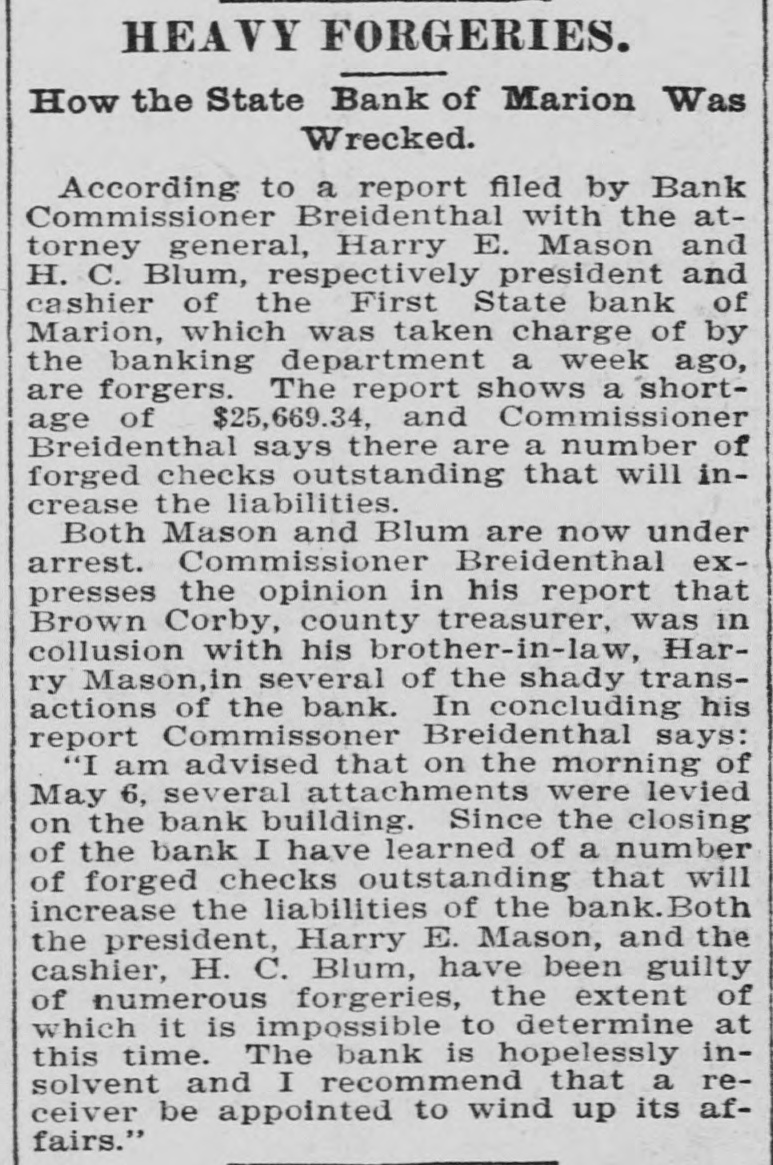
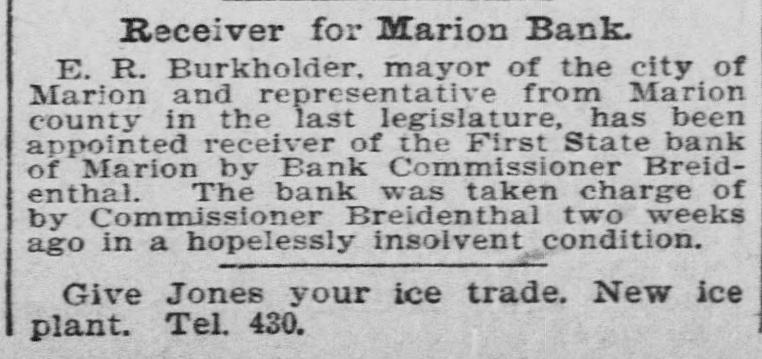
BANKER'S PARDON Effort Being Made to Secure Release of H. E. Mason. He is Ex-President of Marion State Bank. IS NOW IN PRISON. Was Sentenced For Two Years by District Court. the W. H. Carpenter Writes Review of the Case. Harry E Mason, president of the First State bank of Marion, convicted of violations of the banking law and now serving a sentence of two years in the penitentiary, has made application to Governor Stanley for a conditional pardon. W. H. Carpenter, of Marion, makes, in a letter to the governor which is on file with the papers in the case at the executive office, a statement of the case, a part of which follows: 'Six or seven years ago, Mr. Mason purchased the Cottonwood Valley National bank, assuming its liabilities, under what seems to me to be very peculiar circumstances; and, I am inclined to think that Mr. Mason was led to believe that the Cottonwood Valley bank was in much better condition than it really was, and that after he had possession of all the books and papers, he found that the liabilities of the bank were much more than he supposed. Under the management of Mason the National bank liquidated, paying off its depositors in full, and reorganizing under the name of the First State bank "There organization of course had to take care of the obligations of the old Cottonwood Valley bank and it seems that these were carried along from time to time by Mr. Mason, who borrowed money on the strength of the credit of the First State bank. to keep up these obligations. In addition to this Mr. Mason was very unfortunate in making some loans to some fellows in this county by the name of Smith without any fault on his part he lost between $6,000 and $7,000 by making loans to these parties. These facts I am familiar with by reason of having been connected with the litigation growing out of these loans and having been connected with other litigations as attorney against the bank I think can safely say that there was a loss to Mr. Mason of $10,000 or $12.000. occasioned by the condition of the bank and these loans that I personally know about. "There can be no question that Mason e 'kited' the checks in order to keep the funds on hand to meet the obligations of his depositors and obligations he had to make to cover the loss. "Kiting" a check is a fictitious transaction. The banker to retain the use of n money for short period makes draft on some person out of town who has no money belongi: to the maker of the of draft, but he completes the fictitious transaction by making a draft upon the person drawing the original draft Such r at a draft is not bankable; it is worthless, but it creates a transaction which provides an opportunity for the retenn tion of funds contemplated by the transto action. "Kiting" a check by bankers is regarded as an unprofessional, dishonorable act. But I am convinced,' continues Mr Carpenter, 'that Mr. Mason did not 'kite' these checks for the purpose of y raising money to appropriate to his private use, and there is not a bit of evidence to indicate that he ever did appropriate any of the funds of the ld bank or any of the funds that may have been received by 'kiting' these checks, to his own use. And, no one lost any g money by reason of the "kiting" of these checks. 00 am inclined to think the bank would have pulled through as the evide dence showed the bank in better condition at the time it was closed than it was two or three years prior to that time. am inclined to think that the bank would have pulled through had it not been for an unfortunate altercation that took place between Mr. Mason and our county attorney; not that the is county attorney sought to afterwards bring about the ruin of the bank. or the prosecution of Mr. Mason, but after the ze altercation parties took sides -as they always do in a little bit of a town like st this (Marion and friends of the county attorney withdrew their deposits This was known to other depositors, as all ct things are known in towns of this size st to everybody as soon as they happen occasioned a run on the bank which culminated in its closing by the bank commissioner." Mr. Carpenter thereafter explains that hat the outset he believed Mason guilty and declined to defend him as attorney However he now states that he has at changed his opinion and believes Mason he should be liberated. Mr. Carpenter says: as "The bank has already paid 60 is cents on the dollar and the facts show that were it not for the expense of the eivership the bank would pay x out in full, which of course shows that a. the bank was solvent at the time it closed. was Mr. Carpenter believes "the law hav le. ing been vindicated no good can come the el. from detaining Mason longer in penitentiary n. te. Carpenter charges that Commissione le. Breidenthal closed the bank when was solvent. County Attorney J. T Dickerson who prosecuted Mason says: 'His wife is in poor health; a parole would assist fe them by giving the family his services for support. Judge O. L. Moore who sentenced he Mason concurs in the statement made aby Dickerson and recommends a conditional pardon. tly J. H. Smith, clerk of the court, also recommends the pardon F on G. F. Sacket. F. Sacket. G. ck Donaldson, W. P Morris, Taylor Rid im dle, D. W. Wheeler, W H Evans, O. 10 Billings, ex -Representative Ferd Funk, S. C. Freeland, Henderson Mar W tin, N.F. Miesse, J. C. Thomas. E M Hoch, County Superintendent L reKnowles. and Receiver Burkholder joir act in letters to the governor asking for the nd conditional pardon. These men say that int Mason's wife and four children rely or public charity for their sole support. Weather Indications June -For Kansas: