United National Bank (New York, NY)

Episode Information

Episode UID
599001273
Episode Type
Suspension โ†’ Closure
Bank Type
national
Bank ID
59900 national
Charter Number
5990
Start Date
January 1, 1906*
Location
New York, New York (40.714, -74.006)

Metadata

Model
gemini-3-flash-preview (chosen from majority vote of a three-model LLM ensemble)
Short Digest
f073bf2b0611fb3b

Response Measures

None

Description

The bank entered voluntary liquidation to convert into the Hudson Trust Company; minority stockholders sued for a receiver alleging mismanagement of assets during this process.

Events (4)

1. October 12, 1901 Chartered
Source
historical_nic
2. January 1, 1906* Suspension
Cause
Voluntary Liquidation
Cause Details
The bank entered voluntary liquidation to convert its business into the Hudson Trust Company.
Newspaper Excerpt
In order to become a trust company the bank was obliged to go into voluntary liquidation.
Source
newspapers
3. July 28, 1906 Voluntary Liquidation
Source
historical_nic
4. November 30, 1906 Other
Newspaper Excerpt
application made to-day to Justice O'Gorman, of the supreme court, for the appointment of a receiver for the United National bank.
Source
newspapers

Newspaper Articles (4)

Article from New-York Tribune, May 10, 1905

Click image to open full size in new tab

Article Text

RECEIVERS HERE ALSO. Local Banks and Trust Companies Restrained from Paying. Judge Lacombe, in the United States Circuit Court, yesterday afternoon signed an order appointing J. D. Colt, of Boston, and Walter D. Edmunds, of No. 31 Nassau-st., this city, ancillary receivers of the Haight & Freese Company, fixing their bond at $10,000. The court also granted an order restraining New-York banks and trust companies from paying out any money deposited in the name of the alleged bankrupts, or that of William H Lillis, George G. Turner, Harry Watson, Charles B. Poor, jr., William G. Conklin, - Beardesley, John Doe and Richard Roe. The appointment of the receivers was secured by Roger Foster, of No. 15 Broad-st., who filed with the court three affidavits, which contain charges against the company. One. made by Ridgeway Bowker, of Camden, N. J., states that he deposited $5,500 with the concern's Philadelphia offices, and alleges he was induced by George W. Turner to permit a man named Daniels to manipulate his account. He further alleges that on January 11, 1903, his account was without warning closed out. Bowker swears that the concern bought and sold no stocks whatsoever, and made up fictitious accounts of alleged stock transactions which were given to its customers. The Haight & Freese Company, the affidavit declares. had more than five thousand customers, whose claims amounted to more than $1,000,000. An affidavit made by Arthur M. Johnson, of No. 502 West 152a-st., stated that he had been employed by the company in various capacities and in a number of the offices. Johnson also swore that no stocks were bought and sold on margins for customers and explained at great length the method employed by the managers in making up the alleged fictitious sales accounts so that each customer would be a loser. A similar affidavit, made by John M. Warwick, another employe, purported to corroborate the statements of both Bowker and Johnson as to the methods employed by the concern. Receiver Edmunds late in the afternoon took possession of the company's local offices, at Broadway and Exchange Place. Mr. Foster, who is counsel for the receiver. said later that the appointment of a receiver had been asked for on the ground that the Haight & Freese Company was insolvent and on the additional ground of fraud. "It is charged." continued Mr. Foster. "that the brokerage business of Haight & Freese was entirely fletitious. The firm took orders to buy and sell stocks for customers and never executed these orders. The orders. in other words. were bucketed. Fraud on customers and abstraction of assets by officers are charged. Every customer who ever gave an order to this firm can be a creditor of the firm. "Some assets have been found in the Seaboard and in the Consolidated National banks. but they will not meet the debts. Bowker, I understand, made his trades through the Philadelphia office of the concern, but that does not affect the issue in any way." The offices of the Haight & Freese Company were crowded all the morning. but toward noon, when news of the Boston court proceedings became known, a line of customers formed to withdraw their accounts. Harvey Watson, the local manager. said early in the afternoon that steps were being taken to get the Boston receivership vacated. "We do not know why this suit for a receiver was brought, added Mr. Watson. "It is evidently a matter of spite. Mrs. Welss formerly had an account with the Boston house, but we settled with her some time ago, and she signed a release. No claims were made upon us. and we do not know what she wants. Our counsel in Boston tells us that the court must have been imposed on in getting the receivership. Here in New-York, and everywhere else, we are paying all claims made upon us. Some of our customers here. when they heard about the trouble in Boston, came to us for their money. and we have paid them promptly. Some of them have reopened accounts with us since they have talked with us over the matter. We have been here fifteen years. and we have always paid every just claim. I understand that the main executive office in Boston is making a formal statement." The Haight & Freese Company has been well known for years as a broker in stocks and grain on margin. It advertises extensively. and has many branch offices and correspondents throughout the country. It was formerly a member of the Consolidated Exchange, but now has no local exchange connections. The most recent number of "The Corporation Directory" gives the directors of the concern as William B. Sommerville, George G. Turner and John M. Campbell, who are named respectively as president, secretary and treasurer. The capital is given as $100,000.
Article from New-York Tribune, December 1, 1906

Click image to open full size in new tab

Article Text

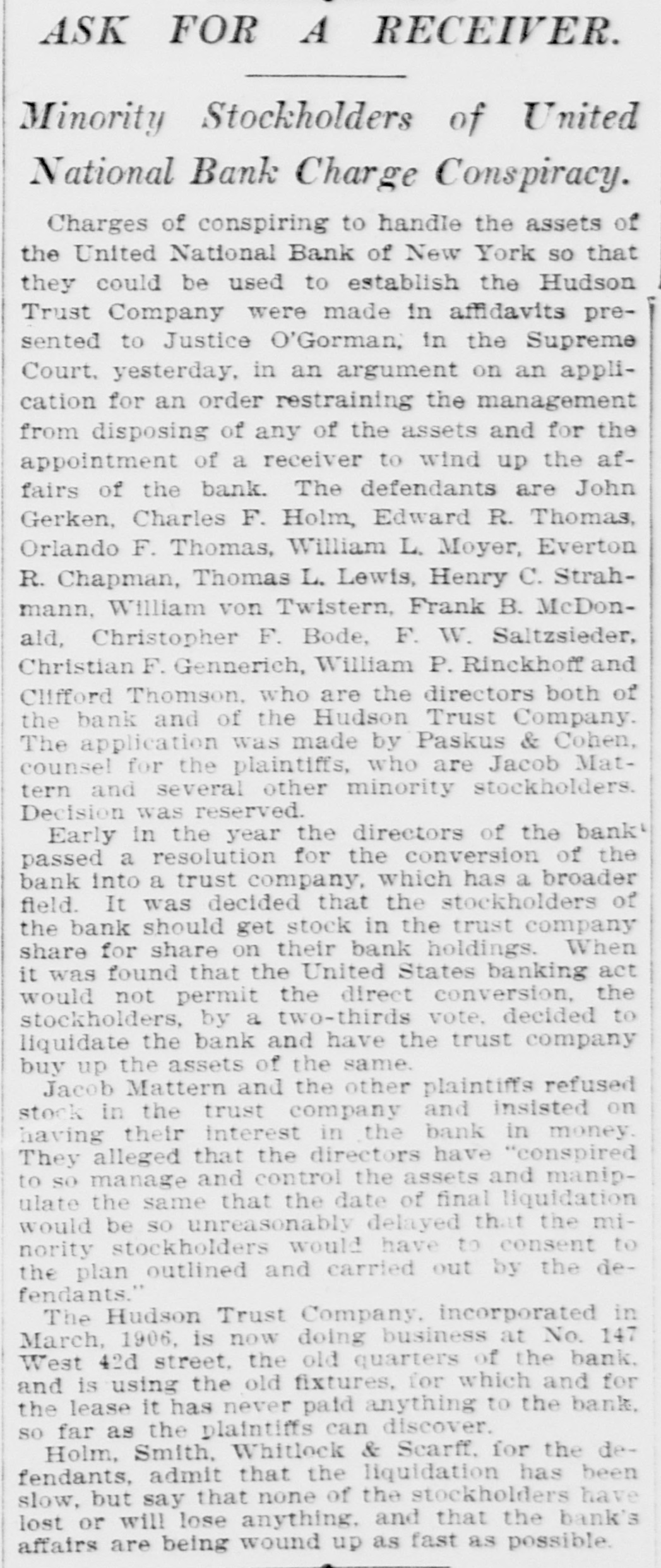
ASK FOR A RECEIVER. Minority Stockholders of United National Bank Charge Conspiracy. Charges of conspiring to handle the assets of the United National Bank of New York so that they could be used to establish the Hudson Trust Company were made in affidavits presented to Justice O'Gorman, in the Supreme Court, yesterday, in an argument on an application for an order restraining the management from disposing of any of the assets and for the appointment of a receiver to wind up the affairs of the bank. The defendants are John Gerken, Charles F. Holm, Edward R. Thomas, Orlando F. Thomas, William L. Moyer, Everton R. Chapman, Thomas L. Lewis, Henry C. Strahmann, William von Twistern, Frank B. McDonald, Christopher F. Bode, F. W. Saltzsieder, Christian F. Gennerich, William P. Rinckhoff and Clffford Thomson, who are the directors both of the bank and of the Hudson Trust Company. The application was made by Paskus & Cohen, counsel for the plaintiffs, who are Jacob Mattern and several other minority stockholders. Decision was reserved. Early in the year the directors of the bank passed a resolution for the conversion of the bank into a trust company, which has a broader field. It was decided that the stockholders of the bank should get stock in the trust company share for share on their bank holdings. When it was found that the United States banking act would not permit the direct conversion, the stockholders, by a two-thirds vote. decided to liquidate the bank and have the trust company buy up the assets of the same. Jacob Mattern and the other plaintiffs refused stock in the trust company and insisted on having their interest in the bank in money. They alleged that the directors have "conspired to so manage and control the assets and manipulate the same that the date of final liquidation would be SO unreasonably delayed that the mimority stockholders would have to consent to the plan outlined and carried out by the defendants." The Hudson Trust Company. incorporated in March, 1906, is now doing business at No. 147 West 42d street, the old quarters of the bank. and is using the old fixtures, for which and for the lease it has never paid anything to the bank. so far as the plaintiffs can discover. Holm, Smith, Whitlock & Scarff. for the defendants, admit that the liquidation has been slow, but say that none of the stockholders have lost or will lose anything. and that the bank's affairs are being wound up as fast as possible.


Article from The Daily Morning Journal and Courier, December 1, 1906

Click image to open full size in new tab

Article Text

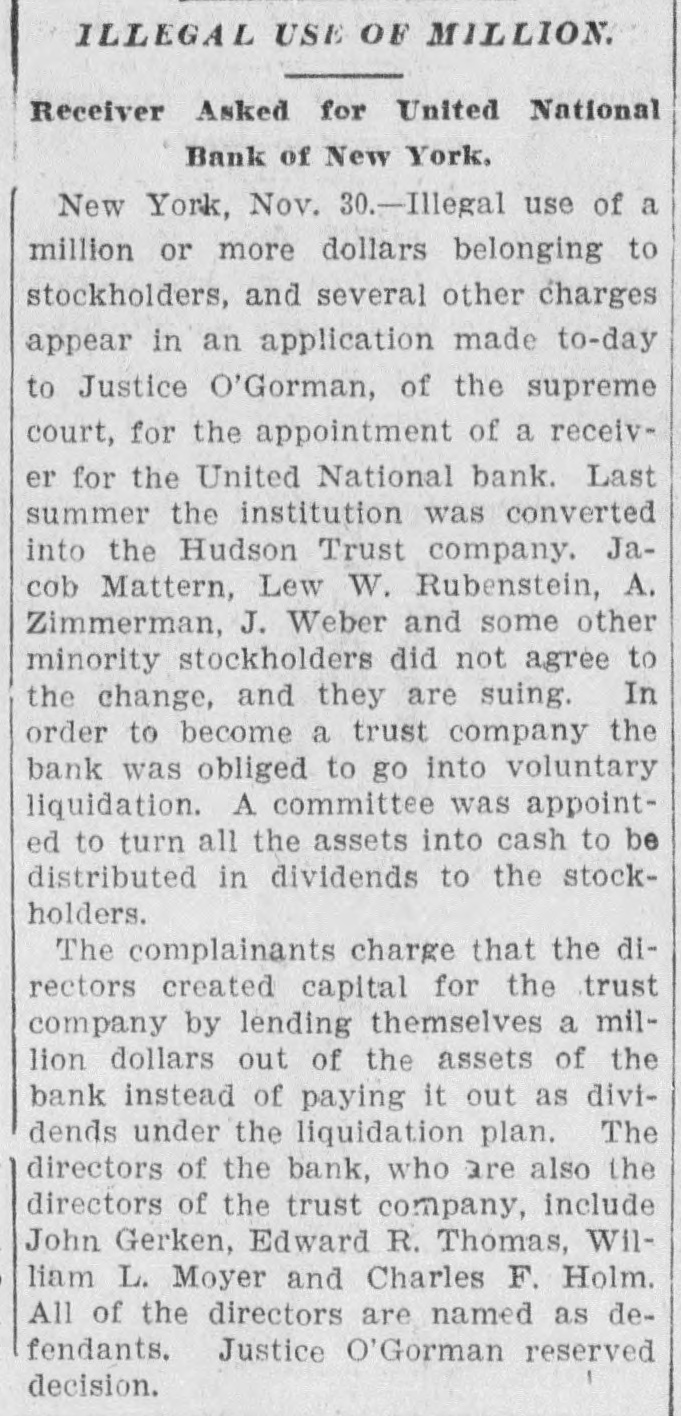
ILLEGAL USE OF MILLION. Receiver Asked for United National Bank of New York, New York, Nov. 30.-Illegal use of a million or more dollars belonging to stockholders, and several other charges appear in an application made to-day to Justice O'Gorman, of the supreme court, for the appointment of a receiver for the United National bank. Last summer the institution was converted into the Hudson Trust company. Jacob Mattern, Lew W. Rubenstein, A. Zimmerman, J. Weber and some other minority stockholders did not agree to the change, and they are suing. In order to become a trust company the bank was obliged to go into voluntary liquidation. A committee was appointed to turn all the assets into cash to be distributed in dividends to the stockholders. The complainants charge that the directors created capital for the trust company by lending themselves a million dollars out of the assets of the bank instead of paying it out as dividends under the liquidation plan. The directors of the bank, who are also the directors of the trust company, include John Gerken, Edward R. Thomas, William L. Moyer and Charles F. Holm. All of the directors are named as defendants. Justice O'Gorman reserved decision.


Article from New-York Tribune, December 12, 1906

Click image to open full size in new tab

Article Text

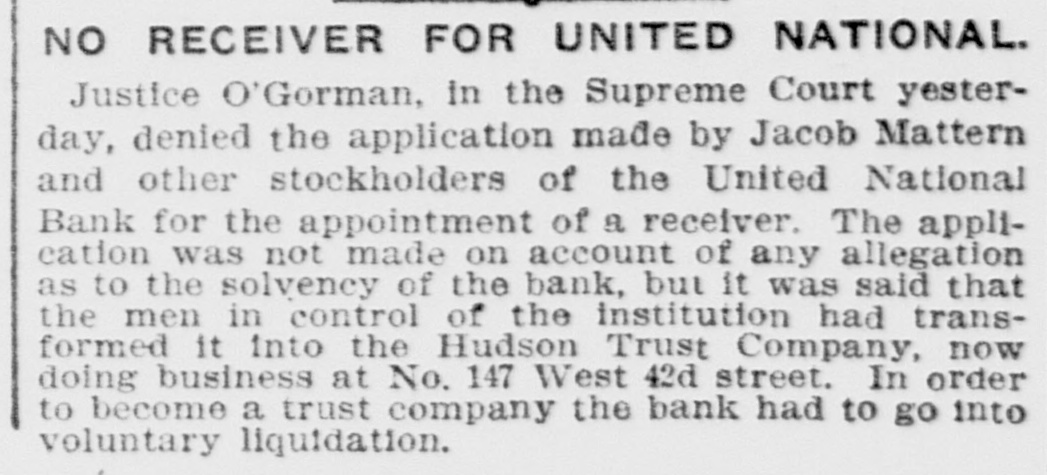
NO RECEIVER FOR UNITED NATIONAL. Justice O'Gorman, in the Supreme Court yesterday, denied the application made by Jacob Mattern and other stockholders of the United National Bank for the appointment of a receiver. The application was not made on account of any allegation as to the solvency of the bank, but it was said that the men in control of the institution had transformed it into the Hudson Trust Company, now doing business at No. 147 West 42d street. In order to become a trust company the bank had to go into voluntary liquidation.