Article Text
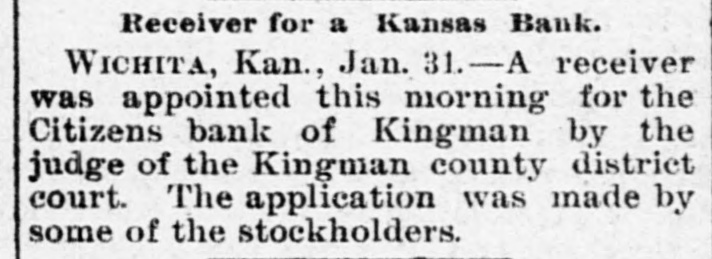
Receiver for a Kansas Bank. WICHITA, Kan., Jan. 31.-A receiver was appointed this morning for the Citizens bank of Kingman by the judge of the Kingman county district court. The application was made by some of the stockholders.
2751231a74309fd7None
Click image to open full size in new tab
Receiver for a Kansas Bank. WICHITA, Kan., Jan. 31.-A receiver was appointed this morning for the Citizens bank of Kingman by the judge of the Kingman county district court. The application was made by some of the stockholders.
Click image to open full size in new tab
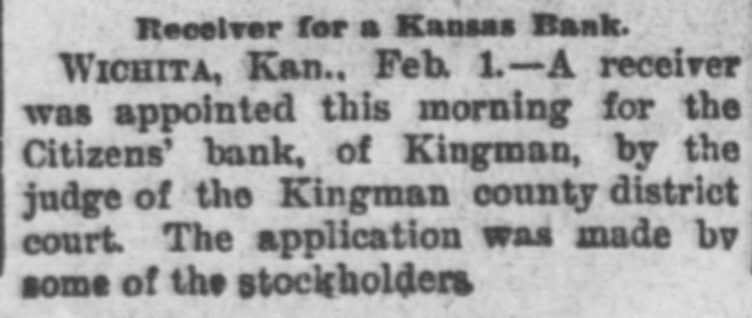
Receiver for a Kansas Bank. WICHITA, Kan.. Feb. 1.-A receiver was appointed this morning for the Citizens' bank, of Kingman, by the judge of the Kingman county district court. The application was made by some of the stockholders

Click image to open full size in new tab
speakers of the Rival Houses at Tope The Eogage in a Spley Correspondence. ka Kan., Feb. 1.-Just before night, the rival TOPEKA, houses adjourned Monday Speaker Speaker Dunsmore handed letter, to and Douglass a typewritten 9 o'clock when the two houses met at on hand yesterday a big crowd was sides were in a scene. Both the let to witness several hours last night, the reter caucus and the probable action of of discus. publicans being the subjects caueas resulted The republican Doug sion. vote of confidence in Speaker him to in a and permission was Dunsmore. given : lass draft a letter in reply to DOUGLASS DUNSMORE TO MR. PRESENTATIVES H ALL MR OF THE HOUSE OF REP L Douglass. My printer Dear Jan. 30, Sir: 1893 As by Hon. the election George the of political a United States reasons senator obstruction and a state in the house of representatives justifiable for exist. I can conceive of no authorno longer your refusal to recognize the the house now excuse ity of the in executive, the senate constituted. and of taken of As a good representatives lawyer as you are doubtless the trouble aware to in the fact yourself (if you in have relation to the house) facts and that have the form consulted the journals of the executive and legisstatus between the disturbed or anpresent departments cannot be other tribunal lative nulled by the authority of any attempt to exercise unless such tribunal granted should by the constitution for con- and laws, a power and not that the only now possible existing reason is either perdelay tinued sonal to obstruction yourself and the and hope the that favor by legal of a quibbling court. the law the republican partv. or at of least railpartisan managers and the representatives may preits other corporate interests demand our hands roads vent the and legislation that the people in is Kansas aware Every well that informed the railroad and man other corporate promptthe of managers the fact in this state are action behind of your you, party to ing and directing wheels of legislation, even going as SO to block ar, as the I am informed yourself by good and authority other republicadvance the pay one of of the banks of this city interests. close ans through with certain railroad slation rely connected ou desire the legis! Kansas, If as you profess, the burdened people of evidence of quired is it not by about time that you the give executive and legislative that fact by authorities recognizing now working in harmony? experience of the last session required should can The that the legislation between convince you by a political union Upon only be obtaine tives and the house of representa in a great measure the world's posthis union of legislation depends in favor of the throughout sibility fair and many especially public institutions along the line of railthe state, and Two years ago it was the repub- house. road control. against the opposition against lican senate desire a republican house the result an opposition Many now senate In either case must the same be few committees have been appointed adjustby As me, but opportunities a trouble still exist in a for manner an honorment of the present and to that end I would be able to all to receive concerned and consider any proposition verbally or pleased deem proper to make. either question of the legislature you in may writing. that does not bring as into now organin relation ized the integrity and the acts of adjustment the executive can be made. we thereto. will be under If no such the necessity without of the promptly valuable pro- aid ceeding to of business yourself If and political between friends. and us. With and advice of K ansas judge 1 am let the assurance people of my personal regard, very trul yours, J. M DUNSMORE Speaker. DOUGL ASS DECLINES TO GIVE WAY. Yesterday Mr. Douglass replied the re- at setting forth once more revolulength, claims, the alleged minority publican action of the populist by Ben and tionary the "forging" of the rolls €. Rich and contending in part: the proceeding by mean+ was of which organized the of If over which you preside the neool body life ever be nuelesced in by regular orderly Kansas, she it would be he ernment end of in this comm onand constituti The fact mal gove that the governor succumbed and a ma to jority wealth in the senat partisan have so far nions no as the pressure of such a proceed ng, latensitios in to wise countenance chang S the fast. empaa-izes excep. as the it duty of all executive lawabiding the obligati citizens on and to protest against and the it genate Such countenance annihilate by the or destroy the legal chosen and con- by th: to the do people stitutional cannot house of representative people's will The powers are and many senate of the executive the and power the to perform miracles to is remains great: not one@of but them and despite true all that assertions they are a powerless by their the contrary. either it to create majority flat the out of minority tutional and or to lawful destroy bod, of representative of the people issue with your assumption that to deter- the I take have no constitutional power legislature courts whether an alleged act of the or by mine passed by the legisl the some other was ever in body fact It is the highest duty of courts to so declare . rights Your intimation that body. in defending of which the I am mo- the of the constitution may be influenced by personal legislation speaker. tives. and that I desire people to is prevent an unworthy impudemanded tation which by I the must In leave like thos^ m inner who know I notice. me best to answer. without comment. the unworbut pass upon the integrity and character of of thy the uemocra reflection and republican tatives members involved the lawful House that of represen in this struggle for law and the your assertion they are prom oted and directed You by will order and other corporations. impropriety of railroads recognize the peculiar that, the yoursel when I recall to you the fact conferring on with 12th this day of members this mouth, of the after house, I offered (in onl. event many of of the the then proposed adjustment a large number of our of leading give 10 difficulties commit to give tees to no the members them of the the chair peomanship ple's party and but full also control of the railroad committee. always been ready, and still am. with a to to not an securi confer have with yourself honorable OF any member adjustment of that lezisiamay and view the present proceed difa cuities But to any the end adjustment which revo tion involves assent thods $0 th whereby extraordinary the bod over remain which you lutionary preside m was organized is and will an impossibility the best of personal feeling. I beg house leave of With that the constitutional the high to assure you is here to perform here it will representatives intrusted to it br the people. and duties remain Ver re-pectfully yours G EORGE L. DOUGLAS Speaker. Receiver for a Kaasas Bank WICHITA. Kan.. Feb 1.- A receiver the appointed this morning for the Citizens' was bank. of Kingman. by
Click image to open full size in new tab
Receiver for a Kaasas Bank WICHITA, Kan., Feb 1.-A receiver was appointed this morning for the Citizens' bank. of Kingman, by the judge of the Kingman county district court. The application was made by some of the stockholders