Click image to open full size in new tab
Article Text
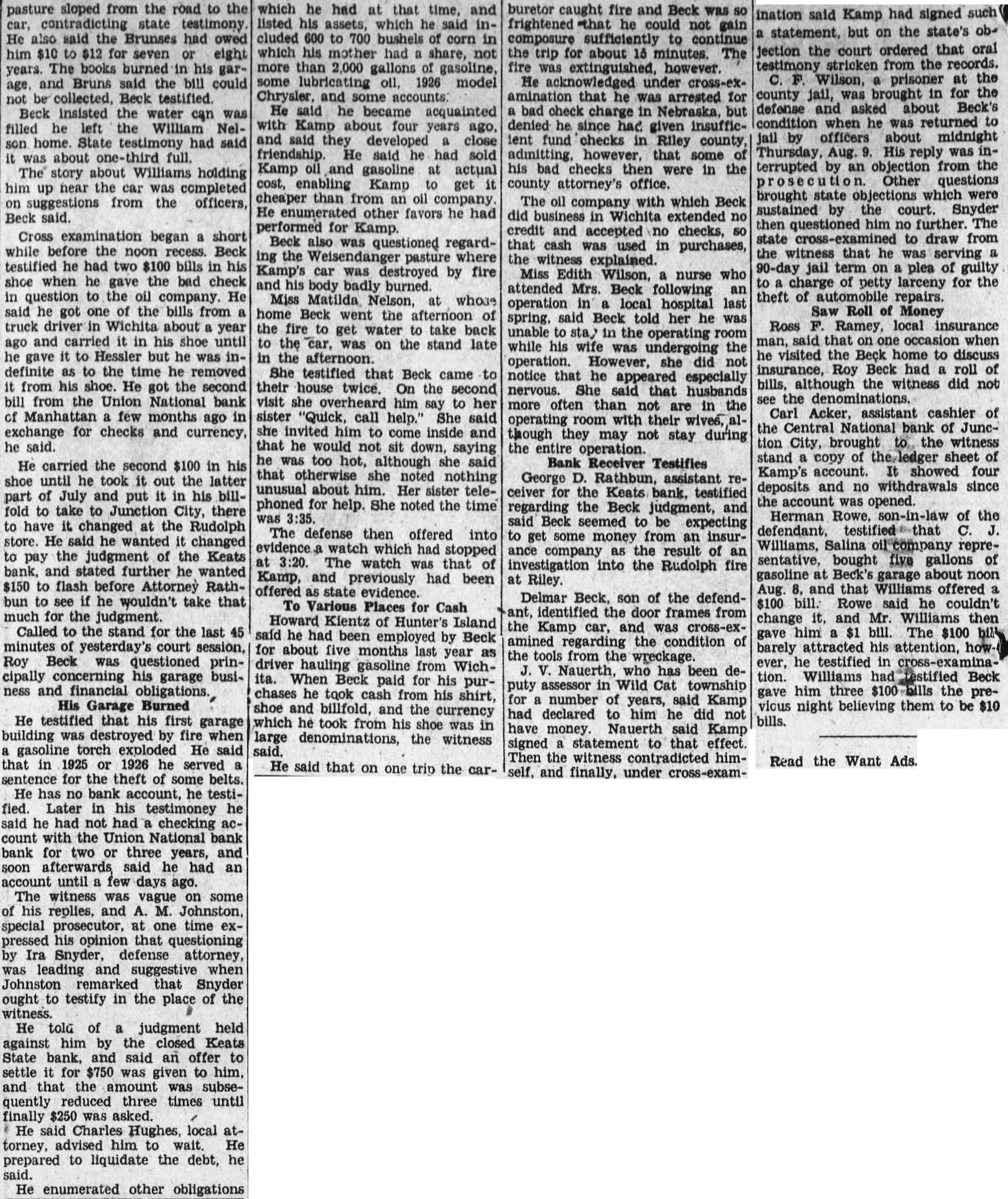
pasture sloped from the road to the car, contradicting state testimony He also said the Brunses had owed him $10 to $12 for seven or eight years. The books burned in his garage, and Bruns said the bill could not be collected, Beck testified. Beck insisted the water can was filled he left the William Nelson home. State testimony had said it about full. The story about Williams holding him up near the car was completed on suggestions from the officers, Beck said. Cross examination began short while before the noon recess Beck testified he had two $100 bills his shoe when he gave the bad check in question to the oil company. He he got one of the bills from truck Wichita year ago and carried in his shoe until he gave to Hessler but he was indefinite as to the time he removed it from his shoe. He the second bill from the Union National bank of Manhattan few months ago in exchange for checks and currency, he said.
He carried the second $100 in his shoe until he took it out the latter part of July and put it in his billfold to take to Junction there to have changed at the Rudolph store. He said he wanted it changed to pay the judgment of the Keats and stated further he wanted $150 to flash before Attorney Rathbun to see he wouldn't take that much for the judgment. Called to the stand for the last minutes of yesterday's court session, Roy Beck was questioned principally concerning his garage business and financial obligations. His Garage Burned He testified that his first garage building destroyed by fire when gasoline torch exploded He said that in 1925 1926 he served sentence for the theft of some belts. He has no bank account, he testified. Later in his testimoney he said he had not had checking account with the Union National bank bank for two or three years, and soon afterwards, said he had an account until few days ago. The witness was vague some of his replies, and M. Johnston, special prosecutor, one time expressed his opinion that questioning Ira Snyder, defense attorney, was leading and suggestive when Johnston remarked that Snyder ought to testify in the place of the witness He told of judgment held against him by the closed Keats State and said an offer to settle for $750 was given to him, and that the amount was subsequently reduced three times until finally $250 was asked. He said Charles Hughes, local torney, advised him to wait. He prepared to liquidate the debt, he said. He enumerated other obligations which he had at that time, and listed his assets, which he said included 600 to 700 bushels of corn in which his mother had share, not more than 2,000 gallons of gasoline, some lubricating 1926 model Chrysler, and some accounts. He said he became acquainted with Kamp about four years ago, and said they developed close friendship. He said he had sold Kamp oil and gasoline at actual cost, enabling Kamp to get cheaper than from an oil company. He enumerated other favors he had performed for Kamp. Beck also was questioned regarding the Weisendanger pasture where Kamp's car was destroyed by fire his body badly burned Miss Matilda Nelson, at whose home Beck went the afternoon the fire get water to take back to the car, was on the stand late the afternoon She testified that Beck came to their house twice. On the second visit she overheard him say to her sister "Quick, call She said she invited him to come inside and that he would not sit down, saying he was too hot, although she said that otherwise she noted nothing unusual about him. Her sister telephoned for help. She noted the time was 3:35. The defense then offered into evidence.a watch which had stopped 3:20. The watch was that of Kamp, and previously had been offered state evidence. Various Places for Cash Howard Kientz of Hunter's Island said he had been employed by Beck for about five months last year driver hauling gasoline from Wichita. When Beck paid for his purchases he took cash from his shirt, shoe and billfold, and the currency which he took from his shoe was in large denominations, the witness said.
He said that on one trip the car- buretor caught fire and Beck was frightened he could not gain composure sufficiently to continue the trip for about 15 minutes. The fire was extinguished, however. He acknowledged under cross-examination that he was arrested for bad check charge in Nebraska, but denied he since had given insufficient fund checks in Riley county, admitting. however, that some his bad checks then were in the county attorney's office. The oil company with which Beck did business in Wichita extended no credit and accepted no checks, that cash was used in purchases, the witness explained. Miss Edith Wilson, nurse who attended Mrs. Beck following operation local hospital last said Beck told her he unable sta, in the operating room while his wife was undergoing the operation. However, she did notice that he appeared especially She that husbands more often than not are the operating room with their wives, though they may not stay during the entire operation. Bank Receiver Testifies George D. Rathbun, assistant ceiver for the Keats bank, testified regarding the Beck judgment, and said Beck seemed to be expecting to get some money from an insurance company as the result of an investigation the Rudolph fire at Riley. Delmar Beck, son of the defendidentified the door frames from the Kamp car, was cross-examined regarding the condition of the tools from the wreckage. Nauerth, who has been deputy assessor Wild Cat township for number of years, said Kamp had declared to him he did not have money. Nauerth said Kamp signed statement to that effect. Then the witness himand finally, under ination said Kamp had signed such statement, but on the state's jection the court ordered that oral stricken from the records. Wilson, prisoner at the county jail, was brought in for the defense and asked about Beck's condition when he was returned to jail by officers about midnight Thursday, Aug. His reply was interrupted by an objection from the Other questions brought state objections which sustained by the court. Snyder then questioned him no further. The state to draw from the that he was serving 90-day jail term on plea of guilty to charge of petty larceny for the theft of automobile repairs. Saw Roll Money Ross Ramey, local insurance man, said that when he visited the Beck home to discuss insurance, Roy Beck had of bills, although the witness did not see the denominations. Carl Acker, assistant cashier of the Central National bank of Junetion City, brought the witness stand copy sheet of Kamp's account. showed four deposits and no withdrawals since the account was opened Herman Rowe, of the defendant, Williams, Salina oil company representative, bought five gallons of gasoline at Beck's garage about noon Aug and that Williams offered $100 Rowe said he couldn't change it, and Mr. Williams then gave him $1 bill. The $100 barely attracted his attention, how ever, he testified in tion. Williams Beck gave him three the previous night believing them to be $10 bills.
Read the Want Ads.