South Carolina Loan & Trust Company (Charleston, SC)

Episode Information

Episode UID
5910518190957
Episode Type
Run โ†’ Suspension โ†’ Unsure
Bank Type
trust
Bank ID
591051819 hash
Start Date
September 20, 1879
Location
Charleston, South Carolina (32.777, -79.931)

Metadata

Model
gpt-5-mini (chosen from majority vote of a three-model LLM ensemble)
Short Digest
dc8784e30e7ea2cc

Response Measures

None

Description

Partial suspension invoked via the sixty days' notice rule; no follow-up about reopening in provided articles.

Events (2)

1. September 20, 1879 Run
Cause
Local Banks
Cause Details
Failures of James Adger & Co. and related suspensions caused losses and depositor withdrawals from the trust company's savings department.
Measures
Took advantage of the sixty days' notice rule for savings withdrawals (partial suspension of payments).
Newspaper Excerpt
the South Carolina Loan and Trust Company is stated to have lost $49,000, and a run on its savings department this morning
Source
newspapers
2. September 20, 1879 Suspension
Cause
Local Banks
Cause Details
Resulting pressure from losses tied to the failure of James Adger & Co. and consequent local failures prompted invocation of the 60-day notice rule.
Newspaper Excerpt
a run on its savings department this morning has compelled it to take advantage of the sixty days' notice rule
Source
newspapers

Newspaper Articles (2)

Article from The New York Herald, September 21, 1879

Click image to open full size in new tab

Article Text

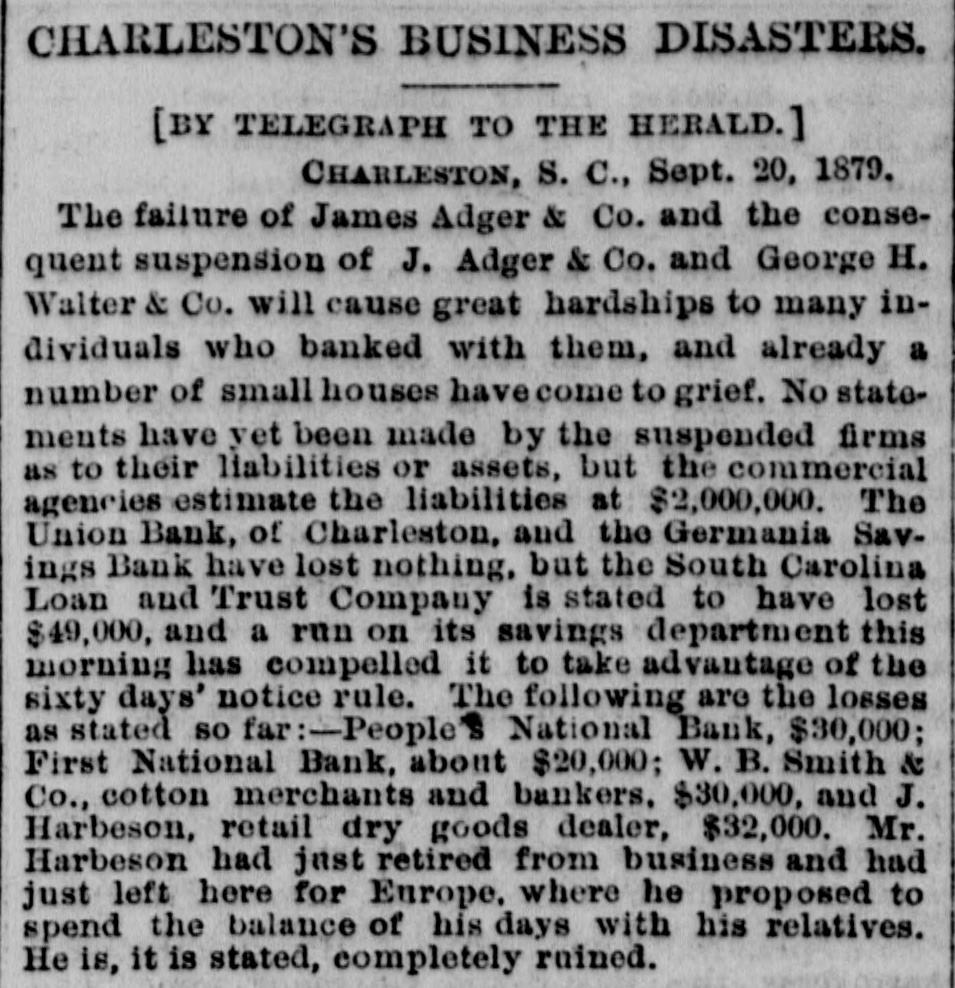
CHARLESTON'S BUSINESS DISASTERS. [BY TELEGRAPH TO THE HERALD.] CHARLESTON, S. C., Sept. 20, 1879. The failure of James Adger & Co. and the consequent suspension of J. Adger & Co. and George H. Walter & Co. will cause great hardships to many individuals who banked with them, and already a number of small houses havecome to grief. No statements have yet been made by the suspended firms as to their liabilities or assets, but the commercial agencies estimate the liabilities at $2,000,000. The Union Bank, of Charleston, and the Germania Savings Bank have lost nothing, but the South Carolina Loan and Trust Company is stated to have lost $49,000, and a run on its savings department this morning has compelled it to take advantage of the sixty days' notice rule. The following are the losses as stated so far:-People's National Bank, $30,000; First National Bank, about $20,000; W. B. Smith & Co., cotton merchants and bankers. $30,000, and J. Harbeson, retail dry goods dealer, $32,000. Mr. Harbeson had just retired from business and had just left here for Europe. where he proposed to spend the balance of his days with his relatives. He is, it is stated, completely ruined.

Article from Keowee Courier, October 2, 1879

Click image to open full size in new tab

Article Text

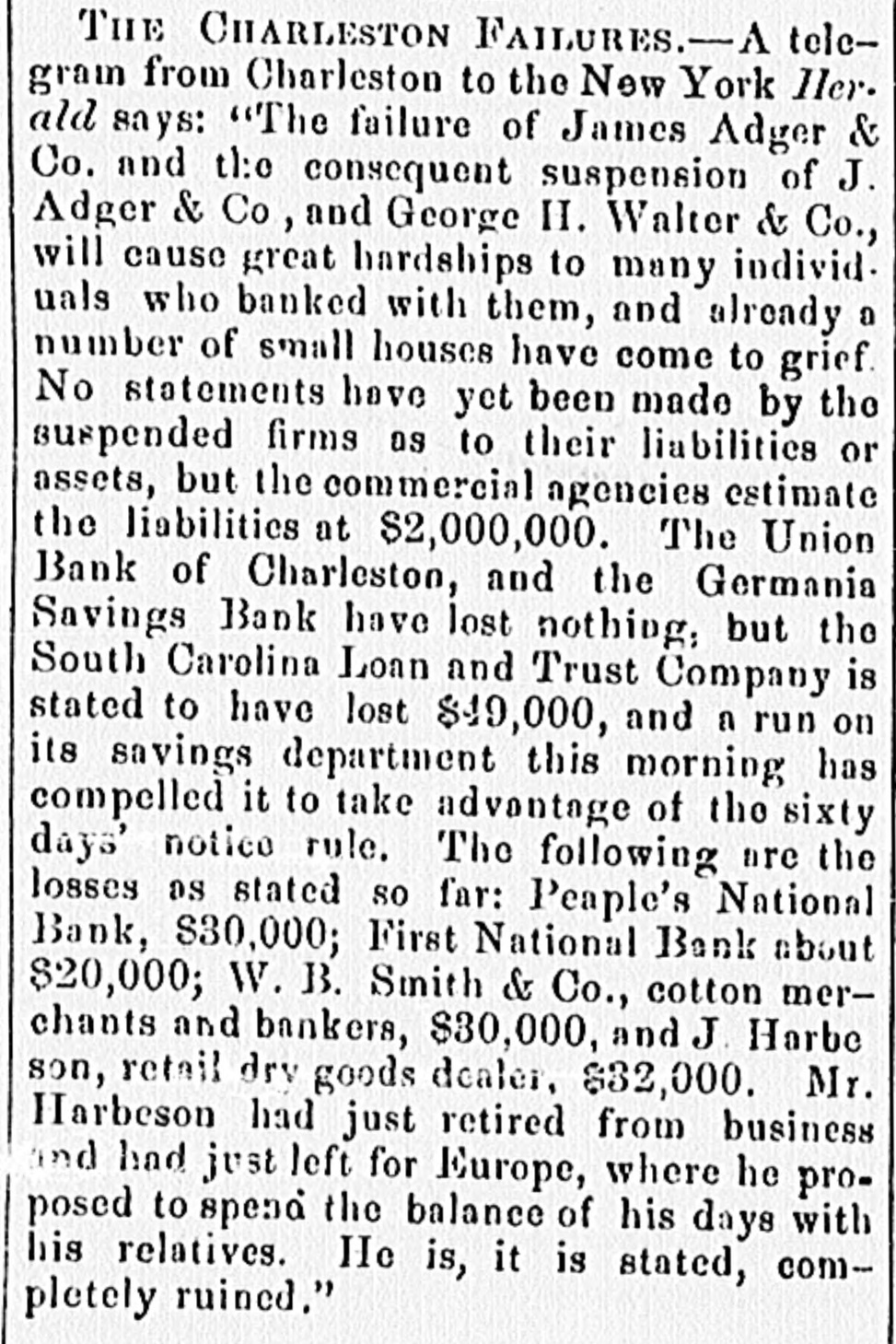
THE CHARLESTON FAILURES.-A telegram from Charleston to the New York Her. ald says: "The failure of James Adger & Co. and tl:e consequent suspension of J. Adger & Co, and George II. Walter & Co., will cause great hardships to many individuals who banked with them, and already a number of small houses have come to grief. No statements have yet been made by the suspended firms as to their liabilities or assets, but the commercial agencies estimate the liabilities at $2,000,000. The Union Bank of Charleston, and the Germania Savings Bank have lost nothing, but the South Carolina Loan and Trust Company is stated to have lost $49,000, and a run on its savings department this morning has compelled it to take advantage of the sixty days' notice rule. The following are the losses as stated 80 far: Peaple's National Bank, $30,000; First National Bank about $20,000; W. B. Smith & Co., cotton merchants and bankers, $30,000, and J. Harbe son, retail drv goods dealer, $32,000. Mr. Harbeson had just retired from business and had just left for Europe, where he proposed to spend the balance of his days with his relatives. He is, it is stated, completely ruined."