Article Text
S. J. Keith, president of the Fourth National Bank, said that the situation was nothing like as bad as it might appear. Although during the morning one small bank had closed its doors permanently and another availed itself of the sixty days allowed savings banks, yet it was evident that the other banks were amply prepared to take care of themselves, and as for the Fourth National, it was never, in its twenty-seven years of business, better prepared to take care of its customers, and, in fact, had during the day taken over a great many new depositors and the deposits were largely in excess of the checks. He said the business condition of the city was entirely healthy and would not be seriously disturbed because disaster had overtaken the Commercial National.
Pledging Their Fortunes.
Before the doors of the First National bank were opened a large crowd had gathered on the pavement and in the streets. It appeared that a decided run on the bank would be made, but when the doors finally opened there was no general rush, though a steady stream of men flowed into the bank. From that time until noon there was a mild run, but the amount deposited during the same time was vastly in excess of the amount taken out. Only small depositors, such as had amounts in sums ranging under $1,000, presented checks to be cashed, while the state and firms and corporations that are in the habit of dealing with the First National deposited unusually large sums. It was generally said in addition to this that that the bank had received some $800,000 by express today. At no time was there the least excitement. Those depositors who felt panicky simply came up and drew out their money and went quietly away. The space around the railing of this bank was more crowded all morning than that of any other bank.
The following notice was posted above the paying teller's window in the American National bank today:
We, the undersigned, hereby pledge and bind our personal estates to pay and satisfy any obligations of the American National bank.
V. L. Kirkman, W. W. Berry, C. D. Berry, Byrd Douglass, J. E. Harris, Benj. B. Allen, N. Kirkman, Thomas J. Weaver, Richard Cheatham, Joseph W. Allen, W. H. Jackson, R. L. Weakley, A. W. Harris, A. H. Robinson, R. W. Turner, E. H. Fall, Thomas Craighead, James Burns.
About the bank everything was as calm and orderly as at any previous time. The regular business was transacted without the least hitch or excitement. The bank took in more money than it paid out. For the benefit of small depositors the doors were kept open until 4 o'clock this afternoon.
Shortly after 10 o'clock the following notice was posted on the door of the Bank of Commerce:
"Board of directors in meeting considering affairs of bank. No business done today. J. N. BROOKS, Cashier."
Bank of Commerce Assigns.
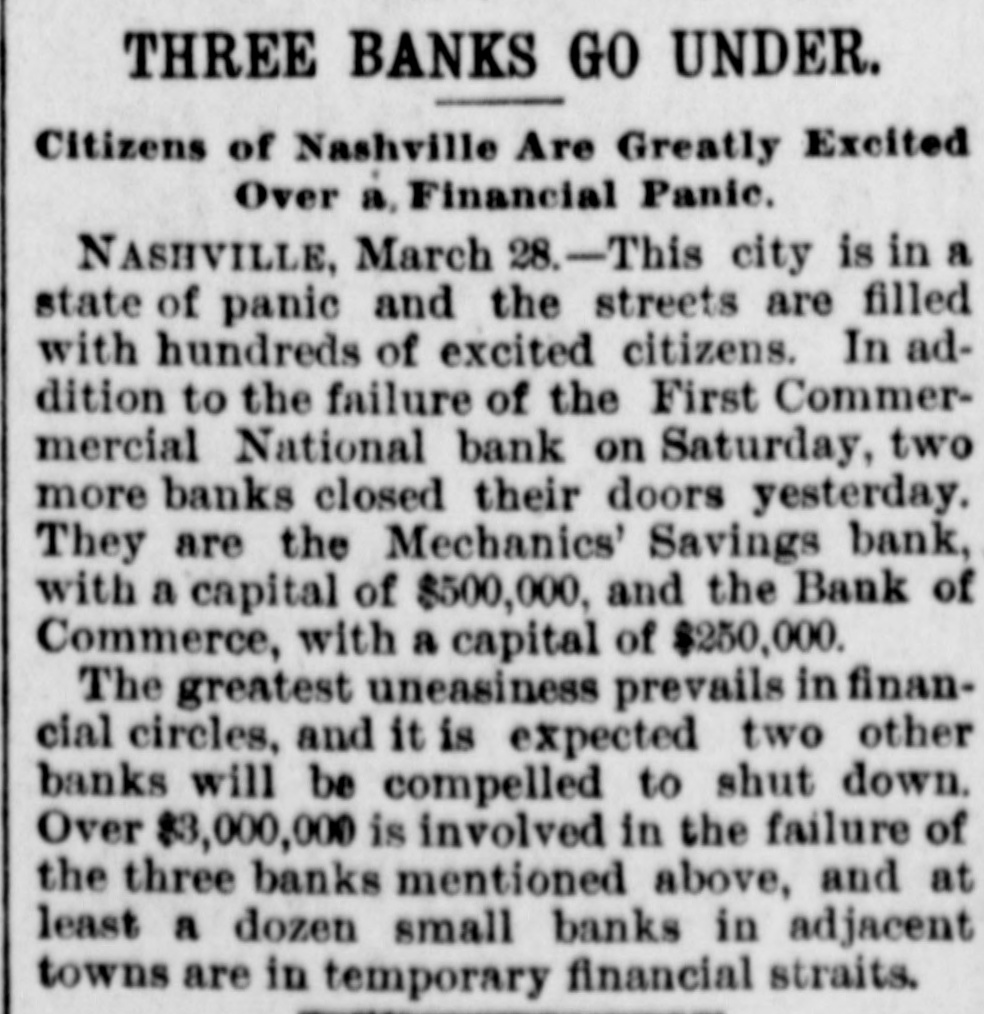
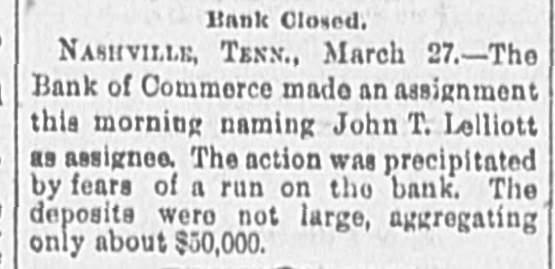
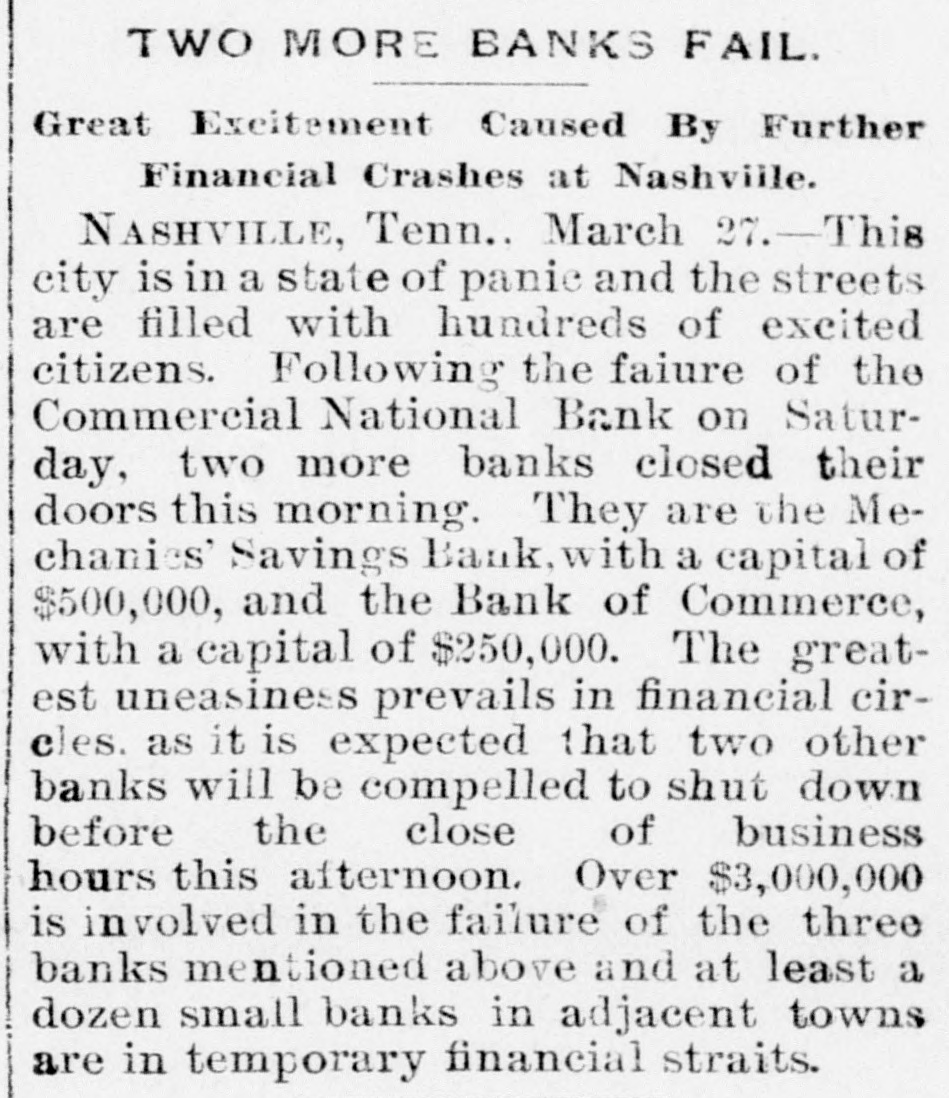
The Bank of Commerce made an assignment this morning, naming John T. Lellyett as assignee. This action was precipitated by the general apprehension of a run on the bank, which the officers believed would be made.
The deposits were not large, aggregating only about $50,000, $15,000 of which was by small depositors, ranging from $5 upward in the saving department. The bank might have availed itself of the sixty days' notice for the withdrawal of these deposits, which would, however, not have prevented the withdrawal of regular deposits, thus placing the small savings depositors at a disadvantage. To avoid this, and also because the small depositors were laboring people, and would, therefore, perhaps, be at their work and not on hand to claim what was their own with the others during the morning, the directors determined, in the interest of all depositors alike, to close the bank.
The withdrawal of deposits from the bank has been going on gradually for some days—so late Saturday evening it was thought suspension on Monday would become necessary, and in order that the savings deposits put into the bank late Saturday evening by the laboring people might not share the fate of those made on former days, such deposits, although accepted, were not entered upon the regular bank books, but purposely treated as special deposits, and will be at once returned to the depositors upon call.
The president of the bank, J. H. Yarbrough, is not in the city. J. N. Brooks, the cashier, said the suspension was due mainly to the failure of certain parties who are largely in debt to the bank to meet their obligations. Mr. Brooks declined to state who the parties were, but from outside sources it was learned that at the time C. B. Duncan was cashier large sums of money were loaned to W. M. Duncan and Duncan & Gaines, which, owing to their misfortune, they had been unable to pay.
The financial status of the bank is approximately as follows:
ASSETS. Notes discounted $76,000 Real estate and cash 21,700—$97,700
LIABILITIES. Capital stock paid in $27,500 Deposits, savings account 14,000 Deposits, special account 15,000 General deposits 19,000 Profit and loss 22,200—$97,700
Mr. Brooks said to a Banner reporter: "You may say for me that not a single present director or officer of the bank owes a dollar to the bank; on the contrary, some of them are losers as depositors. I don't know what the final outcome will be. If we can collect our debts the stockholders, as well as depositors, will be paid 100 cents on the dollar, and if we collect only one-half of the debts, the depositors ought not to lose a farthing."
There was a great deal of sympathy expressed for Mr. Brooks who has the confidence of the community and feels very deeply depressed because of his inability to stem the current.
John P. White and J. H. Yarbrough are among the largest stockholders, but as they are men of means they can stand the loss even though the stockholders should fail to realize in full their holdings.
E. B. Stahlman, who is one of the directors of the bank, happening to be in the city, was asked to meet with the board, and after hearing a free statement from Mr. Brooks as to the condition of the bank, advised the assignment, making, if possible, preferred creditors of the small depositors who had put their money into the savings department of the bank.
Mr. Stahlman says if those who owe the bank will half way do their duty the depositors will not lose a dollar.
Speaking of his connection with the bank he said: "I have not attended a meeting of the board of directors in three years; continuous absence has kept me from doing so. I will say this, however, if the matter had been taken in hand last Saturday with vigor the bank would not have been compelled to close its doors. I proposed even this morning to help raise money, but no one else responded. The truth is Mr. Brooks has not been properly supported in his effort to keep the bank in good shape. I feel very sorry for Mr. Brooks, who personally made every sacrifice in his power to avert the trouble."
During the attempted run on the Mechanics' Savings Bank and Trust company Joseph G. Branch walked into the bank and announced that he had deposited in the bank $3,500 and he was satisfied to allow it to stand. He was perfectly satisfied that it was safe and he would be paid in full. He approved of the course taken by the directors.
This was the only display of confidence. A depositor from Maury county, who has an equal amount deposited in this bank, called in to say that he had $3,500 more which, if the bank needed, he was ready to transfer to the Mechanics' vaults.
No Cause for Alarm.
Gen. W. H. Jackson, a director of the American National bank, said today in an interview: "No, sir, there is no cause for alarm beyond what has happened to the Commercial Saturday.
"The other banks are solid, even more solid than ever before. This is due to the fact that the officers have been more conservative for the past six months than they have ever been before.
"The strain for popularity is what gives very high tension to any bank. Any popularity in a bank that is not based on conservative management which inspires the confidence of the public is not worth having."
J. H. Fullton, cashier of the Capitol City bank, said when approached: "The situation is all right. Some excitement is the natural consequence of the failure of the Commercial, but there is no need of alarm.
"The savings banks which have temporarily suspended payment were keeping accounts at the Commercial, and this, of course, created uneasiness and caused the attempted runs. The cause of the Commercial's losses was peculiar to that bank alone. Other banks are in as good shape as ever.
"Our bank is doing a good business today. Our deposits are equal to any day, and are in excess of the amounts drawn out. We apprehend no trouble at all."
President Settle, of the City Savings bank, said at noon that his bank had received more deposits by several thousand than had been drawn out, and that the checks drawn on the bank were in the main in the usual order of business.
A. W. Harris, cashier of the American National bank, said this afternoon that the situation was much more favorable than anyone could possibly have expected so soon after the failure of the Commercial National bank, and in view of the magnitude of the failure.
"This community is one which has great confidence in its banks, and this is properly so. As a rule the banks are characterized by the conservative methods of management, and it would be difficult to shake the confidence of the public.
"The apprehension has almost entirely died out, and, as you can see, there is little or no excitement now existing.
"The directors of all the banks have acted nobly in coming to the support of their institutions, pledging their personal estate to the maintenance of their credit, and I take this as the greatest commendation that could be shown the banks."
Business at all of the open banks has been satisfactory today.
At the First National bank it was impossible to give the figures as to the excess of deposits over the amount paid out. But the amount was very large. Two deposits were made aggregating $200,000. No large amounts were drawn out.
At the Fourth National bank the amounts deposited were probably five or six times in the aggregate as large as the amounts drawn out.
At the American National bank the deposits were far in excess of the amounts paid out. Two gentlemen early in the day drew out $8,000 each. One of them presently returned the same $8,000 that he had drawn out and the other $10,000.
The deposits at the Capital City bank were easily in excess of the amounts checked out.
The City Savings bank, which is the youngest institution of its kind, took in $7,000 over amounts paid out. The day was very satisfactory to them.
At the Merchants' bank the deposits were largely in excess of checks. Here, also, the day was very satisfactory.
At the Mechanics' bank the excess of deposits was $671.61.
The deposits at the Union Bank and Trust company exceeded the checks by 50 per cent.
NOW THE LAW.
President Spurr and Cashier Porterfield Are Likely to Be Arrested—Lewis T. Baxter Makes a Personal Assignment. Special to The Chattanooga Times.
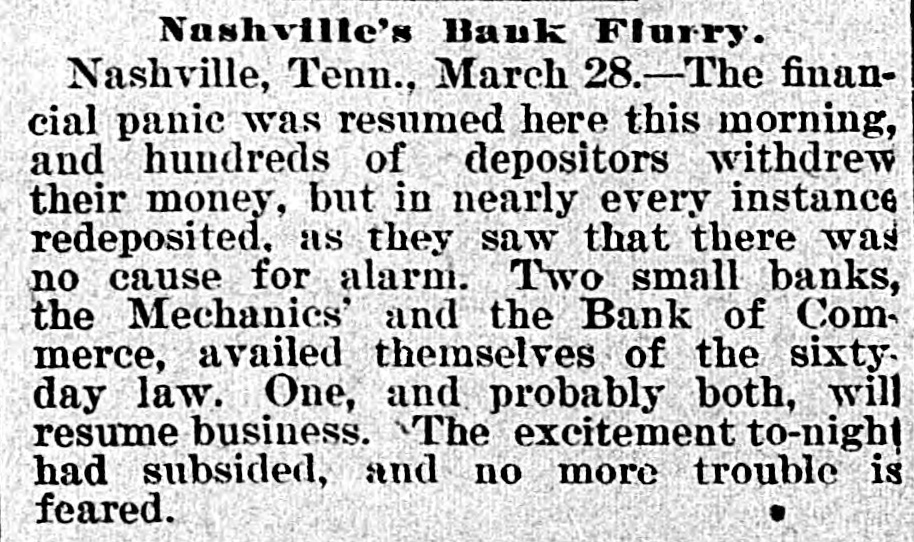
Nashville, March 27.—It has been difficult to learn exactly the status of the monetary panic which is at present absorbing the interest of the Nashville public. It is admitted that the condition of the Bank of Commerce is in a state of total collapse, though Mr. Brooks, the cashier, still thinks and states that all depositors will be paid dollar for dollar. The Mechanics' Savings bank is in a comparatively safe condition and their doors will probably be open tomorrow. Lewis T. Baxter, president of the bank, this afternoon made a partial personal assignment. He was indebted to the bank to the extent of about $25,000, but M. T. Bryant, one of the directors in the bank, and its attorney, tonight stated that this would not materially increase the bank's embarrassment, as Mr. Baxter had secured his indebtedness to them. Mr. McKnight, the United States bank examiner, is on the scene and it is rumored tonight that arrests will be made in the case of the Commercial Bank in a few days. Mr. McKnight was questioned upon this subject tonight, but stated that he had ordered no arrests. If arrests are made they will probably be Maj. M. A. Spurr, president of the bank, and Frank Porterfield, the cashier. Mr. Porterfield is at his home in a state of almost mental distraction. Rumors of suicide have been afloat all day in which his name was connected, but they are false. Mr. Baxter's personal assets are about $100,000. Mr. Baxter's assignment was made solely to secure the Mechanics' Savings bank, which is done by surrendering personal property. Leading bankers and citizens are inclined to think that the worst is over and that business will not be further demoralized.