5822. First National Bank (Indianapolis, IN)

Bank Information

Episode Type
Run → Suspension → Reopening
Bank Type
national
Bank ID
55
Charter Number
2556
Start Date
August 9, 1883
Location
Indianapolis, Indiana (39.768, -86.158)

Metadata

Model
gpt-5-mini
Short Digest
e0b476eb

Response Measures

Accommodated withdrawals, Capital injected, Full suspension, Books examined

Other: Syndicate (Depauw & English) doubled capital and provided management; Comptroller/state examiner instructed to investigate.

Description

Large depositor withdrawals / run occurred Aug 9–10, 1883; bank's directors temporarily kept doors closed (suspension), then syndicate (DePauw & English) doubled capital and reopened the bank paying checks. Some accounts attribute the trouble to the state treasurer withdrawing state deposits.

Events (6)

1. August 8, 1863 Chartered
Source
historical_nic
2. September 1, 1881 Chartered
Source
historical_nic
3. August 9, 1883 Run
Cause
Bank Specific Adverse Info
Cause Details
Sudden large withdrawals by depositors (reports mention state treasurer withdrawing large state deposits as a precipitating factor).
Measures
Directors convened; syndicate formed to recapitalize; later opened to pay checks.
Newspaper Excerpt
Run on Banks. INDIANAPOLIS, August 9th -This afternoon there has been a large demand by depositors on the First National Bank...
Source
newspapers
4. August 10, 1883 Suspension
Cause
Bank Specific Adverse Info
Cause Details
Bank remained closed while directors and capitalists conferred to secure additional capital and support following heavy withdrawals; press mentions state deposits withdrawn as factor.
Newspaper Excerpt
Large crowds gathered around the First National bank ... At 9:42 the doors of both banks were still closed. The announcement has just been made that they will not open for two or three hours.
Source
newspapers
5. August 11, 1883 Reopening
Newspaper Excerpt
The conference ... ended between 2 and 3 o'clock this afternoon. At 2:50 the doors of the bank were opened, and W. English appeared, inviting the depositors to come in and get their money. ... all the checks presented were promptly paid; ... reorganization ... double its former capital, has been fully agreed upon.
Source
newspapers
6. November 11, 1886 Voluntary Liquidation
Source
historical_nic

Newspaper Articles (22)

Article from Sacramento Daily Record-Union, August 10, 1883

Click image to open full size in new tab

Article Text

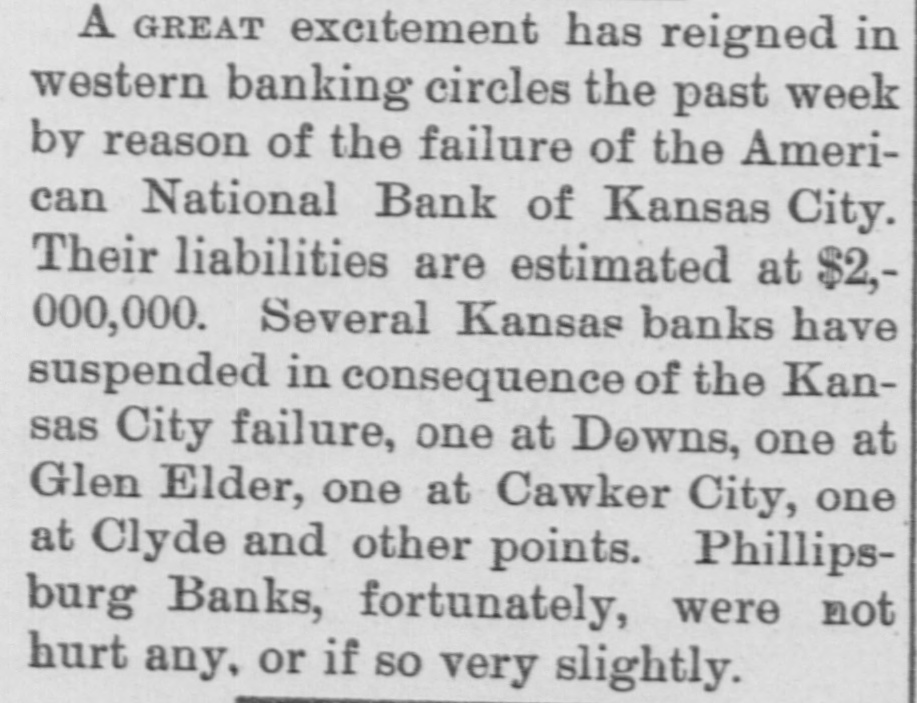
persons are down with the disease, No deaths are reported to-day. The disease 's said to be malignant dysentery, whose attack grow on a person. The Storm in "The West." DODGE CITY (Kas.), August 9th.-The severest storm ever known in this section struck this city after midnight last night, The wind-guage at the Signal office was blown down, but good judges estimated the velocity at nicety miles per hour. The storm was accompanied by the grandest display of lightning ever witnessed here, it being one continuous sheet of angry flame, There was also a very heavy rainfall, and water stood over a foot deep on Front street. The Salvation Army Again. SYRACUSE (N. Y.), August 9th.-Several weeks ago the Common Council passed resolutions prohibiting the Salvation Army from parading the streets. To-night the entire army determised to defy the Board of Aldermen, and marched through the streets shouting "Hallelujah" and singing hymns adapt ed to popular airs. The police arreated the whole body and escorted them to the stationhouse. When about to be placed in cells the Alderman who opposed the resolution signed their bail bond, and the parties will appear before a Justice to-morrow. Destruction by Fire. DANVILLE, August 9th.-The cotton factory of E. L. & A. Gerst, the tobacco warehouse of S. Holland & Co., the tobacco factory of Soll, Pickery & Oyer; the tobacco factory of W. F. Lowe and several outhouses were burned to-day. The estimated loss is $150,000; insurance, $116,000. VICKSBURG, August 9th.-A fire at Meridian to-day burned three blocks of residences and tenements, causing S loss of $50,000, distributed among a number of perLODS. Insurance, $10,000. A Cave in Lookout Mountain. CHATTANOOGA (Tenn.), August 9th.-Explorers recently discovered a cave at the base of Lookout Mountain, the opening being at low water mark in the Tennesses river, three miles from the city, Explorationa developed a wonderful cave of unknown depth. At the extreme point a very large lake was encountered, into which a fall 150 feet high poured its water with a noise of thunder. Other waterfalls and other interesting phenomens were discovered. Carey's Slayer. MILWAUKEE, August 9th.-It is discovered that Edward O'Donnell, who killed informer Carey in South Africa, lived with his parents, brothers and sisters in Milwaukee for many years. Two or three of the family died insane, and it is said O'Donnell at times showed an unbalanced mind. Indian Hanged for Murder. GALQUAT (Indian Territory), August 9.h.Running Bird" was hanged here to-day for the murder of Running Water." Run on Banks. INDIANAPOLIS, August 9th -This afternoon there has been & larga demand by depositors on the First National Bank, and that of the Indiana Banking Company, and large amounts have been withdrawn from both these institutions. Thermometrical. NEW York, August 9th.-Highest tempera ture to-day, 85° ; lowest, 65°.


Article from The Portland Daily Press, August 11, 1883

Click image to open full size in new tab

Article Text

Trying to Save the Indianapolis Bank. INDIANAPOLIS, Ind., Aug. 10.-The board of directors of the suspended First National Bank adopted a resolution at their meeting this morning to double the stock of the bank to $800,000 instead of $400,000, provided a syndicate headed by Messrs. Depauw and English, was formed to take the management and a controlling amount of the stock. A paper was drawn to this effect, which was signed by all the directors. Both banks are still closed. A Chicago despatch says that prices are steadily but slowly declining, owing to financial disturbances at Indianapolis. Other banks held meetings and offered to help the First National.


Article from Daily Globe, August 11, 1883

Click image to open full size in new tab

Article Text

NO, 223 Virginia ? North Carolina 70; Ohio 93, Connecticut 87, and Wisconsin 90. f COLLAPSING. h $ TWO INDIANAPOLIS BANKS CLOSE 1 THEIR DOORS YESTERDAY. One Subsequently Resumes and Pays Checks on Demand-It Will Double,Its Capital and Resume Business-Other Business Troubles. INDIANAPOLIS, Ind., Aug. 10.-Large crowds gathered around the First National bank and the Indiana Banking company an hour before opening time this morning. At 9:42 the doors of both banks were still closed. The announcement has just been made that they will not open for two or three hours. The directors of the First National bank with several large influential capitalists of the state met at 8 o'clock this morning and are still in session, but nothing has been made public as to the result of the conference. LATER-Both suspended banks remained closed. The following notice was posted on the door of the First National: "The board of directors are in session considering what is best to be done, but have not arrived at a conclusion." The board of directors of the First National bank adopted a resolution at their meeting this morning to double the stock of the bank, $800,000 of stock instead of $400,000, provided the syndicate, headed by Mr. Depau and Mr. English, was formed to take the management and controlling amount of the stock. A paper was drawn up to this effect, which was signed by all the directors and stockholders present, and a committee was appointed to get the consent of the stockholders not present. Assoon as this consent is completed, it is understood that new and strong parties will come into the concern that will make it one of the strongest institutions in the country. It may take a few days to do this and gather in the required amount of currency, but it may be done in a few hours. The other banks also held a meeting this morning and agreed that if the proposed syndicate was formed they would afford all the assistance to the First National that might be required. It may be said, therefore, that whilst it is unfortunate that any trouble occured, there is really no reason for alarm, and that ultimate good may result from it in giving the bank increased strength. Very little information has been obtained as Indiana to what the Banking company may do, but it is probable they will be able to resume also in a very short time, There has been no extraordinary demand on any of the other banks for funds to-day. INDIANAPOLIS, Aug. 10.-The conference between the directors of the First National bank and the English-Depau syndicate ended between 2 and 3 o'clock this afternoon. At 2:50 the doors of the bank were opened, and W. English appeared, inviting the depositors to come in and get their money. The crowd outside rushed in, but were checked by the police, and ladies were given the preference. The bank continued open for an hour or more after the closing hour, and all the checks presented were promptly paid; but few of the larger depositors drew their money. It is understood that a reorganization of the bank, with double its former capital, has been fully agreed upon, and will be perfected as speedily as possible, with Mr. English as president. The other banks were fully prepared, but no runs were perceptible. The Indiana Banking company has not resumed. SIOUX CITY, Aug. 10.-The creditors of Cottrell Bros., agricultural implements, have not yet effected a settlement. It is believed the liabilities of the firm will reach about $160,000 with assets of about $140,000. The firm has offered fifty cents on a dollar. A general meeting of creditors is called to meet here the 14th inst.


Article from National Republican, August 11, 1883

Click image to open full size in new tab

Article Text

TOTTERING BANKS. The Directors of the First National of Indianapolis Trying to Double Their Capital. The Bank Closed and a Large Crowd Awaiting Results-History of the Bank. Special Dispatch. NEW YORK, Aug. Vice President Murray, of the United States National bank here, says: "We have not been advised of the closing of the First National bank of Indianapolis. The demand upon them yesterday must have been sudden, as they have not in. timated to us the want of funds. Their balances are fairly good with us, and they have not called upon us for currency. This bank will not be involved in of their was caused by Their embarrassment any probably troubles. the sudden withdrawal of the state treasurer's funds." By Associated Press. IND., crowds around the First INDIANAPOLIS, gathered Aug. 10.-Large National bank and the Indiana Banking company's office an hour before the opening time this morning. At 9:45 an announcement was made that the directors, who had met at 8 o'clock, were in session, and that the banks would not open for two or three hours at least. Several prominent and influential capitalists were known to be in consultation with the directors, and this fact did much to allay anxiety and excitement, though nothing was made public as to what their plans or hopes, if they had any, might be. Later a notice was posted on the door of the Frst National saying, "The board of director# is in session considering what is best to be done, but have not yet reached a conclusion.' Late in the afternoon it was announced that the directors of the First National had adopted a resolution to double the stock of the bank to $800,000 instead of $400,000, provided the and was to take the syndicate English headed formed by Mr. Depauw management Mr. and controlling amount of the stock. A paper was drawn up to this effect, which was signed by all the directors and stockholders present, and a committee was appointed to get the consent of the stockholders not present. As soon as this consent is completed it is understood that new and strong parties will come into the concern who will make it one of the strongest financial institutions in the country. It may take a few days to do this and gather in the required amount of currency, but it may be done in a few hours. Other banks also held meetings this morning and agreed that if the proposed syndicate was formed they would afford all the assistance to the First National that might be required. It may be said, therefore, that while it is unfortunate that the trouble occurred, there is really no reason for alarm, and that ultimate good may result from it in giving the bank increased strength. Very little information has been obtained as to what the Indiana Banking company may do, but is probable they will be able to resume also in a very short time. There has been no extraordinary demand on any of the other banks for funds to-day. The conference between the directors of the First National bank and the EnglishDepauw syndicate ended at between 2 and o'clock this afternoon. At 2:50 the doors of the bank were thrown open and W. H. English appeared and invited the depositors to draw their money. The crowd outside rushed in, but were checked by policemen, and ladies were given the remained for an or more the all were checks few hour preference. of the presented The after bank promptly closing hour. cashed. open and depositors drew The Indiana larger Banking company their money. has not But resumed. The First National bank of Indianapolis, whose suspension is arinounced was owned Wm. and New for dispatches, John C. many by years. H. in English About the six years ago Mr. New bought the English stock. paying a larie premium for it. This gave him control of the bank in person. Some two years/later rumors got out affecting the financial standing of Wm. H. Morrison. president and principal owner of the Indiana Banking company. The talk became general, and Mr Morrison found it necessary to stop the tangue of gossip. This he did most effectivally for the time by buying Mr. New's interest in the First National paying that gentleman $185,000 in cash for his stock, the price paid being $1.65. This coup d'etat enabled him to pull through, and arrange his affairs to face any storm that might arise. It was inside talk at the time of transfer of Mr. New's stock that Morrison obtained the $485,000 by resorting to extraordinary measures, and predictions were made years age-that both banks would go under. There was flurry in First National stock, and several small holders threw their stock on the market. spicked up by two or three nervy men and a panic was averted. Mr. Morrison, who was reputed to be a two millionaire, but whose property was scattered about in real estate and the like, died about a year ago, and Indiana people in Washington assume that the failure of the bank is due to the discovery that the Morrison estate was found to be practically insolvent when it came to be wound up, WITT WING


Article from The Daily Cairo Bulletin, August 11, 1883

Click image to open full size in new tab

Article Text

Telegraphic. DOMESTIC NEWS. The Suspension of Two Banks in Indianapolis. The Suspension Claimed to be Temporary-The President Among the Indians-A Hanging in New York-Items of All Sorts. INDIANPOLIS, Ind., August 10.-Large crowds gathered around the First National bank and the Indiana Banking company an bour before opening tnime, this morning. Both banks remain closed. The following notice is posted on the door of the First National: **The board of directors are in session considering what is best to be done, but have not yet arrived at a conusion. The board of directors of the First National bank adopted a resolution at their meeting this morning to double the stock of the bank-$800,000 of stock instead of $400,000-provided a syndicate headed by Mr. DePauw and Mr. English was formed to take the management and a controlling amount of the stock. A paper was drawn up to this effect, which was signed by all the directors and stockholders present, and a committee was appointed to get the consent of the stockholders not present. As soon as this consent is compieted it is understood that new and strong parties will come into the concern that will make it one of the strongest financial institutions in the country. It may take a few days to do this and gather in the regular amount of currency, but it may be done in a few hours. The other bank also held a meeting and agreed that if the proposed syndicate was formed they would afford all the ssistance to the First National that might be required. It may be said, toerefore, that whilst it is unfortunate that any trouble occurred there is really no reason for alarm, and that ultimate good may result from it in giving the bank increased strength. Very little information has been obtained as to what the Indiana Banking company may do, but it is probable they will be able to resume also in a very short time. There basi been no 'extraordinary demand on any of the other banks for funds to-day. THE ACTION IN WASHINGTON. WASHINGTON, August 10.-The Acting Comptroller of the currency has instructed the State examiner to look into the condition of the First National Bank of Indianapolis and report.


Article from Daily Kennebec Journal, August 11, 1883

Click image to open full size in new tab

Article Text

TROUBLES. Certain Indianapolis Banking institu. tions Closed. NEW YORK, Aug. 10. A special from Indianadolis to Kiennon's agency this morning says the First National bank and the Indiana Banking Company have not opened this "morning. The announcement has just been made to a crowd outside that they will not be open for two or three hours. Large crowds gathered around the First National Bank at Indianapolis and the Indiana Banking Co. an hour before opening time this morning. At935 the doors of both banks remained closed. The announcement was made that they would not open for two or three hours. The directors of the National with several large and influential capitalists of the State met at eight and are still in session, but nothing is public as to the result of the conference. Both suspended banks remain closed. The following notice is posted on the door of the First National: "The board of directors are in session, considering what is best to be done. but have not yet arrived at any conclusion." The board of directors of the First National Bank Lave adopted a resolution at their meeting this morning to double the stock of the bank to $800.000, instead of a was $400,000. Depau & English, provided syndicate, formed to headed take the by management and controlling amount of stock. A paper was drawn to this effect which was signed by all the directors. A committee was appointed to get the consent of the stockholders who were not present. As soon as this consent is obtained it is understood that new and strong parties will come into the concern that will make one of the strougest financial institutions in the country. It may take a few days to do this and get in the required amount of currency, bat it may be done in a few hours. Other banks also held meetings this morning and agreed that if the proposed syndicate was formed they would afford all assistance to the First National that might be required. INDIANAPOLIS, Ind., Aug. 10. A conference between the directors of the First National Bank and the English and Depau syndicate ended at between two and three o'clock this afternoon. At ten minutes before three o'clock the doors of the bank were thrown open and W. H. English appeared and invited the depositors to draw their money. The crowd outside rushed but were checked by the police. The ladies were give the preference. The bank remained open for an hour or more after the closing hour and all the checks presented were promptly cashed. But few of the large depositors drew their money. The Indiana Banking Co. has not resumed.


Article from Daily Globe, August 11, 1883

Click image to open full size in new tab

Article Text

NO. 223 Virginia 74, North Carolina 70; Ohio 93, Connecticut 87, and Wisconsin 90. COLLAPSING. TWO INDIANAPOLIS BANKS CLOSE THEIR DOORS YESTERDAY. One Subsequently Resumes and Pays Checks on Demand-It Will Double,It Capital and Resume Business-Other Business Troubles. INDIANAPOLIS, Ind., Aug. 10.-Large crowds gathered around the First National bank and the Indiana Banking company an hour before opening time this morning. At 9:42 the doors of both banks were still closed. The announcement has just been made that they will not open for two or three hours. The directors of the First National bank with several large influential capitalists of the state met at8 o'clock this morning and are still in session, but nothing has been made public as to the result of the conference. LATER-Both suspended banks remained closed. The following notice was posted on the door of the First National: "The board of directors are in session considering what is best to be done, but have not arrived at a conclusion." The board of directors of the First National bank adopted a resolution at their meeting this morning to double the stock of the bank, $800,000 of stock instead of $400,000, provided the syndicate, headed by Mr. Depau and Mr. English, was formed to take the management and controlling amount of the stock. A paper was drawn up to this effect, which was signed by all the directors and stockholders present, and a committee was appointed to get the consent of the stockholders not present. Assoon as this consent is completed, it is understood that new and strong parties will come into the concern that will make it one of the strongest institutions in the country. It may take a few days to do this and gather in the required amount of currency, but it may be done in a few hours. The other banks also held a meeting this morning and agreed that if the proposed syndicate was formed they would afford all the assistance to the First National that might be required. It may be said, therefore, that whilst it is unfortunate that any trouble occured, there is really no reason for alarm, and that ultimate good may result from it in giving the bank increased strength. Very little information has been obtained as to what the Indiana Banking company may do, but it is probable they will be able to resume also in a very short time, There has been no extraordinary demand on any of the other banks for funds to-day. INDIANAPOLIS, Aug. 10.-The conference between the directors of the First National bank and the English-Depau syndicate ended between 2 and 3 o'clock this afternoon. At 2:50 the doors of the bank were opened, and W.H. English appeared, inviting the depositors to come in and get their money. The crowd outside rushed in, but were checked by the police, and ladies were given the preference. The bank continued open for an hour or more after the closing hour, and all the checks presented were promptly paid; but few of the larger depositors drew their money. It is understood that a reorganization of the bank, with double its former capital, has been fully agreed upon, and will be perfected as speedily as possible, with Mr. English as president. The other banks were fully prepared, but no runs were perceptible. The Indiana Banking company has not resumed. SIOUX CITY, Aug. 10.-The creditors of Cottrell Bros., agricultural implements, have not yet effected a settlement. It is believed the liabilities of the firm will reach about $160,000 with assets of about $140,000. The firm has offered fifty cents on a dollar. A general meeting of creditors is called to meet here the 14th inst.


Article from The Waco Daily Examiner, August 11, 1883

Click image to open full size in new tab

Article Text

Twa Indianapolis Banks Temporarily Suspended-Capitalists to the Rescue. INDIANAPOLIS, August 10. Large crowds Ruthered around the First Na. tional bank and the Indiana Banking I company one hour before opening both time this morning. At 9:45 the doors of banks were still closed The announcement has just been made that they will ot open for two or three hours. The directors of the First National and several large and influential capitalists of this state met at 8 o'clock this morning, and are still in session, but n thing has been made public HA to the result of the conference LATER.-Both of the suspended banks closed. The following notice 18 posted remain on the door of the First Niv. tional : "The board of directors are be in session considering what is best to done, but have not yet arrived at a conclusion." The board of directors of the First National bank have adopted 11 resat their meeting this the stock of the double olution bank morning $800,000, by Mr to provided the syndicate headed to Depew and Mr. English, WITH formed take the management and a controlling interest in the bank. A paper WHA to this effect, which WIH signall the directors and is drawn ed holders by up present, committee and of stock- was the appointe to get the consent this absent stockholders. As ROOD as consent is gained it is understood that ) new and strong parties will come into the t the concern that will make it one of , strongest institutions in the countr It take 8 few days to do this and , gather may in the required amount of cur, but it may bedone in 11 few hours. other bank held it rency, The that meeting if the pro- this t morning, and agreed I posed syndicate was formed they would the afford all the assistance to be first national bank that might required It may be said, therefore, that I whilet it is unfortunate that any trouble for , occurred, there is really no reason I alarm, and that ultimate good may re, suit from it,10 giving the bank increased strength. Very little information has 0 been obtained as to what the Indiana y Bank may do, but it 18 probable they . be able to esume also in B very short will time. There has been no extraordinary demand on any of the other banks for funds to day. W. H. ENGLISH TO THE FRONT. , INDIANAPOLIS. Ind.. August 10.-The conference between the directors of the First National bank and the English D syndicate ended Between bank two e and pew three o'clock, the doors of the 1. and W H. English appeared H depositors comeinand if The crowd outside inviting were opened rushed get ladles their in. 1. money. were checked by the police and bank but given the preference The continued were open for an Lour or check more ir after the closing hour and all But lo were promptly cashed. er the larger depositors It In understood that few presented money. of drew prelimi- their bank for the reorganization of the paries with double of its former capital have 11 been fully agreed upon, and wi I be per- Eufeeted 88 speed HB possible with gli-h BB president. Other banks were to meet any no H, ari e, but there has er that fully might prepared emergency entire been day. excitement or runduring the + 1 The Indiana Banking company has not


Article from New-York Tribune, August 11, 1883

Click image to open full size in new tab

Article Text

CONDITION OF THE CHICAGO MARKETS. WHEAT RISES AND CORN, PORK AND LARD BECOME LOWER IN PRICE. |BY TELEGRAPH TO THE TRIBUNE.1 CHICAGO, Aug. 10.-If this market had not been through the lard paule and been made proof against ordinary financial disturbances by its own extraordinary experience, the stoppage of two banks at Indianapolis would have turned things upside down to-day. Indianapolis trades here proportionately on a larger scale than either Cineinnati or St. Louis. Many lots of provisious are held there now, and half the dealers in the place are interested more or less in the prices of produce at Chicago; yet while the bank failures started a cloud of rumors and gave the gossips much to enlarge upon, provisions were depressed not at all alarmingly, and wheat actually increased in price. A gentleman whose retations with Indianapolis are very close, and whose facilities for getting correct information is better probably than anybody else here, said that he had a dispatch late in the afternoon which said that the Indianapolis packers had borrowed no money of the insolvent banks, had withdrawn their accounts, and that consequently none of the Indiana product would come on the market sim.ply because of these suspensions. It was not extraordinary that pork should drop 25 cents, lard 10, and ribs 20 cents. It has been for a long while an open secret that all the Indiana speculators lost enormously through McGeoch's failure to corner Jard, and that the local packers were loaded with property that had greatly depreciated in value. It was naturally feared that the banks had lost money by the pork speculators, and that there would be much produce to sell instantly for what it would bring. At night the prices of provisions had not recovered much, neither had the feeling of the crowd improved greatly, but the packers had received word that the 44 Bill English clique would certainly take hold of the First National, that it would be opened in the morning better than ever, and that the Indianapolis pork product was not to be sacrificed. If there is no new disaster to-morrow (not an unlikely thing, however, for they are becoming unpleasantly common), provisions are likely to begin to recover the ground lost during the past twenty - four hours. The supply and demand have not changed so as to encourage selling. The shipments to-day were very heavy and the receipts of hogs continued small. August pork stopped at $127212 and September at $1285; August lard at $8 35 and September at $8 371g. August ribs closed at $6 80. The relation between the buyer and the seller of cash wheat was evidently very notably changed within the past few days. The man who had it to sell a few days ago crept about from office to office with the subservient air of an ole clo'" man. To-day he was erect, inde. pendent and reliant. Charters were made for the shipbushels. The Newment York said of 180,000 dispatches from that No. 2 spring wheat $113 The markets. These circumstances accounted and higher above. cables were firmer was partly selling and announced at for the change in the relationship between the wheat "bulls" and "bears." The electrical condition of the local crowd, however, had more than all to do with it. Lester started 11. it is believed, to cover some short wheat and several lesser shorts followed. The bulls' soon began to feel that their loads a little more wheat at $1 04 le and at October closed were becoming August buoyant, $1 024; September at These better than A $1 0578 night's. rumor figures from are New-York 12@4 cents said that the Kent last crowd" had sold its the action first week of the because month of wheat the market for October during and the September had been a disappointment and they said Xent had actually gone short again. The rumor is not worth much, but the local crowd is rightfully suspicious of Kent. It is not at all likely that he will ship much wheat out, if any, nor likely that he will hold on to his grain very long. The best traders here are getting to wheat 1s but believe that it is to agree Very A sharp few that tending toward move up a higher fast or level steadily. to up-turn would be pretty sure bring into the market Kent's holdings and would be


Article from Fort Worth Daily Gazette, August 11, 1883

Click image to open full size in new tab

Article Text

RATHER SHAKY. A Run on Two Indiana Banks-The Panic Probably Tided Over. Indianapolis, August 10.-Large crowds githered around the First National bank and the Indiana Banking company one hour before opening time this morning. At 9:43 toe doors of both banks were still closed, and the announcement has just been made that they will not open for two or three National hours. bank, The several directors large of and the influ- First ential capitalists of the state, met at 8 o'clock this 111 ruing and are still in session. but nothing is made public as to the result of the conference. LATER DETAILS. Indianapolis, August 10.-Both the suspended banks remain closed. The following 'notice is posted on the door of the First tional bank: "The board of directors are insession considering what is best to be done, but have not yet arrived at a conclusion." The board of directors of the First National bank adopted a resoulution at their meeting this morning to double the stock of the bank, $800,000, provided a syndicate headed by Mr. Depew and Mr. English was formed to take the management and a controlling interest in the bank. A was drawn to was all up the this directors effect, and which paper stockholders signed pres- by ent, and a committee was appointed to get the consent of the stockholders not present. As soon as this consent is new and come completed, strong parties it is understood will that into the concern that will make it one of the the strongest country. institutions It may take # financially few days in to do this and gather in the required amount or currency. but it may be done in a few h urs. The other bank held a meeting. this morning and agreed that if the proposed syndicate was formed they would afford all the assistance to the First National that might be required. It may be said therefore that whilst it is unfortunate that no reason for really any trouble has occurred, alarm. and there ulti- is mate good may result from it in giving the bank increased strength. Very little information has been obtained as to what the Indiana Banking company may do, but it is probable they will be able to resume also in a very short time. There has been no extraordinary demand on any of the other banks for funds to-day.


Article from Evening Star, August 11, 1883

Click image to open full size in new tab

Article Text

A SYNDICATE RELIEVES THE INDIANAPOLIS NATIONAL BANK-The directors of the First National Bank of Indianapolis, on which a run was made on Thursday, formed a syndicate yesterday, and increased the stock to $800,000, Mr. W. H. English and Mr. Depaw becoming responsible for the management. At 10 minutes before 8 p. m. the doors were thrown open, and Mr. English invited the crowd of depositors who had gathered on the outside to come in and get their money. The bank was kept open an hour after the closing time, and all checks presented were paid. But few of the larger depositors drew their money. The Indiana Banking company has not resumed.


Article from The Salt Lake Herald, August 12, 1883

Click image to open full size in new tab

Article Text

The Worried Banks. Indianopolis, 11.-First National Bank opened this morning at the usual hour and had paid out money on small chicks but has not cashed any large draft, but will be able to honor all demanded by Monday. The Indiana Banking Company is still closed. The following notice was pasted on the door this morning "This bank will not open to-day, and the determination arrived at will be announced on Monday." It is generally conceded that with the assets of the bank and the personal responsibility of individual members of the firm there will be sufficient to cover all liabilities and prevent loss to depositors. Indianapolis, 11. - The suspended bank ofthis city is the Indiana Banking Company, a private corporation and not an Indiana national bank. the latter is in no wise afflicted.


Article from The Rock Island Argus, August 13, 1883

Click image to open full size in new tab

Article Text

THE INDIANAPOLIS BANKS. Doors of the First National Open and Business Going On. INDIANAPOLIS, Ind., Aug. 11.-The Depauw-English syudicate is still figuring on the First National, whose doors are open,and the business thereof going along as usual; only the small depositors have checked out, and large ones have increased their deposits in some cases. Mr. DePauw says there seems to be little use of a syndicate. It has taken the $104,000 of stock held by the Indiana Banking Company and put it into the First National at double, paying in the difference. What they paid for it. is, of course, not known. But besides this, Mr. DePauw says, so far, about 80 per cent. of the stockholders have reported by holding on to their stock. and paying in a like amount of cash. The future of the First National seems settled. Mr. English is likely to be president. The future of the Indiana Banking Company is yet unrevealed. It hasn't opened its doors yet, and has TO definite statement to make. LATER-The First National bank opened at the usual hour, and has paid out money on small checks, but has not cashed any large drafts. It is stated they will be able to honor all demands by Monday. The Indiana Banking company is still closed. The following notice is posted on the door: "This bank will not open. A full examination into the situation will be made, and the determination arrived at will be announced soon." It is generally conceded that, with the assets of the bank and the persoual responsibility of individual members of the firm, there will be sufficient to cover all liabilities and prevent loss to depositors. The suspended bank of this city is the Indiana Banking company, a private cor poration, and not the Indiana National bank. The latter is nowise affected


Article from National Republican, August 13, 1883

Click image to open full size in new tab

Article Text

# THE MARKETS. A Considerable Decline in Prices Nearly Creates a Panic in Wall Street. A Rally Followed by a Partial Restoration of Confidence-Gossip of the Day. GENERAL GOSSIP. Special Dispatch. NEW YORK, Aug. 11. The telegraphers' brotherhood is excited over defections in their ranks, and the strike is evidently break- ing up and will be ended by next Tuesday. The Baltimore and Ohio, and Western Union companies are each ready to treat with indi- viduals but not with the brotherhood. The failures of the First National bank and the Indiana Banking company, of Indianapolis known here early yesterday, and the reported complications among western roads led to a complete change of sentiment among opera- tors and caused a general decline in prices. The trading was on a large scale and with more spirit than for some time past. The sharp decline brought considerable long stock out, causing a very unsettled feeling. Never- theless some brokers bought freely presumably for the prominent speculators, as important time loans have been effected during the past few days for from four to six months. The crop advices from abroad are unfavora- ble, while reports from the west are more en- couraging than for a long time past. Fur- thermore the railways are beginning to feel the effect of crop freights. GOSSIP. The market opened active and excited, and from to 1 lower. The London bankers are free sellers of Erie, and the buyers were Hen- derson, Brownell, Landon, Gutman, and Harding. In Western Union the buyers were Jameson and Content. The sellers were Durkee, Watts, and Prince & Whiteley. In Reading, Whitfield was a large seller, and the buyers were Von Hoffman, Cohn, and Zerega. In Lake Shore the sellers were Heath, Enos, and Hughes; the buyers were James and Campbell. In St. Paul L. L. White was the principal buyer. Stocks were lending at yes- terday's prices; New York Central at one- sixty-fourth, A Philadelphia dispatch says Mr. Cassatt is reported to have said: "Should I ever return to railway life my services will be first at the command of the Pennsylvania railway." The telegraphers generally expect to re- sume work next week, and their failure they ascribe in part to the lack of support and as- sistance from the Knights of Labor which was promised them. The cause of the inter- ruption to the stock exchange tickers for a few minutes this morning was the malicious cutting of twenty circuits. The London market for American stocks closed unsettled, and with a further decline of to 1 per cent. Chas. Johnes has been buying considerably of Lake Shore, New York Central, and Lack- awanna. Ball bought Central Pacific and Stephens sold it. Alley & Dowd have been large sellers of the general market this morning and yes- terday. Dominick & Dickinson sold consid- erable Jersey this morning and Drake bought. Governments are steady and dull; sterling exchange weak. In Chicago wheat is up for cash. Cotton is 4 to 6 points better. The rumor committee was in full blast last evening, and the bear brokers declared the situation strained, and many long stocks have been sold out. It is claimed the brokers of a prominent operator (not Smith) has thrown over 10,000 shares of Lackawanna and a block of Jersey Central, &c. The room traders have control of the mar- ket excopt the Vanderbilt stocks, New York Central, Lake Shore, St. Paul. Gould stocks are fairly sustained, but yield in sympathy at any moment. Other stocks are standing it on the last available support. It was generally belived that the market would not be further depressed to-day, but the lack of confidence induced the room traders to hammer the prices. At the opening the prices were lower all around, Denver being driven to 33. Heavy blocks of Lackawanna were thrown over but found ready buyers, Union Pacific, Western Union and the Vanderbilts were the best sus- tained. There was an advance of 1 in Northwestern preferred, and the grangers were strong with an upward tendency. On the opening the London bankers were free sellers of Erie. The room traders threw their efforts against Western Union, but the sus- taining orders held the price firm. The traders drove against the Wabashes and other Gould specialties with all possible fury, and for a time the market looked like a veritable panic. There was great activity in Northern Pa- cific preferred, which was sold down 2 by Johnes, and Slayback got after Oregon Trans- continental, which both Johnes and Slayback drove. The market then got into a state of panic between 12 and 1 o'clock, Oregon Transcontinental dropping three points to 674. There was much excitement on the board, and the further fall shook out consid- erable long stock. Lackawanna was pressed down to 1214 on enormous transactions, and while Northwestern Lake Shore, and New York Central were creditably sustained there appeared to be nobody to give the market general support. Cammack, although not in the city, took a hand in by private wire, and sold stocks liberally through Wm. Heath & Co. On the second call there was a rally of to in dividend paying stocks, but the remainder of the market was feverish and ex- cited, with little improvement. The day, as a whole, was the most active of the year. Prince & Whitely and other large shorts were large buyers of the market this after- noon. During the last hour the market was irregular, and a portion of the recovery was lost. Jersey Central lent at of 1 per cent. premium for the use. A large house was reported in trouble to- day, and it is understood that $40,000 was loaned by a syndicate of bull operators, and this rumor helped the decline at noon. # THE FINANCIAL SITUATION. Further important failures in commercial circles have been announced during the past week. All these, together with the suspen- sion of two banks at St. Albans, also of runs by depositors on a bank in New York state, and two in the west, besides rumors affecting several other financial institutions, have served to keep the public mind in a disturbed condition all the week. On the surface the appearance is easily interpreted as indicating quite a general disorder, and parties inter- ested in depressing prices do not hesitate to exaggerate this feature and predict the most disastrous consequences. The stock market is now in a condition of extreme sensitiveness, growing out of the distrust which the large operators have pro- duced by their manipulations. For this reason it is comparatively easy to depress prices, for no story is too absurd not to frighten the timid. One cause why general mercantile trade at the west is somewhat below the usual volume at this season of the year is that the move- ment of wheat is comparatively small. The crop was a partial failure, and the harvest was late, and though the loss will to some ex- tent be made up by an increase of spring wheat, yet this latter kind of wheat does not make its influence felt till much later in the season. The money market continues in a stagnant condition, the rates remaining un- changed at 4 to 5 per cent.


Article from Savannah Morning News, August 14, 1883

Click image to open full size in new tab

Article Text

BRADSTREET'S BUDGET. Trade Embarrassments Reported During the Past Week-Slight Decrease in the Southern States. There were 168 failures in the United States reported to Bradstreet's during the past week, 13 more than the preceding week, 73 more than the same week in 1882, and 62 more than the same week in 1881. Compared with the previous week the Middle States had 38, an increase of 6; New England States 34, an increase of 7; Western States 47, an increase of 7; Southern States 21, a decrease of 2; Pacific States and Territories 28, a decrease of 9; Canada and the Provinces 36, an increase of 4. The important failures were Hersey, Whittier & Wyman, hides and leather, Wright, Worster & Co., wool, the Auburndale Watch Company, manufacturers of watches, William B. Fowle, President Auburndale Watch Company, the Whipple Music Company, and Charles W. Clements, wholesale boots and shoes, all of Boston, Mass.; Stein & Trough, flour mills, Pottsville, Pa.; George R. Fiske & Co., bankers, Kokomo, Col.; Seltz & Mertz, tailors, Washington, D.C.; Cockroft & Black, manufacturers of worsted yarns, Philadelphia, Pa.; W, A. Northrop & Co., clothing, Cleveland. O.; Carl Lotz, coal, Chicago, Ill.; Hersey & N. Blotchford Co., tanners, & Co., Moose tanners, River, Glensdale, Y.; G.M. N. Y.; the First National Bank and the Indiana Banking Company, Indianapolis, Ind. In the principal trades they were as follows: General stores 31, grocers 22, liquors 15, boots and shoes 11, hotels and restaurants 9, dry goods 6, hardware 6, bankers, banks and brokers 7, clothing confectioners drugs leather 4, furniture 5, bakers 4, and butchers 3, coal 4, 5, 3, grain, flour, etc., 3, jewelry 3, paper 8, tobacco and cigars 3, books, etc., 2, iron 2, lumber 2, millinery 2, oil 2. commission 1, cotton 1. The following were reported from Georgia and adjoining States: ALABAMA. Almond-W.S.Rice, general store, is reported to have failed and left town. C.P. Motley & Son, Daviston, Ala., are said to have a mortgage on his stock and to have taken possession of his notes and accounts. FLORIDA. Lake City-J. G. Hinson, general store, has failed and closed out. GEORGIA. Bainbridge-Smith, Boynton and Fleming, general store and turpentine, have assigned. Miller's Station-A.l L. Mamlock (agent), general store, has been closed by the Sheriff.


Article from The Austin Weekly Statesman, August 16, 1883

Click image to open full size in new tab

Article Text

FAILURES. THE INDIANAPOLIS BANK. INDIANAPOLIS, August 11.-The First National bank opened this morning at the usual hour, and has paid out money on small checks, but has not cashed any large drafts. The suspended bank is the Indiana banking company, a private corporation, and not the Indiana National bank. The latter is nowise affected. STOCK BROKERS GO UNDER. PHILADELPHIA, August 11.-W. H. Miller & Co., stock brokers, have suspended. ANOTHER FAILURE. ST. LOUIS, August 11.-The drug firm of Dalton Bros. has assigned. Assets, $20,000; liabilities unknown.


Article from Daily Globe, August 17, 1883

Click image to open full size in new tab

Article Text

UNDER A CLOUD. Ind.. Closes A Stedman Bank at Richmond, Failure in New mi Morse's Assignment. Doors-The York-The Clement-Shaw Failure-SalBANK SUSPENSION. was Ang.16-Itwas reported RICHMOND, Ind., that the Farmers' emyesterday afternoon of this city, promptly was private institution all demands were but hour of up to the the bank not understood its doors to-day, that The and directors it had are open to noon. and it is believed barrassed, a paid was up regular bank. closing. would They done they now not so holding a meeting affairs of the farmers, and wind up principally of full. The by James will be in paid 1877 in E. by Thomas, Stanley & Its depositors are to between depositors ier. will are and was composed established managed the amount principally $40,000 farm- cash- bank hold Co., ers. and $50,000. on which the regarded bank as shaky The bank has and been its suspension comment. at any est. certificates, Deposits time, The depositors mostly paid interfor a long would have caused to no have been bad it. The other suspension time management. is supposed None of the caused banks by are affected FAILURE. by of other STEDMAN story NEW YORK, THE Aug. 16. of -In the newspapers, the Street," in one "Edmund C. Stedparagraph: Co., was visited Cecil, would lose for man "The this them they Ward son." & It Monday, nothing was and the assared dealings of his not reveal the operareason they With this for a the young man. "Of all the Stedman of the firm I went this made tions by Mr. by unpardonable. one writes: did It afternoon named, is true, assertions this to make is text, to most Monday friend with an of the assured investigation, office on taking rest of a the statement is absolutely matter whom whole that The their whole no hurt, false. the I the exposure bottom. affair them me. might be probed to of his counsel, My should son, made at a full the and request frank Ward statement & Co. of his I has with Cecil, impress transactions It bears the to have just received its face, it. and will be given the public." Stedman's by On inquiry at statement the to the would be stock exchange of ascertained truth upon submitted prepared office made governing to-mor- it wub- was his son committee of the would not be he had row morning, and Stedman said $67,000 he lic obtained until afterward. from which Cecil, had Ward been & Co. had deposited been to of securities them by his son, securities but amounting his office. unable with $30,000, to trace which other were missing from of the THE CLEMENT SHOE FAILURE. meeting BOSTON, Aug. 16.-At W. Clement, that Decem- gencreditors said of Charles he started business Shaw in as special ber tleman 1881, His with business Fayette has been relations prosper- with ous, partner. Shaw and but Brothers, for peculiar to-day. he would The have financial a strong of the house liabilities statement and $559,400. solvent There presented books is also shows of an Shaw item advanced Brothers against on Clement on and the merchandise The assets for money te $215,480. rated at notes the stock and salable was MORSE are visory $302,290, amounting committee value. SALMI An investigating appointed. 16. being ASSIGNS. -Salmi Morse ad- its YORK, Aug. George D. Roberts the NEW assignment to the lease of made Albert an G. Eaves for of the production five of and built by him lease is for years theater the Passion at $15,000 play. a year, The with the privilege PRESIDENT. REORGANIZED of renewal. WITH H. ENGLISH 16. The AS reorgan- this INDIANAPOLIS, Aug. bank of ization was of completed the Frst National from this evening. $400,000 The to $800,- stock a list city increased is in capital. W.JH. English, of 'officers and Glaypool, vice has 000 president; been paid E. F. directors: The cashier. following Directors: president, Jno. O. McCutheon, F. Claypool, H. English, W. W. ReyWright, A. B. of New Albany; Simon Gandes, Terre and W. Jno. W. W. nolds, C. Depew, of Robt. Conduit, Browning, Haute; E. letter Jno. to Johnston, the A. pub Jar- J. P. Shipp, W. H. English in a recent trouble in lic says at the time Bank of in the First stock or in it, I had neither no pecuniary interest to arrest what bank and I did what I fearful widespread vies. ever. National a of |could the deposits Indianapolis disinter- what- that camight have been entirely from direclamity and I am urged of the ested motives. did it presidency in every bank imtion to am accept told that the my acceptance doubt is an this reand necessity. with extreme perative and accept great care, worry he necessity knowing the In closing inluctance strain of that position. best to protect the and I shall do my care and promote the says: terest confided to my of banking and It will correct principles the community. bank fairly time to get as well as aid is lic under take prosperity a little way and of forbearance depositors the and the pubon the needed part of and the will be appreciated. AH SIN'S MISTAKE


Article from Millheim Journal, September 6, 1883

Click image to open full size in new tab

Article Text

It is said the failure of the First National Bank of Indianapolis was caused by the state treasurer of Indiana withdrawing $500,000 of the state deposits. One question the people are vitally interested in is what right has a state treasurer to allow hundreds of thousands of dollars to accumulate in the treasury and then divide this money up among favored banking institutions out of which politicians draw large dividends? What would happen to the Alleghany National Bank if General Baily should withdraw the $800,000 of the people's money he has on deposit there, or to the Farmers' and Mechanics' bank of Philadelphia which has $822,000 of the state's money, or to the People's Bank of Philadelphia which has $423,000, or to the Uniontown Bank which has $285,000? Wolfe never made a better hit than when he said at Titusville, October 9, 1881: "The People's Bank of Philadelphia is properly called the People's Bank because the money of the people of Pennsylvania is deposited there, and the politicians grow rich off its dividends." Elect Powell state treasurer and the people's money will be invested as required by law. Elect Livsey and the politicians will continue to use it - Patriot.


Article from The Indianapolis Journal, June 2, 1884

Click image to open full size in new tab

Article Text

A Receiver Wanted. A motion asking for the appointment of a receiver for the First National Bank, of Indianapois (No. 55), which suspended in 1881. at the expiration of its charter, was filed in the United States Court last Saturday. The bank is insolvent, and its affairs, it is claimed, are confused with the new First National and the defunct Indiana Banking Company. The suit of Mr. Wishard involves a claim of $10,000, which he holds as receiver of Woollen. Webb & Co. A denial to the complaint was filed by A. B. Conduitt, president of the old First National, who says that he is settling the affairs of the bank in a way by which the greatest amount possible may be realized from its assets, and that it is not in solvent


Article from The Indianapolis Journal, May 14, 1885

Click image to open full size in new tab

Article Text

# To Quiet Title. Yesterday the papers in a case relative to the estate of the wife of Deloss Root were filed, praying for injunction and the quieting of title in certain lots which she gave by will to her son, Henry Bennett Root. In 1875 Mrs. Kate Root agreed with George and Samuel Yandes that if judgments, amounting to $65,000, held against her husband were given to her she would convey to them her separate property, provided that the property acquired by the sale to satisfy their judgments should be hers. This agreement was fulfilled, and gave to Mrs. Root 220 pieces of land, mostly city lots. In 1878 her husband went into bankruptcy, but sometime later other judgments held principally by the First National Bank of Indianapolis, were taken, and it is sought to satisfy the judgments by the sale of the property in question. Henry Bennett Root, Deloss Root, executor et al., brings this suit against Joseph Montgomery, William F. Green, the First National Bank and its receiver, Henry J. Milligan, to restrain them from levying on the property and to make Henry Bennett Root's title good.


Article from The Indianapolis Journal, September 2, 1885

Click image to open full size in new tab

Article Text

# Creditors Must File Their Claims. In accordance with an agreement by the attorneys representing interested parties, Judge Woods has decided to issue an order directing all creditors of the old First National Bank, except the depositors whose accounts are shown on the books, to file their claims within thirty days, and Receiver Milligan to make a sale of the assets at the end of sixty days.


Article from The Indianapolis Journal, September 10, 1885

Click image to open full size in new tab

Article Text

OTICE TO CREDITORS-Circuit Court of the N United States. District of Indiana. Lippencott and others vs. Shaw Carriage Company and others. No. 7002. Receivership of the First National Bank of Indianapolis, Ind., No. 55. Notice is hereby given that on the 2d day of September, 1885, an order was entered by the court in the above-entitled cause, That all claims against the (Old) First National Bank of Indianapolis, Ind., No. 55. and the trust represented by the receiver of said bank, be filed by the holders thereof with the Clerk of said Court by the 10th day of October, 1885. The statement of the claims so filed to contain a full account of such claims and to be verified by the oath of the party making the claim, or some person thereunto authorized. It was further ordered by the Court that all claims not filed within the time limited as above should be barred. HARRY J. MILLIGAN, Receiver of (Old) First National Bank of Indianapolis, Ind. Wright's Block, Indianapolis, September 4, 1885.