People's Bank (Paterson, NJ)

Episode Information

Episode UID
5759484990621
Episode Type
Suspension โ†’ Closure
Bank Type
state
Bank ID
575948499 hash
Start Date
September 24, 1851
Location
Paterson, New Jersey (40.917, -74.172)

Metadata

Model
gpt-5-mini (chosen from majority vote of a three-model LLM ensemble)
Short Digest
766aa3f4c70090ea

Response Measures

None

Description

Contemporary reports describe insolvency and self-dealing by the cashier; receivers were appointed.

Events (2)

1. September 24, 1851 Suspension
Cause
Bank Specific Adverse Info
Cause Details
Institution insolvent from large bad discounts and self-dealing by cashier; circulation far exceeds assets per receivers' reports.
Newspaper Excerpt
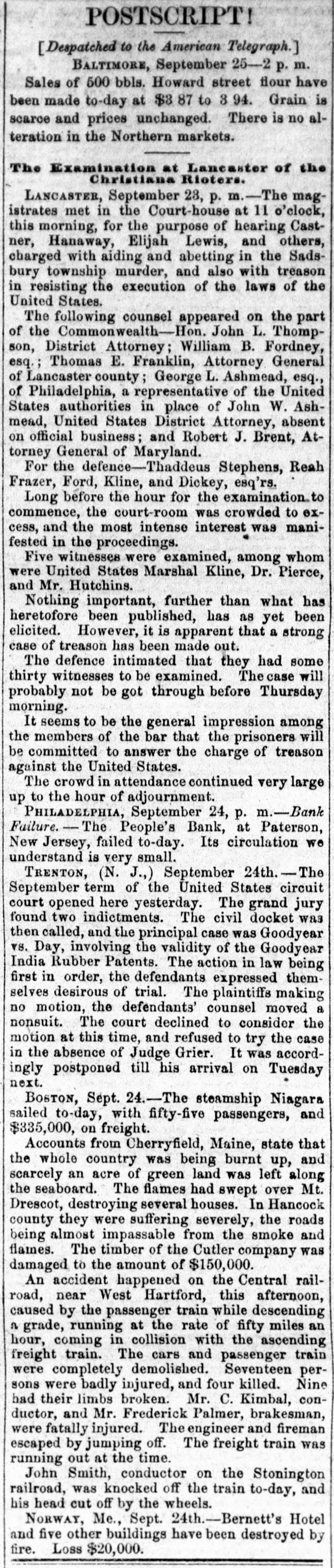
Bank Failure. - The People's Bank, at Paterson, New Jersey, failed to-day.
Source
newspapers
2. November 17, 1851 Receivership
Newspaper Excerpt
The receivers appointed to investigate the affairs of the exploded People's Bank, of Paterson ... have closed their labors; the People's Bank owes about two hundred and fifty thousand dollars, and has assets to the amount of fifty thousand.
Source
newspapers

Newspaper Articles (18)

Article from American Telegraph, September 25, 1851

Click image to open full size in new tab

Article Text

POSTSCRIPT! [Despatched to the American Telegraph.] BALTIMORE, September 25-2 p. m. Sales of 500 bbls. Howard street flour have been made to-day at $8 87 to 94. Grain is scarce and prices unchanged. There is no alteration in the Northern markets. The Examination at Lancaster of the Christiana Rioters. LANCASTER, September 23, p. n.-The magistrates met in the Court-house at 11 o'clock, this morning, for the purpose of hearing Castner, Hanaway, Elijah Lewis, and others, charged with aiding and abetting in the Sadsbury township murder, and also with treason in resisting the execution of the laws of the United States. The following counsel appeared on the part of the Commonwealth-Hon. John L. Thompson, District Attorney; William B. Fordney, esq.; Thomas E. Franklin, Attorney General of Lancaster county; George L. Ashmead, esq., of Philadelphia, a representative of the United States authorities in place of John W. Ashmead, United States District Attorney, absent on official business; and Robert J. Brent, Attorney General of Maryland. For the defence-Thaddeus Stephens, Reah Frazer, Ford, Kline, and Dickey, esq'rs. Long before the hour for the examination. to commence, the court-room was crowded to excess, and the most intense interest was manifested in the proceedings. Five witnesses were examined, among whom were United States Marshal Kline, Dr. Pierce, and Mr. Hutchins. Nothing important, further than what has heretofore been published, has as yet been elicited. However, it is apparent that a strong case of treason has been made out. The defence intimated that they had some thirty witnesses to be examined. The case will probably not be got through before Thursday morning. It seems to be the general impression among the members of the bar that the prisoners will be committed to answer the charge of treason against the United States. The crowd in attendance continued very large up to the hour of adjournment. PHILADELPHIA, September 24, p. m.-Bank Failure. - The People's Bank, at Paterson, New Jersey, failed to-day. Its circulation we understand is very small. TRENTON, (N. J.,) September 24th.-The September term of the United States circuit court opened here yesterday. The grand jury found two indictments. The civil docket was then called, and the principal case was Goodyear vs. Day, involving the validity of the Goodyear India Rubber Patents. The action in law being first in order, the defendants expressed themselves desirous of trial. The plaintiffs making no motion, the defendants' counsel moved a nonsuit. The court declined to consider the motion at this time, and refused to try the case in the absence of Judge Grier. It was accordingly postponed till his arrival on Tuesday next. BOSTON, Sept. 24.-The steamship Niagara sailed to-day, with fifty-five passengers, and $335,000, on freight. Accounts from Cherryfield, Maine, state that the whole country was being burnt up, and scarcely an acre of green land was left along the seaboard. The flames had swept over Mt. Drescot, destroying several houses. In Hancock county they were suffering severely, the roads being almost impassable from the smoke and flames. The timber of the Cutler company was damaged to the amount of $150,000. An accident happened on the Central railroad, near West Hartford, this afternoon, caused by the passenger train while descending a grade, running at the rate of fifty miles an hour, coming in collision with the ascending freight train. The cars and passenger train were completely demolished. Seventeen persons were badly injured, and four killed. Nine had their limbs broken. Mr. C. Kimbal, conductor, and Mr. Frederick Palmer, brakesman, were fatally injured. The engineer and fireman was escaped by jumping off. The freight train running out at the time. John Smith, conductor on the Stonington railroad, was knocked off the train to-day, and his head cut off by the wheels. NORWAY, Me., Sept. 24th.-Bernett's Hotel and five other buildings have been destroyed by fire. Loss $20,000.
Article from The New York Herald, September 25, 1851

Click image to open full size in new tab

Article Text

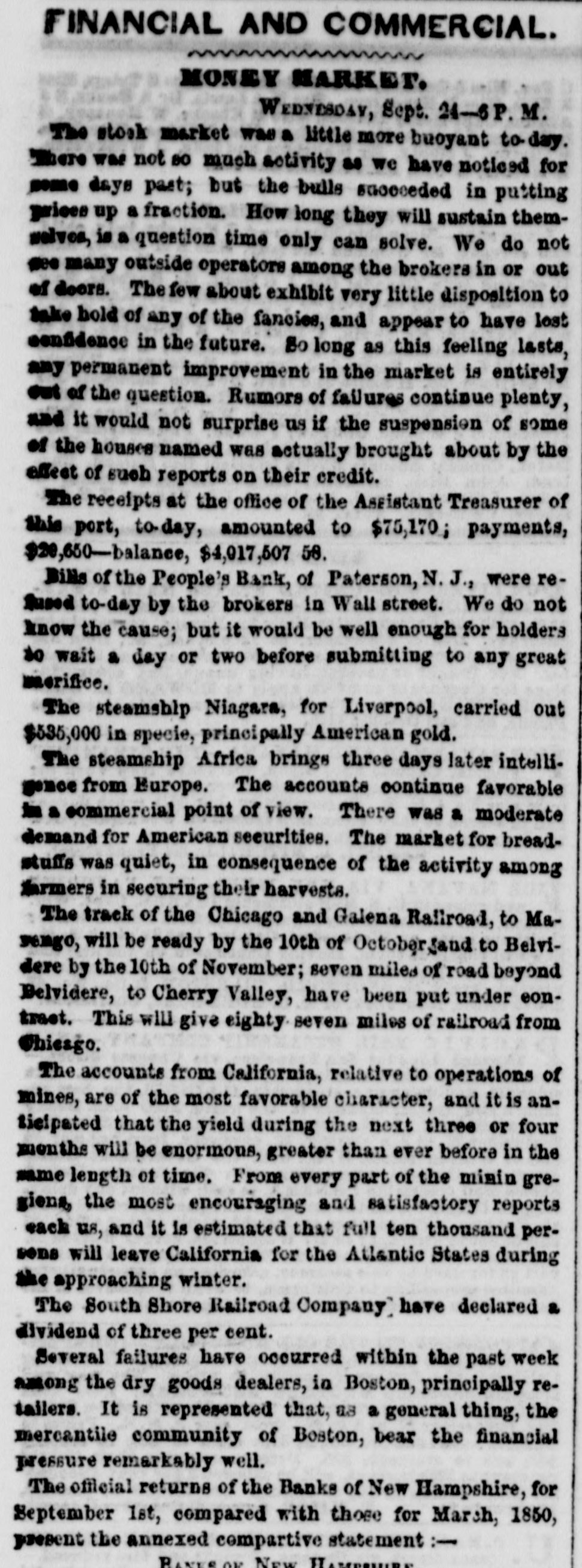
FINANCIAL AND COMMERCIAL. MONEY MARKET. WEDNESDAY, Sept. 24-6 P.M. The stock market was a little more buoyant to-day. There was not 80 much activity as we have noticed for name days past; but the bulls succeeded in putting prices up a fraction. How long they will sustain themwelves, is a question time only can solve. We do not we many outside operators among the brokers in or out of doors. The few about exhibit very little disposition to take hold of any of the fancies, and appear to have lost confidence in the future. So long as this feeling lasts, any permanent improvement in the market is entirely out of the question. Rumors of failures continue plenty, and it would not surprise us if the suspension of some of the houses named was actually brought about by the effect of such reports on their credit. The receipts at the office of the Assistant Treasurer of this port, to-day, amounted to $75,170; payments, $20,650-balance, $4,017,507 58. Bills of the People's Bank, of Paterson, N. J., were refused to-day by the brokers in Wall street. We do not know the cause; but it would be well enough for holders to wait a day or two before submitting to any great merifice. The steamship Niagara, for Liverpool, carried out $535,000 in specie, principally American gold. The steamship Africa brings three days later intelligence from Europe. The accounts continue favorable in a commercial point of view. There was a moderate demand for American securities. The market for breadstuffs was quiet, in consequence of the activity among farmers in securing their harvests. The track of the Chicago and Galena Railroad, to Mavengo, will be ready by the 10th of October and to Belvidere by the 10th of November; seven miles of road beyond Belvidere, to Cherry Valley, have been put under eontract. This will give eighty seven miles of railroad from Chiesgo. The accounts from California, relative to operations of mines, are of the most favorable character, and it is anticipated that the yield during the next three or four months will be enormous, greater than ever before in the same length et time. From every part of the minin gregions, the most encouraging and satisfactory reports each us, and it is estimated that full ten thousand persens will leave California for the Atlantic States during the approaching winter. The South Shore Railroad Company have declared a dividend of three per cent. Several failures have occurred within the past week among the dry goods dealers, in Boston, principally retailers. It is represented that, as a general thing, the mercantile community of Boston, bear the financial pressure remarkably well. The official returns of the Banks of New Hampshire, for September 1st, compared with those for March, 1850, present the annexed compartive statement:BANEROK New


Article from The New York Herald, September 28, 1851

Click image to open full size in new tab

Article Text

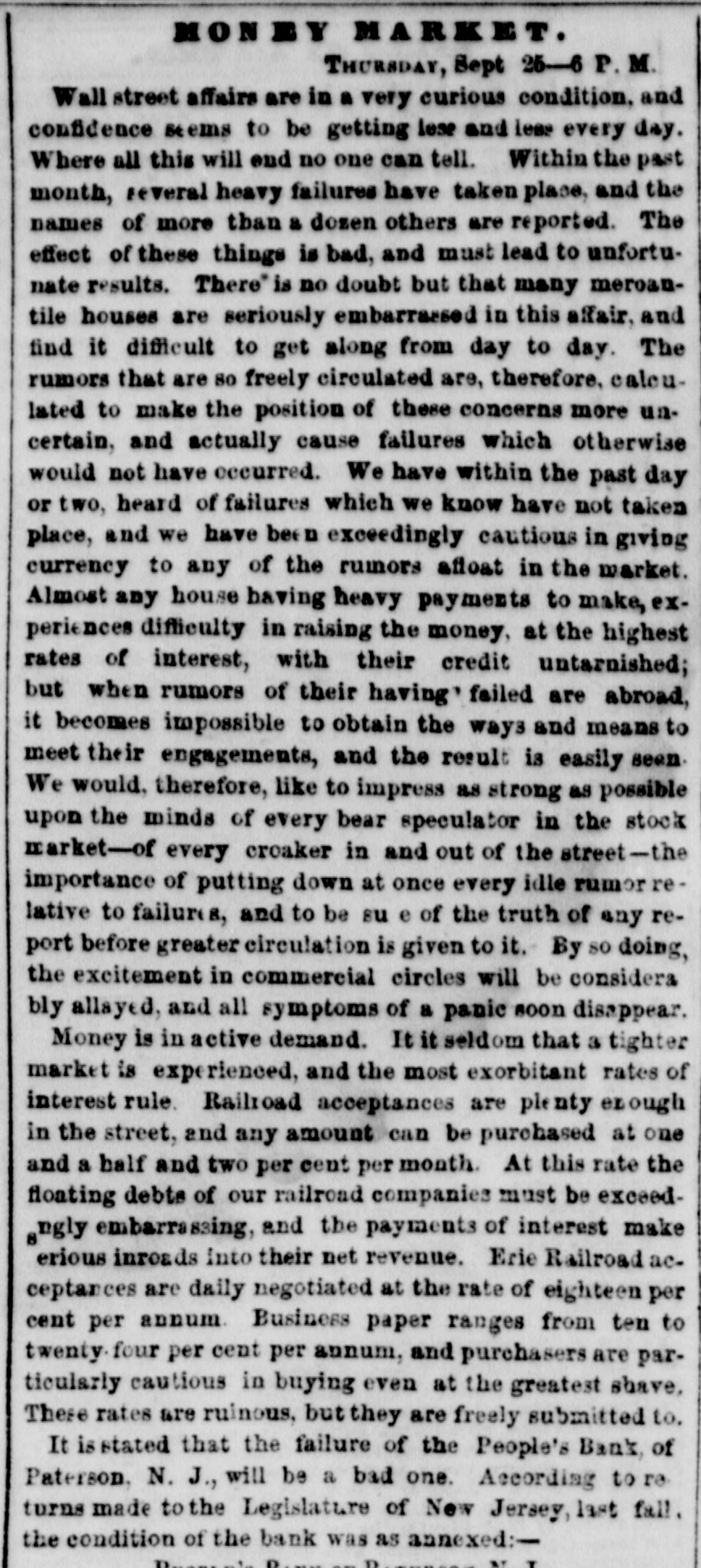
MONEY MARKE T. SATURDAY, Sept. 27-6 P. M. The panic in Wall street is rapidly increasing. Holders of fancy stocks looked blue enough to day, and there appears to be no bottom. A week ago, it was the opinion of many that the quotations for stocks could go no lower, since which time they have fallen five and ten per cent. At the first board, to-day, Erie Income Bonds declined 1/2 per cent; Erie Railroad, 1; Harlem, 11/6; Long Island, 1/6; Reading Railroad, 1)4; Norwich and Worcester, X. New Jersey Zinc Company closed firm at yesterday's prices, and it was the only stock sold that did not fall off materially. There were large sales of Erie Railroad, and plenty of sellers on time, notwithstanding the large depreciation. The bears seem to think that there is a much deeper depth than that already reached. We have heard of no new reports of bank failures. The People's Bank of Paterson, Commercial Bank of Perth Amboy, and Saliebury Bank, Maryland, are the only banks which have actually suspended. Thompson, at 64 Wall street, redeems the bills of the following banks, at % per cent discount:Government Stock Bank. Michigan; Bank of America New Jersey; Ocean Bank, do.; Atlantic Bank, do.; Merchants' Bank, do.; Farmers' Bank, do; Delaware and Hudson, do. The anthracite coal trade is still active, and prices are well sustained. The Lehigh Navigation Company brought down, for the week ending on Saturday last, 29,750 tons. and for the season 732,975 tons The Reading Railroad Company brought down, for the week ending on Thurs day, 36,141 tons, and for the season 1,290,168 tons. The Schuylkill Navigation Company brought down, for the week ending at the same time, 14,187 tons, and for the season 422,057 tons. The aggregate tonnage for the week by the three lines, is 80,078 tens, The steamship Pacific, for Liverpool. carried out $546,422 in American gold, and ยฃ12,887 in British gold, making an aggregate of about six hundred thousand dollars. The receipts at the office of the Assistant Treasurer of this port, to-day, amounted to $102,010; payments, $34,090 11-balance, $4,202,166 60.


Article from Weekly National Intelligencer, October 4, 1851

Click image to open full size in new tab

Article Text

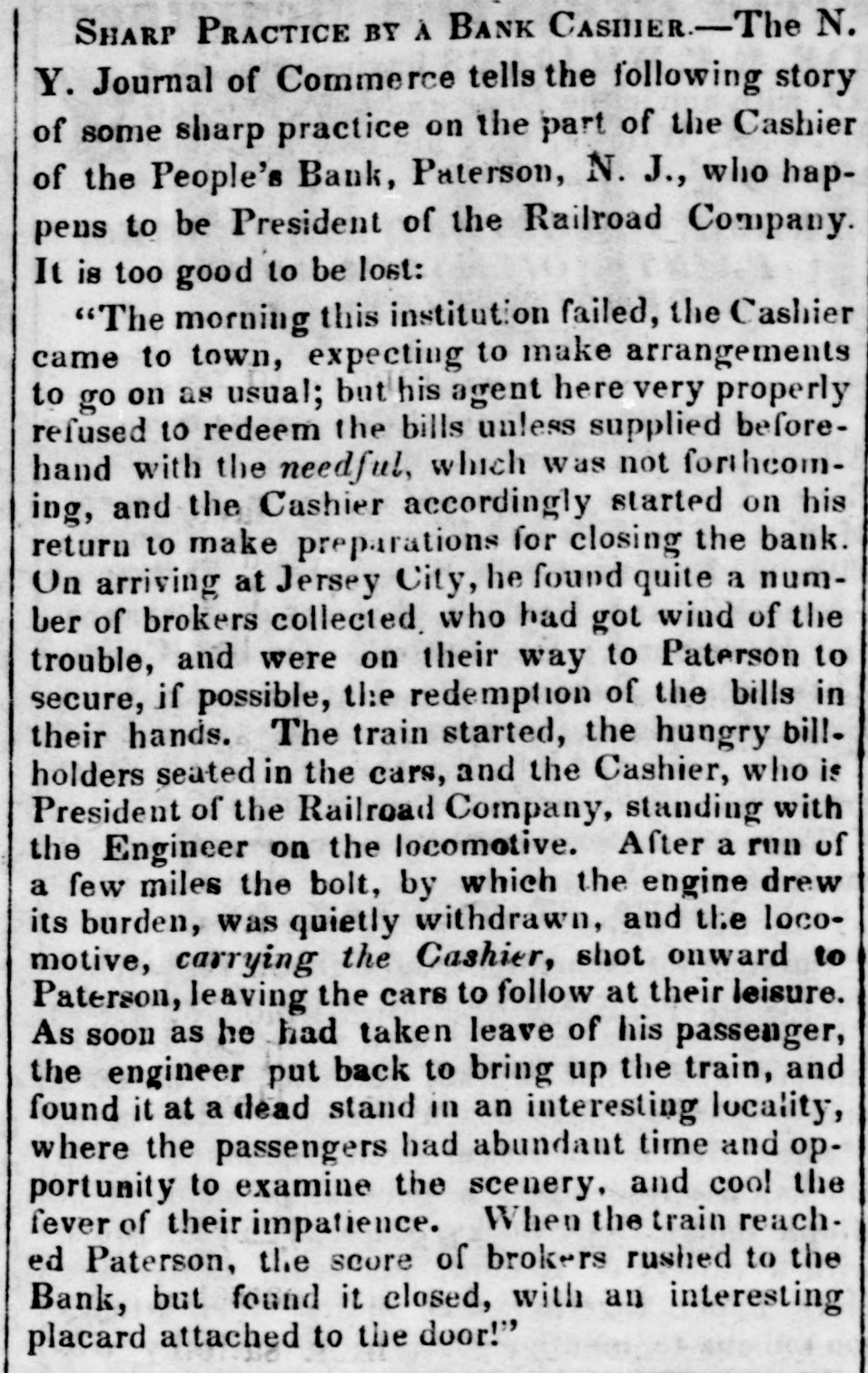
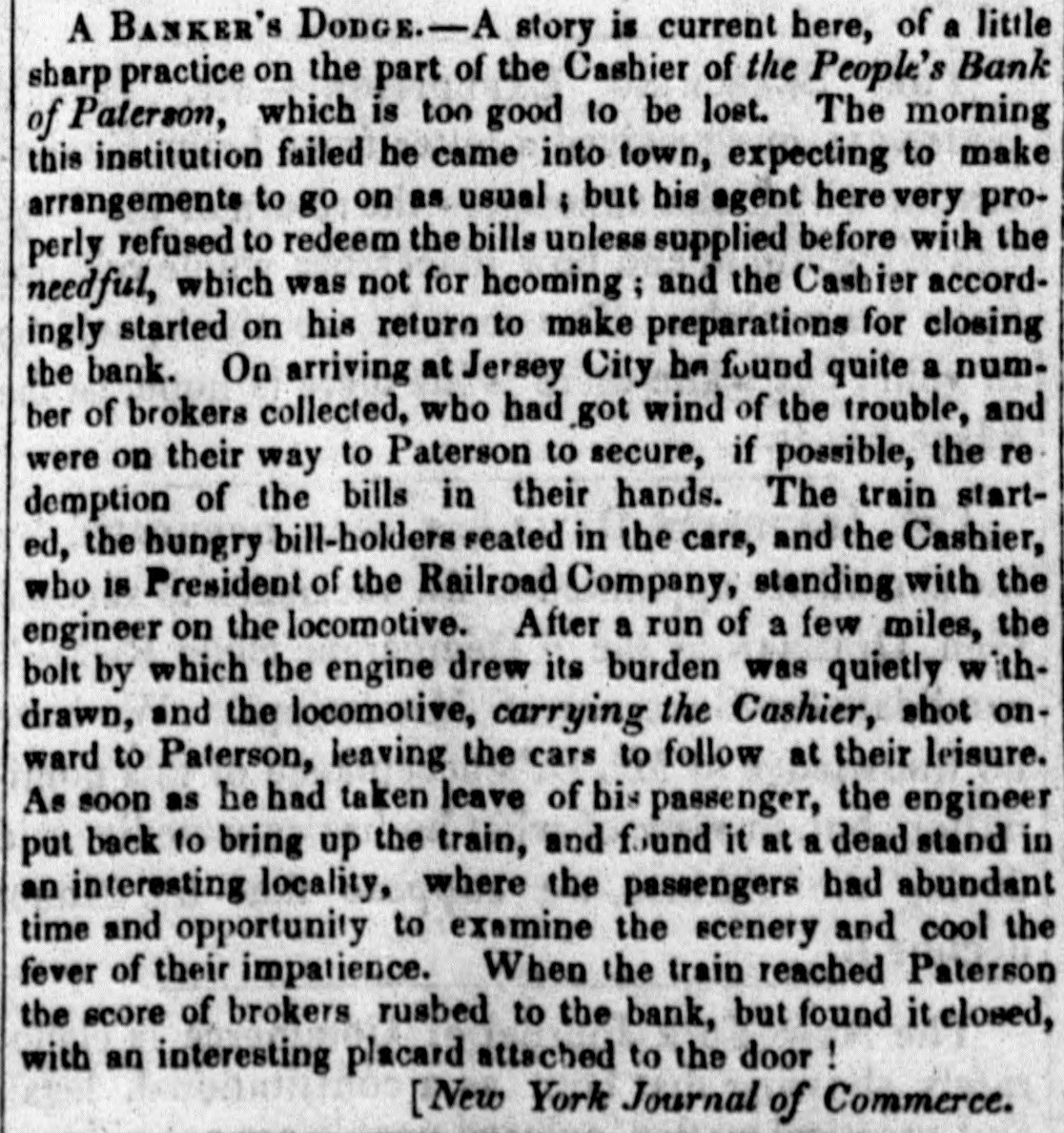
A BANKER'S DODGE.-A story is current here, of a little sharp practice on the part of the Cashier of the People's Bank of Paterson, which is too good to be lost. The morning this institution failed he came into town, expecting to make arrangements to go on as usual but his agent here very properly refused to redeem the bills unless supplied before with the needful, which was not for hooming and the Cashier accordingly started on his return to make preparations for closing the bank. On arriving at Jersey City he found quite a number of brokers collected, who had got wind of the trouble, and were on their way to Paterson to secure, if possible, the re demption of the bills in their hands. The train started, the hungry bill-holders Feated in the cars, and the Cashier, who is President of the Railroad Company, stending with the engineer on the locomotive. After a run of a few miles, the bolt by which the engine drew its burden was quietly withdrawn, and the locomotive, carrying the Cashier, shot onward to Paterson, leaving the cars to follow at their leisure. As soon as he had taken leave of his passenger, the engineer put back to bring up the train, and found it at a dead stand in an interesting locality, where the passengers had abundant time and opportunity to examine the scenery and cool the fever of their impatience. When the train reached Paterson the score of brokers rusbed to the bank, but found it closed, with an interesting placard attached to the door ! [New York Journal of Commerce.


Article from The Miners' Express, October 8, 1851

Click image to open full size in new tab

Article Text

BANK FAILURES.-Unf telegrapa.re. the other night, brought news of the failure of the peoples Bank, Patterson, N. J. W enow learn from the Louisville Democrat that the Merchants Bank of Cincinnati has suspended. No. body to blame-officers all honest; but somehow the people have to bear the loss.


Article from Portage Sentinel, October 20, 1851

Click image to open full size in new tab

Article Text

A Banker's Dodge. A story is current here, of a sharp practice on the part of the Cashier of the l'eople's Bank f Patterson, which is 100 good to be lost The morning the institution failed he came into town, expecting to make arrangements to go on as usual; but his agent here very properly refused to redeem the bills unless supplied before with the needful, which was not forthcoming; and the Cashier accordingly started on his re turn to make preperations for closing the bank. On arriving at Jersey City he found quite a number of brokers collected who had got wind of the trouble, and were on their way to Paterson to secure, if possible, the redemption of the bills in their hands. The train started, the hungry bill holders sented in the cars, and the Cashier, who was President of the Rail Road Com. pany, standing with the engineer on the locomotive. After a run of a few miles, the bolt by which the engine drew its bur. den was quitely withdrawn, and the loco. motive carrying the Cashier, shot on ward to Patterson, leaving the cars to follow at their leisure. As soon as he had taken leave of his passenger, the engineer put back to bring up the train, and found it at a dead stand in an interesting locality, where the passengers had abundant time and opportunity to examine the scenery and cool the fever of their impatience.When the train reached Patterson, the score of brokers rushed to the bank, but found it closed with an interesting placard attached to the door!-N. Y. Journal of Commerce


Article from The Davenport Gazette, October 23, 1851

Click image to open full size in new tab

Article Text

FUNNY INCIDENT-DoINGs OF A CASHIER We venture to say that neither Mr. Lath rop nor Mr. De Wolfe would perform such an act in financiering as the following, even for a large reward. But the joke is rich and shows how quick the Jersey operaters get ahead of Wall street, when they are both put upon the same track. The Journal of Commerce says: "A story is current here, of a little sharp practice on the part of the cashier of the People's Bank of Patterson, which is too good to be lost. The morning this institution failed, he came in town expecting to make arrangements to go on as usual; but his agent here very properly refused to redeem the bills unless supplied beforehand with the needful, which was not forth coming, and the Cashier accordingly started ou his return to make preparations for closing the bank. On arriving at Jersey City, he found quite a number of brokers collected, who had get wind of the trouble, and were on their way to Patterson to secure, if possible, the redemption of the bills in their hands. The hungry billholders seated in the ears, and the Cashier. who is President of the Railroad Company, standing with the Engineer on the locomolive. After a run of a few miles, the bolt, by which the engine drew its burden, was quietly withdrawn, the locomotive, carrying the Cashier, shot onward to Patterson, leaving the cars to follow at their leisure. As soon as he had taken leave of his passenger, the engineer put back to bring up the train, and found it at a dead stop in an interesting locality, where the passengers had abundant time and opportunity to examine the scenery, and cool the fever of their impatience. When the train reached Patterson, the score of brokers rushed to the bank. but found it closed, with an interesting placard attached to the door!"


Article from The Star of the North, October 23, 1851

Click image to open full size in new tab

Article Text

A Banker's Dodge, A very good story is told of a little sharp practice on the part of the Cashier of the People's Bank of Patterson. The morning this institution failed he went to Philadelphia, expecting to make arrangements to go on as usual; but his agent there very properly refused to redeem the bills unless previously supplied with the needful, which was not forthcoming and the Cashier accordingly started on his return to make preparations for closing the banks.-On arriving at Jersey City he found quite a number of brokers collected, who had got wind of the trouble, and were on their way to Patterson to secure it possible, the redemption of the bills in their hands. The train started, the hungry bill-holders seated in the cars, and the Cashier, who is President of the Railroad Company, standing with the engineer on the locometive. After a run of a few miles, the bolt by which the engine drew its burthen was quietly withdrawn, and the locomotive carrying the Cashier, shot onward to Patterson, leaving the cars to follow at their leisure. As soon as he had taken leave of his passengers, the engineer put back to bring up the train, and found it at a dead stand in an interesting locality, where the passengers had abundant time and opportunity to examine the scenery, and cool the fever of their impatience. When the train reached Patterson the score of brokers rushed to the bank, but found it closed, with an interesting placard attached to the door.


Article from Wilmington Journal, October 24, 1851

Click image to open full size in new tab

Article Text

A Banker's Dodge. A story is current here of a little sharp practice on the part of the Cashier of the People's Bank of Patterson, which is too good to be lost. The morn= ing this institution failed he caine into town, expecting to make arrangements to go on as usual; but his agent here very properly refused to redeem the bills unless supplied before with the needful, which was not forthcoming; and the Cashier accordingly started on his return to make preparations for closing the bank: On arriving at Jersey City he found quite a number of brokers collected. who had got wind of the trouble, and were on their way to Patterson to secure if possible, the redemption of the bills in their hands. The train started. the hungry bill-holders seated in the Cars, and the Cashier, whois President of the Railroad Company. standing with the engineer on the locomotive. After a run of a few miles, the bolt by which the engine drew its bur= den was quietly withdrawn, and the locomotive, carrying the Cashier, shot onward to Patterson, leaving the cars to follow at their leisure. As soon as he had taken leave of his passenger, the engineer put back to bring up the train. and found it at a dead stand in an interesting locality, where the passengers had abundant time and opportunity to examine the scenery and cool the fever of their impatience. When the train reached Patterson the score of bankers rushed to the bank, but found it closed, with an interesting placard attached to the door! New York Journal of Commerce. THE PRINTER.-A Printer is the most curious thing alive. He may have a bank and coins and not be worth a cent-have small caps and have neither wife nor children. Others may run fast but he getsalong the swiftest by setting fast. He may be making impressions without eloquence; may use the lye with= out offending, and be telling the truth. While others cannot stand when they set, he can set standing, and even do both at the same time-use furniture and yet have no dwelling-may make and put away pi; and never see a pie much less eat it during his life-be a human being and a rat at the same time-may press a great deal and not ask a favor--may handle a shooting iron. and know nothing about a cannon: gun or pistol; he may move the lever that moves the world, and yet be as far from moving the globe as a hog with his nose under a mole hill-spread sheets without being a housewife-he may lay his form on a bed, and yet be obliged to sleep on the floor-and he may use the t without shedding blood, and from the earth may handle the -he may be of a rolling disposition, and yet never desire to travel-he may have a sheep's foot, and not be deformed-never be without a case, and know nothing of law or physic- be always correcting his errors, and growing worse every dayhave emmins without ever having the arms of a lass around him--have his form locked up, and at the same time be free from jail, watch house or any other confinement.


Article from Jeffersonian Republican, November 6, 1851

Click image to open full size in new tab

Article Text

A Banker's Dodge. A story is current here, of a little sharp practice on the part of the Cashier of the People's Bank of Paterson, which is too good to be lost. The morning this institution failed he came into town, expecting to make arrangements to go on as usual; but his agent here very properly refused to redeem the bills unless supplied before with the needful, which was not forthcoming; and the Cashier accordingly started on his return to make preparations for closing the bank. On arriving at Jersey City he found quite a number of brokers collected, who had got wind of the trouble, and were on their way to Paterson to secure, if possible, the redemption of the bills in their hands. The train started, the hungry bill-holders seated in the cars, and the Cashier, who is President of the Railroad Company, standing with the engineer on the locomotive. After a run of a few miles, the bolt by which the engine drew its burden was quietly with-drawn, and the locomotive carrying the Cashier, shot onward to Paterson, leaving the cars to follow at their leisure. As soon as/he had taken leave of his passenger, the engineer put back to bring up the train, and found it at a dead stand in an interesting locality, where the passengers had abundant time and opportunity to examine the scenery and cool their impatience. When the train reached Paterson the score of brokers rushed to the bank, but found it closed, with an interesting placard attached to the door!-New York Journal of Commerce.


Article from Washington Telegraph, November 12, 1851

Click image to open full size in new tab

Article Text

SHARP PRACTICE BY ร€ BANK CASHIER.-The N. Y. Journal of Commerce tells the following story of some sharp practice on the part of the Cashier of the People's Bank, Paterson, N. J., who happens to be President of the Railroad Company. It is too good to be lost: "The morning this institution failed, the Cashier came to town, expecting to make arrangements to go on as usual; but his agent here very properly refused to redeem the bills unless supplied beforehand with the needful, which was not forthcoming, and the Cashier accordingly started on his return to make preparations for closing the bank. On arriving at Jersey City, he found quite a number of brokers collected who had got wind of the trouble, and were on their way to Paterson to secure, if possible, the redemption of the bills in their hands. The train started, the hungry bill. holders seated in the cars, and the Cashier, who is President of the Railroad Company, standing with the Engineer on the locomotive. After a run of a few miles the bolt, by which the engine drew its burden, was quietly withdrawn, and the locomotive, carrying the Cashier, shot onward to Paterson, leaving the cars to follow at their leisure. As soon as he had taken leave of his passenger, the engineer put back to bring up the train, and found it at a dead stand in an interesting locality, where the passengers had abundant time and opportunity to examine the scenery, and cool the fever of their impatience. When the train reached Paterson, the score of brokers rushed to the Bank, but found it closed, with an interesting placard attached to the door!"


Article from The New York Herald, November 17, 1851

Click image to open full size in new tab

Article Text

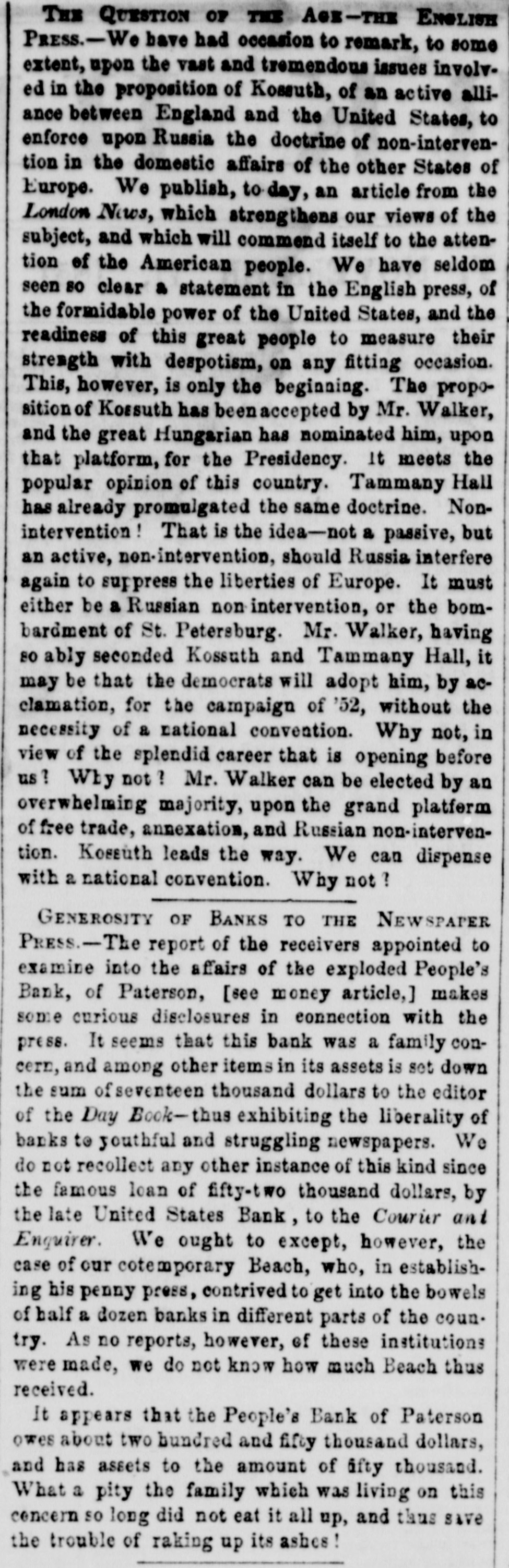
THE QUESTION OF THE AGE-THE ENGLISH PRESS.-We have had occasion to remark, to some extent, upon the vast and tremendous issues involved in the proposition of Kossuth, of an active alliance between England and the United States, to enforce upon Russia the doctrine of non-intervention in the domestic affairs of the other States of Europe. We publish, to day, an article from the London News, which strengthens our views of the subject, and which will commend itself to the attention of the American people. We have seldom seen so clear a statement in the English press, of the formidable power of the United States, and the readiness of this great people to measure their strength with despotism, on any fitting occasion. This, however, is only the beginning. The proposition of Koesuth has been accepted by Mr. Walker, and the great Hungarian has nominated him, upon that platform, for the Presidency. It meets the popular opinion of this country. Tammany Hall has already promulgated the same doctrine. Nonintervention! That is the idea-not a passive, but an active, non-intervention, should Russia interfere again to suppress the liberties of Europe. It must either be a Russian non intervention, or the bombardment of St. Petersburg. Mr. Walker, having 80 ably seconded Kossuth and Tammany Hall, it may be that the democrats will adopt him, by acclamation, for the campaign of '52, without the necessity of a national convention. Why not, in view of the splendid career that is opening before us? Why not ? Mr. Walker can be elected by an overwhelming majority, upon the grand platferm of free trade, annexation, and Russian non-intervention. Kossuth leads the way. We can dispense with a national convention. Why not? GENEROSITY OF BANKS TO THE NEWSPAPER PRESS.-The report of the receivers appointed to examine into the affairs of the exploded People's Bank, of Paterson, [see money article, makes some curious disclosures in connection with the press. It seems that this bank was a family concern, and among other items in its assets is set down the sum of (seventeen thousand dollars to the editor of the Day Book-thus exhibiting the liberality of banks to youthful and struggling newspapers. We do not recollect any other instance of this kind since the famous loan of fifty-two thousand dollars, by the late United States Bank, to the Courier ant Enquirer. We ought to except, however, the case of our cotemporary Beach, who, in establishing his penny press, contrived to get into the bowels of half a dozen banks in different parts of the coun. try. As no reports, however, of these institutions were made, we do not know how much Beach thus received. It appears that the People's Bank of Paterson owes about two hundred and fifty thousand dollars, and has assets to the amount of fifty thousand. What a pity the family which was living on this concern so long did not eat it all up, and thus save the trouble of raking up its ashes!


Article from The New York Herald, November 17, 1851

Click image to open full size in new tab

Article Text

Summary of the News-Eleven Days Later from California, &c. The steamship Daniel Webster, ten days from San Juan, arrived last night at this port. She brings, via the Nicaragua route, eleven days' later intelNgence from California. There is nothing extraordinary, though much that is interesting, in the news. The important movement in the southern counties of California, for the division of the State, is assuming the form of systematic action. The address of the delegates of Monterey, an extract of which we publish this morning, presents, in a forcible manner, the reasons and necessities calling for the proposed division A convention of all the southern counties was to have been held at Santa Barbara on the 20th ult. When we consider that California extends through ten degrees of latitude, with a seaboard of some nine hundred miles, it is impossible that it can continue for any length of time under the jurisdiction of a single State. A division will soon be inevitable, whatever may be the extent of the local or sectional agitation of the subject. The quartz mining continues highly successful. San Francisco is steadily pushing enwards in her giant strides of prosperity, and the general affairs of the whole country are steadily onward. We refer our readers to the news, on the first page of this paper. The latest information from the seat of war in Northern Mexico, announcestb the revolutionists had finally succeeded in routing the government troops, and taking entire possession of the city of Matamoras. The previous advices stated that a very large number of Mexican troops were being congentrated at that place, with the avowed intention of effectually checking, punishing, and putting to flight the disaffected people in that regist but the government. it appears, was entraly see slow in its movements, or, what is 300 listly it had not the means to pay this beasted andy of men; and soldiers, like other people, are not overly fond of working the more giory slone This success of the revolutioniate inficates that they are determined, and have sufficient force to carry out their design of compelling the government to accede to their demands. They have captured a very strong hold, and, unless the central power speedily backs out from its position, Mexico will certainly lose another rich and fertile portion of her domain. Under our financial head day, will be found a review of the movements in the stock market, relative to the Erie Railroad Those purchasing for a rise, or selling for a fall, will find some important advice on the subject. The shipments of special have become very interesting to all classes. The importation, up to this time, is larger than ever before known in the same length of time. This subject has a very important bearing upon the financial and political affairs of Europe; and the position occupied by this country never was more important, or our influence more widely extended. The affairs of the People's Bank of Paterson have been investigated and the receivers will publish their report in a few days. If the list we give to-day is a fair sample of the assets, bill holders will get but a small per ent of their claims. The Commercial Bank of Amboy is probably in a similar condition. Receivers are at work investigating the affairs of that concern. Governor Hunt has peremptorily declined to grant a further respite to Conklin, who is to be hung for arson next Friday, at Utica. A curiousstatement of the trinkets, gimcracks, and notions of all kinds, lost and found in the Crystal Palace, will challenge the reader of our columns day. The list of lesses and findings embraces a vast variety of articles, from parasols to petticoats and bustles, and from a toothpick to a box of car. penters' toels. The catalogue is only exceeded by the curiosities of the late election.


Article from The New York Herald, November 17, 1851

Click image to open full size in new tab

Article Text

The balance-three hundred millions-i divided among the smaller States-Bremen, Hamburg, and some of the smaller German States. This aggregate, considering the population, is not at all excessive. The average being at the rate of about $4 per head which is less than in this country. We have, with a population of twenty.four millions, a paper currency of one hundred and fifty millions of dollars, averaging six dollars for every man, WOman and child in the United States. The debt of the United States amounts to seventy millions of dollars, averaging three dollars per head, or fifteen dollars for the head of every family of five, instead of two hundred dollars per head, as in Europe. A very good idea can be formed from this, of the way the people of Europe are oppreesed by the governments under which they live. They have long borne all these burdens, but by no means patiently. Several attempts have been made to shake off the yoke that has bound them to the worst kind of slavery, but 80 far they have been unsuccessful. How soon another will be made, and what the result will be, time only will determine. The discovery of gold in California and Australia, the immense amounts sent to Europe, and embodied in the currency, forming a basis for an issue of hundreds of millions of paper promises to pay, may put off to a longer period the great revolution that will ultimately sweep away every vestige of the enormous debts, and ruin half of the capitalists of Europe. Whatever tends to check the intercourse between the new and the old world, will add largely to the financial difficulties of the European governments, and hasten the desired result. Non-intercourse with the United States for six months, would revolutionize every government in Europe, including Great Britain. They must have our cotton and our gold. Their very existence depends upon it, and any important interruption in the movement of these artiticles, would threaten the direst events. The receivers appointed to investigate the affairs of the People's Bank of Patterson, N. J, have closed their labors, and will soon make a report to the Chancellor Among the assets of the institution, the following appear :PEOPLE'S BANK OF PATTERSON, N. J -PORTION OF AsSETS.


Article from The New York Herald, November 18, 1851

Click image to open full size in new tab

Article Text

The People's Bank of Paterson, and the Day Book. NEW YORK, Nov. 17, 1851. JAMES G. BENNETT. Esq DEAR SIR:-Will you please correct the statement of the HERALD, this morning. respecting assistance given the Day Book, by the People's Bank of Paterson? In 1845 and '46. while I was connected with a nercantile firm in this city, the People's Bank discounted a large amount of our business paper- so.ne seventy or eighty thousand dollars. The yeve nteen thousand dollars reported as due from the editor of the Day Book, by the receivers, is, I suppose, the amount of that discounted paper, now unpaid, and has no more to do with the Day Book than it has with the HERALD. That I 811 liable on that paper as endorser. is true: but I never have bad the money for newspaper business. norto spend. Others andochers, too, who stand high in the world-bad the goods and the money, and should bear the odium of Lot paying. Some of the very men who raiso the greatest outery against banks and suspensions are debtors to the People's Bank of Paterson; and if the receivers were less Festile to the cashier, and more inclined to do justice to all, they would, I imagine, have made a very different report. Trusting that you will correct the impression that the Day Book has received money from the People's Bank of Paterson, I remain, respec fully, N. R. STIMSON. your obedient servant.


Article from Jeffersonian Republican, November 27, 1851

Click image to open full size in new tab

Article Text

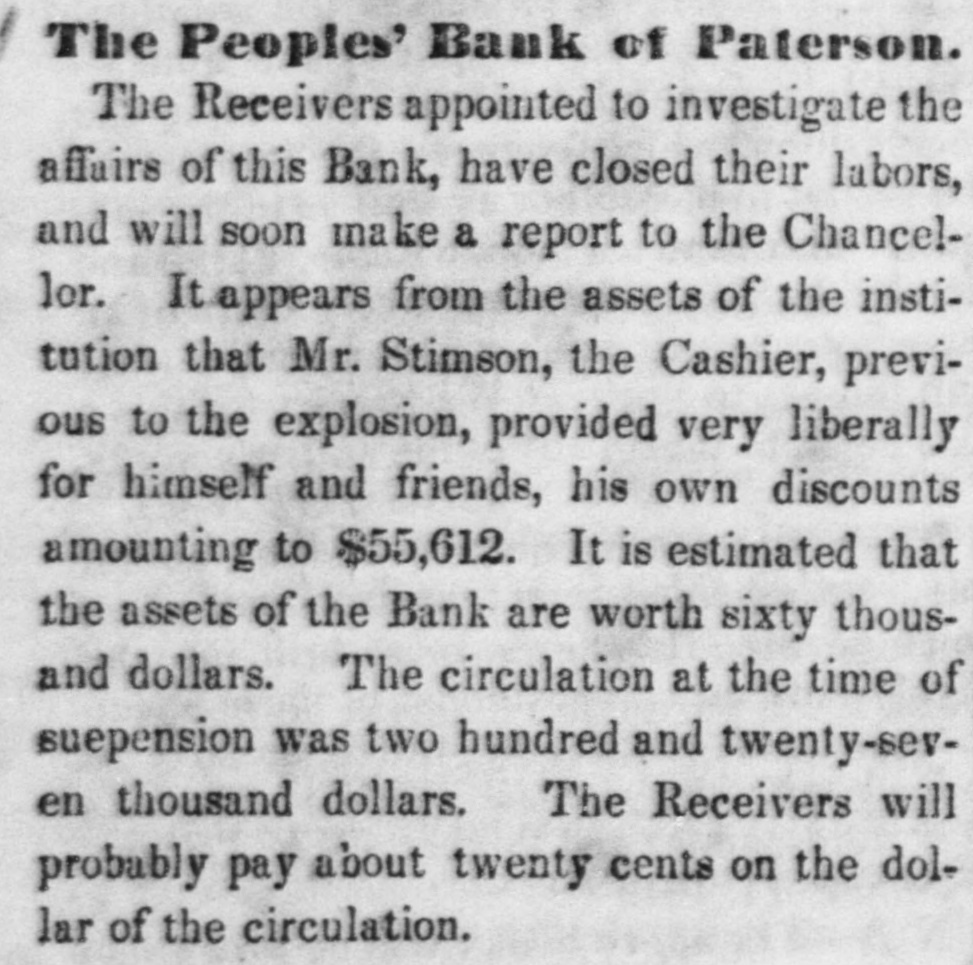
The Peoples' Bank of Paterson. The Receivers appointed to investigate the affairs of this Bank, have closed their labors, and will soon make a report to the Chance!lor. It appears from the assets of the institution that Mr. Stimson, the Cashier, previous to the explosion, provided very liberally for himself and friends, his own discounts amounting to $55,612. It is estimated that the assets of the Bank are worth sixty thousand dollars. The circulation at the time of suepension was two hundred and twenty-seven thousand dollars. The Receivers will probably pay about twenty cents on the dollar of the circulation.


Article from The New York Herald, April 16, 1852

Click image to open full size in new tab

Article Text

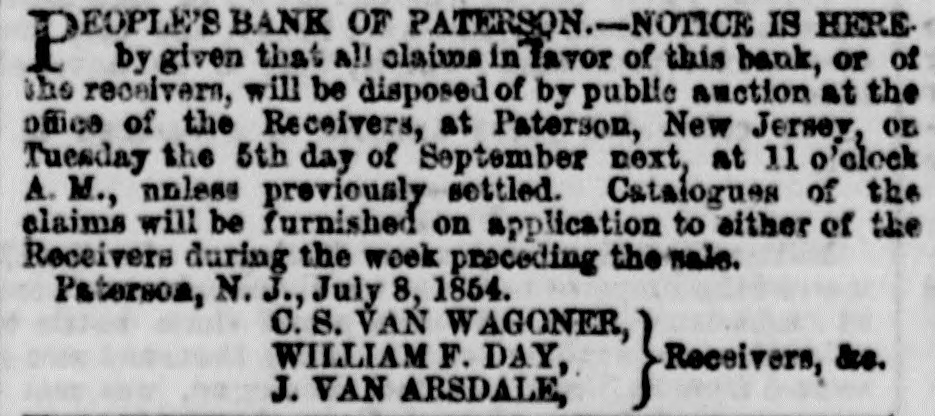
COMMERCIAL AFFAIRS. MONEY MARKET THURSDAY April 15-6 P.M. The weather. in the early part of the day. no doubt had a tendency to depress prices for stocks generally. There was lees activity in the leading railroad securities, and lower prices ruled. An additional movement was apparent in other stocks. The most prominent was New Jereey Zinc. which advanced % per cent with very large sales. New Haven Railroad went up 1/6 per cent: HarIcm, M. Erie Bonds, 1871. declined 1/4 per cent; Edgworth, V: Long Island, 14: Norwich and Worcester, 1/4 We have noticed. for some time past daily sales of bank stocks. to some extent. This is something new in Wall street, and is doubtless the effect of such a rapid increase of these institutions in this city. With the feeling that exists among stock speculators. the pause in the market cennet but be temporary. Money is 100 abundant and too cheap. and stocks of even the mo t uncertain value too easily hypothecated not to be made available by those who are involved in this species of excitement. The movement has now such headway that its own impetus will carry it some further. without the aid of any new influence or any increase of outside operators. Those who purchased at high prices are of course anxious to realize profits, or at least cost and charges. and they will therefore. make great efforts to extend the inflation. The boar influence in the street at this moment is not strong. The bears are not overanxious to involve themselves deeply in contracts before the market has touched its culminating point. and when the steam is up in Wall street it is very easy to keep the excitement on if the supply of fuel holds out. It is not difficult for weak parties to carry large lots of fancies at moderate ratee of interest. There is not a bank in Wall street that will not loan money ou fancy stocks, with a very limited margin for depreciation; and so long as such facilities can be obtained. there will not bean over quantity of stock pressing for sale The most un. favorable feature in the existing state of things is the absence of shorts. This must sooner or later have an in jurious influence on the market, as it removes all compulsion to purchase, and leaves it optional with all parties to buy or not, as they please. This will not do for holders at high prices. They depend upon the shorts. who are obliged to purchase for the fulfilment of their contracts, for not only sustaining prices. but for any improvement they may require to give a profit. The bulls have not this dependence this season. Sellers of stocks have generally been holders : at low prices; and even those who have sold on time. have held the stocks for the maturity of their contracts. The bears. therefore. occupy a strong position, and when the proper time arrives. will come into the market in great strength Until then the bulls will have the field entirely to themselves. The higher prices go. the wider the margin for depreciation. At the second board, Eric took quite a start, and nearly three thousand shares were sold. It closed firm at an advance of 1/4 per cent. In other stocks there was not much done; but prices current in the morning were fully sustained. The receipts at the office of the Assistant Treasurer of this port, to-day, amounted to $46,132 75; payments, $9.840 16-balance, $3,386.397 33. The members of the Stock Exchange refused to allow transactions to be made in the Montgomery Mining Company steck at the meeting of their board. until a committeo shall report on the respectability of the concern. which seems, at present, doubtful. The time fixed by the receivers of the Commercial Bank, Perth Amboy. N. J., for the presentation of the notes and other claims against that bank, expires on the 22d inst. Receivers-T. G. Marsh, Perth Amboy; Cortlandt Parker, Newark Oliver S. Halstead, Newark. All claims against the People's Bank of Paterson must be presented by the 15th May. The receivers are. Jacob Van Arsdale, Paterson; C. S. Van Wagoner, Paterson; Wm. P.Day. Elizabethtown. The Manufacturers' Insurance Company. of Boston. have declared a dividend of 15 per cent. The Neptune Insurance Company have declared s dividend of 7 per cent. The Washington Insurance Company have declared 3 dividend of 4 per cent. The Boylston Insurance Company have declared a semi annual dividend of 8 per cent, payable on demand. The Grand Bank, (Marblehead.) remi-annual dividend of 3 per cent; Marblehead do., 31/4 per cent. The steamship America. at Halifax. from Liverpool, brings seven days later intelligence from Europe. The news does not amount to much and what little there is cannet be considered otherwise than of an unfavorable character Quotations for cotton were drooping. Noaetotal decline since the last steamer had been realized. but the market was heavy. not only for this. but for all our most important staple exporting products.


Article from New-York Daily Tribune, May 6, 1852

Click image to open full size in new tab

Article Text

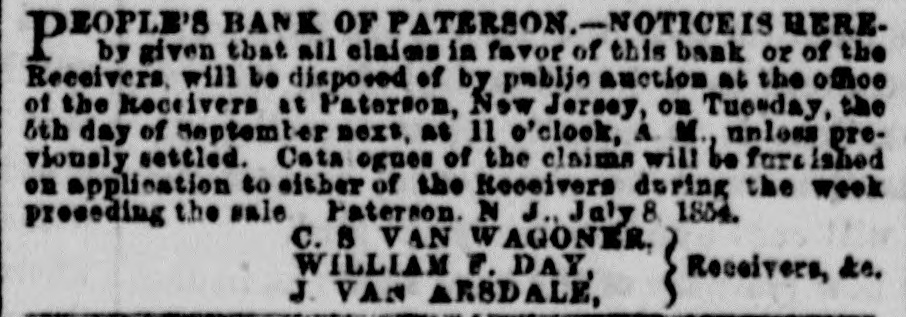
The City of New-Orleans IS about to make a loan of two millions of dollars. The stockholders of the Joint Companies of New-Jersey, at their meeting last week, passed a resolution in favor of subscribing $100,000 to the Jamesburg Railroad, $75,000 to the Flemmington road, and $500,000 to the Belvidere road. There are now about 16 miles of the Belvidere road above Lambertville under contract, part of which is graded, and which will be completed 88 soon as practicable. The above subscription, it is supposed, will enable the Company to put the remainder of the road under contract forthwith. The extension of the Harlem Hailroad, from Ghent to Troy, has been put under contract. An election was held in Buffalo yesterday, to decide whether the city shall raise money to invest in the Brantford, Canada West, Railroad. A new Board of Directors to the Norfolk County (Maseachusetts) Railroad was elected on Monday. It is understood that its members are in favor of the immediate adoption of measures to give the road a connection with the Norwich and Worcester road, to form 8 new through line to New-York by land. Over $300,000 Pennsylvania 5s have been bought in Philadelphia, supposed forrign, 7c. The citizens of Lewistown, Pa., held a meeting on the 26th ult., and authorized the Councils of that Borough to make a conditional subscription to the stock of the Susquehannah Railroad Company, of $50,000 in bonds to run twenty years, in aid of the extension of the road to Sunbury and Williamsport. Cleveland, Columbus, and Cincinnati Railroad Stock is selling at Cleveland, at 104@105 โ‚ฝ cent. The stockholders of the Dayton (Ohio) Bank have determined, by a unanimous vote, to 'wind up' affairs. The exactions of the tax-law are assigned for the reasons of this course. All claims against the People's Bank of Paterson must be presented by the 15th of May inst. The New-Jersey Railroad and Transportation Company have resolved to distribute their Reserved Stock, on the first of July next, when an installment of forty P cent. is to be paid. It is understood that the Company intend to pay off their debt, extend their double track, and make other improvements on their road.