5715. Exchange Bank (Greencastle, IN)

Bank Information

Episode Type
Suspension → Closure
Bank Type
state
Start Date
January 11, 1867
Location
Greencastle, Indiana (39.644, -86.865)

Metadata

Model
gpt-5-mini
Short Digest
91d49415

Response Measures

None

Description

Exchange Bank (Greencastle, Indiana) failed on Jan 11, 1867 due to proprietor Wm. D. Allen's speculative losses in gold and pork; owner made an assignment for creditors. No run on this specific bank is reported in the articles (a run is described later at a different local bank). OCR errors corrected (e.g., 'Indians' -> Indiana).

Events (2)

1. January 11, 1867 Other
Newspaper Excerpt
the proprietor, Wm. D. Allen, has made an assignment for the benefit of the home creditors; but it is thought that it will make no difference, as Eastern creditors have prior claims.
Source
newspapers
2. January 11, 1867 Suspension
Cause
Bank Specific Adverse Info
Cause Details
Failure caused by proprietor Wm. D. Allen's heavy speculative losses (lost about $40,000 in gold and $60,000 on pork); assets insufficient to cover liabilities.
Newspaper Excerpt
The Exchange Bank at Greencastle, Indians, which failed on the 11th inst., has liabilities amounting to one hundred and sixty thousand dollars ... the proprietor, Wm. D. Allen, has made an assignment for the benefit of the home creditors
Source
newspapers

Newspaper Articles (2)

Article from Nashville Union and Dispatch, January 17, 1867

Click image to open full size in new tab

Article Text

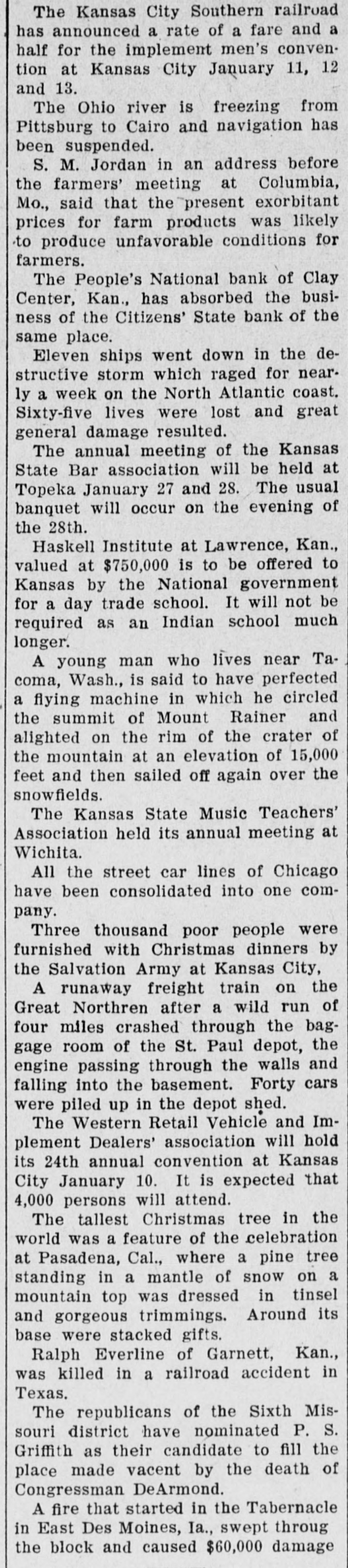
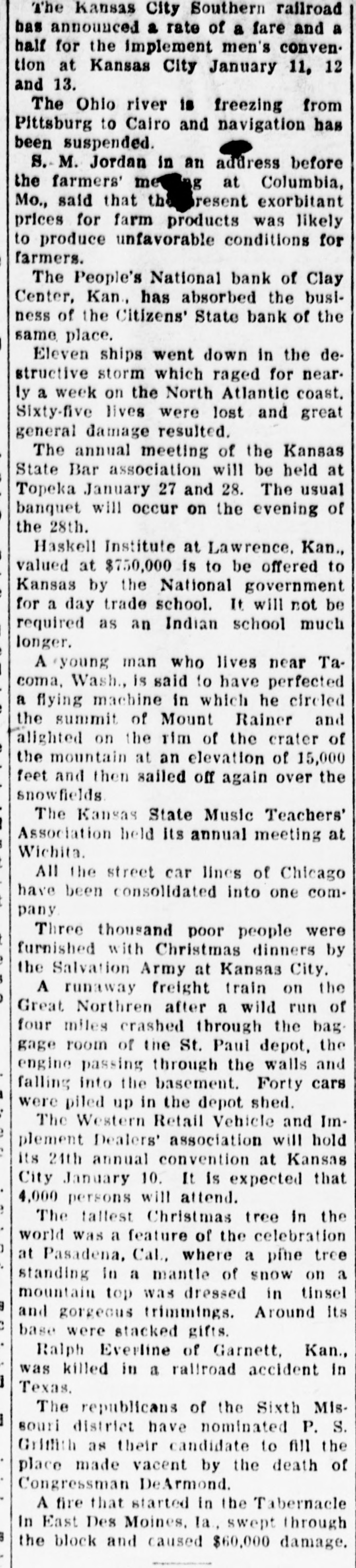
London advices of the 10th quoti 5-20's at 72% Exchange on New York was unchanged. Bankers were buying at 1/2 discount, and selling at par. There WAR but little doing in uncurrent money. Bank of Tennessee was a shade firmer at 50c buying, and 53c selling. Planters Bank was bought at 82c, and sold at 83c, while Union Bank was firm at 80@S1c buying and 83c selling. Southern Bank notes were very dull at the advertised rates. Nashville corporation checks were taken at 9@ 10c discount, and sold at 7@Sc off. They are used in paying corporation taxes. Tennessee bonds sold in New York on the 12th inst. as follows: $1,000 new at 651e, $20,000 at 65e, and $5,000 2d call at 653c. North Carolina bonds of the new issue were quoted at 54kc. During the month of December last the Acting Comptroller of the Currency destroyed national bank notes to the amount of $88,100, $63,500 of which was returned by the national banks in the State of New York. There has been considerable stringency in the New York money market of late,and it is explained to have resulted from the operations of speculators who sought to bring on crisis in money matters. The New York Herald of the 11th inst. says these would-be panic makers have been less successful than they have been anticipated, and adds: "The money they borrowed on Wednesday and Thursday by paying seven per cent in gold, and in some cases a commission besides, still remains under their control, but the greater part of it will probably be restored to circulation on Monday. Some of this money was engaged without being taken, the interest being paid on condition of its not being used, and some of the lenders profess to have been in ignorance of the bear operation they were lending themselves to. Loans were made in some cases on certified checks through both bank and private lenders, and all the machinery of credit was employed to shut legal tender notes out of circulation. The result is partially seen in the returns of the Clearing House this morning. The bank of the State of New York was crediter to the extent of $3,300,000, the Tenth National Bank $1,250,000, the Bank of the Republic $500,000, and the Bank of Commerce $700,000 -making total of $5,750,000, while nearly all the other banks were debtors." The New York World substantially corroborates this statement, and adds that firms in good standing were freely supplied with what money they needed at 7 per cent., so that, as far as an easy money market is concerned, there is no drawback to an advance in the prices of stock The World insists, however, that "the heaviness and declining tendency of the stock market are not cansed by stringency in loans, but by the gradual weakening of mercantile confidence in the stability of prices, owing to the policy of contraction of greenbacks adopted by the government. The contraction of greenbacks, while they continue to be the lawful money of the country, acts precisely the same on the money market as a foreign drain of specie in specie-paying times. It enforces contraction of loans on the part of the banks, and when that is pushed to an extremity, as in 1857, the results are panica, bankruptcies, and a ruinous decline in prices. If the government continues the contraction of $4,000,000 per month, the banks must contract their loans, and prices will decline. Some twenty memorials were presented to the House of Representatives on Saturday from different portions of the West, protesting against any curtailment of The national currency. They were laid before the Banking Committee. There is very strong pressure being brought to bear upon Congress to stop the further contraction of the currency, and this comes from both New York and the West. The drain of the precious metals to the Asiatic continent from Great Britain from 1851 to 1866 inclusive, has amounted to £16,074,938 in gold, and $112,522,808 in silver. Notwithstanding the demand to pay for cotton in Egypt, the draft has been less the past year than for several years. The opinion of the House of Represent atives was indirectly expressed on the 14th inst., on two important financial questions. The first was embodied in Wilson's resolution declaring that the public interest will not justify greater curtailment of the legal tenders than four millions of dollars per month; and the second was presented by Mr. Hooper's resolution from the Committee on Banking and Currency, deelaring that it is not expedient to increase the national bank circulation above $800,000,000. It required the suspension of the rules to bring these resolutions before the House for action, and a two-thirds vote could not be secured for either. The vote in favor of the first was to and in favor of the latter 87 to 52. It is thought both resolutions would have carried if a direct vote could have been reached. The Exchange Bank at Greencastle, Indians, which failed on the 11th inst., has liabilities amounting to one hundred and sixty thousand dollars, of which one hundred thousand dollars is held by one hundred and sixty-three depositors. The assets are estimated one hundred thousand, and the proprietor, Wm. D. Allen, has made an assignment for the benefit of the home creditors; but it is thought that it will make no difference, as Eastern creditors have prior claims. Thefailure wasowing tospeenlations in pork and gold, Allen having lost $40,000 in gold at one time and $60,000 on pork at another. The New York Journal of Commerce of inst says of domestic dry goods


Article from The Evansville Journal, January 24, 1867

Click image to open full size in new tab

Article Text

STATE ITEMS. m. Hannaman, of Indianapolis, says e is no reasonable probability that the nent of the extra bounty will be made re the first of April, 1867. ter the failure of the Exchange Bank, reencastle, Keightby's Bank, at that e, was subjected to a heavy run. It 1 the "pressure." e Vincennes girls now go to balls in O dresses, white aprons, minus crinoand refuse to allow the young men to mpany them either to or from the e. Seymour Times says that nearly all e persors arrested in that place on harge of robbing the freight trains on effersonville Railroad were acquitted. eresting revivals of religion are in ess at the two Methodist churches at Wayne. Trustees of the sinking fund have d over the property, books and of that institution to the Auditor of : Montgomery, of Owen County, did ke a saloon in his neighborhood, and dingly demolished it. He was tried e Common Pleas Court and fined -fivedollars. le Moses and Leonard Warner were ing hogs, in Noble County, one of the