Trust Company (New York, NY)

Episode Information

Episode UID
5676432590883
Episode Type
Run β†’ Suspension β†’ Reopening
Bank Type
trust
Bank ID
567643259 hash
Start Date
July 19, 1873
Location
New York, New York (40.714, -74.006)

Metadata

Model
gpt-5-mini (chosen from majority vote of a three-model LLM ensemble)
Short Digest
aff5be063c3de0eb

Response Measures

None

Description

Run and suspension followed disclosure of Rodman's large defalcation; directors/receiver later proposed paying dividend and resuming business.

Events (3)

1. July 19, 1873 Run
Cause
Bank Specific Adverse Info
Cause Details
Public disclosure and rumors around large defalcation by Deputy City Treasurer M.T. Rodman and overdrafts/forged or worthless securities triggered heavy withdrawals.
Measures
Directors/receiver convened; suspension invoked and receiver appointed to stop run and examine affairs; requested depositors hand in passbooks.
Newspaper Excerpt
The run on the Trust Company continues. The company is still paying.
Source
newspapers
2. July 19, 1873 Suspension
Cause
Bank Specific Adverse Info
Cause Details
Discovery of large defalcations/overdrafts (Rodman, Mills) and questionable/forged securities prompted suspension and appointment of a receiver (Daniel Chauncey).
Newspaper Excerpt
Mr. M. T. Rodman has been suspended... Very few depositors have returned their books in response to the request of the receiver.
Source
newspapers
3. September 1, 1873 Reopening
Newspaper Excerpt
The directors are confident that the receiver will be able to pay a dividend of fifty per cent of the amount due depositors on the 11th of August, and the directors propose to call a meeting of the stockholders ... the Trust Company intends to collect 50 per cent from the large stockholders, and to resume business on Sept. 1 ... depositors will be paid 50 per cent on their deposits, but no small deposits will be taken in future. (Receiver Daniel Chauncey).The run on the Trust Company continues.The Trust Company still holding out.The meeting of the Trust company to-day reached no final decision on the resumption of business, but a director states that the company expect to resume Monday next.
Source
newspapers

Newspaper Articles (20)

Article from Worcester Daily Spy, June 20, 1872

Click image to open full size in new tab

Article Text

LATEST MARKETS. NEW YORK STOCK MARKET. NEW YORK. June 19.-Money easy at 3 @ 4 per cent. Sterling easy at 109% @ 109%, with an increased supply. Gold dull and heavy at 113% @ 113% Loans were I @ 4 per cent. for carrying Clearings $32,000,000. Export to day $300.000. Treasury disbursements $132,000. Governments quiet and % @ % per cent lower, The treasury bought only $921,900 of the three millions offered at 113 55-100 @ 113 62-100. State bonds dull and steady. Stocks active and higher. Erie sold up from 51 to 55% closing at 55; Canton to par: Quicksilver to 40, with a general advance of nearly 1 per cent throughout the list, and the market closed strong. with an advancing tendency A Washingten disdatch says of the three calls of 5-20s for redemption, there remain: outstanding $8.000,000. The rumored famous bargain of Daniel Drew, to sell 50,000 shares of Erie at 55, deliverable any time to December 31. has been compromised and the money withdrawn from the trust company. German houses have made large purchases of Erie. It Is rumored that Gen McClelian. S. L. M. Barlow. Wm. B. Dunean, Namuel D. Babcock, Watts Sherman, Charles Lan-ing, Gibson Homans and E H Green are likely to enter on the new direction, and the first-named to be president, and close running arrangement to be made with the Atlantie and Great Western, and possibly the lease of the latter to Erie. Other reports mention Blackstone of Chicago and Alton, an Joy of Michigan Central for the Erie presidency, but the first statement Is generally believed. It is reported that the canal commissioners of this state have decided to pay in coin the bonds due in Juy.


Article from The Sun, July 23, 1873

Click image to open full size in new tab

Article Text

Ins station-Depart City Treasurer M. T. Rodman suspended. The affairs of the Trust Company assumed a more reassuring aspect yesterday, and depositors were sanguine of receiving dollar for dollar. Mr. John J. Allen, ex Assistant United States District Attorney, who is a depositor to the extent of $1,400. had filed a petition in bankruptey, but if the examination going on results 111 showing the institution to be sound. it is probable that proceedings will be dropped The attorney of the New Haven and Willimatic Hailroad visited the Trust Company officials yester. day. and declared that 11.2 bonds upon which the bank had advanced the sum of $150.000 were worth every cent they represent. They are valued variously at from 45 to 75. but when cartain pending arrangements are completed they will approach to par. if the sworn statement of the deceased President's son 18 to be credito d. his estate will amply cover the overdrawn account. The following is the will field yesterday in the Surrogate's office: THE WILL. 1. Ethelbert S. Mills, of the city of Brooklyn. county of Kings, and State of New York, do declare the 10. lowin to be my last will and testainent: give, devise, and bequeath all my property and on. tate both real and pers nal, to my beloved wife, Ellen L Mills to her and her heirs and assigns forevo the reby appoint my said Wile executrix. and my son Thomas 11. Mills my brother, James b. Mile, and my brother.a-law, Edward H. 1. Lyman executors and I hereb. aut orize them. and the survivor of them. and any one or more of them who may quality as execute X or executor, to sell or convey any or all of my real Che tate at public or private sal and for cash or upon credit. In witness whereof. I have hereunto set my hand and seal this tour earth day of June. one thousand eih hundred and seventy-three ETHELBERT 8. MILL The witnesses are M. T. Rodman and E. F. Lombard Thom 18 11. Mills swore that his father's real estate is about $300.000 In value, and that the next of kin are his widow. Ellen 8. Mills, and three children. Thomas 11. Mids. of full age, Fanelbert P. Mills, aged nineteen, and Albert L. Mills. azed Ofteen. The heirs were cited to appear on the 31st inst. to prove the will. THE FAVORED DEPOSITORY OF CITY FUNDS, Alderman Hopes declared that after fin ting from a reliable source how matters stood. he was satisfied that the depositors would not lose a dollar Referring to the city moneys plac d with the Trust Company, he said that a year ago la.t January there were deposited with the Trust Company between eight and nine hundred thousand dollars of city funds. On this the company was paying only 214 per cent., while advertising 4 per Ct nt. in the newspapers. The Alderman offered a resolution directing the Treasurer to require 4 per cent. from the Trust Company and 3 per cent. from banks. which I tter have, under United States law, to reserve 20 per cent. of their deposits It was agreed by the representatives of the several banking institutions th t the banksshould payBand the Trust Company 3X per cent., and that deposits should be made pro rata with the capital and surplus. The Finance Committee of the Aldermen did not re ort in conformity with this agreement. The Mayor and Comptroller afterward withdrew between $2.1 ,000 and $8.0,000 of the sinking fund from the Trust Company and Invested it in certificates, but the Treasurer continued to deposit largely with the company. SUSPENDED. Mr. M. T. Rodman h 8 been suspended from his flice of Deputy City Treasurer. He WAR WHI.... to resig but Treasurer Sprague thought it best to await the result of the investigation into the Trust Company's affairs. Very few depositors have returned their books in response to the request of the receiver. One depositor. who has $9,000 in suspense, appeared at the office to ask when business would be resumed. but declined to part with his book. Mr. George W. Quintard, Secretary of the East River Bridge Company. denied the report that the Bridge Company's funds are deposited with the Trust Company. The Atlantic Bank is the present depository for the bridge's funds. The Bridge Company had an account with the Trust Institution some time ago, and in consequence of delay by the Comptroller in furnishing hem with the installment last due. they were compelled to overdraw to the amount of $81,000.


Article from The Wheeling Daily Register, July 24, 1873

Click image to open full size in new tab

Article Text

BROOKLYN, The Trust Company. BROOKLYN, July 23.-The Directors of the Trust Company met this evening to consider the situation and decide on the best course of action. The stockholders are also agitating a meeting, and will to-day fix a time and place. The general impression among the stockholders appears to be that by prompt action of the [directors in sus. pending and stopping a run, the company may yet be enabled, not only to pay depositors, but to save a large por tion of the capital. Roscoe. The detectives on the track of Roscoe, the supposed accomplice in the Goodrich murder, are still at fault. It is reported that, yesterday, Lizzie King received a letter from Roscoe saying: "Do not tell them of me; I will give you more than anybody; watch Fanny Hyde. ROSCOE." [Signed]


Article from The New York Herald, July 24, 1873

Click image to open full size in new tab

Article Text

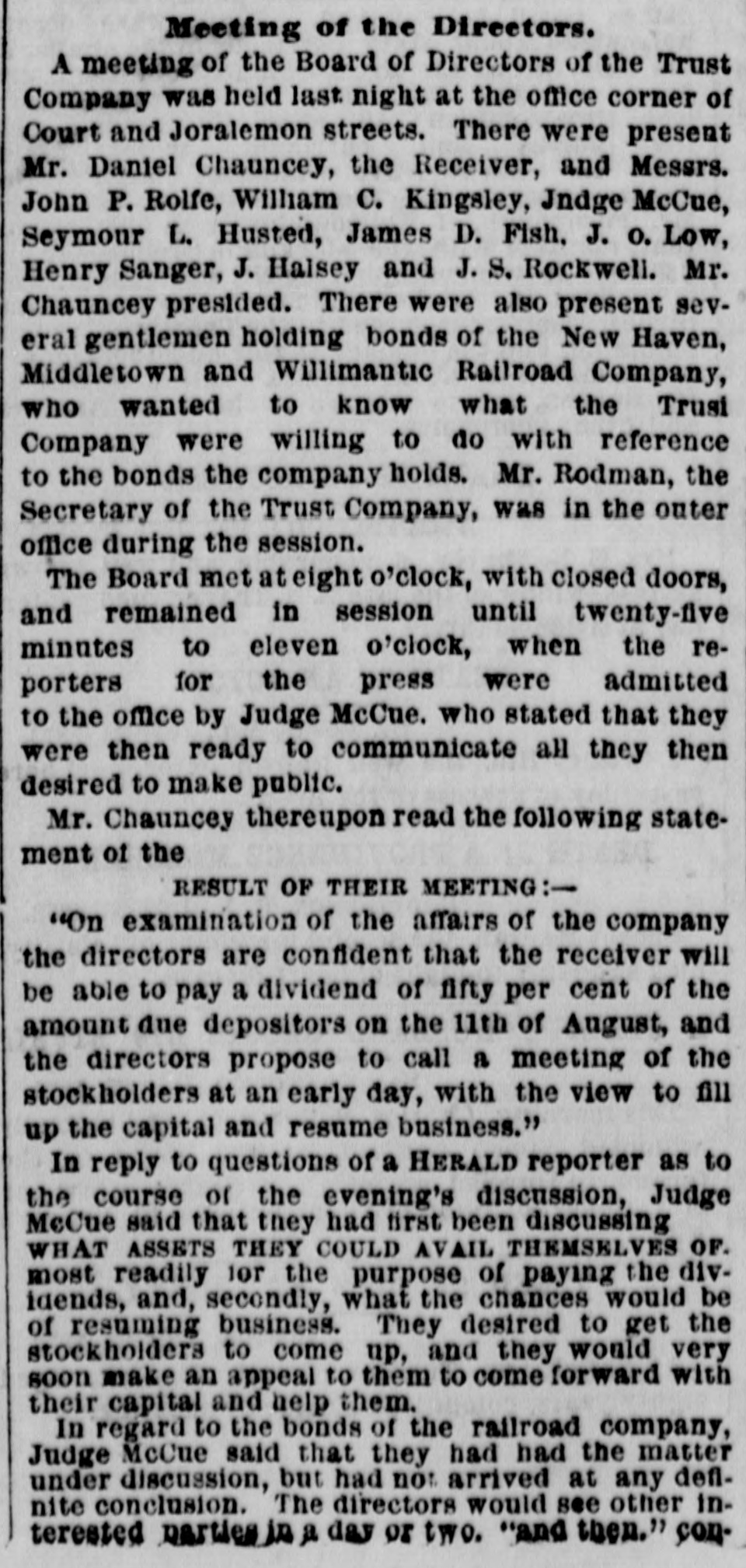
Meeting of the Directors. A meeting of the Board of Directors of the Trust Company was held last night at the office corner of Court and Joralemon streets. There were present Mr. Daniel Chauncey, the Receiver, and Messrs. John P. Rolfe, William C. Kingsley, Jndge McCue, Seymour L. Husted, James D. Fish, J. O. Low, Henry Sanger, J. Halsey and J. S. Rockwell. Mr. Chauncey presided. There were also present several gentlemen holding bonds of the New Haven, Middletown and Willimantic Railroad Company, who wanted to know what the Trust Company were willing to do with reference to the bonds the company holds. Mr. Rodman, the Secretary of the Trust Company, was in the outer office during the session. The Board met at eight o'clock, with closed doors, and remained in session until twenty-five minutes to eleven o'clock, when the reporters for the press were admitted to the office by Judge McCue. who stated that they were then ready to communicate all they then desired to make public. Mr. Chauncey thereupon read the following statement of the RESULT OF THEIR MEETING:"On examination of the affairs of the company the directors are confident that the receiver will be able to pay a dividend of fifty per cent of the amount due depositors on the 11th of August, and the directors propose to call a meeting of the stockholders at an early day, with the view to fill up the capital and resume business." In reply to questions of a HERALD reporter as to the course of the evening's discussion, Judge McCue said that they had first been discussing WHAT ASSETS THEY COULD AVAIL THEMSELVES OF. most readily for the purpose of paying the dividends, and, secondly, what the chances would be of resuming business. They desired to get the stockholders to come up, and they would very soon make an appeal to them to come forward with their capital and help them. In regard to the bonds of the railroad company, Judge McCue said that they had had the matter under discussion, but had not arrived at any deflnite conclusion. The directors would see other interested parties is a day or two. "and then." con-


Article from The Portland Daily Press, July 25, 1873

Click image to open full size in new tab

Article Text

NEW YORK. Summer Amusements. NEW YORK, July 24.-There was a collision last night at an up-town garden known as Lion Park, where a military organization, called the "Knights of Columbia" were holding a picnic. When the programme of dancing was exhausted, Donavan's Band, hired for the occasion, refused to play more without further pay. The picnickers insisted on compelling them to play and an angry altercation ensued. Capt. McDonaid and the police interferred to preserve order and were assailed by the Knights with clubbed muskets, and the latter used clubs Five Knits received scalp wounds and were taken to the station. Capt. McDonald received a serious contusion in the leg from a clubbed musket. The tight was renewed on the cars and one rioter attempted to stab an officer with a bayonet. but was disarmed and arrested. The German American Association. The delegation from the German American Association waited on the Mayor this afternoon for the purpose of requesting him to attend the meeting of the Association on the 29th inst., the object of which is to obliterate all old world prejudices and opinions and unite the different elements and, nationalities in the United States in a common bond of citizenship. The Mayor promised if possible to address the meeting. Prof. Wilson of Cornell University, and Chas. Francis Adams are expected to be present. Various Matters. The schooner Nellie J. Dinsmore from Havana, which arrived here yesterday, lost two men by yellow fever during the voyage, and has the captain and one man now sick. There are nearly one hundred prisoners now in the Tombs awaiting trial under grand jury indictments. It is stated that nearly all the members of the Brooklyn ring knew of the shaky condition of the Trust Company, and all were secretly notified to secretly withdraw their deposits, which they did including nearly all the members of the Oceanic Club. About 300 suspended workmen have been put to work on the parks. Two bathers were carried off by the undertow at Rockaway, yesterday, in the presence of hundreds of persons. A boat was launched and rescued one Jno Harshaw of Green Point. The other, whose name is unknown, was drowned. The Emigration Commissioners are running the State in debt, and it is believed they will next year recommend an increase of head money to square their accounts. The chairman of the Finance Committee went to Europe yesterday. Their debt will probably reach a quarter of a million of dollars by December. The body of an unknown woman, 35 years of age, and a boy seven years old, both wiapped together by a shawl, was found yesterday in East River, near the foot of 28th street. There is no clue to their identity. The scene around the markets this morning beggars description. The booths and shanties are all in ruins. There was no disturbance, owing to the presence of abody of policemen. It is reported the negotiations for a loan of $700,000 real estate in San Francisco has fallen through.


Article from New-York Tribune, July 28, 1873

Click image to open full size in new tab

Article Text

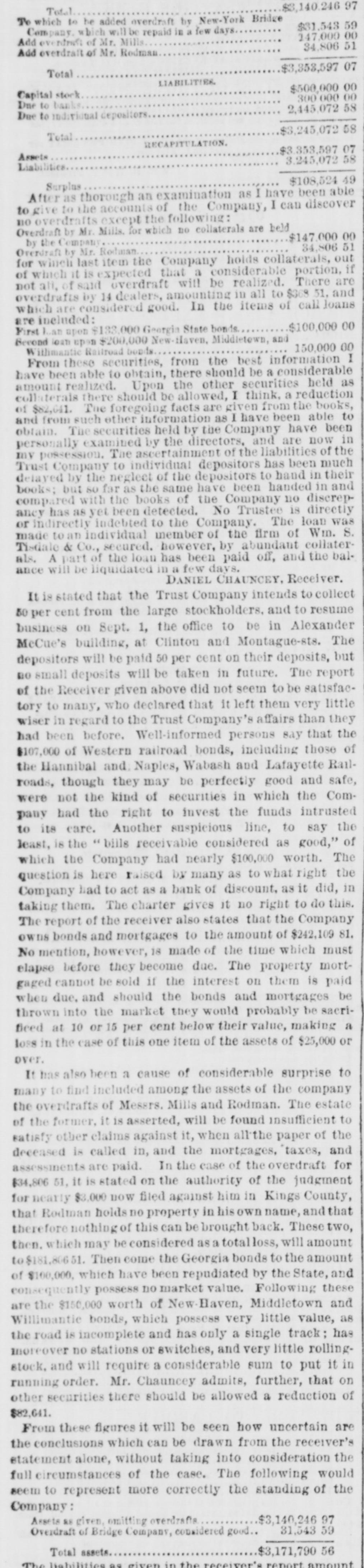
$3,140,246 97 Total To which to be added overdraft by New-York Bridge $31,543.59 Company which will be repaid in a few days 247,000 00 Add eventraft of Mr. Mills 34.806 51 Add overdraft of Mr. Rodman $3,353,597 07 Total LIABILITIES. $500,000 00 Capital stock 300 000 00 Due to banks 2,445,072 58 Due to individual depositors $3,245,072 58 Total RECAPITULATION $3,353,597 07 Assets 3.245.072 8 58 Liabilities $108,524.49 After Surplus as thorough an examination as I have been able to give to the accounts of the Company, I can discover no overdrafts except the following: Overdraft by Mr. Mills. for which no collaterals are beld $147.000 00 by the Company 34,806 5 Overdraft by Mr. Rodman for winch last item the Company holds collaterals, out of which it is expected that a considerable portion, if not all, of said overdraft will be realized. There are overdrafts by 14 dealers, amounting in all to $368 51, and which are considered good. In the items of call loans are included: $100,000 00 First Lan upon $133,000 Georgia State bonds Second loan upon $200,000 New-Haven, Middletown, and 150,000 00 Withmantic Railroad bonds. From these securities, from the best information I have been able to obtain, there should be a considerable amount realized. Upon the other securities held as collaterals there should be allowed, I think. a reduction of $82,641 The foregoing facts are given from the books, and from such other information as I have been able to obtain. The securities held by the Company have been personally examined by the directors, and are now in my possession. The ascertainment of the liabilities of the Trust Company to individual depositors has been much delayed by the neglect of the depositors to hand in their books: but so far as the same have been handed in and compared with the books of the Company no discrepancy has as yet been detected. No Trustee is directly or indirectly indebted to the Company. The loan was made to an individual member of the firm of Wm. S. Tisdale & Co., secured. however, by abundant collaterals. A part of the loan has been paid off, and the balance will be liquidated in a few days. DANIEL CHAUNCEY. Receiver. It stated that the Trust Company intends to collect 50 per cent from the large stockholders. and to resume business on Sept. 1, the office to be in Alexander McCue's building, at Clinton and Montague-sts. The depositors will be paid 50 per cent on their deposits, but no small deposits will be taken in future. The report of the Receiver given above did not seem to be satisfactory to many, who declared that it left them very little wiser in regard to the Trust Company's affairs than they had been before. Well-informed persons say that the $107,000 of Western railroad bonds, including those of the Hannibal and Naples, Wabash and Lafayette Railroads, though they may be perfectly good and safe, were not the kind of securities in which the Company had the right to invest the funds intrusted to its care. Another suspicious line, to say the least, is the bills receivable considered as good," of which the Company had nearly $100,000 worth. The question is here raised by many as to what right the Company had to act as a bank of discount. as it did, in taking them. The charter gives it no right to do this. The report of the receiver also states that the Company owns bonds and mortgages to the amount of $242,109 81. No mention, however, 18 made of the time which must elapse before they become due. The property mortgaged cannot be sold if the interest on them is paid when due, and should the bonds and mortgages be thrown into the market they would probably be sacrificed at 10 or 15 per cent below their value, making a loss in the case of this one item of the assets of $25,000 or over. It has also been a cause of considerable surprise to many to find included among the assets of the company the overdrafts of Messrs. Mills and Rodman. The estate of the former. it is asserted, will be found insufficient to satisfy other claims against it, when all the paper of the deceased is called in, and the mortgages, taxes, and assessments are paid. In the case of the overdraft for $34,806.51 it is stated on the authority of the judgment for r nearly $3,000 DOW filed against him in Kings County, that Rodman holds no property in sown name, and that therefore nothing of this can be brought back. These two, then. which may be considered as a total loss, will amount to $181.806 51. Then come the Georgia bonds to the amount of $100,000. which have been repudiated by the State, and consequently possess no market value. Following these are the $150,000 worth of New Haven, Middletown and Willimantie bonds, which possess very little value, as the road is incomplete and has only a single track: has moreover no stations or switches, and very little rollingstock, and will require a considerable sum to put it in running order. Mr. Chauncey admits, further, that on other securities there should be allowed a reduction of $82,641. From these figures it will be seen how uncertain are the conclusions which can be drawn from the receiver's statement alone, without taking into consideration the full circumstances of the case. The following would seem to represent more correctly the standing of the Company: $3,140,246 97 Assets 88 given omitting overdrafte 31,543 59 Overdraft of Bridge Company, considered good.. $3,171,790 56 Total assets. The given in the receiver's report amount
Article from The Sun, September 1, 1873

Click image to open full size in new tab

Article Text

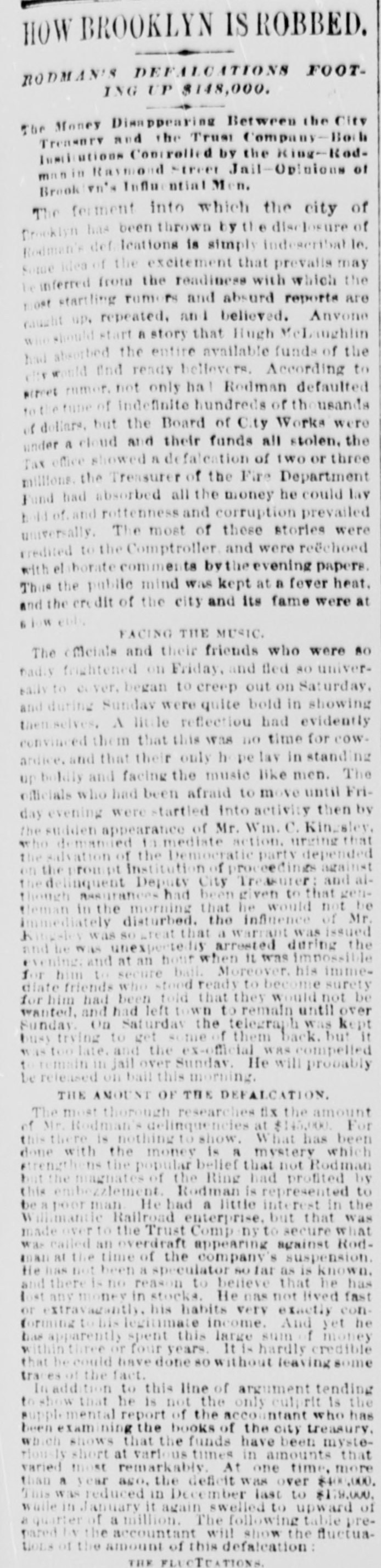
# HOW BROOKLYN IS ROBBED. # RODMAN'S DEFALCATIONS FOOTING UP $148,000. The Money Disappearing Between the City Treasury and the Trust Company-Both Institutions Controlled by the Ring-Rod- man in Raymond Street Jail-Opinions of Brooklyn's Influential Men. The ferment into which the city of Brooklyn has been thrown by the disclosure of Rodman's defalcations is simply indescribable. Some idea of the excitement that prevails may be inferred from the readiness with which the most startling rumors and absurd reports are caught up, repeated, and believed. Anyone who should start a story that Hugh McLaughlin had absorbed the entire available funds of the city would find ready believers. According to street rumor, not only had Rodman defaulted to the tune of indefinite hundreds of thousands of dollars, but the Board of City Works were under a cloud and their funds all stolen, the Tax office showed a defalcation of two or three millions, the Treasurer of the Fire Department Fund had absorbed all the money he could lay hold of, and rottenness and corruption prevailed universally. The most of these stories were credited to the Comptroller, and were reΓ«choed with elaborate comments by the evening papers. Thus the public mind was kept at a fever heat, and the credit of the city and its fame were at a low ebb. FACING THE MUSIC. The officials and their friends who were so badly frightened on Friday, and fled so univer- sally to cover, began to creep out on Saturday, and during Sunday were quite bold in showing themselves. A little reflection had evidently convinced them that this was no time for cow- ardice, and that their only hope lay in standing up boldly and facing the music like men. The officials who had been afraid to move until Fri- day evening were startled into activity then by the sudden appearance of Mr. Wm. C. Kingsley, who demanded immediate action, urging that the salvation of the Democratic party depended on the prompt institution of proceedings against the delinquent Deputy City Treasurer; and al- though assurances had been given to that gen- tleman in the morning that he would not be immediately disturbed, the influence of Mr. Kingsley was so great that a warrant was issued and he was unexpectedly arrested during the evening, and at an hour when it was impossible for him to secure bail. Moreover, his imme- diate friends who stood ready to become surety for him had been told that they would not be wanted, and had left town to remain until over Sunday. On Saturday the telegraph was kept busy trying to get some of them back, but it was too late, and the ex-official was compelled to remain in jail over Sunday. He will probably be released on bail this morning. # THE AMOUNT OF THE DEFALCATION. The most thorough researches fix the amount of Mr. Rodman's delinquencies at $145,000. For this there is nothing to show. What has been done with the money is a mystery which strengthens the popular belief that not Rodman but the magnates of the Ring had profited by this embezzlement. Rodman is represented to be a poor man. He had a little interest in the Willimantic Railroad enterprise, but that was made over to the Trust Company to secure what was called an overdraft appearing against Rod- man at the time of the company's suspension. He has not been a speculator so far as is known, and there is no reason to believe that he has lost any money in stocks. He has not lived fast or extravagantly, his habits very exactly con- forming to his legitimate income. And yet he has apparently spent this large sum of money within three or four years. It is hardly credible that he could have done so without leaving some traces of the fact. In addition to this line of argument tending to show that he is not the only culprit is the supplemental report of the accountant who has been examining the books of the city treasury, which shows that the funds have been myste- riously short at various times in amounts that varied most remarkably. At one time, more than a year ago, the deficit was over $400,000. This was reduced in December last to $118,000, while in January it again swelled to upward of a quarter of a million. The following table pre- pared by the accountant will show the fluctua- tions of the amount of this defalcation: # THE FLUCTUATIONS.


Article from The Rutland Daily Globe, September 1, 1873

Click image to open full size in new tab

Article Text

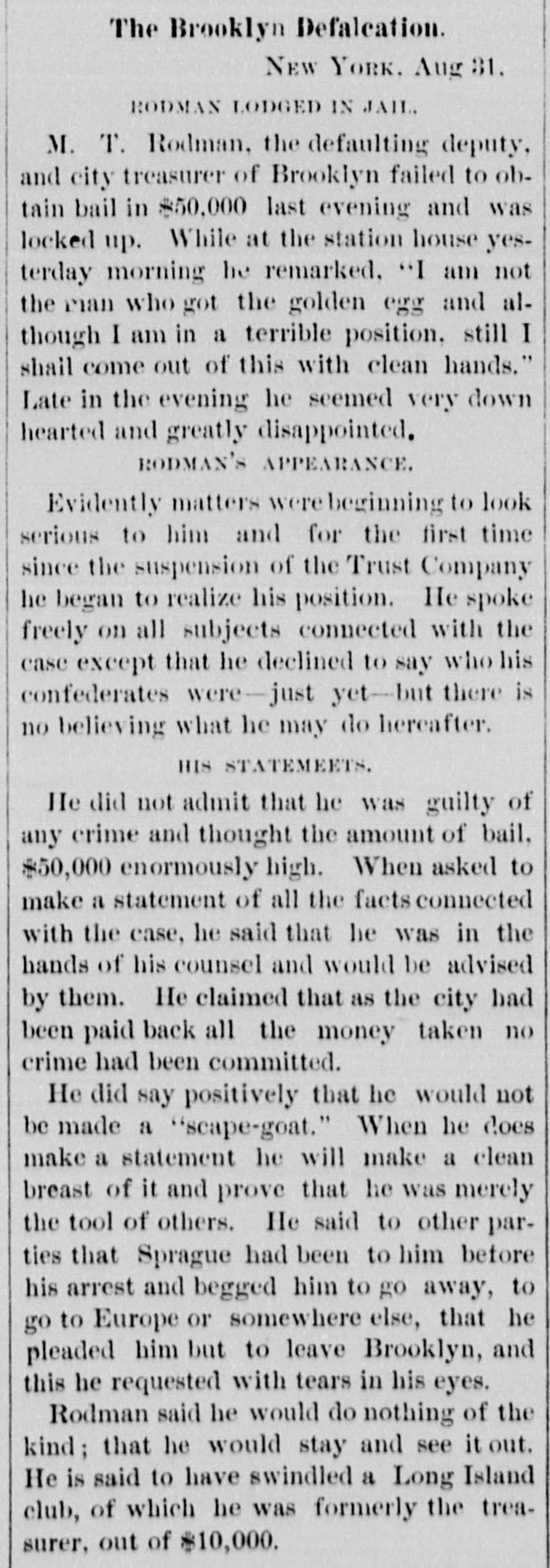
The Brooklyn Defalcation. NEW YORK. Aug 31. RODMAN LODGED IN JAHL M. T. Rodman, the defaulting deputy, and city treasurer of Brooklyn failed to obtain bail in $50,000 last evening and was locked up. While at the station house yesterday morning he remarked, "I am not the man who got the golden egg and although I am in a terrible position, still I shall come out of this with clean hands." Late in the evening he seemed very down hearted and greatly disappointed, RODMAN'S APPEARANCE. Evidently matters werebeginning to look serious to him and for the first time since the suspension of the Trust Company he began to realize his position. He spoke freely on all subjects connected with the case except that he declined to say who his confederates were-just yet-but there is no believing what he may do hereafter. HIS STATEMEETS. He did not admit that he was guilty of any crime and thought the amount of bail. $50,000 enormously high. When asked to make a statement of all the facts connected with the case, he said that he was in the hands of his counsel and would be advised by them. He claimed that as the city had been paid back all the money taken no crime had been committed. He did say positively that he would not be made a "scape-goat." When he does make a statement he will make a clean breast of it and prove that he was merely the tool of others. He said to other parties that Sprague had been to him before his arrest and begged him to go away, to go to Europe or somewhere else, that he pleaded him but to leave Brooklyn, and this he requested with tears in his eyes. Rodman said he would do nothing of the kind; that he would stay and see it out. He is said to have swindled a Long Island club, of which he was formerly the treasurer, out of $10,000.


Article from New-York Tribune, September 1, 1873

Click image to open full size in new tab

Article Text

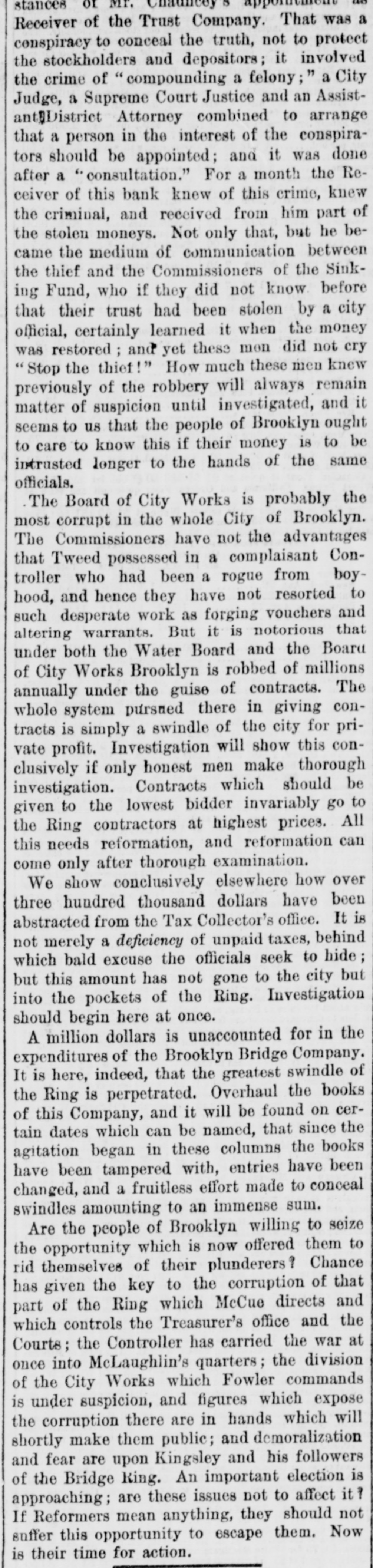
stances or appomme Receiver of the Trust Company. That was a conspiracy to conceal the truth, not to protect the stockholders and depositors; it involved the crime of compounding a felony;' a City Judge, a Supreme Court Justice and an Assistant$District Attorney combined to arrange that a person in the interest of the conspirators should be appointed ; and it was done after a "consultation." For a month the Receiver of this bank knew of this crime, knew the criminal, and received from him part of the stolen moneys. Not only that, but he became the medium of communication between the thief and the Commissioners of the Sinking Fund, who if they did not know before that their trust had been stolen by a city official, certainly learned it when the money was restored and yet these mon did not cry 'Stop the thief! How much these men knew previously of the robbery will always remain matter of suspicion until investigated, and it seems to us that the people of Brooklyn ought to care to know this if their money is to be intrusted longer to the hands of the same officials. The Board of City Works is probably the most corrupt in the whole City of Brooklyn. The Commissioners have not the advantages that Tweed possessed in a complaisant Controller who had been a rogue from boy hood, and hence they have not resorted to such desperate work as forging vouchers and altering warrants. But it is notorious that under both the Water Board and the Board of City Works Brooklyn is robbed of millions annually under the guise of contracts. The whole system pursued there in giving contracts is simply a swindle of the city for private profit. Investigation will show this conclusively if only honest men make thorough investigation. Contracts which should be given to the lowest bidder invariably go to the Ring contractors at highest prices. All this needs reformation, and reformation can come only after thorough examination. We show conclusively elsewhere how over three hundred thousand dollars have been abstracted from the Tax Collector's office. It is not merely a deficiency of unpaid taxes, behind which bald excuse the officials seek to hide but this amount has not gone to the city but into the pockets of the Ring. Investigation should begin here at once. A million dollars is unaccounted for in the expenditures of the Brooklyn Bridge Company. It is here, indeed, that the greatest swindle of the Ring is perpetrated. Overhaul the books of this Company, and it will be found on certain dates which can be named, that since the agitation began in these columns the books have been tampered with, entries have been changed, and a fruitless effort made to conceal swindles amounting to an immense sum. Are the people of Brooklyn willing to seize the opportunity which is now offered them to rid themselves of their plunderers Chance has given the key to the corruption of that part of the Ring which McCue directs and which controls the Treasurer's office and the Courts; the Controller has carried the war at once into McLaughlin's quarters; the division of the City Works which Fowler commands is under suspicion, and figures which expose the corruption there are in hands which will shortly make them public; and demoralization and fear are upon Kingsley and his followers of the Bridge Ring. An important election is approaching; are these issues not to affect it If Reformers mean anything, they should not suffer this opportunity to escape them. Now is their time for action.


Article from New-York Tribune, September 6, 1873

Click image to open full size in new tab

Article Text

MORE BROOKLYN FRAUDS. IS THE TRUST COMPANY SOLVENT 338 STOCK REFUSED AT 65 AND OFFERED AT 50 CENTS ON THE DOLLAR NO LIST OF ASSETS ONTAINABLE-BOGU8 RAILWAY, BOGUS SEWINGMACHINE, BOGUS STATE BONDS, AND FORGED CHECKS AMONG THEM. For several days past, in certain narrow cirof Brooklyn, chiefly among rich men who invest class in eles and bonds, but not heard among the larger stocks men who are depositors of hard-earned money, which of there have poorer been whispers that the Trust Company, lately suspended under such unhappy circumstances, manner. and which had resumed in such a mysterious bankrupt. There has been no time since its not suspen- been sion was on July 19 that doubts of its solvency have entertained by those most intimate with its manage- As soon ment and most deeply interested in its success. careful the reports reached THE TRIBUNE office a was as familiar with the history of its supension, satisfied of reporter. investigate the rumors, and when for directed to truth of the rumor to publish the facts the falsity information or of depositors for it is this class who the the most interested, and who are entirely the unrepresented really in the management and consequently least protected. Denials and demurrers were met on every band. The susprious persons who had knowledge of the facts coneealed them, or at least declined communicating them, for fear they would be held accountable, and in hope that the company in which they held stock which could not be sold at any price might yet pull through. The denials of insolvency came from the officials of the bank, who are interested in concealing the frauds which have been committed there. Neverthless, enough information was obtained to justify THE TRIBUNE in warning depositors against placing funds in a corporation so mismanaged as this has been. These reports grew so thick and fast that the President was forced yesterday to obtain a certificate of the soundness of the bank from the accountant who has lately been examining the books. But It will be seen from what follows that the accountant certifies only to the correctness of the accounts; and in an interview with a TRIBUNE reporter disclaimed any knowledge of the character of the securities which go to make up the assets. Among the suspicious facts discovered it was learned that the meeting of stockholders which was held soon after the resumption of the bank was failure. Some of those who voted to pay 50 per cent of their stock have since declined to do so, and have put their stock on the market at less than 50 per cent of what it cost them. One gentleman who paid $120 for his stock offered it for $65. and a bidder was found, but after some inquiry he declined to receive it. It was then offered to him for 865. and it was declined with the significant remark, Not at price." There is hardly a question that much of the suspicions attaching to the bank arises from the manner in which It has been managed lately. The exposure of the fact that its own counsel threw it into the hands of a receiver who was its actual President by collusion with Judge of the Supreme Court, caused much comment. The fact that after its resumption a noted politician. who has been under favors to the Ring, and who is en tirely dependent on it for the further advancement which he seeks, was made its President, and has carefully concealed from the public a knowledge of its assets and liabilities, gave greater alarm still. Though little is known of the nature of the assets, that little increases the anxiety and doubts as to the solvency of the concern. It is well known, however, that among others there are $200,000 of bogus Georgia State bonds on which $150,000 were loaned, and which securities are well known to be utterly worthless. Of this amount not one penny can ever be collected, though the officers hope they will be good in time," and the amount may as well be put down as lost. There are overdrafts of Mr. Mills for $147,000; but his estate is bankrupt, no securities have been obtained to satiefy the same, and it is known that the Ring dare not push the heirs lest one of them, who had his father's confidence and possesses the Ring's se-, crets. will reveal the manner in which they corruptly used the late President. This sum his simply bad debt, and the bank officers so set it down to profit and loss. The bank also counts among its assets $200,000 of the mortgage bonds of the New-Haven, Middletown and Willimantic Railway. There is very little doubt that these bonds are worth much less than their face; it 18 a problem whether the road can ever pay the interest on the issue. and certainly they cannot be realized except at a heavy shave. The Trust Company was induced to invest these bonds by & partner of McCue, Mills, Sprague and Rodman in a wild-cat Sewing Machine Company, whose embarrassment, as a natural consequence of the failure of the Trust Company and the stoppage of the City Treasury supplies, is aunounced elsewhere. There are also among the assets $242,109 81 of bonds and mort gages on Brooklyn property. None of these can be realized upon at once, and probably each will have to wait the full time it has to run. and then be foreclosed. It is believed that nine-tenths of these bonds and mortgages are upon property belonging to Mills. It also reported in this connection that loans had been made on tax certificates ou which nothing could be realized in many years. Other damaging reports relative to a forged check for $50,000 were floating about. but it was learned that this had been partly redeemed with $26,000 of the stock of a Sewing Machine Company, which Judge McCue has pronounced an active company whose stock, however, was not counted as worth anything." The reason why he looked upon it as worthless is explained in another column. Among the demand loans accured by collaterals there are said to be immense loans to the Lathrop Combination Sewing Machine Company," and the collaterals are the Company's bonds. This load is said to be $300,000, half the total capital stock of the Company. Of this Company, Judge McCue. Mille, Sprague and Rodman-a the Trust Company Ring, in fact, except Ropes and Chauncey directors, is only just to add, however, that Judge McCue denies allegation. Thus it will be seen that among the assets are the following doubtful and worthless securities Georgia bogus b'ds..$200.000 Bonds and mortg's $242,000 ring-machine Coun. railroad b'ds.. 200,000 Millsoverdraft 147,000 stock 326,000 Here are over million of doubtful and worthless 80curities. Omitting the merely doubtful ones, and it will be found that the assets embrace over half a million worthless securities. to which are to be added some loans and bills receivable from men who failed with Mills. It was also said that the bank had been made liable for the defalcation in the City Treasury. Wm. C. Kings ley is one of Sprague's bondsmen. and, in order to save himself, be had Rodman arrested, and, in the meeting of bondsmen. raised the question of the Trust Company's liability for this sum. The point be made was that on July 21, MeCue, its counsel, had officially stated the deposite of the city to be $593,803 43, and though it was BOOD found that the actual sum on deposit was only $357,983 38, the bank is responsible for what its books above and its counsel has admitted. This question causes great doubt of the safety of the bank. It is further said that *the new treasurer, to be ap pointed next Monday, will, of course, immediately draw out the city deposits still in the bank. Public epinion will insist on this and it is believed to be doubtful if the bank can stand such a demand at the moment. There have been many daclarations to the contrary. but these are from officials who are little credited with a facts and who are known to have con-


Article from The Wheeling Daily Intelligencer, September 17, 1873

Click image to open full size in new tab

Article Text

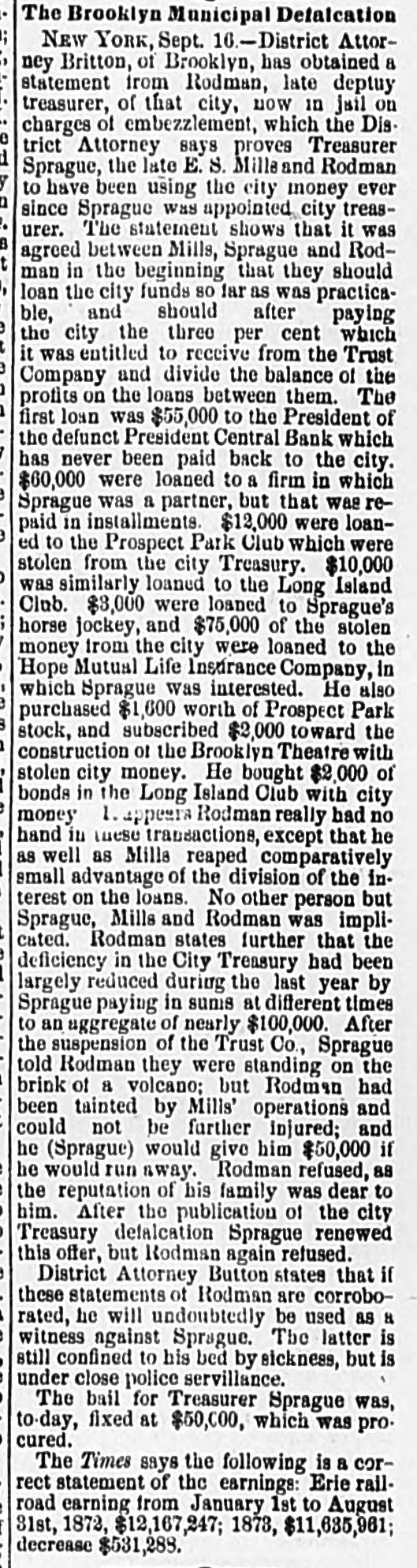
The Brooklyn Municipal Detalcation NEW YORK, Sept. 16.-District Attorney Britton, of Brooklyn, has obtained a statement from Rodman, late deptuy treasurer, of that city, now in jail on charges of embezzlement, which the Dis. e trict Attorney says proves Treasurer d Sprague, the late E.S. Mille and Rodman to have been using the city money ever a since Sprague was appointed city treas. urer. The statement shows that it was a agreed between Mills, Sprague and Rodman in the beginning that they should loan the city funds so far as was practicable, and should after paying the city the three per cent which it was entitled to receive from the Trust Company and divide the balance of the profits on the loans between them. The first loan was $55,000 to the President of the defunct President Central Bank which has never been paid back to the city. $60,000 were loaned to a firm in which Sprague was a partner, but that was repaid in installments. $12,000 were loaned to the Prospect Park Club which were stolen from the city Treasury. $10,000 was similarly loaned to the Long Island Club. $3,000 were loaned to Sprague's horse jockey, and $75,000 of the stolen money from the city were loaned to the Hope Mutual Life Insurance Company, in which Sprague was interested. He also purchased $1,000 worth of Prospect Park stock, and subscribed $2,000 toward the construction of the Brooklyn Theatre with stolen city money. He bought $2,000 of bonds in the Long Island Club with city money 1. appears Rodman really had no hand in these transactions, except that he as well as Mills reaped comparatively small advantage of the division of the interest on the loans. No other person but Sprague, Mills and Rodman was implicated. Rodman states further that the deficiency in the City Treasury had been largely reduced during the last year by Sprague paying in sums at different times to an aggregate of nearly $100,000. After the suspension of the Trust Co., Sprague told Rodman they were standing on the brink of a volcano; but Rodman had been tainted by Mills' operations and could not be further injured; and he (Sprague) would give him $50,000 if he would run away. Rodman refused, as the reputation of his family was dear to him. After the publication of the city Treasury defalcation Sprague renewed this offer, but Rodman again refused. District Attorney Button states that if these statements of Rodman are corroborated, he will undoubtedly be used as a witness against Sprague. The latter is still confined to his bed by sickness, but is under close police servillance. The bail for Treasurer Sprague was, to-day, fixed at $50,000, which was procured. The Times says the following is a correct statement of the earnings: Erie railroad earning from January 1st to August 1872, $12,167,247; 1873, $11,635,961; decrease $531,288.


Article from Evening Star, September 19, 1873

Click image to open full size in new tab

Article Text

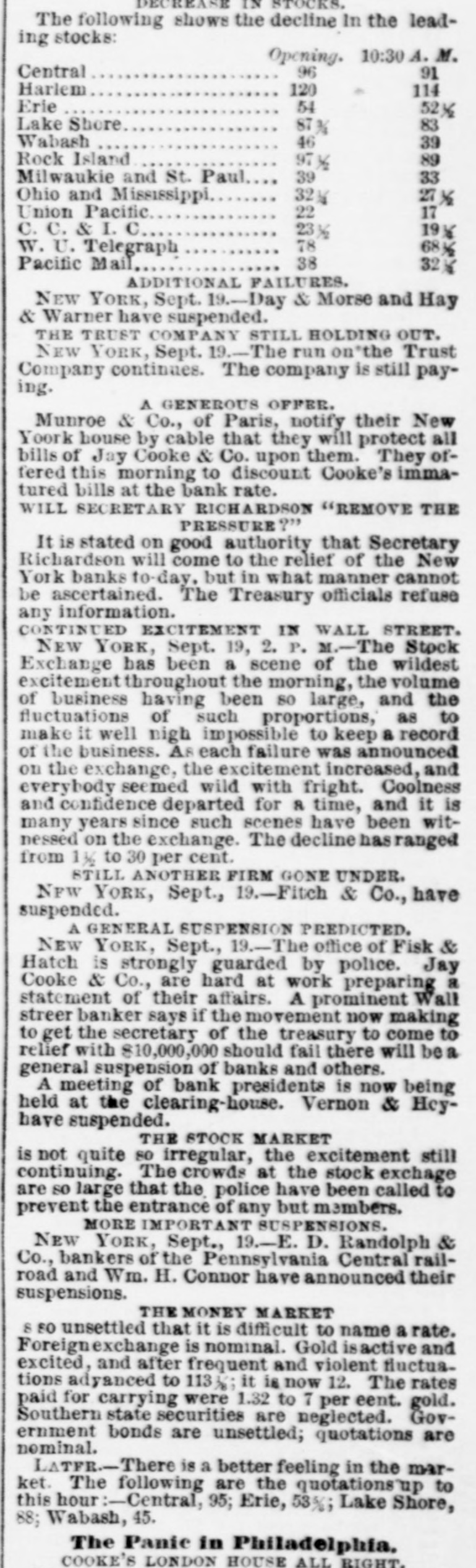
STOCKS. The following shows the decline In the leading stocks: Opening. 10:30 A. M. 96 Central 91 Harlem 120 114 Erie 54 52 1/2 Lake Shore 83 87 % Wabash 46 39 Rock Island 89 97 39 33 Milwaukie and St. Paul 32 Ohio and Mississippi, 27 % 22 17 Union Pacific 23 C.C. & I. C 19 Β₯ 78 W. U. Telegraph 68% 38 Pacific Mail 32% ADDITIONAL FAILURES. NEW YORK, Sept. 19. Day & Morse and Hay & Warner have suspended. THE TRUST COMPANY STILL HOLDING OUT. NEW YORK, Sept. 19. The run on the Trust Company continues. The company is still paying. A GENEROUS OFFER. Munroe & Co., of Paris, notify their New Yoork house by cable that they will protect all bills of Jay Cooke & Co. upon them. They offered this morning to discount Cooke's immatured bills at the bank rate. WILL SECRETARY RICHARDSON "REMOVE THE PRESSURE?" It is stated on good authority that Secretary Richardson will come to the relief of the New York banks to-day. but in what manner cannot be ascertained. The Treasury officials refuse any information. CONTINUED EXCITEMENT IN WALL STREET. NEW YORK, Sept. 19, 2. P. M.-The Stock Exchange has been a scene of the wildest excitement throughout the morning, the volume of business having been so large, and the fluctuations of such proportions, as to make it well nigh impossible to keep a record of the business. As each failure was announced on the exchange, the excitement increased, and everybody seemed wild with fright. Coolness and confidence departed for a time, and it is many years since such scenes have been witnessed on the exchange. The decline has ranged from 1 1/2 to 30 per cent. STILL ANOTHER FIRM GONE UNDER. NFW YORK, Sept., 19.-Fitch & Co., have suspended. A GENERAL SUSPENSION PREDICTED. NEW YORK, Sept., The office of Fisk & Hatch is strongly guarded by police. Jay Cooke & Co., are hard at work preparing a statement of their affairs. A prominent Wall streer banker says if the movement now making to get the secretary of the treasury to come to relief with $10,000,000 should fail there will bea general suspension of banks and others. A meeting of bank presidents is now being held at the clearing-house. Vernon & Heyhave suspended. THE STOCK MARKET is not quite so irregular, the excitement still continuing. The crowds at the stock exchage are so large that the police have been called to prevent the entrance of any but members. MORE IMPORTANT SUSPENSIONS. NEW YORK, Sept., 19.-E. D. Randolph & Co., bankers of the Pennsylvania Central railroad and Wm. H. Connor have announced their suspensions. THE MONEY MARKET 8 so unsettled that it is difficult to name a rate. Foreignexchange is nominal. Gold is active and excited, and after frequent and violent fluctua. tions advanced to 113 it is now 12. The rates paid for carrying were 1.32 to 7 per eent. gold. Southern state securities are neglected. Government bonds are unsettled; quotations are nominal. LATFR--There is a better feeling in the market. The following are the quotations up to this hour: Central, 95; Erie, 53%; Lake Shore, 88; Wabash, 45. The Panic in Philadelphia. COOKE'S LONDON HOUSE ALL RIGHT.


Article from Evening Star, September 19, 1873

Click image to open full size in new tab

Article Text

ADDITIONAL FAILURES. NEW YORK, Sept. 19.-Day & Morse and Hay & Warner have suspended. THE TRUST COMPANY STILL HOLDING OUT. NEW YORK, Sept. 19.-The - run on the Trust Company continues. The company is still paying. . OPERP


Article from Nashville Union and American, September 24, 1873

Click image to open full size in new tab

Article Text

YOUNG CARLETON. An Interview with HIs Father. / $500,000 Worth of Emotional In. sanity. NEW YORK, Sept. 23.-Dr. Thos. Carleton, father of the Secretary, was interviewed yesterday. He was in the office of the Trust Company when his son took his final departure. "Charley seemed," said the Doctor, "to be very nervots and excited. When he was not busy signing checks, he conversed with me, and several times I saw tears rolling down his cheeks. Since his wife died, three weeks ago, he has not been himself, and 1 have frequently found him weeping, while he has continually been despondent and depressed. supposed on the morning in question he was thinking of his loss, being also flurred about the affairs of the company. I talked to him earnestly, telling him that he should be cool and not get excited. Finally, just before noon, Charley went and got his hat, saying to me, 'You must excuse me, father, but it is necessary for me to go out a few minutes; I will be back soon.' Supposing he was going out on business, I did not attempt to stop him. After waiting some time for him to return, I went away. My son did not, as has been stated, go to a safe and take out a thousand dollars. He couldn's have done so, as the cashier pays out the money. "He did not even take his OV rcoat and nothing missing from his wardrobe at home except the clothes he wore. I cannot uaderstand why Charley should have run away. He has friends who would have made good any deficiency. It is my opinion he has been crazy since the death of his wife." Being questioned as to the loan said to have been made to h in by his son, the Doctor said: My business that morning was about these very loans. Some time ago the Trust Company loaned me $30,000 for which I gave the very best securities, and when I heard of the run on the bank I went up there to offer to pay the loans if the company wished. [ S&W Mr. Schell and he told me it was not necessary. However on Saturday after banking hours I received a no ice calling in the loans and this very morning paid $15,000 and would have paid the remainder, but one of the checks I eld was dishonored by the bank because the institution issuing it had not that amount on deposit in the bank. This loan was not made to me by my son personally as been stated, but by the Trust Company. Do you know of any speculations your son engaged in? Yes; I have been told since his departure that Mr. Carleton speculated heavily. bought 1,500 shares of Pacific mail and 1,000 shares of Western Union, but I cannot speak definitely as to other investments. Do you think Mr. Carleton took any of the missing securities or bonds with him? No, I do not; but I was told by a gentleman who was with my son at the time he went to one of the down town savings banks where he has deposits and withdrew $2,000. Have you seen your son since Friday? From the time he left the office at noon on that day I have neither seen nor heard from him, and I have not the slightest idea of his whereabouts.


Article from New-York Tribune, September 26, 1873

Click image to open full size in new tab

Article Text

and Cincignati banks, which were at first reported as having totally suspended, and the excitement was-hightened at noon by the suspension of the private bankinghouse of Woollen, Web: & Co., owing mainly to the return of their drafts on the suspended Trust Company of New-York. Public confidence became 80 shaken that there was a heavy run on Ritzing er's Bank and on the Indianapolis Savings Bank by a class of generally small depositors, and a few persons withdrew their money from other banks. The First National Bank, instead of closing at the usual hour, kept open an hour later to give depositors an opportunity to withdraw their money if they wished, and when it closed it had received more money than it had paid out. The unquestionable solvency of all the city banks, together with the fearless way in which they met the excitement, seems to have sent home the crowds, who thronged the streets until after the banks had closed, in a better state of feeling, and it is not thought that there will be any further trouble. Previous to the excitement, the banks in conference had decided to go ahead in the usual way, and this determination will still be followed.


Article from The New York Herald, September 26, 1873

Click image to open full size in new tab

Article Text

The Panic in Indianapolis. INDIANAPOLIS, Sept. 25, 1873. Considerable excitement was caused here this morning by the announcement of precautionary measures adopted by Chicago and Cincinnati banks, which were at first reported as having totally suspended, and the excitement was heightened at noon by the suspension of the private banking house of Woollen, Webb & Co., owing mainly to the return of their drafts on the suspended Trust Company of New York. Public confidence became 80 shaken that there was quite a heavy run on Ritzinger's Bank and on the Indianapolts Savings Bank by a class of generally small depositors, and some few persons withdrew their money from other banks. The First National Bank, instead of closing at the usual hour kent ORGA BA


Article from Perrysburg Journal, October 3, 1873

Click image to open full size in new tab

Article Text

THE NEW WORLD. A dispatch from Philadelphia of the 19th says that ten other failures had occurred in that city besides those of Jay Cooke & Co., and E. W. Clarke & Co., reported on the day preceding. as follows: De Haven & Brothers; Gilbough, Bond & Co.; Geo. H. North; J. P. & H. E. Yerks; Charles P. Bayard; John P. Lloyd; Henry H. Douglas; H. Heber Ball; T. C. Knight, and H. L. Fell & Bro. Runs had been made upon all of the banks, but up to the time of closing business they had paid every dollar demanded. The most decided attack had been made upon the Fidelity Trust and Safe Deposit Company, there being a prevalent impression that it had been connected in some way with the houses of Cooke and Clarke. The aggregate of funds drawn out was something over $1,000,000. The President had arrived, and it was believed that he had come to offer the sympathy and probably the assistance of the Government to Jay Cooke & Co. A New York despatch of the 19th says the excitement in that city had largely exceeded that of any preceding day. Nineteen additional failures had been announced, among others, those of Fisk & Hatch; White, Defreitas & Rathbone; Beers & Edwards; E. J. Jackson; Thomas Reed & Co.; W. H. Warren; Greenleaf, Norris & Co.; George Alley; Theodore Bedell; A. M. Kidder; Hay & Warner; Day & Morse; Fitch & Co; E. D. Randolph & Co, representatives of Tom Scott, of the Pennsylvania Central Railway, and W. C. Conner. The sacrifice of stock values had been largely in excess of the depreciation of the preceding day. By noon Harlem had fallen 30 per cent.; New York Central, 5; Rock Island, 91/2; St. Paul, 9; Ohio & Mississippi, 11; Western Union, 10 per cent. from the opening prices. Money brought extravagant prices, the ruling rate being one and a half per cent. per day, even this rate being reluctantly accetped. Strong and persistent attacks had been made against all the monied institutions, notably the Fourth National Bank and the Trust Company, of which Richard Schell was President. Up to the close of business, every demand presented had been paid. The effect upon gold had been to raise the price to 1131/2 early in the day, but by afternoon the price had receded to 1111/4 Dispatches from New York on the 20th say that the results of that day's operation "had been disastrous only to a class of stock gamblers whom everybody wished to see overwhelmed, and the suspension of three banks, weakened by outside considerations, unexpectedly revealed by distrust consequent on the agitation of the stock market. The "Bank of the Commonwealth," The National Trust Company," and the "Union Trust Company' had suspended. In the case of the "National," the disaster had resulted from an inability to realize instantly on Government securities. The suspension of the "Union' had resulted not from inability to realize on securities, but from the discovery of the defaication by Carleton, the Secretary, for $600,000, and an over-draft of E. S. Haight for $200,000. It was reported that Vanderbilt had been involved financially in the defalcation. The Stock Exchange


Article from The Dallas Weekly Herald, October 11, 1873

Click image to open full size in new tab

Article Text

the question to emis determined ANNEVEPORT, grate to the Dave I nited October States en mussel Interments yesterday 12. 9. The October NN VILLE, Missons and thousand Odd Fellows dollars chur have Rein seven provisions to Memphis. was in money and October -There LATTLE Rock, frost last evening. another BAUTIMORE, heavy October -Patrick lawyer, Me- is Laughlin, a prominent dond. YORK, October 9.-The railroad sixth conNEW meeting insurance of the association the author ductor's report fifty-seven life deaths during one of year. Seever, of Jersey in City, New JerDiscol wealthiest capitalists a bankrupt. the been adjudged of the New with and Maryland it is York, Oswego His liabilities, sey, He has Vice President Railroad said, has Company will reach $8,000,000. 9.--Young LAKE, October of the Latter SALT elected President Day been Union ST. LOUIS, has gone Saints. October 9.-The into liquidaNational Bank by scarcity of currency. banks NEW resumed greenbacks tion, have caused virtually YORK, October report currency pay Home the Bankers understood that ments. quite plenty. Trust It Company is has resumed business. National CHICAGO, October resumed. 9.-The Third National Bank October has night. _There was Sister were fever. another MEMPHIS, heavy frost forty-one last interments; thirty-three There were a Dominican, yellow Academy, formerly is Joseph, Agnes Peter's Superior, Mary Father of St. O'Brien, of St. has tabasse dead. Church, WASHINGTONIVED is very low. October with p.--The Tak- the Polaris October 9.-Ten crew. SHREVEPORT, Adaline Field, Wardman, N. deaths to-day: Richard Book, Hi Bark, Sweitzer, F. Rev. FitMary Wright, Lelia W. Stewart, colored ran Sanders, J. Dan Brooks, trial of ther Lonesconoctober YORK, 9.-The The chaiNEW resumed to-day. entire array Stokes lenge of was the defense sustained to the although by the court. the jurors said faith, The was made rather than had been would challenge of counsel sustained, was yet that in withdraw. good thousand and delay the hundred trial he and been at pounds Six United sterling States have Assay office failed. since the Monday. Casavana & 9.--A Co. have brisk can- the Gibson, October by was kept up, MADRID, beseiging yesterday. Carthagena. from nonade force deserters the Republican the day ranks many came into During the insurgent veroment troops. The Board camp WASHINGTON of the who October9. investigated will make the of Examiners from the Polaris, the circum- beidefirst party eximination.casters into as will comstances an of the Buddington party, is not exfailed by the to-morrow. It be elicited, mencing that new facts will after the sepapected excepting ration of The Poluris crew occurrences not credit Hall. the The reports authori- of ties here play in do lie death October of 9.-The Total Genfoul YORK, of the Catholic resoeral Abstinence NEW Convention ympathy union the with to-day many the passed afflictions Holy also Fations ther at of Rome lately in experienced: the action of which he has condemning in expulsion orders. and Italy religious Germany and other showed Secretary's of a resolution Jenuits report condition. the The in a flattering of the Clearinghouse an opinThe could not be to-day when there as he banks union manager said he payments, would give resump- was tion jon as of to currency to admit currency that payments the to not prepared only refused LeThey had suspended have, legal he tenders says, and increasing checks. banks in out are rapidly and the the gal pay tenders banks of the legitimate city, demands upon pay them all regular session Association of the Evan- hall, of was relations gelical The devoted afternoon alliance, to of at the the the free church discussion to the 9.-Chaplain Henry the of October the United States Navy, is dead.


Article from The Dallas Daily Herald, November 25, 1873

Click image to open full size in new tab

Article Text

# THE LATEST NEWS. NEW ORLEANS, November 24. The delegates to the Peoples' Convention assembled this morning at the St. Charles hotel, and from thence proceeded to McEnery's office, where the committee of Seventy with the delegates adjourned to Greenwald Hall on Baronne street, which had been chosen for the session. The hall was tastefully decorated with numerous inscriptions and a profusion of flags, the busts of Washington, Clay, Webster and Chief Justice Martin being prominent. Ata quarter past 12 o'clock R. H. Marr, Chairman of the committee of Seventy, called the convention to order, and named Dr. Chappin, temporary Chairman and Thomas L. Maxwell, temporary Secretary, These nominations were adopted unanimously. Dr. Chappin, taking the chair, said he did so because he believed every man in Louisiana should contribute his mite in this struggle for liberty. Committees on credentials and organization were appointed, when a recess of half an hour was taken. After the recess the committee on organization nominated Judge W. B. Eagan, of Caddo, for President, and Thomas L. Maxwell, of New Orleans, Secretary. On mocion, the nominations were accepted. Judge Eagan, upon assuming the chale, addressed the convention, reviewing the situadoo, etc. Other addresses followed. After the appointment of the usual committees, the convention adjourned until 10 o'clock to-morrow morning. NEW ORLEANS, November 24. The board of United States engineer officers appoiated to deliberate upon the feasibility, of the proposed Fort St. Phillip canal, have arrived here. Cotion in good demand; sales 5300 bales. Prices easier. Good ordinary to strict good ordinary 14@15c; low midling to strict low midling 15@15Β½c; midling to strict midling 18@18Β½c; good midling 17@17Β½c for certified checks. Gold 8ΒΌ@8Β½; currency 14@1 sight 1ΒΌ for certified checks; sterling 17ΒΎ@18 for certified checks. NEW YORK, November 24.-Edmund J. Randolph & Co., bankers, who sus-dended during the panie, have resumed. The Spanish iron-clad Arapeles has so far progressed in her repairs as to be almost ready to leave the navy yard. Coal will be put on board to-day. She will go to an anchorage in the North river to-morrow to take in coal, stores and powder, Her commander is determined to have her away at sea before December 1st. WASHINGTON, November 24. In the case of the United States vs. Lapine and others, the Supreme Court to-day decided that where a party advanced funds to a firm in New Orleans, to be used by their agents in the interior in the purchase of cotton prior to the capture of the city in 1862, all the parties being then im New Orieans and the city was captured by the Federal forces before th cotion was purchased with the funds so advanced, the agent having gone into the interior prior to the capture, his agency to purchase cotton was terminated by the hostile position of his principais toward the cotton of the owners, consequent upon the capture and that a purchase of cotton afterwards was an effectual aid to the enemy. It was forbidden by the soundest principles of public law. The purchaser therefore obtained no title to the cotton and had no claim against the governmeat for its capture. Mr. Justice Hunt delivered the opinion, Justices Miller and Fields dissenting. Secretary Richardson issues the following: "The instructions of the 27th ult., in reference to the limited disbursement of silver coin in lieu of currency, are hereby so modified that hereafter in making disbursements silver coin will be paid only in the fractional parts of a dollar." The Postmaster-General, having received a number of inquiries from Postmasters, as to whether a circular issued by a Rhode Island Postmaster calling for a convention of Postmasters at Washington on the 9th of January, is in accordance with his wishes, states that his name was used in the circular without authority, and he has directed the project to be abandoned and the circula to be withdrawn as far as possible. LIVERPOOL, November 24. Not below good ordinary shipped December and January 8"d; not below low middlings shipped November and December 8 5-16d. NEW YORK, November 24. The Spanish sloop or war Arapeles, left the navy yard this morning, and dropped down to the battery, preparatory to sailing for Cuba. Her repairs are incomplete. A full jury was drawn in the Ingersoll case to-day, and the trial will proceed. It is expected to be short, as the proof of his forgeries is said to be quite plain. The charity cor. missioners of Brooklyn state that they cannot meet a quarter of the demands for assista ace made on them by the poor of that city. A. L. Roberts and Valentine Greene were to-day arraigned before the Over and Terminer on forty-alne indictments for boad forgeries. There are sixty-eight indictments against them also at the court of General Sessions. The meeting of the Toust company to-day reached no final decision on the resumption of business, bot a director states that the company expect to resume Monday next. Several hundred men were at the navy yard to-day who were promised by politicians that they would be put to work, but they were all disappointed, as no men were taken on to-day. MATANORAS, November 24. The concession to construct a railway from the Rio Grande frontier to the city of Mexico and thence to the Pacific has been granted to a company of Mexicans. This defeats the Plum and Rosencranz project and leaves the matter in the hands of the Mexicans, who will doubtless interest other parties in their enterprise or dispose of their concessions to the greatest advantage to themselves. MEMPHIS, November 24. The De Soto bank resumes to-morrow. It is First National will resume


Article from The New York Herald, May 6, 1874

Click image to open full size in new tab

Article Text

you Murray a director 01 the Trust Company? A, I believe was; the only collaterals used except my Fulton Bank stock were whiskey receipts, and I supposed the Trust Company were authorized to receive such collaterals. Q. Did you ever receive certificates of indebtedness from the Comptroller? A. I have no recollection of receiving such certificates: I never pledged such certificates as collaterals for borrowing money. on THE REDIRECT EXAMINATION by Mr. Barnard the witness said he had no other recollection than that be passed over the Brooklyn Building stock to Comptroller Schroeder. He had not seen it since that time. Q. Did you between January 1, 1869, and October, 1872. have other operations by which you had collaterals like certificates of stock, &c.?- Yes, sir, had; some or the stocks had been closed: I had bought and sold Baltimore Gas stock, which had closed; it resulted in a profit of several thousand dollars; Rodman transacted the business and took the money; I had other stock operations; my impression is that I owned about $14,000 worth of Fuiton Bank stock, which was sold at a profit of filteen to twenty per cent; Rodman took the money; my stock in the Eagle Association was closed up after the suspension of the Trust Company: this stock resulted in a profit or $57,500; the Jefferson Car stock resulted in a large profit; it was paying ten per cent on $100,000; that was the par value of the stock. Q. Was there any transaction regarding the Erie Railroad Company about the time 01 the discharge of Mr. Gould? A. At the time of the change Colonel Hall was director, and the transactions which he made for me resulted in $11,000; I GAVE $10,000 OF THIS TO MR. RODMAN: at the time of the failure of the Trust Company I had no children. Q. Did you receive your salary as City Treasurer for tour years and a half? A. Yes, sir; it was $2,500 most of the time; RODMAN RECEIVED MY SALARY and put it to my credit in the Trust Company as a rule; Rodman collected the dividend on my stocks; there were other sources from which 1 derived income while I was Treasurer: I was connected with quite a number of institutions, and got paid for my duties. Q How much Fulton Bank stock did you transfer to the city ? A. $5,000 worth; it cost me at par; the $50,000 worth of stock in the Erie junction matter cost me $28,000; I transferred that to the city; the estimated value of the People's Gas stock which [ transferred to the city was 105. Q. Did you transfer your two houses in Willow street to Mr. Chauncey or did you transfer the mortgages? A. I transferred the mortgages; I sold one of the houses and Mr. Chauncey realized $14,000; the other one 18 still unsold: the equity in this is supposed to be $20,000, and Mr. Channcey holds a mortgage to cover it; the Rockland property is valued at $14,000, the mortgage of which Mr. Chauncey holds; the lots in New Jersey, worth $1,000, were assigned over to Mr. Chanucey; the $15,000 mortgage, on which $12,000 was raised from the Mutual Life Insurance Company; have transferred the equities in my various stocks subject to the loans 1 have detailed; the sinking fund loan was under the entire control of the Sinking Fund Commissioners; it was a separate account. I SUPPOSED I HAD A RIGHT to make the investment of the $60,000 of the sinkday fund: I had the sole management; the $60,000