E. S. Dreyer & Company (Chicago, IL)

Episode Information

Episode Type
Suspension โ†’ Closure
Start Date
December 21, 1896
Location
Chicago, Illinois (41.850, -87.650)
Bank Type
private

Metadata

Notes

Failure followed the suspension/closing of the National Bank of Illinois and receivers were appointed immediately.

Events (2)

1. December 21, 1896 Suspension
Cause
Local Banks
Cause Details
Failure/suspension of the National Bank of Illinois locked up assets and clearing-house action led to Dreyer & Co.'s closure.
Newspaper Excerpt
The suspension of the National Bank of Illinois has resulted in the failure of E. S. Dreyer & Co., one of the oldest establishments in the city
Source
newspapers
2. December 22, 1896 Receivership
Newspaper Excerpt
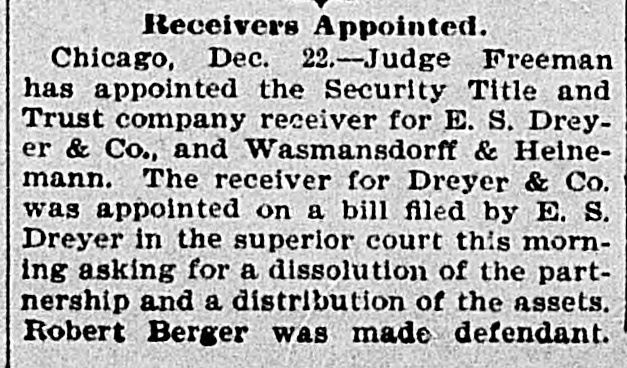
Judge Freeman has appointed the Security Title and Trust company receiver for E. S. Dreyer & Co., and Wasmansdorff & Heinemann.
Source
newspapers

Newspaper Articles (24)

Article from The Record-Union, December 22, 1896

Click image to open full size in new tab

Article Text

on Over Bank Had Loaned Bonds. ions on Street Railway CHICAGO, Dec. which 21.-The was national considered closing bank to an be institution the second quickly strongest followed banking by the houses failChicago, caused a in of three private with it circles ure did business in financial banks flurry which of and excitement led to runs A on flood several of rumors to-day depositors. and business by relative timid to other to the banks intense nervousness of people added all classes the firms prevaded hours and close were which after banking banks which of Illilong of closed the follow: courts. $1,000,000, The National liabilities Bank bankers, $11, nois, E. S. Dreyer real estate 000,000; mortgage capital liabilities brokers $1,500,000; and & Co., Wasmans- estimated dealers, assets and value of Heinemann, $1,650,000; bankers $416,000, mort- estigage dorff & brokers, of liabilities assets $550,000; Ill., Rose- small capital which land mated Savings value and assets Bank, Roseland, estimated equal closed to of liabilities. All the private banks through the Nation- crash their doors cleared Illinois, and the to big conserve compelled al Bank their suspension protect creditors. The assets and went into liquidation the taken private through their city receivership banks proceedings in at a courts. Reassuring action was of the Clear- held attended meeting which was The largely House Association, this afternoon. by exing after banking resolution hours Currency offered E. S. following Comptroller of of the the Bankers' adopted: NaLacey, President was unanimously Committee, tional Bank, Clearing House other "That calling the to their desire, aid be such required enable after persons as they may which will of Illito formulate the a plan National Bank the offer of section avail of themselves make of advances nois Associated to Banks to creditors to the by extent of 75 per the way of loans to cent. said upon properly House proven Chairman claims." of the the Clearing readiness of The stated that SO evident that Committee to do this was formal objecit tion bankers was to not accomplish probable would the any object be necessary set forth will in the resolution committee appointed on of although give prompt the action to the duty imposed the William them. F. and Dummer, President President following of the association, Bank, read the from Eckels, Comptroller Northwestern telegram which of the he had Currency received dated Washington: appointed Bank Examiner the Na"I have temporary receiver of instructed McKeon Illinois and to to publish notice me that the tional him Bank of He informs to creditors claims. will advance Clearing of if prove cent. House on evidence Committee once, claims. and No75 per will be published immediately at I shall claims tice within thirty are proven days be able I to pay appreciate a very considerable dividend. the Clearing House in offering the action to of advance on such certificates." The decision of the clearing Clearing-house privileges to refuse Illinois, and National Bank of the to refuse funds by Committee the voluntary which astound- liqui- bank could also to have gone into to the loaned dation, was bank had ing discovery chiefly that the due Electric Street on $2,500,000 to the Calumet its bonds as sole Railway Company This loan exceeded the account bank's security. and surplus. Another to hesitate capital which caused the bankers $500,000, the stated to be near Co. Robert Berger, was debtor being the only E. S. partner Dreyer of & Mr. Schneider, Dreyer, son-in-law of George bank. is a the failed national which President of two other big loans to There considered were poor collateral. refusal were necessary sequal to this privThe or to continue clearing bank on lend aid was that the big national its doors ileges street failed to open This Dearborn morning for public business. of the this anticipated by the action but there was Clearing-house Committee, depositors small knot of anxious the enwas a on the marble steps of in front waiting the big iron screen o'clock trance the when doors was rolled up at 9:30 9 o'clock of several clerks. At reada to card admit was hung on the grill work .ing as follows: Nabank is in the hands of a of the "This Bank Examiner. By. order detional Comptroller of the Currency." cheerless announcement for by the This was quickly followed private positors of notices that certain would clear posting and business firms checks banks other banks, or pay on the through which had been given Saturday suspended reported institution. that the National 45 Bank per It Illinois is has on hand about and its deposits of $11,000,000. is general confidence that be paid in full in a of cent. there of tors will of stockholders short deposi- time. the officers and last rebank The unite in saying so. The 30th, placed port of the bank, at $11,000,000, November undivided the surplus and total assets, includ-


Article from The Morning News, December 22, 1896

Click image to open full size in new tab

Article Text

this Dec. large of Illinois of the on their room, the of "This the tional of the troller the over Posted of itors on the be by paid the 10 Shortly of ment made Co., at of Institution, and by and closed their the Judge E. for Trust Co. & and Hel& The Co for Dreyer E. on by bill filed this court morning dissol inership of and the Robert was the of the assets. The court and $1,500,000 the The up asking were says that the close agree have been to The unab to to be done. monts open has been of real value the unless conseill loss letter to for close han conseinant to compealize $150,000 S. Co. Dresdine the ding the -day, E. and no informaDreyer the get Co. is Chi- one one firm of anking been Wasma time oldest always of ted at melas of the Hrmest. had for the and in the Wasne appea his nar The dorft & of Otto the and firm. med death with that re- to says so as asse., the William $100,000 of No. The Wielri did of Bank, derick bank Ill1the Bank National the and City Banking Chan the by the the among insta building; knowlion of Bankors depos protosing then falled for closed in who were out. was long The the them several bank. those to to keep and and the only paid. Savings there Banks, who women hand the and glad the the of Illinois money in savings to pay means 1. Both as due Francially & and Dreyer the Conking the firms recen way the Illinois, do ble of firms a largely house The ing at other formuof to enamols of of way per theven the The of the readert that to the them. of the the follow had Eckels, recen and to me that the the to on house to was on the bang.000, on has


Article from The Wilmington Daily Republican, December 22, 1896

Click image to open full size in new tab

Article Text

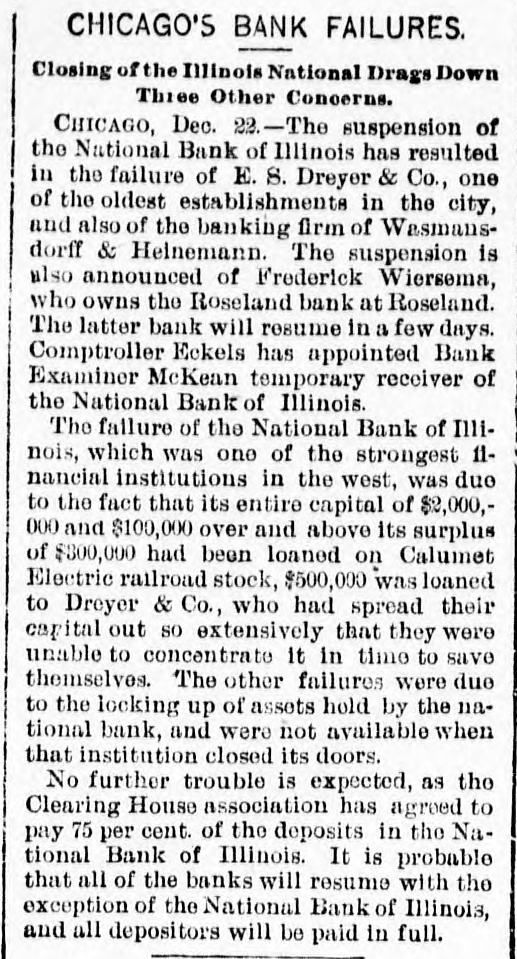
CHICAGO'S BANK FAILURES. Closing of the Illinois National Drags Down Three Other Concerns. CHICAGO, Dec. 22. - The suspension of the National Bank of Illinois has resulted in the failure of E. S. Dreyer & Co., one of the oldest establishments in the city, and also of the banking firm of Wasmansdorff & Heinemann. The suspension is also announced of Frederick Wiersema, who owns the Roseland bank at Roseland. The latter bank will resume in a few days. Comptroller Eckels has appointed Bank Examiner McKean temporary receiver of the National Bank of Illinois. The failure of the National Bank of Illinois, which was one of the strongest 11nancial institutions in the west, was due to the fact that its entire capital of $2,000,000 and $100,000 over and above its surplus of $300,000 had been loaned on Calumet Electric railroad stock, $500,000 was loaned to Dreyer & Co., who had spread their capital out SO extensively that they were unable to concentrate it in time to save themselves. The other failures were due to the locking up of assets hold by the national bank, and were not available when that institution closed its doors. No further trouble is expected, as the Clearing House association has agreed to pay 75 per cent. of the deposits in the National Bank of Illinois. It is probable that all of the banks will resume with the exception of the National Bank of Illinois, and all depositors will be paid in full.


Article from The Saint Paul Globe, December 22, 1896

Click image to open full size in new tab

Article Text

ILLINOIS NATIONAL'S DOORS CLOSED AS A RESULT OF LOOSE MANAGEMENT. RELIEF FOR DEPOSITORS. CLEARING HOUSE WILL ADVANCE SEVENTY-FIVE PER CENT ON CLAIMS TEMPORARY RECEIVER APPOINTED Creditors Will Receive a Large Dividend Within Thirty DaysNo Panic Precipitated CHICAGO, Dec. 21.-The National Bank of Illinois closed its doors today. This action was decided upon at a meeting of the directors of the bank last night, after the bank had been suspended from the clearing house of Chicago, at,a meeting of the clearing house committee held earlier in the day. The causes of the suspension, as given in the resolutions adopted by the clearing house committee, are "unwarrantable and injudicious loans through which the capital and surplus of said bank is seriously imperiled if not absolutely lost." The statement was made that a loan of about $2,400,000 to the Calumet Street Railroad company, of which J. W. Farson, of Farson, Leach & Co., is president, had caused the National Bank of Illinois to suspend. Mr. Farson declined to make a statement on that subject, but stated that the failure would not affect the Calumet road. Heavy loans on real estate are also said to have been made. The last statement of the bank showed deposits $12,175,766; loans $9,199,642; cash resources, $4,983,202. A director of the bank stated that the loan made to the Calumet electric street railway, $2,400,000, was without the knowledge of the directors. The efforts made to dispose of the Calumet stock held as security for the loan drew attention to it and brought about the investigation which resulted in the bank's suspension. Of the sixteen banks which cleared through the National Bank of Illinois, two closed their doors as a result of the closing of that institution. They are E. S. Dreyer & Co. and Wasmansdorff & Heinemann. These two institutions are mortgage loan banks and savings societies in a small way, and their failure is not expected to affect business. The assets of E. S. Dreyer & Co. are given at $1,600,000, with liabilities of $1,200,000. The figures for Wasmansdorff & Heinemann are approximately. Assets, $650,000; liabilities, $400,000. The Security Title and Trust company was appointed receiver for both firms. Six banks have made arrangements to clear through other banks, and the balance of the sixteen are making similiar arrangements as fast as possible. Neither the bank examiner nor any officer of the National Bank of Illinois will make any statement at present. The principal source of trouble of the National Bank of Illinois was a loan of $2,400,000 to the Calumet Electric Railway company. This, with three or four over-loans, threatened such severe losses that the clearing house committee saw no way but to suspend the bank. The loss in liquidations will be small, if any, to depositors. It is not probable that the bank will resume business. At a meeting of the clearing house banks held after the close of business this afternoon, all the banks were represented, and upon recommendation of the clearing house committee which had made a thorough examination of


Article from Santa Fe Daily New Mexican, December 23, 1896

Click image to open full size in new tab

Article Text

STRINGENCY OF THE TIMES Depressing Object Lessons for the Triumphant Advance Agent of Prosperity to Study. ANOTHER LIST OF BUSINESS DISASTERS Lame Explanation of Illinois National Bank Failure-Receivers Appointed for Bank of Minnesona-Dry Goods House Failure. Chicago, Dec. 23.-W. A. Hammond, second vice-president of the National Bank of Illinois, who has been charged with pulling the wool over the eyes of the directors, would not talk to-day when seen in his palatial home at Evanston. Through intimate friends, however, he made a statement calculated to inculpate several directors as well as two or three others connected with the bank. "Hammond is to be made the scape-goat for the failure of the Mational Bank of Illinois," said a friend. "Hammond is a broken man to-day, bat he is not any more to blame for the amount of money loaned on Calumet securities than are the members of the finance committee of the bank and its directors. It was necessary to the purposes of a man connected with the South Chicago City railroad and an officer of one of the best known banks in this city to depreciate the Calumet Electric road's stocks and to this end these two men brought about the wrecking of the National Bank of Illinois." "Of the bank's funds $2,475,000 had been loaned on Calumet securities. The plan was to combine this valuable property of sixty-three miles of new track, equipment and franchise, with the South Chicago railway, eventually combining with the Chicago City railway, and make a fortune of millions within five or ten years," says this friend of Hammond. CHICAGO BANKERS ARBESTED. Chicago.-E S. Dreyer and Robert Berger, of the banking firm of E.S. Dreyer & Co., which collapsed on Monday, for whose arrest warrants were issued last night, gave themselves up today. Arrangements had already been made for bonds and the bankers were promptly released. Dreyer and Berger are charged with receiving deposits on Saturday, knowing the bank to be insolvent. FAILURE OF BANK OF MINNESOTA. Paul, Minn.-State Bank Examiner Kenyon was still in charge of the Bank of Minnesota at noon to-day, receivers not having been appointed. There is no excitement to-day in business cirolee, the assurance that the depositors will be paid in full being given by stock-holders who individually can more than pay depositors. RECEIVERS APPOINTED. Frank A. Seymour and Attorney W.R. Lighter were this afternoon appointed by Judge Otis joint receivers of the Bank of Minnesota. They were required to file a joint bond of $1,000,000. ANOTHER BANK GOES DOWN. Weet Superior, Wis.-The bank of West Superior, capital $50,000 and $50,000 surplus, suspended operations this morning as a direct result of the failures of the banks of Minnesota and Illinois. GENERAL STRINGENCY OE THE TIMES. Sioux City, Iowa.-The Arsons-Pelietier Dry Goods company, one of the largest houses in Sioux City, did not open for business to-day. The stock is in the hands of the mortgagees, who hold claims for $91,533. J.V. Farwell & Co., Chicago, $32,434; Marshall, Field & Co., $39,595, and the Farmers' Loan & Trust Co., Sioux City, $9,000 are the holders of the first mortgage. H.B. Claflin & Co., of New York, hold second mortgage for $17,512. No figures as to the assets are given. The failureis due to the general stringency of the times.


Article from River Falls Journal, December 24, 1896

Click image to open full size in new tab

Article Text

ITS DOORS CLOSED. Suspension of the National Bank of IIIInois at Chicago. Chicago, Dec. 22.-The closing of an institution which was considered to be the second strongest national bank in Chicago, quickly followed by the failure of three private banking houses which did business with it, caused a flurry of excitement in financial circles Monday and led to runs on several banks by timid depositors. A flood of rumors relative to other banks and business firms added to the intense nervousness which pervaded all classes of people long after banking hours and the close of the courts. The banks which were closed follow: National bank of Illinois; capital, $1,000,000; liabilities, $11,000,000. E.S. Dreyer & Co., bankers, mortgage brokers and real estate dealers; libilities, $1,500,000; estimated value of assets, $1,650,000. Wasmansdorff & Heinemann, bankers and mortgage brokers; liabilities, $416,000; estimated value of assets, $550,000. Roseland savings bank, Roseland, Ill.; small capital and assets estimated equal to liabilities. All the private banks which closed their doors cleared through the National bank of Illinois and the big crash compelled their suspension to conserve their assets and protect creditors. The two private city banks went into liquidation through receivership proceedings in the courts. The decision of the clearing house committee to refuse clearing privileges to the National bank of Illinois and also to refuse funds by which the bank could have gone into voluntary liquidation was chiefly due to the astounding discovery that the bank had loaned $2,400.000 to the Calumet Electric Street Rail road company on its bonds as sole security. This loan exceeded the bank's capital and surplus. Another account, which caused the bankers to hesitate was stated to be near $500,000, the debtor being E.S. Dreyer & Co. Robert Berger, the only partner of Mr. Dreyer, is a son-in-law of George Schneider. president of the failed national bank. There were two other big loans which were considered poor collateral.


Article from The Saint Paul Globe, December 24, 1896

Click image to open full size in new tab

Article Text

which took place tonight before the Empire Athletic club of this city. HAMMOND DEFENDED. Illinois National Wreck Charged to Other Hands. CHICAGO, Dรจc. 23.-E. S. Dreyer and his partner, Robert Berger, of the banking firm of E. S. Dreyer & Co., which collapsed Monday as a result of the closing of the National Bank of Illinois, and for whose arrest warrants were issued last night, gave themselves up today. Arrangements had already been made for bondsmen, and the two bankers were promptly released. Dreyer and Berger are charged with receiving a deposit on Saturday last, knowing that their bank was insolvent. W. A. Hammond, second vice president of the National Bank of Illinois, who has been charged with pulling the wool over the eyes of the directors of the defunct bank, would not talk today when seen in his home at Evanston. However, he made a statement which is calculated to inculpate several of the directors, as well as two or three men who are not connected with the bank. The Post makes the above statement, and gives the following: "W. A. Hammond is to be made the scapegoat of the failure of the National Bank of Illinois," said a friend. "Hammond is a broken man today, but he is not any more to blame for the amount of money loaned on Calumet securities than are the members of the finance committee of the bank and its directors. It was necessary to the purposes of a man connected with the South Chicago City railway, and an officer of one of the best known banks in the city, to depreciate the stock of the Calumet street railway, and these two men brought about the wrecking of the National Bank of Illinois. Of the bank's funds $2,475,000 had been loaned on Calumet securities. The plan for wrecking was brilliant: Cause an investigation, depreciate Calumet stock, combine this valuable property of 63 miles of new track, equipment and franchise, with the South Chicago railway, eventually combining with the Chicago City railway, and make a fortune of millions within five or ten years." "Could the matter have been delayed thirty or sixty days the Calumet Electric securities would not have been found among the bank's assets. The sale would have been effected possibly at a loss to the bank, but without disturbance to the public or heavy loss to stockholders of the bank. But this course would not suit the purpose of persons desiring to control the Calumet Electric road. Three years ago E. S. Dreyer alone owed the bank $1,000,000, and for three years Mr. Hammond had been trying to reduce that. It was reduced one-half when the doors of the bank closed and it was due to Vice President Hammond that this was accomplished. If the securities for the loans to these two menDreyer and Weiss-have disappeared, they disappeared Saturday. That point may come out later. One director in the bank who has been talking a great deal since the condition of the concern became public took $12,000 out of the bank Saturday afternoon." The Illinois Trust and Savings bank withdrew today the sixty-day notice given to depositors Tuesday and paid all who called for their money. There was no run whatever. Some of the other savings banks also withdrew the notice and the others that gave it will do likewise, as the anxiety among depositors has entirely abated.


Article from Vermont Phล“nix, December 25, 1896

Click image to open full size in new tab

Article Text

LATE NEWS. A Financial Flurry. Caused by the Failure of the National Bank of Illinois at Chicago---Reckless Methods of Loaning Money. Chicago has had a financial flurry, caused by the closing on Monday of the National bank of Illinois, which was considered the strongest national bank in the city. The failure resulted in three private banking houses going to the wall. The failure of the National bank was precipitated by the action of the Clearing House association in suspending the bank from membership. The comptroller of the currency appointed a temporary receiver for the Institution. The liabilities are $11,000,000. The private institutions that suspended were E.S. Dreyer & Co., liabilities $1,500,000; Wasmansdorf & Heinemann, liabilities $416,000, and the Roseland savings bank of Roseland, III. It is said that the failure of the National bank of Illinois is due to injudicious, reckless and imprudent methods followed by the officers. The Clearing House association met Monday, and took steps for the immediate relief of the bank's creditors, agreeing to advance loans to the extent of 75 per cent upon properly proven claims. The Clearing House committee found that the bank had loaned $2,400,000 to the Calumet Electric Street Railway company on its bonds as sole security. This loan exceeded the bank's capital and surplus. Another account which caused the bankers to hesitate was stated to be near $500,000, the debtor being E. S. Dreyer & Co. Robert Berger, the only partner of Mr. Dreyer, is a son-in-law of George Schneider, president of the failed National bank. There were two other big loans which were considered poor collateral. It is reported that the National bank of Illinois has on hand about 45 per cent of its deposits of $11,000,000, and there is general confidence that depositors will be paid in full in a short time. The failures caused a run on the Garden City banking and trust company. All the depositors received their money, and the company was fully prepared for all who might make demands. On the following day there were runs on the Illinois Trust and Savings bank and the Hibernian Banking association, two of the strongest institutions in the city. It was decided to demand the sixty-day notice in case of all withdrawals exceeding $100. Warrants were issued in Chicago Tuesday for the arrest of E. S. Dreyer and Robert Dreyer, of the failed banking firm of E. S. Dreyer & Co., charged with violation of the state banking law by receiving deposits after the bank was insolvent. The Bank of Minnesota, of St. Paul, was closed Tuesday by the state bank examiner. The Union Stock Yards bank, in South St. Paul, a branch of the Bank of Minnesota, also closed. The failure was caused by the bank's inability to make collections. Angus & Gindele, a large Chicago contracting firm, and a heavy debtor of the suspended National bank of Illinois, failed Tuesday. The assets are claimed to be $800,000 and the liabilities $250,000.


Article from The Iola Register, December 25, 1896

Click image to open full size in new tab

Article Text

GENERAL NEWS. FOUR men were killed by a boiler explosion at a sawmill at Bayou Darbonne, near Farmersville, La. TOMMY RYAN, of Syracuse, won the fightfrom Billy McCarthy, of Australia, in seven rounds before the Empire Athletic club at New York on the 21st. Ryan weighed 145 and McCarthy 152 pounds. AN explosion occurred in a confectionery manufactory at Casino, Italy, on the 21st which killed seven people. THE banking house of E. S. Dreyer & Co., one of the oldest in Chicago, closed its doors on the 21st. The banking firm of Wasmansdorff & Heinemann, of the same city, also went into the hands of a receiver. S. D. HUDSON died recently at Burlington, Ia., aged 80. He practically organized the whig party in Iowa when it was a territory. SOME "speak-easy" whisky did some awful work in the Benwood oil field in Monroe county, O., on the 19th. So far as can be ascertained 16 men imbibed of it and three have died, another was dying, three more had gone crazv and nine others were dangerously sick. ONE of the powder houses of the Winehester Repeating Arms Co. at New Haven. Conn., was blown to pieces by an explosion. Fortunately no one was injured. EL HARALDO, a Spanish newspaper at Madrid, asserted that the minister of war was preparing numerous pamphlets on the georraphy, topography and military condition of the United States to distribute to the chief officers of the Spanish army. SEVERAL bombs, secretly manufactured by a druggist at Rome, exploded on the night of the 19th shattering two stories of his house and killing five persons and injuring six others. A FIRE at Brooklyn on the 18th damaged the car house of the Nassau Electric railroad and partially burned 15 electric cars. THE Missouri congressmen have received notices from the secretary of agriculture that their allotments of seed for this year are ready for their disposal. FIVE miners were instantly killed in the Virginius shaft at Ouray, Col., on the 18th. They were repairing timbers, when the cage fell,carrying them with it to the 1,400 feet level. FIVE persons were recently drowned in the neighborhood of St. Johns, Que., through going on weak ice. FAILURES for the week ended the 18th (Dun's report) were 367 in the United States, against 377 last year, and 47 in Canada, against 32 last year. GEORGE E. LEMON died at Coronado Beach, Cal. He was publisher of the National Tribune at Washington, a pa. per devoted to the interests of pensioners. THE national convention of the United Mine Workers has been called to meet at Columbus, 0., on January 12. 1897. THE Galveston (Tex.) county courthouse was recently partly destroyed by fire, but it was believed that the records were saved. A WRECK occurred on the B. & O. Southwestern railroad at Hamden, 0., on the 18th and a postal clerk was killed outright and the conductor, fireman and another postal clerk were fatally injured. Some passengers were also reported killed and injured. The train ran into some cattle and several cars were derailed,


Article from The Diamond Drill, December 26, 1896

Click image to open full size in new tab

Article Text

CHICAGO BANK TROUBLES. Practically Ended-Placing the Blame for the Crash. Chicago, Dec. 24.-Charges and coun charges in connection with the man of the National Bank of Illi were made Wednesday, and en the attention of the financial mmunity to the exclusion of the day's surrounding the big national collapse. The arrest of Bankers and Berger, the discharge of the eiver of the Roseland bank and the atinuation of the savings depositors on the Illinois Trust and Savings and the Hibertian Banking asso were the principal develop The public scare is practically and a complete restoration of con seems to have been effected. S. Dreyer and his partner, Rober of the banking firm of E. S & Co., which failed on Monday for whom warrants had been issued arging them with receiving a deposit owing their bank to be insolvent themselves up Wedneseday. Sub quently they were released by Justice in $500 bonds each, pending the aring of their case, which will take on January 2. Adolph Kraus, the vyer, and Charles H. Wacker. 1 were their bondsmen. The shortest receivership on record hours, was that of John H. Nichols was appointed receiver Monday aft for Frederick Wiersema, pro of the Roseland savings banl Roseland, which cleared through the tional Bank of Illinois. The receiv appeared before Judge Haneey ednesday afternoon and reported were assets of $83,000 in cash and estate and liabilities of $51,600 fficient money had been raised to on the business, and the judge dis arged the receiver. The bank wil its doors this morning. The runs on the Illinois Trust and vings and the Hibernian banks con Wednesday in lesser degree, and the closing hour arrived there not enough of a line at either banl dignify the scare as a run. N of the excitement is expecte Christmas day. The officers o Illinois Trust were so confiden the run on their bank had come t ignoble end that after paying ou the 60-day notice rule for de of over $100 for an hour or so de to remove all restrictions and be payment in full to all depositors ii At the Hibernian bank the notic adhered to. staff of accountants, in charge o expert, was put to work during th at the Dreyer & Co., and Wasmans & Heinemann banks and nex a report is expected which wil an intelligent idea of the condition both houses. Pending instructions from Comp Eckels, Bank Examiner McKeo taken no steps as yet to criminall osecute William A. Hammond, sec vice-president of the National Ban Illinois. His arrest, however, is sai be a certainty, and the charge which be preferred against him is thn violating the national banking laws Other officials are also believed t had at least a guilty knowledge o same transactions. Presiden hne:der's lips were closed, it is us by allowing the debts of his son law to the bank to overstep all lega The rival banks of the National Ban Illinois in Chicago have profited b failure. This institution had one o largest and most profitable countr rrespondences in the west. On it were also some of the stronges in New York, Boston, Philade Cleveland, Cincinnati, St. Loui Kansas City, and in the west man the largest German-American bank interests transacted their outsid siness through the National Ban Illinois. The bulk of this corre ondence was absorbed by the othe a day after the failure. Before the clearing-house committe taken its final action Sunday after


Article from The Kimball Graphic, December 26, 1896

Click image to open full size in new tab

Article Text

Receivers Appointed. Chicago, Dec. 22.-Judge Freeman has appointed the Security Title and Trust company receiver for E. S. Dreyer & Co., and Wasmansdorff & Heinemann. The receiver for Dreyer & Co. was appointed on a bill filed by E. S. Dreyer in the superior court this morning asking for a dissolution of the partnership and a distribution of the assets. Robert Berger was made defendant.


Article from The Watchman and Southron, December 30, 1896

Click image to open full size in new tab

Article Text

Bank Failures. The directors of the Holliston, Mass., National bank have decided to finish up the affairs of the bank Jan. 1, 1897. after which date no more deposits will be taken. The American Banking and Trust company of Auburo, Maine, chartered in 1886, has closed its doors and has asked the court for the appointment of a receiver. The deposits and bills payable amount to $54,403, and assets nominally $130,743 The business of the institution was largely in western mortgages. The Bank of West Superior, Wis., has closed, being forced in liquidation by the failure of the Bank of Mionesota. The officials of the bank say they will resume soon and pay all depositors in full. E. S. Dreyer and bis partner, Robert Berger. of the banking firm of E. S. Dreyer & Co., Chicago, which failed on Monday, have been arrested charged with receiving a deposit knowing their bank to be insolvent.


Article from The Herald, January 3, 1897

Click image to open full size in new tab

Article Text

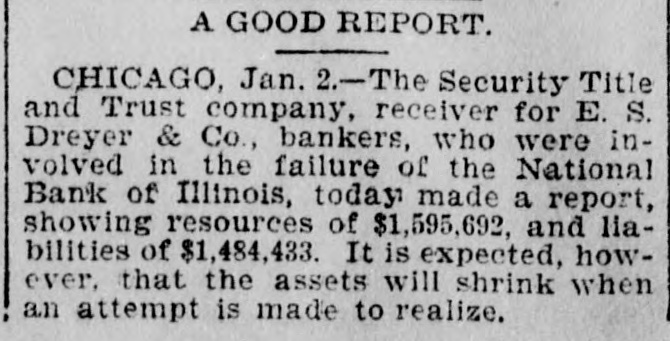
A GOOD REPORT. CHICAGO, Jan. 2.-The Security Title and Trust company, receiver for E. S. Dreyer & Co., bankers, who were involved in the failure of the National Bank of Illinois, today: made a report, showing resources of $1,595,692, and liabilities of $1,484,433. It is expected, however, that the assets will shrink when an attempt is made to realize.


Article from San Antonio Daily Light, January 4, 1897

Click image to open full size in new tab

Article Text

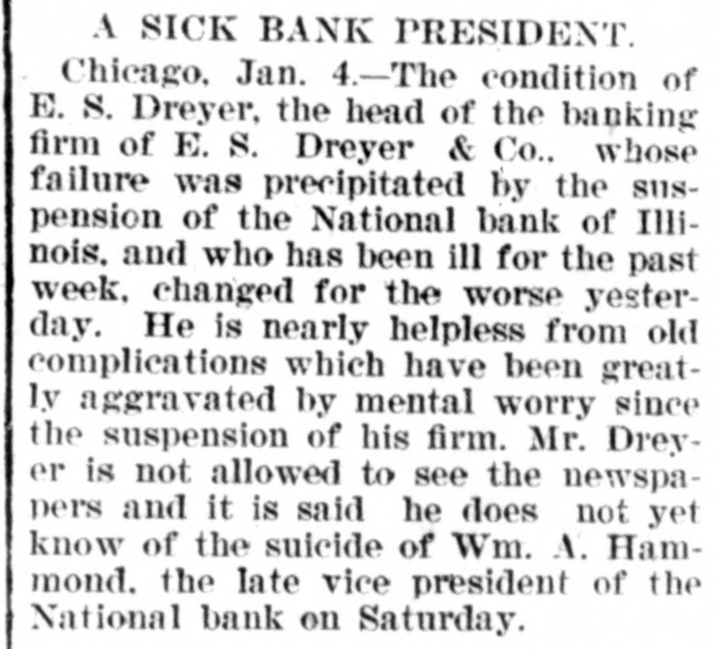
A SICK BANK PRESIDENT. Chicago, Jan. 4.-The condition of E. S. Dreyer, the head of the banking firm of E. S. Dreyer & Co., whose failure was precipitated by the suspension of the National bank of Illinois. and who has been ill for the past week. changed for the worse yesterday. He is nearly helpless from old complications which have been greatly aggravated by mental worry since the suspension of his firm. Mr. Dreyer is not allowed to see the newspapers and it is said he does not yet know of the suicide of Wm. A. Hammond. the late vice president of the National bank on Saturday.


Article from The Topeka State Journal, January 4, 1897

Click image to open full size in new tab

Article Text

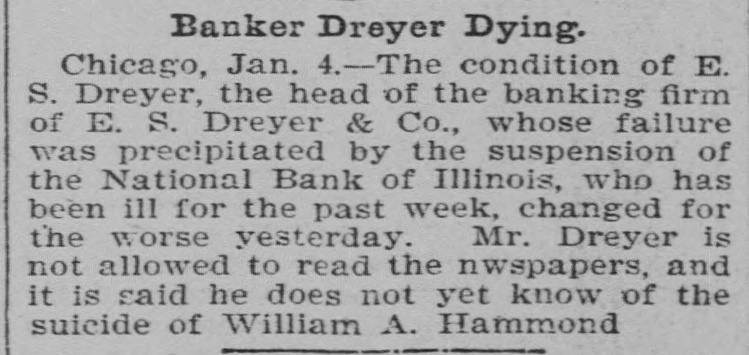
Banker Dreyer Dying. Chicago, Jan. 4.-The condition of E. S. Dreyer, the head of the banking firm of E. S. Dreyer & Co., whose failure was precipitated by the suspension of the National Bank of Illinois, who has been ill for the past week, changed for the worse vesterday. Mr. Dreyer is not allowed to read the nwspapers, and it is said he does not yet know of the suicide of William A. Hammond


Article from The Wichita Daily Eagle, January 5, 1897

Click image to open full size in new tab

Article Text

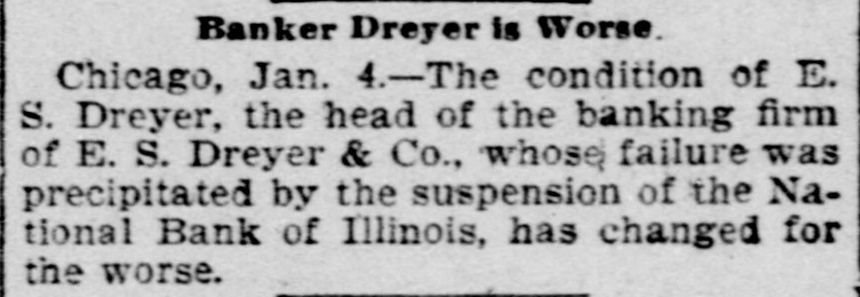
Banker Dreyer is Worse. Chicago, Jan. 4.-The condition of E. S. Dreyer, the head of the banking firm of E. S. Dreyer & Co., whose failure was precipitated by the suspension of the National Bank of Illinois, has changed for the worse.


Article from The Wheeling Daily Intelligencer, January 5, 1897

Click image to open full size in new tab

Article Text

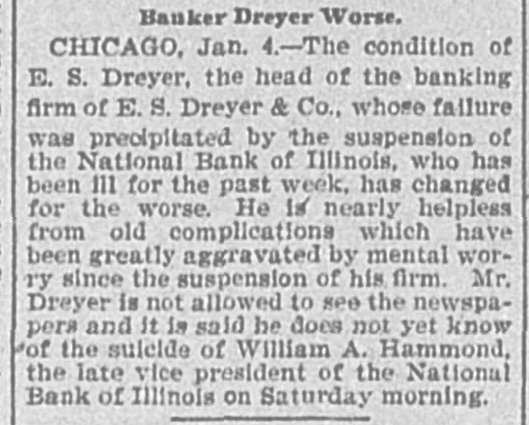
Banker Dreyer Worse. CHICAGO, Jan. 4.-The condition of E. S. Dreyer, the head of the banking firm of E. S. Dreyer & Co., whose failure was precipitated by the suspension of the National Bank of Illinois, who has been III for the past week, has changed for the worse. He is nearly helpless from old complications which have been greatly aggravated by mental worry since the suspension of his firm. Mr. Dreyer is not allowed to see the newspapera and it is said be does not yet know of the suicide of William A. Hammond, the late vice president of the National Bank of Illinois on Saturday morning.


Article from Wheeling Register, January 5, 1897

Click image to open full size in new tab

Article Text

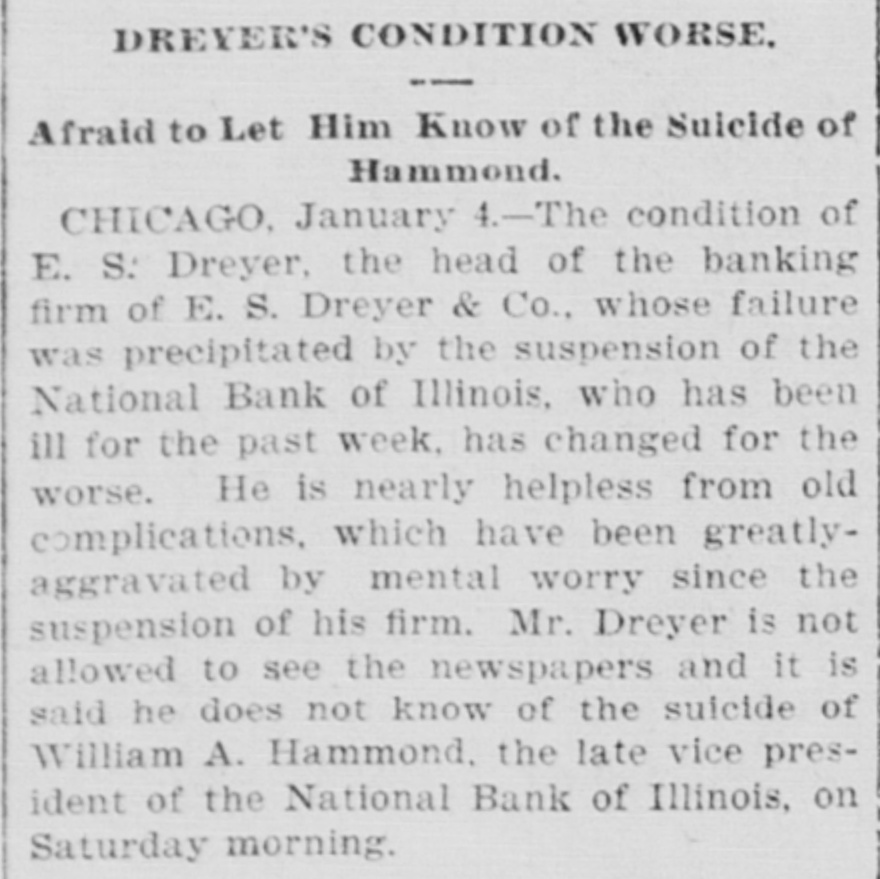
DREYER'S CONDITION WORSE, -Afraid to Let Him Know of the Suicide of Hammond. CHICAGO, January 4.-The condition of E. S: Dreyer, the head of the banking firm of E. S. Dreyer & Co., whose failure was precipitated by the suspension of the National Bank of Illinois, who has been ill for the past week. has changed for the worse. He is nearly helpless from old complications, which have been greatlyaggravated by mental worry since the suspension of his firm. Mr. Dreyer is not allowed to see the newspapers and it is said he does not know of the suicide of William A. Hammond, the late vice president of the National Bank of Illinois, on Saturday morning.


Article from The Salt Lake Herald, January 5, 1897

Click image to open full size in new tab

Article Text

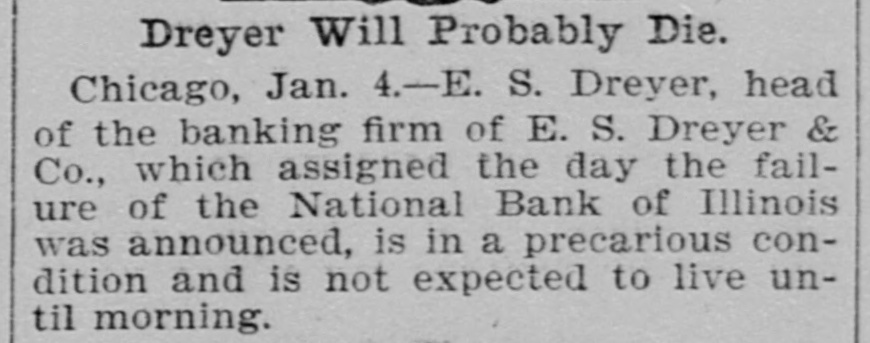
Dreyer Will Probably Die. Chicago, Jan. 4.-E. S. Dreyer, head of the banking firm of E. S. Dreyer & Co., which assigned the day the failure of the National Bank of Illinois was announced, is in a precarious condition and is not expected to live until morning.


Article from The Copper Country Evening News, January 7, 1897

Click image to open full size in new tab

Article Text

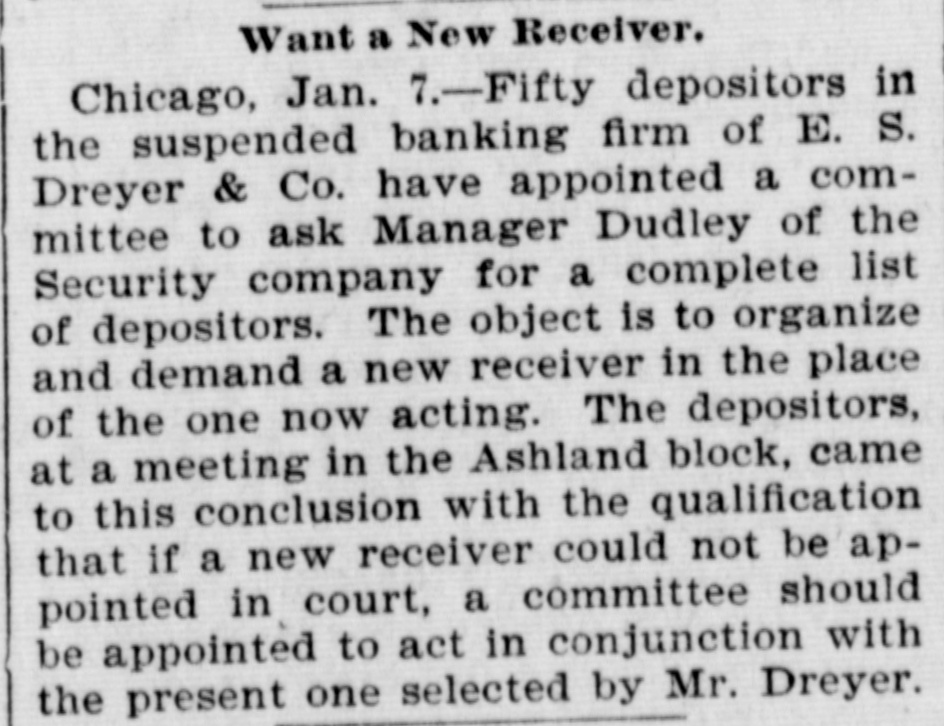
Want a New Receiver. Chicago, Jan. 7.-Fifty depositors in the suspended banking firm of E. S. Dreyer & Co. have appointed a committee to ask Manager Dudley of the Security company for a complete list of depositors. The object is to organize and demand a new receiver in the place of the one now acting. The depositors, at a meeting in the Ashland block, came to this conclusion with the qualification that if a new receiver could not be appointed in court, a committee should be appointed to act in conjunction with the present one selected by Mr. Dreyer.


Article from Deseret Evening News, January 9, 1897

Click image to open full size in new tab

Article Text

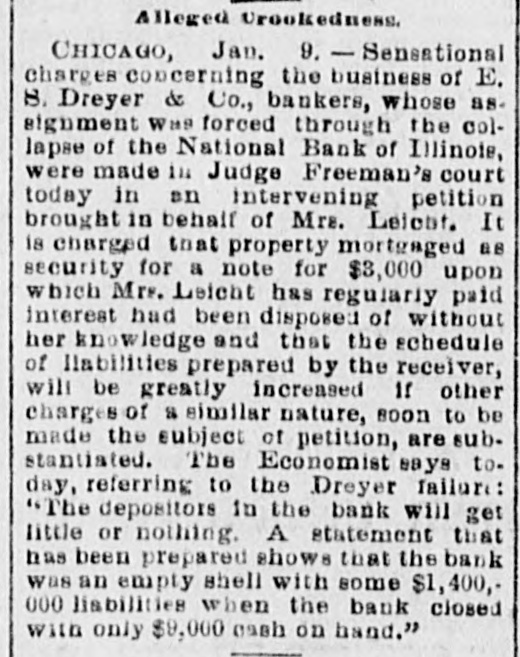
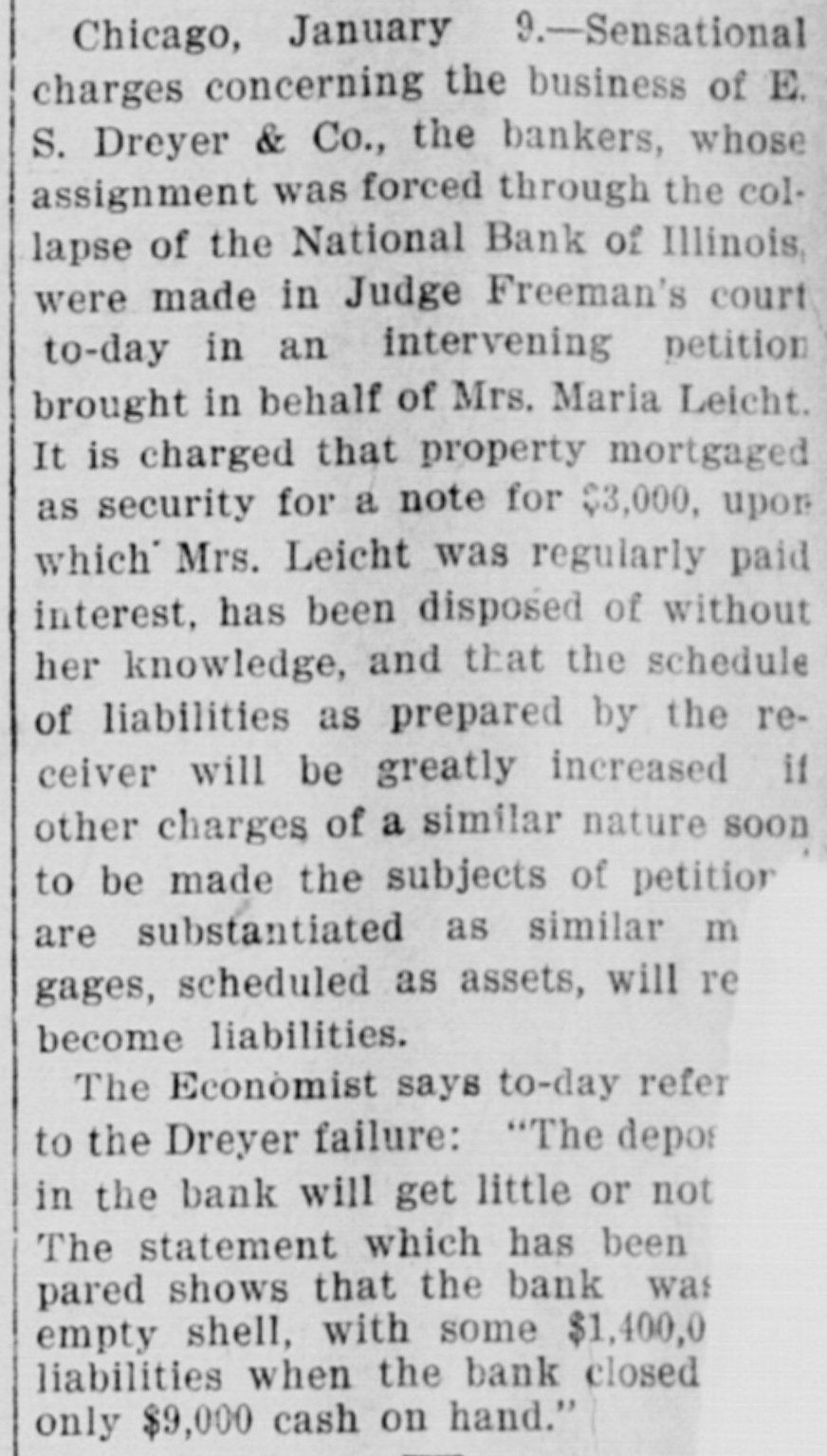
Alleged Crookedness. CHICAGO, Jan. 9. - Sensational charges concerning the business of E. S. Dreyer & Co., bankers, whose as. signment Was forced through the collapse of the National Bank of Illinois, were made in Judge Freeman's court today in an intervening petition brought in behalf of Mrs. Leicht. It is charged that property mortgaged as security for a note for $3,000 upon which Mrs. Leicht has regularly paid interest had been disposed of without her knowledge and that the schedule of llabilities prepared by the receiver, will be greatly increased If other charges of a similar nature, soon to be made the subject of petition, are substantiated. The Economist eays to. day, referring to the Dreyer failure: "The depositors in the bank will get little or nothing. A statement that has been prepared shows that the bank was an empty shell with some $1,400,000 liabilities when the bank closed with only $9,000 cash on hand."


Article from The Saint Paul Globe, January 10, 1897

Click image to open full size in new tab

Article Text

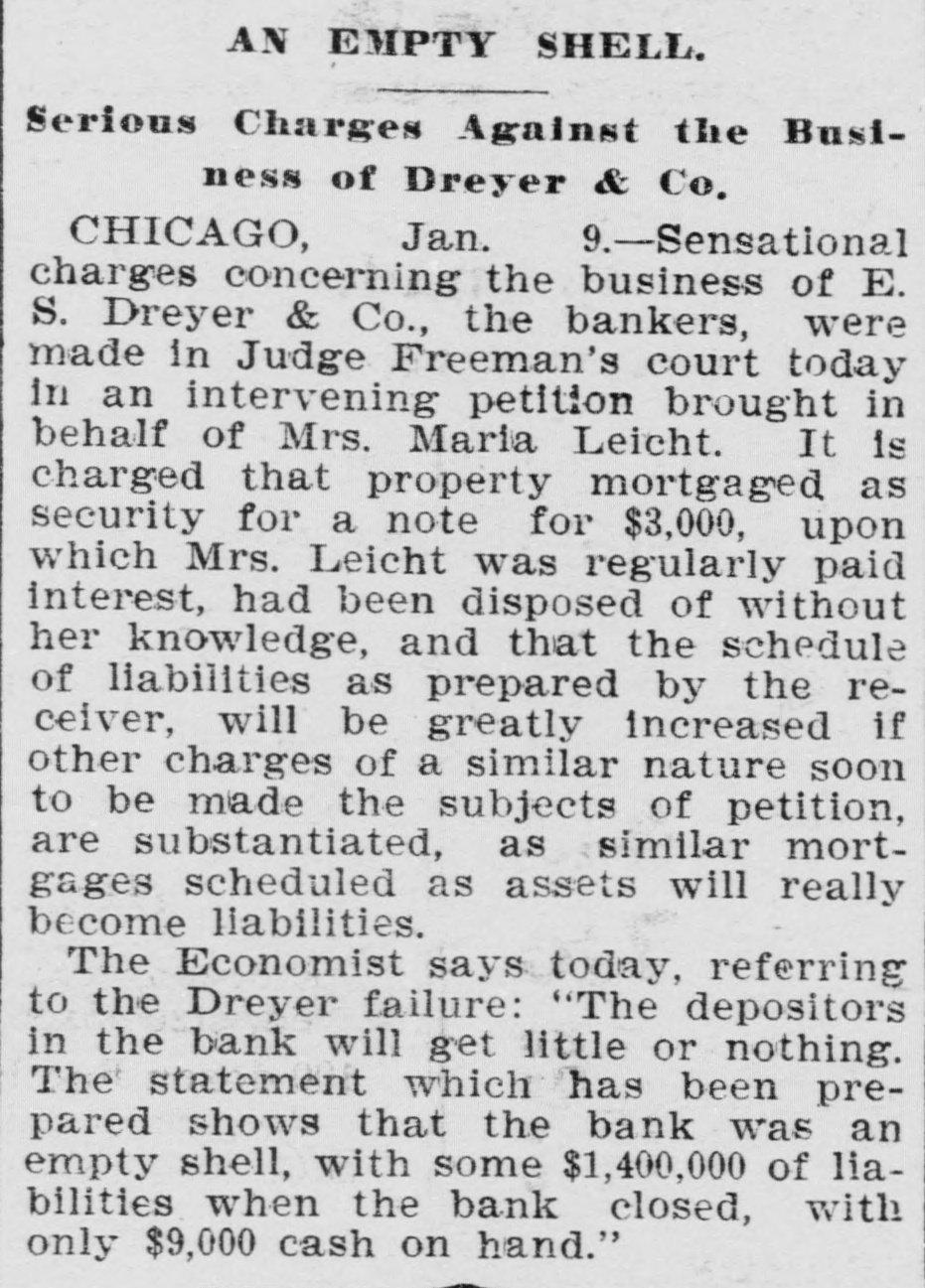
AN EMPTY SHELL. Serious Charges Against the Business of Dreyer & Co. CHICAGO, Jan. 9.-Sensational charges concerning the business of E. S. Dreyer & Co., the bankers, were made in Judge Freeman's court today in an intervening petition brought in behalf of Mrs. Maria Leicht. It is charged that property mortgaged as security for a note for $3,000, upon which Mrs. Leicht was regularly paid interest, had been disposed of without her knowledge, and that the schedule of liabilities as prepared by the receiver, will be greatly increased if other charges of a similar nature soon to be made the subjects of petition, are substantiated, as similar mortgages scheduled as assets will really become liabilities. The Economist says today, referring to the Dreyer failure: "The depositors in the bank will get little or nothing. The statement which has been prepared shows that the bank was an empty shell, with some $1,400,000 of liabilities when the bank closed, with only $9,000 cash on hand."


Article from Wheeling Sunday Register, January 10, 1897

Click image to open full size in new tab

Article Text

Chicago, January 9.-Sensational charges concerning the business of E. S. Dreyer & Co., the bankers, whose assignment was forced through the collapse of the National Bank of Illinois, were made in Judge Freeman's court to-day in an intervening petition brought in behalf of Mrs. Maria Leicht. It is charged that property mortgaged as security for a note for $3,000, upon which Mrs. Leicht was regularly paid interest, has been disposed of without her knowledge, and that the schedule of liabilities as prepared by the receiver will be greatly increased if other charges of a similar nature soon to be made the subjects of petitior are substantiated as similar m gages, scheduled as assets, will re become liabilities. The Economist says to-day refer to the Dreyer failure: "The depos in the bank will get little or not The statement which has been pared shows that the bank was empty shell, with some $1,400,0 liabilities when the bank closed only $9,000 cash on hand."


Article from The Roanoke Daily Times, January 10, 1897

Click image to open full size in new tab

Article Text

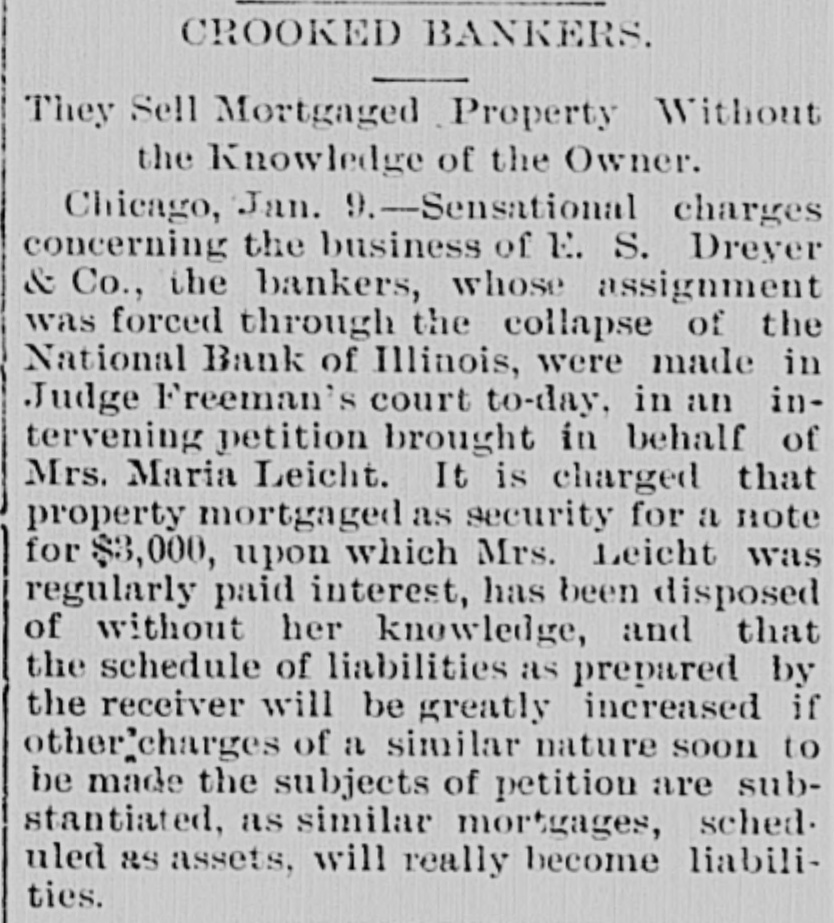
CROOKED BANKERS. They Sell Mortgaged Property Without the Knowledge of the Owner. Chicago, Jan. 9.-Sensational charges concerning the business of E. S. Dreyer & Co., the bankers, whose assignment was forced through the collapse of the National Bank of Illinois, were made in Judge Freeman's court to-day, in an intervening petition brought in behalf of Mrs. Maria Leicht. It is charged that property mortgaged as security for a note for $3,000, upon which Mrs. Leicht was regularly paid interest, has been disposed of without her knowledge, and that the schedule of liabilities as prepared by the receiver will be greatly increased if other'charges of a similar nature soon to be made the subjects of petition are substantiated, as similar mortgages, scheduled as assets, will really become liabilities.