555. National Bank (Pine Bluff, AR)

Bank Information

Episode Type
Run → Suspension → Closure
Bank Type
national
Bank ID
10768
Charter Number
10768
Start Date
July 21, 1930
Location
Pine Bluff, Arkansas (34.228, -92.003)

Metadata

Model
gpt-5-mini
Short Digest
3c601f58

Response Measures

Full suspension, Books examined

Other: Receiver Jay M. Riley appointed; liquidation/receivership followed closure.

Receivership Details

Depositor recovery rate
53.8%
Date receivership started
1930-07-21
Date receivership terminated
1937-12-30
OCC cause of failure
Governance
Share of assets assessed as good
40.1%
Share of assets assessed as doubtful
47.8%
Share of assets assessed as worthless
12.1%

Description

Article headline (1930-07-22) explicitly states a run caused the bank to close; the bank was placed in charge of national bank examiners and a receiver (Jay M. Riley) was later in charge and liquidating the bank (reports as late as 1933). No evidence the bank ever reopened.

Events (5)

1. August 17, 1915 Chartered
Source
historical_nic
2. July 21, 1930 Receivership
Source
historical_nic
3. July 21, 1930 Run
Cause Details
Newspaper headline and text state a run caused the closing but give no specific trigger or rumor; immediate cause unspecified in articles.
Measures
Bank closed its doors; placed in charge of national bank examiners.
Newspaper Excerpt
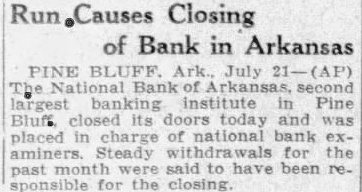
Run Causes Closing of Bank in Arkansas
Source
newspapers
4. July 21, 1930 Suspension
Cause
Government Action
Cause Details
Bank closed and examiners took charge following the run; subsequently placed in receivership and liquidation under a receiver (Jay M. Riley).
Newspaper Excerpt
closed its doors today and was placed in charge of national bank examiners.
Source
newspapers
5. August 1, 1930* Receivership
Newspaper Excerpt
now in process of liquidation under direction of Mr. Jay M. Riley; receiver in charge of the National Bank of Arkansas (Riley). See articles describing Riley as receiver and liquidation activity through 1933) .,event_type:receivership}]}{
Source
newspapers

Newspaper Articles (6)

Article from The Morning Union, July 22, 1930

Click image to open full size in new tab

Article Text

Run Causes Closing of Bank in Arkansas PINE BLUFF. Ark., July 21-(AP) The National Bank of Arkansas, second largest banking institute in Pine Bluff, closed its doors today and was placed in charge of national bank examiners. Steady for the past month were said to have been responsible for the closing.


Article from Lincoln Journal Star, November 30, 1930

Click image to open full size in new tab

Article Text

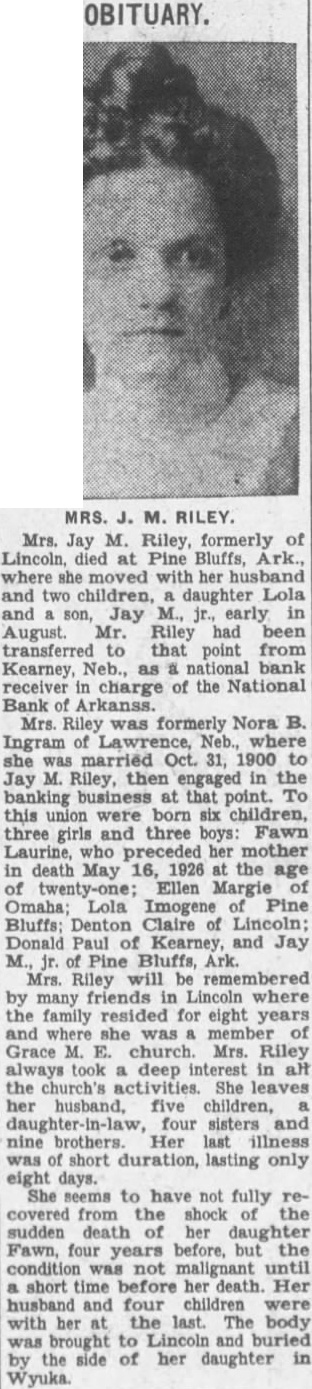
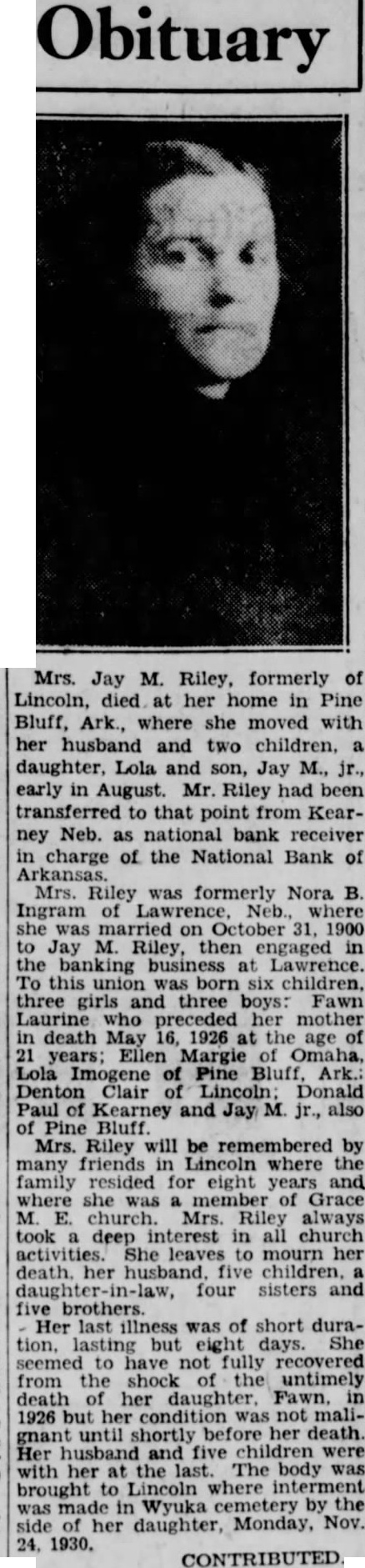
OBITUARY. M. RILEY. Mrs. M. Riley, formerly of Lincoln, died Pine Bluffs, Ark., where moved with her husband children, daughter Lola Jay early in August. Mr. Riley been transferred to that point from Kearney, Neb., national bank receiver charge of the National Bank Arkanss. Mrs. Riley was formerly Nora Ingram Lawrence, Neb., where she married 31, 1900 to Riley, then engaged in banking business that point. union were born six children, three girls and three boys: Fawn Laurine, who preceded her mother death May 1926 the age twenty-one; Ellen Margie Omaha; Lola Imogene Pine Denton Claire Donald Paul of Kearney, and Jay Pine Bluffs, Ark. Mrs. Riley remembered many friends Lincoln where the family resided for eight years and where was member Grace church. Mrs. Riley always took deep interest in the church's leaves five children, four sisters and brothers. Her illness short duration, lasting only days. seems to have not fully covered from the shock the sudden death daughter Fawn, four years before, but the condition not malignant until short time before death. Her husband and four children were with her the brought to buried her daughter


Article from The Lincoln Star, December 1, 1930

Click image to open full size in new tab

Article Text

Obituary Mrs. Jay M. Riley, formerly of Lincoln, died at her home in Pine Bluff, Ark., where she moved with her husband and two children, daughter, Lola and son, Jay M., jr., early in August. Mr. Riley had been transferred to that point from Kearney Neb. as national bank receiver in charge of the National Bank of Arkansas. Mrs. Riley was formerly Nora B. Ingram of Lawrence. Neb., where she was married on October 31, 1900 to Jay M. Riley, then engaged in the banking at Lawrence. To this was six children. three girls and three boys: Fawn Laurine preceded her mother in death May 16, 1926 at the age of years; Ellen Margie of Omaha, Lola Imogene of Pine Bluff, Ark.: Denton Clair Lincoln: Donald Paul of Kearney and Jay M. jr., also of Pine Bluff Mrs. Riley will be remembered by many friends in Lincoln where the family resided for eight years and where she member of Grace M. E. church. Mrs. Riley always took deep interest in all church activities. She leaves to mourn her death. her husband, five children. daughter four sisters and five brothers. Her last illness was of short duration. lasting but eight days. She seemed to have not fully recovered from the shock of the untimely death her daughter. Fawn in 1926 but her condition was not malignant until shortly her death. Her husband and five children were with her at the last. The body was brought to Lincoln where interment was made in Wyuka cemetery by the side of her daughter, Monday, Nov. 24. 1930.


Article from The Nelson Gazette, December 4, 1930

Click image to open full size in new tab

Article Text

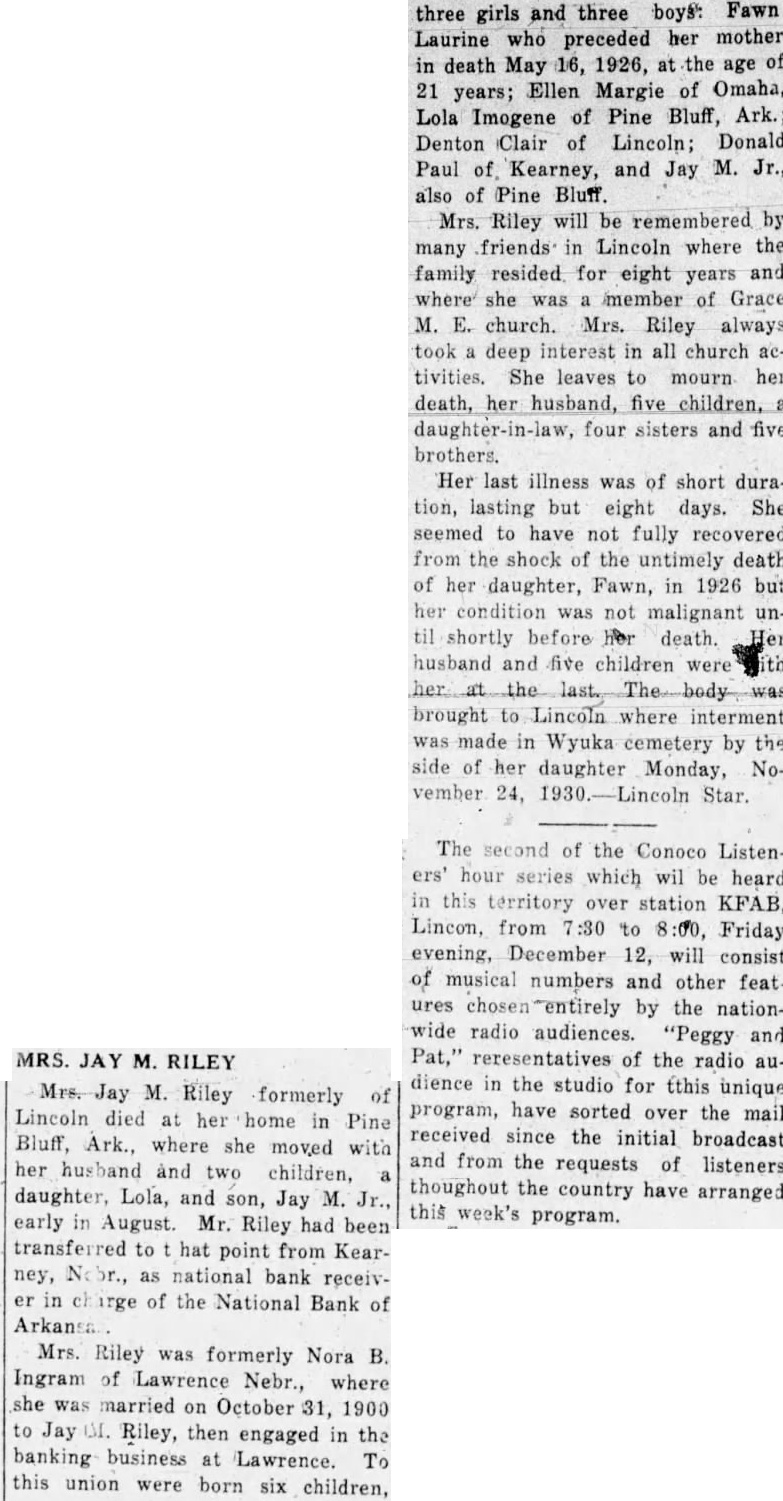
MRS. JAY M. RILEY Mrs. Jay M. Riley formerly of Lincoln died at her home in Pine Bluff, Ark., where she moved with her husband and two children, a daughter, Lola, and son, Jay M. Jr., early in August. Mr. Riley had been transferred to hat point from Kearney, No br., as national bank receiver in ch irge of the National Bank of Arkansa Mrs. Riley was formerly Nora B. Ingram of Lawrence Nebr., where she was married on October 31, 1900 to Jay OI. Riley, then engaged in the banking business at Lawrence. To this union were born six children, three girls and three boys: Fawn Laurine who preceded her mother in death May 16, 1926, at the age of 21 years; Ellen Margie of Omaha, Lola Imogene of Pine Bluff, Ark.; Denton Clair of Lincoln; Donald Paul of Kearney, and Jay M. Jr., also of Pine Bluff. Mrs. Riley will be remembered by many friends in Lincoln where the family resided for eight years and where she was a member of Grace M. E. church. Mrs. Riley always took a deep interest in all church activities. She leaves to mourn her death, her husband, five children, a daughter-in-law, four sisters and five brothers. Her last illness was of short duration, lasting but eight days. She seemed to have not fully recovered from the shock of the untimely death of her daughter, Fawn, in 1926 but her condition was not malignant until shortly before her death. Her husband and five children were to her the last. The body brought to Lincoln where interment was made in Wyuka cemetery by the side of her daughter Monday, November 24, 1930.-Lincoln Star. The second of the Conoco Listeners hour series which wil be heard in this territory over station KFAB, Lincon, from 7:30 to 8:00, Friday evening, December 12, will consist of musical numbers and other feat. ures chosen entirely by the nationwide radio audiences. "Peggy and Pat,' reresentatives of the radio audience in the studio for this unique program, have sorted over the mail received since the initial broadcast and from the requests of listeners thoughout the country have arranged this week's program.
Article from The Daily World, January 8, 1933

Click image to open full size in new tab

Article Text

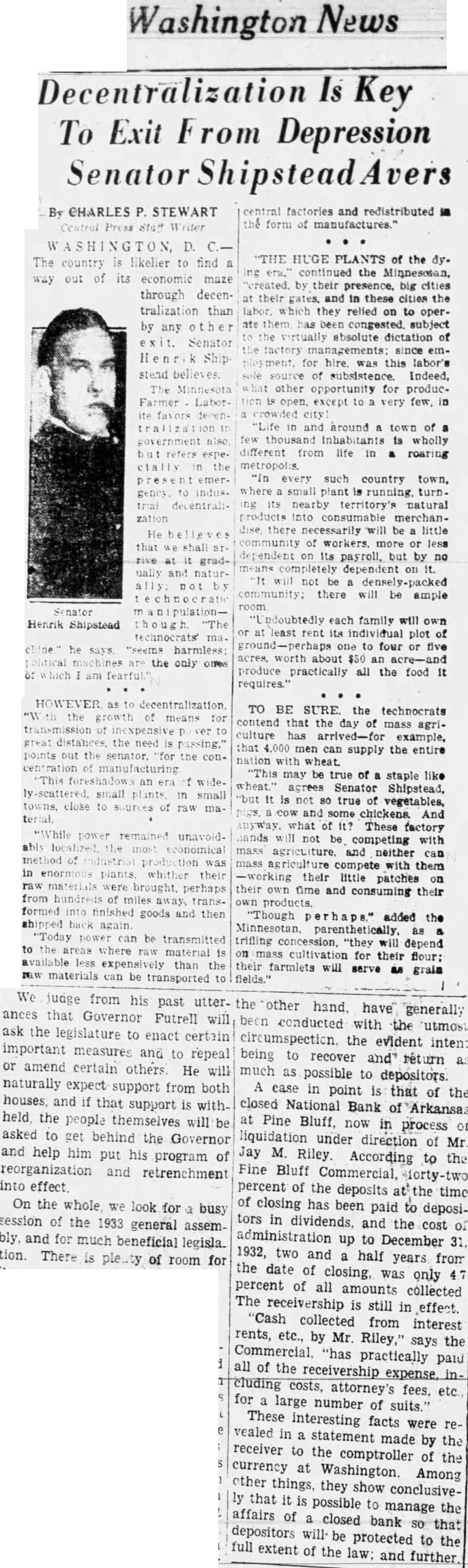
Washington News Decentralization Is Key To Exit From Depression Senator Shipstead Avers By CHARLES P. STEWART W ASHINGTON, D. The country is likelier to find a way out of its economic maze through decentralization than by any exit. Senator Ship stend believes. The Minnesota Farmer Laborite favors decengovernment also but refers espe. gency to indus. zation He that shall rive at gradually and naturally not by Senator m pulationHenrik Shipstead though "The technocrats' ma. political machines are the only offes central factories and redistributed the form of manufactures. HOWEVER as to decentralization "W th the growth of means for transmission of ver to great distances the need is passing." points out the senator. "for the concentration of manufacturing "This foreshadow an era of widely scattered small plants in small towns, close to sources of raw ma "While power remained unavoidably localized the mos economical method of industri tion was in enormous plants whither their raw materials were brought. perhaps from hundreds of miles away, transformed into finished goods and then shipped back again. "Today power can be transmitted to the areas where raw material is available less expensively than the new materials can be transported to "THE HUGE PLANTS of the dy. ing era. continued the Minnesotan, "created by their presence, big cities at their gates. and in these cities the labor. which they relied on to oper. ate them has been congested. subject to the absolute dictation of the factory managements: since employment. for hire. was this labor's sole source of subsistence. Indeed, what other opportunity for production open except to very few, in crowded city "Life in and around a town of a few thousand inhabitants is wholly different from life in a roaring "In every such country town, where small plant is running, turn. ing its nearby territory's natural products into consumable merchandise there necessarily will be a little community of workers. more or less dependent on its payroll, but by no means completely dependent on it. It will not be densely-packed community: there will be ample room 'Updoubtedly each family will own or at least rent its individual plot of ground-perhaps one to four or five acres. worth about $50 an acre-and produce practically all the food it requires." We judge from his past utter. ances that Governor Futrell will ask the legislature to enact certain important measures and to repeal or amend certain others He will naturally expect support from both houses, and if that support is withheld, the people themselves will be asked to get behind the Governor and help him put his program of reorganization and retrenchment into effect On the whole we look for a busy session of the 1933 general assembly. and for much beneficial legisla. tion. There is pleaty of room for TO BE SURE the technocrats contend that the day of mass agriculture has arrived-for example, that 4,000 men can supply the entire nation with wheat. "This may be true of a staple like wheat." agrees Senator Shipstead, "but it is not 80 true of vegetables, pigs. COW and some chickens And anyway what of it? These factory hands will not be competing with mass agriculture, and neither can mass agriculture compete with them -working their little patches on their own time and consuming their own "Though erhaps." added the trifling concession, "they will depend on mass cultivation for their flour: their farmlets will serve as grain fields. the other hand. have generally been conducted with the utmost circumspection, the evident inten: being to recover and réturn as much as possible to depositors. A case in point is that of the closed National Bank of Arkansas at Pine Bluff, now in process of liquidation under direction of Mr. Jay M. Riley. According to the percent of the deposits at the time of closing has been paid to depositors in dividends. and the cost 0. administration up to December 31, 1932, two and a half years from the date of closing, was only 4.7 percent of all amounts collected The receivership is still in effect. "Cash collected from interest rents, etc., by Mr. Riley," says the Commercial. "has practically paid all of the receivership expense, including costs, attorney's fees, etc. for a large number of suits." These interesting facts were revealed in a statement made by the receiver to the comptroller of the currency at Washington. Among other things, they show conclusively that it is possible to manage the affairs of a closed bank SO that depositors will be protected to the full extent of the law: and further.


Article from The Knoxville News-Sentinel, January 21, 1933

Click image to open full size in new tab

Article Text

EAST TENNESSEE BANK RECEIVER STARTS WORK Riley Will Not Say If Depositors Will Get Dividend From Institution. (STARTS ON PAGE ONE) Riley asks that those who can get along now without getting into boxes do their He added that under no cir. cumstance will person be permitted to open his box who owes the bank anything directly or indirectly or is a stockholder, without first paying his indebtedness. In the case of a stockholder, this indebtedness will amount to 100 per cent assessment on the stock, the the call has not yet been made. The receiver's task is to set up an organization. He will give employment to about 50 of the former employes of the bank How long this work will last is indefinite. Brings in Two He is bringing in from the outside two experienced helpers. his chief clerk from Pine Bluff. Ark. and a young lady from Chicago. They are expected here by Mon- day The new organization will at once begin verifying the books and accounts. and make a definite list of the assets and liabilities. This will take from four to six weeks. Mr. Riley said people who owe the bank cannot offset their loans with deposits unless the collateral they put up for their loans has not been pledged to the R. F. C. or the Federal Reserve. He added that inasmuch as most of the collateral had been so pledged, there would not be much off-setting. Native of Nebraska Mr. Riley is native of Lincoln, Neb. Now 55 years old. he has been in banking business continuously for 33 years, 20 years in private banking and the last 13 for As the private government. banker. he said he was "everything from porter to managing editor In 1920 he was made a bank examiner and continued at that until 1925 when he was transferred to the insolvency division of the U. S. Comptroller's office. Since then he has been receiver for closed banks in Colorado, North Dakota, Nebraska and ArHe was transferred from closed bank in Nebraska to Pine Bluff. Ark., in August of 1930 to become receiver for the National Bank of Arkansas. Three months later his wife died. Reorganized Banks In addition to acting as receiver in Pine Bluff he had charge the First National Bank at Holly Grove, Ark. and the First National at Lake Village, Ark. He reorganized both of th m, reopened them. and they are both now running. He also in charge of the Interstate National Bank at Helena, Ark. Of his five children three are boys and two are girls, ranging