Bank of Colfax (Colfax, IA)

Episode Information

Episode UID
5524948991248
Episode Type
Suspension โ†’ Closure
Bank Type
private
Bank ID
552494899 hash
Start Date
December 5, 1903
Location
Colfax, Iowa (41.678, -93.245)

Metadata

Model
gpt-5-mini (chosen from majority vote of a three-model LLM ensemble)
Short Digest
20596804cc9465f1

Response Measures

None

Description

Sources use both 'Wood' and 'Woods' for the cashier's name (OCR/variant).

Events (3)

1. December 5, 1903 Suspension
Cause
Bank Specific Adverse Info
Cause Details
Suicide of owner/cashier George D. Wood(s) precipitated crisis; mechanics' lien filed and county demanded return of deposited funds.
Newspaper Excerpt
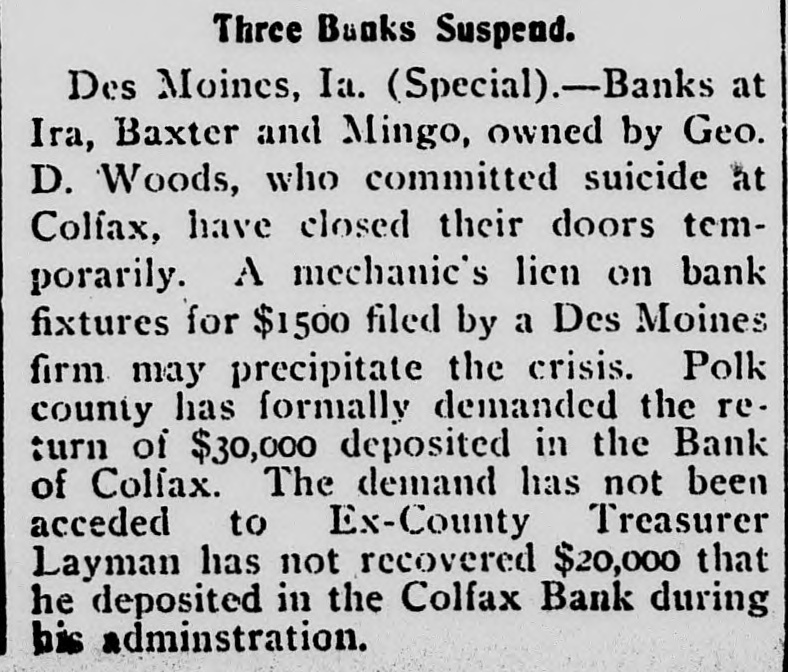
The banks at Colfax ... owned by George D. Woods ... have closed their doors temporarily
Source
newspapers
2. December 9, 1903 Other
Newspaper Excerpt
The Bank of Colfax ... will not be reopened. The affairs of the bank are now in the hands of W. O. McElroy, who has been appointed a receiver and who took charge today.
Source
newspapers
3. December 9, 1903 Receivership
Newspaper Excerpt
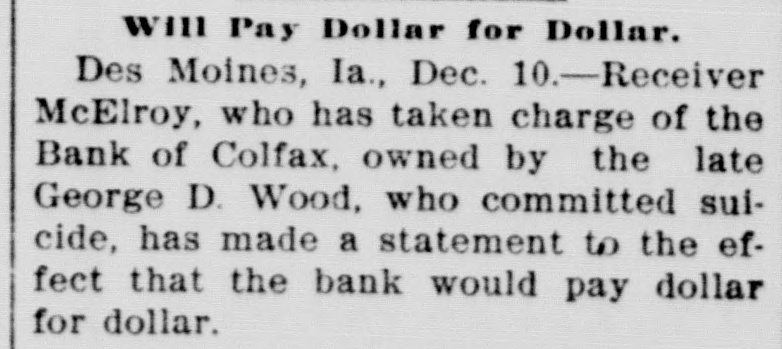
Receiver McElroy, in charge of the Bank of Colfax, owned by the late George D. Wood, ... made a statement ... that the bank would pay dollar for dollar.
Source
newspapers

Newspaper Articles (18)

Article from The Topeka State Journal, December 5, 1903

Click image to open full size in new tab

Article Text

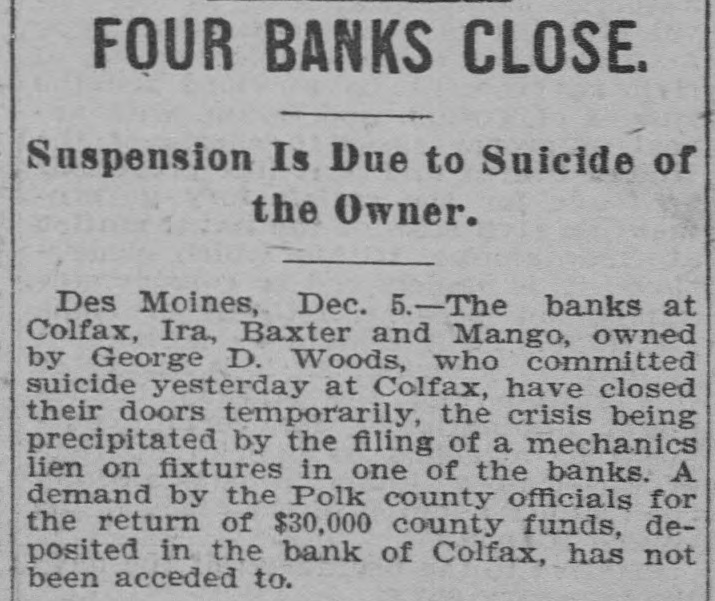
FOUR BANKS CLOSE. Suspension Is Due to Suicide of the Owner. Des Moines, Dec. 5.-The banks at Colfax, Ira, Baxter and Mango, owned by George D. Woods, who committed suicide yesterday at Colfax, have closed their doors temporarily, the crisis being precipitated by the filing of a mechanics lien on fixtures in one of the banks. A demand by the Polk county officials for the return of $30,000 county funds, deposited in the bank of Colfax, has not been acceded to.


Article from The Minneapolis Journal, December 9, 1903

Click image to open full size in new tab

Article Text

COLFAX, IOWA-Receiver McElroy of the Bank of Colfax, owned by the late George D. Wood, who committed suicide, made a statement last night to the effect that the bank would pay dollar for dollar. The assets are $125,000 more than the liabilities.


Article from Adams County News, December 9, 1903

Click image to open full size in new tab

Article Text

SUMMARY CULLED FROM DISPATCHES o THE ASSOCIATED PRESS. A Review of Happenings in Both Eastern and Western Hemispheres During the Past Week-National, I Historical, Political and Personal Events Tersely Told. e Congressman Burke died recently at his home in Philadelphia. Backed financially by the United States government, a salmon fisheries congress will be convened in Seattle February 23. 1904. Jack O'Brien knocked out Jack Williams in the third round of what was scheduled as a SIX round bout recently in Philadelphia. Kalman Foldessy, who was arrested in New York during President Roosevelt's recent visit for writing threatening letters, has been committed to the state hospital for the insane. a The Rappel, of Paris, publishes dispatch from St. Petersburg announcing the massacre by Boxers of a number of Christians in the Szechuan province of China. A cablegram from Tegucigalpa, Honduras, announces the death of Senora Guardiola, mother of the wife of President Palma of Cuba, and wife of former President Guardiola of Honduras. Henry Billings Brown, associate justice of the United States supreme court, will be totally blind within a week or two, according to information imparted to him by his physician. The rise in the Tiber has flooded the country so near Rome that it is impossible to get to St. Paul's, two miles out of the city, as the district surrounding Rome is now covered by four feet of water. Five of the men charged by Lant K. Salsbury with accepting bribes for supporting the project to supply Grand Rapids with water from Lake Michigan. appeared in the superior court and pleaded guilty. The report of Health Officer Snow, in regard to the diphtheria epidemic at Stanford university, shows a total of 12 cases of diphtheria, eight of which have been removed to the newly purchased detention hospital. The declaration of martial law has paralyzed all business in Cripple Creek, Heavily armed pickets of the National Guard are stationed on all street corners and many residents of the city do not venture upon the streets. Handcuffed to a man he is alleged to have defrauded out of $800, Gabriel Hossza, the young foreign banker of Sharon, Pa., wanted for the embezzlement of nearly $15,000. made his escape from an Erie train at Binghamton, N. Y. Paris. Mo.-Enraged because Miss Anna Hartman, for whom he had secured a license to wed, would not marry him, Frank Dawson shot and fatally wounded his sweetheart and seriously wounded his successful rival, Obe Hughes. William Clarke & Sons. bankers of New York, have assigned for the benefit of creditors to the Van Norden Trust company. The firm is composed of James and Hudson Clarke and had a mercantile rating of from $75.000 to $125,000. M. Raume, the French astronomer, noted for his studies of volcanic phenomena, although a very old man. has taken up his residence on Mount Ve suvius in the hope that the researches he is about to undertake will result in important discovery. As a result of the coroner's inquest at Chicago over the body of John Quinn. the detective killed by Gustav Marx. one of the car barn robbers. while the officer was trying to arrest him recently, Marx was held to the grand jury on an additional charge of murder. Later. in the criminal court, Marx changed his plea in all the cases against him to not guilty. It is reported that Edward L. Wentz, the young Philadelphia millionaire who has been missing since October 14. has been found and that he is probably demented. It is said Wentz has been hiding in the mountains not far from Finney, a station on the Norfolk & Western railroad. The banks at Colfax, Ira. Baxter and Mingo, Iowa, owned by George D. Woods. who committed suicide at Colfax. have closed their doors temporarily, the crisis being precipitated by the filing of a mechanics' lien on the fixtures in one of the banks. Governor Peabody of Colorado has issued a proclamation declaring Cripple Creek under martial law and suspending the writ of habeas corpus. He declares that the gold camp is in a state of insurrection and rebellion and that the civil authorities are powerless. Frederick H. Rindge of Los Angeles word of a fire on his one of Cal. The a recently Ventura has Malabu received ranch, county, constructed, together the ranch largest with house. in number of smaller outbuildings, were destroyed. It is rumored that many cattle were destroyed by the flames. Estimates of loss run from $100,000 to $150,000. Delige at Manahae
Article from Evening Times-Republican, December 9, 1903

Click image to open full size in new tab

Article Text

Receiver's Report. Special to Times-Republican. Des Moines, Dec. 9.-Receiver McElroy, in charge of the Bank of Colfax, since the suicide of George D. Woods, the cashier, has prepared a preliminary report on the condition of the bank. His statement shows that the bank is solvent and creditors will be paid. The liabilities consist of $475,000 of deposits, from which should be deducted $26,000 which is owed to George and Alex Woods, partners in the bank and sole owners. The assets consist of $520,000 of bills receivable, $36,000 in overdrafts and $5,000 cash. In addition to this there is the bank building worth $6,000 and real estate owned by the partners estimated to be worth $200,000. The receiver estimates that there will be a shrinkage of probably $100,000 in the notes due, owing to large losses of creditors of the bank, but even at the worst the bank can pay out in full, and it is likely it will be reorganized.


Article from Evening Times-Republican, December 9, 1903

Click image to open full size in new tab

Article Text

Affairs of Colfax Institution Now In the Hands of a Receiver HAD BEEN IN NEED OF FUNDS This is the Bank of Which George D. Wood, Who Committed Suicide Last Friday Was Cashier -- Jasper County's Deposit of About $13,000 Secured by Bond. Special to Times-Republican Newton. Dec. 9.-The Bank of Colfax, of which George D. Wood, who committed suicide Friday, was cashier, will not be reopened. The affairs of the bank are now in the hands or W. O. McElroy, who has been appointed a receiver and who took charge today. He will at once make a complete examination of the affairs of the institution and nothing will be known of the exact condition of affairs until the receiver makes a statement. It was reported today that the amount of cash found to be on hand was about $6,000. The deposits in July last amounted to over $400,000, and as an evidence that the bank had been in need of funds was the fact that they had been offering 5 per cent for time deposits, 1 per cent more than any other bank in the county would pay. Jasper county had on deposit in the Woods bank about $13,000, which is secured by hond, but in case the assets of the bank failed to pay out the sureties on the bond would perhaps go down with it.


Article from The Princeton Union, December 10, 1903

Click image to open full size in new tab

Article Text

WILL PAY DOLLAR FOR DOLLAR. Assets of Colfax, la., Bank Exceed Its Liabilities. Des Moines, Ia., Dec. 9.-Receiver McElroy, who has taken charge of the Bank of Colfax, owned by the late George D. Wood. who committed suicide, made a statement Tuesday night to the effect that the bank would pay dollar for dollar. The assets of the bank are about $500,000, and $125,000 more than the liabilities.


Article from Evening Times-Republican, December 11, 1903

Click image to open full size in new tab

Article Text

ive officers do not compel them TO move out of rooms assigned to them by the legislature." Custodian McCurdy was called in to issue orders. The janitor did not feel like clearing out of his room. "Where are these documents to 1 put?" the jaintor demanded. "Over in the new warehouse," was told. "And when a document is wa how are you to get it?" was ask "Send the janitor with a requir for it." was suggested. "Not for $55 a month," declar janitor. "We'll get a bicycle for you," a clerk. And the war was declared off. Mr. McCurdy felt for a time that he would have to get an act of the legislature to move the janitor from his fortress, but it is possible the moving process will be accomplished without further harm. There is a general shaking up of affairs in the state house since the executive council. which has full control of the state house. has decreed much changing about and refitting of rooms. There will be a state fair in Des Moines next year. There has never been any doubt about It. but some persons tried to make it appear that the board would abandon the fair in deference to the St. Louis exposition. But the members of the board. when they got together, decided unanimously that there should be a fair and that it would be a calamity to omit one fair. This was debated in the m ting, however, whether or not it was advisable to do something that would spur the people of Des Moines to greater efforts. The fair people have felt that Des Moines did not do enough for the state fairs. It was suggested that the decision as to a fair be held up until the Des Moines commercial bodies shall take some action assuring an interest; but this was felt to be an unwise action, as it might indicate fear on the part of the board that the fair would not be a success. It was agreed that the success of the fair must depend next year more than ever bef re upon the work of Des Moines people. It is probable that the fair will be managed a little cheaper than usual and an effort will be made to economize all along the line, because of the certainty that the gate receipts will be reduced. But it will be a state fair. And the managers of county and district fairs who were here the past week all agreed that it will be just as well to go ahead with all their fairs despite the big fair at St. Louis. The people who go to state fairs and district and county fairs either do not go to expositions, or if they go expect to go also to the local fairs. Receiver McElroy. who has charge of the Bank of Colfax. stated while in Des Moines this week that he has not completed his examination of the books and accounts of the bank and has made no statement as yet of assets and liabilities. He states that he is as yet unable to find out the value of the paper in the bank nor does he know of the debts of individual members of the firm. It will take him same time to get out a definite statement as to the condition of the bank. In the meantime there is a wide diversity of opinion as to what will happen. Some of the creditors are saying that they do not expect to get very much out of the wreck. while others are confident that the bank will pay out.


Article from The Kendrick Gazette, December 11, 1903

Click image to open full size in new tab

Article Text

# TELEGRAPH NEWS SUMMARY CULLED FROM DISPATCHES O THE ASSOCIATED PRESS. A Review of Happenings in Both Eastern and Western Hemispheres During the Past Week-National, Historical, Political and Persona' Events Tersely Told. Congressman Burke died recently at his home in Philadelphia. Backed financially by the United States government, a salmon fisheries congress will be convened in Seattle February 23, 1904. Jack O'Brien knocked out Jack Williams in the third round of what was scheduled as a six round bout recently in Philadelphia. Kalman Foldessy, who was arrested in New York during President Roosevelt's recent visit for writing threatening letters, has been committed to the state hospital for the insane. The Rappel, of Paris, publishes a dispatch from St. Petersburg announcing the massacre by Boxers of a number of Christians in the Szechuan province of China. A cablegram from Tegucigalpa, Honduras, announces the death of Senora Guardiola, mother of the wife of President Palma of Cuba, and wife of former President Guardiola of Honduras. Henry Billings Brown, associate justice of the United States supreme court, will be totally blind within a week or two, according to information imparted to him by his physician. The rise in the Tiber has flooded the country so near Rome that it is impossible to get to St. Paul's, two miles out of the city, as the district surrounding Rome is now covered by four feet of water. Five of the men charged by Lant K. Salsbury with accepting bribes for supporting the project to supply Grand Rapids with water from Lake Michigan, appeared in the superior court and pleaded guilty. The report of Health Officer Snow, in regard to the diphtheria epidemic at Stanford university, shows a total of 12 cases of diphtheria, eight of which have been removed to the newly purchased detention hospital. The declaration of martial law has paralyzed all business in Cripple Creek, Heavily armed pickets of the National Guard are stationed on all street corners and many residents of the city do not venture upon the streets. Handcuffed to a man he is alleged to have defrauded out of $800, Gabriel Hossza, the young foreign banker of Sharon, Pa., wanted for the embezzlement of nearly $15,000, made his escape from an Erie train at Binghamton, N. Y. Paris, Mo.-Enraged because Miss Anna Hartman, for whom he had secured a license to wed, would not marry him, Frank Dawson shot and fatally wounded his sweetheart and seriously wounded his successful rival, Obe Hughes. William Clarke & Sons, bankers of New York, have assigned for the benefit of creditors to the Van Norden Trust company. The firm is composed of James and Hudson Clarke and had a mercantile rating of from $75,000 to $125,000. M. Raume, the French astronomer, noted for his studies of volcanic phenomena, although a very old man, has taken up his residence on Mount Vesuvius in the hope that the researches he is about to undertake will result in important discovery. As a result of the coroner's inquest at Chicago over the body of John Quinn, the detective killed by Gustav Marx, one of the car barn robbers, while the officer was trying to arrest him recently, Marx was held to the grand jury on an additional charge of murder. Later, in the criminal court, Marx changed his plea in all the cases against him to not guilty. It is reported that Edward L. Wentz, the young Philadelphia millionaire who has been missing since October 14, has been found and that he is probably demented. It is said Wentz has been hiding in the mountains not far from Finney, a station on the Norfolk & Western railroad. The banks at Colfax, Ira, Baxter and Mingo, Iowa, owned by George D. Woods, who committed suicide at Colfax, have closed their doors temporarily, the crisis being precipitated by the filing of a mechanics' lien on the fixtures in one of the banks. Governor Peabody of Colorado has issued a proclamation declaring Cripple Creek under martial law and suspending the writ of habeas corpus. He declares that the gold camp is in a state of insurrection and rebellion and that the civil authorities are powerless. Frederick H. Rindge of Los Angeles has received word of a fire on his Malabu ranch, one of the largest in Ventura county, Cal. The ranch house,


Article from Camas Prairie Chronicle, December 11, 1903

Click image to open full size in new tab

Article Text

# TELEGRAPH NEWS SUMMARY CULLED FROM DISPATCHES O THE ASSOCIATED PRESS. A Review of Happenings In Both Eastern and Western Hemispheres During the Past Week-National, Historical, Political and Persona Events Tersely Told. Congressman Burke died recently at his home in Philadelphia. Backed financially by the United States government, a salmon fisheries congress will be convened in Seattle February 23, 1904. Jack O'Brien knocked out Jack Williams in the third round of what was scheduled as a six round bout recently in Philadelphia. Kalman Foldessy, who was arrested in New York during President Roosevelt's recent visit for writing threatening letters, has been committed to the state hospital for the insane. The Rappel, of Paris, publishes a dispatch from St. Petersburg announcing the massacre by Boxers of a number of Christians in the Szechuan province of China. A cablegram from Tegucigalpa, Honduras, announces the death of Senora Guardiola, mother of the wife of President Palma of Cuba, and wife of former President Guardiola of Honduras. Henry Billings Brown, associate justice of the United States supreme court, will be totally blind within a week or two, according to information imparted to him by his physician. The rise in the Tiber has flooded the country so near Rome that it is impossible to get to St. Paul's, two miles out of the city, as the district surrounding Rome is now covered by four feet of water. Five of the men charged by Lant K. Salsbury with accepting bribes for supporting the project to supply Grand Rapids with water from Lake Michigan, appeared in the superior court and pleaded guilty. The report of Health Officer Snow, in regard to the diphtheria epidemic at Stanford university, shows a total of 12 cases of diphtheria, eight of which have been removed to the newly purchased detention hospital. The declaration of martial law has paralyzed all business in Cripple Creek, Heavily armed pickets of the National Guard are stationed on all street corners and many residents of the city do not venture upon the streets. Handcuffed to a man he is alleged to have defrauded out of $800, Gabriel Hossza, the young foreign banker of Sharon, Pa., wanted for the embezzlement of nearly $15,000, made his escape from an Erie train at Binghamton, N. Y. Paris, Mo.-Enraged because Miss Anna Hartman, for whom he had secured a license to wed, would not marry him, Frank Dawson shot and fatally wounded his sweetheart and seriously wounded his successful rival, Obe Hughes. William Clarke & Sons, bankers of New York, have assigned for the benefit of creditors to the Van Norden Trust company. The firm is composed of James and Hudson Clarke and had a mercantile rating of from $75,000 to $125,000. M. Raume, the French astronomer, noted for his studies of volcanic phenomena, although a very old man, has taken up his residence on Mount Vesuvius in the hope that the researches he is about to undertake will result in important discovery. It is reported that Edward L. Wentz, the young Philadelphia millionaire who has been missing since October 14, has been found and that he is probably demented. It is said Wentz has been hiding in the mountains not far from Finney, a station on the Norfolk & Western railroad. The banks at Colfax, Ira, Baxter and Mingo, Iowa, owned by George D. Woods, who committed suicide at Colfax, have closed their doors temporarily, the crisis being precipitated by the filing of a mechanics' lien on the fixtures in one of the banks. Governor Peabody of Colorado has issued a proclamation declaring Cripple Creek under martial law and suspending the writ of habeas corpus. He declares that the gold camp is in a state of insurrection and rebellion and that the civil authorities are powerless. Frederick H. Rindge of Los Angeles has received word of a fire on his Malabu ranch, one of the largest in Ventura county, Cal. The ranch house, recently constructed, together with a number of smaller outbuildings, were destroyed. It is rumored that many cattle were destroyed by the flames. Estimates of loss run from $100,000 to $150,000. As a result of the coroner's inquest at Chicago over the body of John Quinn, the detective killed by Gustav Marx, one of the car barn robbers, while the officer was trying to arrest him recently, Marx was held to the grand jury on an additional charge of murder. Later, in the criminal court, Marx changed his plea in all the cases against him to not guilty. A postcard sent from Berlin to Turin on June 7, 1877, has just come back stamped "Address not known."


Article from The Forrest City Times, December 11, 1903

Click image to open full size in new tab

Article Text

will Pay Dollar for Dollar. Des Moines, Ia., Dec. 10.-Receiver McElroy, who has taken charge of the Bank of Colfax, owned by the late George D. Wood, who committed suicide, has made a statement to the effect that the bank would pay dollar for dollar.


Article from Democratic Messenger, December 12, 1903

Click image to open full size in new tab

Article Text

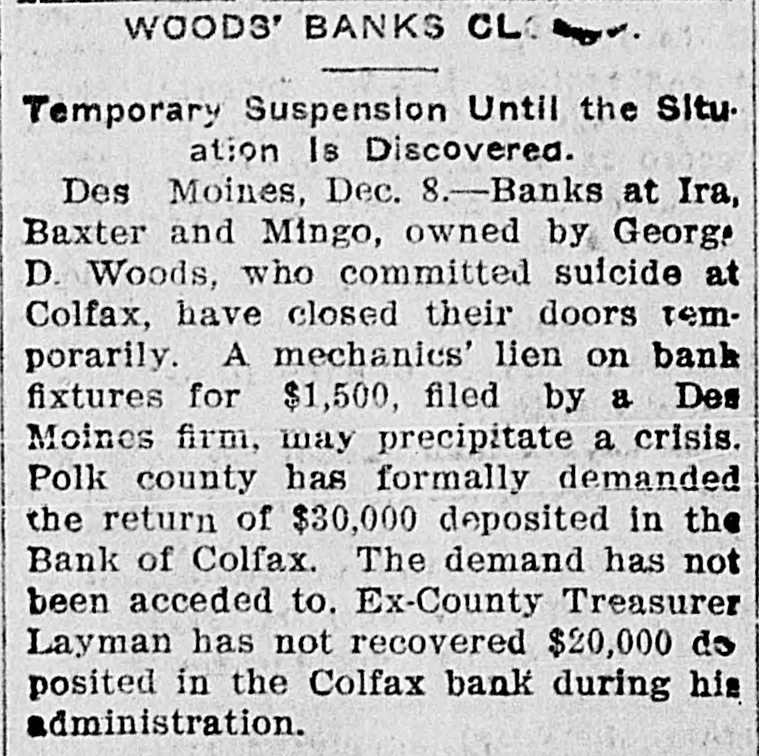
Three Banks Suspend. Des Moines, Ia. (Special).-Banks at Ira, Baxter and Mingo, owned by Geo. D. Woods, who committed suicide at Colfax, have closed their doors temporarily. A mechanic's lien on bank fixtures for $1500 filed by a Des Moines firm may precipitate the crisis. Polk county has formally demanded the return of $30,000 deposited in the Bank of Colfax. The demand has not been acceded to Ex-County Treasurer Layman has not recovered $20,000 that he deposited in the Colfax Bank during his adminstration.


Article from The Oskaloosa Herald, December 17, 1903

Click image to open full size in new tab

Article Text

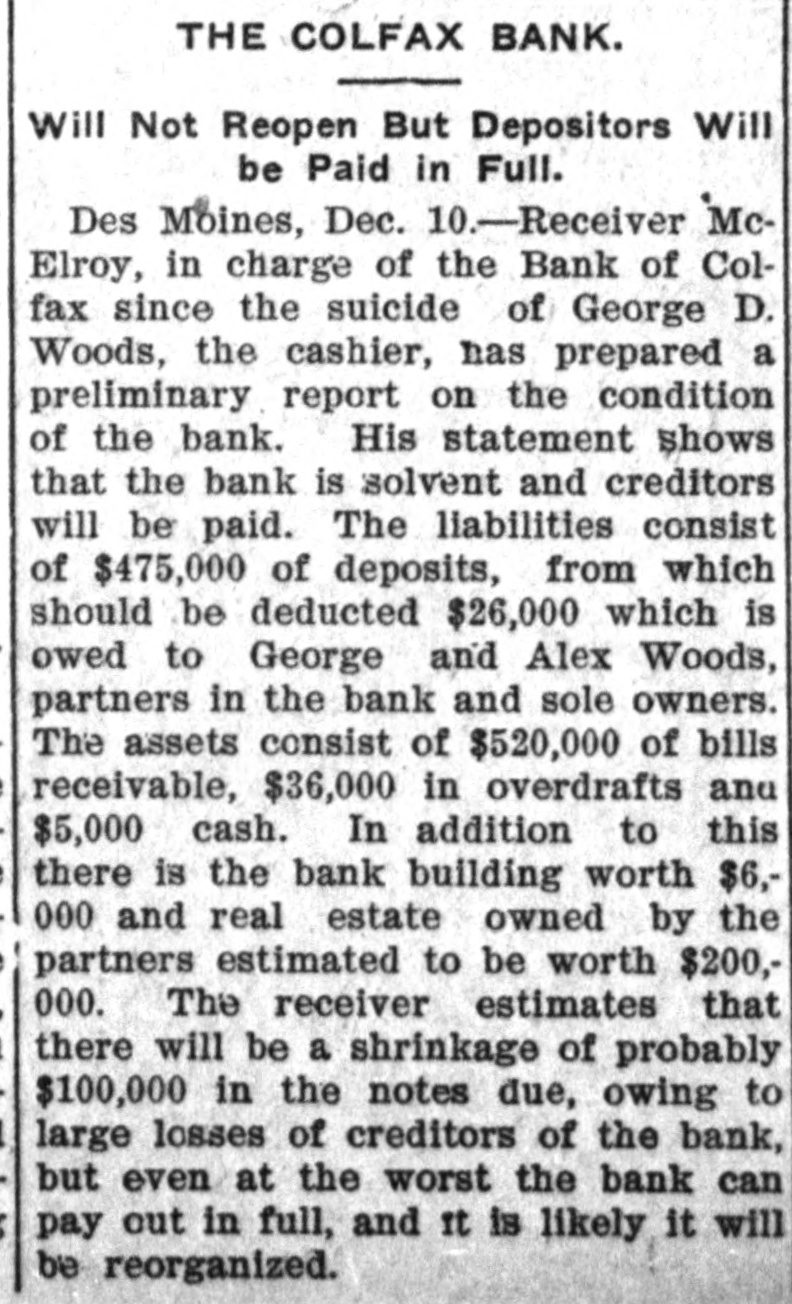
THE COLFAX BANK. Will Not Reopen But Depositors Will be Paid in Full. Des Moines, Dec. 10.-Receiver McElroy, in charge of the Bank of Colfax since the suicide of George D. Woods, the cashier, has prepared a preliminary report on the condition of the bank. His statement shows that the bank is solvent and creditors will be paid. The liabilities consist of $475,000 of deposits, from which should be deducted $26,000 which is owed to George and Alex Woods, partners in the bank and sole owners. The assets consist of $520,000 of bills receivable, $36,000 in overdrafts and $5,000 cash. In addition to this there is the bank building worth $6,000 and real estate owned by the partners estimated to be worth $200,000. The receiver estimates that there will be a shrinkage of probably $100,000 in the notes due, owing to large losses of creditors of the bank, but even at the worst the bank can pay out in full, and It is likely it will be reorganized.


Article from Twice-A-Week Plain Dealer, December 18, 1903

Click image to open full size in new tab

Article Text

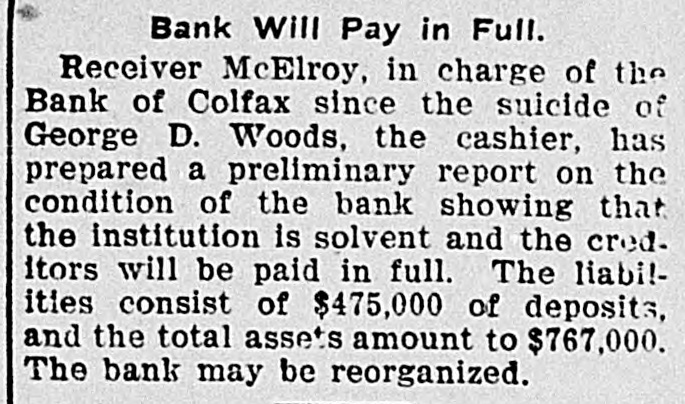
Bank Will Pay in Full. Receiver McElroy, in charge of the Bank of Colfax since the suicide of George D. Woods, the cashier, has prepared a preliminary report on the condition of the bank showing that the institution is solvent and the creditors will be paid in full. The liabilities consist of $475,000 of deposits, and the total assets amount to $767,000. The bank may be reorganized.


Article from The Washington Times, December 28, 1904

Click image to open full size in new tab

Article Text

TEN BANKERS IN IOWA SELF-SLAIN Record Year of Disaster in That State. CATTLE BROUGHT DOWNFALL Faced by Ruin, Half a Score of Hawkeye Officials Committed Suicide. DES MOINES, Dec. 28.-An unprecedented record of disaster among Iowa banks will be disclosed by a report now being prepared at the State auditor's office for 1904. Culminating last week with the closing of the savings bank at Dedham, this is the year's startling record: Ten bank cashiers dead by suicide. Forty banks wrecked and their surplus squandered. Twelve millions of dollars lost to depositors. In two instances bank officers have absconded with funds, thus accounting for the failure, but the remarkable number of failures due to similar circumstances has aroused the curiosity of the whole State to ascertain the cause. These are the suicides of the year due to bank failures, so far as the State officials know: H. C. Spencer and his son, cashier and assistant cashier of the Grinnell National Bank. George D. Wood, cashier of the Bank of Colfax, Colfax, Iowa. Charles Wood, cashier of the Citizens' Bank of St. Charles. F. L. La Rue, cashier of the Corning State Bank. G. D. Utterback, cashier of the Sigourney Savings Bank. H. W. Main, cashier of the Linn Grove Bank. Cashier of the Lone Tree Bank. Two other suicides early in the year, whose names are not recalled by the attaches of the State auditor's office. Tragedy Follows Tragedy. It is only within the past few days that the State has become aware of the magnitude of the disasters and the tragedies attending them, many of the failures having been kept quiet. Not until the two suicides in quick succession at Lone Tree and Linn Grove, and the failure of the Sheldon State Bank, with losses amounting to many thousands, created a State-wide sensation was general attention attracted to the serious condition of affairs. The failure of the bank at Collfax, the National Bank at Storm Lake, and the bank at Sigourney, with the suicide of the cashier, added to the sensation. The suicide of Cashier Utterback, of the Sigourney Bank, was followed by the discovery of extensive forgeries which he had perpetrated to cover up a shortage which had been running for some time. His shortage, like those of the eight other cashier suicides, was apparently due to one of two causesspeculation on the Chicago board of trade and the juggling of prices by the meat trust. Meat Trust Blamed. The meat trust is blamed by thousands throughout Iowa for the year's tragedies. In almost every bank that failed large quantities of paper, based on higher prices for five stock, were found, the makers being unable to meet their loans owing to the cut in prices of live stock. In almost every case the cashier had trusted to the prices of cattle remaining high, and this, coupled with speculative plunges on the board of trade, accomplished their ruin. Back of this recklessness. State Bank Examiner Cox declares, is the lax banking law of the State, and as a result of the year's melancholy record efforts are already making to amend this law. The epidemic of banking suicides started with that of Cashier George D. Wood, of the Bank of Colfax He was regarded as one of the shrewdest and most trustworthy bankers of the State, and his suicks caused a great sensation. Investigation developed that he personally had been a large investor in live stock and had loaned extensively for cattle purchases. The drop in eattle prices brought him face to face with ruin, if not dishonor, and he took his life. Wood had been accounted the wealthiest and most public-spirited man in his county, and imputation of dishonesty is hotly resented by every man in his home city. The cause of his downfall is illustrated by the sale, after his suicide, of paper representing a par value of $175,000 for $640. State Bank Examiner Cox declares that such worthless paper would never have been admitted to the bank if the institution had been subject to State inspection. A Six-Figure Failure. The death of E. H. McCutchon, one of the best-known politicians in the State, precipitated the wreck of the bank at Holstein. Directly after his death it was discovered that the loss at this bank would run into the six


Article from The Montgomery Advertiser, December 28, 1904

Click image to open full size in new tab

Article Text

TEN BANKERS SUICIDE IOWA'S RECORD YEAR WITH FORTY FAILURES AND $12,000,000 LOSS. Many of Them Caused by Drop in Cattie Prices-Faced by Rula and Dishonor, Half a Score of Officials Committed Suicide. Some of the Iowa Banks That Failed. Buck Grove-H. S. Green's private bank. Dow City-H. S. Green's private bank. Grinnell-Citizens' National Bank. Waverly-German-American Loan and Trust Company. Pisgah-Bank of Pisgah, private. Curlew-Bank of Curlew. private. Little Sloux-Little Sloux Bank, private. Gaza -Bank of Gaza, private. Tiffin Corn Exchange Bank, private. Emerson-Farmers' Bank, private. Sheldon-Sheldon State Bank. Germania-State Bank. Ireton-Bank of Ireton, private. Colfax-Bank of Colfax, private. Royal-Bank of Royal, private. Ireton-F. H. McKeever's bank, private. Providence-O. E. Miller's Bank, prsvate. Linn Grove-H. W. Main's Bank, private. St. Charles-Citizens' Bank, private. Victor-Iowa County Bank. private. Mount Ayr-Citizens' Bank, private. Stgourney-Sigourney Savings Bank. Holstein-E. McCuteheon's Bank. Corning-Corning Savings Bank. Pella-People's Savings Bank. Coin-Bank of Coin. Garden Grove-Farmers' Bank, private. Maquoketa-Exchange Bank, private. Pleasanton-Royal-Richardson Bank. private. Dixon-Bank of Dixon, private. New Liberty-New Liberty Savings Birmingham-E. D. Skinner's private Bank. Imogene-Citizens' Bank, private. bank. Olin-Bank of Olin, private. Des Moines Special to N. Y. World. An unprecedented record of disaster among Iowa banks will be disclosed by a report now being prepared at the State Auditor's office for 1904. Culminating last week with the closing of the savings bank in Dedham this is the startling record: Ten bank cashiers dead by suicide. Forty banks wrecked and their surplus squandered. Twelve millions of dollars lost to depositors. In two instances bank officers have absconded with funds, thus accounting for the failure, but the remarkable number of failures due to similar circumstances has aroused the curiosity of the whole State to ascertain the cause. These are the suicides of the year due to bank failures, so far as the State officials know: H. C. Spencer and his son, cashier. and assistant cashier of the Grinnell National Bank. George D. Wood, cashier of the Bank of Colfax, Ia. Charles Wood, cashier of the Citizens Bank of St. Charles. F. L. LaRue, cashier of the Corning State Bank. G. D. Utterback, cashier of the Sigourney Savings Bank. H. W. Main, cashier of the Linn Grove Bank. Cashier of the Lone Tree Bank. Two other suicides early in the year, whose names are not recalled by the attaches of the State Auditor's office. Tragedy Follows Tragedy. It is only within the past few days that the State has become aware of the magnitude of the disaster and the tragedies attending them, many of the failures having been kept quiet. Not until the two suicides in quick succession at Lone Tree and Linn! Grove, and the failure of the Sheldon State Bank, with losses amounting to many thousands, created a State-wide sensation was general attention attracted to the seriour condition of affairs. The failure of the bank at Colfax, the National Bank at Storm Lake and the bank at Sigourney. with the suicide of the cashier, added to the sensation. The sulcide of Cashier Utterback of the Sigourney Bank, was followed by the discovery of extensive forgeries which he had perpetrated to cover up a shortage which had been running for


Article from Ottumwa Tri-Weekly Courier, June 3, 1905

Click image to open full size in new tab

Article Text

account of age. He is a rich man. Mt. Ayr - Citizens' bank. Failed on account of bad management and bad loans, but not to farmers. Sigourney - Sigourney Savings bank. The cashier took $47,000 and used it in speculation on the board of trade, and when the discovery was made, shot himself. The bank paid out. Holstein - F. H. McCutcheon & Co.'s bank, Speculations on the board of trade. Corning - Corning State Savings bank. The proprietor of the bank used the funds as his own and when the discovery was made killed himself. Pella - People's Savings bank. Suspended but in settlement paid out. Coin - Bank of Coin. Broke up on account of bad loans, Banker speculated on board of trade. Garden Grove - Farmers' bank. Speculation on Chicago board of trade. Maquoketa - Exchange bank. Broken up on account of dishonesty, shiftlessness and extravagance. Pleasanton - Royal Richardson & Co.'s bank. Broken up on account of speculation. Dixon - Bank of Dixon. Broken up on account of embezzlement by the banker and his son. New Liberty - New Liberty Savings bank, Broken up by loaning money to a theatrical syndicate in Chicago and by speculation and extravagance on the port of the manager. Imogene - Citizens' bank. This bank did not fail; cashier skipped and his father put up shortage and bank flourishes. Birmingham - E. H. Skinner & Co.'s bank. Failed from bad management. Banker now under nine indictments. Olin - Bank of Olin. Broken up by speculation. Buck Grove - H. S. Green's bank. Banker skipped with the money. Dow City - H. S. Green's bank. Failed on account of speculation, and banker skipped. Waverly - German-American Loan and Trust Co. Failed, but paid out. Curlew - Bank of Curlew. Did not fail; moved to another town. Gaza - Bank of Gaza, Did not fail; sold out and moved away. Little Sioux - Little Sioux bank. Failed on account of speculation; president was a farmer and feeder and speculator; finally paid out. Tiffin - Corn Exchange bank. Did not fail; was the private bank and incorporated under the name of Tiffin Savings bank. Emerson - Farmers' bank. This bank never failed. It was consolidated with another bank under name of Emerson state bank. Sheldon - Sheldon state bank. This bank failed on account of politics and bad business methods. Ireton - Bank of Ireton. Failed because it had no capital; manager was a cranky man, and lost money in a brick plant. Ireton - F. M. McKeever's bank. There was no such bank. The bank referred to was the Bank of Ireton. Germania - State bank. This was one of the W. E. Brown banks and was loaded with northern and Canadian lands, hence its failure. Colfax - Bank of Colfax. This bank failed on account of speculations on the board of trade; the cashier suicided. Royal - Bank of Royal. This is one of the W. E. Brown banks and failed on account of speculations on the board of trade. New Providence - O. E. Miller & Sons' bank. This firm kept a store; had small capital; for various reasons lost public confidence and failed. Linn Grove - H. W. Main's bank. This was one of W. E. Brown's banks and failed on account of the speculation upon the part of Brown; Main suicided. Grinnell - National bank. Failed on account of misuse of funds by the Spencer family, extending over a period of years; Spencer and son were drowned, either by accident or intention. Storm Lake - National bank. This was W. E. Brown's bank and failed on account of Brown's speculations; Brown is under indictment. Le Mars - National bank. This bank failed about the year 1900, and the cashier was convicted of embezzlement. The bank failed for want of public confidence and on account of bucketshop speculations by cashier. In some cases it will be seen that the banks were not failures, but were incorporated with others. But in spite of the fact that the story is entirely wrong it is allowed to go out over the country and exert an influence dangerous to Iowa and her real estate interests. The fact is that loans to farmers in Iowa are sought after by country bankers and are valued by them. There is a great deal of legitimate and truthful ground upon which to fight the beef trust without damaging the reputation of the Iowa farmer. According to the magazine article, Senator L. W. Lewis of Page county is quoted as authority for the statements made by Mr. Russell. The Des Moines Capital wrote to Mr. Lewis and received the following in reply: "I am of the opinion that the Iowa bank failures are due to down-right rascality, outside speculation and over-loans.


Article from Twice-A-Week Plain Dealer, June 29, 1906

Click image to open full size in new tab

Article Text

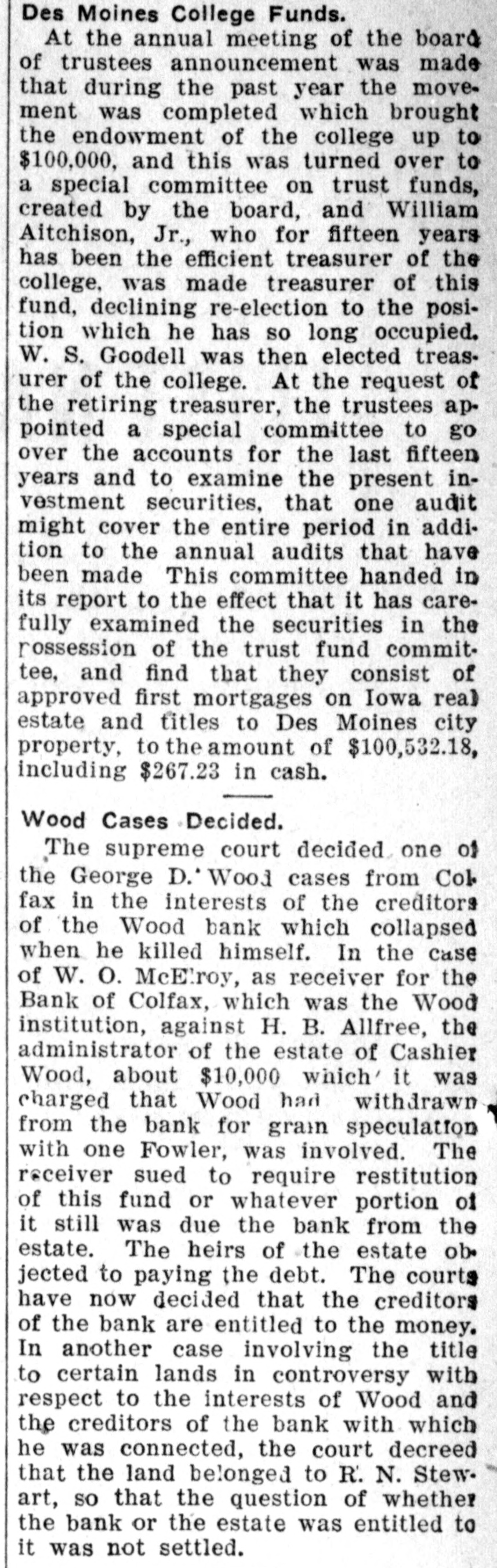
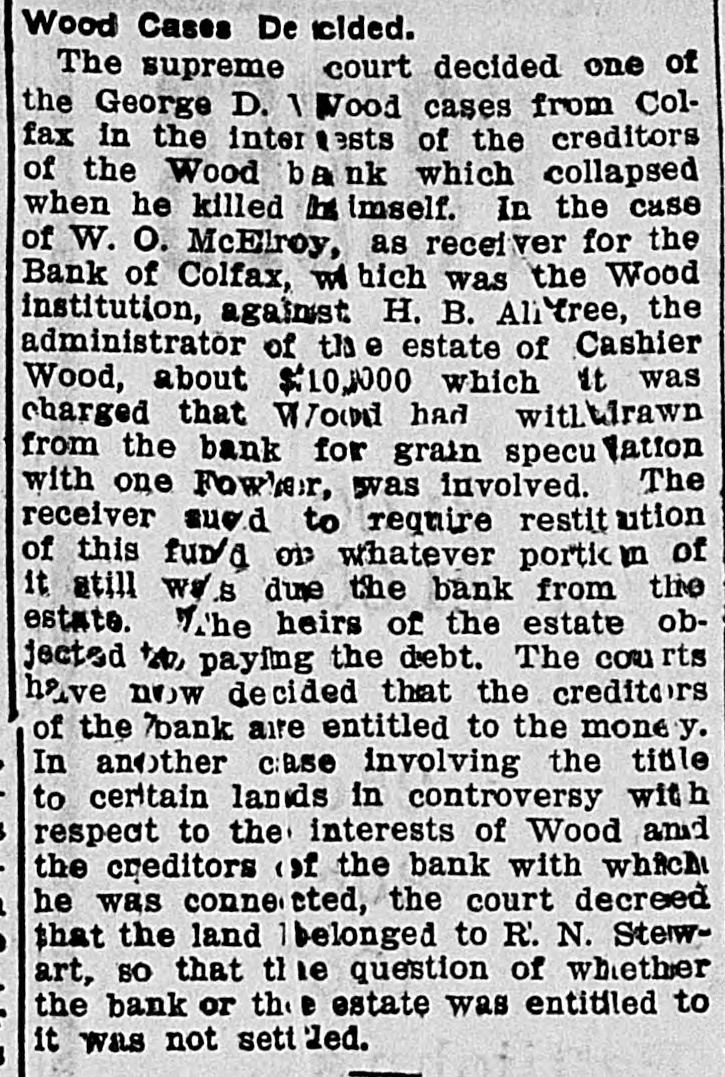
# Wood Cases Decided. The supreme court decided one of the George D. Wood cases from Colfax in the interests of the creditors of the Wood bank which collapsed when he killed himself. In the case of W. O. McElroy, as receiver for the Bank of Colfax, which was the Wood institution, against H. B. Alitree, the administrator of the estate of Cashier Wood, about $10,000 which it was charged that Wood had withdrawn from the bank for grain speculation with one Fowler, was involved. The receiver sued to require restitution of this fund or whatever portion of it still was due the bank from the estate. The heirs of the estate objected to paying the debt. The courts have now decided that the creditors of the bank are entitled to the money. In another case involving the title to certain lands in controversy with respect to the interests of Wood and the creditors of the bank with which he was connected, the court decreed that the land belonged to R. N. Stewart, so that the question of whether the bank or the estate was entitled to it was not settled.


Article from Evening Times-Republican, February 7, 1907

Click image to open full size in new tab

Article Text

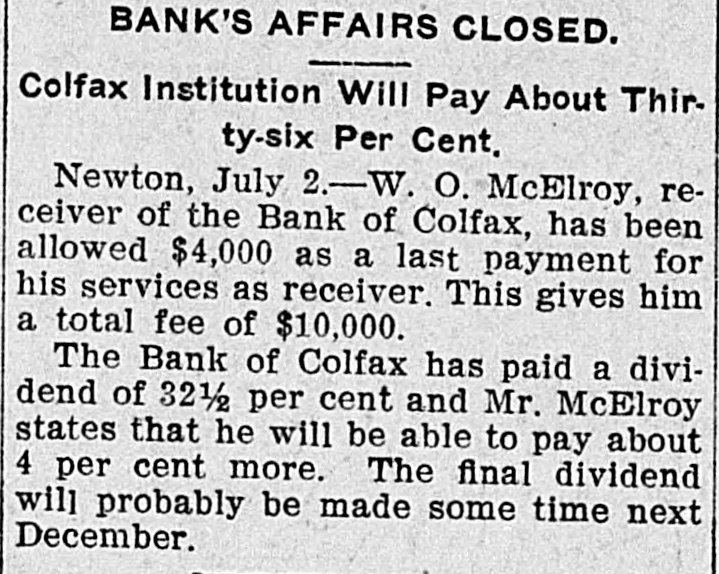
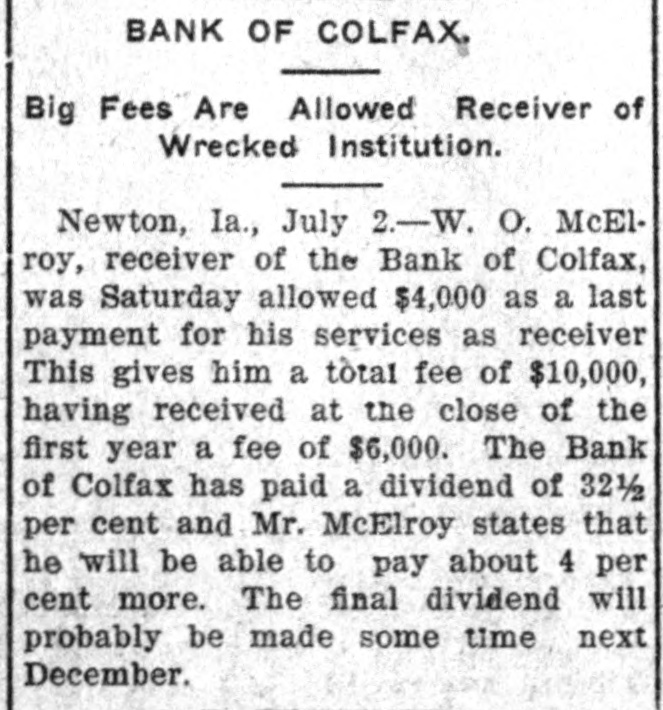
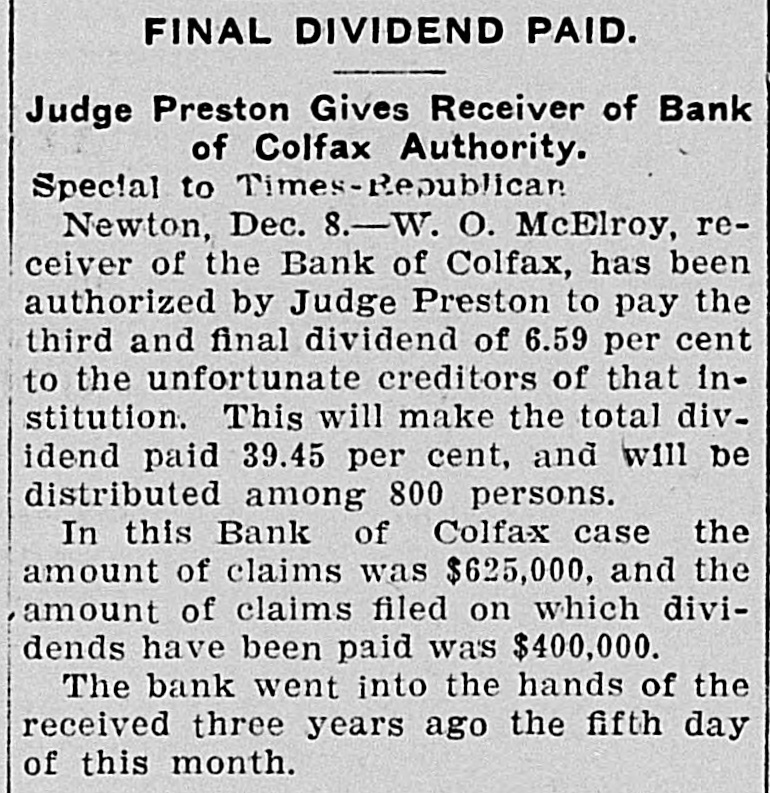
RECEIVER M'ELROY DISCHARGED. Newton Man Was Appointed Receiver for Defunct Bank of Colfax. Newton, Feb. 7.-W. O. McElroy, who WS appointed receiver of the defunct Bank of Colfax following the suicide of George D. Wood, filed his final report yesterday, and was fully discharged. The amount of business was so great that it required a volume of about 300 pages to make this final report aside from the numerous reports and orders made every few months since the appointment. About 800 persons filed claims for unsecured claims against the receiver, claiming approximately $625,000, upon which three dividends, which altogether amounted to 39.45 per cent, were paid. Notwithstanding the fact that a vast amount of litigation was required to collect the assets of the bank, three cases being appealed to the supreme court, and that it took more than three years to close up the business, the total costs, clerk hire, attorney's fees, and compensation for the receiver, will amount to only about 6ยฝ per cent of the actual cash handled by the receiver.