Donnell, Lawson & Simpson (New York, NY)

Episode Information

Episode UID
5481493491013
Episode Type
Suspension β†’ Reopening
Bank Type
private
Bank ID
548149349 hash
Start Date
May 15, 1884
Location
New York, New York (40.714, -74.006)

Metadata

Model
gpt-5-mini (chosen from majority vote of a three-model LLM ensemble)
Short Digest
96bd2098ff47b622

Response Measures

None

Description

Firm made a private assignment to an employee (assignee Weems) rather than being closed by a government receiver; later announced resumption Oct 21, 1884.

Events (3)

1. May 15, 1884 Suspension
Cause
Correspondent
Cause Details
Suspension triggered by inability to draw deposits held at the Metropolitan National Bank after that bank's suspension; firm cited inability to draw on deposits and general panic.
Newspaper Excerpt
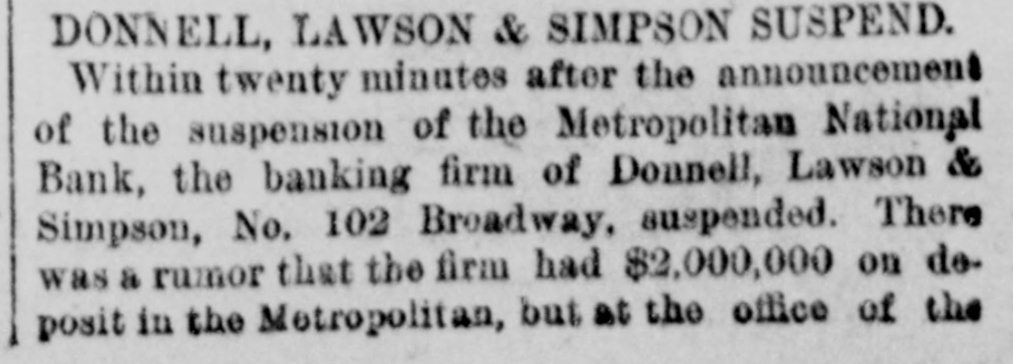
Within twenty minutes after the announcement of the suspension of the Metropolitan National Bank, the banking firm of Donnell, Lawson & Simpson... suspended.
Source
newspapers
2. May 17, 1884 Other
Newspaper Excerpt
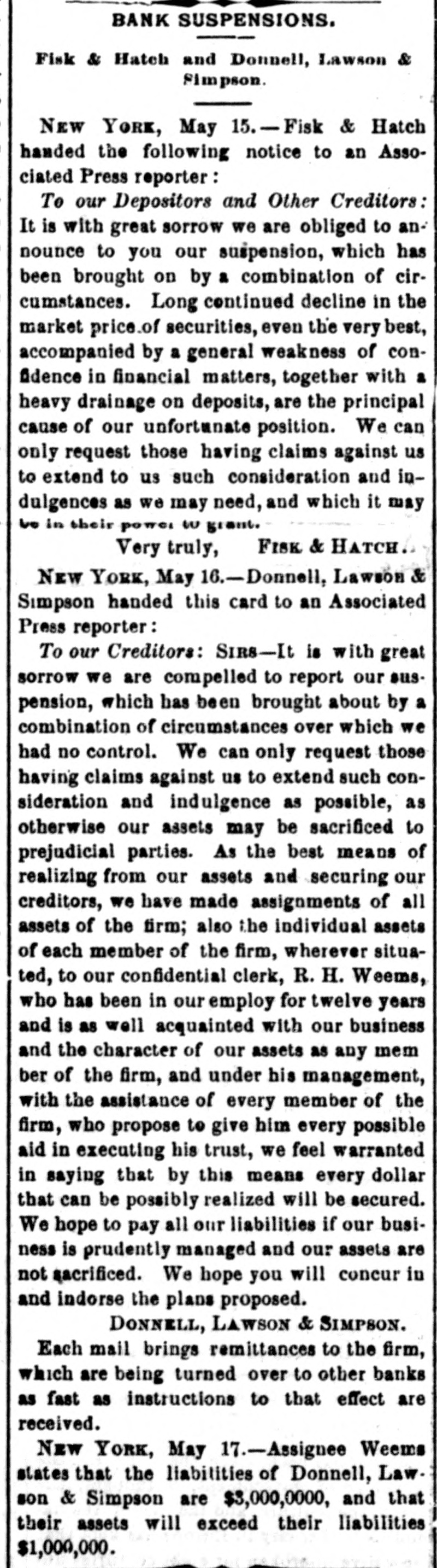
To our Creditors: ... we have made assignments of all assets of the firm; also the individual assets of each member of the firm, ... to our confidential clerk, R. H. Weems ... we hope to pay all our liabilities ... DONNELL, LAWSON & SIMPSON.
Source
newspapers
3. October 21, 1884 Reopening
Newspaper Excerpt
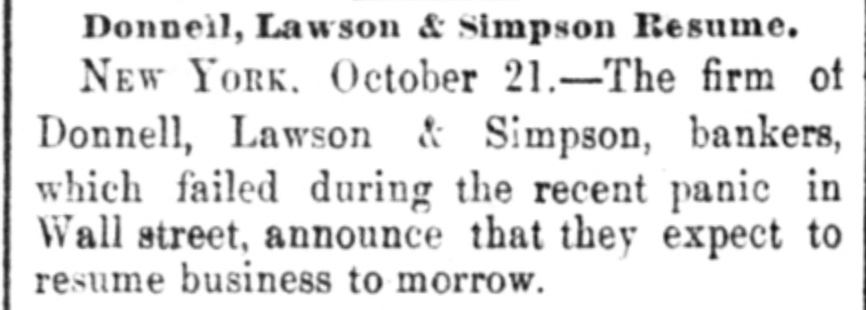
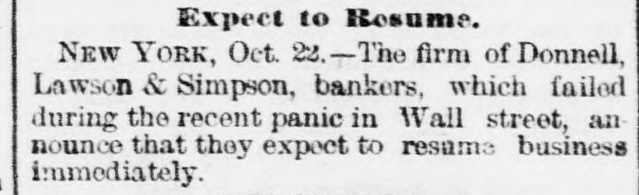
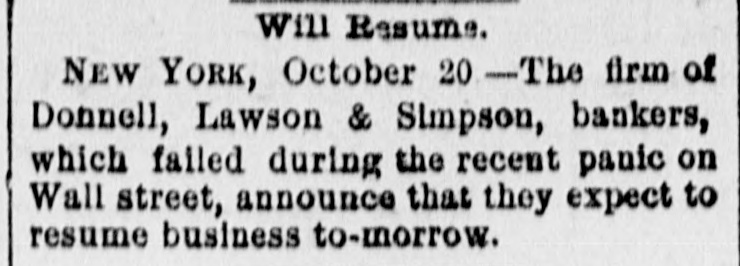
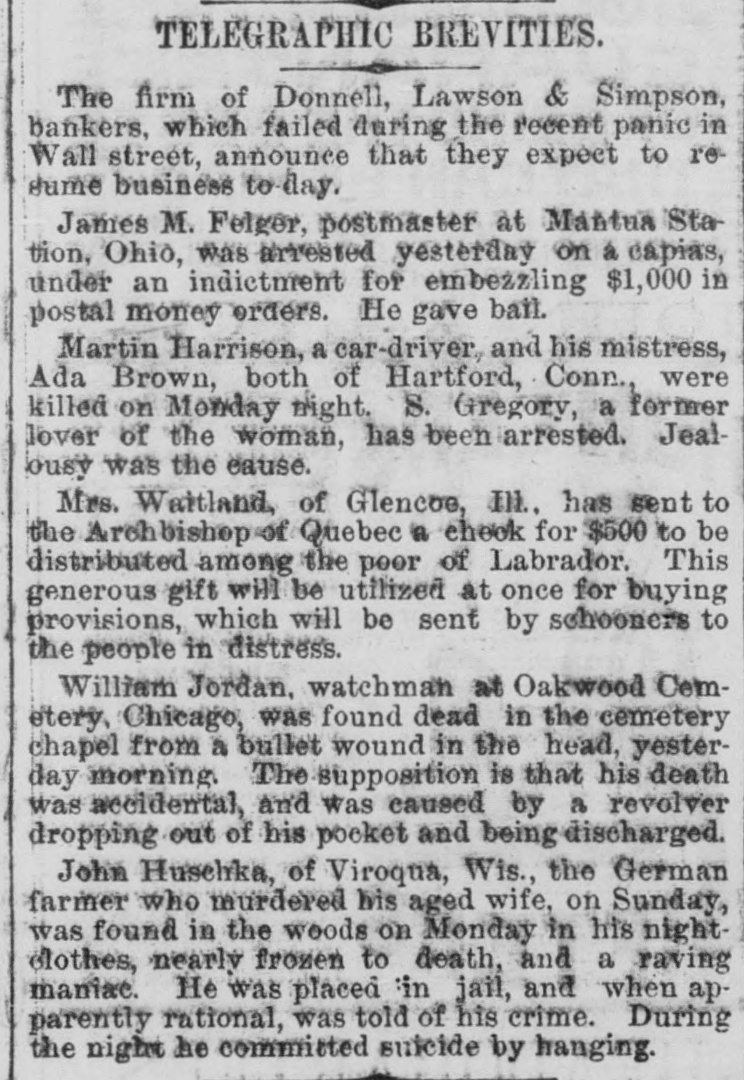
The firm of Donnell, Lawson & Simpson, bankers, which failed during the recent panic in Wall street, announce that they expect to resume business to-morrow.
Source
newspapers

Newspaper Articles (24)

Article from New-York Tribune, May 15, 1884

Click image to open full size in new tab

Article Text

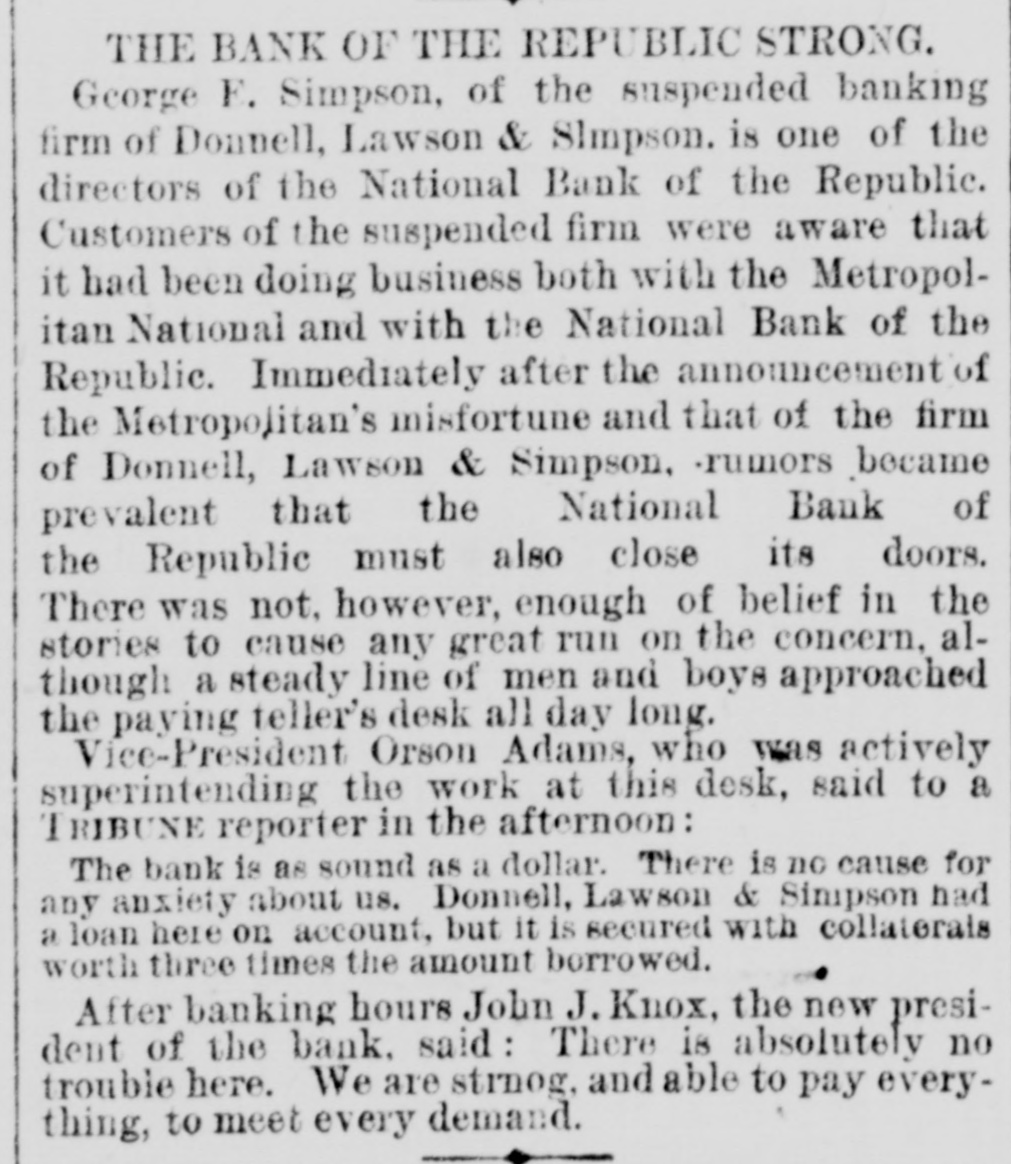
THE BANK OF THE REPUBLIC STRONG. George E. Simpson, of the suspended banking firm of Donnell, Lawson & Slmpson. is one of the directors of the National Bank of the Republic. Customers of the suspended firm were aware that it had been doing business both with the Metropolitan National and with the National Bank of the Republic. Immediately after the announcement of the Metropolitan's misfortune and that of the firm of Donnell, Lawson & Simpson, -rumors became prevalent that the National Bank of the Republic must also close its doors. There was not, however, enough of belief in the stories to cause any great run on the concern, although a steady line of men and boys approached the paying teller's desk all day long. Vice-President Orson Adams, who was actively superintending the work at this desk, said to a TRIBUNE reporter in the afternoon: The bank is as sound as a dollar. There is no cause for any anxiety about us. Donnell, Lawson & Simpson had a loan here on account, but it is secured with collaterais worth three times the amount borrowed. After banking hours John J. Knox, the new president of the bank. said: There is absolutely no trouble here. We are strnog, and able to pay everything, to meet every demand.


Article from Morning Journal and Courier, May 15, 1884

Click image to open full size in new tab

Article Text

FROM ALL QUARTERS. A FINANCIAL CRASH. Disasters Falling Thick and Fast. WALL STREET IN A PANIC. Many Firms Caught in the Whirl. A RAPID ROUND OF FAILURES. The Day a Second Black Friday. A WALL STREET CRASH. A Paule on Change- Failures Fellow Each Other in Rapid Succession-Old Houses Caught 1a the Whirl-Philanthropist Seney Among the NumberBank Closes its Doors The Story of a Day That Was Another Black Friday NEW YORK, May 14.-The financial complications of the past week resulted to-day in a succession of disasters that made the wildest havoc in Wall street. The announcement of failures began with the opening of the Stock Exchange and succeeded each other rapidly, each new disaster adding to the panicky feeling which manifested itself in all directions. The first failures published were those of Nelson Rebinson & Co. and Goffe & Randle. Soen afterward it was known that O. M. Bogart & Co. had suspended. This announcement was soon followed by the suspersion of J. C. Williams. The excitement was greatly intensified when it was first whis pered that Hatch & Foote had been compelled to cease business, and almost immediately afterwards it was rumored that the Metropolitan bank had closed its doors. This Fumor was premature, but it was not long before it became fact and the doors of the bank were actually shuf. The street was wild with excitement and it seemed that another black Friday had cast its bale ful light upon the financial horizon. Men and boys were rushing about, forcing their ways through the crewds that stood wedged in the streets about the Exchange. The news of the disasters seemed to have spread with wonderful rapidity. Private carriages, with liveried servants, from the up-town districts WERE SEEN FLYING THROUGH THE STREETS, and many stood outside the doors of the various banks and banking-houses The directors of nearly all the banks were either in session or present in their buildings ready for any emergency. The doors of the Stock Exchange were guarded by policemen and the visitors' galleries were cleared. No one was admitted to the building except members, clerks, and messengers. This was done because the crowd endeavoring to get admits tance grew too large for the capacity of the building. THE FIRST FAILURE OF THE DAY, that of Nelson Robinson & Ce., wascaused, according to the statement of Mr. Robinson, by the general shrinkage of securities, the disturbed condition of the times, and the circulation of disquieting rumors. He was unable to furnish any statement of liabilities and assets. Most of their loans, he said, were well protected, if the holders did not lose their heads and want to get their money in day. Mr. Randall, of Goffe & Randall, said their failure was due mainly to the troubles of Dyett & Co. Orlando M. Bogart, of O. M. Bogart & Co., said their suspension was due to the indirect influence of the Grant & Ward failure, the shrinkage in 80curities, the many calls on the firm for mon losses through outside parties. The firm simply unable to withstand the general pressure upon it. He could not make any statement of assets and liabilities, but he knew that the present condition of affairs was bad. The firm had been established, he said, for at least twenty five years Tb assignee, Mr. Wheeler, said that he had unex pectedly been called to his position, which he bad accepted reluctantly, and that he was un able to give any information as yet in regard to the firm's affairs. Bogart & Co. give preferences for $55,000. THE SUSPENSION OF JOSEPH C. WILLIAMS was announced early in the day. He bad not been large speculator and the number of his creditors is probably small. THE FAILURE OF HATCH FOOTE caused great excitement, as the firm has long been prominent on the street Mr. Foote said the failure was due to the embarrassment caused by the shrinkage of securities, some of which belonged to the firm, while others were carried for customers. The firm made an assignment to Henry W. Reighley, and the liabilities are thought to amount to half million. But the greatest sensation of the day came when the news was announced that THE METROPOLITAN BANK HAD SUSPENDED. The first news came that the suspension had been ordered by Mr. Seney, the president, in order to prevent run for which the bank might not be prepared. The failure is generally supposed to be due to the railroad speculations of President Seney. The bank owes the clearing house $500,000. AT THE MEETING OF BANK PRESIDENTS this afternoon a committee was appointed to examine the assets of the Metropolitan The bank and ascertain its actual position. committee was instructed to assure the bank tust if the examination proved satisfactory the associated banks would do all in their power to allow the Metropolitan to resume business The committee at once proceeded to the bank and began its nvestigation. The committee also adopted the following Resolved, That in view of the present crisis the banks of the Clearing House assooi ation, for the parpose of sustaining each other, do appoint committee of five to receive from the banks members of the association bills receivable or other securities to be appropriated by said committee, who shall be authorized to issue therefor to such depositing banks loan certificates bearing interest at six per cent. per annum, not in excess of seventy -five per cent. of seou: rities or bills receivable 80 deposited except in the case of United States bonds, and said certificates shall be rece in settlement of balances at the clearing house THIS ACTION HAD GOOD EFFECT on the street. perintendent Camp, of the clearing house, said to reporter: "In 1878 we made the fatal mistake of not appointing a committee on the first day. Deferring action was disastrous. hope this trouble will be over to-morrow and we are doing our best to end it." It is agreed by all that the scenes of excitement in and around the Exchange to day equalled those of 1873. In the midst of the panic, however, few cool headed "old stagers" were observed to be buying large amounts of stock at around the lowest figures touched. BRADSTREET'S SAYS HATCH FOOTE had been in business eighteen years and had never before been seriously embarrassed. They were supposed to be worth $500,000 They were great bulls in the market and have lost heavily. One of their Washington customers who sold out his long stock last week and went short is said to have made $100,000 profit by the turn, but this is swept away with the rest of the firm's losses. The firm had large patronage in Washington including judges, senators, representa tives and politicians. Donnell, Lawson & Simpson's failure was due large deposit being looked up in the Metropolitan bank. They did large business in State, county and municipal bonds and were the financial agents of Missouri, Kansas, Nebraska and other western States. The senior partner, Robert Donnell, is of the firm of Donnell, Clark & Larabee, bankers at Butte City, Mentana, and part owner of the First NaLodge. Montana The


Article from New-York Tribune, May 15, 1884

Click image to open full size in new tab

Article Text

DONNELL, LAWSON & SIMPSON SUSPEND. Within twenty minutes after the announcement of the suspension of the Metropolitan National Bank, the banking firm of Donnell, Lawson & Simpson, No. 102 Broadway, suspended. There was a rumor that the firm had $2,000,000 on deposit in the Metropolitan, but at the office of the


Article from New-York Tribune, May 15, 1884

Click image to open full size in new tab

Article Text

Irm the partners at first would neither deny nor affirm the rumor. Mr. Donnell said to a TRIBUNE reporter about 2 o'clock: Our closing was in consequence of the failure of the Metropolitan Bank, with which we did business. We had deposits there, and not being able to draw on them decided to suspend, at least temporarily, and await the course of events. No receiver will be appointed, nor will there be any other action of that kind to-day. We shall not decide before to-morrow on the permanent action to be pursued. Later in the day, after the elose of business hours, Mr. Simpson said: We deemed a suspension the best thing under all the circumstances, especially considering the general panic prevailing. so that we can find out just where we stand and just what is best to do. We do not know ourselves where we stand, and are waiting to see what the Metropolitan people do. It was stated by an attache of the firm that the deposit in the Metropolitan Bank was between one and two million dollars, but that the firm were perfectly solvent. Vice-President Orson Adams of the National Bank of the Republic, speaking of the Donnell, Lawson & Simpson failure, said: The firm had an account with us, which is secured amply. Their course with us was highly honorable and we believe they will come through all right. They came here this morning, stated their situation and asked advice. Their own view was that they ought to close. We thought so too, and the suspension was immediately announced. The members of the firm are R. W. Donnell, L. M. Lawson and George E. Simpson. The firm do a general banking business, their customers being largely in the West. They are fiscal agents forthe State of Kansas, and principal owners of the stock of the National Water Works Company, which built and operates the water works system of Kansas City, Mo. They have a large line of custom from Missouri. One of their principal customers has so much faith in their ability to pull through that he asked them yesterday if a loan of $100,000 cash would be of any service to them. Their reply was that, having suspended, they believed the best plan now was to await events. and decide after mature copsideration on future action. The following was the only notice posted on the door at Donnell, Lawson & Simpson's Notice -Drafts drawn by the First National Bank of Bante Fe on the firm of Donnell, Lawson & Simpson will be paid at the First National Bank of this city. There was little excitement over the suspension, which was 80 quiet that, though it occurred an hour before noon, it was not known or mentioned in the afternoon papers, At the banking office there was no crowd or rush, and what business was necessary in a clerical way was going forward as if nothing had happened. Mr. Dounell was busy writing dispatches to Western correspondents. The members of the firm did not appear at all cast down. and, while not willing to make any definite statements, pleaded that they were not indifferent to the public demand for information, but only unable at present to communicate their real status.


Article from Memphis Daily Appeal, May 16, 1884

Click image to open full size in new tab

Article Text

A TOTAL FAILURE. The Suspension of Donnell, Lawson & Simpson Believed to be Perma ment-Statements of the Firm Regarding Its Connection With the Metropolitan Bank Not Borne Out by Facts. Interview With Mr. Simpson Regarding His Condition-What an Employe Says. 15.-The New York of will say: Tribune, NEW YORK, Friday, May The statements of members of Donnell, Lawson & Simpson Wednesday that their suspension was dite wholly to the suspension of the Metropolitan National Bank, were not confirmed yesterday The Metropolitan having resumed, similar action on the part of banking firms is axiously waited. Toward the close of banking hours it began to be whispered around that their failure would be total. The bonds of the Cleveland, Youngstown and Pennsylvania tailroad were mentioned as the matter in which they were misstrippled. This was the Security over which the Bank of the Republic directors had a difference about a month ago; which resulted in President Ford's resignation. The Bank of the Republic was one of the two banks with which Donnell, Lawson & Simpson did business, Simpson being a director in it. It was also said that Seney had unloaded a lot of these bonds on the firm, and that their dependence on the Metropolitan was such be that they could not refuse to thus used. At the firm's office on the second Hoor of No. 102 Broadway a long list of notices from correspondients stating where drafts would hereafter be paid indicated how widely the firm's business was distributed. There were over 400 banks for whom they transacted business scattered through Georgia, Florida, Texas, Missouri; Kansas, Arkansas, Nebraska, Iowa, Colorado, Utah and other Territories. Over 100 bulletins were posted on the door. Inside Donnell and Simpson were busy all day trying to see how they stand. Lawson is in Europe. To a Tribune reporter late yesterday Simpson said: 'We are still figuring up and trying to get to a point where we can resume. We can't tell you anything until a about to morrow evening. There is prospect that we will resume. That is the point toward whieh our arrangements are tending "Has an assignee or receiver been decided upon? "No,sir, nothing of that kind has been will be done now. We will not make or assignment unless satisfied we can't go an on or settle our business satisfactorily without it. 'What are your liabilities? We cafi't tell exactly about $300,000." How much are the assets worth We "They will be more than that. shall pay every dollar, I now think. "Is there any truth in the rumor that unloaded Cleveland, Youngstown Seney and Penusylvania bonds upon you 'Not a word of truth. President Seney unloaded nothing on us at any time. has "Hew much were your in deposits with the Metropolitan Bank 'It was a good deal more than we could have wished. "Can you not resume now that the Metropolitan has done so "That is what we are trying to find out. s We shall know to-morrow. "It is understood you have been offered $200,000 to help you out." 'Yes; S. B. Elkins offered that, but that have been a drop in the bucket. o We would were offered several hundred thoue sand dollars, but must see where we stand of first. An attache of the firm told the reporter had gone so far that resumpbe impossible. S. B. Elkin was Y tion that offered would matters by made The re-establish- $200,000 in good faith, and may lead to the ment of the concern under a new name. The members of the firm are Missourians. Robert W. Donnell, the head of the firm, is from St. Joseph, where he owns to came large real estate, and he is a large stock- also in the Savings Bank. He is itpartner holder in the banking firm of Donnell, Mon., Clark & Larabie, of Deer Lodge, the second member of which is a millionB. Lawson and Donnell married sisters. e aire. The former was a lawyer at Booneville, 1Mo. He is a member of the Union League in and Manhattan Clubs. Simpson lives e. d Orange, N. J., and formerly resided house in Kansas City. The loans of the le on or by him. The bankor were was besieged all day mes- and and clerks copying J. sengers inghouse all papers identified. notices with persons to have signatures


Article from New-York Tribune, May 16, 1884

Click image to open full size in new tab

Article Text

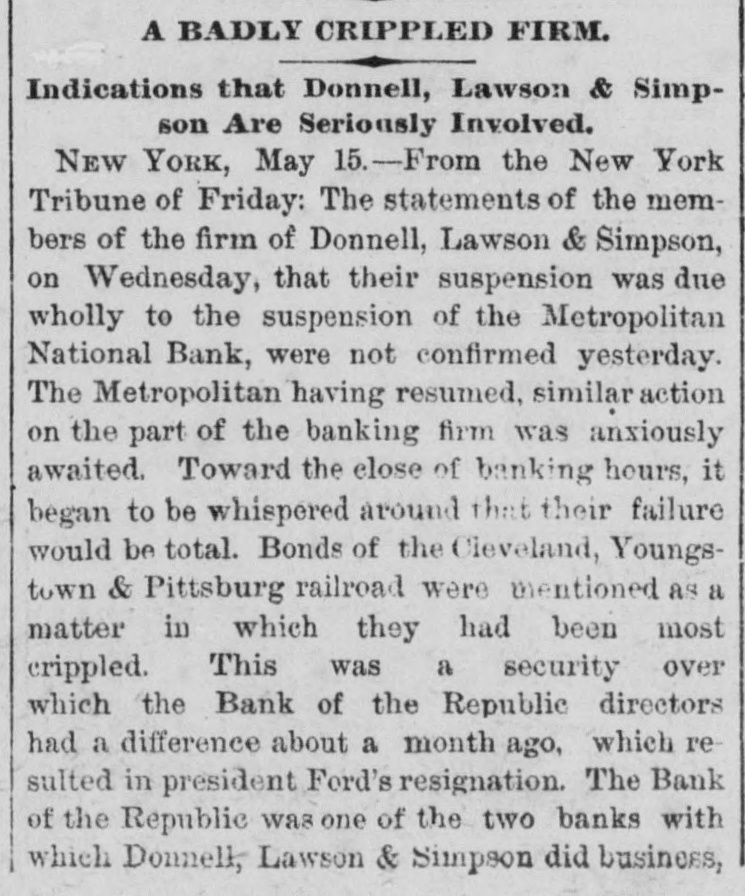
DONNELL, LAWSON & SIMPSON'S TROUBLE. THE FIRM NOT LIKELY TO RESUME-WHAT MR. SIMPSON SAYS. The statements of members of Donnell, Lawson & Simpson on Wednesday that their suspension was due wholly to the supension of the Metropolitan National Bank were not confirmed yesterday. The Metropolitan having resumed similar action on the part of the banking firm was anxiously awaited. Toward the close of banking hours it began to be whispered around that their failure would be total. The bonds of the Cleveland, Youngstown and Pittsburg Railroad were mentioned as the matter in which they had been most crippled. This was the security over which the Bank of the Republic directors had a difference, about a month ago, which resulted in President Ford's resignation. The Bank of the Republic was one of the two bad with which Donnell, Lawson & Simpso n did business, Mr. Simpson being a director in it. It was also said that Mr. Seney had unloaded a lot of these bonds on the firm, and that their dependence on the Metropolitan was such that they could not refuse to be thus used. At the firm's office on the second floor of No. 102 Broadway, the long list of notices from their correspondents stating where drafts would hereafter be paid, indicated how widely the firm's business was distributed. There were over 400 banks for whom they transacted New-York business, scattered through Georgia, Florida, Texas, Missouri, Kansas, Arkansas, Nebraska, Iowa, Colorado, Utah and other Territories. Over 100 bulletins were posted on the door. Inside Messrs. Donnell and Simpson were busy all day trying to see 'where they stand. Mr. Lawson is in Europe. To a TRIBUNE reporter late yesterday Mr. Simpson said: " We are still figuring up and trying to get to a point where we can resume. We can't tell you anything until about to-morrow afternoon. There is a prospect that we will resume. That is the point toward which our arrangements are tending." .. Has an assignee or receiver been decided upon 1" No, sir; nothing of that kind has been or will be done now. We shall not make an assignment unless sati-fied that we cannot go on or settle our business satisfactorily without it." " What are your liabilities We can't tell exactly--in the neighborhood of $3,000, 000." " How much are the assets p'' " They will be more than that. We shall pay every dollar, I now think." " Is there any truth in the rumor that Seney unloaded Cleveland, Youngstown and Pittsburg bonds on you 1" " Not a word of truth. President Seney has unloaded nothing on us, at any time." What has been the character of your securities " They have been such as would commond themselves to conservative judgment. The greatest shirukage in their value has been in some railroad bonds upon which we made advances. Cleveland, Youngstown and Pittsburg ?" Those and some others." " How much was your deposit in the Metropolitan you " It was a good deal larger than we could have wished." Continued on Fourth Page.


Article from The New North-West, May 16, 1884

Click image to open full size in new tab

Article Text

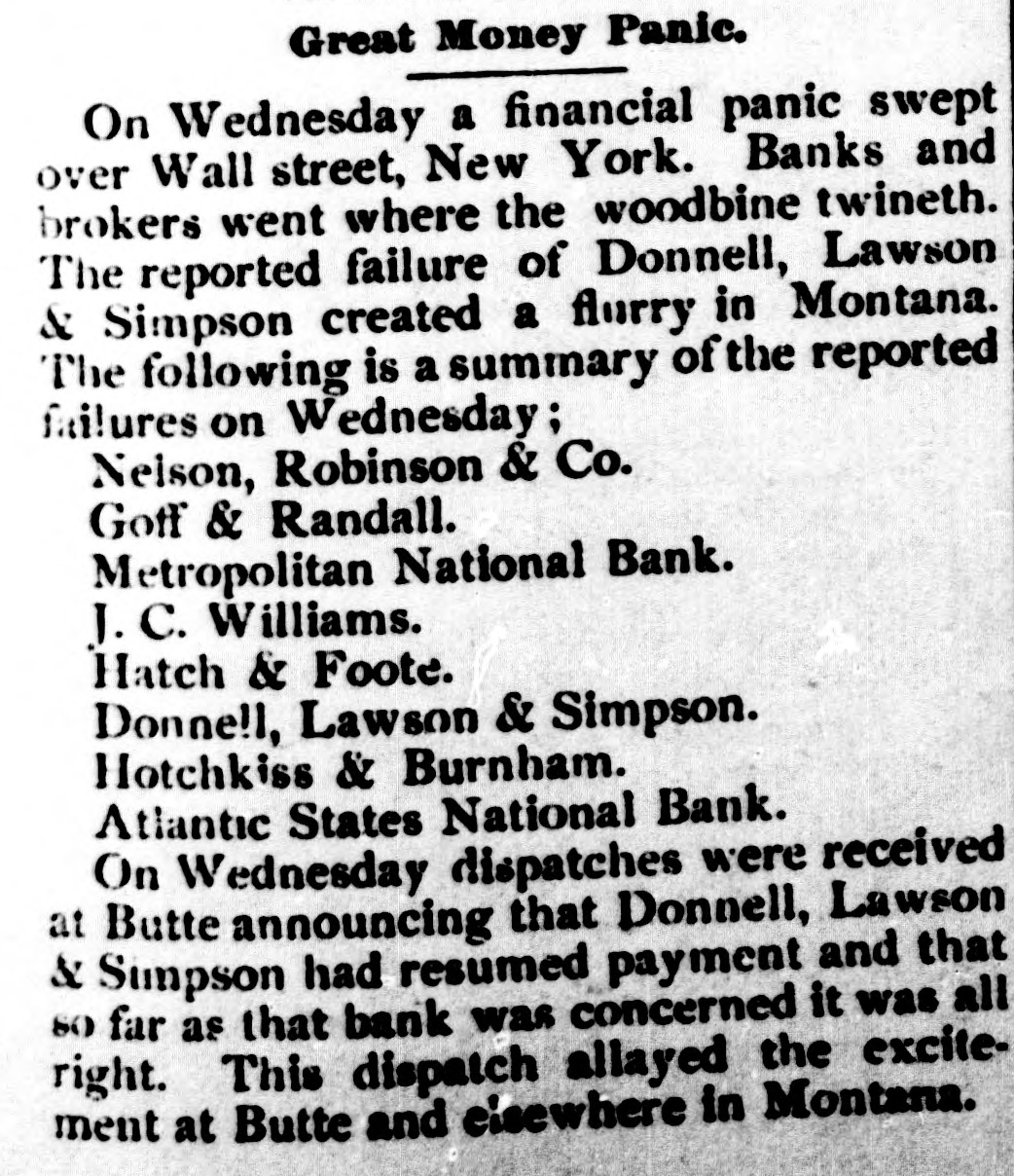
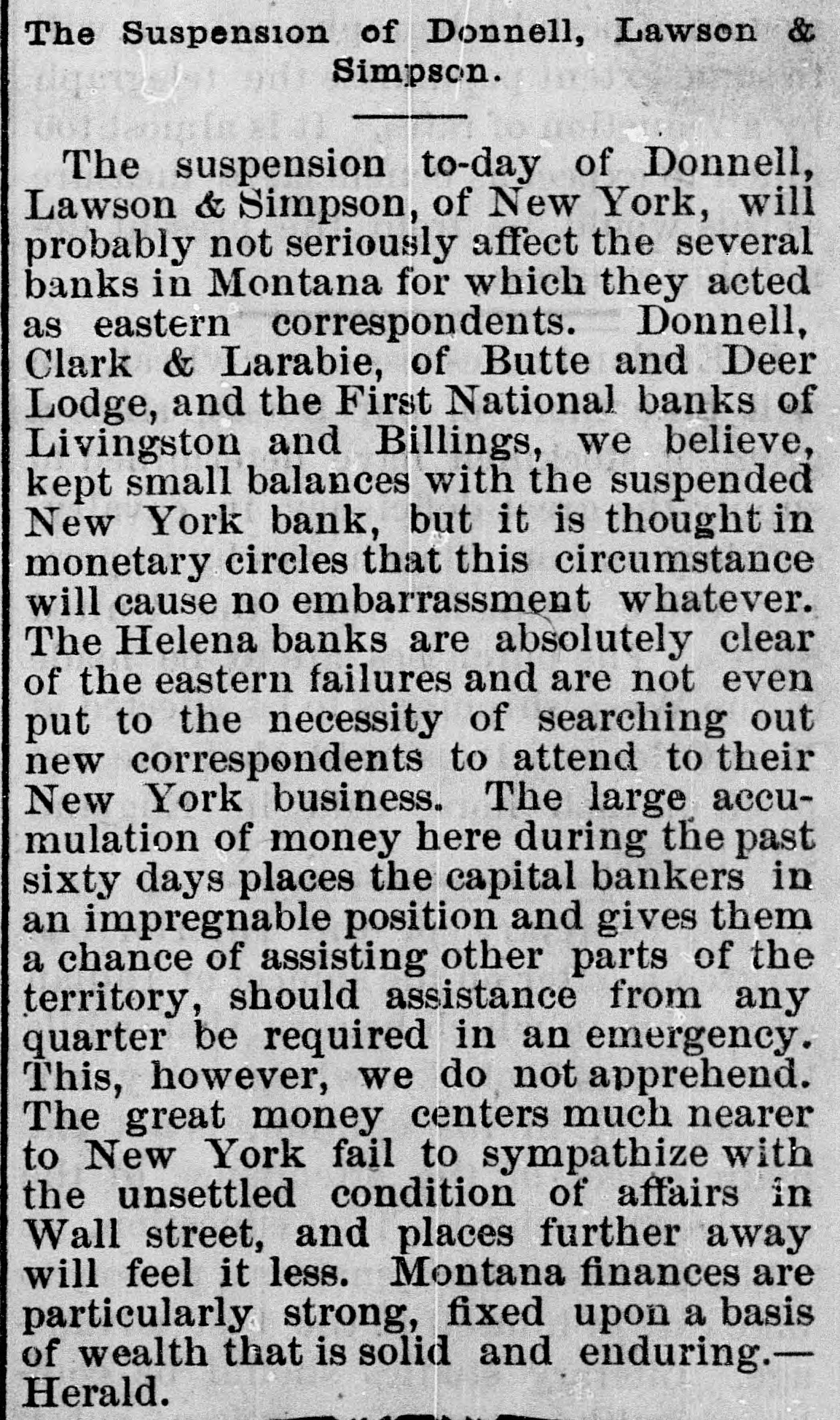
FINANCIAL MATTERS. The financial embarrassments that grew out of the failure of the Marine Bank and Grant & Ward, New York, the Minnesota Car Company and several other large operators, resulted in complications in New York Tuesday and Wednesday that threatened to be serious. The Metropolitan Bank of New York, and six others, were unable to make their clearances on Wednesday, and the situation became critical. Donnell, Lawson & Simpson, the New York correspondents of Donnell, Clark & Larabie, Butte and Deer Lodge, did their city clearing through the Metropolitan Bank, and the temporary embarrassment of that house carried Donnell, Lawson & Simpson with them as one of the seven. Mr. W. A. Clark, of Donnell, Clark & Larable, fortunately happened to be in New York, and at once provided for the drafts from the two Montana houses to be honored as they arrived, pending the lock-up of Donnell, Lawson & Simpson's funds, and until their resumption the drafts of these banks were arranged to be made on other banks, so there was no strain on the Montana Houses. Yesterday afternoon Mr. Hauser received en route from Helena to Butte, the following from Cashier Knight: HELENA, May 15. To S. T. Hauser, en route: Clark, Dodge & Co. report better feeling to day. The Metropolitan will pay depositors in full and resume to day. E. W. KNIGHT. (Signed) This will unlock Donnell, Lawson & Simpson's funds, and probably to-day that house will resume. Although the situation was fully known, there was no run on the Bank in Butte or Deer Lodge; and in addition to their having securities many fold to cover all deposits, Mr. Larabie was gratified by several of our most substantial business and monied men coming promptly forward and volunteering their assistance to the last dollar in case they could be of any service. Mr. Larabie expressed his thanks but did not need any aid. The telegram from Clark, Dodge & Co. showing the resumption of the Metropolitan dissipated all apprehension by bankers of Helena, Butte and Deer Lodge, and it is presumed Donnell, Lawson & Simpson will to-day resume business and take up all drafts. To the uninitiated, and especially to the easy business going people of Montana, it seems strange how far reaching are the complications resulting from the failure of a New York banking firm to clear during banking heurs each day every piece of payable paper out against it. But the bankers over all the land must have their deposits and correspondents in New York and their drafts on them are subject to the vicissitudes of their correspondents, although they have vaults full of money. The word from bankers in Butte and Helena last evening was that an entirely satisfactory condition existed. There had been no excitement whatever.


Article from Morning Journal and Courier, May 17, 1884

Click image to open full size in new tab

Article Text

News by Telegraph FROM ALL QUARTERS. ONE FAILURE ONLY A Better Day on the Street, THE WORST PROBABLY OVER, A Remarkable Story Told by Ward. DORSHEIMER ON THE TARIFF. The Reformers Easy Over His Position. THE FINANCIAL FLURRY A Better Day -The That Feeling One Is Worst Bank Goes Under Stronger Tone at The ose, NEW YORK, May 16 This morning opened in Wall street very much as did esterday with hopefulness all around and an upward tendency for the whole stock list Around the Stock Exchange groups of brokers dis cussed the situation with cheerfulness, and there crowds of sightseers blocking the way in front of the offices of Fisk & Hatch, where rything was quiet. Half an hour later the entire ituation changed for the worse, owing to the extraordinary fluctu of ex ations of the stock market Groups cited men stood around the ticker and shout coled out figures denoting an approaching lapse unless some heavy men came to the rescue. At 11 o'clock came the ment of the failure of H. C. Hardy & Sons. No. 10 Wall street which was attributed to the impossibility of borrowi money from the banks upon such rket, matter conwhat securities offered The firm C. Henry sists Henry C. Frederick high Hardy, jr., `and has always borne house inservative the character as banking and brokerage business The ior member of the firm has been the ness about twenty years, and this the first Mr encountered trouble that he had Hardy said that the liabiliti would not ceed $300 000. and that he believed the sets were worth that amount Mr Hardy was formerly engaged in the cotton brokerage business. WAS UPON MUCH news of the Hardy failure refusal of the moneyed institutions to help perfectly solvent firms to weather the panic caused by nothing but the stringency of the money market Ag an instance of the scarcity of money large broker told reporter that he had found difficult to borrow within ty per cent of the value of one thousand quarter per stock Lack shares cent. day an almost unheard of condition affairs the banks persisted in the their suicidal of ruining policy another panic was tomers noon the market grew so much better that something like confidence reappe and such firms as Hotchkiss, Burnham& Co J. c. Williams Co. who during the morn ing had been unable to make headway in settling their affairs. were again hopeful of resuming business in day or two. The 80 gov. tion the clear ing house in accepting loans bonds as eroment looked upon great factor in solving the which neede firms money and difficulties of were unable for the moment geti through the usual hannels By n'clock stocks were so firm that fear of panic disappeared for the moment THE IN THRONG HOUR THE THIS opposite Russell Sage's office grew so unruly that three had all they could do to prevent the doors from being forced in Sage's method of postponing payment of his "puts' was simply close the door and lock it. From time to time the door was opened admit one enough to eject o'clock said after was Soon another Mr Sage had signed 80 many his hand before with rest before the going night's work signing checks the his the and market Anothe stocks discon price Sage's efusal to do anything give checks for the diffe the back upon stock best they The disposse silence within much color from that Sage had for the day that the men who had been for three days in line thei determ to all night and seize Sage door rush at that moment forced the crowd against one Sage' the board could be put up on the inside, Sage' with have must greeted of such him, as only group of Wall street gan sengers can ovise. When board put up from the inside Sage's door office. the the advantage along and ther on part those on guard to pry the open about half foot, into which ening stal elerk int himself, rewart marking that was ARMED BOTH STOCKS and would stay there until Sage wrote This check his firm. mingled storms of with greeted yells and The the out called inside office to the the hall the but the called dozen in fellows Sage defied strong The fight officers and grinned good- and enjoyed hugely while the corridors stairway with longed ALMOST SIMULT of H Hardy Sons came the had ment that the bank falled open its its doors this morning Hatch after the failure Fisk had been Daniel Dodd who the the hands in went bank bank was placed when ailed five ago and had perm the tinue the nding up affairs Hatch him loaned told had that him 1,000,000 of the bank money and had al lowed them to keep the govern the that were put bonds could not now be found and had been replaced said The and Mr Dodd with been The ordered the bank reated intense excitement Newark and bitter against Dodd who. however, coolly of judgme and Parker Cortland At moon in which aed that Fisk & Hatch owed bank nearly $1,000,000 He thought that the did they loss suffer any would not they would not lose more than 30 per cent The deposite of the bank in January reached $6,063, THE THE GOVERNING shortly after o'clock this afterno but took no regard was only The the of the reorganization and the acceptabe of the resignation of Mr. Hatch, president of the Exchange THE ON Donnell, Lawson Simpson, bankers, No. 109 Broadway, made an giving the Savings St. Joseph, Mo At $6,083. H. $300,000, their it was stated that the liabilitie were three and four millions as the H o. Hardy Sons, stock brokers, 10 Thomas assignment to made Wall street Chatterton without preference Dise An Ward Admits That His Concern Was Swindle. Huge Engaged NEW YORK, May 16.-The examination of Ferdinand Ward was continued to-day and


Article from Savannah Morning News, May 17, 1884

Click image to open full size in new tab

Article Text

AMONG THE FINANCIERS. THE EFFECT OF THE PANIC IN THE COUNTRY. The Situation in Savannah-The Banks Prudent, but Granting Reasonable Amounts of Exchange-The James Suspension in Atlanta Opinions of Leading Bankers and How they Look Upon the Wall Street Excitement-A Hopeful View of the Future. The reported closing of the private banking house of Mr. John H. James at Atlanta, following the financial disturbance in New York earlier in the week, caused some uneasiness here yesterday morning among a certain class of small depositors, who fancied that if a bank failure had taken place in Atlanta a serious wave panic had rolled beyond the limits of Wall street and was about to engulf all the banking institutions in the country. Those who fully understood the situation were not alarmed, however. and continued to make deposits and transact their business with the banks as usua!, knowing that though there had been a shaking up of a few speculating banks and bankers in New York, the Savannah banks, all of which do a strictly legitimate business, would not be embarrassed. Later in the day telegrams from New York increased the confidence of business men and indicated that the worst of the storm was over. A reporter of the MORNING NEWS called on several leading business men and others experienced in banking and learned that while it was proper at this time for the banks to be prudent, and perhaps unusually strict, in dealing in exchange on New York, they were inclined to grant a reasonable amount of accommodation in that way to whoever applied for it, and would continue to do SO from day to day to any one or more persons who might ask for it. One of the banks accepted a check on the Metropolitan National Bank of New York for a small amount, and in this way showed its confidence in the situation. One of the officials of this bank remarked to the reporter that it was absurd now to suppose that the trouble would continue. "Cotton," said he, "has not been hammered down a bit. even in New York, and futures are steadier than they have been for a day or two. If the situation was not already improving futures would be slipping down like a blind man on a greased plank." Horace A. Crane, Esq., Vice President of the Southern Bank of the State of Georgia, said: "The Southern Bank has paid out of deposits a number of small amounts, making a total of about the sum we are in the habit of paying from day to day. We have no apprehension of a run being made on any of the banks in this city, and I believe the worst of the scare has passed." Thomas Gadsden, Esq., Cashier of the Merchants' National Bank, was called upon, and in answer to the question whether there had been bank. the on run any said: "No. Yesterday and to-day we received letters from some country banks asking for certain amounts on deposit. We responded by giving them one-half in currency and told them they could have the other half in gold. The majority of them said one-half in currency would be sufficient and that we could keep the other half for them." "Have you paid out any other amounts?" "No more than what we generally pay in the ordinary course of business, and the most of them were in small sums." The telegraph, in announcing the suspension of Donnell, Lawson & Simpson, stated that out of the 400 banks for whom they transacted New York business, there were a number in the Southern States, including Georgia and Florida. The reporter visited the Savannah banks with


Article from The Austin Weekly Statesman, May 22, 1884

Click image to open full size in new tab

Article Text

mour's bank, which prefers to pay dollar for dollar. The balances at the clearing house will be announced this afternoon, when a plan of settlement will be agreed upon. It is thought the plan in New York will be agreed P n here. There was some excitement this morning,but this materially subsided at noon. NEW YORK, May 15.-There was a much better feeling in the stock exchange circles early in the day, due to the action of the Clearing house, and to the resumption of the Metropolitan bank. Shortly after opening, a slightly weaker feeling prevailed, owing to the announcement of the failure of A. W. Dimmock & Co. This was succeeded by strong buying for foreign and home account, and there was a general improvement. Canadian Pacific rose 3 to 47; Central Pac. 41/2 to 421/4; C. B. & Q., 1Β½ to 116; Northwestern, 2 to 1051/2, preferred 51/2 to 130Β½; Lackawanna, 3 to 113; Lake Shore, 23/3 to 921/2; Mo. Pac., 514 to 73; Kans. & Tex., 13/8 to 143/8; N. Y. Cent., 23/4 to 1101/4; Northern Pac. preferred 51/4 to 49 Oregon Trans., 21/3 to 241/3; Pac. Mail, 3 to 39; Omaha preferred 6 to 90; Texas Pac., 13/3 to 12; Union Pac., 3 to 44; Western Union, 33/4 to 541/4. At the clearing house new certificates were ready for delivery at an early hour, and the banks availed themselves to extend $47,000,000. The resumption of the Merchants Bank also had a favorable effect, as it set at rest the rumors that the suspension was of the Marine Bank character. Buying for European account was an special feature of the market, and every house with foreign connections had liberal orders to purchase. At times during the day when the market flagged, these purchases turned the course of speculation. The extent of this foreign buying movement is plainly shown by the foreign exchanges. There was a larger supply of bills than for a long time, and the pressure to sell caused a sharp decline in the high rates of money at this centre. Foreign capital, and leading English and German institutions, telegraphed their agents here to draw for any amount. Buying stocks for home account was also very large, brokers offices being crowded with investors. This is usually the Case alter a disturbance like the past few days. Stocks SO bought, it should be understood, are paid in full. This operation, aside from reducing the amount of stocks to be carried on the street, brings in SO much fresh capital to aid the money market. Investment purchases, therefore, naturally had an important influence in the direction of improvement just before the close of the suspension of Fisk & Hatch was announced, and there was evidence of strong support in the final dealings, and, compared with last night's, the closing prices were five per cent higher. Donnell, Lawson & Simpson have over four hundred banks for whom they transacted New York business, scattered through Georgia, Florida, Texas, Missouri, Kansas, Arkansas, Nebraska, lowa, Colorado, Utah and other territories, and over one hundred bulletins were posted on the door. Inside, Donnell and Simpson were busy all day trying to see where they stand. Lawson is in Europe. To a Tribune reporter Simpson said: We are still figuring up and trying to get to a point where we can resume. We can't tell you anything until about to-morrow afternoon. There is a prospect we will resume. That is the point towards which our arrangements are tending." "Has an assignee or receiver been ?" decided "No, sir: nothing of that kind has been or will be done, now. We shall not make an assignment unless satisfied that we cannot go on or settle our business satisfactorily withoutit." A RUN ON A BANK. BRIDGEPORT, CONN., May 15.-The raid on the banking house of Watson & Co. was resumed this morning, but the excitement subsided by 10 o'clock. KANSAS CITY, May 15.-The slight flurry of this morning disappeared this afternoon. A large number of deposits were drawn out this morning, but nearly all small amounts, the larger depositors appearing confident that the scare was artificial, and the concerted action of the banks, coupled with the encouraging eastern advices brought about an early reaction, and the excitement gradually subsided. The report which got abroad that the bank of Kansas City was involved seems to have originated in the impression that the bank had a large account with Donnell, Lawson & Simpson. Their books show they had only $39,000 with the New York firm, a comparatively small amount. The feeling now 18 that all occasion for apprehension of serious trouble is over. WALL STREET, 12:40 P. M.-Comparative quiet reigns on the stock exchange, and it is more apparent every moment that the crisis is past. The suspension of Hawley & Co., of Boston, was caused by a run on the banking department of the house of Beliene. It will be temporary. BOSTON, May 15.-F. S. Hawley & Co., bankers and brokers, have suspended and cannot give a statement of their liabilities. They state that their failute is due to the failure to ascertain just where they stand. They have been doing business as bank depositors and the amount due depositors is unknown. The house was rated at $100,000. It wasstated the Bank of Commerce was this morning a debtor to the Clearing house $500,000. Examiner Scribas' work has been discontinued, and the official advices in general continue reassuring. The Commercial says the general subject of discussion was the remarkable position assumed by President Seney and the directors of the Metropolitan bank, who announced the bank


Article from The New North-West, May 23, 1884

Click image to open full size in new tab

Article Text

BANK SUSPENSIONS. Fisk & Hatch and Donnell, Lawson & Simpson. NEW YORK, May 15.-Fisk & Hatch handed the following notice to an Associated Press reporter: To our Depositors and Other Creditors: It is with great sorrow we are obliged to announce to you our suspension, which has been brought on by a combination of circumstances. Long continued decline in the market price.of securities, even the very best, accompanied by a general weakness of confidence in financial matters, together with a heavy drainage on deposits, are the principal cause of our unfortunate position. We can only request those having claims against us to extend to us such consideration and indulgences as we may need, and which it may vo in their power to grant. Very truly, FISK & HATCH NEW YORK, May 16.-Donnell, Lawson & Simpson handed this card to an Associated Press reporter: To our Creditors: SIRs-It is with great sorrow we are compelled to report our suspension, which has been brought about by a combination of circumstances over which we had no control. We can only request those having claims against us to extend such consideration and indulgence as possible, as otherwise our assets may be sacrificed to prejudicial parties. As the best means of realizing from our assets and securing our creditors, we have made assignments of all assets of the firm; also the individual assets of each member of the firm, wherever situated, to our confidential clerk, R. H. Weems, who has been in our employ for twelve years and is as well acquainted with our business and the character of our assets as any mem ber of the firm, and under his management, with the assistance of every member of the firm, who propose to give him every possible aid in executing his trust, we feel warranted in saying that by this means every dollar that can be possibly realized will be secured. We hope to pay all our liabilities if our business is prudently managed and our assets are not sacrificed. We hope you will concur in and indorse the plans proposed. DONNELL, LAWSON & SIMPSON. Each mail brings remittances to the firm, which are being turned over to other banks as fast as instructions to that effect are received. NEW YORK, May 17.-Assignee Weems states that the liabilities of Donnell, Lawson & Simpson are $3,000,0000, and that their assets will exceed their liabilities $1,000,000.


Article from The New North-West, May 23, 1884

Click image to open full size in new tab

Article Text

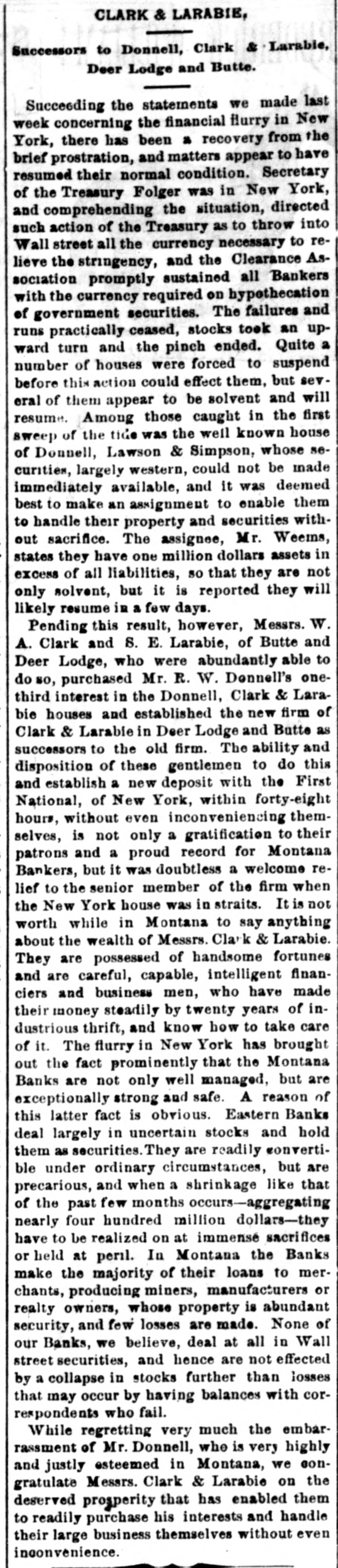
CLARK & LARABIE, Successors to Donnell, Clark & Larabie, Deer Lodge and Butte. Succeeding the statements we made last week concerning the financial Hurry in New York, there has been a recovery from the brief prostration, and matters appear to have resumed their normal condition. Secretary of the Treasury Folger was in New York, and comprehending the situation, directed such action of the Treasury as to throw into Wall street all the currency necessary to relieve the stringency, and the Clearance Association promptly sustained all Bankers with the currency required on hypothecation of government securities. The failures and runs practically ceased, stocks took an upward turn and the pinch ended. Quite a number of houses were forced to suspend before this action could effect them, but several of them appear to be solvent and will resume. Among those caught in the first sweep of the tide was the well known house of Donnell, Lawson & Simpson, whose securities, largely western, could not be made immediately available, and it was deemed best to make an assignment to enable them to handle their property and securities without sacrifice. The assignee, Mr. Weems, states they have one million dollars assets in excess of all liabilities, so that they are not only solvent, but it is reported they will likely resume in a few days. Pending this result, however, Messrs. W. A. Clark and S. E. Larabie, of Butte and Deer Lodge, who were abundantly able to do so, purchased Mr. R. W. Donnell's onethird interest in the Donnell, Clark & Larabie houses and established the new firm of Clark & Larabie in Deer Lodge and Butte as successors to the old firm. The ability and disposition of these gentlemen to do this and establish a new deposit with the First National, of New York, within forty-eight hours, without even inconveniencing themselves, is not only a gratification to their patrons and a proud record for Montana Bankers, but it was doubtless a welcome relief to the senior member of the firm when the New York house was in straits. It is not worth while in Montana to say anything about the wealth of Messrs. Clark & Larabie. They are possessed of handsome fortunes and are careful, capable, intelligent financiers and business men, who have made their money steadily by twenty years of industrious thrift, and know how to take care of it. The flurry in New York has brought out the fact prominently that the Montana Banks are not only well managed, but are exceptionally strong and safe. A reason of this latter fact is obvious. Eastern Banks deal largely in uncertain stocks and hold them as securities. They are readily sonvertible under ordinary circumstances, but are precarious, and when a shrinkage like that of the past few months occurs-aggregating nearly four hundred million dollars-they have to be realized on at immense sacrifices or held at peril. In Montana the Banks make the majority of their loans to merchants, producing miners, manufacturers or realty owners, whose property is abundant security, and few losses are made. None of our Banks, we believe, deal at all in Wall street securities, and hence are not effected by a collapse in stocks further than losses that may occur by having balances with correspondents who fail. While regretting very much the embarrassment of Mr. Donnell, who is very highly and justly esteemed in Montana, we congratulate Messrs. Clark & Larabie on the deserved prosperity that has enabled them to readily purchase his interests and handle their large business themselves without even inconvenience.


Article from Barbour County Index, May 23, 1884

Click image to open full size in new tab

Article Text

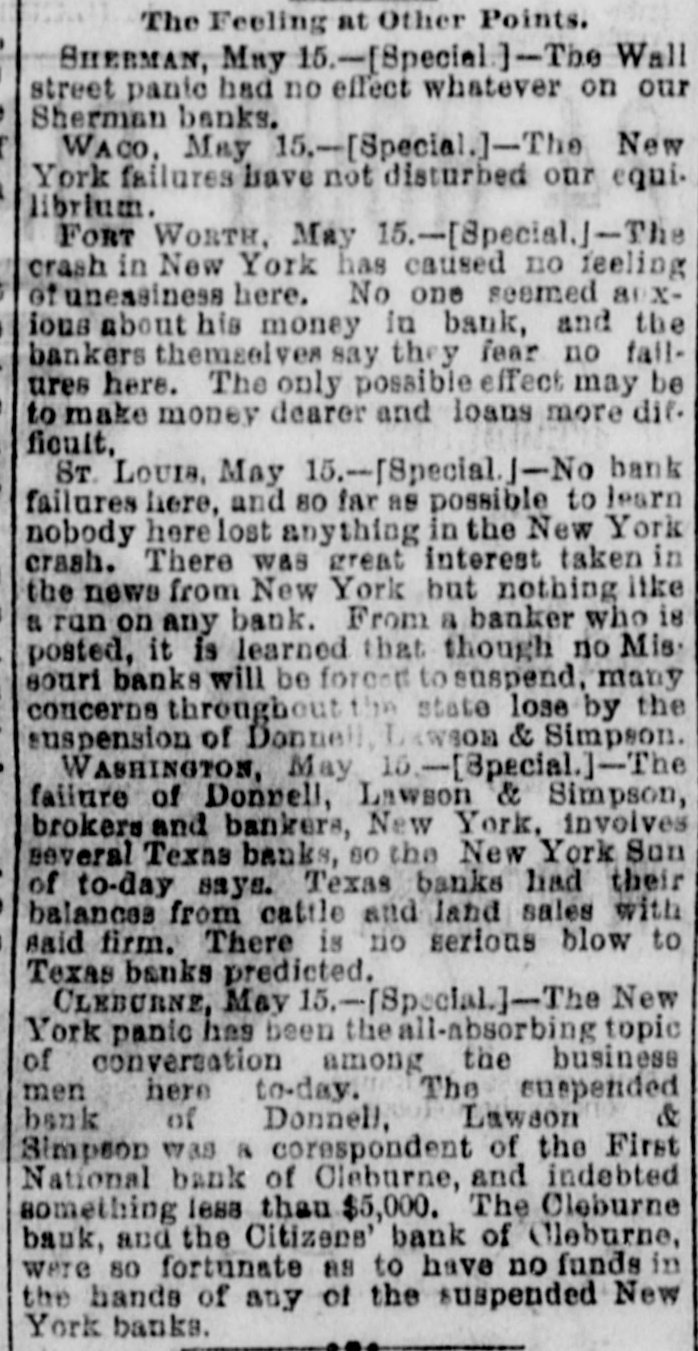
Governor Glick has telegraphed from New York that Kansas will not lose anything on account of the suspension of Donnell, Lawson & Simpson, the state's fiscal agents. He also announces that the First National bank has been selected as the agents of this state.


Article from Wood County Reporter, May 29, 1884

Click image to open full size in new tab

Article Text

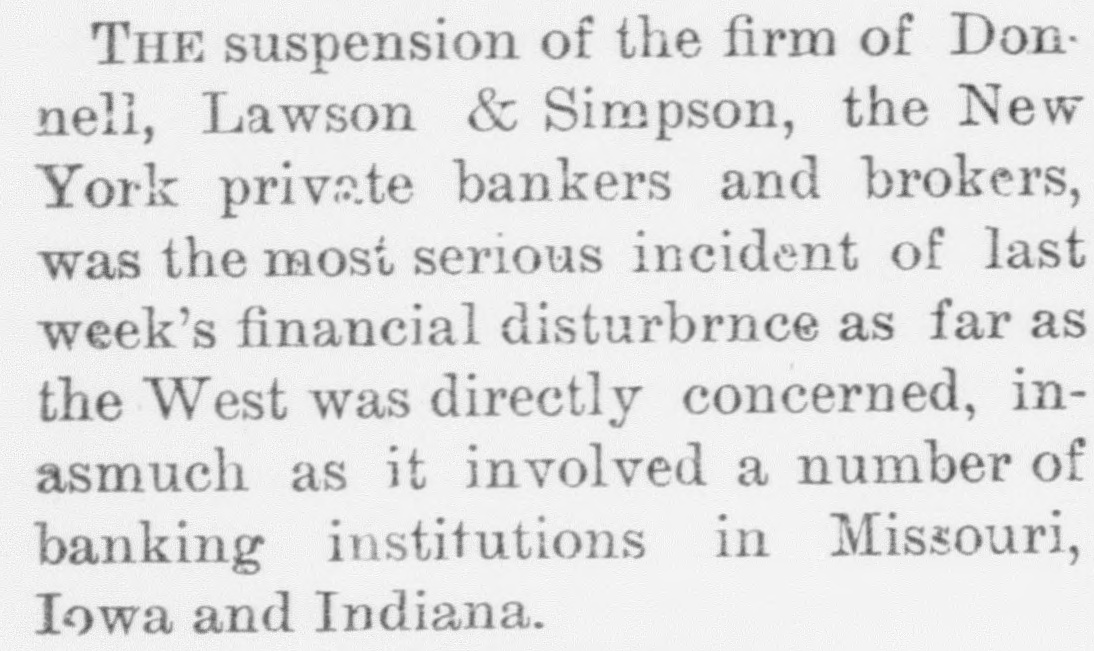
THE suspension of the firm of Don. nell, Lawson & Simpson, the New York private bankers and brokers, was the most serious incident of last week's financial disturbrnce as far as the West was directly concerned, inasmuch as it involved a number of banking institutions in Missouri, Iowa and Indiana.


Article from Eureka Daily Sentinel, October 22, 1884

Click image to open full size in new tab

Article Text

he had saved their lives, in expectation that he would be handsomely remunerated for his gallantry. Murder. SHELBYVILLE, Ky., Oct. 21.-Special reports of the killing of Elijah Kirk by Robert Clark near here have been received. Kirk accused Clark of circulating evil reports about his daughter, and got a shotgun and rode out to Clark's house, after having threatened to kill him. He was riding up and down the road waiting for Clark's appearance, when the latter opened the front door and fired two shots with the gun, riddling Kirk with buckshot and shooting his head almost off. He Never Said So. WASHINGTON, Oct. 21.-In relation to the dispatch from London that Secretary Felinghuysen had declared his inability to understand the reluctance of France for an amicable settlement of the difficulties with China, Mr. Felinghuysen says he never expressed any opinion on the subject. Heavy Registration. NEW YORK, Oct. 21.-To-day is the last day of registration in Brooklyn. The number registered was 29,664, making a total registration of 124,623 against 106,354 last year, and 114,090 in 1880. Fatal Connubiation. HARTFORD, Oct. 21.-Martin Harrison killed his wife and was killed himself last night in a jealous quarrel. The man who had been living with Harrison's wife was cut during the row, but not fatally. A Stage Held Up. HELENA, M. T., Oct. 21.-The coach between Jefferson City and Boulder was held up to-day, the object being to rescue two horse thieves supposed to be on the coach. Parties are in pursuit. Hangs Himself Through Remorse. CHICAGO, Oct. 21.- Charles J. Downe, member of the Board of Trade, who murdered his brother, Wm. H., Sept. 5, committed suicide by hanging in his cell in jail last night. Promised Resumption. NEW YORK, Oct. 21.-The firm of Donnell, Lawson & Simpson, bankers, which failed during the recent panic in Wall street, announce that they expect to resume business to-morrow.


Article from Wheeling Register, October 22, 1884

Click image to open full size in new tab

Article Text

Donneil, Lawson & Simpson Resume. NEW YORK. October 21.-The firm of Donnell, Lawson & Simpson, bankers, which failed during the recent panic in Wall street, announce that they expect to resume business to morrow.


Article from The Salt Lake Herald, October 22, 1884

Click image to open full size in new tab

Article Text

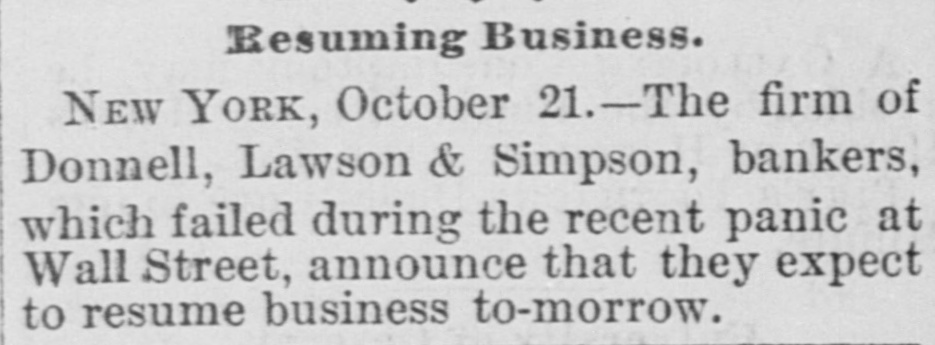
Resuming Business. NEW YORK, October 21.-The firm of Donnell, Lawson & Simpson, bankers, which failed during the recent panic at Wall Street, announce that they expect to resume business to-morrow.


Article from St. Paul Daily Globe, October 22, 1884

Click image to open full size in new tab

Article Text

NEW YORK [Special Telegram to the Globe.] NEW YORK, Oct. 21.-Free selling of stocks commenced as soon as the exchange opened. Central & Hudson dropping from 891/4 to 87% in a few moments. The de pression gradually extended throughout the list. The ups and downs made an exceedingly active market and the dealings were very lively among the room traders. The short interest has increased so of late that the bears acted cautiously. About 2 o'clock selling orders in no small amounts made their appearance and a drop of one per cent. and over took place in several of the active stocks. The market was then bid up again. The situation is still very much mixed, and brokers were not inclined to offer much advice. Among the light weights Ohio & Mississippi was the weakest feature, selling down to 15Β½. Receiver Russell, of the West Shore, says that he was very reluctant to reduce rates, but after consultation with some of the best railroad men in the country he decided that it was best. It was purely a defensive measure, for the other roads cut secretly and the West Shore decided to do it openly. The court to which the receivers report is well informed of what the road is doing. He has heard of no action to restrain the receiver or move him and does not see just how the court could take action in the matter. Members of the West Shore cominittee and other large bondholders of West Shore say that they have not made any objection to the reduction in rates, but admit that strong pressure has been brought to bear upon them by the bulls on the market to take some action in the matter. Apropos of the railroad war, it is noticeable that quotations for the Beltimore & Ohio have dropped from 178 to 169 in the past week, a clean difference of g per cent. Donnell, Lawson & Simpson, the bankers and brokers who suspended during the recent panie and who have a large correspondence in the west, will.resume regular business tomorrow. E. K. Willard says that he is a bear on the situation and claims that the unprecedented cheapness of bread stuffs must bring about a re-valuation in valuss of railway stocks and other securities which will not stop until real estate is reached. A good many operators say they will have no confidence in a bull market until Vanderbilt begins to buy back his stocks, and it is claimed that this will not occur ubtil Lake Shore touches 55. The war in rates goes merrily on, and it is bolieved that Vanderbilt will either have to buy the West Shore at a nominal figure or see the New York Central made bankrupt. The earnings of the Northwestern for the second week in October show a decrease of $52,000. The feeling was somewhat feverish toward the close, and the failure of a cotton house in England for some $10,000,000 helped to unsettle matters. A slight roily at the finish left some stocks a trifle higher than at the beginning and some a shade lower.


Article from The Indianapolis Journal, October 22, 1884

Click image to open full size in new tab

Article Text

TELEGRAPHIC BREVITIES. The firm of Donnell, Lawson & Simpson, bankers, which failed during the recent panic in Wall street, announce that they expect to resume business to-day. James M. Felger, postmaster at Mantua Station, Ohio, was arrested yesterday on a capias, under an indictment for embezzling $1,000 in postal money orders. He gave bail. Martin Harrison, a car-driver, and his mistress, Ada Brown, both of Hartford, Conn., were killed on Monday night. S. Gregory, a former lover of the woman, has been arrested. Jealousy was the cause. Mrs. Waitland, of Glencoe, Ill., has sent to the Arch bishop of Quebec a check for $500 to be distributed among the poor of Labrador. This generous gift will be utilized at once for buying provisions, which will be sent by schooners to the people in distress. William Jordan, watchman at Oakwood Cemetery, Chicago, was found dead in the cemetery chapel from a bullet wound in the head, yesterday morning. The supposition is that his death was accidental, and was caused by a revolver dropping out of his pocket and being discharged. John Huschka, of Viroqua, Wis., the German farmer who murdered his aged wife, on Sunday, was found in the woods on Monday in his nightclothes, nearly frozen to death, and a raving maniac. He was placed in jail, and when apparently rational, was told of his crime. During the night he committed suicide by hanging.


Article from The Stark County Democrat, October 23, 1884

Click image to open full size in new tab

Article Text

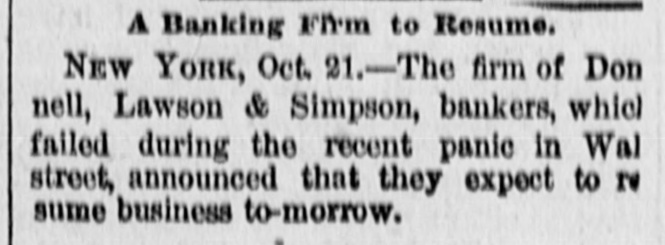
A Banking Firm to Resume. NEW YORK, Oct. 21.-The firm of Don nell, Lawson & Simpson, bankers, which failed during the recent panic in Wal street, announced that they expect to IV sume business to-morrow.


Article from The Dallas Weekly Herald, October 23, 1884

Click image to open full size in new tab

Article Text

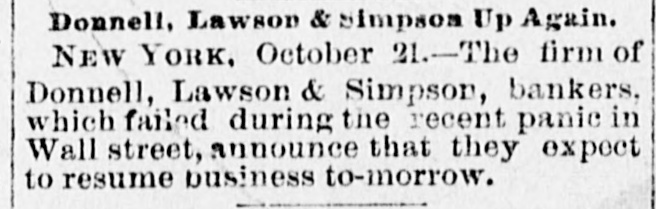
Donnell, Lawson & simpson Up Again. NEW YORK, October 21.-The firm of Donnell, Lawson & Simpson, bankers. which failed during the recent panic in Wall street, announce that they expect to resume business to-morrow.


Article from Daily Inter Mountain, October 30, 1900

Click image to open full size in new tab

Article Text

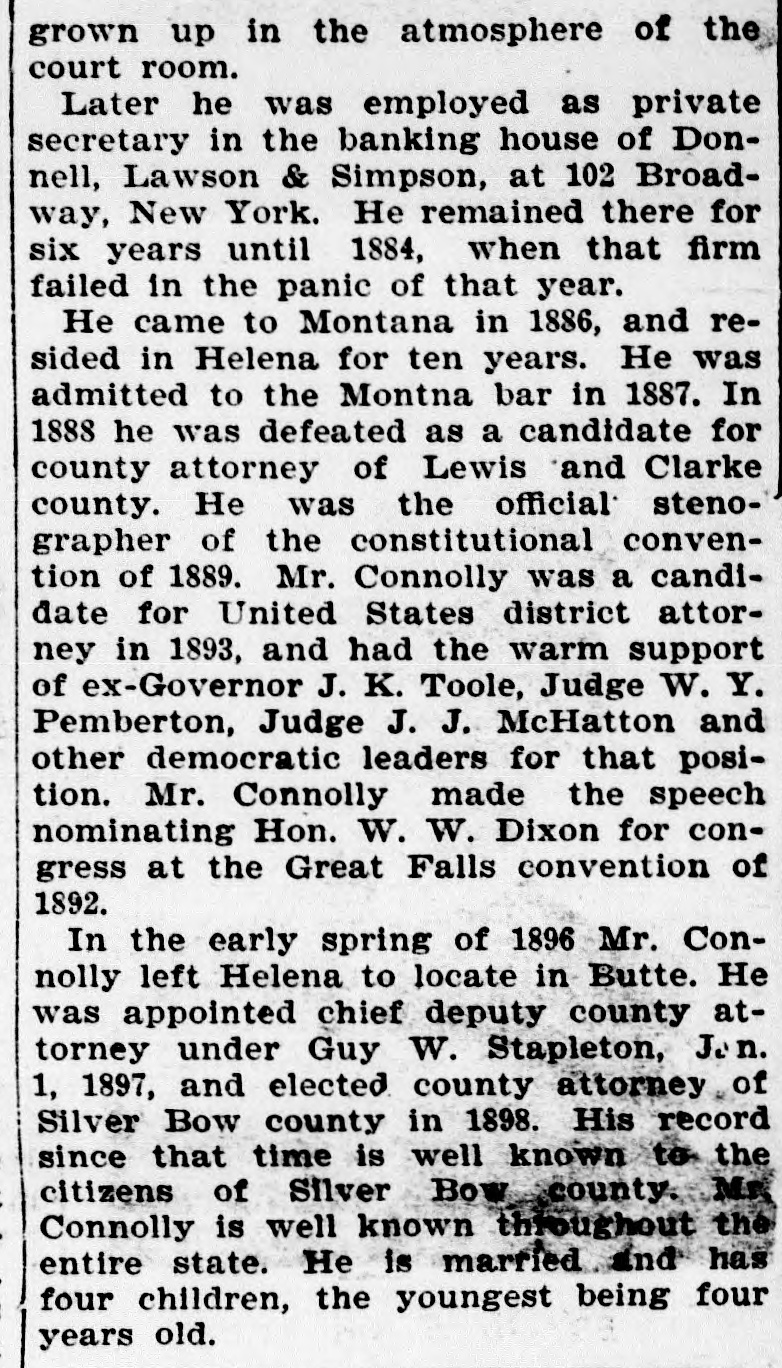
grown up in the atmosphere of the court room. Later he was employed as private secretary in the banking house of Donnell, Lawson & Simpson, at 102 Broadway, New York. He remained there for six years until 1884, when that firm failed in the panic of that year. He came to Montana in 1886, and resided in Helena for ten years. He was admitted to the Montna bar in 1887. In 1888 he was defeated as a candidate for county attorney of Lewis and Clarke county. He was the official stenographer of the constitutional convention of 1889. Mr. Connolly was a candidate for United States district attorney in 1893, and had the warm support of ex-Governor J. K. Toole, Judge W. Y. Pemberton, Judge J. J. McHatton and other democratic leaders for that position. Mr. Connolly made the speech nominating Hon. W. W. Dixon for congress at the Great Falls convention of 1892. In the early spring of 1896 Mr. Connolly left Helena to locate in Butte. He was appointed chief deputy county attorney under Guy W. Stapleton, Jon. 1, 1897, and elected county attorney of Silver Bow county in 1898. His record since that time is well known to the citizens of Silver Bow county. Mr. Connolly is well known throughout the entire state. He is married and has four children, the youngest being four years old.


Article from The Minneapolis Journal, September 21, 1906

Click image to open full size in new tab

Article Text

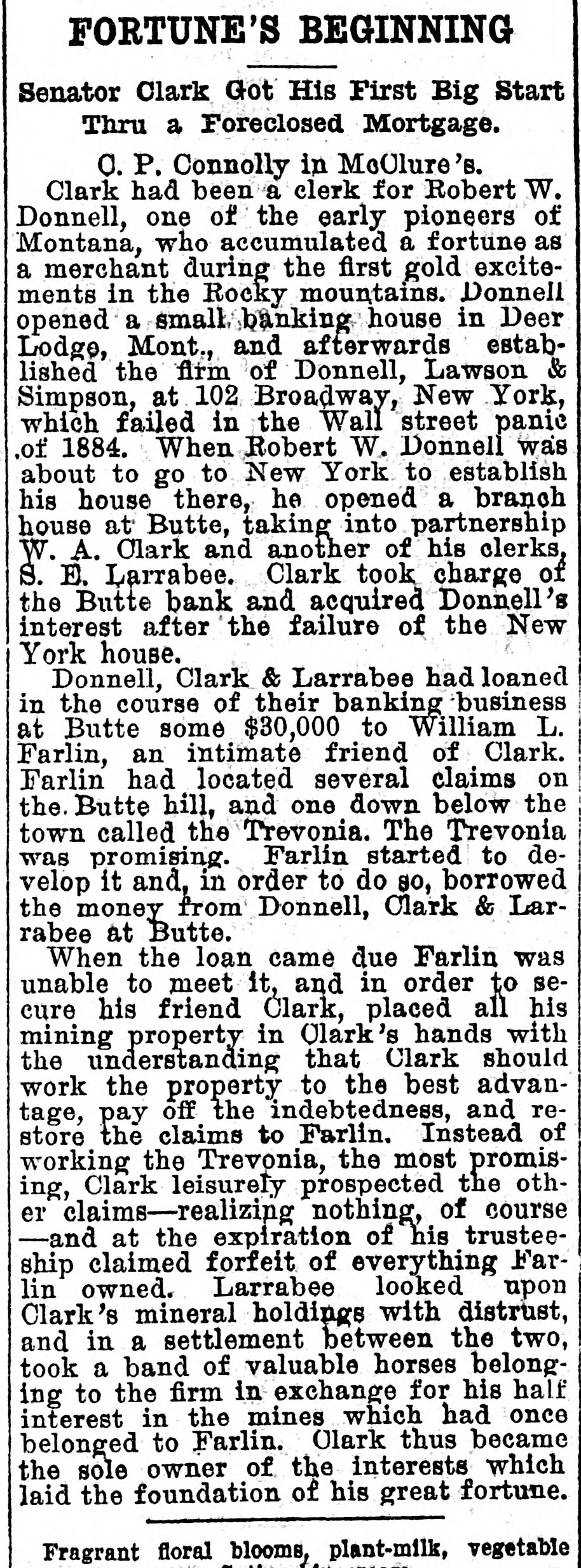
FORTUNE'S BEGINNING Senator Clark Got His First Big Start Thru a Foreclosed Mortgage. O.P. Connolly in McClure's. Clark had been a clerk for Robert W. Donnell, one of the early pioneers of Montana, who accumulated a fortune as a merchant during the first gold excitements in the Rocky mountains. Donnell opened a small banking house in Deer Lodge, Mont., and afterwards established the firm of Donnell, Lawson & Simpson, at 102 Broadway, New York, which failed in the Wall street panic of 1884. When Robert W. Donnell was about to go to New York to establish his house there, he opened a branch house at Butte, taking into partnership W. A. Clark and another of his clerks, S. E. Larrabee. Clark took charge of the Butte bank and acquired Donnell's interest after the failure of the New York house. Donnell, Clark & Larrabee had loaned in the course of their banking business at Butte some $30,000 to William L. Farlin, an intimate friend of Clark. Farlin had located several claims on the. Butte hill, and one down below the town called the Trevonia. The Trevonia was promising. Farlin started to develop it and, in order to do so, borrowed the money from Donnell, Clark & Larrabee at Butte. When the loan came due Farlin was unable to meet it, and in order to secure his friend Clark, placed all his mining property in Clark's hands with the understanding that Clark should work the property to the best advantage, pay off the indebtedness, and restore the claims to Farlin. Instead of working the Trevonia, the most promising, Clark leisurely prospected the other claims-realizing nothing, of course -and at the expiration of his trusteeship claimed forfeit of everything Farlin owned. Larrabee looked upon Clark's mineral holdings with distrust, and in a settlement between the two, took a band of valuable horses belonging to the firm in exchange for his half interest in the mines which had once belonged to Farlin. Clark thus became the sole owner of the interests which laid the foundation of his great fortune. Fragrant floral blooms, plant-milk, vegetable


Article from Omaha Daily Bee, October 14, 1906

Click image to open full size in new tab

Article Text

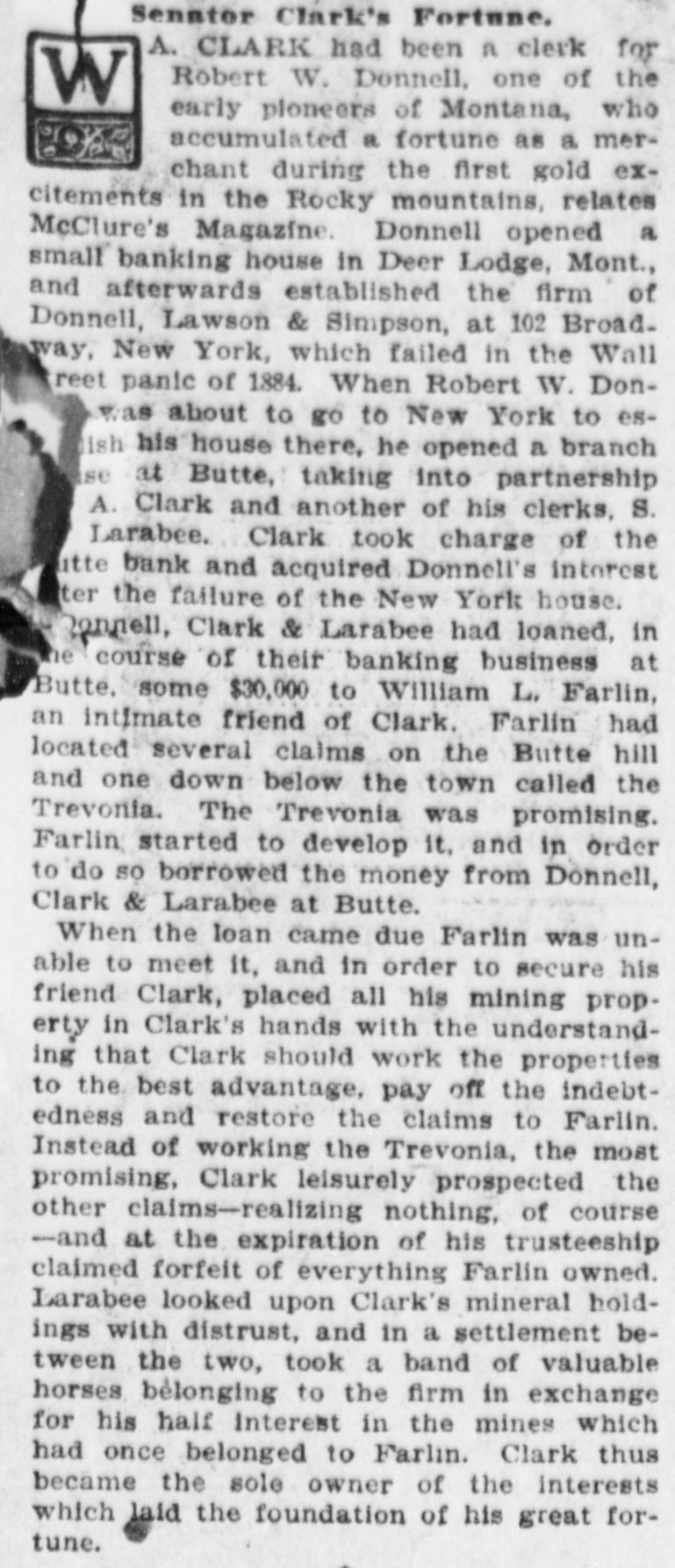
Senator Clark's Fortune. A. CLARK had been R clerk for Robert W. Donnell, one of the W early ploneers of Montana, who accumulated a fortune as a merchant during the first gold excitements in the Rocky mountains, relates McClure's Magazine. Donnell opened a small banking house in Deer Lodge, Mont., and afterwards established the firm of Donnell, Lawson & Simpson, at 102 Broad. way, New York, which failed in the Wall reet panic of 1884. When Robert W. Donwas about to go to New York to esish his house there, he opened a branch se at Butte, taking into partnership A. Clark and another of his clerks, S. Larabee. Clark took charge of the utte bank and acquired Donnell's intorest ter the failure of the New York house. Ronnell, Clark & Larabee had loaned, in the course of their banking business at Butte, some $30,000 to William L. Farlin, an intimate friend of Clark. Farlin had located several claims on the Butte hill and one down below the town called the Trevonia. The Trevonia was promising. Farlin started to develop it, and in order to do so borrowed the money from Donnell, Clark & Larabee at Butte. When the loan came due Farlin was unable to meet It, and in order to secure his friend Clark, placed all his mining property in Clark's hands with the understanding that Clark should work the properties to the best advantage, pay off the indebtedness and restore the claims to Farlin. Instead of working the Trevonia, the most promising, Clark leisurely prospected the other claims-realizing nothing, of course -and at the expiration of his trusteeship claimed forfeit of everything Farlin owned. Larabee looked upon Clark's mineral holdings with distrust, and in a settlement between the two, took a band of valuable horses bΓ©longing to the firm in exchange for his half Interest in the mines which had once belonged to Farlin. Clark thus became the sole owner of the interests which laid the foundation of his great fortune.