Click image to open full size in new tab
Article Text
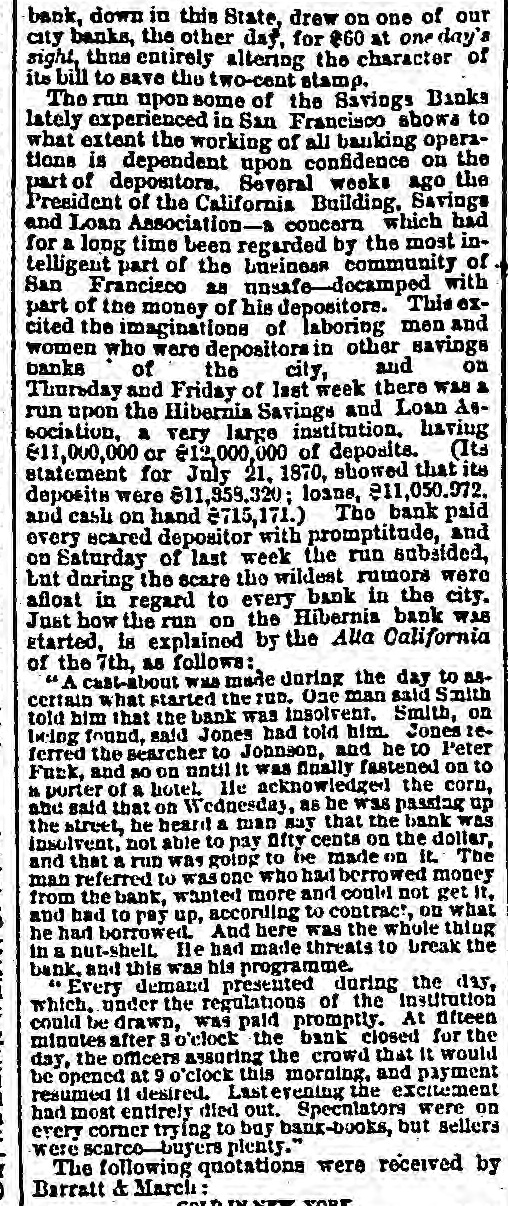
bank, down in this State, drew on one of our
city banks, the other day, for $60 at one day's
sight, thus entirely altering the character of
its bill to save the two-cent stamp.
The run upon some of the Savings Banks
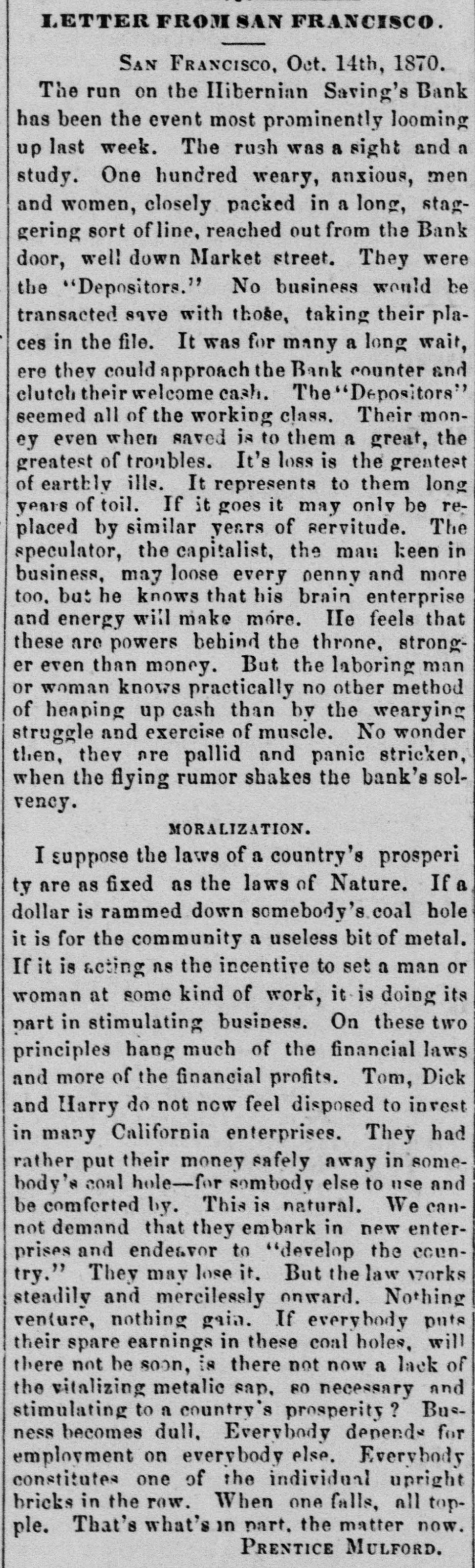
lately experienced in San Francisco shows to
what extent the working of all banking opera-
tions is dependent upon confidence on the
part of depositors. Several weeks ago the
President of the California Building, Savings
and Loan Association-a concern which had
for a long time been regarded by the most in-
telligent part of the business community of
San Francisco as unsafe-decamped with
part of the money of his depositors. This ex-
cited the imaginations of laboring men and
women who were depositors in other savings
banks of the city, and on
Thursday and Friday of last week there was a
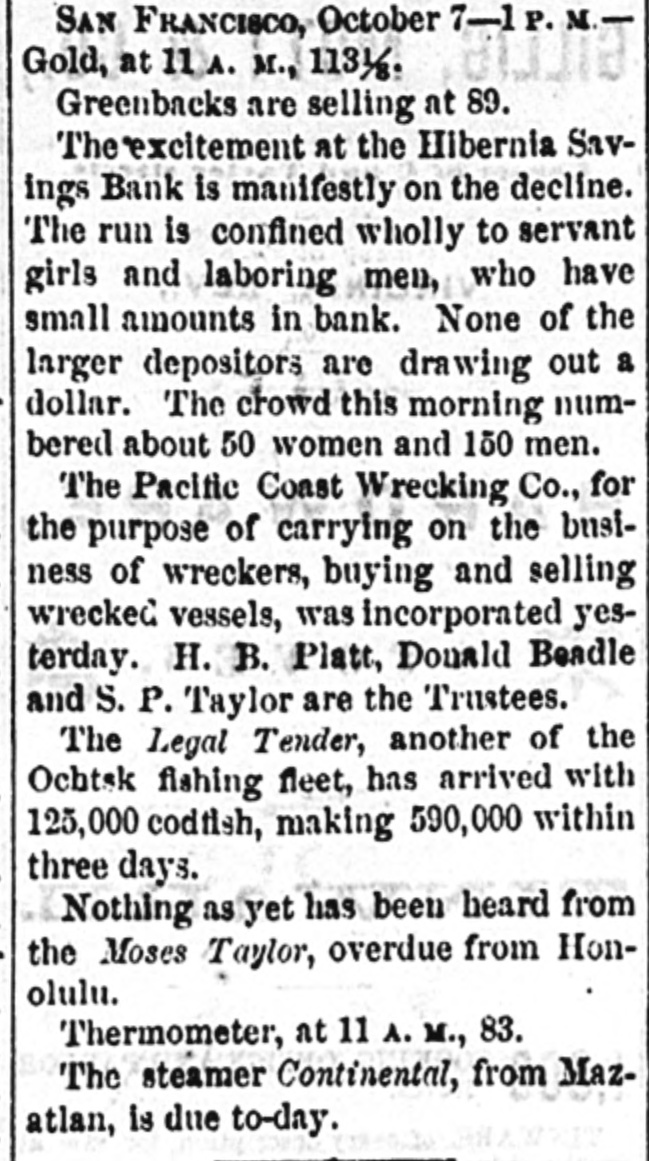
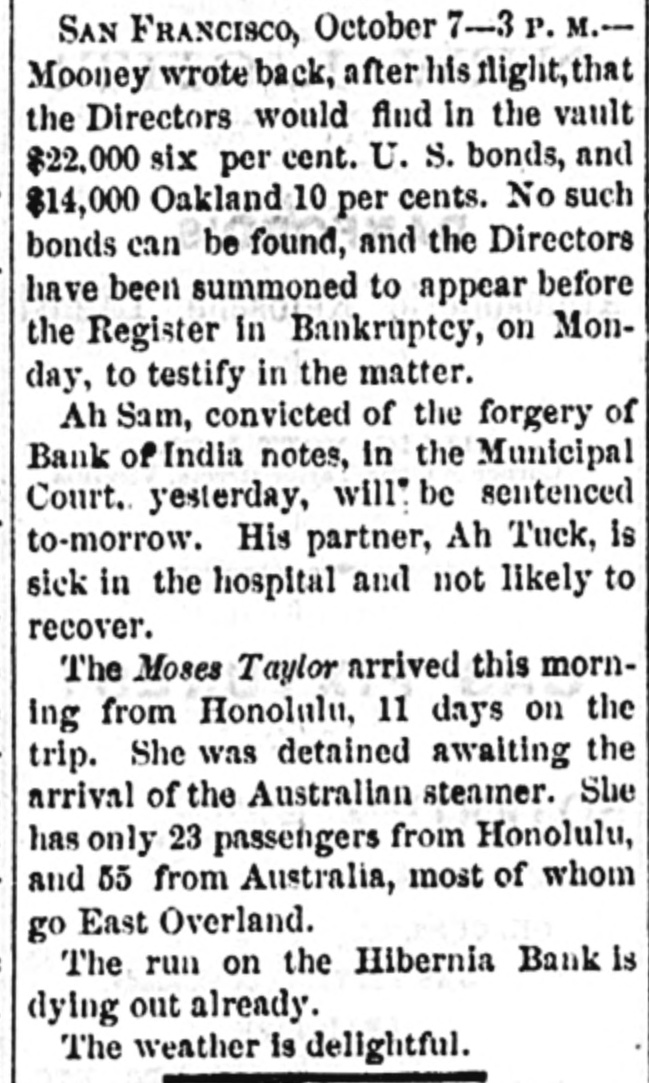
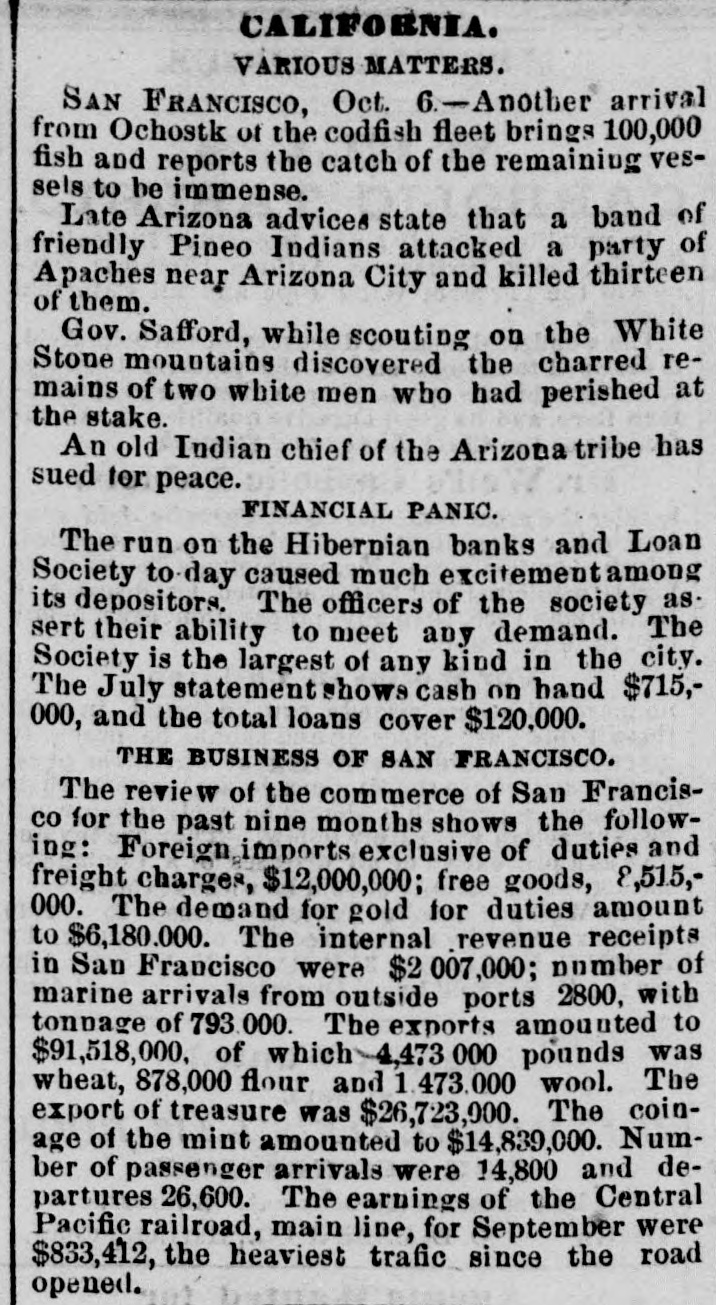
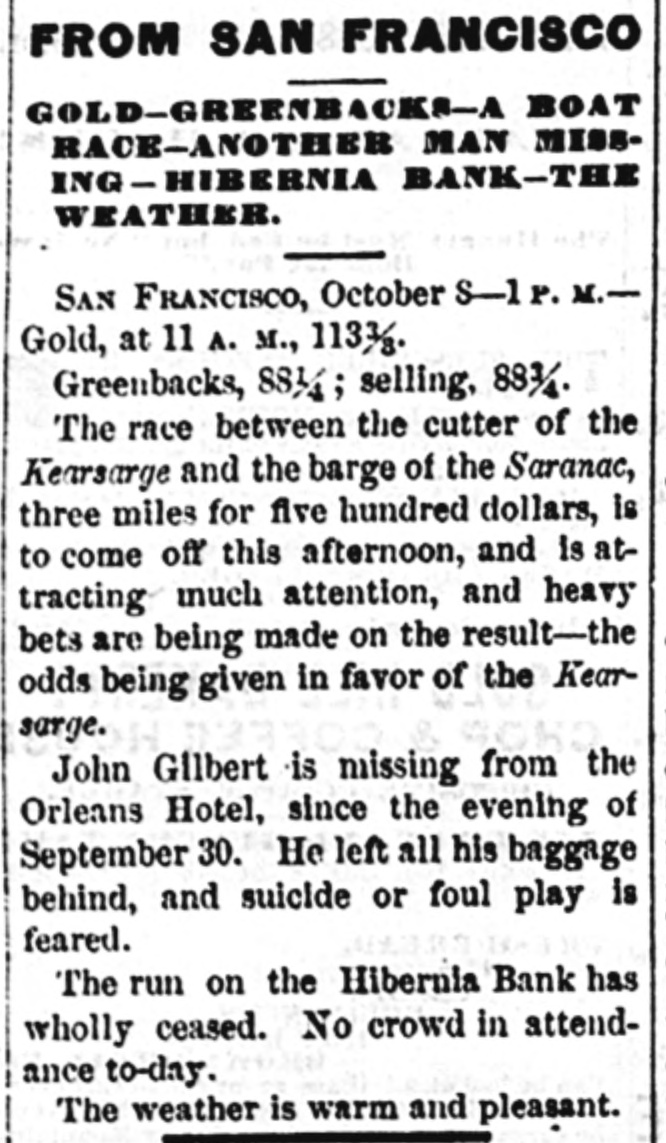
run upon the Hibernia Savings and Loan As-
sociation, a very large institution, having
$11,000,000 or $12,000,000 of deposits. (Its
statement for July 21, 1870, showed that its
deposits were $11,959,320; loans, $11,050.972.
and cash on hand $715,171.) The bank paid
every scared depositor with promptitude, and
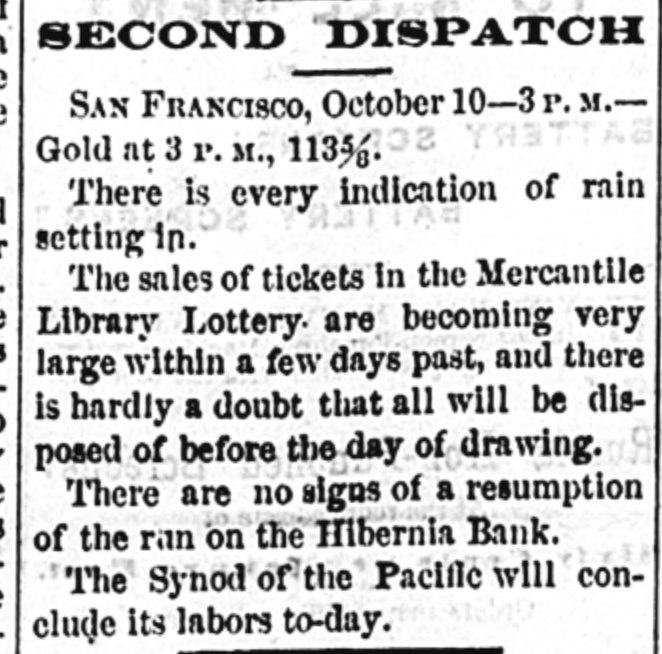
on Saturday of last week the run subsided,
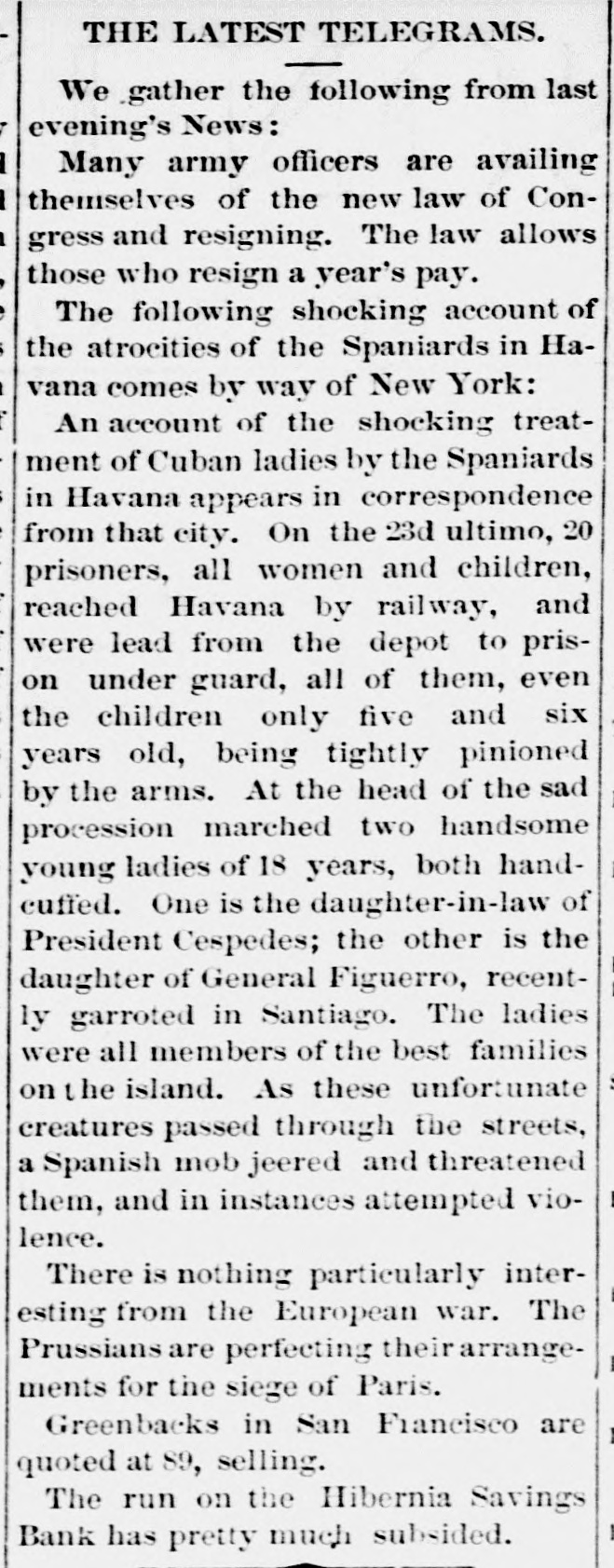
but during the scare the wildest rumors were
afloat in regard to every bank in the city.
Just how the run on the Hibernia bank was
started, is explained by the Alta California
of the 7th, as follows:
"A cast-about was made during the day to as-
certain what started the run. One man said Smith
told him that the bank was insolvent. Smith, on
being found, said Jones had told him. Jones re-
ferred the searcher to Johnson, and he to Peter
Furk, and so on until it was finally fastened on to
a porter of a hotel. He acknowledged the corn,
and said that on Wednesday, as he was passing up
the street, he heard a man say that the bank was
insolvent, not able to pay fifty cents on the dollar,
and that a run was going to be made on it. The
man referred to was one who had borrowed money
from the bank, wanted more and could not get it,
and had to pay up, according to contract, on what
he had borrowed. And here was the whole thing
in a nut-shell. He had made threats to break the
bank, and this was his programme.
"Every demand presented during the day,
which, under the regulations of the institution
could be drawn, was paid promptly. At fifteen
minutes after 3 o'clock the bank closed for the
day, the officers assuring the crowd that it would
be opened at 9 o'clock this morning, and payment
resumed if desired. Last evening the excitement
had most entirely died out. Speculators were on
every corner trying to buy bank-books, but sellers
were scarce-buyers plenty."
The following quotations were received by
Barratt & March: