President T. J. Cornwell allegedly embezzled large sums and fled; receivers were appointed.
Events (2)
1.June 11, 1903Suspension
Cause
Bank Specific Adverse Info
Cause Details
Large shortage/embezzlement by president T. J. Cornwell discovered, prompting closure and suspension.
Newspaper Excerpt
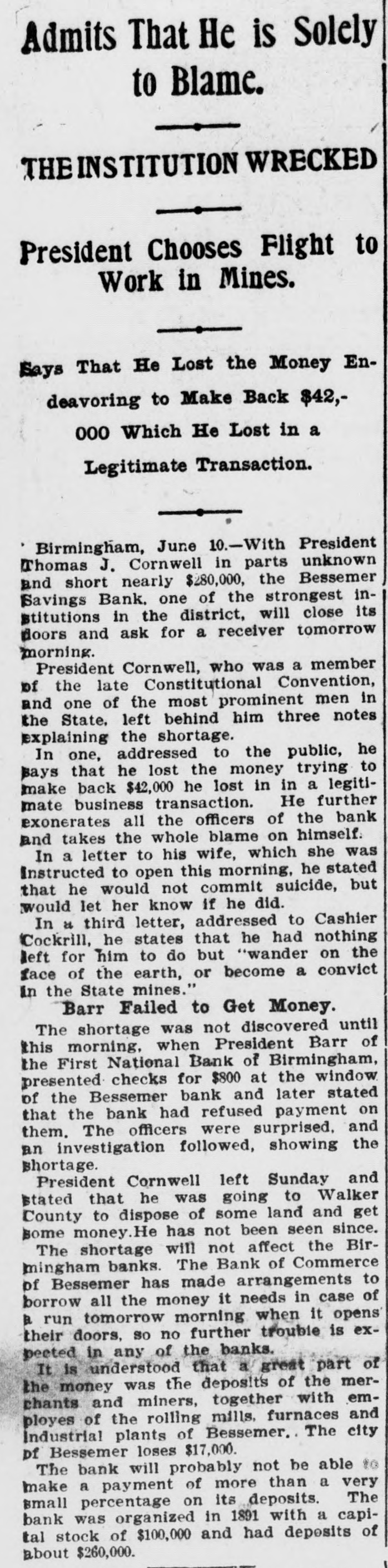
With President T. J. Cornwell in parts unknown and short nearly $280,000, the Bessemer Savings Bank ... will close its doors and ask for a receiver tomorrow morning.
Source
newspapers
+1 day
2.June 12, 1903Receivership
Newspaper Excerpt
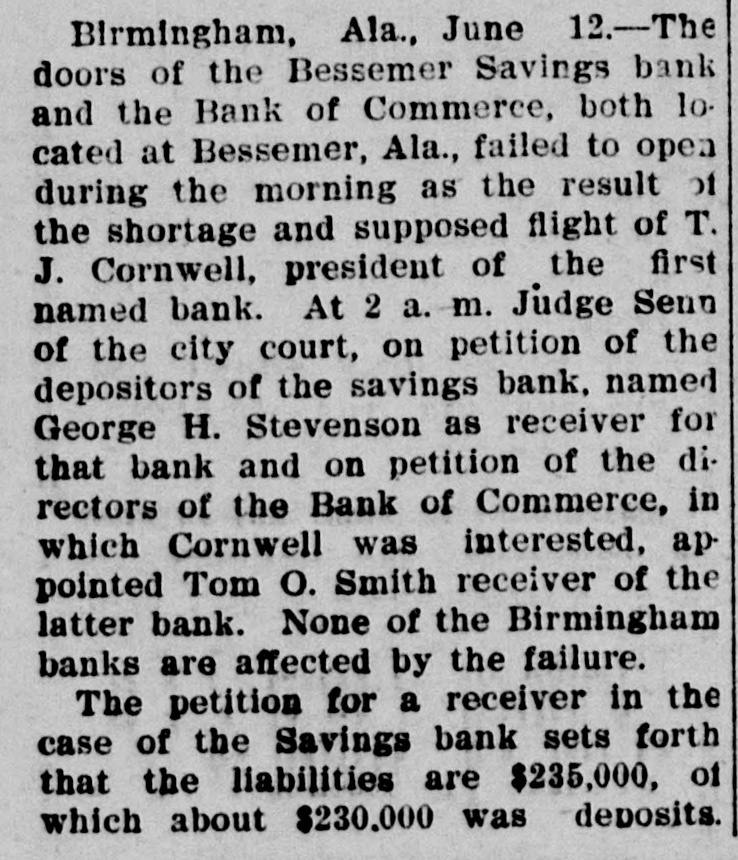
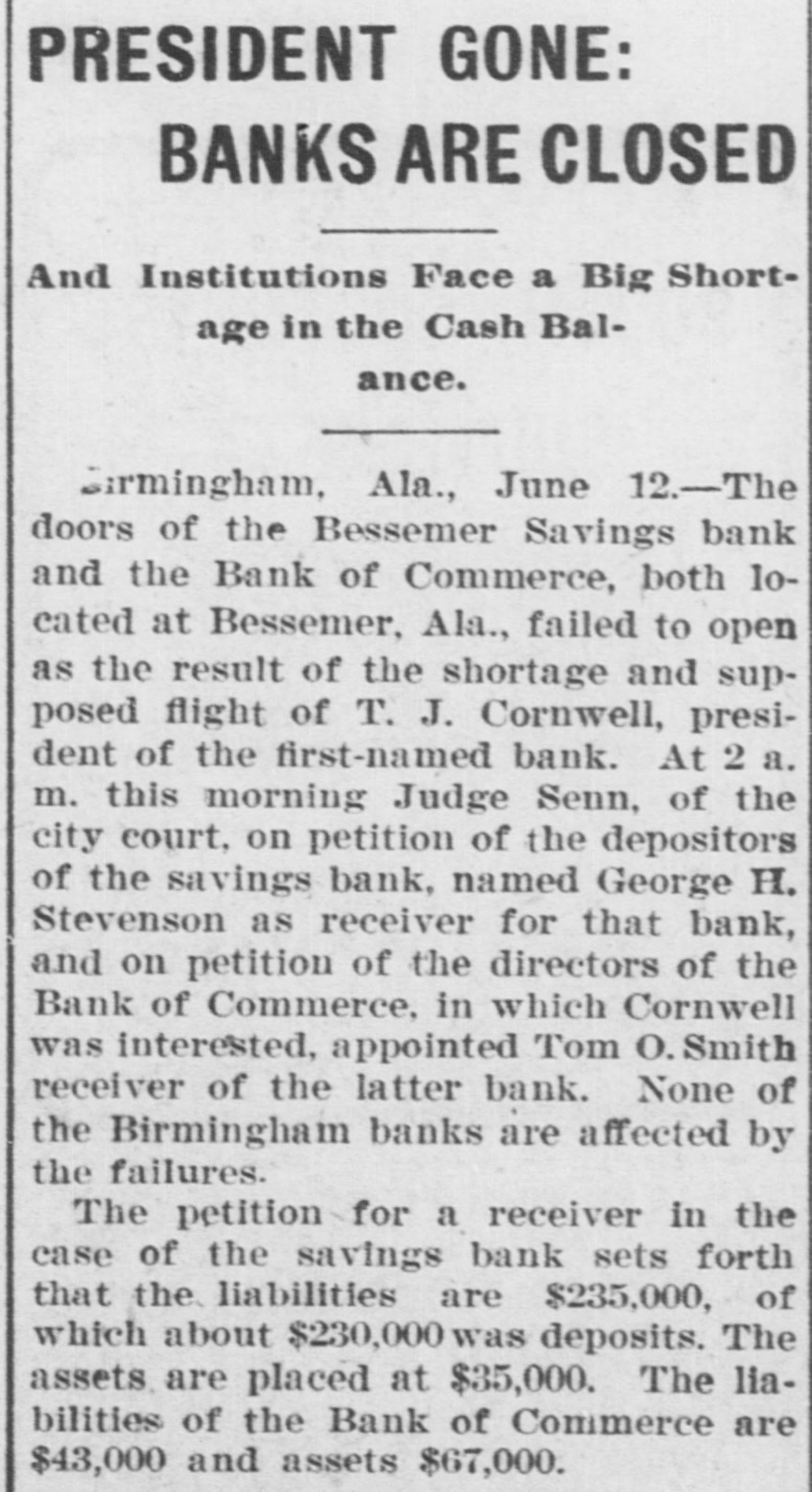
Judge Senn ... named George H. Stevenson as receiver for that bank ... the doors of the Bessemer Savings bank ... failed to open as the result of the shortage and supposed flight of T. J. Cornwell, president of the first-named bank.
Source
newspapers
Newspaper Articles (24)
1.June 11, 1903The Montgomery AdvertiserMontgomery, AL
Click image to open full size in new tab
Article Text
Admits That He is Solely to Blame. THEINSTITUTION WRECKED President Chooses Flight to Work in Mines. Says That He Lost the Money Endeavoring to Make Back $42,000 Which He Lost in a Legitimate Transaction. Birmingham, June 10.-With President Thomas J. Cornwell in parts unknown and short nearly $280,000, the Bessemer Savings Bank. one of the strongest institutions in the district, will close its doors and ask for a receiver tomorrow morning. President Cornwell, who was a member of the late Constitutional Convention, and one of the most prominent men in the State. left behind him three notes explaining the shortage. In one, addressed to the public, he Bays that he lost the money trying to make back $42,000 he lost in in a legitimate business transaction. He further exonerates all the officers of the bank and takes the whole blame on himself. In a letter to his wife, which she was Instructed to open this morning, he stated that he would not commit suicide, but would let her know if he did. In a third letter, addressed to Cashier Cockrill, he states that he had nothing left for him to do but "wander on the face of the earth, or become a convict in the State mines." Barr Failed to Get Money. The shortage was not discovered until this morning, when President Barr of National the First for Bank $800 of Birmingham, the window presented checks at of the Bessemer bank and later stated that the bank had refused payment on them. The officers were surprised, and an investigation followed, showing the shortage. President Cornwell left Sunday and stated that he was going to Walker County to dispose of some land and get not seen not banks. The some mingham The money. shortage He will has Bank been affect of Commerce the since. Bir- to of Bessemer has made arrangements borrow all the money it needs in case of B run tomorrow morning when it opens' their doors, so no further trouble is expeeted in any of the banks. It is understood that a great part of the money was the deposits of the merchants and miners, together with employes of the rolling mills, furnaces and Industrial plants of Bessemer. The city of Bessemer loses $17,000. The bank will probably not be able to make a payment of more than a very small percentage on its deposits. The bank was organized in 1891 with a capital stock of $100,000 and had deposits of about $260,000.
2.June 11, 1903The Birmingham Age-HeraldBirmingham, AL
Click image to open full size in new tab
Article Text
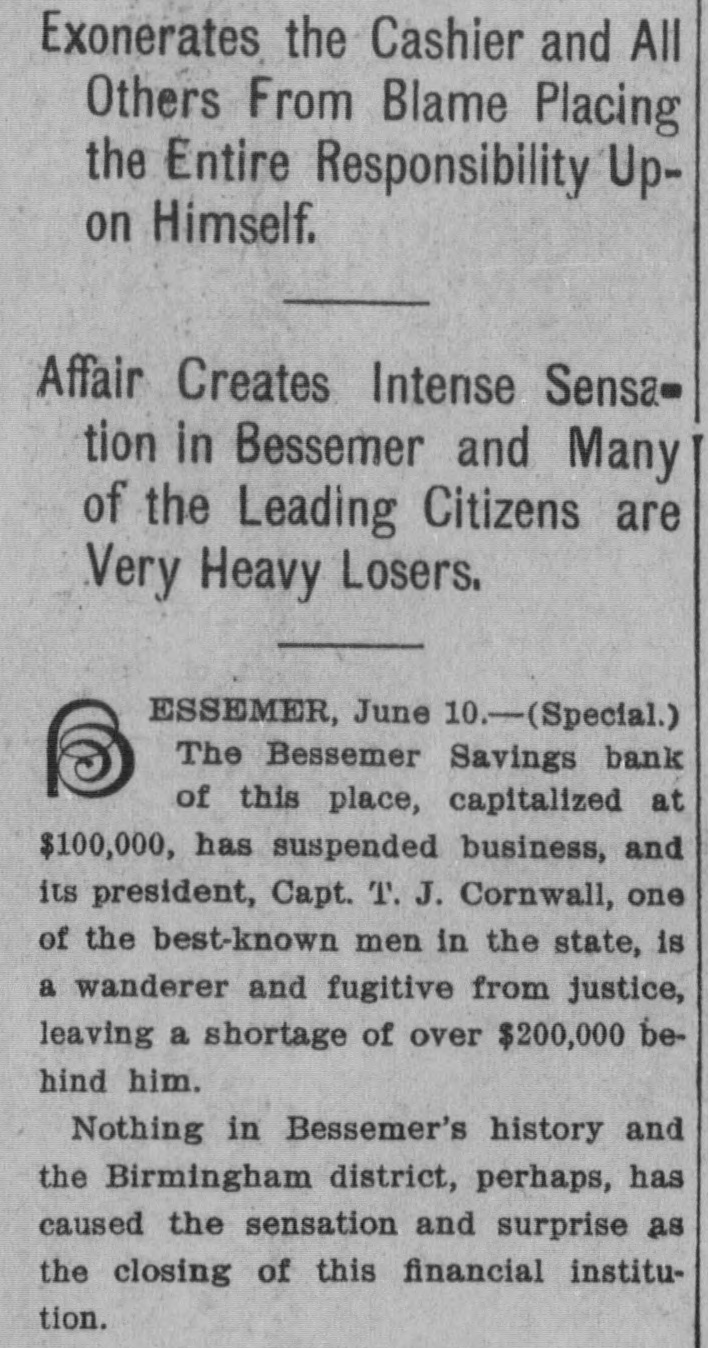
Exonerates the Cashier and All Others From Blame Placing the Entire Responsibility Upon Himself. Affair Creates Intense Sensation in Bessemer and Many of the Leading Citizens are Very Heavy Losers. ESSEMER, June 10.-(Special.) The Bessemer Savings bank of this place, capitalized at $100,000, has suspended business, and its president, Capt. T. J. Cornwall, one of the best-known men in the state, is a wanderer and fugitive from justice, leaving a shortage of over $200,000 behind him. Nothing in Bessemer's history and the Birmingham district, perhaps, has caused the sensation and surprise as the closing of this financial institution.
3.June 12, 1903Bismarck Daily TribuneBismarck, ND
Click image to open full size in new tab
Article Text
Birmingham, Ala., June 12.-The doors of the Bessemer Savings bank and the Bank of Commerce, both 10cated at Bessemer, Ala., failed to open during the morning as the result of the shortage and supposed flight of T. J. Cornwell, president of the first named bank. At 2 a. m. Judge Senn of the city court, on petition of the depositors of the savings bank. named George H. Stevenson as receiver for that bank and on petition of the directors of the Bank of Commerce, in which Cornwell was interested, appointed Tom O. Smith receiver of the latter bank. None of the Birmingham banks are affected by the failure. The petition for a receiver in the case of the Savings bank sets forth that the liabilities are $235,000, of which about $230.000 was deposits.
4.June 12, 1903Rock Island ArgusRock Island, IL
Click image to open full size in new tab
Article Text
PRESIDENT GONE
BANKS ARE CLOSED And Institutions Face a Big Shortage in the Cash Balance. Girmingham, Ala., June 12.-The doors of the Bessemer Savings bank and the Bank of Commerce, both Iocated at Bessemer, Ala., failed to open as the result of the shortage and supposed flight of T. J. Cornwell, president of the first-named bank. At 2 a. m. this morning Judge Senn, of the city court, on petition of the depositors of the savings bank, named George H. Stevenson as receiver for that bank, and on petition of the directors of the Bank of Commerce, in which Cornwell was interested, appointed Tom O. Smith receiver of the latter bank. None of the Birmingham banks are affected by the failures. The petition for a receiver in the case of the savings bank sets forth that the liabilities are $235,000, of which about $230,000 was deposits. The assets are placed at $35,000. The liabilities of the Bank of Commerce are $43,000 and assets $67,000.
5.June 12, 1903Evening StarWashington, DC
Click image to open full size in new tab
Article Text
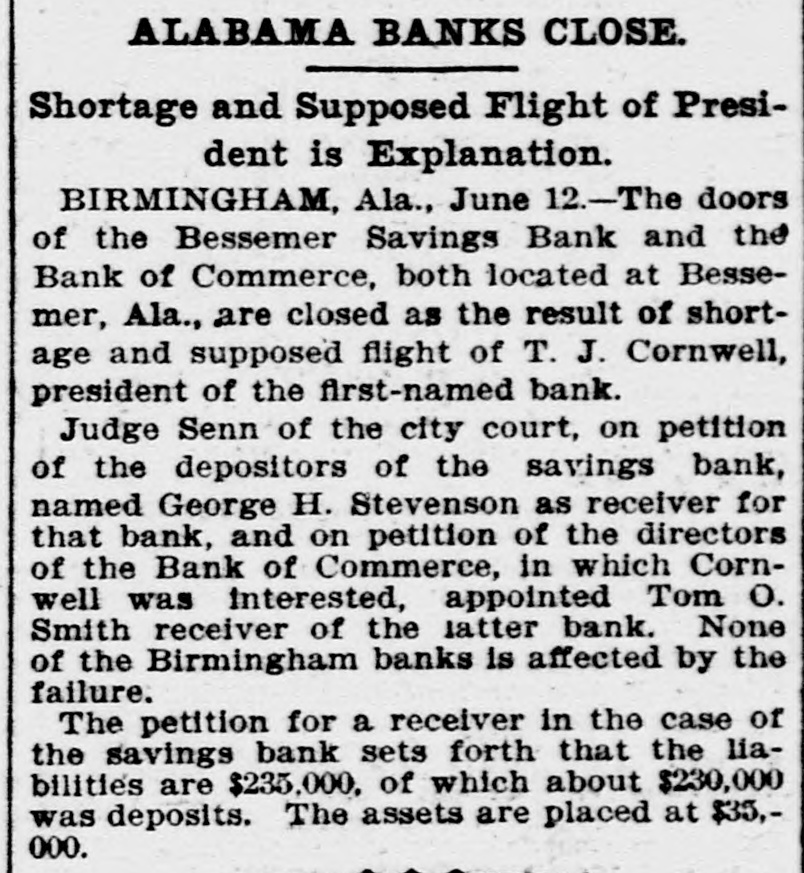
ALABAMA BANKS CLOSE
Shortage and Supposed Flight of President is Explanation. BIRMINGHAM, Ala., June 12.-The doors of the Bessemer Savings Bank and the Bank of Commerce, both located at Bessemer, Ala., are closed as the result of shortage and supposed flight of T. J. Cornwell, president of the first-named bank. Judge Senn of the city court, on petition of the depositors of the savings bank, named George H. Stevenson as receiver for that bank, and on petition of the directors of the Bank of Commerce, in which Cornwell was interested, appointed Tom O. Smith receiver of the latter bank. None of the Birmingham banks is affected by the failure. The petition for a receiver in the case of the savings bank sets forth that the liabilities are $235,000. of which about $230,000 was deposits. The assets are placed at $35,000.
6.June 12, 1903Evening JournalWilmington, DE
Click image to open full size in new tab
Article Text
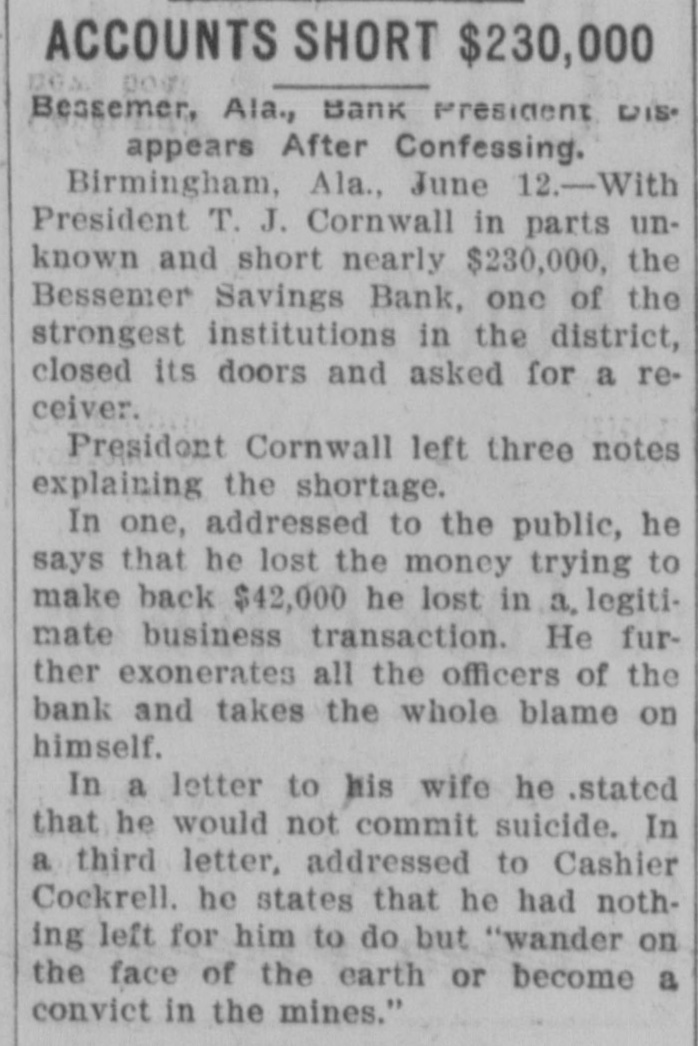
ACCOUNTS SHORT $230,000 DOG Bessemer, Ala., Bank President DIS* appears After Confessing. Birmingham, Ala., June 12.-With President T. J. Cornwall in parts unknown and short nearly $230,000, the Bessemer Savings Bank, one of the strongest institutions in the district, closed its doors and asked for a receiver. President Cornwall left three notes explaining the shortage. In one, addressed to the public, he says that he lost the money trying to make back $42,000 he lost in a, legitimate business transaction. He further exonerates all the officers of the bank and takes the whole blame on himself. In a letter to his wife he .stated that he would not commit suicide. In a third letter, addressed to Cashier Cockrell. he states that he had nothing left for him to do but "wander on the face of the earth or become a convict in the mines."
7.June 13, 1903The Montgomery AdvertiserMontgomery, AL
Click image to open full size in new tab
Article Text
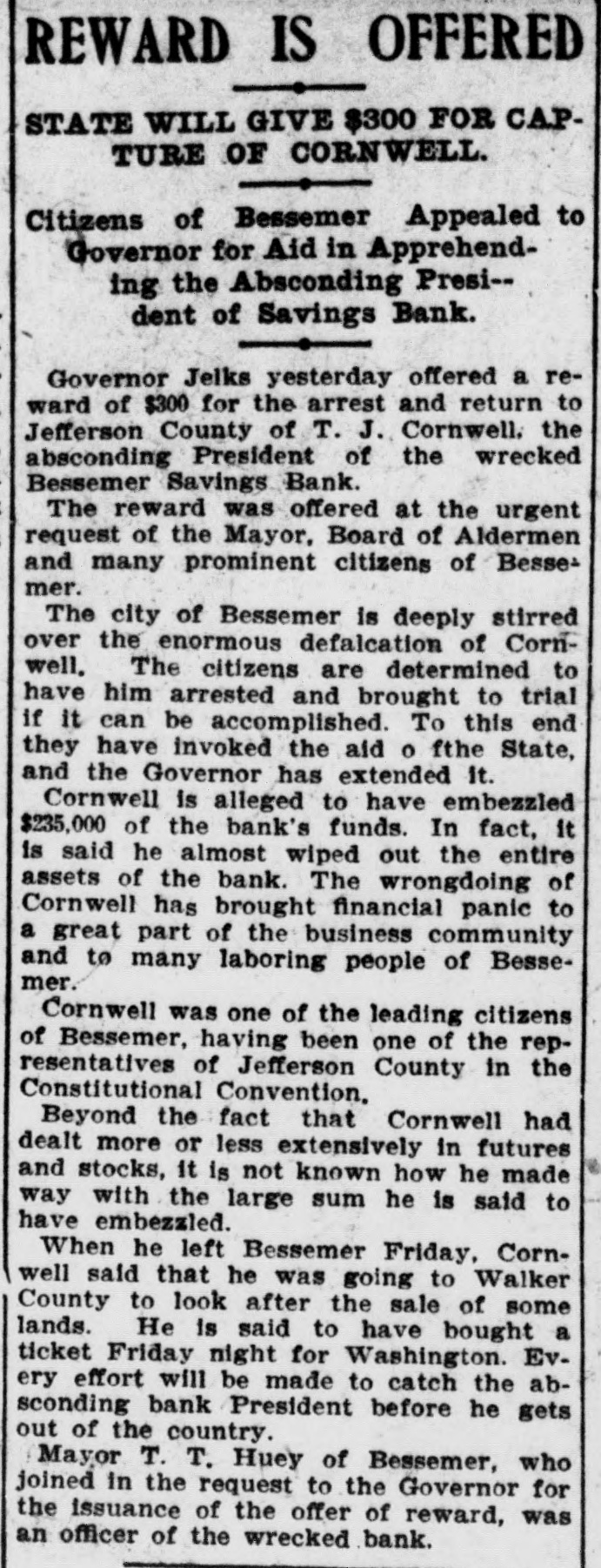
REWARD IS OFFERED STATE WILL GIVE $300 FOR CAPTURE OF CORNWELL. Citizens of Bessemer Appealed to Governor for Aid in Apprehending the Absconding Presi-dent of Savings Bank. Governor Jelks yesterday offered a reward of $300 for the arrest and return to Jefferson County of T. J. Cornwell. the absconding President of the wrecked Bessemer Savings Bank. The reward was offered at the urgent request of the Mayor, Board of Aldermen and many prominent citizens of Bessemer. The city of Bessemer is deeply stirred over the enormous defalcation of Cornwell, The citizens are determined to have him arrested and brought to trial if it can be accomplished. To this end they have invoked the aid o fthe State, and the Governor has extended It. Cornwell is alleged to have embezzled $235,000 of the bank's funds. In fact, it is said he almost wiped out the entire assets of the bank. The wrongdoing of Cornwell has brought financial panic to a great part of the business community and to many laboring people of Bessemer. Cornwell was one of the leading citizens of Bessemer, having been one of the representatives of Jefferson County in the Constitutional Convention. Beyond the fact that Cornwell had dealt more or less extensively in futures and stocks, it is not known how he made way with the large sum he is said to have embezzled. When he left Bessemer Friday, Cornwell said that he was going to Walker County to look after the sale of some lands. He is said to have bought a ticket Friday night for Washington. Every effort will be made to catch the absconding bank President before he gets out of the country. Mayor T. T. Huey of Bessemer, who joined in the request to the Governor for the issuance of the offer of reward, was an officer of the wrecked bank.
8.June 18, 1903The Manitowoc PilotManitowoc, WI
Click image to open full size in new tab
Article Text
Bank Wrecked
Birmingham, Ala., June 11.-With President T. J. Cornwall in parts unknown and short nearly $280,000, the Bessemer savings bank, one of the strongest institutions in the district, has closed its doors and asked for a receiver.
9.June 19, 1903The Aberdeen DemocratAberdeen, SD
Click image to open full size in new tab
Article Text
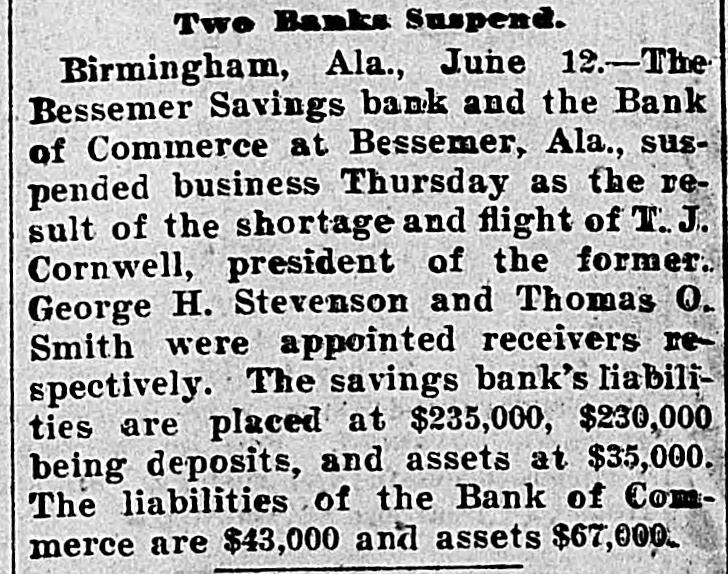
Two Banks Suspend
Birmingham, Ala., June 12.-The Bessemer Savings bank and the Bank of Commerce at Bessemer, Ala., suspended business Thursday as the result of the shortage and flight of T.J. Cornwell, president of the former. George H. Stevenson and Thomas O. Smith were appointed receivers respectively. The savings bank's liabilities are placed at $235,000, $230,000 being deposits, and assets at $35,000. The liabilities of the Bank of Commerce are $43,000 and assets $67,000.
10.June 19, 1903The Birmingham Age-HeraldBirmingham, AL
Click image to open full size in new tab
Article Text
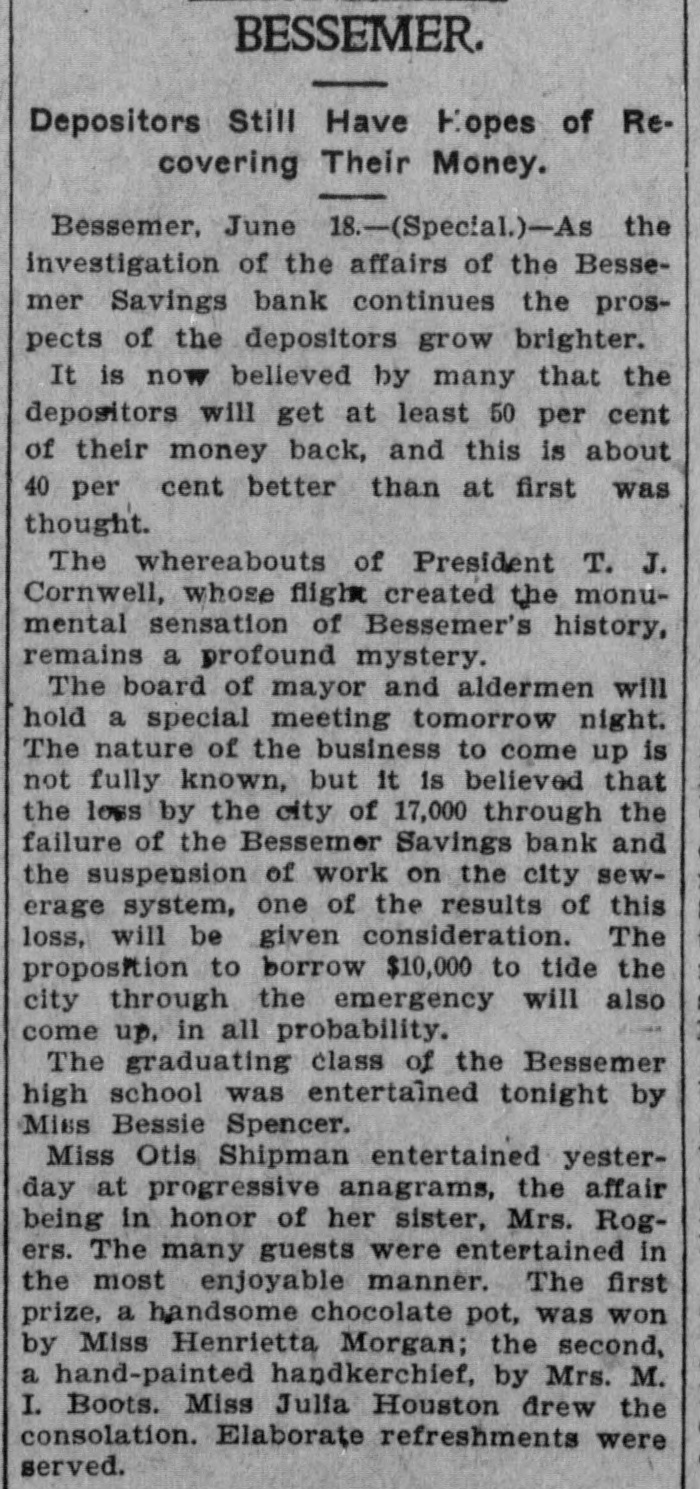
BESSEMER
Depositors Still Have Hopes of Recovering Their Money. Bessemer, June 18.-(Special.)-As the investigation of the affairs of the Bessemer Savings bank continues the prospects of the depositors grow brighter. It is now belleved by many that the depositors will get at least 50 per cent of their money back, and this is about 40 per cent better than at first was thought. The whereabouts of President T. J. Cornwell, whose flight created the monumental sensation of Bessemer's history, remains a profound mystery. The board of mayor and aldermen will hold a special meeting tomorrow night. The nature of the business to come up is not fully known, but it is believed that the loss by the city of 17,000 through the failure of the Bessemer Savings bank and the suspension of work on the city sewerage system, one of the results of this loss, will be given consideration. The proposition to borrow $10,000 to tide the city through the emergency will also come up, in all probability. The graduating class of the Bessemer high school was entertained tonight by Miss Bessie Spencer. Miss Otis Shipman entertained yesterday at progressive anagrams, the affair being in honor of her sister, Mrs. Rogers. The many guests were entertained in the most enjoyable manner. The first prize, a handsome chocolate pot, was won by Miss Henrietta Morgan; the second, a hand-painted handkerchief, by Mrs. M. I. Boots. Miss Julia Houston drew the consolation. Elaborate refreshments were served.
11.June 19, 1903The Ely MinerEly, MN
Click image to open full size in new tab
Article Text
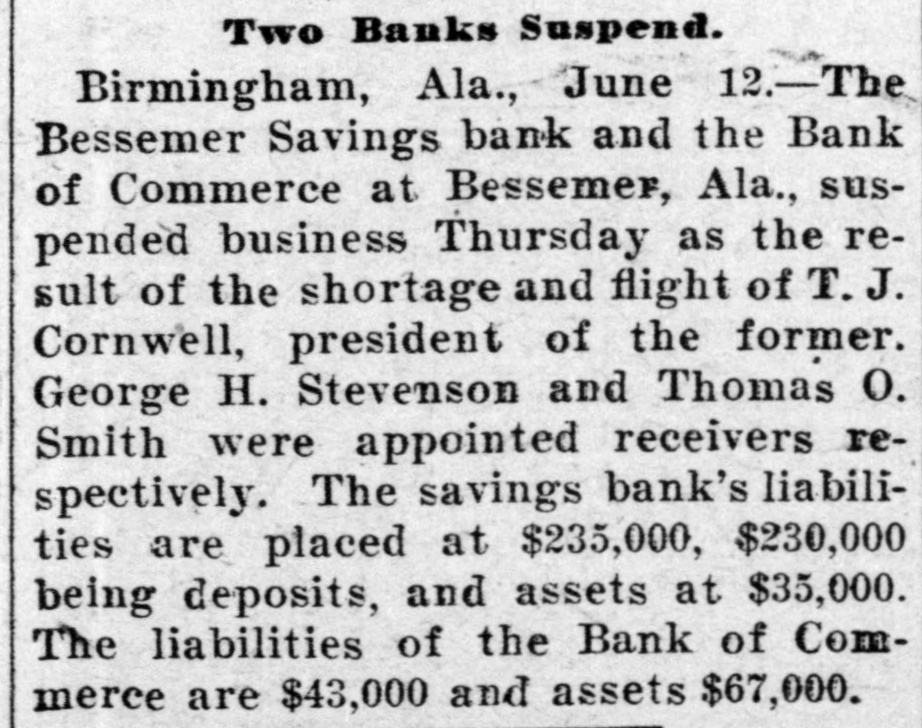
Two Banks Suspend
Birmingham, Ala., June 12.-The Bessemer Savings bank and the Bank of Commerce at Bessemer, Ala., suspended business Thursday as the result of the shortage and flight of T.J. Cornwell, president of the former. George H. Stevenson and Thomas O. Smith were appointed receivers respectively. The savings bank's liabilities are placed at $235,000, $230,000 being deposits, and assets at $35,000. The liabilities of the Bank of Commerce are $43,000 and assets $67,000.
12.June 20, 1903Watertown RepublicanWatertown, WI
Click image to open full size in new tab
Article Text
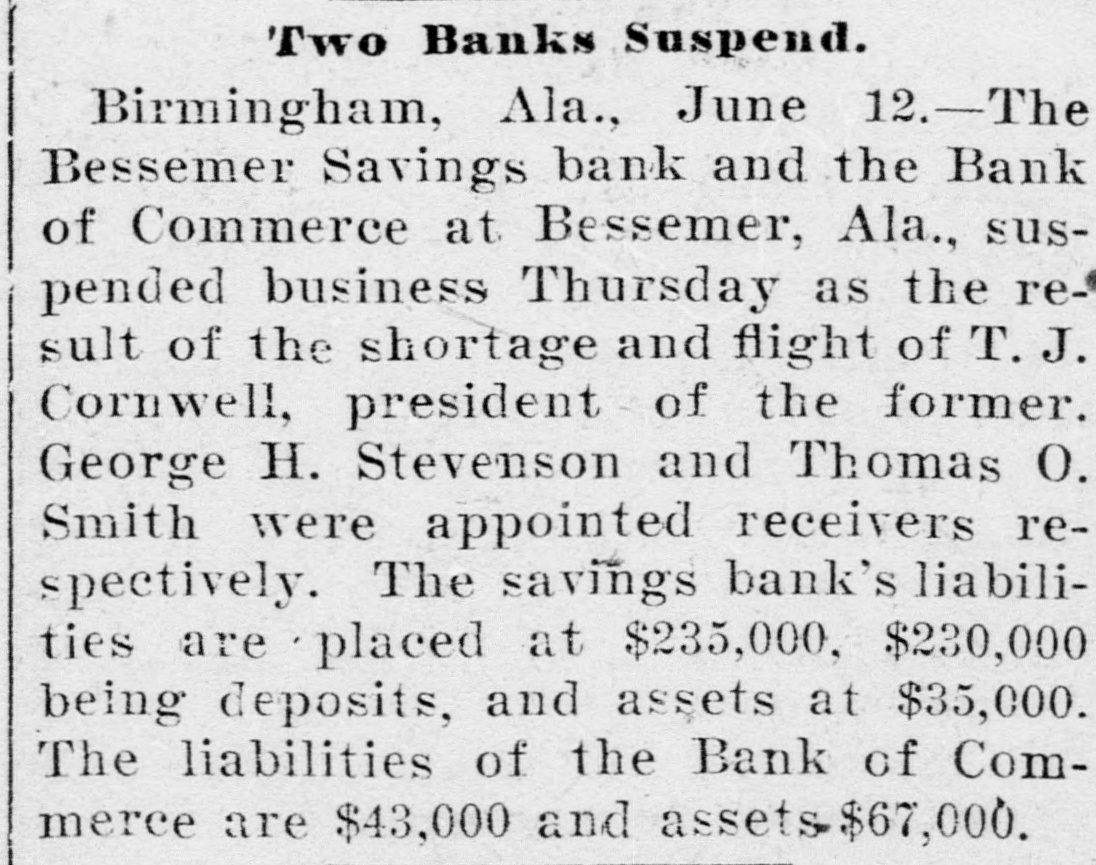
Two Banks Suspend
Birmingham, Ala., June 12.-The Bessemer Savings bank and the Bank of Commerce at Bessemer, Ala., suspended business Thursday as the result of the shortage and flight of T.J. Cornwell, president of the former. George H. Stevenson and Thomas O. Smith were appointed receivers respectively. The savings bank's liabilities are placed at $235,000, $230,000 being deposits, and assets at $35,000. The liabilities of the Bank of Commerce are $43,000 and assets. $67,000.
13.July 1, 1903The Montgomery AdvertiserMontgomery, AL
Click image to open full size in new tab
Article Text
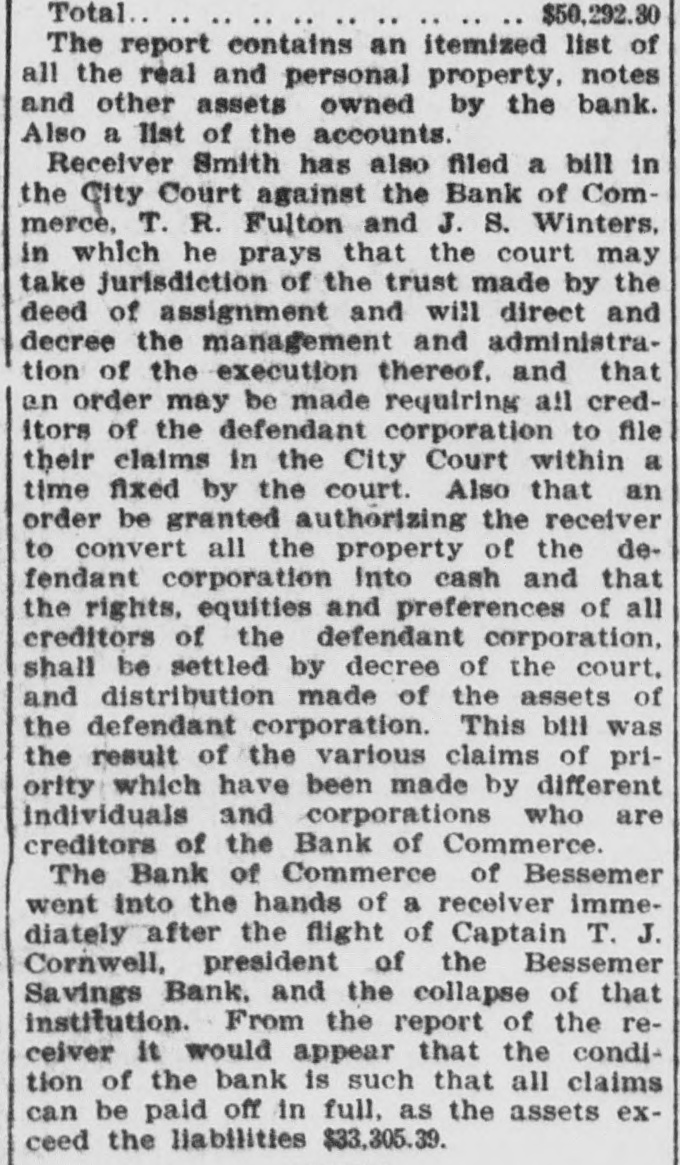
Total $50,292.30 The report contains an itemized list of all the real and personal property, notes and other assets owned by the bank. Also a list of the accounts. Receiver Smith has also filed a bill in the City Court against the Bank of Commerce, T. R. Fulton and J. S. Winters. in which he prays that the court may take jurisdiction of the trust made by the deed of assignment and will direct and decree the management and administration of the execution thereof. and that an order may be made requiring all creditors of the defendant corporation to file their claims in the City Court within a time fixed by the court. Also that an order be granted authorizing the receiver to convert all the property of the defendant corporation into cash and that the rights, equities and preferences of all creditors of the defendant corporation, shall be settled by decree of the court, and distribution made of the assets of the defendant corporation. This bill was the result of the various claims of priority which have been made by different individuals and corporations who are creditors of the Bank of Commerce. The Bank of Commerce of Bessemer went into the hands of a receiver immediately after the flight of Captain T. J. Cornwell, president of the Bessemer Savings Bank, and the collapse of that institution. From the report of the receiver it would appear that the condition of the bank is such that all claims can be paid off in full, as the assets exceed the liabilities $33,305.39.
14.July 7, 1903The Birmingham Age-HeraldBirmingham, AL
Click image to open full size in new tab
Article Text
Real Estate Not Included
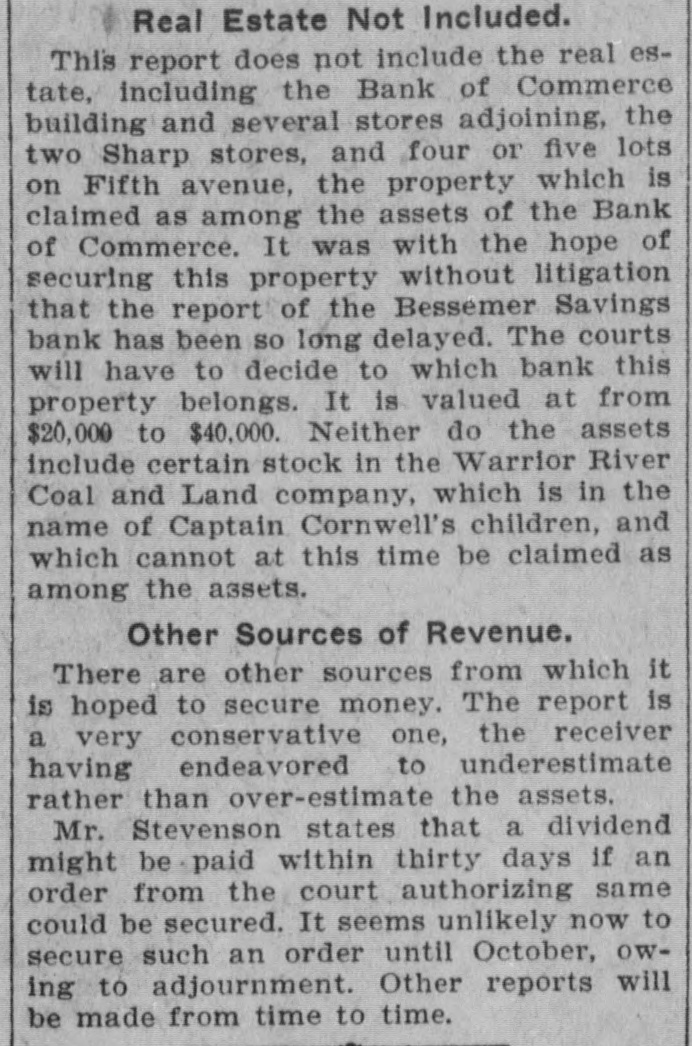
This report does not include the real estate, including the Bank of Commerce building and several stores adjoining, the two Sharp stores, and four or five lots on Fifth avenue, the property which is claimed as among the assets of the Bank of Commerce. It was with the hope of securing this property without litigation that the report of the Bessemer Savings bank has been so long delayed. The courts will have to decide to which bank this property belongs. It is valued at from $20,000 to $40,000. Neither do the assets include certain stock in the Warrior River Coal and Land company, which is in the name of Captain Cornwell's children, and which cannot at this time be claimed as among the assets. Other Sources of Revenue. There are other sources from which it is hoped to secure money. The report is a very conservative one, the receiver having endeavored to underestimate rather than over-estimate the assets. Mr. Stevenson states that a dividend might be paid within thirty days if an order from the court authorizing same could be secured. It seems unlikely now to secure such an order until October, owing to adjournment. Other reports will be made from time to time.
15.March 27, 1904The Montgomery AdvertiserMontgomery, AL
Click image to open full size in new tab
Article Text
Contests Sale of Property.
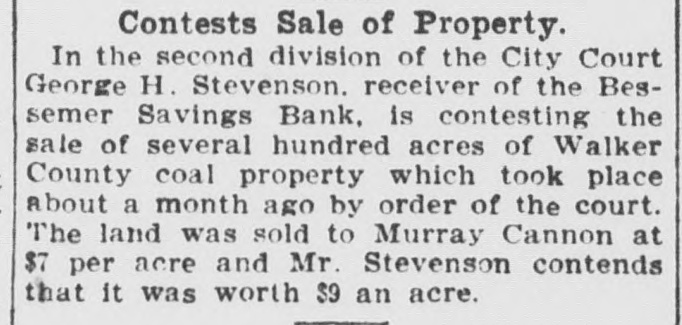
In the second division of the City Court George H. Stevenson, receiver of the Bessemer Savings Bank, is contesting the sale of several hundred acres of Walker County coal property which took place about a month ago by order of the court. The land was sold to Murray Cannon at $7 per acre and Mr. Stevenson contends that it was worth $9 an acre.
16.June 2, 1904The Montgomery AdvertiserMontgomery, AL
Click image to open full size in new tab
Article Text
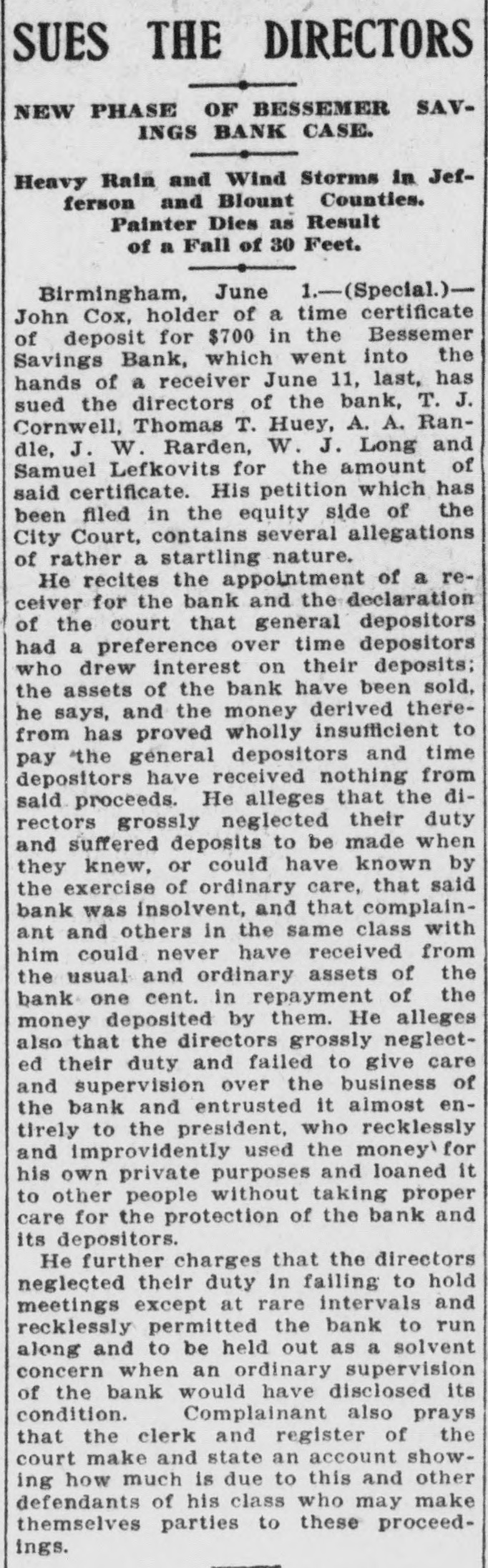
SUES THE DIRECTORS NEW PHASE OF BESSEMER SAVINGS BANK CASE. Heavy Rain and Wind Storms in Jefferson and Blount Counties. Painter Dies as Result of a Fall of 30 Feet. Birmingham, June 1.-(Special.)John Cox, holder of a time certificate of deposit for $700 in the Bessemer Savings Bank, which went into the hands of a receiver June 11, last, has sued the directors of the bank, T. J. Cornwell, Thomas T. Huey, A. A. Randle, J. W. Rarden, W. J. Long and Samuel Lefkovits for the amount of said certificate. His petition which has been filed in the equity side of the City Court, contains several allegations of rather a startling nature. He recites the appointment of a receiver for the bank and the declaration of the court that general depositors had a preference over time depositors who drew interest on their deposits; the assets of the bank have been sold, he says, and the money derived therefrom has proved wholly insufficient to pay the géneral depositors and time depositors have received nothing from said proceeds. He alleges that the directors grossly neglected their duty and suffered deposits to be made when they knew, or could have known by the exercise of ordinary care, that said bank was insolvent, and that complainant and others in the same class with him could never have received from the usual and ordinary assets of the bank one cent. in repayment of the money deposited by them. He alleges also that the directors grossly neglected their duty and failed to give care and supervision over the business of the bank and entrusted it almost entirely to the president, who recklessly and improvidently used the money\ for his own private purposes and loaned it to other people without taking proper care for the protection of the bank and its depositors. He further charges that the directors neglected their duty in failing to hold meetings except at rare intervals and recklessly permitted the bank to run along and to be held out as a solvent concern when an ordinary supervision of the bank would have disclosed its condition. Complainant also prays that the clerk and register of the court make and state an account showing how much is due to this and other defendants of his class who may make themselves parties to these proceedings.
17.December 23, 1904The Birmingham Age-HeraldBirmingham, AL
Click image to open full size in new tab
Article Text
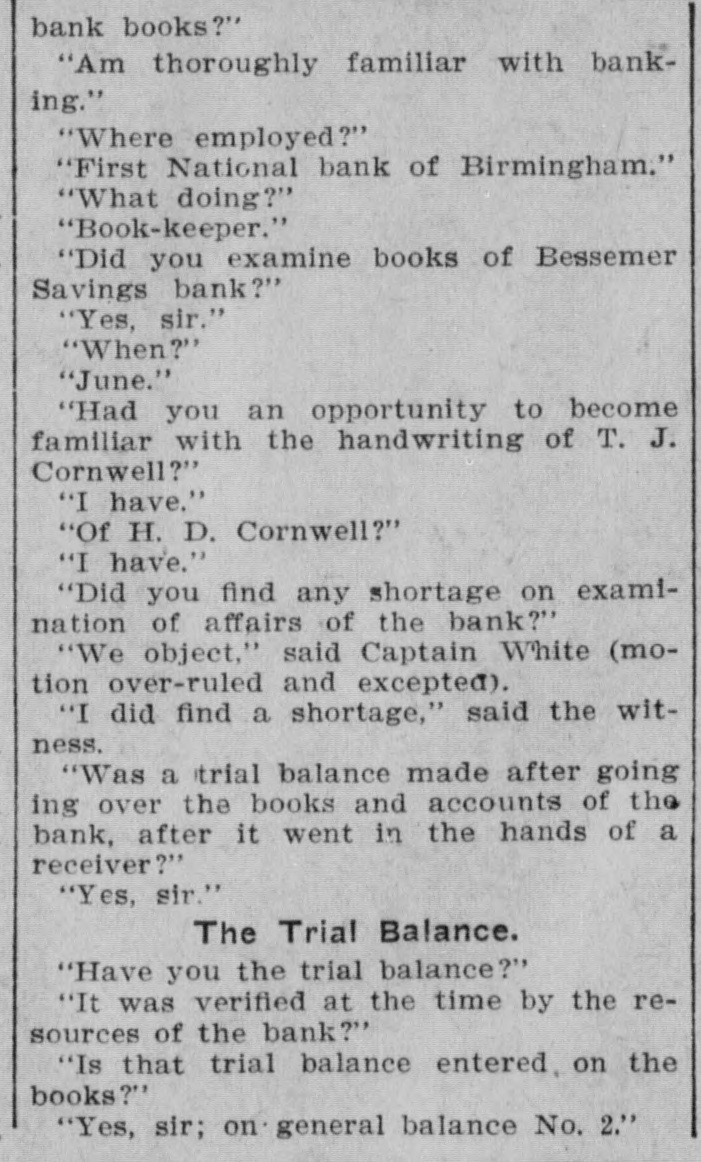
"bank books?" "Am thoroughly familiar with banking."
"Where employed?" "First National bank of Birmingham." "What doing?" "Book-keeper." "Did you examine books of Bessemer Savings bank?" "Yes, sir." "When?" "June." "Had you an opportunity to become familiar with the handwriting of T. J. Cornwell?" "I have." "Of H. D. Cornwell?" "I have." "Did you find any shortage on exami- nation of affairs of the bank?" "We object," said Captain White (mo- tion over-ruled and excepted). "I did find a shortage," said the wit- ness. "Was a trial balance made after going ing over the books and accounts of the bank, after it went in the hands of a receiver?" "Yes, sir."
### The Trial Balance.
"Have you the trial balance?" "It was verified at the time by the re- sources of the bank?" "Is that trial balance entered on the books?" "Yes, sir; on general balance No. 2."
18.December 24, 1904The Birmingham Age-HeraldBirmingham, AL
Click image to open full size in new tab
Article Text
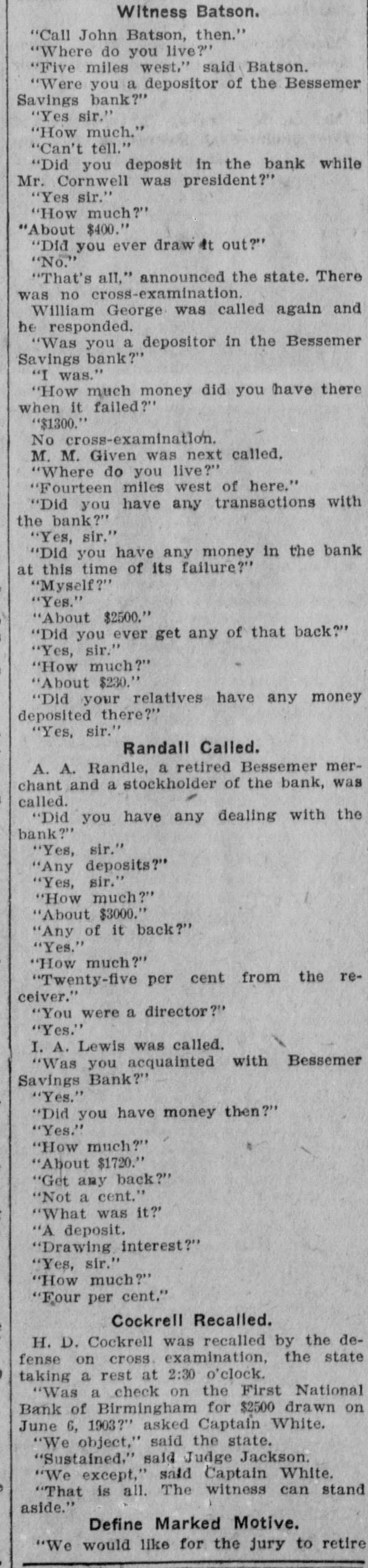
Witness Batson.
"Call John Batson, then." "Where do you live?" "Five miles west," said Batson. "Were you a depositor of the Bessemer Savings bank?" "Yes sir." "How much." "Can't tell." "Did you deposit in the bank while Mr. Cornwell was president?" "Yes sir." "How much?" "About $400." "Did you ever draw it out?" "No." "That's all," announced the state. There was no cross-examination. William George was called again and he responded. "Was you a depositor in the Bessemer Savings bank?" "I was." "How much money did you have there when it failed?" "$1300." No cross-examination. M. M. Given was next called. "Where do you live?" "Fourteen miles west of here." "Did you have any transactions with the bank?" "Yes, sir." "Did you have any money in the bank at this time of its failure?" "Myself?" "Yes." "About $2500." "Did you ever get any of that back?" "Yes, sir." "How much?" "About $230." "Did your relatives have any money deposited there?" "Yes, sir."
Randall Called.
A. A. Randle, a retired Bessemer merchant and a stockholder of the bank, was called. "Did you have any dealing with the bank?" "Yes, sir." "Any deposits?" "Yes, sir." "How much?" "About $3000." "Any of it back?" "Yes." "How much?" "Twenty-five per cent from the receiver." "You were a director?" "Yes." I. A. Lewis was called. "Was you acquainted with Bessemer Savings Bank?" "Yes." "Did you have money then?" "Yes." "How much?" "About $1720." "Get any back?" "Not a cent." "What was it?" "A deposit. "Drawing interest?" "Yes, sir." "How much?" "Four per cent."
Cockrell Recalled.
H. D. Cockrell was recalled by the defense on cross examination, the state taking a rest at 2:30 o'clock. "Was a check on the First National Bank of Birmingham for $2500 drawn on June 6, 1903?" asked Captain White. "We object," said the state. "Sustained," said Judge Jackson. "We except," said Captain White. "That is all. The witness can stand aside."
Define Marked Motive.
"We would like for the jury to retire
19.January 10, 1905The Birmingham Age-HeraldBirmingham, AL
Click image to open full size in new tab
Article Text
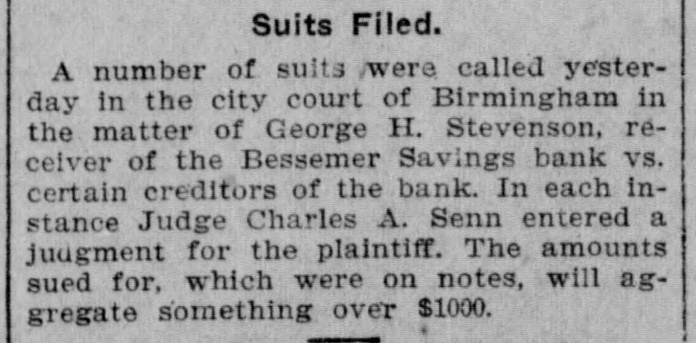
Suits Filed.
A number of suits were called yesterday in the city court of Birmingham in the matter of George H. Stevenson, receiver of the Bessemer Savings bank vs. certain creditors of the bank. In each instance Judge Charles A. Senn entered a judgment for the plaintiff. The amounts sued for, which were on notes, will aggregate something over $1000.
20.February 3, 1905The Birmingham Age-HeraldBirmingham, AL
Click image to open full size in new tab
Article Text
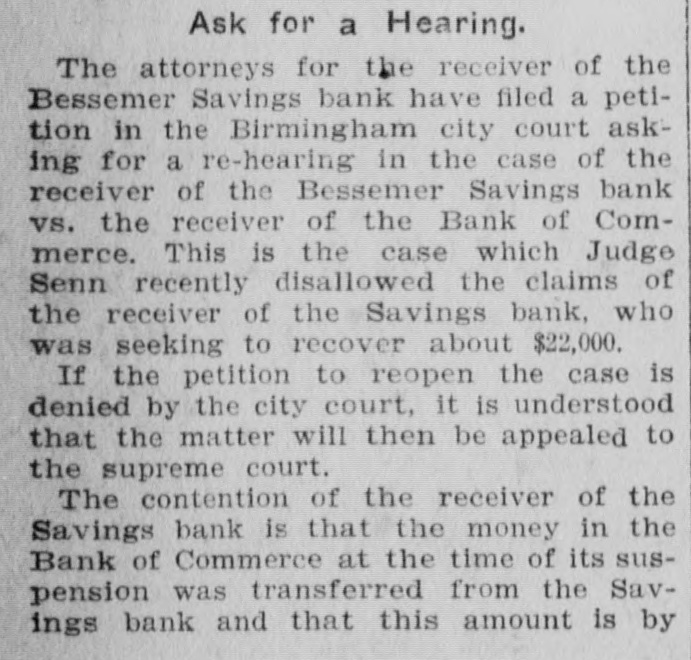
Ask for a Hearing
The attorneys for the receiver of the Bessemer Savings bank have filed a petition in the Birmingham city court asking for a re-hearing in the case of the receiver of the Bessemer Savings bank vs. the receiver of the Bank of Commerce. This is the case which Judge Senn recently disallowed the claims of the receiver of the Savings bank, who was seeking to recover about $22,000. If the petition to reopen the case is denied by the city court, it is understood that the matter will then be appealed to the supreme court. The contention of the receiver of the Savings bank is that the money in the Bank of Commerce at the time of its suspension was transferred from the Savings bank and that this amount is by
21.April 19, 1905The Birmingham Age-HeraldBirmingham, AL
Click image to open full size in new tab
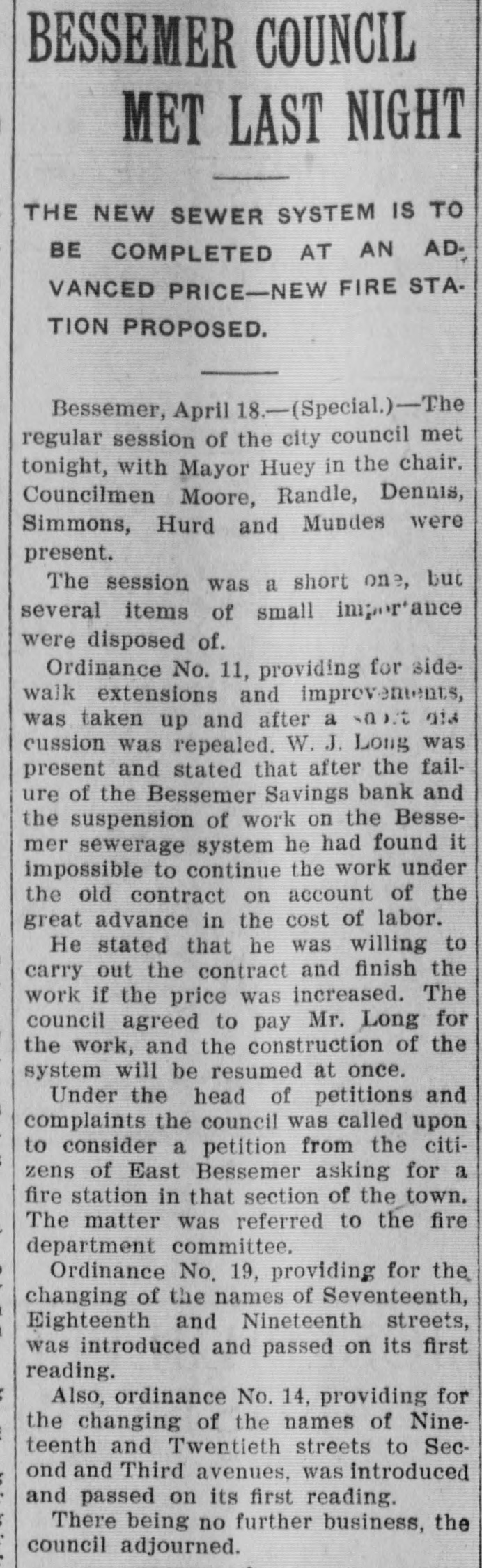
Article Text
BESSEMER COUNCIL MET LAST NIGHT THE NEW SEWER SYSTEM IS TO BE COMPLETED AT AN AD-, VANCED PRICE-NEW FIRE STATION PROPOSED. Bessemer, April 18.-(Special.)-The regular session of the city council met tonight, with Mayor Huey in the chair. Councilmen Moore, Randle, Dennis, Simmons, Hurd and Mundes were present. The session was a short one, but several items of small importance were disposed of. Ordinance No. 11, providing for sidewalk extensions and improvements, was taken up and after a sn 014 cussion was repealed. W. J. Long was present and stated that after the failure of the Bessemer Savings bank and the suspension of work on the Bessemer sewerage system he had found it impossible to continue the work under the old contract on account of the great advance in the cost of labor. He stated that he was willing to carry out the contract and finish the work if the price was increased. The council agreed to pay Mr. Long for the work, and the construction of the system will be resumed at once. Under the head of petitions and complaints the council was called upon to consider a petition from the citizens of East Bessemer asking for a fire station in that section of the town. The matter was referred to the fire department committee. Ordinance No. 19, providing for the changing of the names of Seventeenth, Eighteenth and Nineteenth streets, was introduced and passed on its first reading. Also, ordinance No. 14, providing for the changing of the names of Nineteenth and Twentieth streets to Second and Third avenues, was introduced and passed on its first reading. There being no further business, the council adjourned.
22.April 26, 1905The Montgomery AdvertiserMontgomery, AL
Click image to open full size in new tab
Article Text
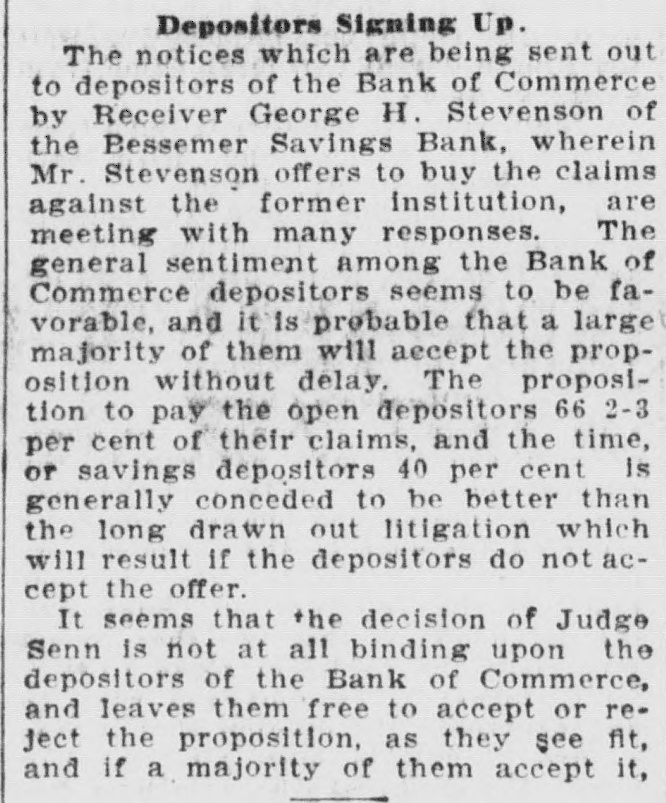
Depositors Signing Up
The notices which are being sent out to depositors of the Bank of Commerce by Receiver George H. Stevenson of the Bessemer Savings Bank, wherein Mr. Stevenson offers to buy the claims against the former institution, are meeting with many responses. The general sentiment among the Bank of Commerce depositors seems to be favorable, and it is probable that a large majority of them will accept the proposition without delay. The proposition to pay the open depositors 66 2-3 per cent of their claims, and the time, or savings depositors 40 per cent is generally conceded to be better than the long drawn out litigation which will result if the depositors do not accept the offer. It seems that the decision of Judge Senn is not at all binding upon the depositors of the Bank of Commerce, and leaves them free to accept or reject the proposition, as they see fit, and if a majority of them accept it,
23.July 11, 1905The Montgomery AdvertiserMontgomery, AL
Click image to open full size in new tab
Article Text
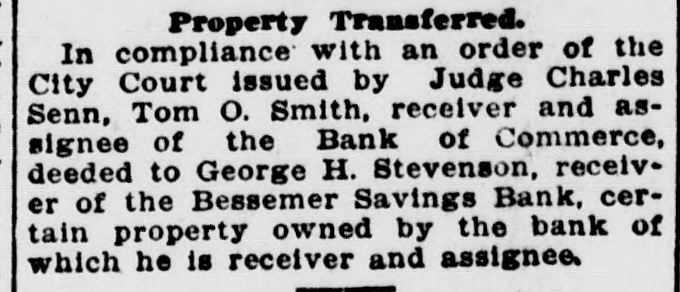
Property Transferred
In compliance with an order of the City Court issued by Judge Charles Senn, Tom O. Smith, receiver and assignee of the Bank of Commerce, deeded to George H. Stevenson, receiver of the Bessemer Savings Bank, certain property owned by the bank of which he is receiver and assignee.
24.October 12, 1905The Birmingham Age-HeraldBirmingham, AL
Click image to open full size in new tab
Article Text
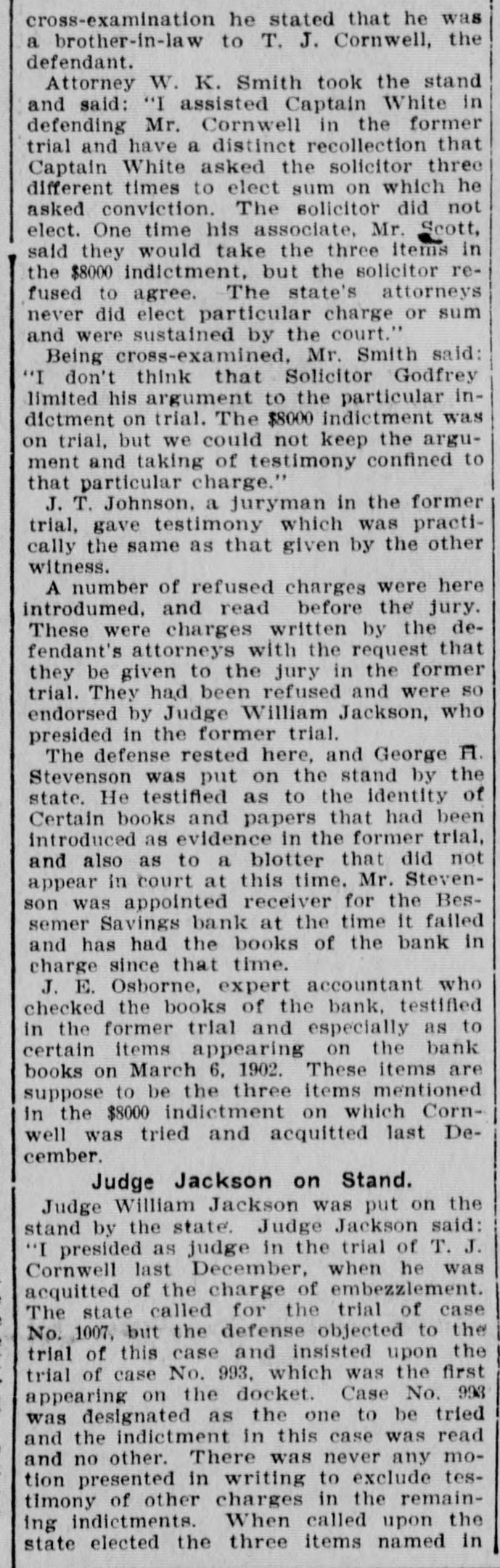
cross-examination he stated that he was a brother-in-law to T. J. Cornwell, the defendant. Attorney W. K. Smith took the stand and said: "I assisted Captain White in defending Mr. Cornwell in the former trial and have a distinct recollection that Captain White asked the solicitor three different times to elect sum on which he asked conviction. The solicitor did not elect. One time his associate, Mr. Scott, said they would take the three items in the $8000 indictment, but the solicitor refused to agree. The state's attorneys never did elect particular charge or sum and were sustained by the court.' Being cross-examined, Mr. Smith said: "I don't think that Solicitor Godfrey limited his argument to the particular indictment on trial. The $8000 indictment was on trial, but we could not keep the argument and taking of testimony confined to that particular charge." J. T. Johnson. a juryman in the former trial, gave testimony which was practically the same as that given by the other witness. A number of refused charges were here introdumed, and read before the jury. These were charges written by the defendant's attorneys with the request that they be given to the jury in the former trial. They had been refused and were so endorsed by Judge William Jackson, who presided in the former trial. The defense rested here, and George A. Stevenson was put on the stand by the state. He testified as to the identity of Certain books and papers that had been introduced as evidence in the former trial, and also as to a blotter that did not appear in court at this time. Mr. Stevenson was appointed receiver for the Bessemer Savings bank at the time it failed and has had the books of the bank in charge since that time. J. E. Osborne, expert accountant who checked the books of the bank, testifled in the former trial and especially as to certain items appearing on the bank books on March 6, 1902. These items are suppose to be the three items mentioned in the $8000 indictment on which Cornwell was tried and acquitted last December. Judge Jackson on Stand. Judge William Jackson was put on the stand by the state. Judge Jackson said: "I presided as judge in the trial of T. J. Cornwell last December, when he was acquitted of the charge of embezzlement. The state called for the trial of case No. 1007, but the defense objected to the trial of this case and insisted upon the trial of case No. 993, which was the first appearing on the docket. Case No. 993 was designated as the one to be tried and the indictment in this case was read and no other. There was never any motion presented in writing to exclude testimony of other charges in the remaining indictments. When called upon the state elected the three items named in
Bank runs are almost always and everywhere a deterioration of bank fundamentals.
But not for you.
You are the measure-zero exception: great fundamentals, solid bank, and yet the Diamond Dybvig fairy spread its rumor. Depositors woke up. Your collateral was not prepositioned. The Clearinghouse had it for you.
Do not pass Go. Do not collect $200. Go directly to jail… or worse.