Click image to open full size in new tab
Article Text
(Continued from First Page.)
their salaries or must endure a substantial cut in wages. This was agreed to. In one shop a non-member of Dowie's flock asked Dowie why he was going to Australia if his finances were so bad.
"Perhaps I may not be able to go at all," quietly returned Dowie. "I may have to stay and see that things are set right before I leave."
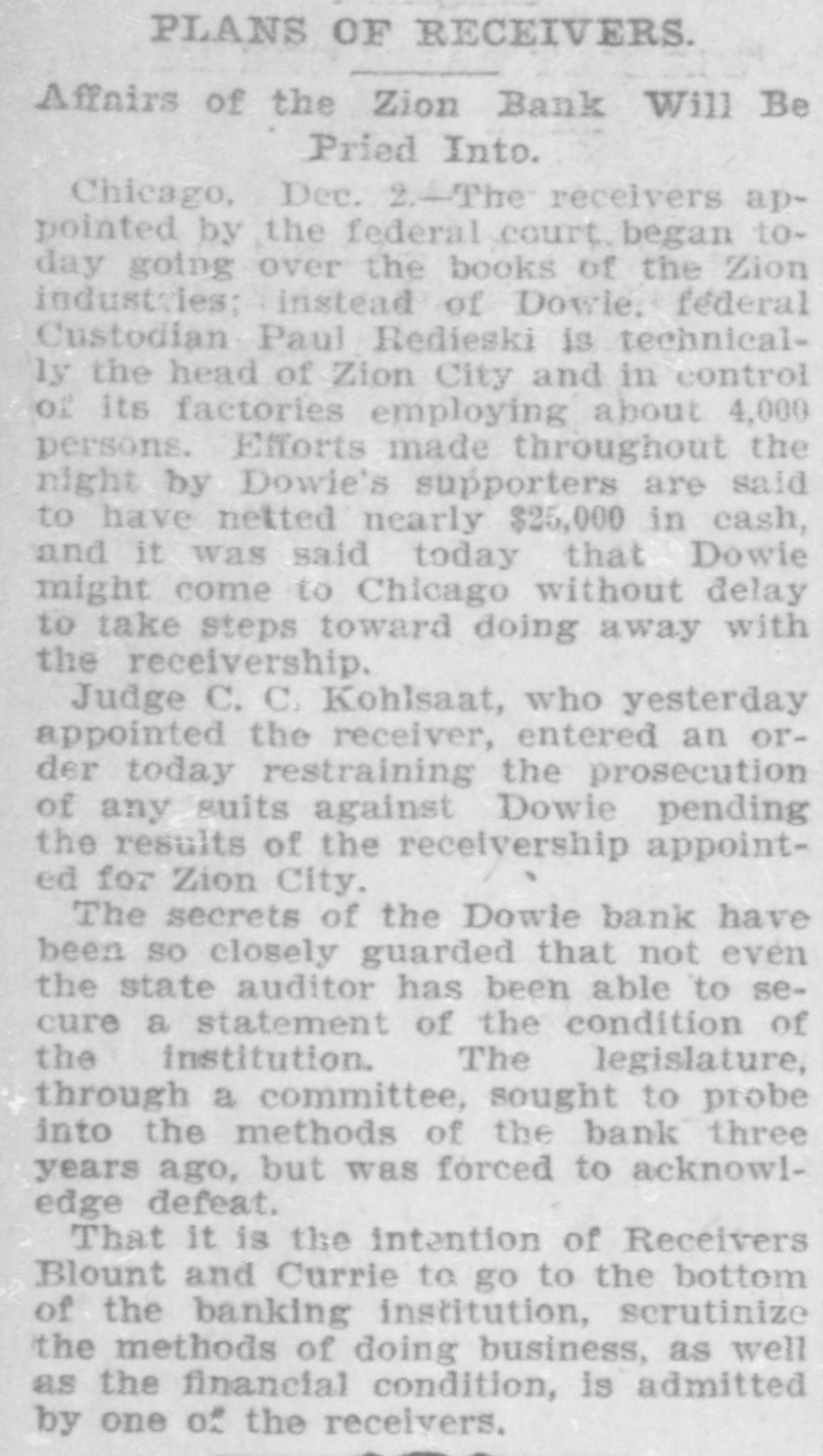
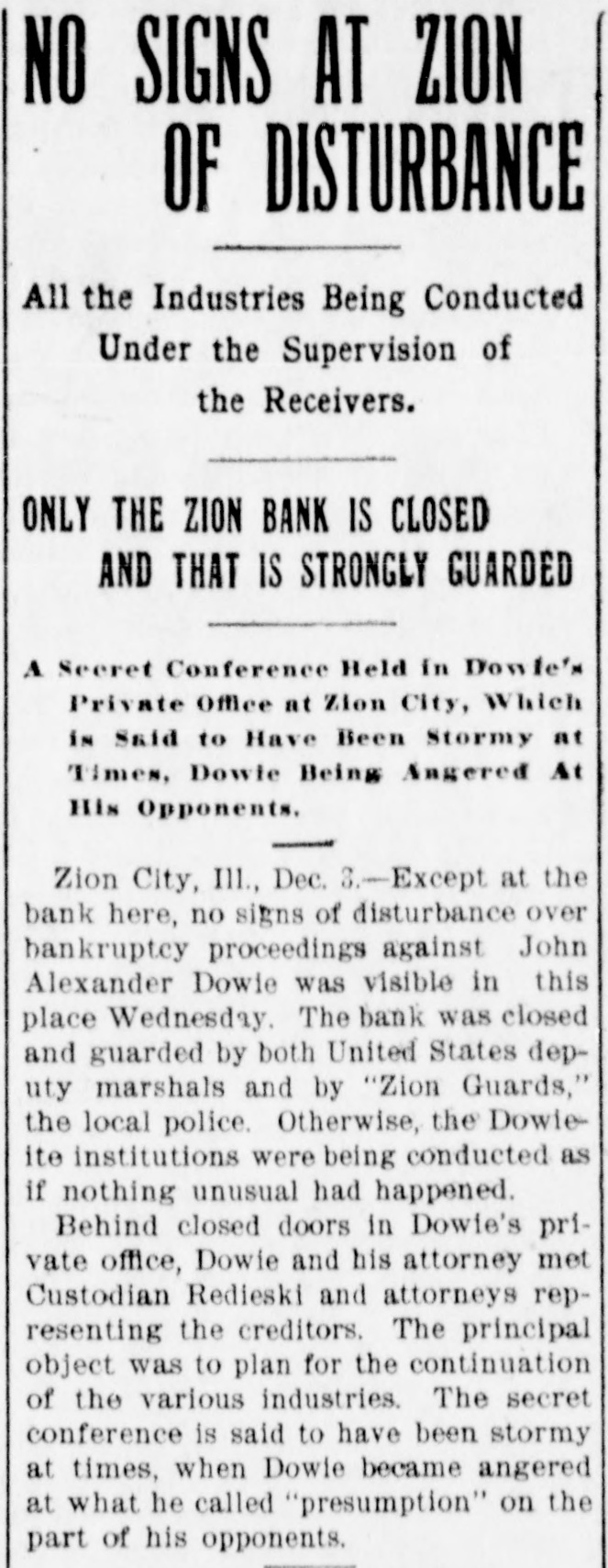
The receivers, with their attorneys, and Custodian Redieske with six deputy marshals, went out to Zion City to serve upon Dowie the notice of the receivership. Redieske and his deputies went ot the bank, while the others called upon Dowie at his residence. As the officers were about to demand admittance to the bank a man ran from a rear door. One of the deputies overtook him, and a second man came running from the bank shouting: "Let me have those papers; I will get away with them."
Redeskie threatened to place them under arrest unless they returned to the bank, which they did. He then placed the bank and the three men in it under a guard.
While this was taking place at the bank the receivers and their attorneys called on Dowie and read to him the petition and order of court which placed Zion in the hands of a receiver.
After hearing the petition Dowie locked himself up with several of his leading subordinates. He refused to allow himself to be seen or to make any statement, merely sending out word that he had nothing to say.
The order of the court compels Dowie to appear in court December 11.
Dowie made his advent in Chicago as a divine healer in 1892. Renting a small apartment he began the treatment of persons afflicted with every known kind of disease and soon hundreds were coming to see him. He called himself the head of the International Divine Healing association and had a tabernacle constructed in Stoney Island avenue near Sixty-third street, where his congregation held its first service.
Outgrowing these quarters in a few years, he leased a tabernacle at Michigan avenue and Thirteenth street, paying for it an immense rental. For several years the services were held there. As the congregation grew he rechristened his organization the Christian Catcholic Church of Zion and three years ago leased the Auditorium in which to hold his Sunday gatherings. All this time he kept up his divine healing, and many of those who came to him to be healed became his staunch-est supporters in the church.
It was shortly after he began the services in the Auditorium that he announced that he was the successor of Elijah, the prophet of God, and that his teachings and actions were inspired.
Four years ago Dowie began negotiations for the purchase of the land north of Waukegan on which Zion City now stands. Having secured options on a tract of 6,400 acres, he platted it. Eighty acres were set aside for the lace factories on which the industrial hopes of Zion City were founded. Samuel Stevenson went to Nottingham, England, ordered and paid deposits on 100 lace making machines which, with the accessories, when laid down in Chicago, cost almost $1,000,000.
Zion City was formally opened July 14, 1901, when Dowie took up his headquarters there in an old farm house after making a speech of consecration. Artisans were hurried to the place, and the construction of buildings and streets began. A year later the town had a population of 2,000 persons, and at the present time the population is estimated at about 10,000.
The lace factories were opened over a year ago, an immense hotel, administration, and auditorium buildings were consthructed, brick, candy and wood-working plants were established and at the present time an imposing building of stone for the Zion college is in course of construction.
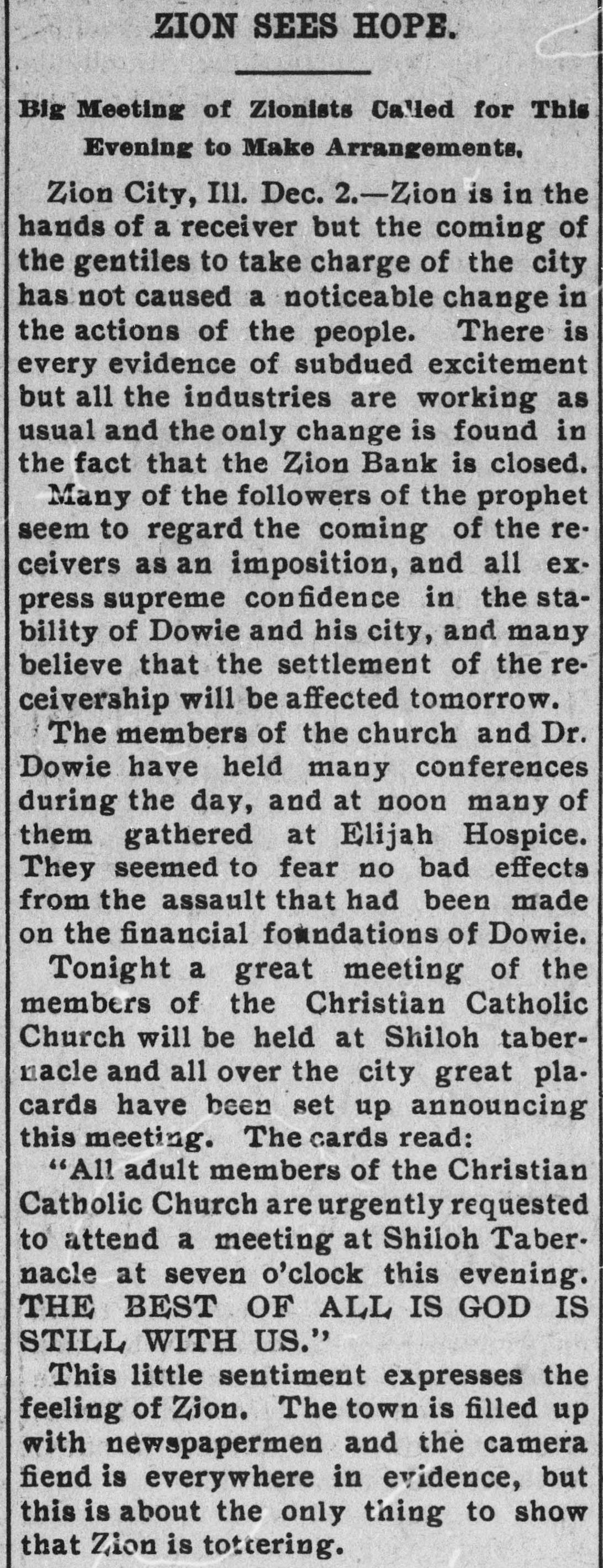
It was nearly midnight when the receivers left Dowie. Although he would make no general statement, he declared to the receivers that the entire proceedings in court was unnecessary, as he was entirely solvent. He declared that the receivership would be very short as he would immediately pay all he owed and secure the discharge of the receivers.
It was decided by the receivers that