5320. State Bank (Monticello, IN)

Bank Information

Episode Type
Run β†’ Suspension β†’ Unsure
Bank Type
state
Start Date
May 20, 1897
Location
Monticello, Indiana (40.745, -86.765)

Metadata

Model
gpt-5-mini
Short Digest
072713268e25f751

Response Measures

None

Description

The State Bank of Monticello experienced a run precipitated by the failure of the State National Bank of Logansport (a local bank). It suspended payment around May 20, 1897. Newspaper reports discuss plans to appoint a receiver but also describe depositors pledging funds and local officials considering reopening; subsequent outcome (permanent closure vs. successful reopening) is not resolved in the provided articles, so I classify as run -> suspension -> unsure. OCR-corrections: 'Johnson' and 'Johnston' variants appear in articles; I follow 'J. F. Johnson' as president per multiple pieces.

Events (3)

1. May 20, 1897 Run
Cause
Local Banks
Cause Details
Run precipitated by the failure of the State National Bank of Logansport (reserve deposits tied up there and large liabilities to that institution).
Measures
Depositors signed agreement pledging not to withdraw more than 15% of their deposits monthly if bank reopened; bank officials sought arrangements with local bankers to carry tied-up funds.
Newspaper Excerpt
The State Bank of Monticello closed its doors this afternoon ... The bank's failure is caused by the Logansport failure
Source
newspapers
2. May 20, 1897 Suspension
Cause
Local Banks
Cause Details
Suspension of payment announced after heavy withdrawals/run linked to the Logansport bank failure.
Newspaper Excerpt
A notice on the door announces that payment is suspended, and depositors will be paid when the bank can realize on its securities.
Source
newspapers
3. May 23, 1897 Receivership
Newspaper Excerpt
Notice has been given for the appointment of a receiver, which will be heard in the Circuit Court next Tuesday.
Source
newspapers

Newspaper Articles (6)

Article from The Indianapolis Journal, May 21, 1897

Click image to open full size in new tab

Article Text

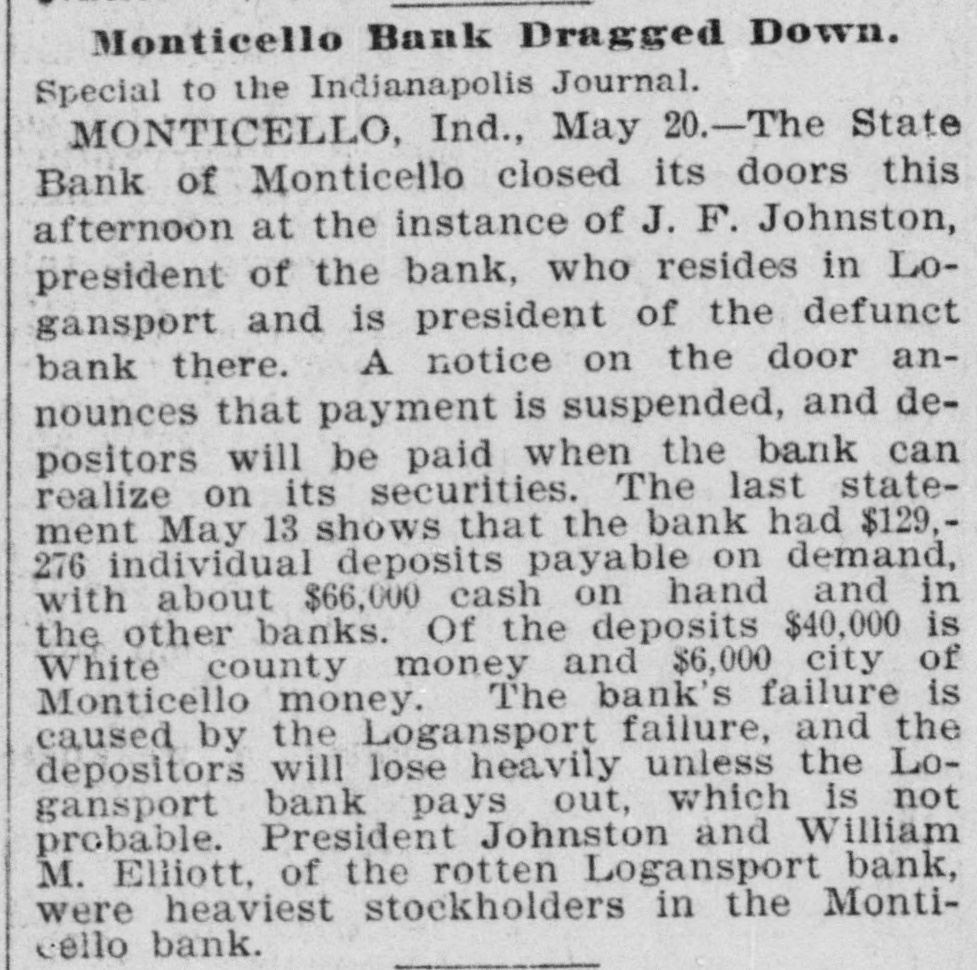
Monticello Bank Dragged Down. Special to the Indianapolis Journal. MONTICELLO, Ind., May 20.-The State Bank of Monticello closed its doors this afternoon at the instance of J. F. Johnston, president of the bank, who resides in Logansport and is president of the defunct bank there. A notice on the door announces that payment is suspended, and depositors will be paid when the bank can realize on its securities. The last statement May 13 shows that the bank had $129,276 individual deposits payable on demand, with about $66,000 cash on hand and in the other banks. Of the deposits $40,000 is White county money and $6,000 city of Monticello money. The bank's failure is caused by the Logansport failure, and the depositors will lose heavily unless the Logansport bank pays out, which is not probable. President Johnston and William M. Elliott, of the rotten Logansport bank, were heaviest stockholders in the Monticello bank.


Article from The Indianapolis Journal, May 23, 1897

Click image to open full size in new tab

Article Text

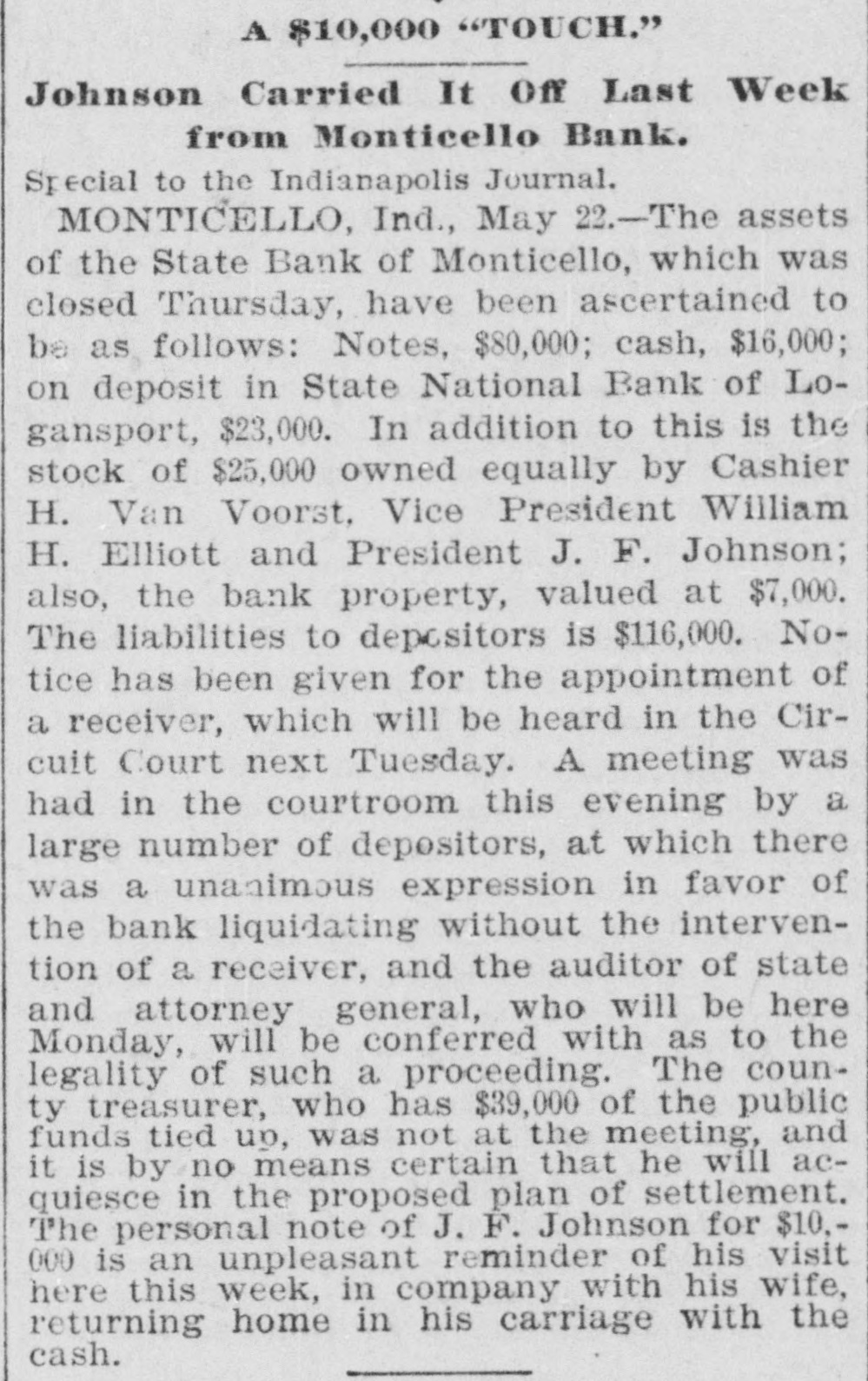
"TOUCH." A $10,000 Johnson Carried It Off Last Week from Monticello Bank. Special to the Indianapolis Journal. MONTICELLO, Ind., May 22.-The assets of the State Bank of Monticello, which was closed Thursday, have been ascertained to be as follows: Notes, $80,000; cash, $16,000; on deposit in State National Bank of Logansport, $23,000. In addition to this is the stock of $25,000 owned equally by Cashier H. Van Voorst, Vice President William H. Elliott and President J. F. Johnson; also, the bank property, valued at $7,000. The liabilities to depositors is $116,000. Notice has been given for the appointment of a receiver, which will be heard in the Circuit Court next Tuesday. A meeting was had in the courtroom this evening by a large number of depositors, at which there was a unanimous expression in favor of the bank liquidating without the intervention of a receiver, and the auditor of state and attorney general, who will be here Monday, will be conferred with as to the legality of such a proceeding. The county treasurer, who has $39,000 of the public funds tied up, was not at the meeting, and it is by no means certain that he will acquiesce in the proposed plan of settlement. The personal note of J. F. Johnson for $10,000 is an unpleasant reminder of his visit here this week, in company with his wife, returning home in his carriage with the cash.


Article from The Indianapolis Journal, May 24, 1897

Click image to open full size in new tab

Article Text

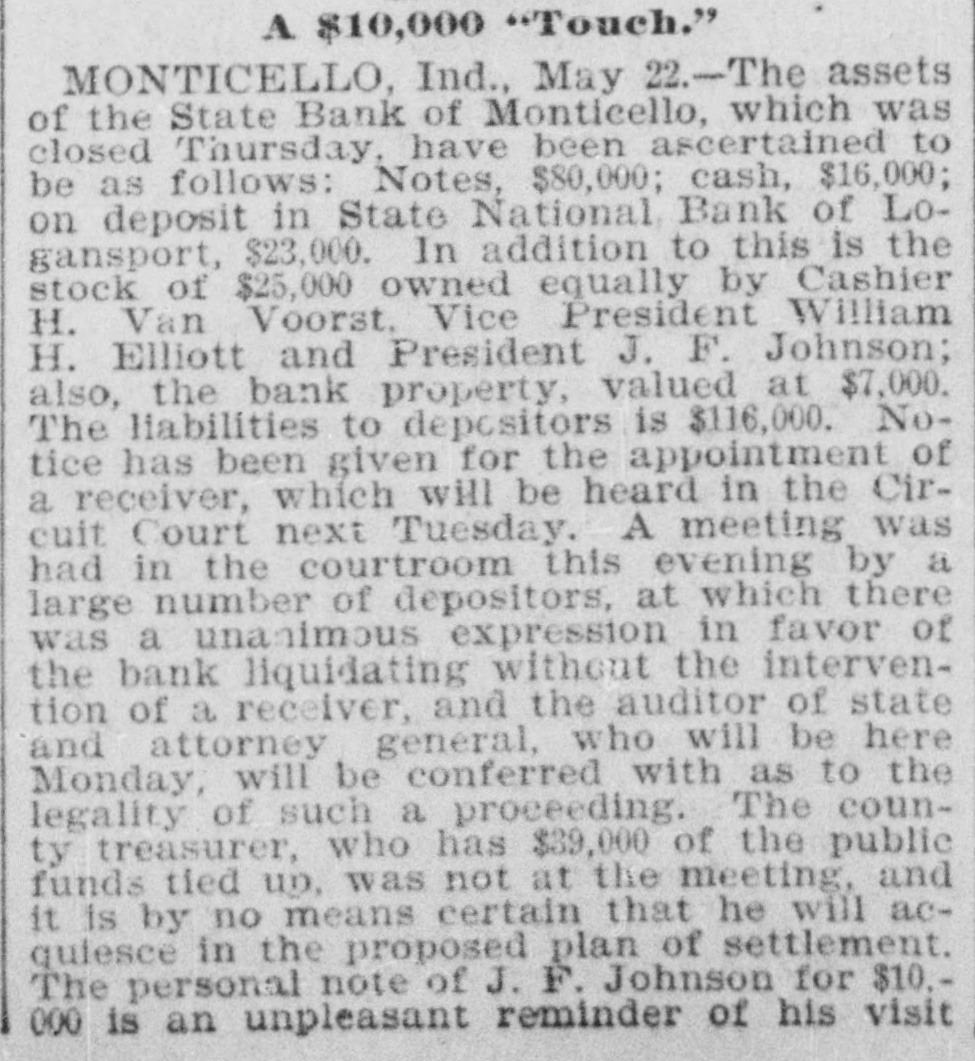
A $10,000 "Touch." MONTICELLO, Ind., May 22.-The assets of the State Bank of Monticello, which was closed Thursday, have been ascertained to be as follows: Notes, $80,000; cash, $16,000; on deposit in State National Bank of Logansport, $23,000. In addition to this is the stock of $25,000 owned equally by Cashier H. Van Voorst. Vice President William H. Elliott and President J. F. Johnson; also, the bank property, valued at $7,000. The liabilities to depositors is $116,000. Notice has been given for the appointment of a receiver, which will be heard in the Circuit Court next Tuesday. A meeting was had in the courtroom this evening by a large number of depositors, at which there was a unanimous expression in favor of the bank liquidating without the intervention of a receiver, and the auditor of state and attorney general, who will be here Monday, will be conferred with as to the legality of such a proceeding. The county treasurer, who has $39,000 of the public funds tied up, was not at the meeting, and it is by no means certain that he will acquiesce in the proposed plan of settlement. The personal note of J. F. Johnson for $10.000 is an unpleasant reminder of his visit


Article from The Indianapolis Journal, May 26, 1897

Click image to open full size in new tab

Article Text

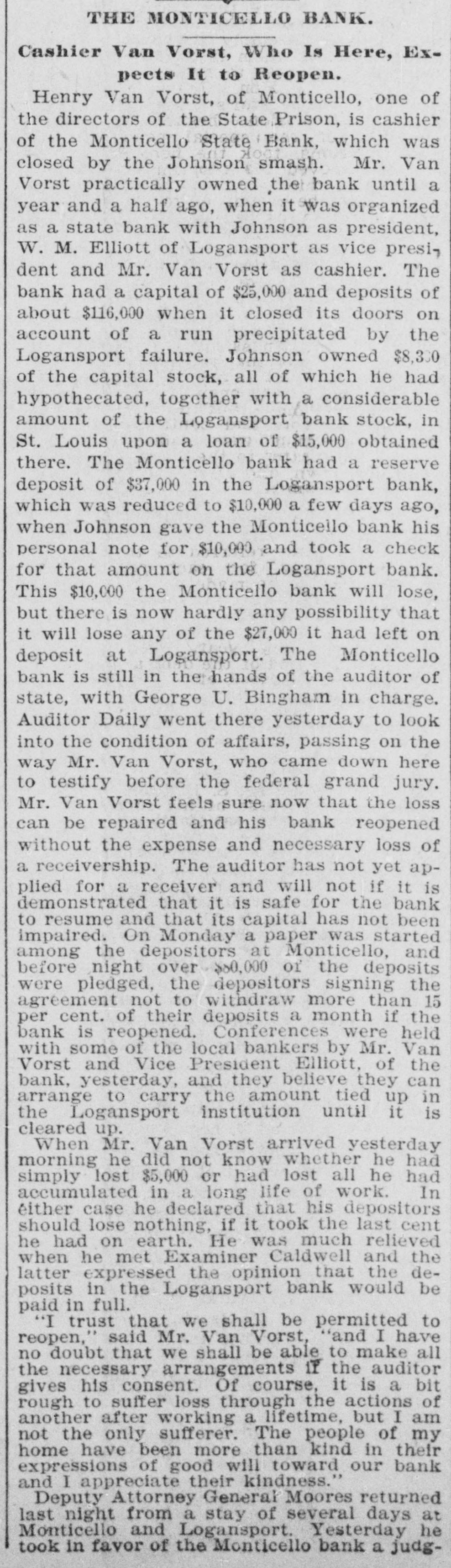
THE MONTICELLO BANK. Cashier Van Vorst, Who Is Here, Expects It to Reopen. Henry Van Vorst, of Monticello, one of the directors of the State Prison, is cashier of the Monticello State Bank, which was closed by the Johnson smash. Mr. Van Vorst practically owned the bank until a year and a half ago, when it was organized as a state bank with Johnson as president, W. M. Elliott of Logansport as vice presi, dent and Mr. Van Vorst as cashier. The bank had a capital of $25,000 and deposits of about $116,000 when it closed its doors on account of a run precipitated by the Logansport failure. Johnson owned $8,300 of the capital stock, all of which he had hypothecated, together with a considerable amount of the Logansport bank stock, in St. Louis upon a loan of $15,000 obtained there. The Monticello bank had a reserve deposit of $37,000 in the Logansport bank, which was reduced to $10,000 a few days ago, when Johnson gave the Monticello bank his personal note for $10,000 and took a check for that amount on the Logansport bank. This $10,000 the Monticello bank will lose, but there is now hardly any possibility that it will lose any of the $27,000 it had left on deposit at Logansport. The Monticello bank is still in the hands of the auditor of state, with George U. Bingham in charge. Auditor Daily went there yesterday to look into the condition of affairs, passing on the way Mr. Van Vorst, who came down here to testify before the federal grand jury. Mr. Van Vorst feels sure now that the loss can be repaired and his bank reopened without the expense and necessary loss of a receivership. The auditor has not yet applied for a receiver and will not if it is demonstrated that it is safe for the bank to resume and that its capital has not been impaired. On Monday a paper was started among the depositors at Monticello, and before night over $80,000 of the deposits were pledged, the depositors signing the agreement not to withdraw more than 15 per cent. of their deposits a month if the bank is reopened. Conferences were held with some of the local bankers by Mr. Van Vorst and Vice President Elliott, of the bank, yesterday, and they believe they can arrange to carry the amount tied up in the Logansport institution until it is cleared up. When Mr. Van Vorst arrived yesterday morning he did not know whether he had simply lost $5,000 or had lost all he had accumulated in a long life of work. In Γ©ither case he declared that his depositors should lose nothing, if it took the last cent he had on earth. He was much relieved when he met Examiner Caldwell and the latter expressed the opinion that the deposits in the Logansport bank would be paid in full. "I trust that we shall be permitted to reopen," said Mr. Van Vorst, "and I have no doubt that we shall be able to make all the necessary arrangements if the auditor gives his consent. Of course, it is a bit rough to suffer loss through the actions of another after working a lifetime, but I am not the only sufferer. The people of my home have been more than kind in their expressions of good will toward our bank and I appreciate their kindness." Deputy Attorney General Moores returned last night from a stay of several days at Monticello and Logansport. Yesterday he took in favor of the Monticello bank a judg-


Article from The Ely Miner, May 26, 1897

Click image to open full size in new tab

Article Text

Failure is announced of the Miners' state bank of Cripple Creek, Col. Gov. Black, of New York, signed the bill providing the death penalty for train wreckers who cause death. The Belknap savings bank at Laconia, N. H., closed its doors with about $1,000,000 due depositors. A fire in Jersey City, N. J., caused a loss of $100,000 and made 60 families homeless. The rapid fall of the Mississippi river at all points from Memphis to the gulf gives notice that the flood of 1897 is over. The total area overflowed was: Arkansas, 3,200 square miles; Mississippi, 6,520 square miles; Louisiana, 975 square miles, and the total damage amounts to $14,520,000. The first public test of the acrograph, an instrument by which photographs may be instantaneously transmitted by wire, was successfully made in Cleveland, O. Albert W. King, a 19-year-old messenger of the Boylston national bank in Boston, was missing with about $20,000 in cash. Two children of Augustus Muetze, residing 12 miles from Redfield, S. D., were killed by lightning. Tramps fired the home of Thomas Biddle, a farmer at White Oak Creek, Tenn., and he and his wife and three children were cremated. The sixty-fifth annual meeting of the American Baptist Home Missionary society convened in Pittsburgh, Pa. The fourth annual banquet of the Associated Press was given in Chicago, 140 members being present. The State bank of Monticello, Ind., suspended payment. It had $135,000 in deposits. At Oakland, Cal., Lucretia Borgia, a four-year-old filly, broke the world's record for four miles, making the distance in 7:11. Terrific wind and rainstorms in Indiana did great damage at Indianapolis, Kokomo and Wabash. Fire at Hoboken, N. J., caused a loss of $650,000 and 150 families were rendered homeless. The National Good Citizens' convention at Nashville, Tenn., adopted a platform which seeks to unite all friends of good government, to promote the duty of good citizens, to contend for purity in politics and to make known to all the truth about the principles of American institutions. The State national bank of Logansport, Ind., closed its doors with liabilities of $300,000. The Randolph county courthouse at Beverly, W. Va., was destroyed by fire with all the official records for 100 years. The Third national bank of New York has decided to retire from business. The one hundred and ninth General Assembly of the Presbyterian church met at Eagle Lake, Ind. President McKinley will visit the Nashville exposition on June 12. Michigan will have no state fair this year. The treasury is bankrupt. A statue of Stephen Girard, the philanthropist and founder of Girard college, was unveiled in Philadelphia. Col. E. B. Gray, of Madison, was elected state commander of the G. A. R. at the annual encampment in Eau Claire, Wis. A statue of the late Cornelius Vanderbilt, "the commodore," was unveiled on the campus of Vanderbilt university at Nashville, Tenn.
Article from Warren Sheaf, May 27, 1897

Click image to open full size in new tab

Article Text

Failure is announced of the Miners' state bank of Cripple Creek, Col. Gov. Black, of New York, signed the bill providing the death penalty for train wreckers who cause death. The Belknap savings bank at Laconia, N. H., closed its doors with about $1,000,000 due depositors. A fire in Jersey City, N. J., caused a loss of $100,000 and made 60 families homeless. The rapid fall of the Mississippi river at all points from Memphis to the gulf gives notice that the flood of 1897 is over. The total area overflowed was: Arkansas, 3,200 square miles; Mississippi, 6,520 square miles; Louisiana, 975 square miles, and the total damage amounts to $14,520,000. The first public test of the acrograph, an instrument by which photographs may be instantaneously transmitted by wire, was successfully made in Cleveland, O. Albert W. King, a 19-year-old messenger of the Boylston national bank in Boston, was missing with about $20,000 in cash. Two children of Augustus Muetze, residing 12 miles from Redfield, S. D., were killed by lightning. Tramps fired the home of Thomas Biddle, a farmer at White Oak Creek, Tenn., and he and his wife and three children were cremated. The sixty-fifth annual meeting of the American Baptist Home Missionary society convened in Pittsburgh, Pa. The fourth annual banquet of the Associated Press was given in Chicago, 140 members being present. The State bank of Monticello, Ind., suspended payment. It had $135,000 in deposits. At Oakland, Cal., Lucretia Borgia, a four-year-old filly, broke the world's record for four miles, making the distance in 7:11. Terrific wind and rainstorms in Indiana did great damage at Indianapolis, Kokomo and Wabash. Fire at Hoboken, N. J., caused a loss of $650,000 and 150 families were rendered homeless. The National Good Citizens' convention at Nashville, Tenn., adopted a platform which seeks to unite all friends of good government, to promote the duty of good citizens, to contend for purity in politics and to make known to all the truth about the principles of American institutions. The State national bank of Logansport, Ind., closed its doors with liabilities of $300,000. The Randolph county courthouse at Beverly, W. Va., was destroyed by fire with all the official records for 100 years. The Third national bank of New York has decided to retire from business. The one hundred and ninth General Assembly of the Presbyterian church met at Eagle Lake, Ind. President McKinley will visit the Nashville exposition on June 12. Michigan will have no state fair this year. The treasury is bankrupt. A statue of Stephen Girard, the philanthropist and founder of Girard college, was unveiled in Philadelphia. Col. E. B. Gray, of Madison, was elected state commander of the G. A. R. at the annual encampment in Eau Claire, Wis. A statue of the late Cornelius Vanderbilt, "the commodore," was unveiled on the campus of Vanderbilt university at Nashville, Tenn.