
Vermilye & Company (New York, NY)

Episode Information

Episode UID
5290870590885
Episode Type
Run Only
Bank Type
private
Bank ID
529087059 hash
Start Date
September 25, 1873
Location
New York, New York (40.714, -74.006)

Metadata

Model
gpt-5-mini (chosen from majority vote of a three-model LLM ensemble)
Short Digest
6c66aa828f554724

Response Measures

None

Events (1)

1. September 25, 1873 Run
Cause
Local Banks
Cause Details
Run triggered by suspension of Howes & Macy and failure of Clews & Co.; contagion from other private bank failures.
Newspaper Excerpt
It started a run on Vermilye & Co., renewed that on George Opdyke & Co.
Source
newspapers

Newspaper Articles (3)

Article from New-York Tribune, September 25, 1873

Click image to open full size in new tab

Article Text

CONFIDENCE RETURNING. s MORNING OF AGITATION AND DEPRESSION FOLLOWED BY AN EVENING FULL OF HOPE AND ENCOURAGEMENT-A BETTER PROSPECT AHEADTHE EVENTS OF YESTERDAY CALCULATED TO ALLAY THE EXCITEMENT. The depression which settled down on the city on Tuesday evening, continued yesterday morning at the opening of business. It was generally recognized that the depression was warranted, and that the excitement consequent on the failure of so prominent a house as that of Henry Clews & Co. caused the actual disasters to be exaggerated and augmented the panic unnecessarily. Superficial and panic-stricken thinkers had gone to rest on Tuesday demoralized, while the substantial and conservative financiers had retired serious and a little apprehensive, but still strong in the belief that the panic was practically ended, and that the banks could sustain themselves. Both parties rose in the same `humor on Wednesday, and, with the same impulses guiding both, they crowded into Wall-st. at an early hour of the morning, the former and more numerous class excited and noisy. the latter few but influential serious and predisposed to be gruff. The crowd on the street was not so large as on previous days, but it was more impressive. In front of the Stock Exchange, in Broad-st., there was gathered, earliest of all the groups, a large number of brokers, who discussed the probabilities of the re-opening of the Exchange. For a time they blockaded the street, and their noisy discussion of the advisability of opening the Exchange so disturbed the peace that the apprehensive police caused large trucks to be repeatedly driven through the street in order to disperse the crowds. This plan, however, proved as futile as the precaution was needless. As soon as the wagons had passed the gaps which they had made in the crowd rapidly closed up and the noise and confusion of excited discussion continued unabated. Finally, when it was announced that the Stock Exchange would not open during the day this group of regular brokers gave way to an equally large gatherin of curbstone operators, who by their loud vociferation and ticulation made the street even more hideous that had their predecessors. On the sidewalks were thousands of men who cared nothing for the Stock Board for the street speculators, but who were anxious about their bank balances, and who dreaded to learn what they expected every moment to hear, that their private banks had succumbed to that pressure which has thus far involved only private bankers and one or two mismanaged, rotten banks. The first startling event of the morning was the announcement thateHowes & Macy, who have been considered as strong a firm of private bankers as there in the city, had declined to open their doors. Instantly it was misinterpreted a failure it was hours before it became understood that these bankers had taken this step solely as a precautionary measure, believing that in the excited state of the market and the general inability to realize on any class of securities, they must eventually run short of greenbacks. There bad been on Tuesday an indication of a run on this house, consequent on the fact that it was in the saine building with Clews & Co. Of course the newly-announced suspension had a very depressing effect: but it was nothing like that which ensued on the closing Clews & Co. on Tuesday. It started a run on Vermilye & Co., renewed that on George Opdyke & Co., and there was a show of depositors asking for their money at the windows of August Belmont & Co. But none of these houses showed the slightest indications of weakness. , Upon the heels of the suspension of Howes & Macy came the news that Clews & Co. had swamped their London house of Clews, Habicht & Co. Their overdrafts on their London house were estimated at $1,200,000, or about the amount which they are said to have paid out previous to their suspension. The information, yesterday, leads to the supposition that Henry Clews & Co.'s suspension is permanent, certainly as complete as that of Jay Cooke & Co. Howes & Macy are likely to resume shortly, when matters are quieted. These two events were really the only disastrous ones of yesterday, and yet actions by stock brokers and by bank presidents were misconstrued by the general public, and helped to increase for the time being the general depression. In the first place, a number of owners of various stocks which could not be bypothecated were forced to place them in the hands of auctioneers at the Real Estate Exchange, and they were sold to the highest bidder. a proceeding unknown heretofore in New-York finances. was looked upon at first as an indication of the worthlessness of the securities, but it was soon found that the stocks brought their current value on the street. The buyers were fortunate men, with plenty of greenbacks to invest, who were loading up" with stocks at the present low rates with the design of taking them out of market altogether. As of course they left their greenbacks in the market, this unusual process of sellingstocks was practically

Article from Chicago Daily Tribune, September 25, 1873

Click image to open full size in new tab

Article Text

Northern Pacific Railroad Affairs. Local Feeling Much Improved. A Bad Outlook for Unfinished Railroads. Expected Discharge of Employes. NEW YORK. Special Dispatch to The Chicago Tribune. THE MORNING nouns, NEW YORK, Sept. 24-8:10 p. m.-The depression which acttled down on the city last evening continued this morning at the opening of business. It was generally recognized that the depression was unwarranted, and that the excitement consequent on the failure of so prominent a house as that of Henry Clews & Co. had caused the actual disasters to be exaggerated and augmented, and the panic unnecessarily superficial; and panic-stricken thinkers had gone to bed domoralized, while substantial and conservative financiers had retired serious and a little apprehensive, but still strong in the belief that the panic was practically ended, and that the banks could sustain themselves. Both parties rose in the same humor, and, with the same impulse guiding both, they crowded into Wall street at an early hour this morning,-the first, excited and noisy; the second, serious and disposed to be gruff. THE CROWD ON THE STREET was not so large as on previous days, but it was more impressive. In front of the Stock Exchange, in Broad street, there was gathered, earliest of all, a large group of brokers, who discussed the probabilities of a reopening of the Exchange. For a time they blockaded the street, and their noisy discussion on the advisability of opening the Exchange 80 disturbed the peace, that the police, apprehensive of a tumult, caused large trucks to be repeatedly driven through the street, in order to disperse the crowd. This plan, however, proved futile. As soon as the wagons had passed, the gaps which they had made in the crowd rapidly closed up, and the noise, confusion, and discussion continued unabated. Finally, when it was announced that THE STOCK EXCHANGE WOULD NOT OPEN during the day, this group of regular brokers gave way to an equally large gathering of operators, who, by their loud vociferation And gesticulations, made the street more hideous than their predecessors had done. On the sidewalks were thousands of men who cared nothing for the Stock Board or for stock speculations, but who were anxious about their bank balances and who dreaded to learn-what they expected every moment to hear-that their private banks had succumbed to that pressure which has ruined only private bankers or rotten banks. The following is a list of correspondents of the suspended firm of HOWES & MACY in the varions Western States: Illinois-Allen & Pinero, Grafton Bailey Thomas Camp Point; Burgesser & Crano, Clayton Crane, Manson & Co., Waverly; Ferris Brothers, Princeton A. A. Glen, Mount Sterling Heaton, DuBois & Chesnut, Virden Henderson Loan and Real Estato Company, Carlinville Jenkins, Dunn & Co., Minonk: G. P. Lawrence, Pana: Mayfield & Co., Lincoln May field & Co., Metropolis; Price & Ellenboun, Mendota; William Shepard & Co., Jerseyville; Wheeler & Alienreid, Cambridge. Indiana-Jesse Arnold & Co., North Manchester Culbertson, Brown & Co., New Albany; F. H. Foust & Co., Columbia City; Indianapolis Insurance Company, Indianapolis: H. Moyer & Co., Kendallville. Iowa-J. W. Dobbins, State Centro: Isaao Ganmoe, Fort Dodge ; Matthew & Son, Rockford Stacy & Wall worth, Anamous Traor Brothers, Vinton: Wilson Van Saun & Co., Codar Falls, Michigan-Bowen & McGowan, Coldwater: Gillett, Orrin, Parma A. Ives & Son, Detroit Lee & Goddell Saranao; George L. Maltz & Co., Alpena; J. Rogers, Decatur T P. Sheldon & Co., East Baginaw; T. P. Sheldon & Co., Kalamazoo; M. L. Stewart, OWARBO Wetmore & Co., Concord: Wheeler & Co., Corunna. Missouri-J. D. Briggs, Warsaw Clinton County Savings Association, Plattsburg J. S. Sterling & Son, Lebanon. Ohto-Barber & Merrill, Wauseon Charles Boessel, New Bremen: O. B. Boseman & Co., McConnellsville City Bank, Oanton : Commercial Banking Company, Alliance C. E. Eaton, Dreaden : Freeman & Hunt, Warren Greener & Co., Salem E. B. Halo & Co. Cleveland T. J. McLain : Son, Warren : Ramsey & Teeple, Delta: Reed & Beverstock, Bowling Green O. 11, Rice & Co., Ottawa Stark County Bank, Canton Stibbs, Hanna & Co., Wooster. The first startling event of the morning was the announcement that Howes & Macy, probably as strong a firm of private bankers as there is in the city, had declined to open their doors, Instantly it was interpreted as failure. It was hours before it became understood that these bankers had taken this step solely as a procautionary measure, believing that, in the excited state of the market and genoral inability to realize on a particular class of securities, they must eventually run short of greenbacks. There had been on Tuesday an indication of a panicky run on this house, consequent on the fact that it is in the same building with Clows & Co., who had just failed. or course, the suspension to-day had A VERY DEPRESSING EFFECT, but it was nothing like that which ensued yesterday on the closing of Clows & Co. It started a run on Vermilye & Co., renewed that on George Opdyke & Co., and there was a show of depositors clamorous for their money at the windows of Belmont & Co., but none of those houses showed the slightest Indications of weakness. Howes & Macy's failure, If, indeed, it may be called so, is not looked upon as serious. The chief fear is that the temporary suspension will affect the Company's correspondents in other cities, and so help to keep up the excitement which all are anxious to allay. Upon the heels of this suspension came the nows that Clews & Co. had swamped their LONDON HOUSE or OLEWS, HABIGHT & 00. The over-drafts on the London house are estimated


Article from Marshall County Republican, October 2, 1873

Click image to open full size in new tab

Article Text

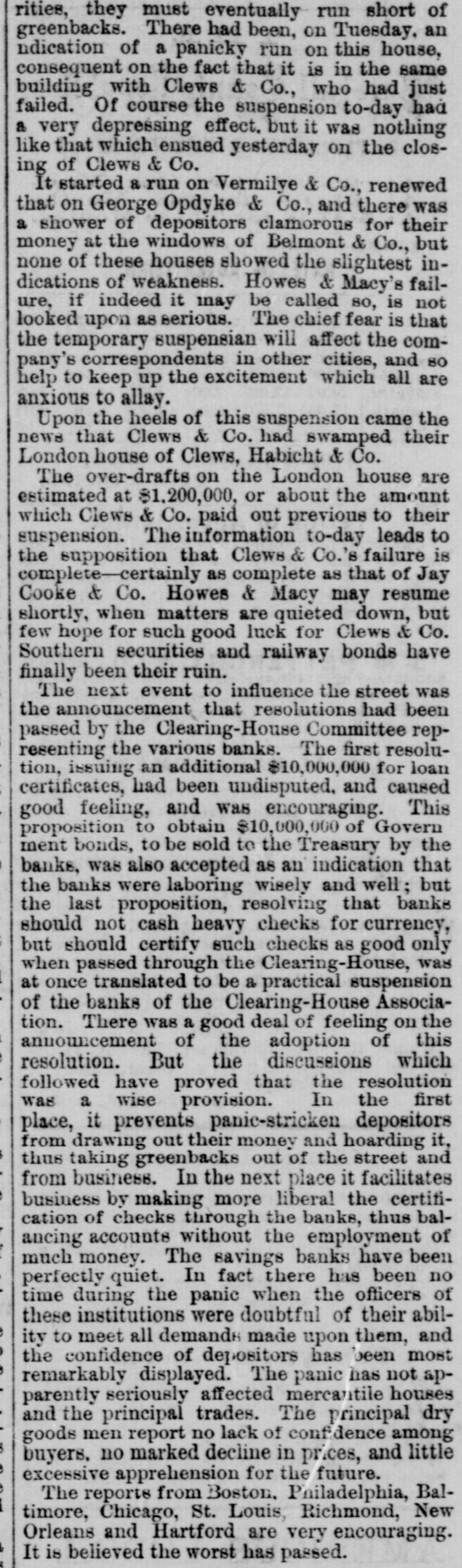
rities, they must eventually run short of greenbacks. There had been, on Tuesday, an indication of a panicky run on this house, consequent on the fact that it is in the same building with Clews & Co., who had just failed. Of course the suspension to-day had a very depressing effect. but it was nothing like that which ensued yesterday on the closing of Clews & Co. It started a run on Vermilye & Co., renewed that on George Opdyke & Co., and there was a shower of depositors clamorous for their money at the windows of Belmont & Co., but none of these houses showed the slightest indications of weakness. Howes & Macy's failure, if indeed it may be called so, is not looked upon as serious. The chief fear is that the temporary suspensian will affect the company's correspondents in other cities, and so help to keep up the excitement which all are anxious to allay. Upon the heels of this suspension came the news that Clews & Co. had swamped their London house of Clews, Habicht & Co. The over-drafts on the London house are estimated at $1,200,000, or about the amount which Clews & Co. paid out previous to their suspension. The information to-day leads to the supposition that Clews & Co.'s failure is complete-certainly as complete as that of Jay Cooke & Co. Howes & Macy may resume shortly, when matters are quieted down, but few hope for such good luck for Clews & Co. Southern securities and railway bonds have finally been their ruin. The next event to influence the street was the announcement that resolutions had been passed by the Clearing-House Committee representing the various banks. The first resolution, issuing an additional $10,000,000 for loan certificates, had been undisputed, and caused good feeling, and was encouraging. This proposition to obtain $10,000,000 of Govern ment bonds, to be sold to the Treasury by the banks, was also accepted as an indication that the banks were laboring wisely and well; but the last proposition, resolving that banks should not cash heavy checks for currency, but should certify such checks as good only when passed through the Clearing-House, was at once translated to be a practical suspension of the banks of the Clearing-House Association. There was a good deal of feeling on the announcement of the adoption of this resolution. But the discussions which followed have proved that the resolution was a wise provision. In the first place, it prevents panie-stricken depositors from drawing out their money and hoarding it, thus taking greenbacks out of the street and from business. In the next place it facilitates business by making more liberal the certification of checks through the banks, thus balancing accounts without the employment of much money. The savings banks have been perfectly quiet. In fact there has been no time during the panic when the officers of these institutions were doubtful of their ability to meet all demande made upon them, and the confidence of depositors has been most remarkably displayed. The panic has not apparently seriously affected mercantile houses and the principal trades. The principal dry goods men report no lack of conf dence among buyers. no marked decline in prices, and little excessive apprehension for the future. The reports from Boston, Philadelphia, Baltimore, Chicago, St. Louis, Richmond, New Orleans and Hartford are very encouraging. It is believed the worst has passed.