Boro Bank (New York, NY)

Episode Information

Episode UID
5151176591294
Episode Type
Run β†’ Suspension β†’ Closure
Bank Type
state
Bank ID
515117659 hash
Start Date
October 1, 1907*
Location
New York, New York (40.714, -74.006)

Metadata

Model
gpt-5-mini (chosen from majority vote of a three-model LLM ensemble)
Short Digest
ba615431ad02e467

Response Measures

None

Description

Bank name appears in sources as 'Borough Bank of Brooklyn' (matches provided 'Boro Bank').

Events (7)

1. October 1, 1907* Suspension
Cause
Bank Specific Adverse Info
Cause Details
Suspended amid the Panic of 1907 with later allegations of misappropriation and criminal management.
Newspaper Excerpt
The Borough Bank closed its doors in October, 1907; and, on the charge that the funds of the institution had been misappropriated, its president ... was indicted.
Source
newspapers
2. November 19, 1907 Receivership
Newspaper Excerpt
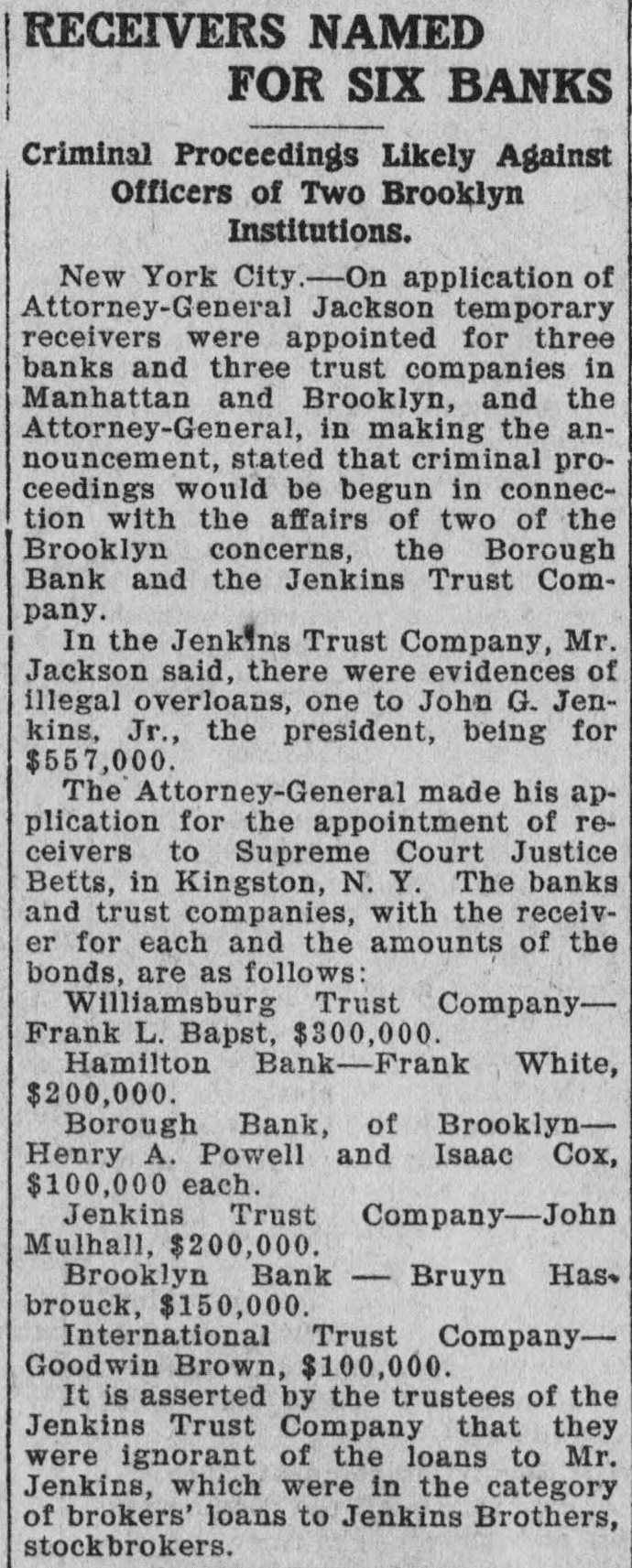
On application of Attorney-General Jackson temporary receivers were appointed for three banks ... Borough Bank, of Brooklyn Henry A. Powell and Isaac Cox, $100,000 each.
Source
newspapers
3. November 21, 1907 Other
Newspaper Excerpt
The Kings county grand jury ... returned indictments charging larceny and other offenses against Howard Maxwell ... of the suspended Borough bank of Brooklyn.
Source
newspapers
4. April 14, 1908 Reopening
Newspaper Excerpt
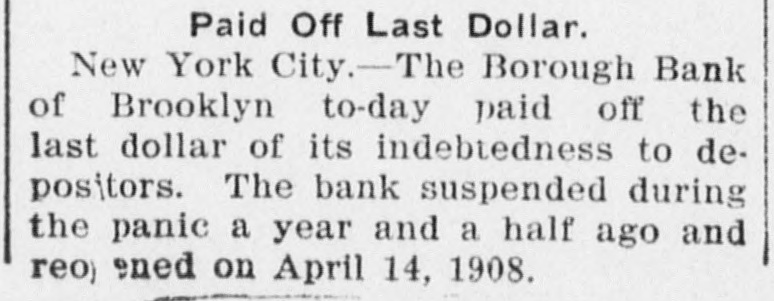
The Borough Bank of Brooklyn reopened on April 14, 1908; Paid Off Last Dollar. ... to-day paid off the last dollar of its indebtedness to depositors.
Source
newspapers
5. April 7, 1910 Receivership
Newspaper Excerpt
The superintendent of banks has taken possession of the property and business of the corporation.
Source
newspapers
6. April 7, 1910 Run
Cause
Local Banks
Cause Details
Heavy withdrawals and a run triggered by the prior closing/failure of the Union Bank of Brooklyn.
Measures
Board requested superintendent of banks to take possession; later superintendent took possession.
Newspaper Excerpt
Following the closing of the Union Bank of Brooklyn, the Borough bank of Brooklyn closed today. ... the closing of the Union bank had caused uneasiness and it resulted in steady withdrawals which exhausted the cash of the Borough bank.
Source
newspapers
7. April 7, 1910 Suspension
Cause
Local Banks
Cause Details
Unable to meet withdrawals after run linked to closure of Union Bank; superintendent of banks took possession.
Newspaper Excerpt
The Borough Bank of Brooklyn closed its doors today and the superintendent of banks has taken possession of its business.
Source
newspapers

Newspaper Articles (23)

Article from Alexandria Gazette, November 8, 1907

Click image to open full size in new tab

Article Text

News of the Day. A terrible explosion of two cars of powder near Nesozari, Ariz., late yeaterday killed ten men. The men killed were employees of the Montezuma Copper Company. The government yesterday sold the frigate Saratoga to a Boston firm which will break her up for junk. The price was $3,212. The old trigate was built at Kiytery, Me., in 1843. The Borough Bank of Brooklyn was t day declared solvent by the State bank examiners. The Borough Bank will open for business within the next few days. President Maxwell and Cashier Campbell will resign. Democratic leaders in Baltimore are already discussing plans for eliminating the negro vote, and there is but little doubt that one of the fruits of Tuesday's democratic victory will be the disfranchising of the colored man. A newspaper of Liege, Belgium, declared yesterday upon the authority of & high official that King Leopold may possibly abdicate rather than give into the Belgian parliament in the question of the Congo independent State. The bodies of Mrs. Eliza Nugent and Mi had Cantlin, of Wilkesbarre, Pa., an aged couple, who were married Wednesday night, were found deadin their room at the Hotel Weies yesterday. They had been suffocated by escaping illuminating gas, having either blown it out or else accidentally turned it on. The whipping post was resorted to in Canton, Miss., yesterday, Joe Shaw a negro, received 100 lashes on tho back. The whipping was public, occuring in front of the mayor's office. Afterward the man was put on a train and told not to return. He had threatened to klll white men. Ex-President Palma, of Cuba, is quoted as saying: "I do not hesitate to declare that it is a hundred times better for our beloved Cuba to be in a dependent political situation in which liberty is prevailing than in a republic independent of a sovereigo, but discredited and ruined by blasting periodical civil strifes." O. H. Lanihan, of Anaconda, Mont., a striking lineman, was sentenced by United States Judge Hunt, at Butte, yesterday, to four months in the county jail for an assault upon 8 nonunion lineman in the employ of the Rocky Mountain Bell Telephone Company. Matthew T. Plunkett, arraigned on the same charge, was sentenced to three months in jail. By order of the board of directors of the institution the Woods National Bank, of San Antonio, Texas, suspended shortly after noon yesterday. W. W. Collier, president of the bank, said, later: "Our bank of directors took this action, in order to protect out depositors. Our board is practically solvent, and we expect every depositor will be paid in full just as soon as we can realize on our assets." The union telegraphers, of Baltimore, at a meeting yesterday voted to "suspend" the strike and advised those who have been on strike to apply for reinstatement. Many followed this advice The Western Union officials says that they are considering the case of each applicant individually. The Washington striking telegraphers have not yet applied for reinstatement to their old jobs. They are awaiting more detailed in. structions from the national executive committee at Chicago. According to officials of the two telegraph companies there are few vacancies in the office there and but few reinstatements are possible.
Article from The Daily Morning Journal and Courier, November 19, 1907

Click image to open full size in new tab

Article Text

BROOKLYN BANKS. Investigation Being Pushed With Prospect of Indictments. New York, Nov. 18.-In the Brooklyn district attorney's office the criminal investigation of the suspended banks of that borough was continued vigorously to-day, and it was freely prophesied that at least two or three indictments would be found against officers of one institution, probably before tomorrow night. It was learned that among the assets of the Borough Bank of Brooklyn had been found a note signed by Senator "Pat" McCarren, democratic leader of Kings county. Report said that it was unendorsed. William B. Hurley, vice president of of the bank, while declining to make public the details of its affairs, said this morning that $767,000 of restitution" had been made. This assured the payment of all depositors in full, he declared. Two men connected with the bank, whose names have not been mentioned conspicuously in the last few days' publications concerning the receivership troubles, are known to have placed their personal property in the hands of the institution to cover loans they had obtained. One of the officers, together with his wife, handed over about twenty plots of land, valued at upwards of $200,000.


Article from The Morris County Chronicle, November 19, 1907

Click image to open full size in new tab

Article Text

RECEIVERS NAMED FOR SIX BANKS Criminal Proceedings Likely Against Officers of Two Brooklyn Institutions. New York City.-On application of Attorney-General Jackson temporary receivers were appointed for three banks and three trust companies in Manhattan and Brooklyn, and the Attorney-General, in making the announcement, stated that criminal proceedings would be begun in connection with the affairs of two of the Brooklyn concerns, the Borough Bank and the Jenkins Trust Company. In the Jenkins Trust Company, Mr. Jackson said, there were evidences of illegal overloans, one to John G. Jenkins, Jr., the president, being for $557,000. The Attorney-General made his application for the appointment of receivers to Supreme Court Justice Betts, in Kingston, N. Y. The banks and trust companies, with the receiver for each and the amounts of the bonds, are as follows: Williamsburg Trust CompanyFrank L. Bapst, $300,000. Hamilton Bank-Frank White, $200,000. Borough Bank, of BrooklynHenry A. Powell and Isaac Cox, $100,000 each. Jenkins Trust Company-John Mulhall, $200,000. Brooklyn Bank - Bruyn Has brouck, $150,000. International Trust CompanyGoodwin Brown, $100,000. It is asserted by the trustees of the Jenkins Trust Company that they were ignorant of the loans to Mr. Jenkins, which were in the category of brokers' loans to Jenkins Brothers, stockbrokers.


Article from Union County Courier, November 21, 1907

Click image to open full size in new tab

Article Text

CRIMES LAID TO BANKERS. Attorney General of New York A1leges Criminal Transactions. New York, Nov. 19.-In securing the appointment of receivers for three banks and three trust companies in New York and Brooklyn which recently suspended payment, State Attorney General Jackson declared that in the Borough Bank of Brooklyn and in the Jenkins Trust company evidence has been found of illegal over. loans and possible warrant for both civil and criminal action and for enforcement of liability.


Article from New-York Tribune, November 24, 1907

Click image to open full size in new tab

Article Text

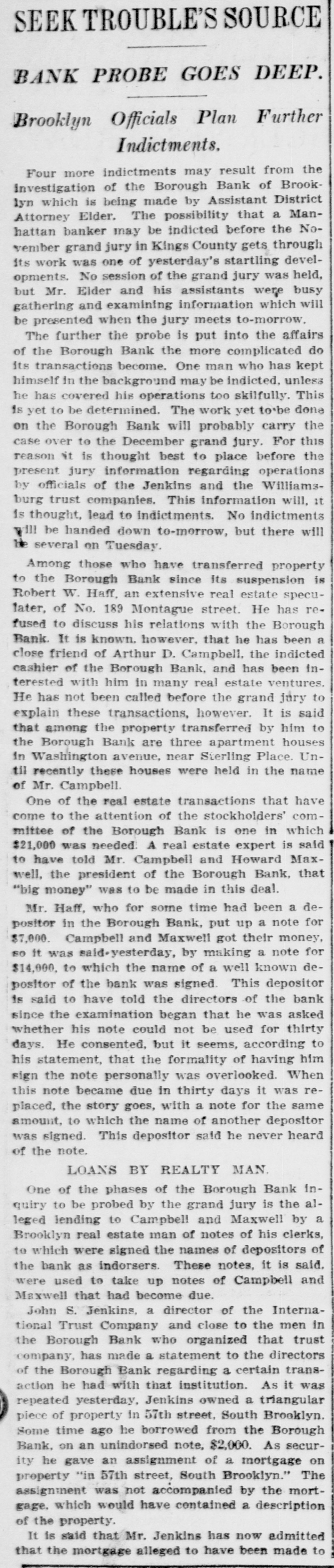
SEEK TROUBLE'S SOURCE BANK PROBE GOES DEEP. Brooklyn Officials Plan Further Indictments. Four more indictments may result from the investigation of the Borough Bank of Brooklyn which is being made by Assistant District Attorney Elder. The possibility that a Manhattan banker may be indicted before the November grand jury in Kings County gets through its work was one of yesterday's startling developments. No session of the grand jury was held, but Mr. Elder and his assistants were busy gathering and examining information which will be presented when the jury meets to-morrow. The further the probe is put into the affairs of the Borough Bank the more complicated do its transactions become. One man who has kept himself in the background may be indicted. unless he has covered his operations too skilfully. This is yet to be determined. The work yet to be done on the Borough Bank will probably carry the case over to the December grand jury. For this reason it is thought best to place before the present jury information regarding operations by officials of the Jenkins and the Williamsburg trust companies. This information will, it is thought, lead to indictments. No indictments will be handed down to-morrow, but there will he several on Tuesday. Among those who have transferred property to the Borough Bank since its suspension is Robert W. Haff. an extensive real estate speculater, of No. 189 Montague street. He has refused to discuss his relations with the Borough Bank. It is known. however, that he has been a close friend of Arthur D. Campbell, the indicted cashier of the Borough Bank, and has been interested with him in many real estate ventures. He has not been called before the grand jury to explain these transactions, however. It is said that among the property transferred by him to the Borough Bank are three apartment houses in Washington avenue, near Sterling Place. Until recently these houses were held in the name of Mr. Campbell. One of the real estate transactions that have come to the attention of the stockholders' committee of the Borough Bank is one in which $21,000 was needed. A real estate expert is said to have told Mr. Campbell and Howard Maxwell, the president of the Borough Bank, that "big money" was to be made in this deal. Mr. Haff, who for some time had been a depositor in the Borough Bank, put up a note for $7,000. Campbell and Maxwell got their money, so it was said-yesterday, by making a note for $14,000. to which the name of a well known depositor of the bank was signed. This depositor is said to have told the directors of the bank since the examination began that he was asked whether his note could not be used for thirty days. He consented, but it seems, according to his statement, that the formality of having him sign the note personally was overlooked. When this note became due in thirty days it was replaced, the story goes, with a note for the same amount, to which the name of another depositor was signed. This depositor said he never heard of the note. LOANS BY REALTY MAN. One of the phases of the Borough Bank inquiry to be probed by the grand jury is the alleged lending to Campbel! and Maxwell by a Brooklyn real estate man of notes of his clerks, to which were signed the names of depositors of the bank as indorsers. These notes, it is said. were used to take up notes of Campbell and Maxwell that had become due. John S. Jenkins, a director of the International Trust Company and close to the men in the Borough Bank who organized that trust company, has made a statement to the directors of the Borough Bank regarding a certain transaction he had with that institution. As it was repeated yesterday, Jenkins owned a triangular piece of property in 57th street, South Brooklyn. Some time ago he borrowed from the Borough Bank, on an unindorsed note, $2,000. As security he gave an assignment of a mortgage on property "in 57th street, South Brooklyn." The assignment was not accompanied by the mortgage. which would have contained a description of the property. It is said that Mr. Jenkins has now admitted othered to have been made to


Article from New-York Tribune, November 26, 1907

Click image to open full size in new tab

Article Text

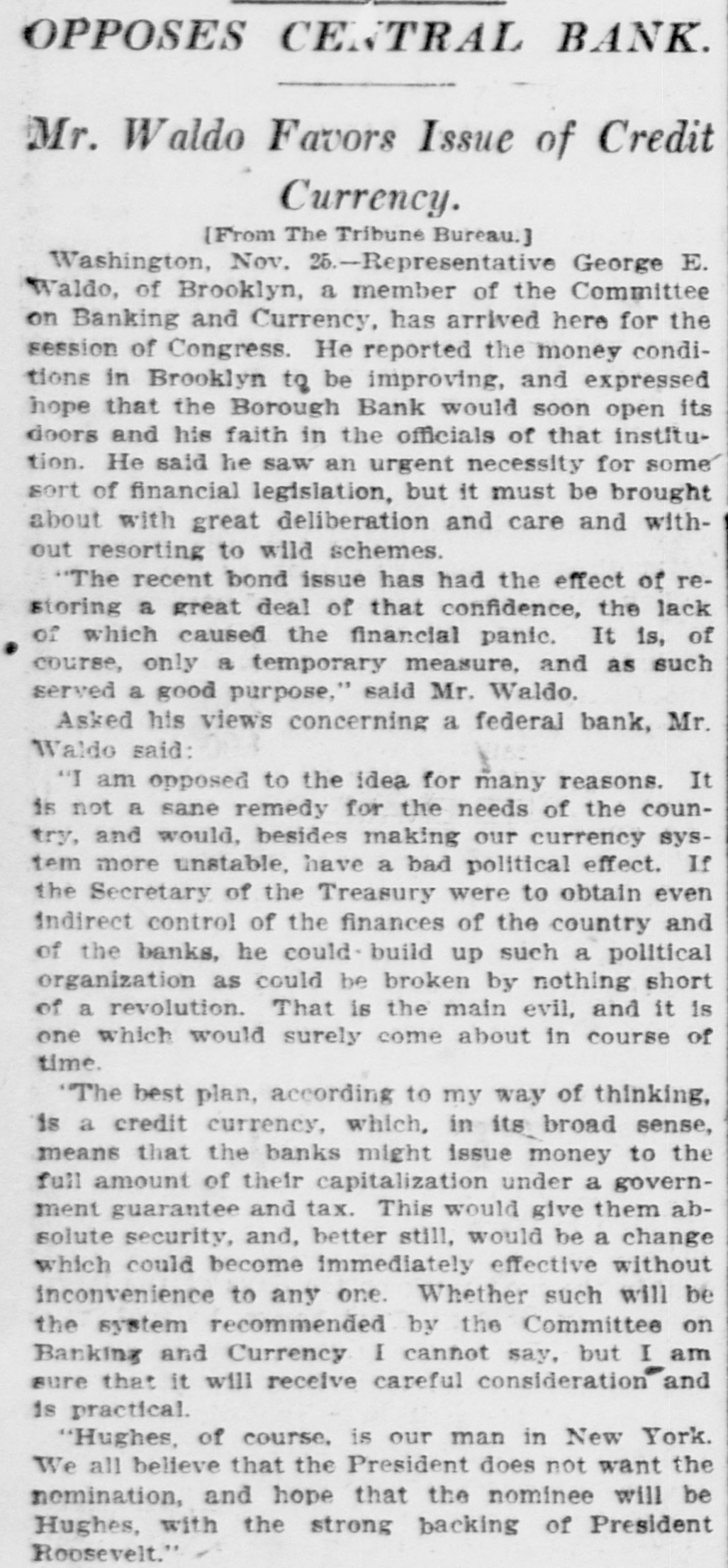
OPPOSES CENTRAL BANK. Mr. Waldo Favors Issue of Credit Currency. [From The Tribune Bureau.] Washington, Nov. 25.-Representative George E. Waldo, of Brooklyn, a member of the Committee on Banking and Currency. has arrived here for the session of Congress. He reported the money conditions in Brooklyn to be improving, and expressed hope that the Borough Bank would soon open its doors and his faith in the officials of that institution. He said he saw an urgent necessity for some sort of financial legislation, but it must be brought about with great deliberation and care and without resorting to wild schemes. "The recent bond issue has had the effect of restoring a great deal of that confidence, the lack of which caused the financial panic. It is, of course, only a temporary measure, and as such served a good purpose," said Mr. Waldo. Asked his views concerning a federal bank, Mr. Waldo said: "I am opposed to the idea for many reasons. It is not a sane remedy for the needs of the country, and would, besides making our currency system more unstable, have a bad political effect. If the Secretary of the Treasury were to obtain even indirect control of the finances of the country and of the banks, he could build up such a political organization as could be broken by nothing short of a revolution. That is the main evil, and it is one which would surely come about in course of time. 'The best plan, according to my way of thinking, is a credit currency, which, in its broad sense, means that the banks might issue money to the full amount of their capitalization under a government guarantee and tax. This would give them absolute security, and, better still, would be a change which could become immediately effective without inconvenience to any one. Whether such will be the system recommended by the Committee on Banking and Currency I cannot say, but I am sure that it will receive careful consideration and is practical. "Hughes, of course, is our man in New York. We all believe that the President does not want the nomination, and hope that the nominee will be Hughes, with the strong backing of President Roosevelt."


Article from The Hope Pioneer, November 28, 1907

Click image to open full size in new tab

Article Text

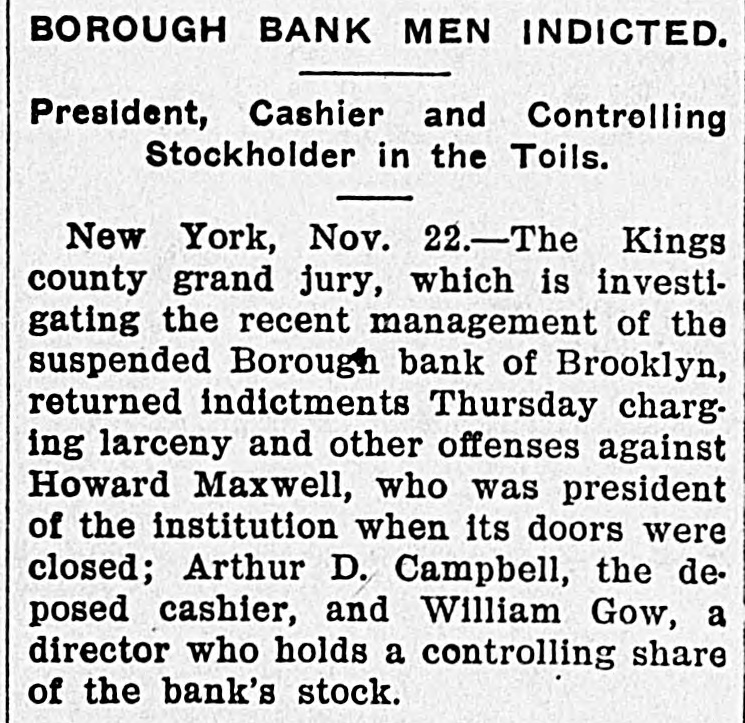
# BOROUGH BANK MEN INDICTED. President, Cashier and Controlling Stockholder in the Toils. New York, Nov. 22.-The Kings county grand jury, which is investi-gating the recent management of the suspended Borough bank of Brooklyn, returned indictments Thursday charg-ing larceny and other offenses against Howard Maxwell, who was president of the institution when its doors were closed; Arthur D. Campbell, the de-posed cashier, and William Gow, a director who holds a controlling share of the bank's stock.


Article from The Washburn Leader, November 29, 1907

Click image to open full size in new tab

Article Text

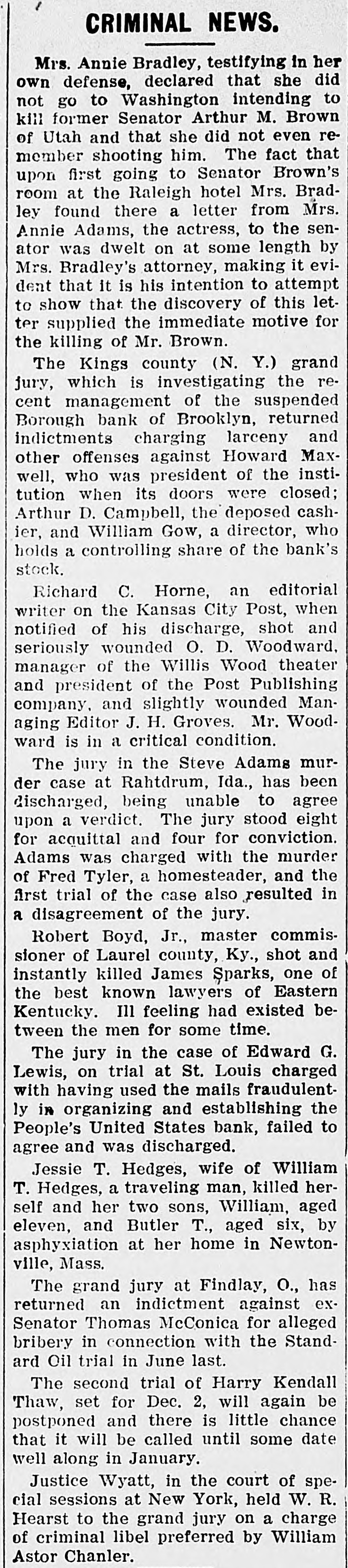
# CRIMINAL NEWS. Mrs. Annie Bradley, testifying in her own defense, declared that she did not go to Washington intending to kill former Senator Arthur M. Brown of Utah and that she did not even remember shooting him. The fact that upon first going to Senator Brown's room at the Raleigh hotel Mrs. Bradley found there a letter from Mrs. Annie Adams, the actress, to the senator was dwelt on at some length by Mrs. Bradley's attorney, making it evident that it is his intention to attempt to show that the discovery of this letter supplied the immediate motive for the killing of Mr. Brown. The Kings county (N. Y.) grand jury, which is investigating the recent management of the suspended Borough bank of Brooklyn, returned indictments charging larceny and other offenses against Howard Maxwell, who was president of the institution when its doors were closed; Arthur D. Campbell, the deposed cashier, and William Gow, a director, who holds a controlling share of the bank's stock. Richard C. Horne, an editorial writer on the Kansas City Post, when notified of his discharge, shot and seriously wounded O. D. Woodward, manager of the Willis Wood theater and president of the Post Publishing company, and slightly wounded Managing Editor J. H. Groves. Mr. Woodward is in a critical condition. The jury in the Steve Adams murder case at Rahtdrum, Ida., has been discharged, being unable to agree upon a verdict. The jury stood eight for acquittal and four for conviction. Adams was charged with the murder of Fred Tyler, a homesteader, and the first trial of the case also resulted in a disagreement of the jury. Robert Boyd, Jr., master commissioner of Laurel county, Ky., shot and instantly killed James Sparks, one of the best known lawyers of Eastern Kentucky. Ill feeling had existed between the men for some time. The jury in the case of Edward G. Lewis, on trial at St. Louis charged with having used the mails fraudulently in organizing and establishing the People's United States bank, failed to agree and was discharged. Jessie T. Hedges, wife of William T. Hedges, a traveling man, killed herself and her two sons, William, aged eleven, and Butler T., aged six, by asphyxiation at her home in Newtonville, Mass. The grand jury at Findlay, O., has returned an indictment against ex-Senator Thomas McConica for alleged bribery in connection with the Standard Oil trial in June last. The second trial of Harry Kendall Thaw, set for Dec. 2, will again be postponed and there is little chance that it will be called until some date well along in January. Justice Wyatt, in the court of special sessions at New York, held W. R. Hearst to the grand jury on a charge of criminal libel preferred by William Astor Chanler.


Article from The Ketchikan Miner, November 30, 1907

Click image to open full size in new tab

Article Text

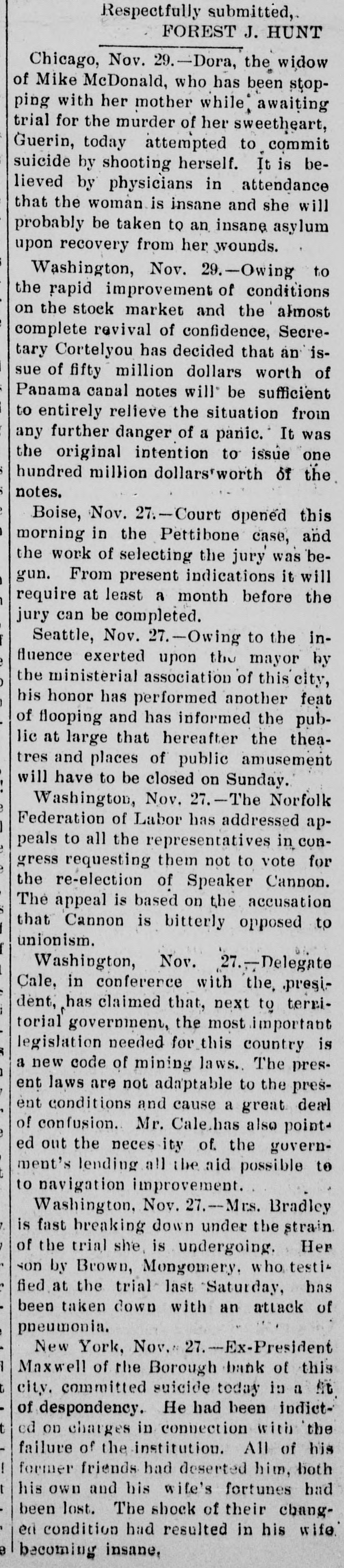
Respectfully submitted, FOREST J. HUNT Chicago, Nov. 29.-Dora, the widow of Mike McDonald, who has been stopping with her mother while awaiting trial for the murder of her sweetheart, Guerin, today attempted to commit suicide by shooting herself. It is believed by physicians in attendance that the woman is insane and she will probably be taken to an insane asylum upon recovery from her ,wounds. Washington, Nov. 29.-Owing to the rapid improvement of conditions on the stock market and the almost complete revival of confidence, Secretary Cortelyou has decided that an issue of fifty million dollars worth of Panama canal notes will be sufficient I to entirely relieve the situation from : any further danger of a panic. It was the original intention to issue one i hundred million dollars'worth of the $ notes. : Boise, Nov. 27.-Court opened this ) morning in the Pettibone case, and the work of selecting the jury was begun. From present indications it will ) require at least a month before the n jury can be completed. f Seattle, Nov. 27.-Owing to the iny fluence exerted upon the mayor by ) the ministerial association of this city, his honor has performed another feat , I of flooping and has informed the public at large that hereafter the theatres and places of public amusement will have to be closed on Sunday. : Washington, Nov. 27.-The Norfolk e Federation of Labor has addressed ap) peals to all the representatives in cone gress requesting them not to vote for , P the re-election of Speaker Cannon. The appeal is based on the accusation $ that Cannon is bitterly opposed to I unionism. f Washington, Nov. 27.-Delegate 1 Cale, in conference with the, presi$ dent, has claimed that, next to terri; torial government, the most important I legislation needed for this country is R a new code of mining laws. The pres) ent laws are not adaptable to the pres( ent conditions and cause a great deal of confusion. Mr. Cale.has also point+ e ed out the neces ity of. the government's lending all the aid possible to b to navigation improvement. Washington, Nov. 27.-Mrs. Bradley 7 is fast breaking down under the strain / of the trial she, is undergoing. Her son by Brown, Mongomery. who testiC fied at the trial last Saturday, has been taken down with an attack of pneumonia. ) New York, Nov. 27.-Ex-President I Maxwell of the Borough bank of this t city. committed suicide today in a fit of despondency. He had been indictt ed on charges in connection with the failure of the institution. All of his ! former friends had deserted him, both I his own and his wife's fortunes had been lost. The shock of their chang. en condition had resulted in his wife e becoming insane,


Article from Edgefield Advertiser, December 4, 1907

Click image to open full size in new tab

Article Text

# SPIRIT BROKEN BY PRISON CELL Unable to Stand the Humiliation of Facing Serious Charges Against Him and the Desertion of Former Friends in His Hour of Need Leads Howard Maxwell, Deposed President of Broklyn Banks, to Take His Own Life. New York, Special. Howard Maxwell, deposed president of the Borough Bank of Brooklyn, who was under indictment for grand larceny and forgery and was later released from jail on $30,000 bail, committed suicide. He cut his throat and left wrist with a razor and penknife in the bath room of his home in Brooklyn and died later at Long Island College Hospital. Maxwell, who was locked up last Thursday, had felt his humiliation keenly and during his incarceration keenly shrdluashrΓ‘laqua incarceration had appeared hopelessly despondent. He had, however, given his family no intimation so far as known that he had contemplated suicide. His wife was prostrated. Maxwell was released from Raymond street jail where he had been held a prisoner since the three indictments charging him with misdoings in connection with the management of the suspended Borough Bank were returned. There was some difficulty in obtaining bail, and officers of the jail reported that Maxwell was greatly broken. All day Monday and the day before he lay on his bed and appeared to be oblivious to surroundings. Later Justice Burr signed an order for Maxwell's release when bail to the amount of $30,000 was furnished. Maxwell, in company with his counsel, I. R. Ocland, was driven to his residence at 182 Congress street, where he was greeted by his wife. Maxwell spent the forenoon quietly at his home, In the afternoon he announced his intention of taking a bath and going for a walk. Shortly before 2 o'clock Hannah Scott, a colored maid, heard a sound as of some one falling on the second floor. She discovered the banker lying on the bath room floor, half dressed, with gaping wounds in his throat and left wrist. The banker was bleeding so profusely that it was decided to remove him to Long Island College Hospital, where an operation was performed. The wind pipe was found to be nearly severed and his left wrist was cut almost to the bone. Maxwell died within a short time after the operation. He left no statement so far as is known. Coroner Brewer began the official investigation Tuesday night. Maxwell was 49 years old and leaves a wife but no children. On November 21st he was jointly indicted for grand larceny with former Cashier Arthur Campbell and Director William Gow, of the Borough Bank. There were other indictments against him, involving forgery in a quarterly bank statement made to the State banking department. When these three men were arraigned Campbell and Gow secured bondsmen, but none offered to-go on Maxwell's bond. For some time his four sisters, who, offering the house left them by their mother, who died three days after the Borough bank suspended, could secure only a $10,000 bond, came to his aid. This desertion on the art of men to whom he had looked for his freedom, it is said, embittered and depressed Maxwell. During his arraignment, Maxwell's counsel stated that his client had put up every dollar in the world that he possessed to secure the bank and that he had absolutely stripped himself to protect the institution. His humiliation was aggravated when like a common felon he was measured by the Bertillor system and his pedigree placed in the jail records.


Article from The Salt Lake Herald, December 4, 1907

Click image to open full size in new tab

Article Text

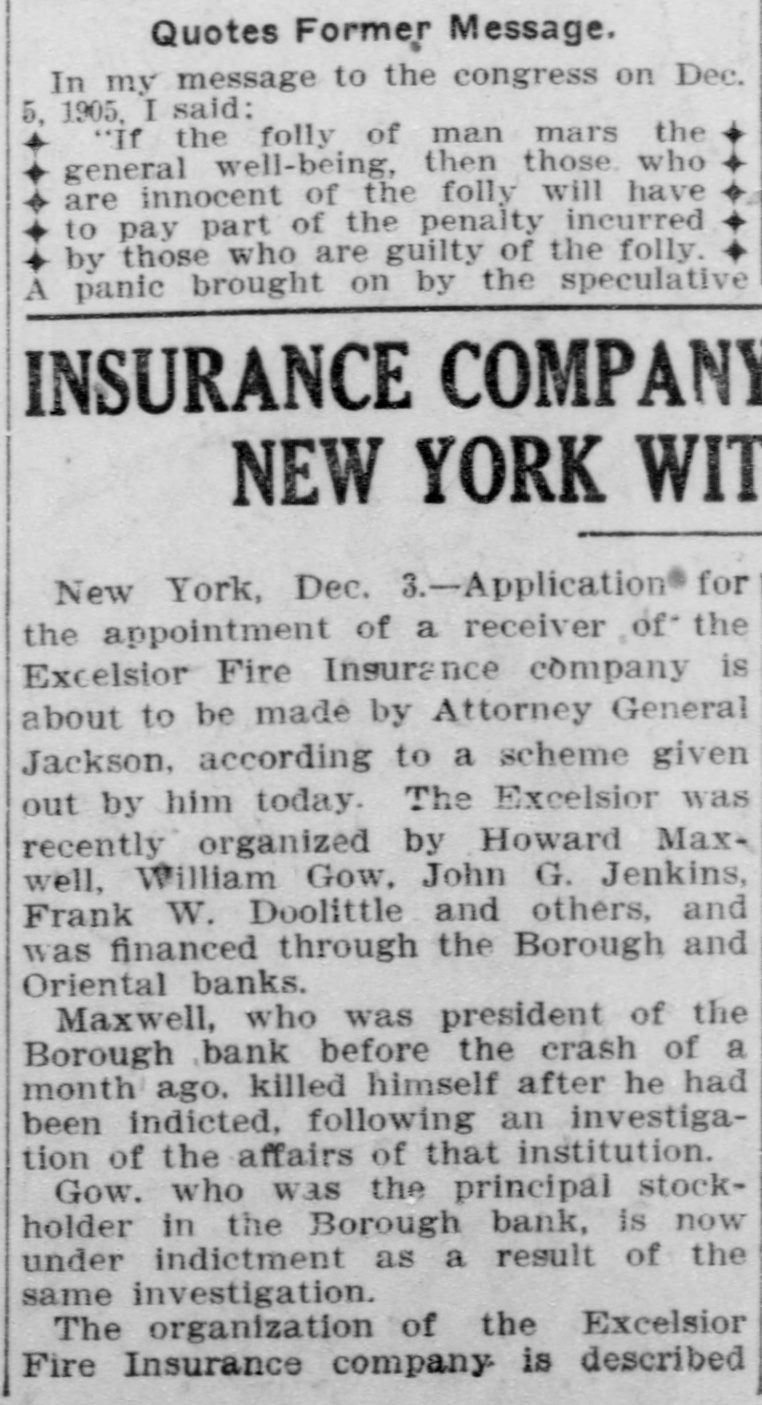
Quotes Former Message. In my message to the congress on Dec. 5, 1905, I said: "If the folly of man mars the general well-being, then those. who are innocent of the folly will have to pay part of the penalty incurred by those who are guilty of the folly. A panic brought on by the speculative INSURANCE COMPANY NEW YORK WIT New York, Dec. 3.-Application for the appointment of a receiver of the Excelsior Fire Insurance company is about to be made by Attorney General Jackson, according to a scheme given out by him today. The Excelsior was recently organized by Howard Maxwell, William Gow, John G. Jenkins, Frank W. Doolittle and others, and was financed through the Borough and Oriental banks. Maxwell, who was president of the Borough bank before the crash of a month ago, killed himself after he had been indicted, following an investigation of the affairs of that institution. Gow. who was the principal stockholder in the Borough bank, is now under indictment as a result of the same investigation. The organization of the Excelsior Fire Insurance company is described


Article from Bluefield Evening Leader, December 11, 1907

Click image to open full size in new tab

Article Text

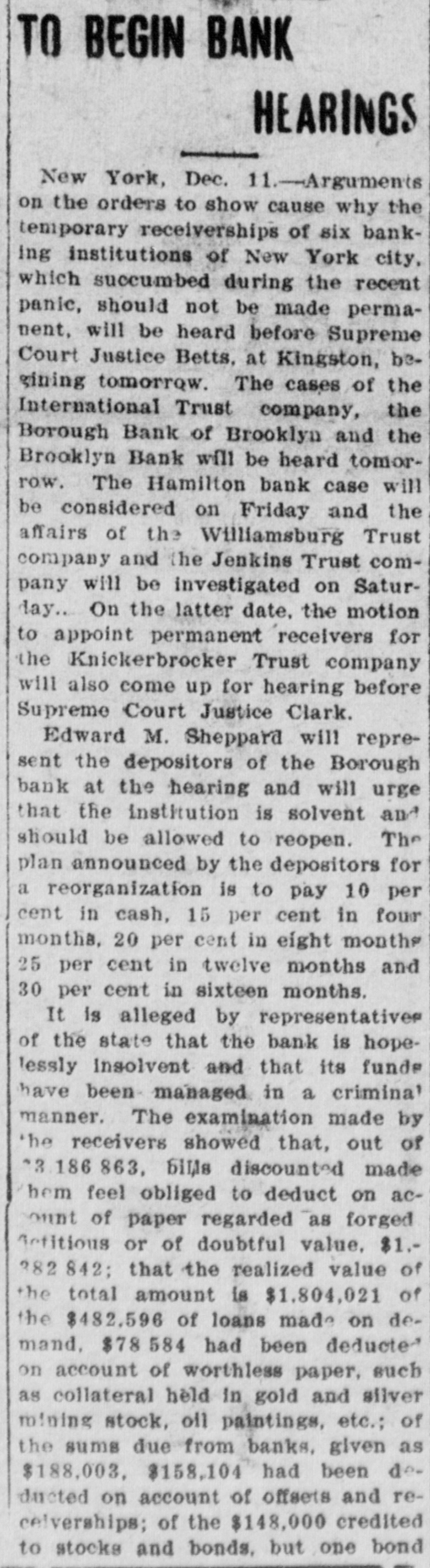
TO BEGIN BANK HEARINGS / New York, Dec. 11.-Arguments on the orders to show cause why the temporary receiverships of six banking institutions of New York city, which succumbed during the recent panic, should not be made permanent, will be heard before Supreme Court Justice Betts. at Kingston, begining tomorrow. The cases of the International Trust company, the Borough Bank of Brooklyn and the Brooklyn Bank will be heard tomorrow. The Hamilton bank case will be considered on Friday and the affairs of the Williamsburg Trust company and the Jenkins Trust company will be investigated on Saturday On the latter date, the motion to appoint permanent receivers for the Knickerbrocker Trust company will also come up for hearing before Supreme Court Justice Clark. Edward M. Sheppard will represent the depositors of the Borough bank at the hearing and will urge that the institution is solvent and should be allowed to reopen. The plan announced by the depositors for a reorganization is to pay 10 per cent in cash, 15 per cent in four months, 20 per cent in eight months 25 per cent in twelve months and 30 per cent in sixteen months. It is alleged by representatives of the state that the bank is hopelessly Insolvent and that its funde have been managed in a criminal manner. The examination made by 'he receivers showed that, out of *3 3.186 863, bills discounted made hem feel obliged to deduct on acount of paper regarded as forged Actitious or of doubtful value, $1.382 842; that the realized value of the total amount is $1,804,021 of the $482,596 of loans made on demand, $78 584 had been deducte on account of worthless paper, such as collateral held in gold and silver mining stock, oil paintings, etc.; of the sums due from banks. given as $188,003. $158,104 had been deducted on account of offsets and recelverships; of the $148,000 credited to stocks and bonds, but one bond


Article from The Fairmont West Virginian, December 12, 1907

Click image to open full size in new tab

Article Text

IN NEW YORK Cause of Panic To Be Sought NEW YORK, Dec. 11.-Arguments on the orders to show cause, why the temporary receiverships of six bankinb institutions of New York City, which succumbed during the recent panic, should not be made permanent, will be heard before Supreme Court Justice Botts at Kingston, beginning to-morrow. The cases of the International Trust Company, the Borough Bank of Brooklyn and the Brooklyn bank will be heard to-morrow. The Hamilton bank case will be considered on Friday, and the affairs of the Willlamsburg Trust Company and the Jenkins Trust Company will be Investigated on Saturday. On the latter date, the motion to appoint permanent receivers for the Knickerbocker Trust Company will also come up for hearing before Supreme Court Justice Clark. Edward M. Shepard will represent the depositors of the Borough bank at the hearing and will urge that the Institution is solvent and should be be allowed to re-open. The plan announced by the depositors for a re-organization Is to pay 10 per cent. in cash, 15 per cent. in four months, 20 per cent. in eight months, 25 per cent. in twelve months and 30 per cent. in sixteen months. It is allleged by representatives of the State that the bank is hopelessly Insolvent and that Its funds have been managed in a criminal manner. The examination made by the receivers showed that, out of $3,186,863. bills discounted. more then feel obliged to deduct on account of paper regarded as forged, fictitious or of doubtful value. $1,382,842; that the realized value of the total amount is $1,804,021; of the $482,596 of loans made on demand, $78,584 had been deducted on account of worthless paper, such as collateral t held in gold and silver mining stock, e oil paintings, etc.; of the sums due I PO from banks, given as $188,003. $158,I 104 had been deducted on account of offsets and receiverships; of the $148,M 000 credited to stocks and bonds, but I one bond of $1,000 was on file with the State banking department. It is al1 leged by the receivers that the total 1 deficiency of the bank is $1,500,000. Ex-Judge Alton B. Parker is chief counsel for the Hamilton bank, and will urge that that institution was forced to suspend business only because the bank through which it cleared could no longer serve in that capacity. Judge Parker declares that the 18,000 depositors are anxious for the bank to re-open its doors, and that he is prepared to show that there was nothing of a fraudulent nature con-nected with the management of this bank. The attorney general's office will make a hard fight aaginst the accepte ance of the plan of re-organization sug1 gested by the Williamsburg and Jenkins Trust Companies. In regard to the Williamsburg institution, Deputy Attorney General Mackey alleges that it had "loans credited to clerks and t roustabouts on security of a cat-andt dog nature," and that "the directors and their friends grabbed their money just before the bank closed." One of


Article from The Fairmont West Virginian, December 12, 1907

Click image to open full size in new tab

Article Text

IN NEW YORK Cause of Panic To Be Sought NEW YORK, Dec. 11.-Arguments on the orders to show cause why the temporary receiverships of six bank. inb institutions of New York City, which succumbed during the recent panic, should not be made permanent, will be heard before Supreme Court Justice Botts at Kingston, beginning to-morrow. The cases of the International Trust Company, the Borough Bank of Brooklyn and the Brooklyn bank will be heard to-morrow. The Hamilton bank case will be considered on Friday, and the affairs of the WilTiamsburg Trust Company and the Jenkins Trust Company will be investigated on Saturday. On the latter date, the motion to appoint permanent recelvers for the Knickerbocker Trust Company will also come up for hearing before Supreme Court Justice Clark. Edward M. Shepard will represent the depositors of the Borough bank at the hearing and will urge that the Institution Is solvent and should be be allowed to re-open. The plan announced by the depositors for a re-organization is to pay 10 per cent. In cash, 15 per cent. in four months, 20 per cent. in eight months, 25 per cent. in twelve months and 30 per cent. in sixteen months. It Is allleged by representatives of the State that the bank is hopelessly Insolvent and that its funds have been managed in a criminal manner. The examination made by the receivers showed that, out of $3,186,863, bills discounted. more then feel obliged to deduct on account of paper regarded as forgeil, fictitious or of doubtful value, $1,382,842: that the realized value of the total amount is $1,804,021; of the $482,596 of loans made on demand, $78,584 had been deducted on account of worthless paper, such as collateral held in gold and silver mining stock, oil paintings, etc.; of the sums due from banks, given as $188,003. $158,104 had been deducted on account of offsets and receiverships; of the $148,000 credited to stocks and bonds, but one bond of $1,000 was on file with the State banking department. It is aldeged by the receivers that the total deficiency of the bank is $1,500,000. Ex-Judge Alton B. Parker is chief (counsel for the Hamilton bank. and will urge that that institution was forced to suspend business only because the bank through which It cleared could no longer serve In that capacity. Judge Parker declares that the 18,000 depositors are anxious for the bank to re-open its doors. and that 'he is prepared to show that there was nothing of a fraudulent nature connected with the management of this bank. The attorney general's office will make a hard fight aaginst the acceptance of the plan of re-organization sug-


Article from New-York Tribune, January 29, 1909

Click image to open full size in new tab

Article Text

SHIFT IN GOW CASE PLACES BLA ON SUICIDE Witness Tells of Maxwell's Alleged Part in McGuire Transaction. More of the banking methods of William Gow. on trial before Justice Crane, in the Supreme Court. Brooklyn, on a grand larceny charge in connection with the wrecking of the Brooklyn Borough Bank, were shown yesterday in the testimony of Arthur D. Campbell, the cashier, who turned state's evidence. He was on the stand nearly all day, his testimony making up the bulk of the prosecution's case. District Attorney Clarke will rest for the prosecution when Mr. Campbell concludes his testimony to-day. The cashier, who escaped trial on the same indictment by testifying for the people, testified yesterday that Mr. Gow floated the Excelsior Fire Insurance Company by an illegal use of the funds of the Borough Bank, that fraudulent and unsecured notes, signed by irresponsible persons, were used by the defendant to cover his overdrawn account, and explained the details of Mr. Gow's alleged apof propriation of the Carrie McGuire account $145,000. Mr. Campbell's testimony of the part of Howard Maxwell, the suicide, in the alleged theft of the McGuire money was generally accepted as an aid to the defence. The defence was further strengthened by the statement of Robert J. Cuddihy, the McGuire executor, that he had no difficulty in drawing money on the account at any time, and that he had withdrawn the last dollar and closed the account on the day the bank collapsed. Richard W. Jones, jr., formerly president of the defunct Oriental Bank, of Manhattan, was crossexamined by Martin W. Littleton, attorney for Mr. Gow, and told much the same story of the defendant's alleged financial feat in acquiring $1,000,000 assets for his International Trust Company as was outlined by District Attorney Clarke on Wednesday. Mr. Jones said, however, that the $145,000 in McGuire money was already credited to the International Trust Company when the Oriental Bank made its loans aggregating $750,000, whereas Mr. Clarke stated the $145,000 was the last. item secured. After Mr. Cuddihy had been cross-examined and Arthur D. Campbell started his history of the wrecking of the Borough Bank it became evident that much of the blame for the McGuire transaction would be put on the shoulders of Mr. Maxwell, the bank president who shot himself after being indicted. The witness said that after the $145,000 had been deposited to the Carrie McGuire account Mr. Gow instructed him over the telephone not to loan any of the money, because it wouldn't remain there long, and not to tell Mr. Hurley, vice-president of the bank, about it, because he might want to borrow the money. "Mr. Gow called me on the telephone on the morning of September 30. 1907," said the witness, "and asked me to draw a cashier's check for $145,000 and send it over to him in New York. I asked him what we were to get for it, and Mr. Maxwell, who was in the same room with Mr. Gow, came to the telephone. "I asked him what I was going to get for the $145,000. 'Mr. Cuddihy is going to give us a check for it,' he replied. He told me that it was all right, and that I should send the check over. I made out the check on the Borough Bank to the International Trust Company. and sent it over to Mr. Maxwell. It came back paid. It was indorsed to the Oriental Bank and signed by Howard Maxwell, as president. On October 1 Mr. Maxwell told me that Mr. Cuddihy would give us a check for the amount very soon. The next day he said he hadn't received the check yet, but told me to credit $145.000 to the McGuire account, which I did. "When young Mr. McGuire called soon after to get some checks certified I told Mr. Maxwell there was no money there, and he instructed me to transfer $105,000 in the chairman's fund, which he controlled, to the McGuire account. A day or two later $12,000 more was transferred from the chairman's fund to the McGuire account. The account was finally made up when Mr. Maxwell brought a check for $28,000 signed by Frank W. Doolittle, Mr. Gow's secretary. I immediately credited it to the McGuire estate Henry M. White, a bookkeeper, identified the entries which showed the history of the deposits and withdrawals in the McGuire account, as recited by Mr. Campbell. Mr. Clark asked the cashier about the $250,000 Maxwell note on the Borough Bank. "Was this note, as was usual with notes given by the Borough Bank, entered in your books?' re"No, it was never entered," Mr. Campbell plled. "Mr. Gow asked me on October 24 If there wasn't some way the notes could be entere on the books, but I told him there wasn't." Mr. Campbell swore that although it was the custom to read all the large notes at the directors' meetings, the Burr, Jenkins or Maxwell notes were not mentioned. The largest individual loan, prior to September 27, 1907, was $50,000. he said. The flotation of the Excelsior Fire Insurance Company was taken up. "I told Mr. Gow in August, 1907," testified Mr. Campbell, "that he could not draw out money because the reserve fund was very low. But on August 7 Mr. Gow executed a loan of $137,500 to other members of his Excelsior Fire Insurance Company from the funds of the Borough Bank, as follows: John S. Jenkins, $13,250; E. B. Armstrong, loans of $36,750 and $37,500; Eugene Van Skirk, two loans of $25,000. "This money will never go out of the bank," Gow said to me, 'until it goes into the International Trust Company and can be safely carried, because of additional privileges we will have then.' The reserve fund was then less than 15 per cent of the deposits, which is illegal." Mr. Campbell testified that the defendant cancelled his overdrawn account by crediting himself with the following notes, which were never made known to the members of the board of directors and remained unsatisfied in the bank until late in October, when it falled: By James Bartlett, a negro hotel porter. March 27, 1907, $25,000; James R. Studwell, March 27. 1907, $25,000; Charles Pfeiffer, August 27, 1907 $21,000; Charles Pfeiffer, September 3. 1907, $10,000; Herman Veit, February 26, 1906, $9. 204 19. The only note indorsed was that of Herman Veit, to which Mr. Gow affixed his name on its second renewal. The trial continues to-day, the defence opening its case.


Article from Cameron County Press, April 22, 1909

Click image to open full size in new tab

Article Text

Paid Off Last Dollar. New York City.-The Borough Bank of Brooklyn to-day paid off the last dollar of its indebtedness to depositors. The bank suspended during the panic a year and a half ago and reo) ened on April 14, 1908.


Article from The Daily Sentinel, April 7, 1910

Click image to open full size in new tab

Article Text

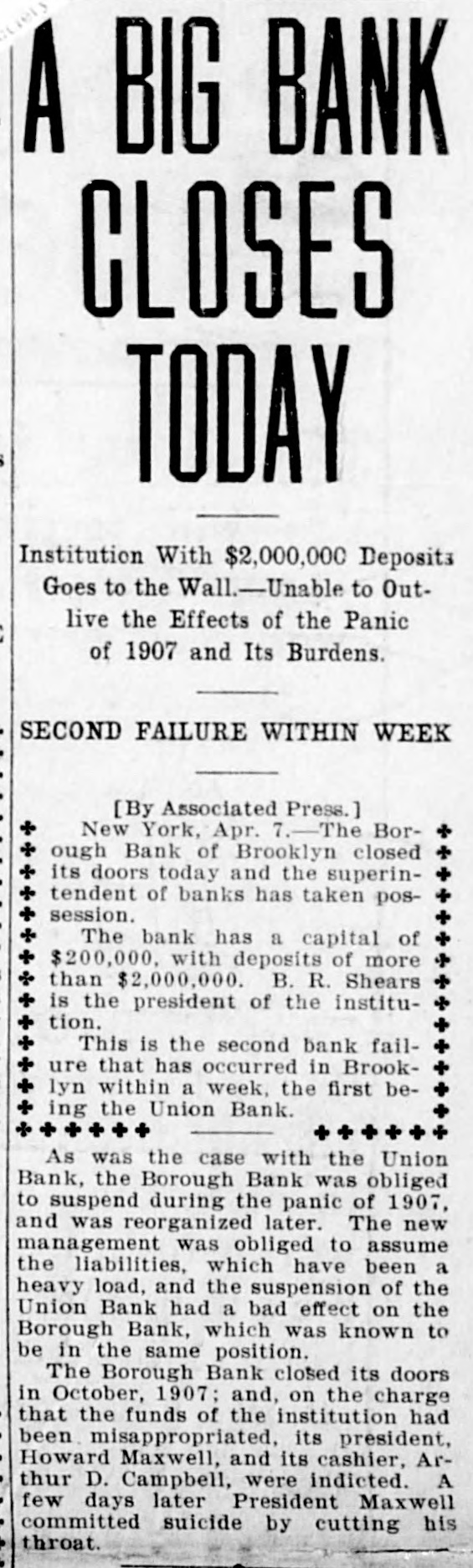
SERVIS A BIG BANK CLOSES $ TODAY Institution With $2,000,000 Deposits Goes to the Wall.-Unable to Outlive the Effects of the Panic : of 1907 and Its Burdens. . SECOND FAILURE WITHIN WEEK [By Associated Press.] . New York, Apr. 7.-The Bor+ + ough Bank of Brooklyn closed : + its doors today and the superintendent of banks has taken possession. + The bank has a capital of + $200,000. with deposits of more I + than $2,000,000. B. R. Shears + is the president of the institution. This is the second bank failure that has occurred in Brook+ lyn within a week, the first being the Union Bank. As was the case with the Union Bank, the Borough Bank was obliged to suspend during the panic of 1907, and was reorganized later. The new management was obliged to assume the liabilities, which have been a heavy load, and the suspension of the Union Bank had a bad effect on the Borough Bank, which was known to be in the same position. The Borough Bank closed its doors in October, 1907; and, on the charge that the funds of the institution had been misappropriated, its president, Howard Maxwell, and its cashier, Arthur D. Campbell, were indicted. A few days later President Maxwell committed suicide by cutting his throat.


Article from Coeur D'alene Evening Press, April 7, 1910

Click image to open full size in new tab

Article Text

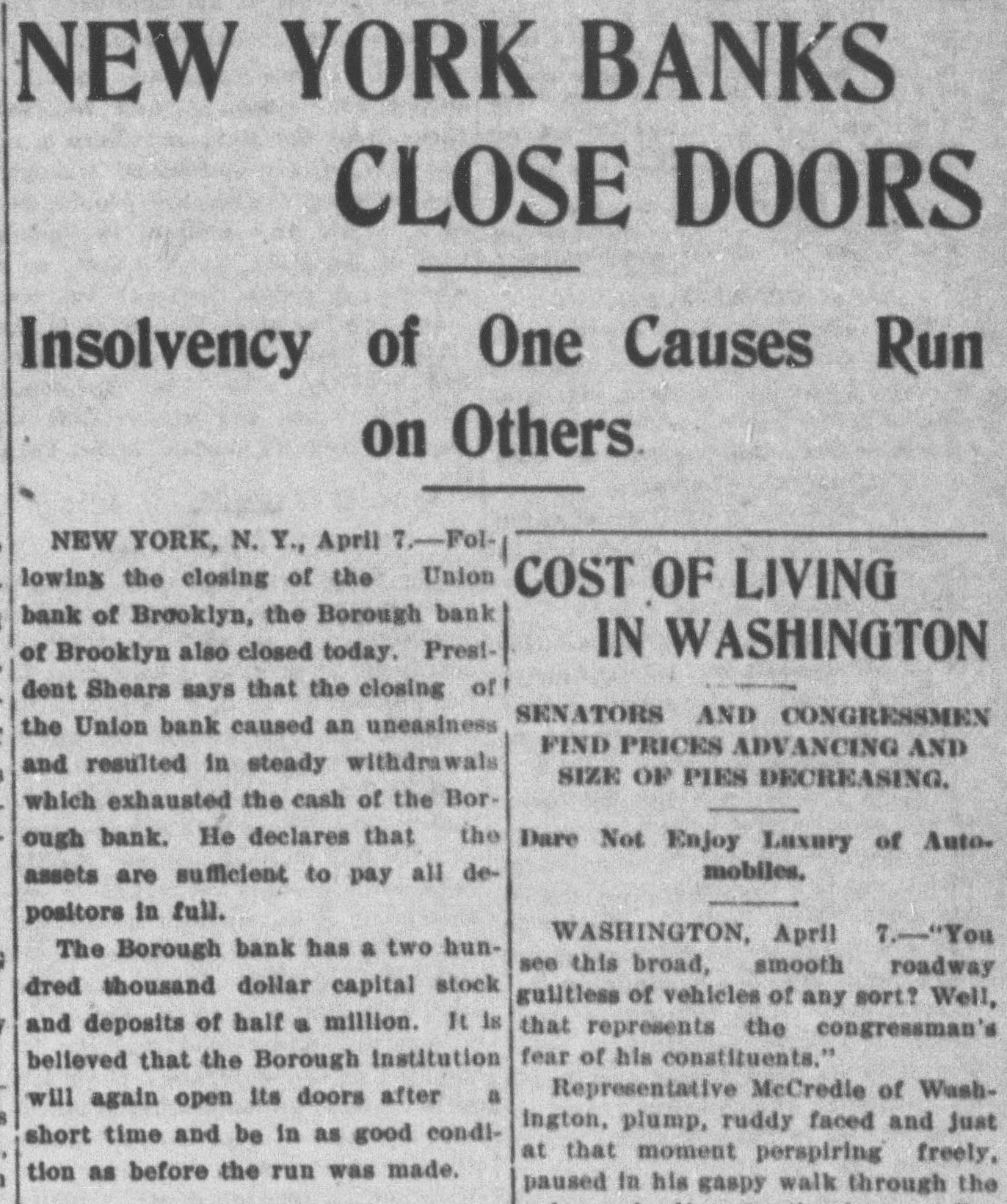
NEW YORK BANKS CLOSE DOORS Insolvency of One Causes Run on Others. NEW YORK, N. Y., April 7.-FolUnion lowing the closing of the COST OF LIVING bank of Brooklyn, the Borough bank IN WASHINGTON of Brooklyn also closed today. President Shears says that the closing of SENATORS AND CONGRESSMEN the Union bank caused an uneasiness FIND PRICES ADVANCING AND and resulted in steady withdrawals SIZE OF PIES DECREASING, which exhausted the cash of the Borough bank. He declares that the Dare Not Enjoy Luxury of Automobiles. assets are sufficient to pay all depositors in full. WASHINGTON, April 7.-"You The Borough bank has a two hunsee this broad, smooth roadway dred thousand dollar capital stock guiltless of vehicles of any sort? Well, and deposits of half a million. It is that represents the congressman's fear of his constituents." believed that the Borough Institution Representative McCredie of Washwill again open its doors after a ington, plump, ruddy faced and just short time and be in as good condiat that moment perspiring freely, tion as before the run was made. paused in his gaspy walk through the


Article from Daily Capital Journal, April 7, 1910

Click image to open full size in new tab

Article Text

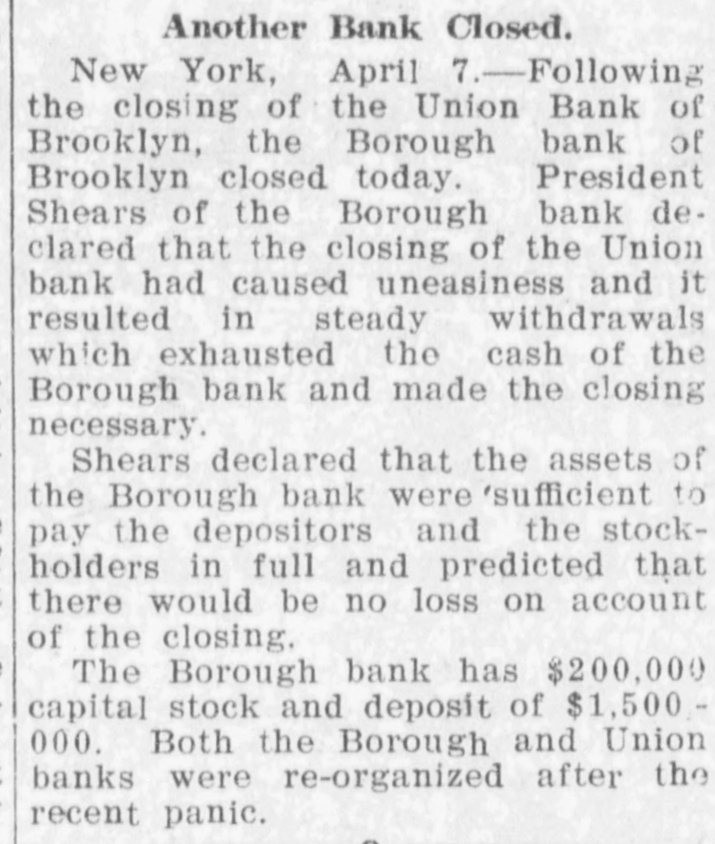
Another Bank Closed. New York, April 7.-Following the closing of the Union Bank of Brooklyn, the Borough bank of Brooklyn closed today. President Shears of the Borough bank declared that the closing of the Union bank had caused uneasiness and it resulted in steady withdrawals which exhausted the cash of the Borough bank and made the closing necessary. Shears declared that the assets of the Borough bank were 'sufficient to pay the depositors and the stockholders in full and predicted that there would be no loss on account of the closing. The Borough bank has $200,000 capital stock and deposit of $1,500 000. Both the Borough and Union banks were re-organized after the recent panic.


Article from Daily Kennebec Journal, April 8, 1910

Click image to open full size in new tab

Article Text

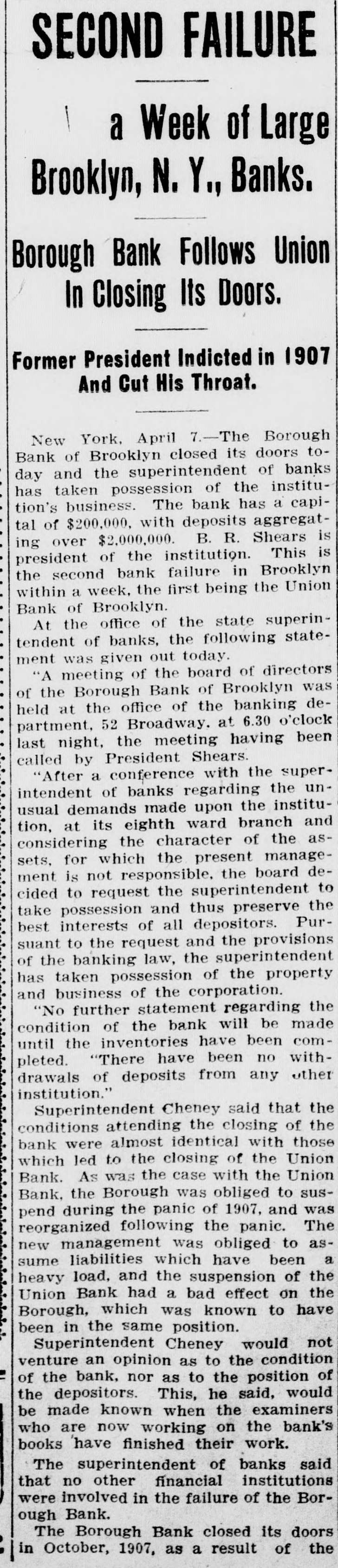
SECOND FAILURE a Week of Large Brooklyn, N. Y., Banks. Borough Bank Follows Union In Closing Its Doors. Former President Indicted in 1907 And Cut His Throat. New York, April 7.-The Borough Bank of Brooklyn closed its doors today and the superintendent of banks has taken possession of the institution's business. The bank has a capital of $200,000, with deposits aggregating over $2,000,000. B. R. Shears is president of the institution. This is the second bank failure in Brooklyn within a week, the first being the Union Bank of Brooklyn. At the office of the state superintendent of banks, the following statement was given out today. "A meeting of the board of directors of the Borough Bank of Brooklyn was held at the office of the banking department, 52 Broadway. at 6.30 o'clock last night, the meeting having been called by President Shears. "After a conference with the superintendent of banks regarding the unusual demands made upon the institution, at its eighth ward branch and considering the character of the assets, for which the present management is not responsible, the board decided to request the superintendent to take possession and thus preserve the best interests of all depositors. Pursuant to the request and the provisions of the banking law, the superintendent has taken possession of the property and business of the corporation. "No further statement regarding the condition of the bank will be made until the inventories have been completed. "There have been no withdrawals of deposits from any other institution." Superintendent Cheney said that the conditions attending the closing of the bank were almost identical with those which led to the closing of the Union Bank. As was the case with the Union Bank, the Borough was obliged to suspend during the panic of 1907, and was reorganized following the panic. The new management was obliged to assume liabilities which have been a heavy load, and the suspension of the Union Bank had a bad effect on the Borough, which was known to have been in the same position. Superintendent Cheney would not venture an opinion as to the condition of the bank, nor as to the position of the depositors. This, he said, would be made known when the examiners who are now working on the bank's books have finished their work. The superintendent of banks said that no other financial institutions were involved in the failure of the Borough Bank. The Borough Bank closed its doors in October, 1907, as a result of the


Article from Omaha Daily Bee, April 8, 1910

Click image to open full size in new tab

Article Text

Borough Bank of Brooklyn Closes Run Begins at One of Its Branches and State Superintendent Takes Charge. NEW YORK, April 7.-The Borough Bank of Brooklyn closed its doors today and the superintendent of banks has taken possession of its business. The bank has a capital of $200,000, with deposits ag. gregating over $2,000,000. B. R. Shears is president. This is the second bank failure in Brooklyn within a week, the first being the Union Bank of Brooklyn. At the office of the state superintendent of banks, the following statement was given out: "A meeting of the board of directors of the Borough Bank of Brooklyn was held at the office of the banking department, 52 Broadway, at 6:30 clock last night. the meeting having been called by President Shears. "After a conference with the superintendent of banks regarding the unusual demands being made on the institution at its Eighth ward branch, and considering the character of the assets for which the present management is not responsible, the board decided to request the superintendent to take possession and preserve the best interests of all depositors. "Pursuant to the request and the provisions of the banking law, the superintendent has taken possession of the property and business of the corporation. "No further statement regarding the con cloon of the bank will be made until the inventories have been completted. "There has been no withdrawal of deposit from any other Institution." Superintendent Chenny said that the conditions attending the closing of the bank were almost identical with those which led to the closing of the Union bank.


Article from New-York Tribune, April 10, 1910

Click image to open full size in new tab

Article Text

BANKS FORCED TO CLOSE Unable to realize on its assets in time to meet demands upon it, the Union Bank of Brooklyn, after a hard struggle under the burdens which it inherited from the old Me hanics and Traders Bank. was forcell to close its doors. The officers of the bank of which ex-Controller Edward M. Grout is the president, found it impossible to main. tain the reserve of 20 per cent of the, depΓ΄sits required by law. "The troubles of the institution are as cribed to its holdings of slow assets, including real estate in Brooklyn and Jamales, which cannot be advantageously sold at this time, and certain securities, among which is stock of the Knickerboe ker Loe/Company of Chicago, held as collateral for a loan of several hundred thousand dollars to E. R. and O. F. Thomas, who at one time controlled the bank. The bank has a paid-up capital of $1,000,000, and its deposits are^estimated at $5,500,000. "The Borough Bank of Brooklyn, on account of heavy withdrawals by frightened degositors following the suspension of the Union Bank. and because of slow assets inherited from the former management, on which the new management had been unable to realize, closed its doors also. The bank is said to have 2 paid up capital of $200,000. and its individual deposits are estimated at $1,760,000. It has had a stormy carrer, its deposed president in 1908. Howard Maxwell, committing sucide while


Article from The Evening World, May 10, 1912

Click image to open full size in new tab

Article Text

# BANK SUES WARD & GOW. First National Wants $100,000 on a Promissory Note. The First National Bank of New York has sued the advertising firm of Ward & Gow on a promissory note for $100,000. Interest is asked for from Sept. 27, 1907. Judgment was obtained in March, 1910. Since then Gow has begun a proceeding to have set aside an agreement of dissolution of partnership between him and Ward. The bank now demands that the Court appoint a receiver for the firm. It is said the firm has contracts for advertising which will return a profit of two and a half millions of dollars. It was after the failure of the Borough Bank of Brooklyn that Gow, in order to protect Ward and others, entered into the dissolution agreement.