Boro Bank (New York, NY)

Episode Information

Episode Type
Run → Suspension → Reopening
Start Date
September 14, 1907
Location
New York, New York (40.714, -74.006)
Bank Type
state

Metadata

Notes

Newspapers refer to the institution as the Borough Bank of Brooklyn (OCR/short-name variant).

Events (4)

1. September 14, 1907 Run
Cause Details
Vault combination jammed, causing impatience/crowd and imminent run
Measures
Vice-president hurriedly brought over $100,000 in coin and currency to the branch and transported it in express wagons to reassure depositors.
Newspaper Excerpt
To ward off a possible run when the combination of the vault of the Eighth ward branch of the Borough Bank of Brooklyn refused to work this morning ... threw more than $100,000 in coin and currency into three express wagons ...
Source
newspapers
2. October 25, 1907 Suspension
Cause
Macro News
Cause Details
Part of the wider 1907 financial panic/Knickerbocker crisis leading to runs and temporary closures across New York
Newspaper Excerpt
The International Trust Company, of No. 206 Broadway; the Brooklyn Bank and the Borough Bank of Brooklyn failed to open their doors for business.
Source
newspapers
3. November 16, 1907 Receivership
Newspaper Excerpt
Temporary receivers were appointed today for six New York banks which recently suspended payment. They are: ... Borough Bank of Brooklyn ...
Source
newspapers
4. April 14, 1908 Reopening
Newspaper Excerpt
Justice Betts ... permitting the bank to reopen for business on April 14. There was no opposition.
Source
newspapers

Newspaper Articles (23)

Article from Macon Beacon, September 14, 1907

Click image to open full size in new tab

Article Text

To Prevent Bank Run

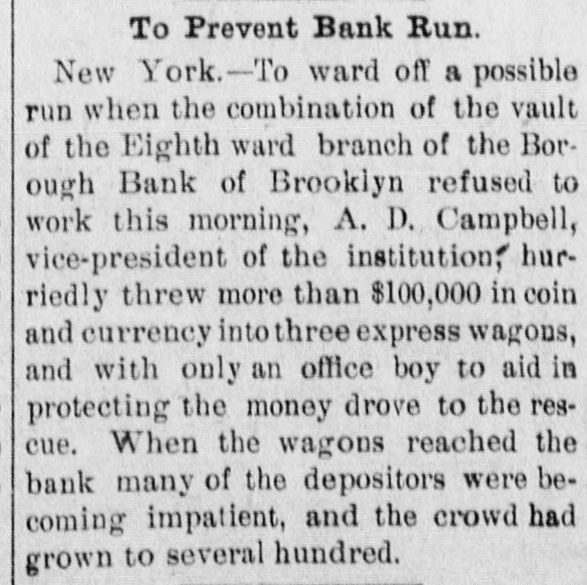
New York.-To ward off a possible run when the combination of the vault of the Eighth ward branch of the Borough Bank of Brooklyn refused to work this morning, A. D. Campbell, vice-president of the institution; hurriedly threw more than $100,000 in coin and currency intothree express wagons, and with only an office boy to aid in protecting the money drove to the rescue. When the wagons reached the bank many of the depositors were becoming impatient, and the crowd had grown to several hundred.


Article from The Evening World, October 25, 1907

Click image to open full size in new tab

Article Text

FIRST NATIONAL OF BROOKLYN AND SIX OTHER BANKS CLOSE

SITUATION AT A GLANCE.

Secretary Cortelyou said after the close of banking hours:

"The situation is good. This is the third day, and I see no setback of serious import. I shall probably remain in the city all day tomorrow, and if there is no critical development—which I see no sign of at this time and do not expect by any means—I shall return to Washington."

The First National Bank of Brooklyn, a Clearing-House institution; the Williamsburg Trust Company and the Jenkins Trust Company of Brooklyn, with numerous branches, suspended temporarily. The solvency of the institution has not been questioned.

President William A. Nash, of the Corn Exchange Bank, said:

"The outlook is decidedly better, and I think the crucial point has been passed. The failure of the smaller banks is not disturbing. They did not have much cash on hand and it was better for them to suspend than to stand a run. They are perfectly solvent and will be able to resume business when the present hysteria subsides."

The International Trust Company, of No. 206 Broadway; the Brooklyn Bank and the Borough Bank of Brooklyn failed to open their doors for business.

The Union Dime Savings Bank, Thirty-second street and Broadway, with deposits of over $27,000,000, has given notice that it will require thirty days' notice in writing of intent to withdraw. Other savings banks have adopted this course.

J. Pierpont Morgan and half a dozen bankers raised a pool of $10,000,000 late this afternoon which was loaned on call on the Stock Exchange to protect the market.

International banking houses have arranged to import between $10,000,000 and $15,000,000 in gold from Europe.

The Lincoln Trust Company, the Trust Company of America, the Colonial Trust Company and the Harlem Savings Bank safely weathered runs. The trust companies received substantial aid and the Harlem Savings Bank took advantage of the sixty-day clause.

Secretary of the Treasury Cortelyou placed about $8,000,000 in New York banks during the day, a total of $30,000,000 since last Friday.

Superintendent of Banks Clark Williams said that conditions have improved and will continue to improve if bank depositors are reasonable.

The stock market passed through a precarious, feverish day, closing in a skyrocket finish that sent the general range of prices away above yesterday's final quotations.

State Bank Examiner Leonard stated that the Lincoln Trust Company is in a solvent condition.

An officer of the Hanover National Bank suggested that Gov. Hughes proclaim special holidays enabling the banks to close next week to allow the arrival of gold from abroad. Gov. Hughes, over the long-distance telephone, said he had no power to order such holidays.

A shipment of $2,500,000 in small bills was received from the United States Treasury in Washington.

Ernst Thalman, Otto T. Bannard and Gen. Henry C. Ide were appointed temporary receivers of the Knickerbocker Trust Company.

Before the close of the stock market Halstead & Hodges and Van Emburgh & Atterbury, brokers, loaned on the floor of the Stock Exchange $10,000,000 of the syndicate money at 50 per cent.

The amount pledged by the Clearing House banks to the aid of the Stock Exchange will be between $12,000,000 and $15,000,000.

Williamsburg and Jenkins Concerns, Belonging to the Jenkins String of Banking Institutions, Temporarily Close Their Doors.

THERE WAS VERY LITTLE EXCITEMENT AT EITHER BANK

Borough and Brooklyn Banks and International Trust Company Had Been Forced to Suspend Earlier in the Day.

In rapid succession the Williamsburg Trust Company and its branch on Fulton street, Brooklyn, the Jenkins Trust Company and all its branches and the First National Bank of Brooklyn closed their doors this afternoon for lack of ready cash.

In each instance it was announced that the suspension was temporary and that all the institutions would reopen as soon as currency for carrying on business could be secured.

All the institutions that are affected belong in what is known as the Jenkins string of banking companies which enjoy the best of reputation. It is stated that they are absolutely solvent.

Article from Rock Island Argus, November 16, 1907

Click image to open full size in new tab

Article Text

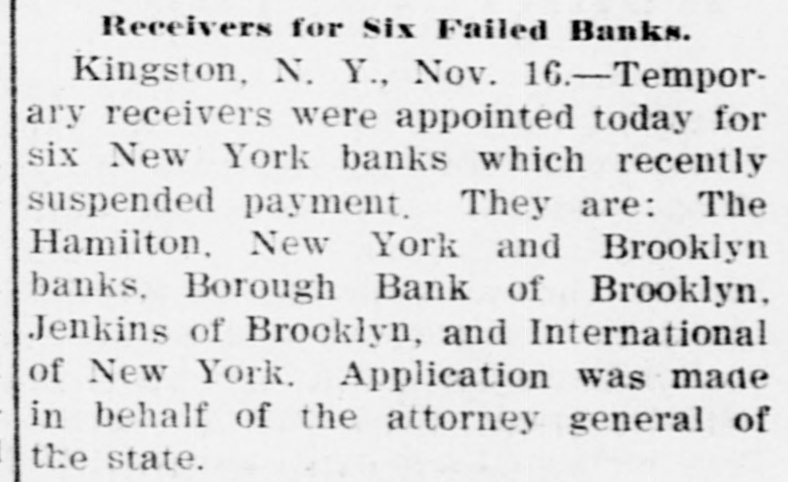
Receivers for Six Failed Banks

Kingston, N. Y., Nov. 16.-Temporary receivers were appointed today for six New York banks which recently suspended payment. They are: The Hamilton, New York and Brooklyn banks, Borough Bank of Brooklyn. Jenkins of Brooklyn, and International of New York, Application was made in behalf of the attorney general of the state.


Article from The Bennington Evening Banner, November 18, 1907

Click image to open full size in new tab

Article Text

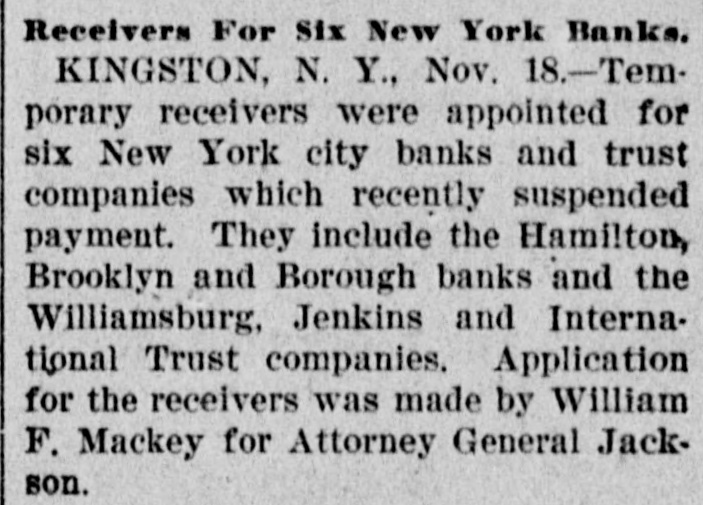
Receivers For Six New York Banks. KINGSTON, N. Y., Nov. 18.-Temporary receivers were appointed for six New York city banks and trust companies which recently suspended payment. They include the Hamilton, Brooklyn and Borough banks and the Williamsburg, Jenkins and International Trust companies. Application for the receivers was made by William F. Mackey for Attorney General Jackson.


Article from The Newport Miner, November 22, 1907

Click image to open full size in new tab

Article Text

Fraud Charged.

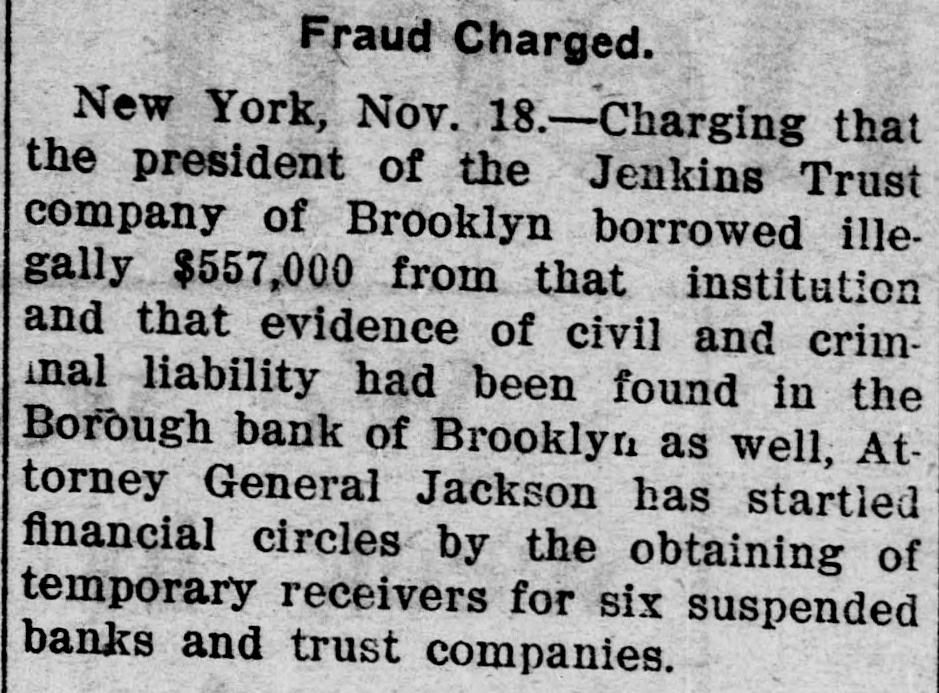
New York, Nov. 18.—Charging that the president of the Jenkins Trust company of Brooklyn borrowed illegally $557,000 from that institution and that evidence of civil and criminal liability had been found in the Borough bank of Brooklyn as well, Attorney General Jackson has startled financial circles by the obtaining of temporary receivers for six suspended banks and trust companies.


Article from The Plymouth Tribune, November 28, 1907

Click image to open full size in new tab

Article Text

Indicted for Larceny.

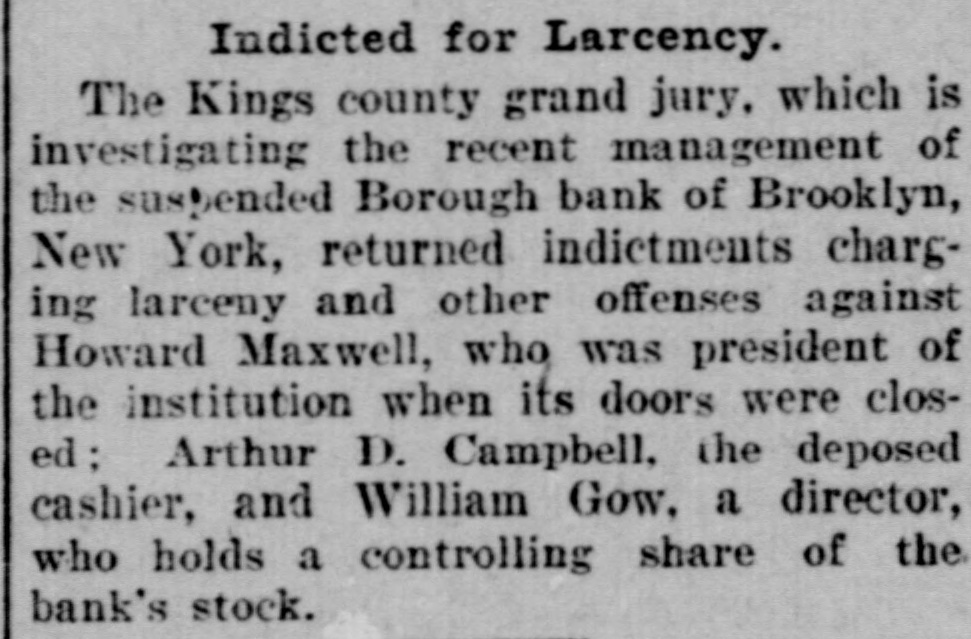
The Kings county grand jury, which is investigating the recent management of the suspended Borough bank of Brooklyn, New York, returned indictments charging larceny and other offenses against Howard Maxwell, who was president of the institution when its doors were closed; Arthur D. Campbell, the deposed cashier, and William Gow, a director, who holds a controlling share of the bank's stock.


Article from The Hope Pioneer, November 28, 1907

Click image to open full size in new tab

Article Text

BOROUGH BANK MEN INDICTED.

President, Cashier and Controlling Stockholder in the Toils.

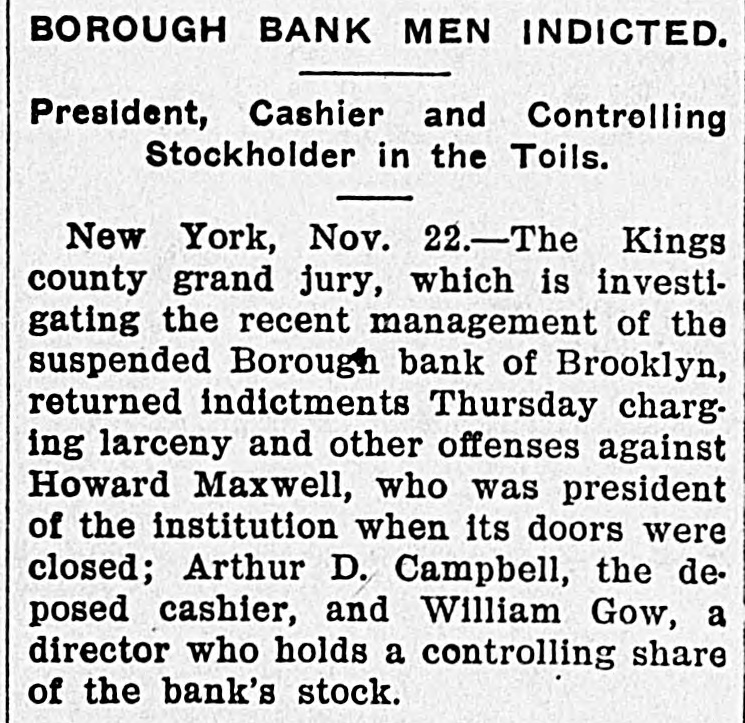
New York, Nov. 22.-The Kings county grand jury, which is investi-gating the recent management of the suspended Borough bank of Brooklyn, returned indictments Thursday charg-ing larceny and other offenses against Howard Maxwell, who was president of the institution when its doors were closed; Arthur D. Campbell, the de-posed cashier, and William Gow, a director who holds a controlling share of the bank's stock.


Article from The Stark County Democrat, November 29, 1907

Click image to open full size in new tab

Article Text

Bank Papers Mysteriously Missing.

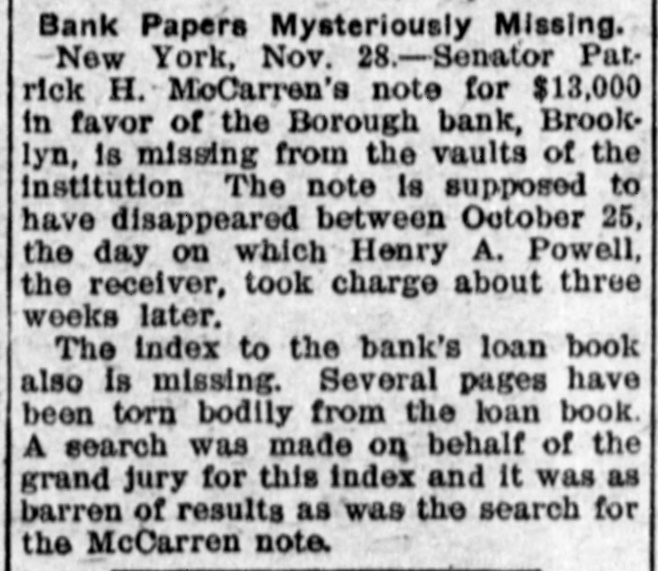
New York, Nov. 28.-Senator Patrick H. MoCarren's note for $13,000 in favor of the Borough bank, Brooklyn, is missing from the vaults of the institution The note is supposed to have disappeared between October 25, the day on which Henry A. Powell, the receiver, took charge about three weeks later.

The index to the bank's loan book also is missing. Several pages have been torn bodily from the loan book. A search was made on behalf of the grand jury for this index and it was as barren of results as was the search for the McCarren note.


Article from The Ketchikan Miner, November 30, 1907

Click image to open full size in new tab

Article Text

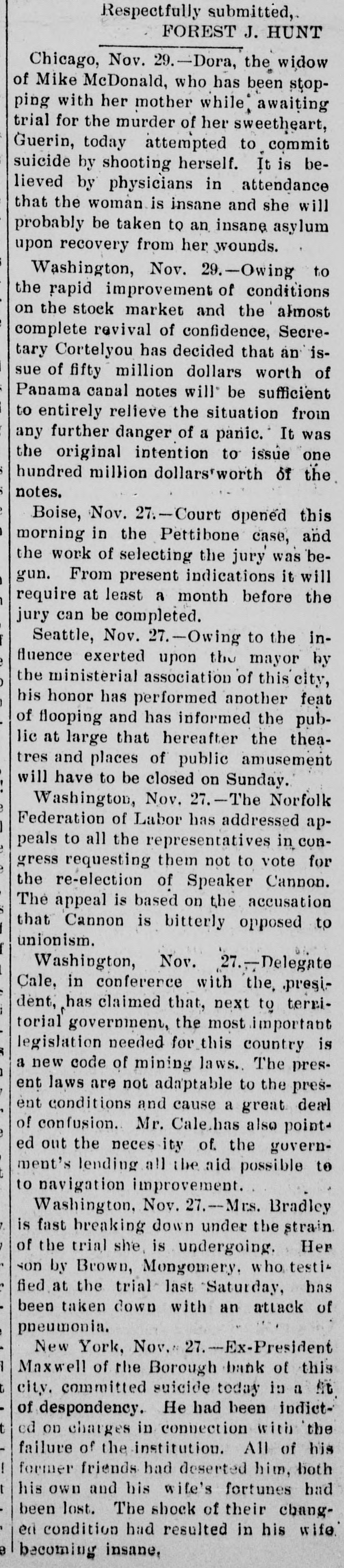
Respectfully submitted, FOREST J. HUNT Chicago, Nov. 29.-Dora, the widow of Mike McDonald, who has been stopping with her mother while awaiting trial for the murder of her sweetheart, Guerin, today attempted to commit suicide by shooting herself. It is believed by physicians in attendance that the woman is insane and she will probably be taken to an insane asylum upon recovery from her ,wounds. Washington, Nov. 29.-Owing to the rapid improvement of conditions on the stock market and the almost complete revival of confidence, Secretary Cortelyou has decided that an issue of fifty million dollars worth of Panama canal notes will be sufficient I to entirely relieve the situation from : any further danger of a panic. It was the original intention to issue one i hundred million dollars'worth of the $ notes. : Boise, Nov. 27.-Court opened this ) morning in the Pettibone case, and the work of selecting the jury was begun. From present indications it will ) require at least a month before the n jury can be completed. f Seattle, Nov. 27.-Owing to the iny fluence exerted upon the mayor by ) the ministerial association of this city, his honor has performed another feat , I of flooping and has informed the public at large that hereafter the theatres and places of public amusement will have to be closed on Sunday. : Washington, Nov. 27.-The Norfolk e Federation of Labor has addressed ap) peals to all the representatives in cone gress requesting them not to vote for , P the re-election of Speaker Cannon. The appeal is based on the accusation $ that Cannon is bitterly opposed to I unionism. f Washington, Nov. 27.-Delegate 1 Cale, in conference with the, presi$ dent, has claimed that, next to terri; torial government, the most important I legislation needed for this country is R a new code of mining laws. The pres) ent laws are not adaptable to the pres( ent conditions and cause a great deal of confusion. Mr. Cale.has also point+ e ed out the neces ity of. the government's lending all the aid possible to b to navigation improvement. Washington, Nov. 27.-Mrs. Bradley 7 is fast breaking down under the strain / of the trial she, is undergoing. Her son by Brown, Mongomery. who testiC fied at the trial last Saturday, has been taken down with an attack of pneumonia. ) New York, Nov. 27.-Ex-President I Maxwell of the Borough bank of this t city. committed suicide today in a fit of despondency. He had been indictt ed on charges in connection with the failure of the institution. All of his ! former friends had deserted him, both I his own and his wife's fortunes had been lost. The shock of their chang. en condition had resulted in his wife e becoming insane,


Article from The Salt Lake Herald, December 4, 1907

Click image to open full size in new tab

Article Text

Quotes Former Message

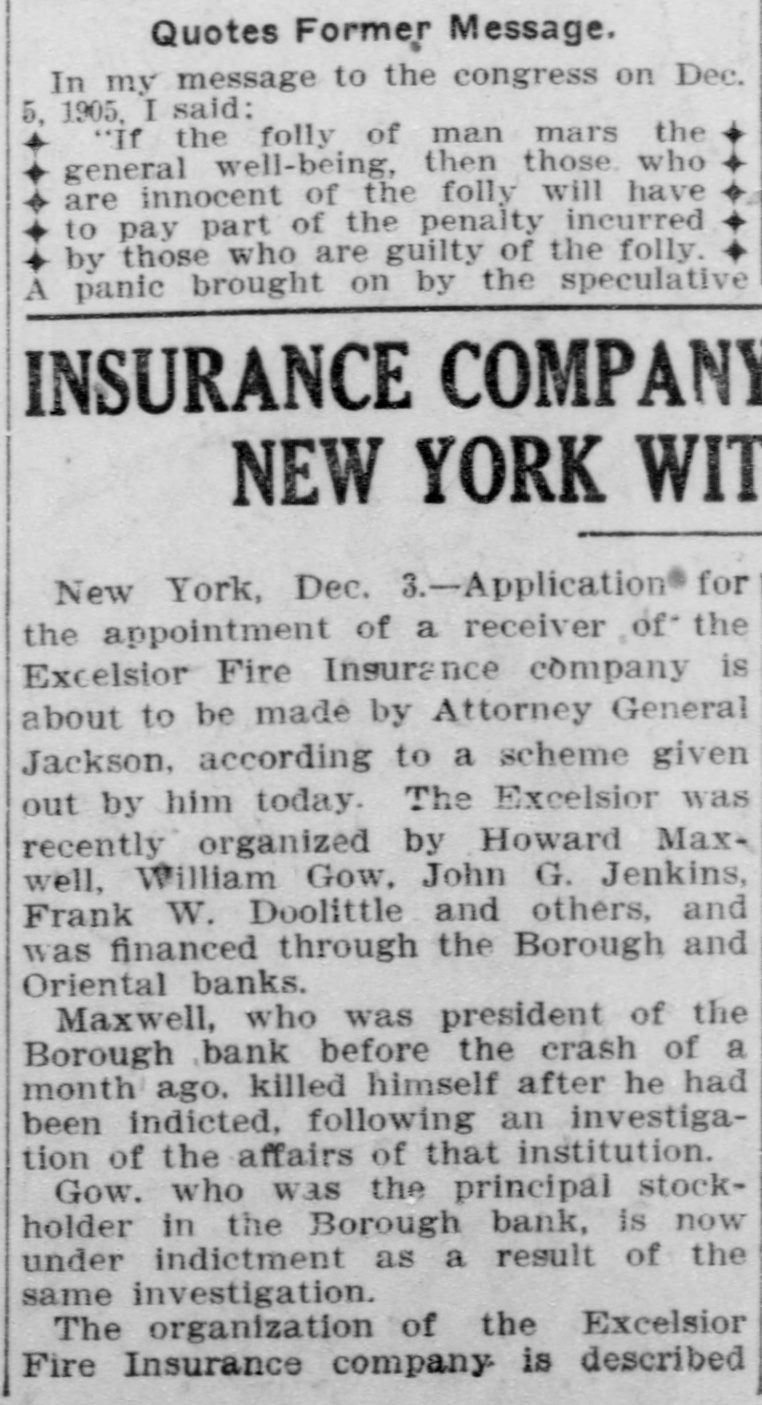
In my message to the congress on Dec. 5, 1905, I said: "If the folly of man mars the general well-being, then those. who are innocent of the folly will have to pay part of the penalty incurred by those who are guilty of the folly. A panic brought on by the speculative INSURANCE COMPANY NEW YORK WIT New York, Dec. 3.-Application for the appointment of a receiver of the Excelsior Fire Insurance company is about to be made by Attorney General Jackson, according to a scheme given out by him today. The Excelsior was recently organized by Howard Maxwell, William Gow, John G. Jenkins, Frank W. Doolittle and others, and was financed through the Borough and Oriental banks. Maxwell, who was president of the Borough bank before the crash of a month ago, killed himself after he had been indicted, following an investigation of the affairs of that institution. Gow. who was the principal stockholder in the Borough bank, is now under indictment as a result of the same investigation. The organization of the Excelsior Fire Insurance company is described


Article from Meade County News, December 12, 1907

Click image to open full size in new tab

Article Text

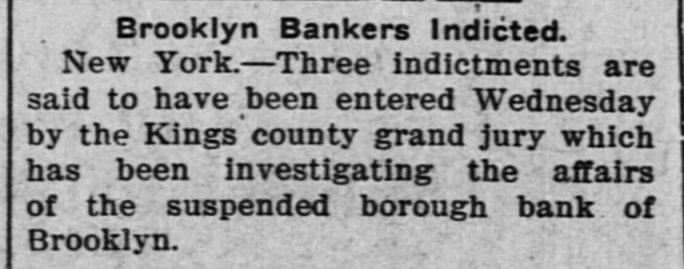
Brooklyn Bankers Indicted.

New York. -Three indictments are said to have been entered Wednesday by the Kings county grand jury which has been investigating the affairs of the suspended borough bank of Brooklyn.


Article from The Evening World, February 8, 1908

Click image to open full size in new tab

Article Text

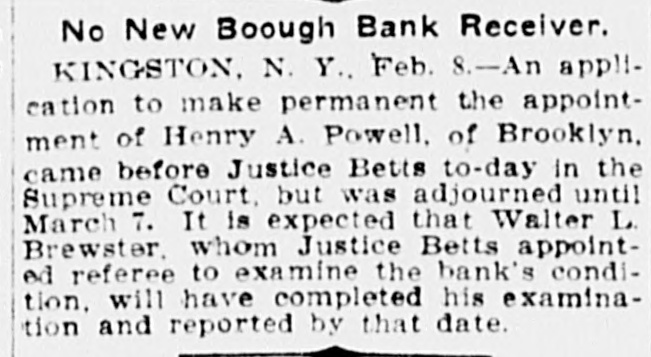
No New Boough Bank Receiver.

KINGSTON, N. Y., Feb. 8.-An application to make permanent the appointment of Henry A. Powell, of Brooklyn, came before Justice Betts to-day in the Supreme Court, but was adjourned until March 7. It is expected that Walter L. Brewster, whom Justice Betts appointed referee to examine the bank's condition, will have completed his examination and reported by that date.


Article from New-York Tribune, February 11, 1908

Click image to open full size in new tab

Article Text

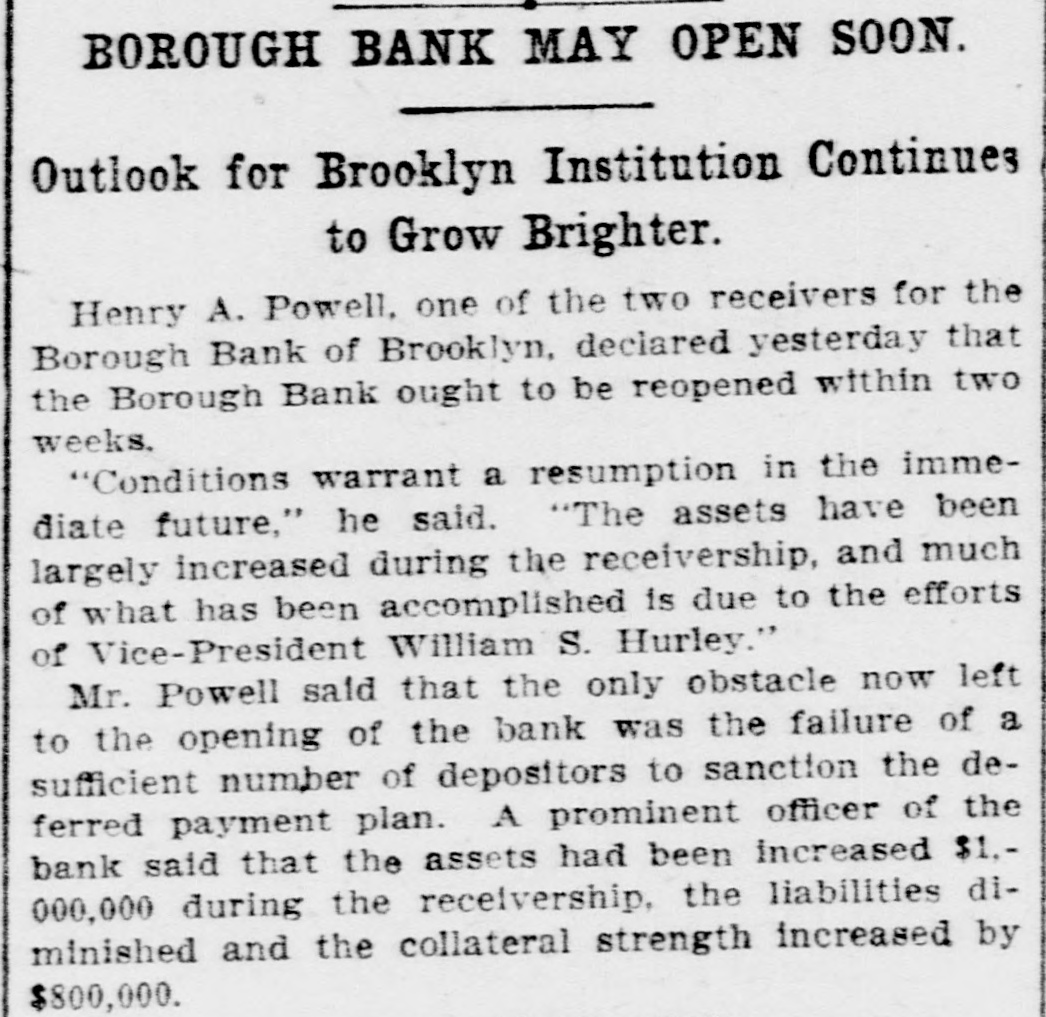
BOROUGH BANK MAY OPEN SOON

Outlook for Brooklyn Institution Continues to Grow Brighter. Henry A. Powell, one of the two receivers for the Borough Bank of Brooklyn, declared yesterday that the Borough Bank ought to be reopened within two weeks. "Conditions warrant a resumption in the immediate future," he said. "The assets have been largely increased during the receivership, and much of what has been accomplished is due to the efforts of Vice-President William S. Hurley." Mr. Powell said that the only obstacle now left to the opening of the bank was the failure of a sufficient number of depositors to sanction the deferred payment plan. A prominent officer of the bank said that the assets had been increased $1.000,000 during the receivership, the liabilities diminished and the collateral strength increased by $800,000.


Article from New-York Tribune, April 12, 1908

Click image to open full size in new tab

Article Text

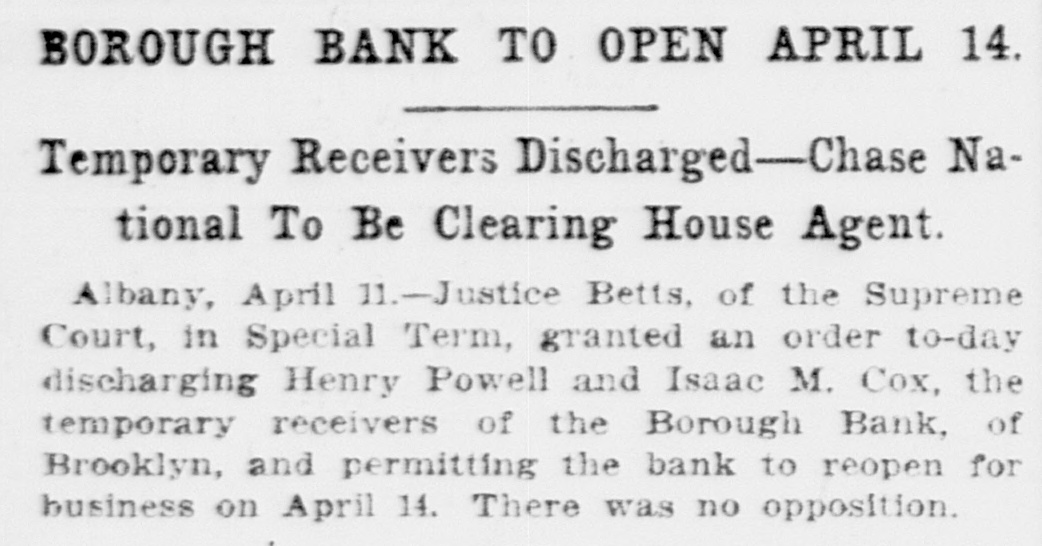
BOROUGH BANK TO OPEN APRIL 14

Temporary Receivers Discharged-Chase National To Be Clearing House Agent. Albany, April 11.-Justice Betts, of the Supreme Court, in Special Term, granted an order to-day discharging Henry Powell and Isaac M. Cox, the temporary receivers of the Borough Bank, of Brooklyn, and permitting the bank to reopen for business on April 14. There was no opposition.


Article from Alexandria Gazette, April 14, 1908

Click image to open full size in new tab

Article Text

The borough bank of Brookylo, one of the financial institutions fore.d to el se during the recent panic, reopened for business today.


Article from The Marion Daily Mirror, April 14, 1908

Click image to open full size in new tab

Article Text

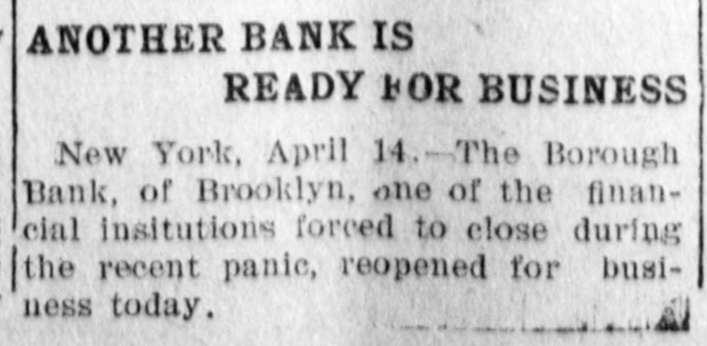
ANOTHER BANK IS READY FOR BUSINESS New York, April 14.-The Borough Bank, of Brooklyn, one of the financial insitutions forced to close during the recent panic, reopened for busiI ness today.


Article from New-York Tribune, January 29, 1909

Click image to open full size in new tab

Article Text

SHIFT IN GOW CASE PLACES BLA ON SUICIDE Witness Tells of Maxwell's Alleged Part in McGuire Transaction. More of the banking methods of William Gow. on trial before Justice Crane, in the Supreme Court. Brooklyn, on a grand larceny charge in connection with the wrecking of the Brooklyn Borough Bank, were shown yesterday in the testimony of Arthur D. Campbell, the cashier, who turned state's evidence. He was on the stand nearly all day, his testimony making up the bulk of the prosecution's case. District Attorney Clarke will rest for the prosecution when Mr. Campbell concludes his testimony to-day. The cashier, who escaped trial on the same indictment by testifying for the people, testified yesterday that Mr. Gow floated the Excelsior Fire Insurance Company by an illegal use of the funds of the Borough Bank, that fraudulent and unsecured notes, signed by irresponsible persons, were used by the defendant to cover his overdrawn account, and explained the details of Mr. Gow's alleged apof propriation of the Carrie McGuire account $145,000. Mr. Campbell's testimony of the part of Howard Maxwell, the suicide, in the alleged theft of the McGuire money was generally accepted as an aid to the defence. The defence was further strengthened by the statement of Robert J. Cuddihy, the McGuire executor, that he had no difficulty in drawing money on the account at any time, and that he had withdrawn the last dollar and closed the account on the day the bank collapsed. Richard W. Jones, jr., formerly president of the defunct Oriental Bank, of Manhattan, was crossexamined by Martin W. Littleton, attorney for Mr. Gow, and told much the same story of the defendant's alleged financial feat in acquiring $1,000,000 assets for his International Trust Company as was outlined by District Attorney Clarke on Wednesday. Mr. Jones said, however, that the $145,000 in McGuire money was already credited to the International Trust Company when the Oriental Bank made its loans aggregating $750,000, whereas Mr. Clarke stated the $145,000 was the last. item secured. After Mr. Cuddihy had been cross-examined and Arthur D. Campbell started his history of the wrecking of the Borough Bank it became evident that much of the blame for the McGuire transaction would be put on the shoulders of Mr. Maxwell, the bank president who shot himself after being indicted. The witness said that after the $145,000 had been deposited to the Carrie McGuire account Mr. Gow instructed him over the telephone not to loan any of the money, because it wouldn't remain there long, and not to tell Mr. Hurley, vice-president of the bank, about it, because he might want to borrow the money. "Mr. Gow called me on the telephone on the morning of September 30. 1907," said the witness, "and asked me to draw a cashier's check for $145,000 and send it over to him in New York. I asked him what we were to get for it, and Mr. Maxwell, who was in the same room with Mr. Gow, came to the telephone. "I asked him what I was going to get for the $145,000. 'Mr. Cuddihy is going to give us a check for it,' he replied. He told me that it was all right, and that I should send the check over. I made out the check on the Borough Bank to the International Trust Company. and sent it over to Mr. Maxwell. It came back paid. It was indorsed to the Oriental Bank and signed by Howard Maxwell, as president. On October 1 Mr. Maxwell told me that Mr. Cuddihy would give us a check for the amount very soon. The next day he said he hadn't received the check yet, but told me to credit $145.000 to the McGuire account, which I did. "When young Mr. McGuire called soon after to get some checks certified I told Mr. Maxwell there was no money there, and he instructed me to transfer $105,000 in the chairman's fund, which he controlled, to the McGuire account. A day or two later $12,000 more was transferred from the chairman's fund to the McGuire account. The account was finally made up when Mr. Maxwell brought a check for $28,000 signed by Frank W. Doolittle, Mr. Gow's secretary. I immediately credited it to the McGuire estate Henry M. White, a bookkeeper, identified the entries which showed the history of the deposits and withdrawals in the McGuire account, as recited by Mr. Campbell. Mr. Clark asked the cashier about the $250,000 Maxwell note on the Borough Bank. "Was this note, as was usual with notes given by the Borough Bank, entered in your books?' re"No, it was never entered," Mr. Campbell plled. "Mr. Gow asked me on October 24 If there wasn't some way the notes could be entere on the books, but I told him there wasn't." Mr. Campbell swore that although it was the custom to read all the large notes at the directors' meetings, the Burr, Jenkins or Maxwell notes were not mentioned. The largest individual loan, prior to September 27, 1907, was $50,000. he said. The flotation of the Excelsior Fire Insurance Company was taken up. "I told Mr. Gow in August, 1907," testified Mr. Campbell, "that he could not draw out money because the reserve fund was very low. But on August 7 Mr. Gow executed a loan of $137,500 to other members of his Excelsior Fire Insurance Company from the funds of the Borough Bank, as follows: John S. Jenkins, $13,250; E. B. Armstrong, loans of $36,750 and $37,500; Eugene Van Skirk, two loans of $25,000. "This money will never go out of the bank," Gow said to me, 'until it goes into the International Trust Company and can be safely carried, because of additional privileges we will have then.' The reserve fund was then less than 15 per cent of the deposits, which is illegal." Mr. Campbell testified that the defendant cancelled his overdrawn account by crediting himself with the following notes, which were never made known to the members of the board of directors and remained unsatisfied in the bank until late in October, when it falled: By James Bartlett, a negro hotel porter. March 27, 1907, $25,000; James R. Studwell, March 27. 1907, $25,000; Charles Pfeiffer, August 27, 1907 $21,000; Charles Pfeiffer, September 3. 1907, $10,000; Herman Veit, February 26, 1906, $9. 204 19. The only note indorsed was that of Herman Veit, to which Mr. Gow affixed his name on its second renewal. The trial continues to-day, the defence opening its case.


Article from Cameron County Press, April 22, 1909

Click image to open full size in new tab

Article Text

Paid Off Last Dollar

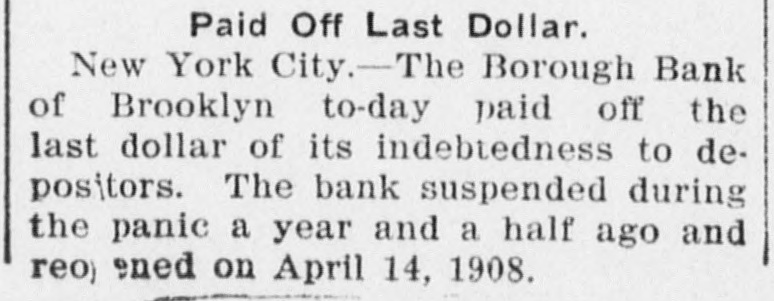
New York City.-The Borough Bank of Brooklyn to-day paid off the last dollar of its indebtedness to depositors. The bank suspended during the panic a year and a half ago and reo) ened on April 14, 1908.


Article from Coeur D'alene Evening Press, April 7, 1910

Click image to open full size in new tab

Article Text

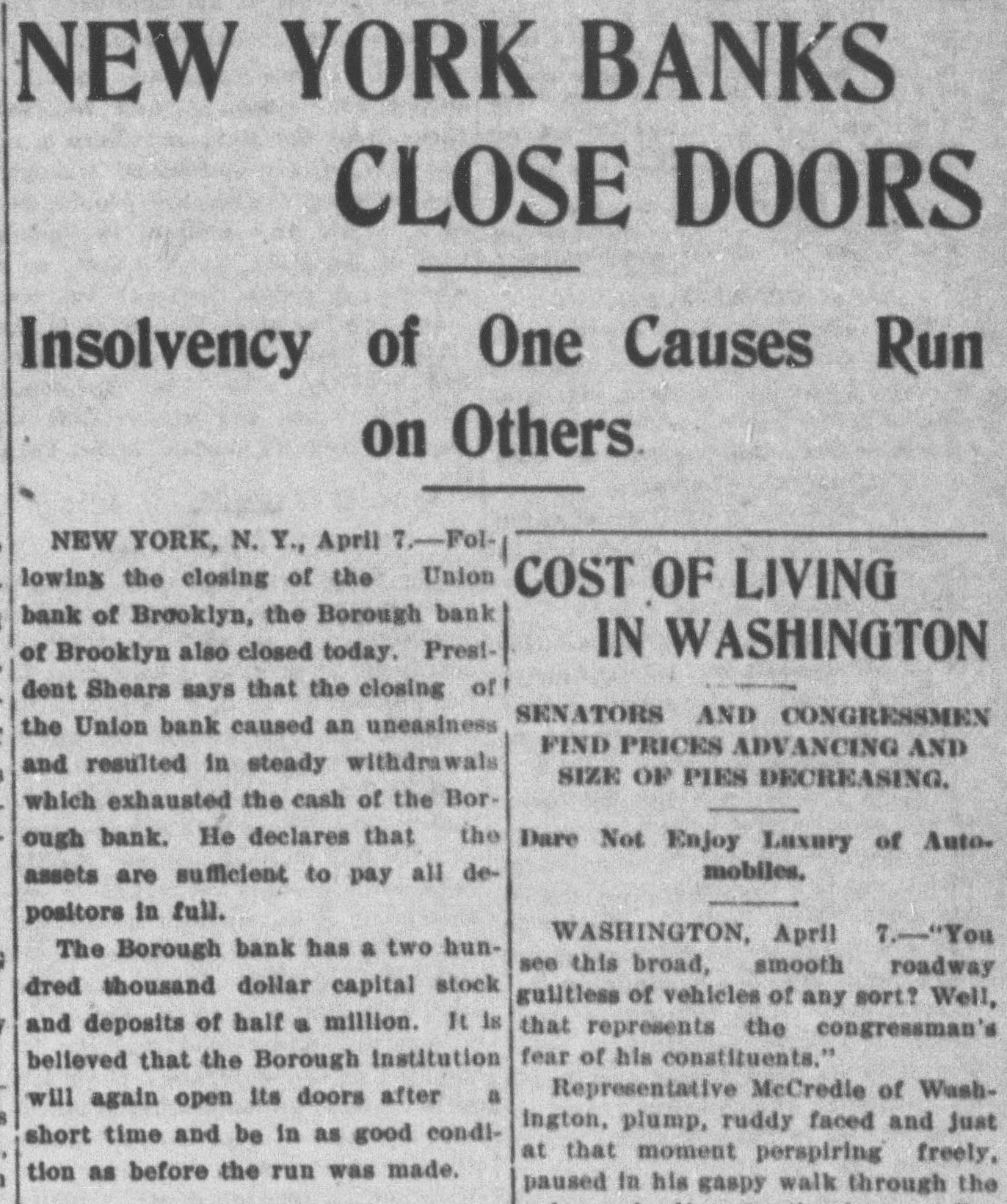
NEW YORK BANKS CLOSE DOORS Insolvency of One Causes Run on Others. NEW YORK, N. Y., April 7.-FolUnion lowing the closing of the COST OF LIVING bank of Brooklyn, the Borough bank IN WASHINGTON of Brooklyn also closed today. President Shears says that the closing of SENATORS AND CONGRESSMEN the Union bank caused an uneasiness FIND PRICES ADVANCING AND and resulted in steady withdrawals SIZE OF PIES DECREASING, which exhausted the cash of the Borough bank. He declares that the Dare Not Enjoy Luxury of Automobiles. assets are sufficient to pay all depositors in full. WASHINGTON, April 7.-"You The Borough bank has a two hunsee this broad, smooth roadway dred thousand dollar capital stock guiltless of vehicles of any sort? Well, and deposits of half a million. It is that represents the congressman's fear of his constituents." believed that the Borough Institution Representative McCredie of Washwill again open its doors after a ington, plump, ruddy faced and just short time and be in as good condiat that moment perspiring freely, tion as before the run was made. paused in his gaspy walk through the


Article from Daily Capital Journal, April 7, 1910

Click image to open full size in new tab

Article Text

Another Bank Closed

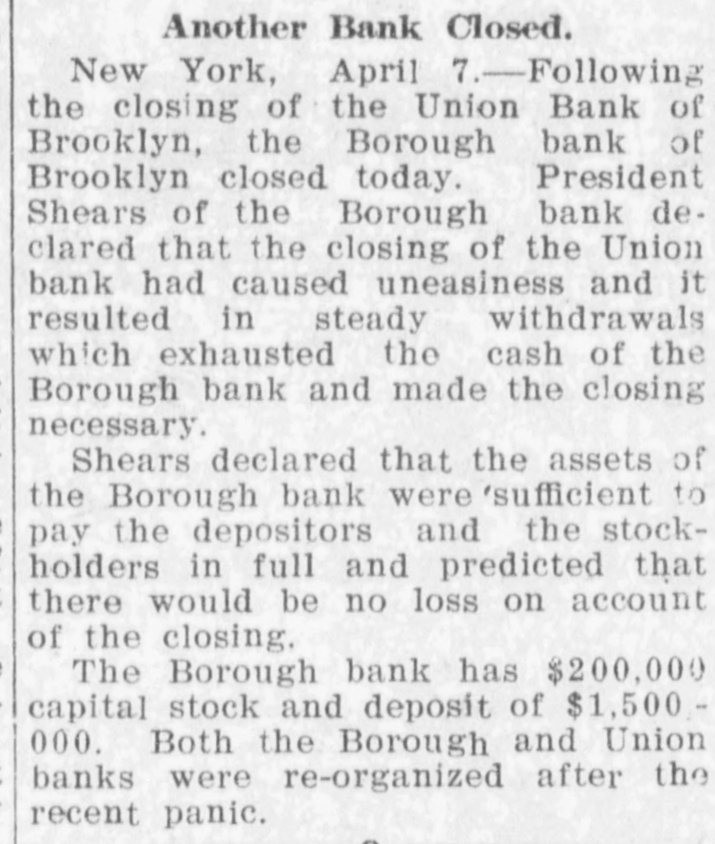
New York, April 7.-Following the closing of the Union Bank of Brooklyn, the Borough bank of Brooklyn closed today. President Shears of the Borough bank declared that the closing of the Union bank had caused uneasiness and it resulted in steady withdrawals which exhausted the cash of the Borough bank and made the closing necessary. Shears declared that the assets of the Borough bank were 'sufficient to pay the depositors and the stockholders in full and predicted that there would be no loss on account of the closing. The Borough bank has $200,000 capital stock and deposit of $1,500 000. Both the Borough and Union banks were re-organized after the recent panic.


Article from The Bennington Evening Banner, April 8, 1910

Click image to open full size in new tab

Article Text

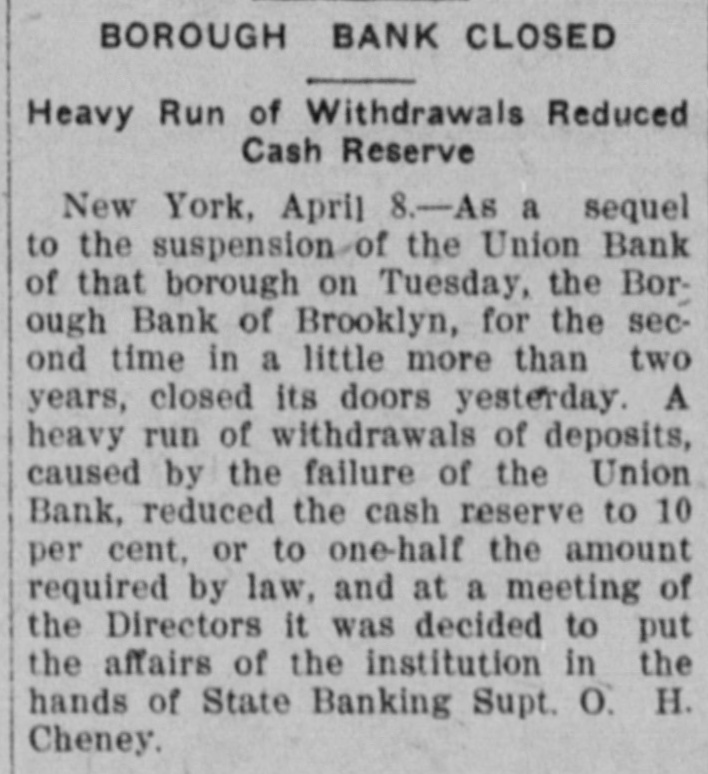
BOROUGH BANK CLOSED Heavy Run of Withdrawals Reduced Cash Reserve New York, April 8.-As a sequel to the suspension of the Union Bank of that borough on Tuesday, the Borough Bank of Brooklyn, for the second time in a little more than two years, closed its doors yesterday. A heavy run of withdrawals of deposits, caused by the failure of the Union Bank, reduced the cash reserve to 10 per cent, or to one-half the amount required by law, and at a meeting of the Directors it was decided to put the affairs of the institution in the hands of State Banking Supt. O. H. Cheney.


Article from New-York Tribune, April 10, 1910

Click image to open full size in new tab

Article Text

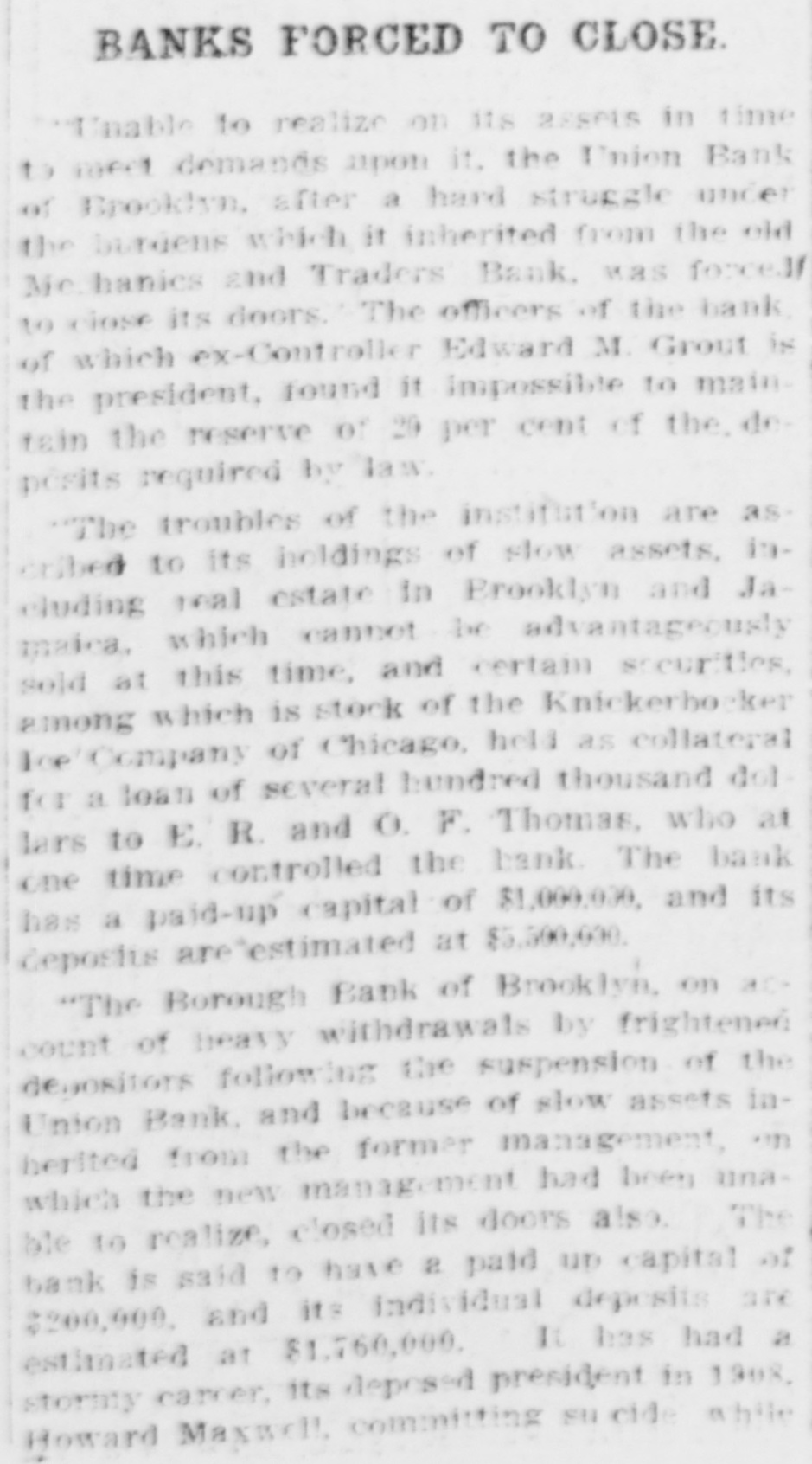
BANKS FORCED TO CLOSE Unable to realize on its assets in time to meet demands upon it, the Union Bank of Brooklyn, after a hard struggle under the burdens which it inherited from the old Me hanics and Traders Bank. was forcell to close its doors. The officers of the bank of which ex-Controller Edward M. Grout is the president, found it impossible to main. tain the reserve of 20 per cent of the, depôsits required by law. "The troubles of the institution are as cribed to its holdings of slow assets, including real estate in Brooklyn and Jamales, which cannot be advantageously sold at this time, and certain securities, among which is stock of the Knickerboe ker Loe/Company of Chicago, held as collateral for a loan of several hundred thousand dollars to E. R. and O. F. Thomas, who at one time controlled the bank. The bank has a paid-up capital of $1,000,000, and its deposits are^estimated at $5,500,000. "The Borough Bank of Brooklyn, on account of heavy withdrawals by frightened degositors following the suspension of the Union Bank. and because of slow assets inherited from the former management, on which the new management had been unable to realize, closed its doors also. The bank is said to have 2 paid up capital of $200,000. and its individual deposits are estimated at $1,760,000. It has had a stormy carrer, its deposed president in 1908. Howard Maxwell, committing sucide while


Article from The Evening World, May 10, 1912

Click image to open full size in new tab

Article Text

BANK SUES WARD & GOW.

First National Wants $100,000 on a Promissory Note.

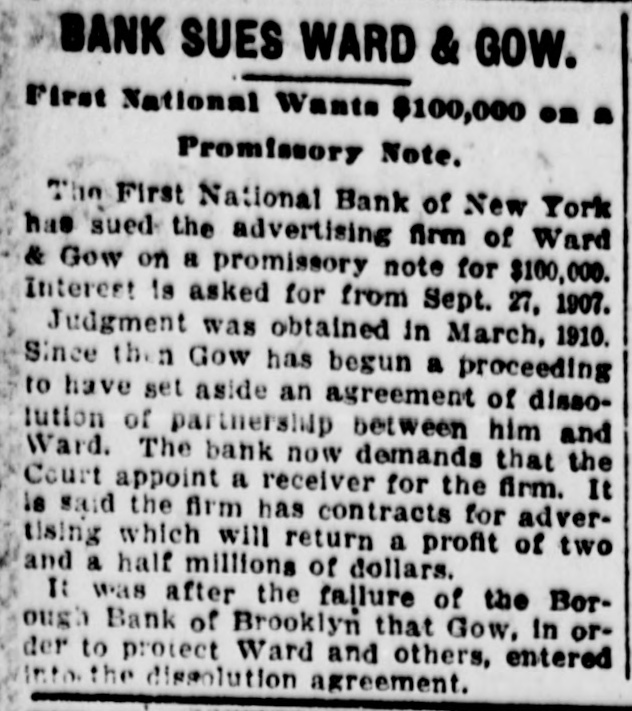
The First National Bank of New York has sued the advertising firm of Ward & Gow on a promissory note for $100,000. Interest is asked for from Sept. 27, 1907. Judgment was obtained in March, 1910. Since then Gow has begun a proceeding to have set aside an agreement of dissolution of partnership between him and Ward. The bank now demands that the Court appoint a receiver for the firm. It is said the firm has contracts for advertising which will return a profit of two and a half millions of dollars.

It was after the failure of the Borough Bank of Brooklyn that Gow, in order to protect Ward and others, entered into the dissolution agreement.