5122. Indiana Trust Company (Indianapolis, IN)

Bank Information

Episode Type
Run Only
Bank Type
trust
Start Date
April 26, 1904
Location
Indianapolis, Indiana (39.768, -86.158)

Metadata

Model
gpt-5-mini
Short Digest
6c8bee2770adda75

Response Measures

None

Description

Multiple contemporaneous newspaper accounts (late April 1904) describe a short-lived run on the Indiana Trust Company triggered by a telephone girl's misconstruing of a business conversation. The bank paid all depositors who presented themselves, kept doors open late, refused to invoke the 60-day suspension clause, and remained open and solvent. No suspension or receivership is reported in these articles.

Events (1)

1. April 26, 1904 Run
Cause
Rumor Or Misinformation
Cause Details
A telephone girl overheard and misconstrued a business conversation, confusing Indiana Trust with a small Commercial Trust Company in receivership; rumor spread that Indiana Trust could not cash warrants.
Random Run
Yes
Random Run Snippet
Telephone girl misconstrued conversation; rumor of inability to cash warrants
Measures
Paid every depositor who applied, kept doors open until 7:30 pm to accommodate withdrawals, refused to invoke sixty-day suspension clause; received cash shipments from Cincinnati and Louisville to bolster reserves.
Newspaper Excerpt
A run was started on the bank as a result of a telephone girl hearing a business conversation involving the bank which she misconstrued and enlarged upon till the rumor appeared in the nature of the bank's inability to cash a warrant.
Source
newspapers

Newspaper Articles (11)

Article from The Indianapolis Journal, March 30, 1904

Click image to open full size in new tab

Article Text

Superior Court's Receiver Succeeded by Trust Company George B. Elliott, recently appointed receiver for the W. H. Smith Company by Judge Leathers, made his final report yesterday and asked that he be discharged. The Indiana Trust Company, made receiver also by Judge Anderson, of the Federal Court, upon the petition of outside creditors, will remain. In his report Mr. Elliott shows the appraised value of the stock of the W. H. Smith Company to be $14,817.40. The sum of $2,706.19 was collected, out of which bills amounting to $354.23 were paid, leaving a cash balance of $2,351.69. All of these accounts were referred by Judge Leathers to the court.


Article from Lewiston Evening Teller, April 26, 1904

Click image to open full size in new tab

Article Text

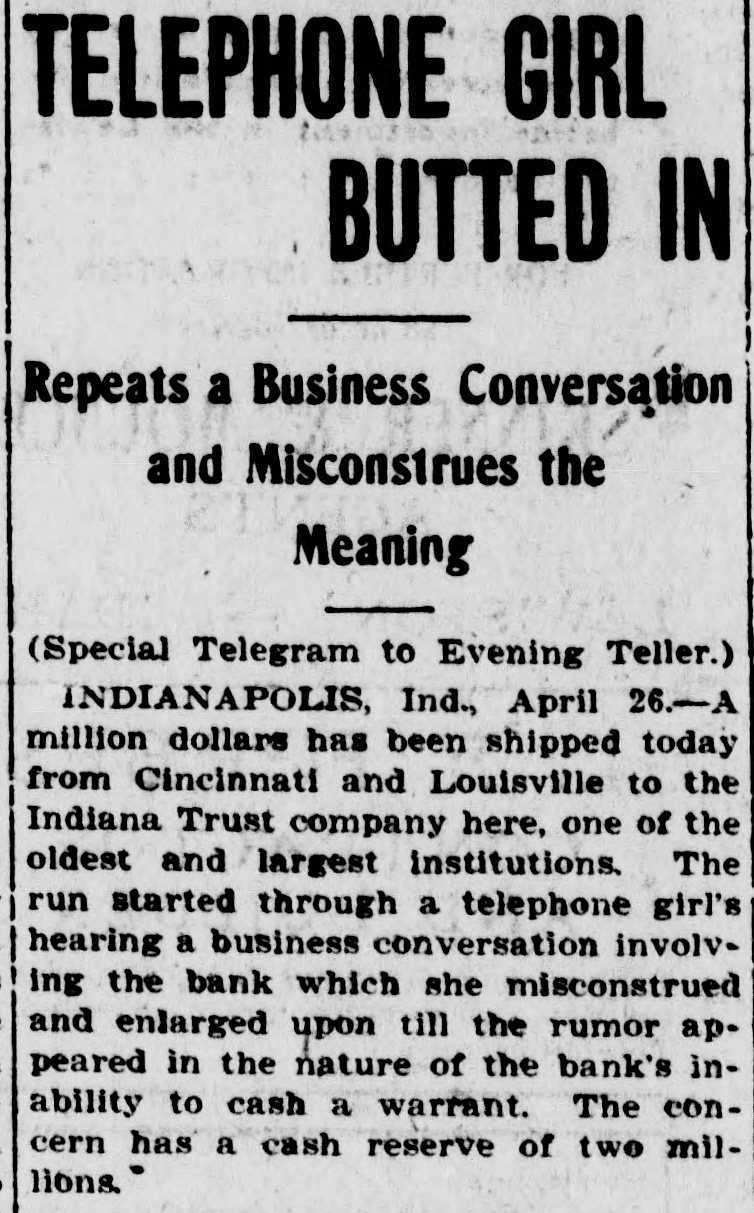
TELEPHONE GIRL BUTTED IN Repeats a Business Conversation and Misconstrues the Meaning (Special Telegram to Evening Teller.) INDIANAPOLIS, Ind., April 26.-A million dollars has been shipped today from Cincinnati and Louisville to the Indiana Trust company here, one of the oldest and largest institutions. The run started through a telephone girl's hearing a business conversation involving the bank which she misconstrued and enlarged upon till the rumor appeared in the nature of the bank's inability to cash a warrant. The concern has a cash reserve of two millions.


Article from The Tacoma Times, April 26, 1904

Click image to open full size in new tab

Article Text

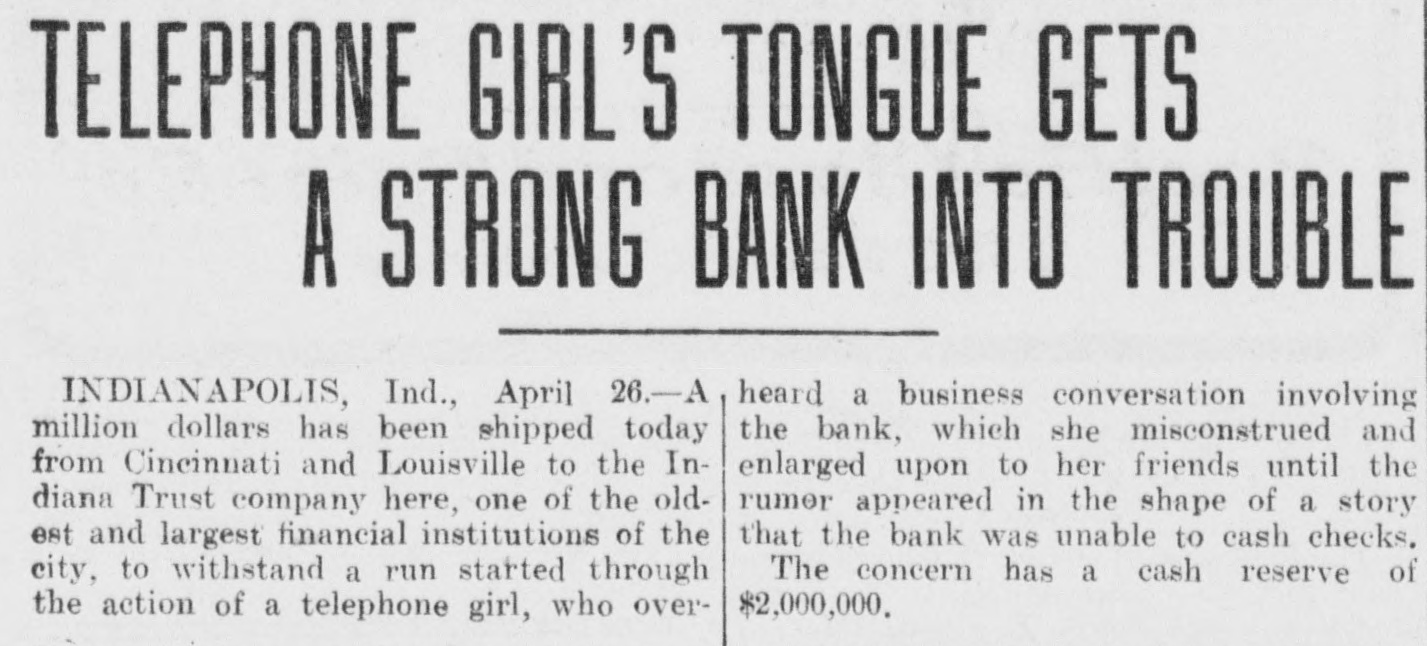
TELEPHONE GIRL'S TONGUE GETS A STRONG BANK INTO TROUBLE INDIANAPOLIS, Ind., April 26.-A heard a business conversation involving million dollars has been shipped today the bank, which she misconstrued and from Cincinnati and Louisville to the Inenlarged upon to her friends until the diana Trust company here, one of the oldrumor appeared in the shape of a story est and largest financial institutions of the that the bank was unable to cash checks. The concern has a cash reserve of city, to withstand a run started through $2,000,000. the action of a telephone girl, who over-


Article from The Evening Statesman, April 26, 1904

Click image to open full size in new tab

Article Text

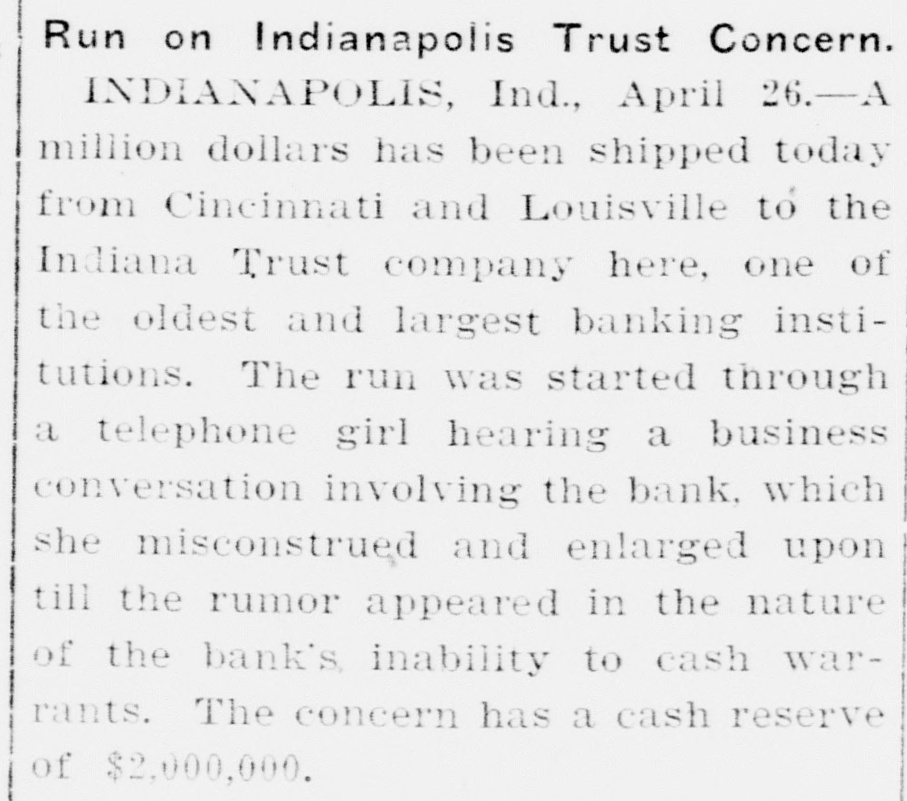
Run on Indianapolis Trust Concern. INDIANAPOLIS, Ind., April 26.-A million dollars has been shipped today from Cincinnati and Louisville to the Indiana Trust company here, one of the oldest and largest banking institutions. The run was started through a telephone girl hearing a business conversation involving the bank. which she misconstrued and enlarged upon till the rumor appeared in the nature of the bank's inability to cash warrants. The concern has a cash reserve of $2,000,000.


Article from The Seattle Star, April 26, 1904

Click image to open full size in new tab

Article Text

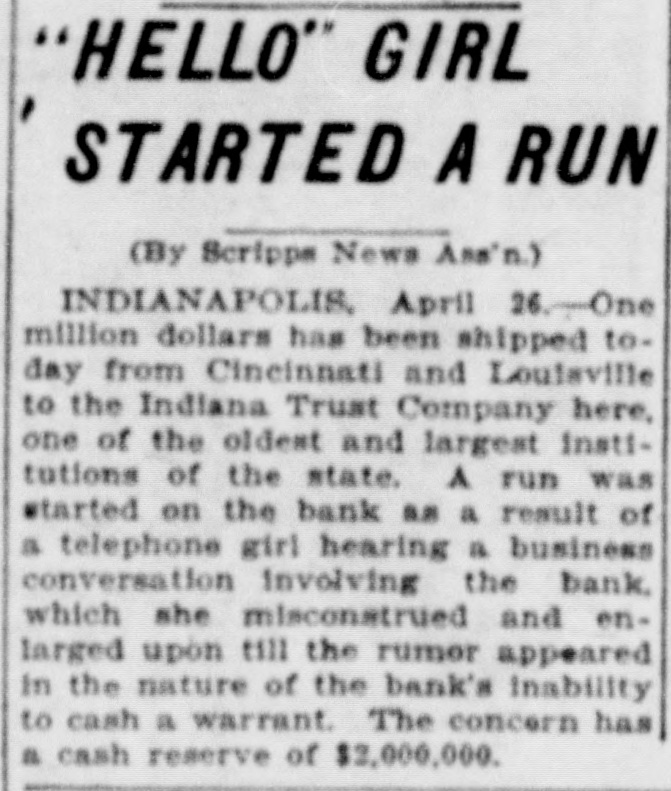
"HELLO" GIRL STARTED A RUN (By Scripps News Ass'n.) INDIANAPOLIS April 26. One million dollars has been shipped today from Cincinnati and Louisville to the Indiana Trust Company here, one of the oldest and largest Institutions of the state. A run was started on the bank as a result of a telephone girl hearing a business conversation involving the bank. which she misconstrued and enlarged upon till the rumor appeared In the nature of the bank's Inability to cash a warrant. The concern has a cash reserve of $2,000,000.


Article from The Indianapolis Journal, April 26, 1904

Click image to open full size in new tab

Article Text

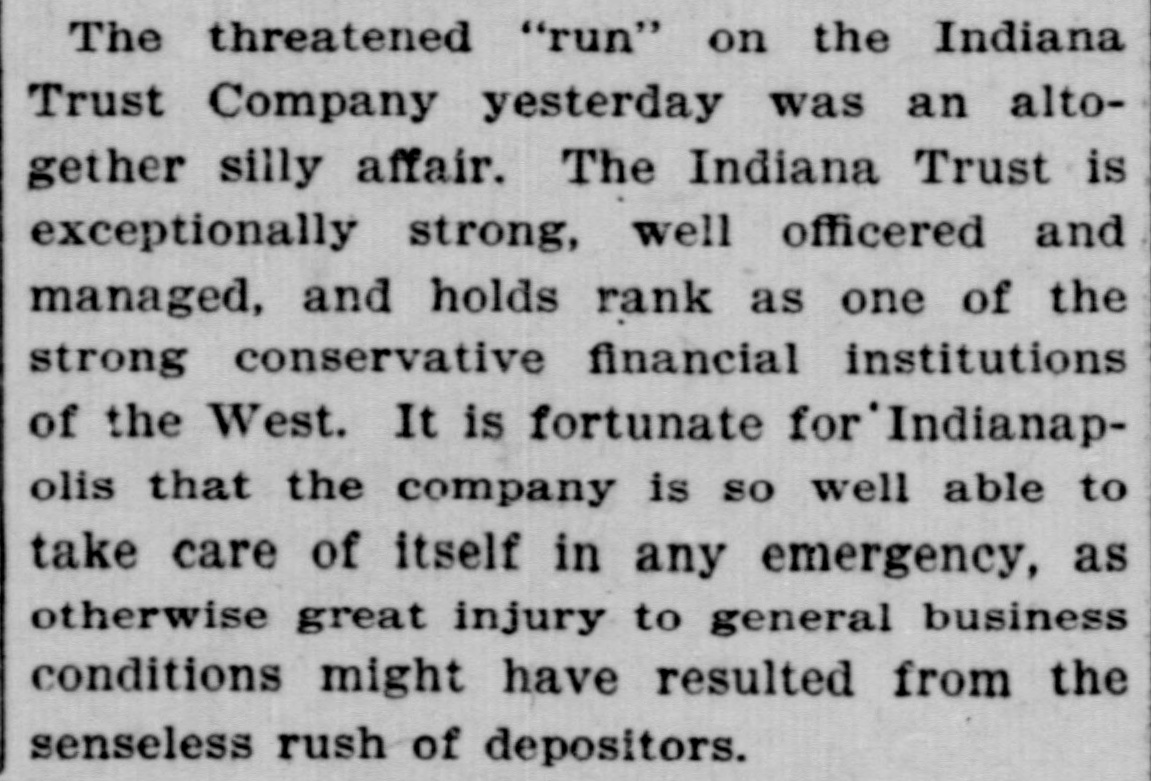
The threatened "run" on the Indiana Trust Company yesterday was an altogether silly affair. The Indiana Trust is exceptionally strong, well officered and managed, and holds rank as one of the strong conservative financial institutions of the West. It is fortunate for'Indianapolis that the company is so well able to take care of itself in any emergency, as otherwise great injury to general business conditions might have resulted from the senseless rush of depositors.


Article from The Indianapolis Journal, April 26, 1904

Click image to open full size in new tab

Article Text

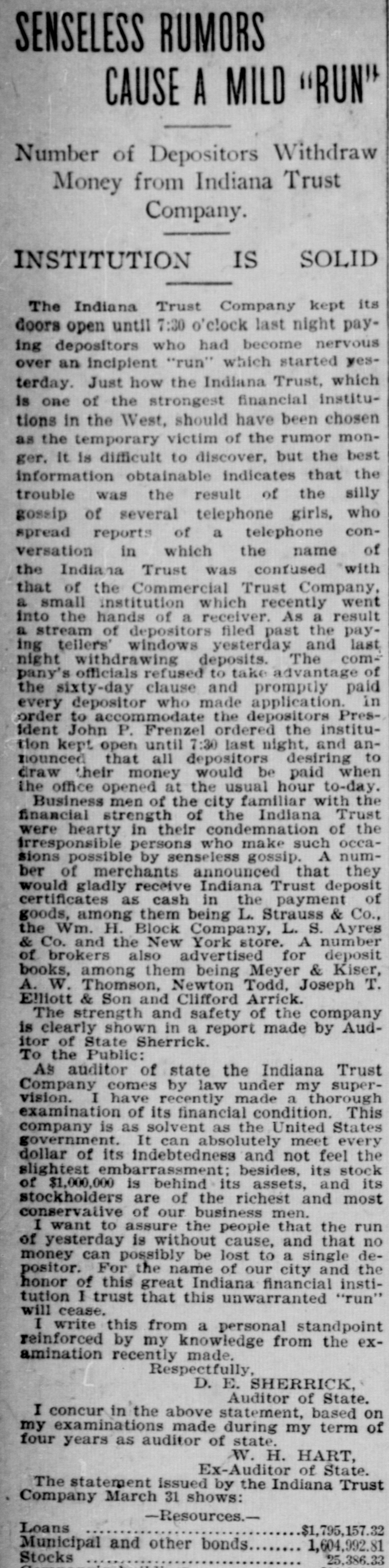
SENSELESS RUMORS CAUSE A MILD "RUN" Number of Depositors Withdraw Money from Indiana Trust Company. IS SOLID INSTITUTION The Indiana Trust Company kept its doors open until 7:30 o'clock last night paying depositors who had become nervous over an incipient "run" which started yesterday. Just how the Indiana Trust, which is one of the strongest financial institutions in the West, should have been chosen as the temporary victim of the rumor monger. It is difficult to discover, but the best information obtainable indicates that the trouble was the result of the silly gossip of several telephone girls, who spread reports of a telephone conversation in which the name of the Indiana Trust was confused with that of the Commercial Trust Company, a small institution which recently went into the hands of a receiver. As a result a stream of depositors filed past the paying tellers' windows yesterday and last night withdrawing deposits. The company's officials refused to take advantage of the sixty-day clause and promptly paid every depositor who made application. in order to accommodate the depositors PresIdent John P. Frenzel ordered the institution kept open until 7:30 last night, and announced that all depositors desiring to draw their money would be paid when the office opened at the usual hour to-day. Business men of the city familiar with the financial strength of the Indiana Trust were hearty in their condemnation of the irresponsible persons who make such occasions possible by senseless gossip. A number of merchants announced that they would gladly receive Indiana Trust deposit certificates as cash in the payment of goods, among them being L. Strauss & Co., the Wm. H. Block Company, L. S. Ayres & Co. and the New York store. A number of brokers also advertised for deposit books, among them being Meyer & Kiser, A. W. Thomson, Newton Todd, Joseph T. E!liott & Son and Clifford Arrick. The strength and safety of the company is clearly shown in a report made by Auditor of State Sherrick. To the Public: As auditor of state the Indiana Trust Company comes by law under my supervision. I have recently made a thorough examination of its financial condition. This company is as solvent as the United States government. It can absolutely meet every dollar of its indebtedness and not feel the slightest embarrassment: besides, its stock of $1,000,000 is behind its assets, and its stockholders are of the richest and most conservative of our business men. I want to assure the people that the run of yesterday is without cause, and that no money can possibly be lost to a single depositor. For the name of our city and the honor of this great Indiana financial institution I trust that this unwarranted "run" will cease. I write this from a personal standpoint reinforced by my knowledge from the examination recently made. Respectfully, D. E. SHERRICK, Auditor of State. I concur in the above statement, based on my examinations made during my term of four years as auditor of state. W. H. HART, Ex-Auditor of State. The statement issued by the Indiana Trust Company March 31 shows: -Resources.Loans $1,795,157.32 Municipal and other bonds. 1,604,992.81 Stocks 25,386.33


Article from The Plymouth Tribune, April 28, 1904

Click image to open full size in new tab

Article Text

'PHONE GIRL'S GOSSIP Causes a Run on a Solvent Bank That Gives the Bankers Much Trouble. BIG SUMS SENT FROM OUTSIDE Concern Pays Every One That CallsHarrison Family LitigationCurious Development. Indianapolis, April 27. - The gossip of a telephone girl resulted in a run on the Indiana Trust company, one of the largest and oldest financial institutions in the state. Last Friday the girl overheard an employe of a local manufacturing company telephoning his employers that the trust company had not cashed a warrant which was erroneously drawn. This she enlarged upon until the harmless statement of the employe had grown to abnormal proportions. There was nothing alarming in the situation so far as the trust company was concerned, as it has an available cash reserve of nearly $2,000,000, and its officers readily met every demand of the depositors, but for several hours there was a scene of great confusion in and about the big building. Plenty of Money Coming. The run was on the savings department and excited men and women made frantic efforts to get their money out. All demands were promptly met. The Union National Savings' bank. of Cincinnati, shipped $500,000 in small bills by express to the Indiana Trust, and another half million has been sent by express from Louisville. Indiana Is Growing Healthier. Indianapolis, April 27.-As a result of the battle for health that the state authorities have made in the last few years, both the death rate and the number of deaths are on the decrease in Indiana. Last year there were 33.892 deaths. a rate of 13.46 a thousand. In 1902 there were 34.069 deaths. a rate of 13.58. In 1901 there were 36.54 deaths, a rate of 14.52, and in 1900 there were 35,516 deaths ,a rate of 14.11. Russell Harrison's New Plea. Indianapolis, April 27.-In a mysterious brief filed in the probate court by Colonel Russel B. Harrison, son of the late President Harrison, he declares that certain stocks, which had been set aside for the fund of $125,000 for Mrs. Harrison's support, should not be so included because his father had not paid for them either in money or services. The clause reads: Says It Was Pay for Nothing. "The late Fenjamin Harrison was not called upon to render any services to said company, therefore the delivery of the stock to him from year to year was only retaining or hiring him not to appear against the company in any litigation, and was therefore not clearly a case of exchange or barter, as he did not pay for said stock, even in services, but simply took engagements not to appear against said company."


Article from The Forrest City Times, April 29, 1904

Click image to open full size in new tab

Article Text

OTHERWISE UNNOTICED. A party of Jews have left Russia to cultivate beets in Colorado. World's fair opening day will be observed by the state of Missouri as a general holiday. The run on the Indiana Trust Co., Indianapolis, continues, despite exhibitions of confidence by men of affairs. Litigation has been begun at St. Joseph, Mo., for the distribution of the Burnes estate. a $5,000,000 corporation. Senator Fairbanks, of Indiana, declares that he is in no wise a candidate for the pice-presidential nomination. The bureau of the interparliamentary peace conference has been called to hold the next conference at St. Louis, August 5. The town of Illig, on the coast of Somaliland, has been bombarded by the British. The sultan of Illig was captured. Secretary of the Treasury Shaw, in an address at Syracuse, N. Y., said the United States should rule the Pacific ocean trade. Gladys Stevens, aged four years, died as the result of burns received while striking a match, which ignited her clothing, at Pana, Ill. Because of high wages demanded by the waiters' union, hotel and restaurant men of St. Louis have decided on an "open-shop" policy. Emperor William will appear in Rome shortly after President Loubet's departure, with the especial object of paying a visit to the pope. After chasing her recreant husband through three countries for four years, Mrs. Gitel Tablinsky found him in St. Louis, living with another wife. A New York court refused to set aside the interlocutory decree granted Mrs. Clemence Dodge Morse on the application of her second husband, Morse. The collapse of a cage in the Robinson mine, at Johannesburg, South Africa, precipitated 43 natives 2.000 feet to the bottom. All were mashed to a pulp. "Mother" Jones broke out of quarantine in Utah and marched through town with striking miners, exposing scores of persons to infection. She was placed in jail. The original "Mrs. Wiggs of the Cabbage Patch" appeared in a Louisville police court to answer a charge of throwing a jar of slop on the head of Yy an unwelcome visitor. Japenese ladies, en route to the World's fair, refused to walk through the mud from the sleeper of a wrecked train near Oskaloosa, Ia. and were carried out pack-saddle fashion by the men on the Pullman.


Article from The Van Buren Press, April 30, 1904

Click image to open full size in new tab

Article Text

OTHERWISE UNNOTICED A party of Jews have left Russia to cultivate beets in Colorado. World's fair opening day will be observed by the state of Missouri as a general holiday. The run on the Indiana Trust Co., Indianapolis, continues, despite exhibitions of confidence by men of affairs. Litigation has been begun at St. Joseph, Mo., for the distribution of the Burnes estate, a $5,000,000 corporation. Senator Fairbanks, of Indiana, declares that he is in no wise a candidate for the pice-presidential nomination. The bureau of the interparliamentary peace conference has been called to hold the next conference at St. Louis, August 5. The town of Illig. on the coast of Somaliland, has been bombarded by the British. The sultan of Illig was captured. Secretary of the Treasury Shaw, in an address at Syracuse, N. Y., said the United States should rule the Pacific ocean trade. Gladys Stevens, aged four years, died as the result of burns received while striking a match, which ignited her clothing, at Pana, III. Because of high wages demanded by the waiters' union, hotel and restaurant men of St. Louis have decided on an "open-shop" policy. Emperor William will appear in Rome shortly after President Loubet's departure, with the especial object of paying a visit to the pope. After chasing her recreant husband through three countries for four years, Mrs. Gitel Tablinsky found him in St. Louis, living with another wife. A New York court refused to set aside the interlocutory decree granted Mrs. Clemence Dodge Morse on the application of her second husband, Morse. The collapse of a cage in the Robinson mine, at Johannesburg, South Africa, precipitated 43 natives 2,000 feet to the bottom. All were mashed to a pulp. "Mother" Jones broke out of quarantine in Utah and marched through town with striking miners, exposing scores of persons to infection. She was placed in jail. The original "Mrs. Wiggs of the Cabbage Patch" appeared in a Louisville police court to answer a charge of throwing a jar of slop on the head of an unwelcome visitor. Japenese ladies, en route to the World's fair, refused to walk through the mud from the sleeper of a wrecked train near Oskaloosa, la., and were carried out pack-saddle fashion by the men on the Pullman.
Article from The Arizona Sentinel, April 12, 1905

Click image to open full size in new tab

Article Text

The gossip of a telephone girl resulted in a run on the Indiana Trust Company at Indianapolis, Indiana.