Click image to open full size in new tab
Article Text
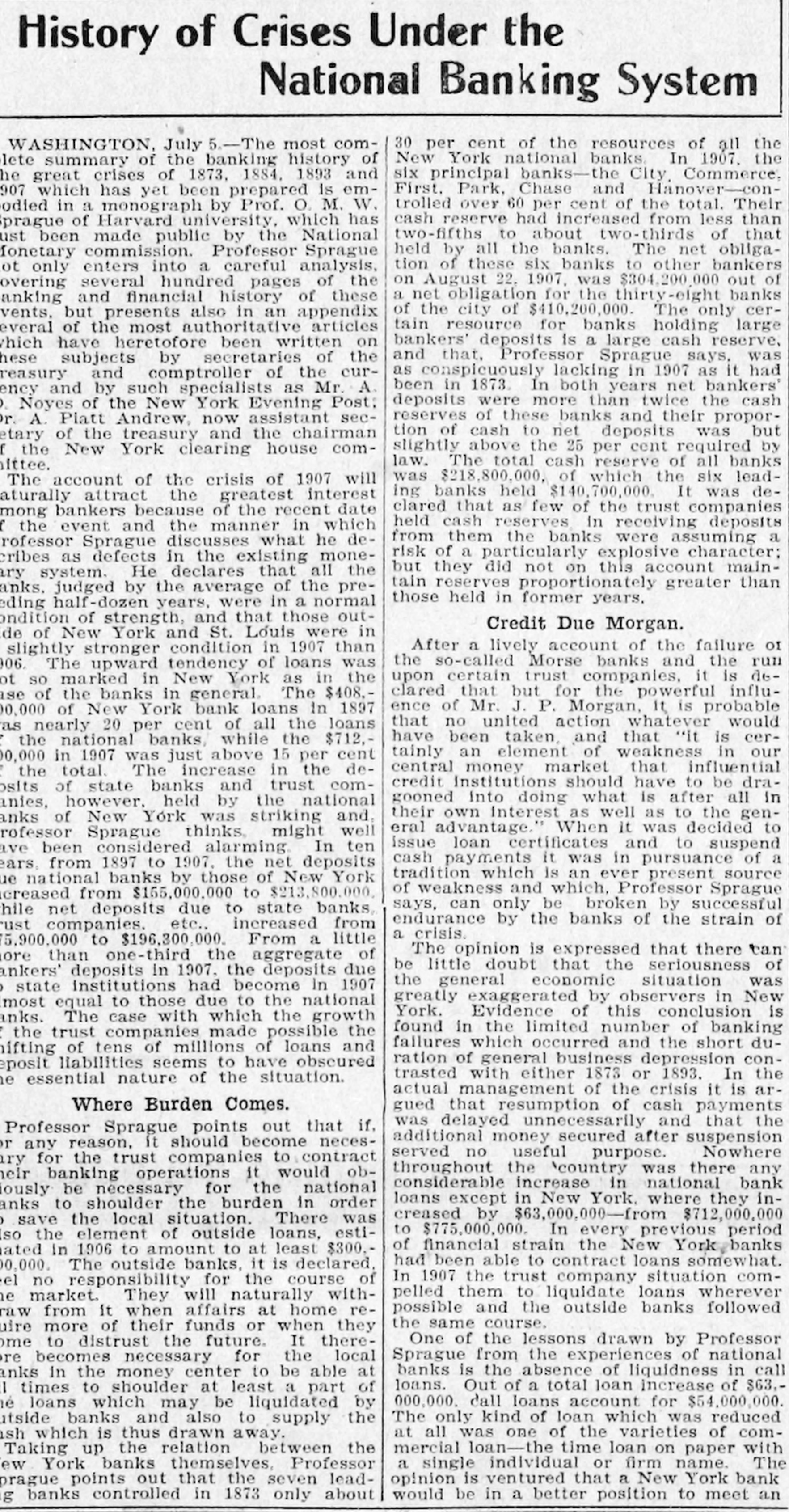
History of Crises Under the National Banking System 30 per cent of the resources of all the WASHINGTON July 5.-The most comNew York national banks In 1907. the lete summary of the banking history of six principal banks-the City, Commerce, he great crises of 1873. 1884. 1893 and First. Park, Chase and Hanover-con907 which has yet been prepared Is emtrolled over 60 per cent of the total. Their odied in a monograph by Prof. O. M. W. cash reserve had increased from less than prague of Harvard university, which has two-fifths to about two-thirds of that ust been made public by the National held by all the banks. The net obligaIonetary commission. Professor Sprague tion of these six banks to other bankers lot only enters into a careful analysis, on August 22. 1907. was $304,200,000 out of overing several hundred pages of the a net obligation for the thirty-eight banks anking and financial history of these of the city of $410,200,000. The only cervents. but presents also in an appendix tain resource for banks holding large everal of the most authoritative articles bankers' deposits is a large cash reserve, which have heretofore been written on and that, Professor Sprague says, was hese subjects by secretaries of the as conspicuously lacking in 1907 as it had reasury and comptroller of the curbeen in 1873 In both years net bankers' ency and by such specialists as Mr. A. deposits were more than twice the cash > Noyes of the New York Evening Post: reserves of these banks and their proporr. A. Platt Andrew, now assistant section of cash to net deposits was but etary of the treasury and the chairman slightly above the 25 per cent required by f the New York clearing house comlaw. The total cash reserve of all banks littee. was $218,800,000. of which the six leadThe account of the crisis of 1907 will ing banks held $140,700,000. It was deaturally attract the greatest interest clared that as few of the trust companies mong bankers because of the recent date held cash reserves in receiving deposits f the event and the manner in which from them the banks were assuming a rofessor Sprague discusses what he derisk of a particularly explosive character; cribes as defects in the existing monebut they did not on this account mainary system. He declares that all the tain reserves proportionately greater than anks, judged by the average of the prethose held in former years. eding half-dozen years, were in a normal ondition of strength, and that those outCredit Due Morgan. de of New York and St. Louis were in After a lively account of the failure or slightly stronger condition in 1907 than the so-called Morse banks and the run 906. The upward tendency of loans was upon certain trust companies, it is deot so marked in New York as in the clared that but for the powerful influse of the banks in general. The $408.ence of Mr. J. P. Morgan, It is probable 0.000 of New York bank loans in 1897 that no united action whatever would as nearly 20 per cent of all the loans have been taken and that "It is certhe national banks, while the $712,tainly an element of weakness in our 0,000 in 1907 was just above 15 per cent central money market that influential the total. The increase in the decredit Institutions should have to be draosits of state banks and trust comgooned into doing what is after all in nies, however, held by the national their own Interest as well as to the genanks of New York was striking and, eral advantage." When it was decided to rofessor Sprague thinks might well Issue loan certificates and to suspend ave been considered alarming In ten cash payments it was in pursuance of a ears, from 1897 to 1907. the net deposits tradition which is an ever present source ue national banks by those of New York of weakness and which, Professor Sprague creased from $155,000,000 to $213,800,000 says, can only be broken by successful hile net deposits due to state banks, endurance by the banks of the strain of ust companies. etc., increased from a crisis. 5.900.000 to $196,300,000. From a little The opinion is expressed that there 'can ore than one-third the aggregate of be little doubt that the seriousness of ankers' deposits in 1907. the deposits due the general economic situation was > state institutions had become In 1907 greatly exaggerated by observers in New most equal to those due to the national York. Evidence of this conclusion is anks. The case with which the growth found in the limited number of banking : the trust companies made possible the failures which occurred and the short duhifting of tens of millions of loans and ration of general business depression coneposit liabilities seems to have obscured trasted with either 1873 or 1893. In the e essential nature of the situation. actual management of the crisis it is arWhere Burden Comes. gued that resumption of cash payments was delayed unnecessarily and that the Professor Sprague points out that if, additional money secured after suspension r any reason, it should become necesserved no useful purpose. Nowhere rry for the trust companies to contract throughout the \country was there any heir banking operations it would obconsiderable increase in national bank lously be necessary for the national loans except in New York, where they inanks to shoulder the burden in order creased by $63,000,000-from $712,000,000 ) save the local situation. There was to $775,000,000. In every previous period so the element of outside loans, estiof financial strain the New York banks lated in 1906 to amount to at least $300.had been able to contract loans somewhat. 0.000. The outside banks, it is declared, In 1907 the trust company situation comel no responsibility for the course of pelled them to liquidate loans wherever e market. They will naturally withpossible and the outside banks followed raw from it when affairs at home rethe same course. uire more of their funds or when they One of the lessons drawn by Professor me to distrust the future. It thereSprague from the experiences of national re becomes necessary for the local banks is the absence of liquidness in call anks in the money center to be able at loans. Out of a total loan increase of $63.I times to shoulder at least a part of 000,000. call loans account for $54,000,000. e loans which may be liquidated by The only kind of loan which was reduced utside banks and also to supply the at all was one of the varieties of comsh which is thus drawn away. mercial loan-the time loan on paper with Taking up the relation between the few York banks themselves, Professor a single individual or firm name. The opinion is ventured that a New York bank prague points out that the seven leadwould be in a better position to meet an g banks controlled in 1873 only about