Willimantic Savings Institute (Willimantic, CT)

Episode Information

Episode UID
51017471148
Episode Type
Run โ†’ Suspension โ†’ Unsure
Bank Type
savings
Bank ID
5101747 routing
Routing Number
51-0174
Start Date
August 1, 1895
Location
Willimantic, Connecticut (41.711, -72.208)

Metadata

Model
gpt-5-mini (chosen from majority vote of a three-model LLM ensemble)
Short Digest
9fc5a85f98a9bdfb

Response Measures

None

Description

Evidence shows multiple episodes (1895 troubles, 1896 run/suspension, 1897 injunction); final disposition unclear from provided articles.

Events (5)

1. August 1, 1895 Other
Newspaper Excerpt
Commissioner Crofut...figures amount of insolvency at $27,469.73. He recommends that the bank go into the hands of a receiver.

Source
newspapers
2. November 28, 1895 Receivership
Newspaper Excerpt
Amos T. Fowler...has paid to Receiver Dooley $5,000 as his liability on the bond.
Source
newspapers
3. October 16, 1896 Run
Cause
Local Banks
Cause Details
Withdrawals triggered by shaken confidence due to prior local bank failures (First National and Dime Savings Banks) and circulating reports about the bank's dividend.
Measures
Directors required the four months' notice of withdrawal (invoked statutory 4-months notice).
Newspaper Excerpt
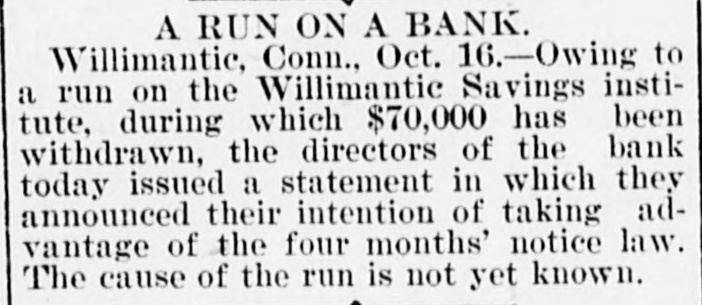
a run on the Willimantic Savings Institute, during which $70,000 had been withdrawn.
Source
newspapers
4. October 16, 1896 Suspension
Cause
Local Banks
Cause Details
Directors invoked the four-months-notice law after heavy withdrawals (~$70,000) to avoid selling securities at a loss.
Newspaper Excerpt
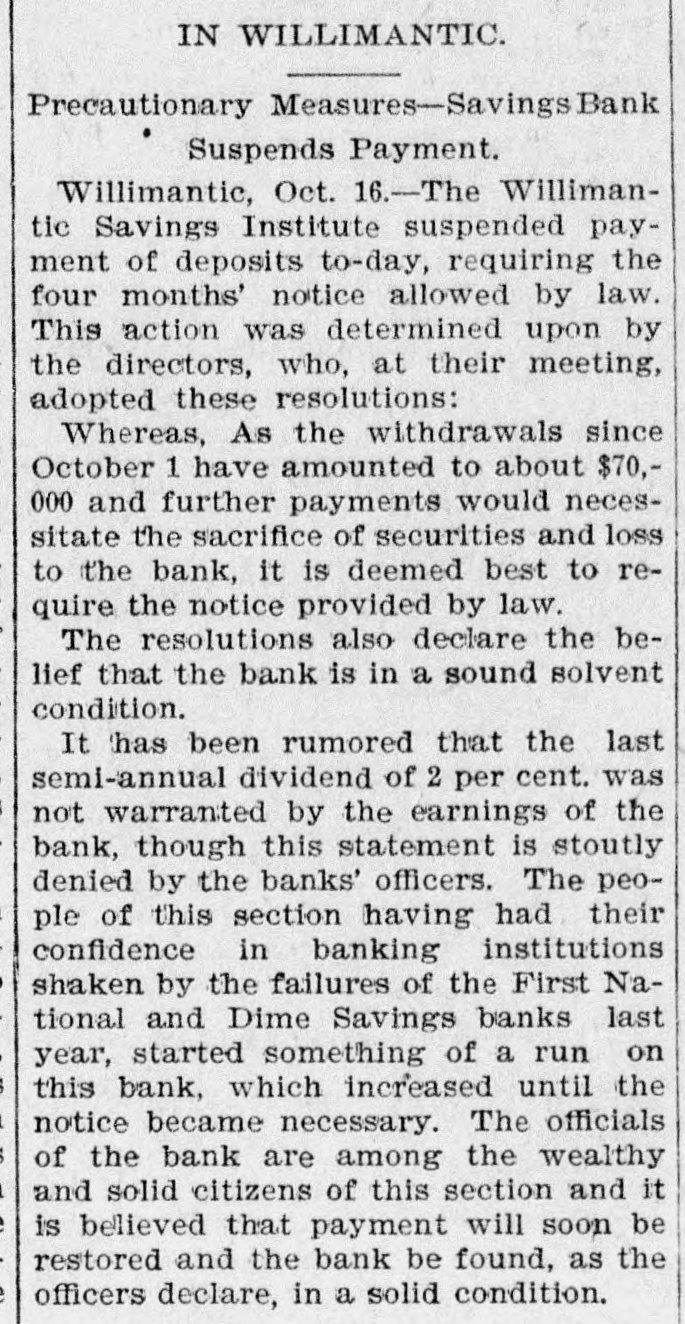
The Willimantic Savings Institute suspended payment of deposits today, requiring the four months' notice allowed by law.
Source
newspapers
5. February 8, 1897 Suspension
Cause
Government Action
Cause Details
Court injunction issued at request of bank commissioners to preserve assets and protect depositors.
Newspaper Excerpt
Judge Prentice...granted an injunction restraining the officers of the Willimantic Savings Institute from paying out any money except for expenses of running the bank, for nine months.
Source
newspapers

Newspaper Articles (16)

Article from The Press, August 1, 1895

Click image to open full size in new tab

Article Text

proves to have been an anaconda 25 feet long, thrown overboard from a vessel laden with living curios, because it had died. THE speech of Senator Fuller of the 24th district, printed on page 1st, while interesting and readable, is a clear and instructive presentation of insurance matters, put into such plain language as to be easily understood by any one. The speech has been highly spoken of by the legislative reporters, and in editorial columns of state papers. The Hartford Post says: "Seldom has a more scholarly and able speech been made in the senate than that made by Senator Fuller against the valued policy fire insurance bill, yet he was not a frequent speaker. But he always voted." THE reports of massacres by the Indians are generally turning out to be murderous assaults on the Indians by whites, and the result is, as usual, a lot of infuriated red men, an Indian war, an enormous expense to the government, and the killing of brave soldiers who had no part in inciting the uprising. The beginning was the arrest of Indians on a trumped up charge of violation of the game laws. It appears that the Indians were only exercising rights given them by United States treaties, and the violated laws were those made by unauthorized local authority. The party in charge of the arrested Indians claim that they tried to escape, and that it was necessary to kill them. It would be a good thing if Uncle Sam's troops would point their guns at some of the trouble breeding white squatters on Indian reservations. IT is probable that the worst was told in the beginning about the Willimantic savings bank trouble, more than the worst, in fact. The sensational reports first issued are reducing their dimensions with investigation, and now the wonder is why did Walden destroy or mutilate the books and run away, instead of facing the music. Perhaps the people will be the more willing to forgive in the exultation of finding that the matter is not as bad as at first feared. But it is bad enough. The bank may go on. It will be better for depositors and all if it is continued in life. To wind it up would shrink its assets, sadly cripple its borrowers, and generally demoralize business. It will be better for everybody concerned if the bank takes a thorough house-cleainng, and starts over with a new set of servants, or at least a discharge of the imprudent, incapable, or untrustworthy ones. The bank is likely to realize $9,000 on one transaction in which its money was risked without giving it a share of profits. It is said that it has no legal right to this, and the inference is that the concession is in the shape of "hush money" to stop investigation. The disclosure or suspicion may lead to something more than a "hush." Commissioner Crofut estimates the resent liabilities of the bank to be $490,747.09, and figures amount of insolvency at $27,469.73. He recommends that the bank go into the hands of a receiver.

Article from Connecticut Western News, November 28, 1895

Click image to open full size in new tab

Article Text

STATE NEWS. Amos T. Fowler, one of the bonds. men of Cashier Risley, the defaulting cashier of the Willimantic Savings Bank, has paid to Receiver Dooley $5,000 as his liability on the bond. Jailer Osgood of the Brooklyn jail, Windham county, has notified the county commissioners that there are 65 prisoners in the jail, with accommodations for only 33. Two burglars were caught while breaking into Sniffen's jewelry store at Newtown last week. The burglar alarm brought the proprietor and his son to the scene from a distance of one-eight of a mile. Rev Joseph Brewster, an Episcopal clergyman, a native of New Haven and formerly of Wallingford Windham, died in Brooklyn, N. Y., last week Wednesday. He was a lineal decendant of Elder William Brewster of the Mayflower colony. Miss Ann Deming, of New\ Boston, was found dead at her home, Friday evening, Nov. 22 It is presumed that Miss death resulted from apoplexy. Deming was 70 years of age. S. A Gordon has been appointed postmaster at Chapinville, vice T. A. McElroy, resigned and T. J. Byron has been appointed postmaster at Sharon Valley, vice C. C.Gordon, resigned. Veterans of the 6th, 7th, and 10th, Connecticut regiments and the 1st, Conacticut Light Battery propose to secure the erection of a memorial of these commands in the Bay View Park at New Haven. It is hoped that four long range field pieces, now at Fort Monroe, can be obtained and used in the monument. Representative Hubert Williams, of Salisbury, member of the fish commission, thinks that the state should establish trout hatcheries of its own. Bristol's new sewer system, now nearlv completed, cost the borough about $50,000, and embraces seven miles of pipe. The state prison at Wethersfield is 80 overcrowded that Warden Woodbridge is refusing to accept any more prisoners for the present. The Watertown Mutual Protective Association has 47 members, and is a useful organization for-business men and farmers. The Litchfield warden has instructed the berough bailiff to arrest all persons who ride bicycles on the sidewalk, and a young lady was the first victim. At the 29th annual meeting of the General Conference of Congregational Churches of Connecticnt,held at Waterbury last week, after some spirited debate, in which the methods of the Law and Order League in procuring evidence were criticised by a few of the ministers, & resolution was passed heartily commending the "fearless and efficient service" of the league. The will of the late Rev John H Duggan has been offered for probate. Bishop Tierney and William C. Robinson, of New Haven, are named as executors. The bishop has resigned in favor of Rev Fr Slocum, of Waterbury. The will, after appropriating $500 for masses, de votes one-half of the residue, after payment of debts, to the establishment of a library and reading room in Waterbury and the other half to the founding of a protectory for boys in the diocese The estate 18 estimated at from $10,000 to $15,000. Henry R. Bond and Henry W. Sage, Yale students. and the Misses May Wilson, 21, and Annie True, 22, of New Haven, were found in an intoxicated condition (one of the girls being ill) by a policeman in New Haven, at about 4 o'clock Friday morning. The officer took them to the station house. The party had been to a suburban resort known as the Centreville Hotel, where they stayed till 3 'clock & m. The girls are said to be pretty, stylish, well educated and to move in the best society. Sage claims to be a nephew of Russell Sage. Francis Wright, 55, an eccentric man, living between New Britain and Plainville, was found dead on the side of the railroad track of the New England road Friday morning. It is supposed that he met his death while returning home from the city Thursday night. There are several cases of diphtheria in Collinsville. C. H. Scholey has become the editor and publish of the Shore Line Times Mr Allis, the retiring editor. has made the Times a newsy sheet and it is expected that Mr Scholey will maintain the standard of the paper. There are still in Danbury four surviving members of an almost extinct religions sect called the Scandinavians. At one time it is said to have had 2,000 followers. Bridgeport is at last to have a new railroad depot Litchfield barbers have been notifi ed that if they open their studios OD Sundays they will be prosecuted. A 16 pound cannon ball was dug up in South Norwalk last week. It lay seven feet below the surface and is believed to have been, there since the time of the Revolution. The New Hartford railroad station was broken into by two tramps last Thursday night. They securred a trunk containing two suits of clothes, which clothes they exchanged for their own garments. The old Bidwell gold mine at Sandy Hook, which has been twice abandoned during the past fifty years, is being reopened by Meriden men, and they hope to find a rich vein of gold beneath the mountain. A large force of men are working in the mine. Michael McMahon died in Bridge. port last Friday,aged eighty-four years. For twenty years he was watchman at the railroad tunnel just below Hawley-


Article from The Jersey City News, October 16, 1896

Click image to open full size in new tab

Article Text

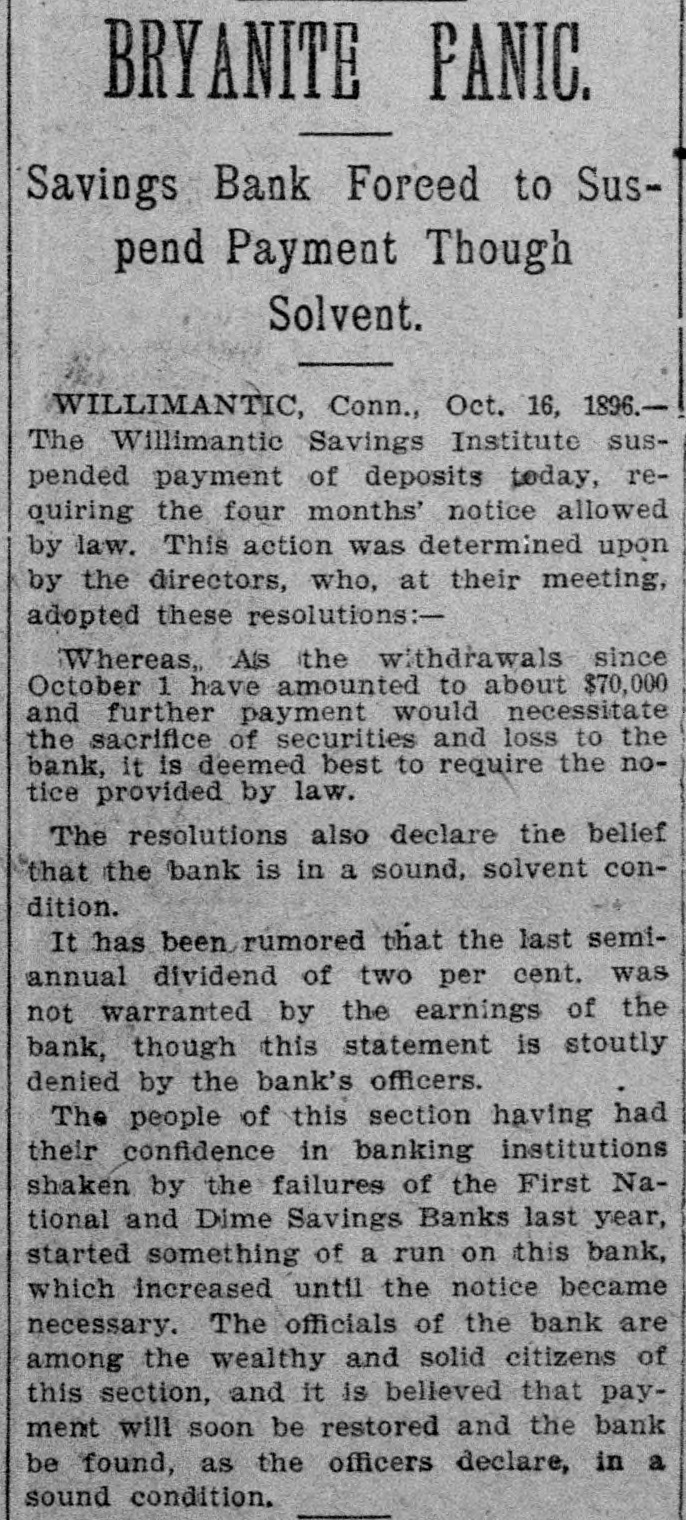
BRYANITE PANIC. Savings Bank Forced to Suspend Payment Though Solvent. WILLIMANTIC, Conn., Oct. 16, 1896.- 1 The Willimantic Savings Institute suspended payment of deposits today, requiring the four months' notice allowed by law. This action was determined upon by the directors, who, at their meeting, adopted these resolutions:Whereas, Als the withdrawals since October 1 have amounted to about $70,000 and further payment would necessitate the sacrifice of securities and loss to the bank, it is deemed best to require the notice provided by law. The resolutions also declare the belief that the bank is in a sound, solvent condition. It has been rumored that the last semiannual dividend of two per cent. was not warranted by the earnings of the bank, though this statement is stoutly denied by the bank's officers. The people of this section having had their confidence in banking institutions shaken by the failures of the First National and Dime Savings Banks last year, started something of a run on this bank, which increased until the notice became necessary. The officials of the bank are among the wealthy and solid citizens of this section, and it is believed that payment will soon be restored and the bank be found, as the officers declare, in a sound condition.


Article from The Providence News, October 16, 1896

Click image to open full size in new tab

Article Text

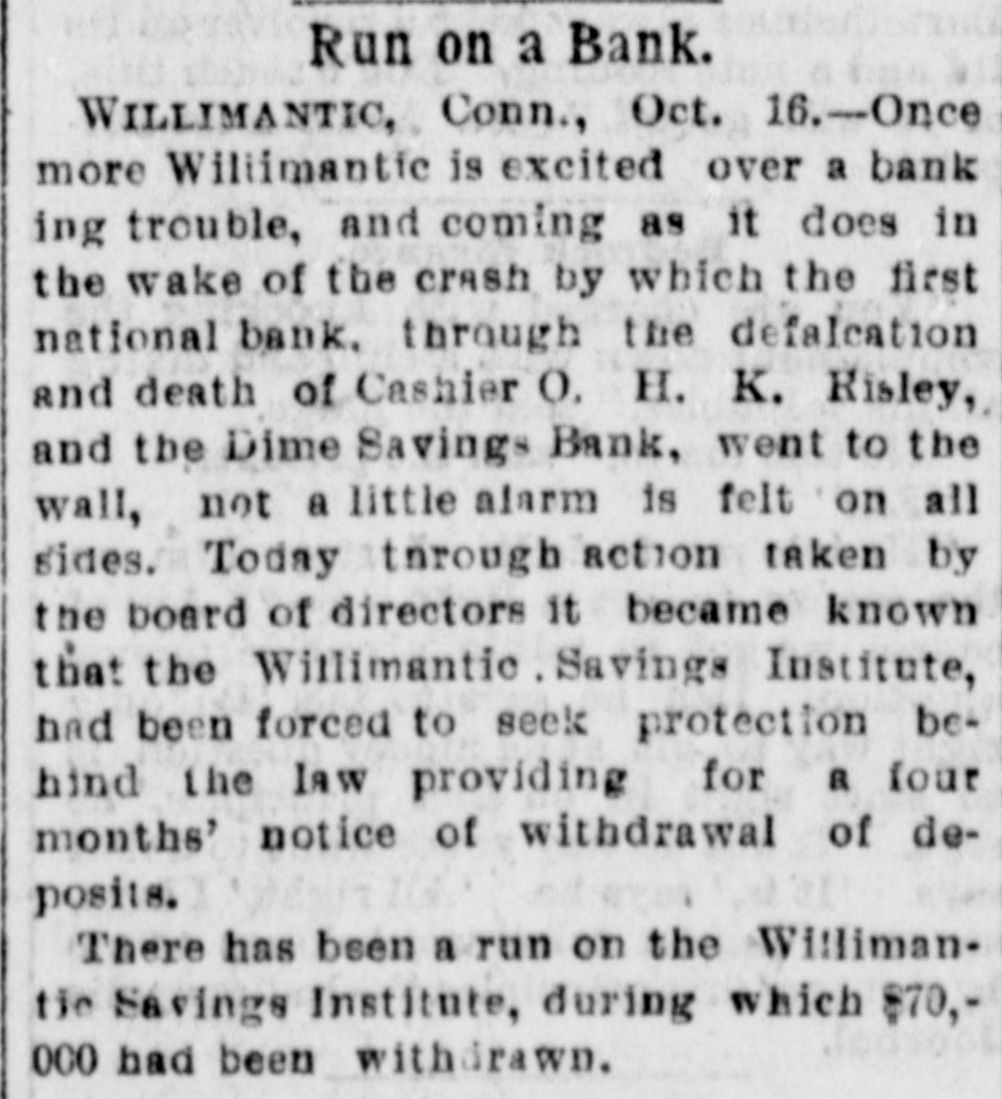
Run on a Bank. WILLIMANTIC, Conn., Oct. 16.-Once more Willimantic is excited over a bank ing trouble, and coming as it does in the wake of the crash by which the first national bank. through the defalcation and death of Cashier O. H. K. Risley, and the Dime Savings Bank, went to the wall, not a little alarm is felt on all sides. Today through action taken by the board of directors it became known that the Willimantic. Savings Institute, had been forced to seek protection behind the law providing for a four months' notice of withdrawal of deposits. There has been a run on the Willimantie Savings Institute, during which $70,000 had been withdrawn.


Article from The Roanoke Daily Times, October 17, 1896

Click image to open full size in new tab

Article Text

THE LAW'S PROTECTION. Willimantic, Conn., Oct. 16.-Owing to a run on the Wiliimantic Savings Institute, during which $70,000 has been withdrawn, the directors of the bank to-day issued a statement in which they announced their intention of taking advantage of the "four months notice" law. The cause of the run is not known.


Article from The Indianapolis Journal, October 17, 1896

Click image to open full size in new tab

Article Text

Savings Bank in Straits. WILLIMANTIC, Conn., Oct. 16.-Owing to a run on the Willimantic Savings Institute, during which $70,000 has been withdrawn, the directors of the bank to-day issued a statement in which they announced their intention of taking advantage of the "four-months-notice" law. The cause of the run is not yet known.


Article from The Sun, October 17, 1896

Click image to open full size in new tab

Article Text

BANK SUSPENDS PAYMENT. Willimantio Savings Institute Enforces the Four Months' Notice Rule. WILLIMANTIC, Conn., Oct. 16.-The Willimantic Savings Institute suspended payment of deposits to-day. requiring the four months' notice allowed by law. This action was determined upon by the directors, who at their meeting adopted this preamble: "Whereas, As the withdrawals since Oct. 1 have amounted to about $70,000. and further payment would necessitate the sacrifice of securities and loss to the bank. it is deemed best to require the notice provided by law." Resolutions also declare the belief that the bank is in a sound, solvent condition. The officials of the bank are among the wealthy and solid citizens of this region, and it is believed that payment will soon be restored and the bank be found. as the officers declare, in sound condition.


Article from The Wichita Daily Eagle, October 17, 1896

Click image to open full size in new tab

Article Text

DAY'S LIST OF FAILURES Merchants Bank, of Atlanta, Ga, at the Head of the List. Atlanta, Ga., Oct. 16.-The Merchant's bank, one of the oldest and for many years soundest financial institutions in this city, closed its doors this morning, having made an assignment for the benefit of its creditors. J. G. Oglesby and George W. Scott are named as assignees. The failure was not unexpected in financial circles, but its announcement created considerable excitement among bank depositors, a large crowd of whom quickly gathered about the unopened doors. A notice posted on the door simply stated that the bank had assigned to J. G. Oglesby, George W. Scott and George Winship, and that it was believed that all depositors would be paid in full. The failure of the bank was due to the withdrawal of deposits within the last few days ,caused by a rumor to the effect that Tax Collector A. P. Stewart, who had $49,000 on deposit there, had been asked by the bank officials not to check any of his money out. The officials deny that any such request was made. All of Stewart's checks were honored. He withdrew the $49,000, and that, coupled with the withdrawals caused by the rumor, occasioned embarrassment and it was deemed best to go into liquidation. The amount owned depositors is $275,000. There is no run on any of the other banks. Houghton, Mich., Oct. 16.-The Sturgeon River Lumber company, the largest and oldest lumbering concern in the Copper district, has been placed in charge of E. L. Wright as trustee for mortgages. The differences of the company are due exclusively to the depression in their lumber trade and inability to collect outstanding accounts. Wilimantic, Conn., Oct. 16.-Owing to a run on the Willmantic Savings Institute, during which $70,000 has been with drawn, the directors of the bank today issued a statement in which they announced their intention of taking advantage of the four-months notice law. The cause of the run is yet unknown. Little Falls, N. Y., Oct. 16.-Freeman, Ives & Co., produce dealers, have assigned, Liabilities and assets and the cause of the failure are as yet unknown. The firm was rated at from $150,000 to $300,000.


Article from The Daily Morning Journal and Courier, October 17, 1896

Click image to open full size in new tab

Article Text

IN WILLIMANTIC. Precautionary Measures-Savings Bank Suspends Payment. Willimantic, Oct. S.-The Willimantic Savings Institute suspended payment of deposits to-day, requiring the four months' notice allowed by law. This action was determined upon by the directors, who, at their meeting, adopted these resolutions: Whereas, As the withdrawals since October 1 have amounted to about $70,000 and further payments would necessitate the sacrifice of securities and loss to the bank, it is deemed best to require the notice provided by law. The resolutions also declare the belief that the bank is in a sound solvent condition. It has been rumored that the last semi-annual dividend of 2 per cent. was not warranted by the earnings of the bank, though this statement is stoutly denied by the banks' officers. The people of this section having had their confidence in banking institutions shaken by the failures of the First National and Dime Savings banks last year, started something of a run on this bank, which increased until the notice became necessary. The officials of the bank are among the wealthy and solid citizens of this section and it is believed that payment will soon be restored and the bank be found, as the officers declare, in a solid condition.


Article from The Providence News, October 17, 1896

Click image to open full size in new tab

Article Text

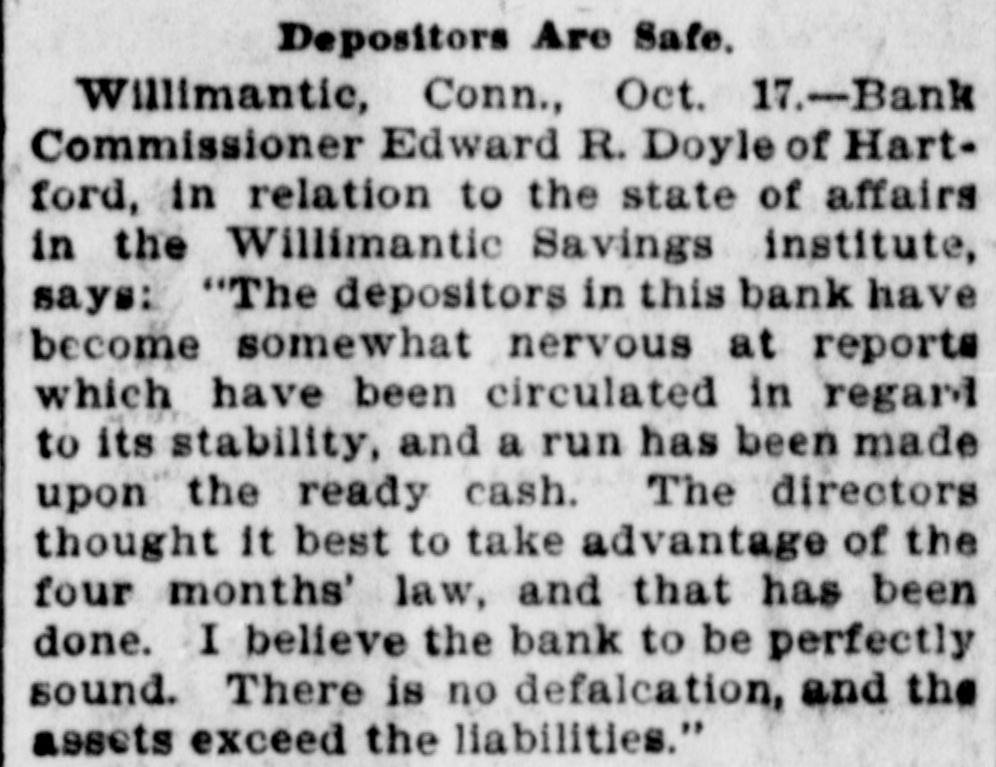
Depositors Are Safe. Willimantie, Conn., Oct. 17.-Bank Commissioner Edward R. Doyle of Hartford, in relation to the state of affairs in the Willimantic Savings institute, says: "The depositors in this bank have become somewhat nervous at reports which have been circulated in regard to its stability, and a run has been made upon the ready cash. The directors thought it best to take advantage of the four months' law, and that has been done. I believe the bank to be perfectly sound. There is no defalcation, and the assets exceed the liabilities."


Article from The Austin Weekly Statesman, October 22, 1896

Click image to open full size in new tab

Article Text

A RUN ON A BANK. Willimantic, Conn., Oct. 16.-Owing to a run on the Willimantic Savings institute, during which $70,000 has been withdrawn, the directors of the bank today issued a statement in which they announced their intention of taking advantage of the four months' notice law. The cause of the run is not yet known.


Article from The Somerset Reporter, October 22, 1896

Click image to open full size in new tab

Article Text

Depositors Are Safe. Willimantic, Conn., Oct. 17.-Bank Commissioner Edward R. Doyle of Hart. ford, in lation 10 the state of affairs in the Willimantic Savings institute, says: "The depositors in this bank have become somewhat nervous at reports which have been circulated in regard to its stability, and a run has been made upon the ready cash. The directors thought it best to take advantage of the four months' law. and that has been done. I believe the bank to be perfectly sound. There is no defalcation, and the assets exceed the liabilities."


Article from Vermont Phล“nix, October 23, 1896

Click image to open full size in new tab

Article Text

The Willimantic, Conn., Savings Institute suspended payment of deposits Friday, requiring the four months' notice allowed by law. This action was determined upon by the directors owing to recent heavy withdrawals and in order to prevent the sacrifice of the bank's securities. The action caused great uneasiness on account of the bank trouble in Willimantic two or three years ago, but the organization is said to be in good condition.


Article from The Universalist, October 24, 1896

Click image to open full size in new tab

Article Text

TWENTY years have past since the wheat market has seen any such activity. Europeans have been accustomed to wait for war times before expecting such market excitement as seen in Liverpool yesterday. Their uniform cablegrams to Chicago agents were: "Wheat ex cited and 5d higher." On the continent the excitement was still greater. Paris and Antwerp felt the tremendous bulge of Saturday in the Berlin market. Berlin, which set the pace Saturday, advanced 31/2 cents yesterday. On the Pacific coast the net gain for the day was but 5 cents per cental, although at one time it was 8 cents. New York's opening gain was 5 cents, and of this it re. tained 3 cents until the close. December wheat in Chicago waswithin one-fourth of a cent of 80 cents at 11 o'clock Monday morning. This was the highwater mark of the day. Two years ago on October 19, December wheat sold at closing at 60% cents. The closing price was 77%, or 17 cents higher than two years ago. The biggest bear on the market could not take cheer out of that comparison, especially since the foreign demand continues strong and without a sign of letting up. The advance was not checked by the posted figures showing an increase in the visible supply of 2,500,000 bushels, making a grand total in sight of 55,000,000. Europe wanted wheat-wants it still-and that badly. America has the grain. Chicago is the great distributing point. No one better explains the situation or makes it more plain why the eyes of the whole world are now turned to the wheat stores of America than John Hyde, expert special agent of the eleventh census, in his statement: "It is worthy of note that in 1867 and 1868 the failure of crops in Great Britain, which the United States was unable to make good out of its own surplus, caused an advance in price of no less than 42 cents a bushel. Wheat during the last ninety days, owing to deficient harvests in other countries, has advanced from 64 cents to 78 cents per bushel." THE Bay State Gas Company was last week placed in the hands of receivers by the United States Court at Wilmington, Delaware, on the application of William Buchanan, a New York stockholder. A rule was issued upon the officers of the company, returnable, No_ vember 7, restraining them from disposing of any of the company's effects. The Merchants' Bank of Atlanta, Georgia, closed its doors. It is said the failure was "due to a persistent fight made by outsiders on President J. H. Porter." The President says that depositors will get every dollar back. The Willimantic, Conn, Savings Institute suspended payment of deposits yester. day requiring the four months' notice allowed by law. This action was determined upon by the directors owing to recent heavy withdrawals and in order to prevent the sacrifice of the bank's securities. Freman Ives & Co., produce dealers of Little Falls, New York, have assigned. The firm's capital was rated at from $150,000 to $300,000. The assets and liabilities are unknown. A Houghton, Michigan, despatch says that the Sturgeon River Lumber Company, the largest and oldest lumbering concern in the copper district, is in financial difficulties. A DISPATCH on Friday from Juneau,


Article from The Daily Morning Journal and Courier, February 9, 1897

Click image to open full size in new tab

Article Text

TO PROTECT DEPOSITORS. Willimantic Bank Enjoined From Paying Out Money. Hartford, Feb. 8.-Judge Prentice this afternoon, in the superior court, granted an injunction restraining the officers of the Willimantic Savings institute of Willimantic from paying out any money, except for expenses of running the bank, for nine months. The bank is considered solvent, but $200,000 was paid out last October, and applications by depositors for $125,000 more are on file. They cannot be paid without sacrificing the bank's assets, foreclosing mortgages, etc. Commissioner Doyle stated that the object of the order was to preserve the assets and protect the depositors. The bank is perfectly solvent, he said, and has stood a run of $200,000. Another run of $125,000 might lead to double that amount and would compel the bank to sacrifice its securities. besides compelling the foreclosure on mortgages held by the bank, and it would be a hardship to many residents of Willimantic who own their homes. The application for the injunction was made by the bank commissioners under a new law passed by the general assembly last week. Their action was approved by the directors of the Willimantic bank.


Article from Daily Kennebec Journal, February 10, 1897

Click image to open full size in new tab

Article Text

Judge Prentice, in the superior court at Hartford. Ct.. Monday, granted an injunction restraining the officers of the Willimantic Savings Institute of Willimantic, Ct., from paying out any money except for expenses of running. The bank is considered solvent, out $200,000 was paid out. last October. and applications by depositors for $125,000 more are on file. They cannot be paid without sacrificing the bank's assets, foreclosing mortgages, etc.