5097. First National Bank (Indianapolis, IN)

Bank Information

Episode Type
Run → Suspension → Reopening
Bank Type
national
Bank ID
55
Charter Number
2556
Start Date
August 9, 1883
Location
Indianapolis, Indiana (39.768, -86.158)

Metadata

Model
gpt-5-mini
Short Digest
0a3ab92e8a5b65ec

Response Measures

Accommodated withdrawals, Public signal of financial health, Capital injected, Full suspension, Books examined

Description

Multiple August 1883 dispatches report a run beginning Aug. 9, 1883, followed by a temporary suspension (doors closed Aug. 10) and a reopening after a Depauw–English syndicate increased capital and took control (bank reopened Aug. 11). Causes mentioned include heavy withdrawal of state funds ($500,000) and acceptance of inconvertible paper/illiquid assets — treated here as bank-specific adverse information/liquidity problems. Later 1884–85 items refer to an older/defunct First National (suspended in 1881) and receivership proceedings for the 'old' bank; those appear to concern the prior charter and are distinct from the 1883 reorganization described above.

Events (6)

1. August 8, 1863 Chartered
Source
historical_nic
2. September 1, 1881 Chartered
Source
historical_nic
3. August 9, 1883 Run
Cause
Bank Specific Adverse Info
Cause Details
Large withdrawals, notably State Treasurer Cooper reportedly drew $500,000; officers also cited heavy acceptance of inconvertible paper and illiquid assets causing inability to realize funds quickly.
Measures
Directors met; sought outside syndicate support; arranged to double capital and secure a syndicate (Depauw & English) to provide relief.
Newspaper Excerpt
There was a run to-day on the First National Bank ... a large amount has been drawn from both institutions.
Source
newspapers
4. August 10, 1883 Suspension
Cause
Bank Specific Adverse Info
Cause Details
Bank closed temporarily because assets could not be realized quickly enough to meet heavy withdrawal demands; directors in session considering recapitalization and syndicate support; suspension described as temporary in multiple dispatches and tied to liquidity/asset realization problems.
Newspaper Excerpt
At 9:45 o'clock the doors of both banks were still closed, and the announcement was made that they would not open for two or three hours.
Source
newspapers
5. August 11, 1883 Reopening
Newspaper Excerpt
The directors ... formed a syndicate ... At ten minutes before 3 P. M. the doors were thrown open, and Mr. English invited the crowd of depositors ... The bank was kept open an hour after the closing time, and all checks presented were paid.
Source
newspapers
6. November 11, 1886 Voluntary Liquidation
Source
historical_nic

Newspaper Articles (23)

Article from The Portland Daily Press, August 10, 1883

Click image to open full size in new tab

Article Text

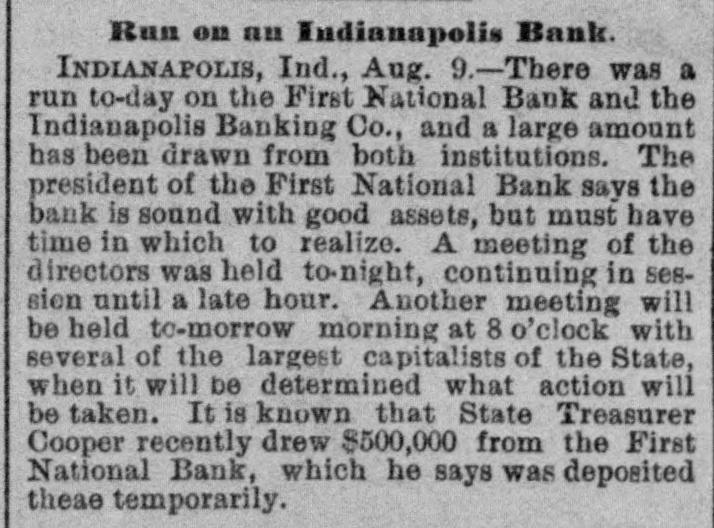
Run on an Indianapolis Bank. INDIANAPOLIS, Ind., Aug. 9.-There was a run to-day on the First National Bank and the Indianapolis Banking Co., and a large amount has been drawn from both institutions. The president of the First National Bank says the bank is sound with good assets, but must have time in which to realize. A meeting of the directors was held to-night, continuing in sessien until a late hour. Another meeting will be held to-morrow morning at 8 o'clock with several of the largest capitalists of the State, when it will be determined what action will be taken. It is known that State Treasurer Cooper recently drew $500,000 from the First National Bank, which he says was deposited theae temporarily.


Article from Morning Journal and Courier, August 10, 1883

Click image to open full size in new tab

Article Text

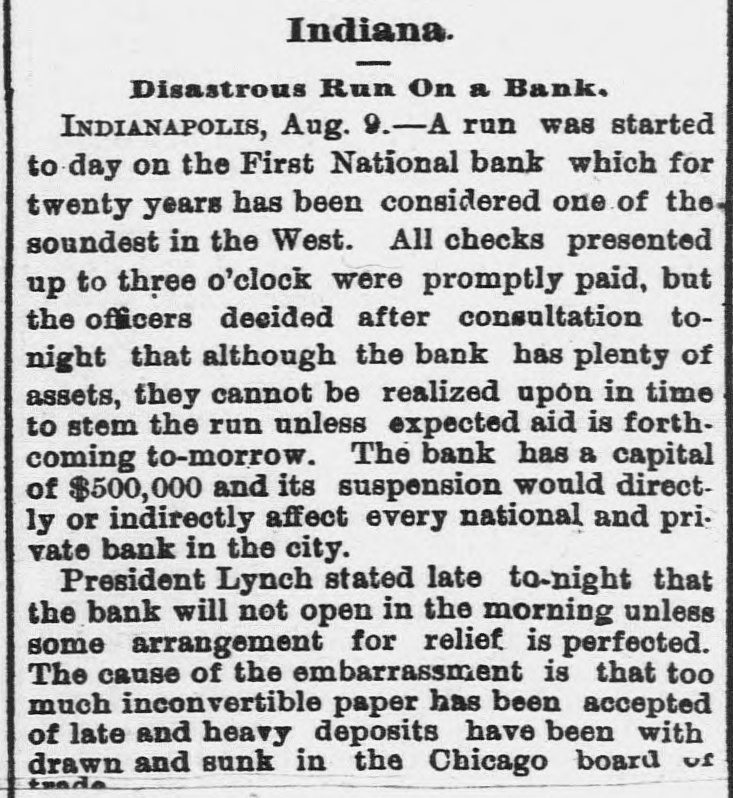
Indiana. Disastrous Run On a Bank. INDIANAPOLIS, Aug. 9.-A run was started to day on the First National bank which for twenty years has been considered one of the soundest in the West. All checks presented up to three o'clock were promptly paid, but the officers decided after consultation tonight that although the bank has plenty of assets, they cannot be realized upon in time to stem the run unless expected aid is forthcoming to-morrow. The bank has a capital of $500,000 and its suspension would directly or indirectly affect every national and private bank in the city. President Lynch stated late to-night that the bank will not open in the morning unless some arrangement for relief is perfected. The cause of the embarrassment is that too much inconvertible paper has been accepted of late and heavy deposits have been with drawn and sunk in the Chicago board of tuade


Article from Savannah Morning News, August 11, 1883

Click image to open full size in new tab

Article Text

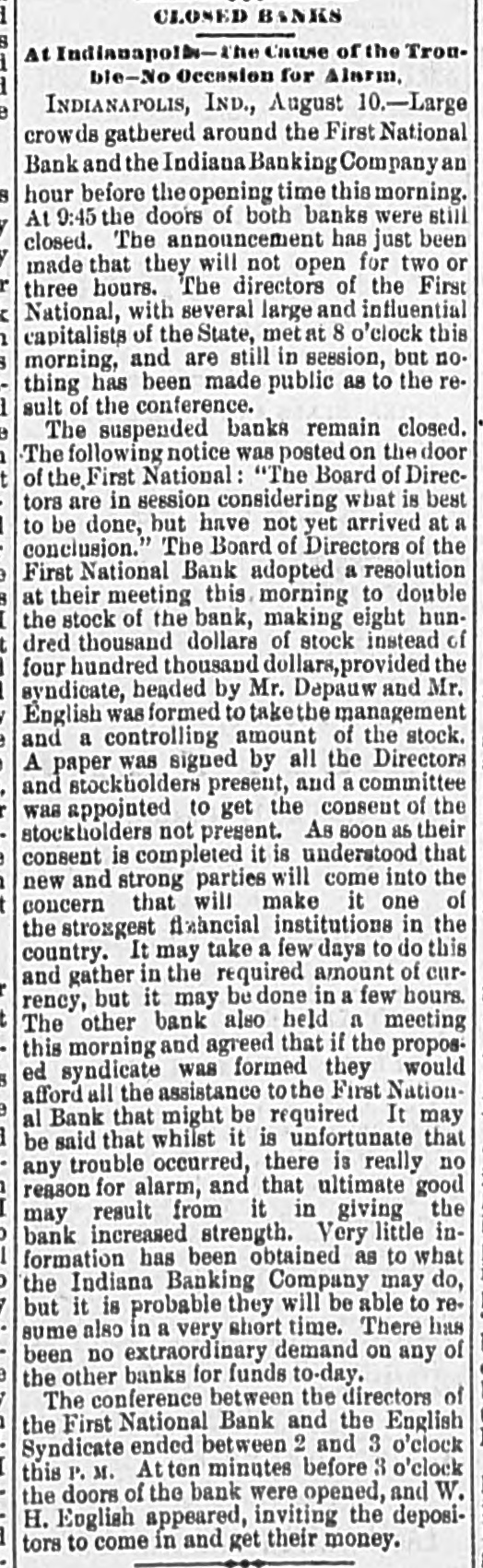
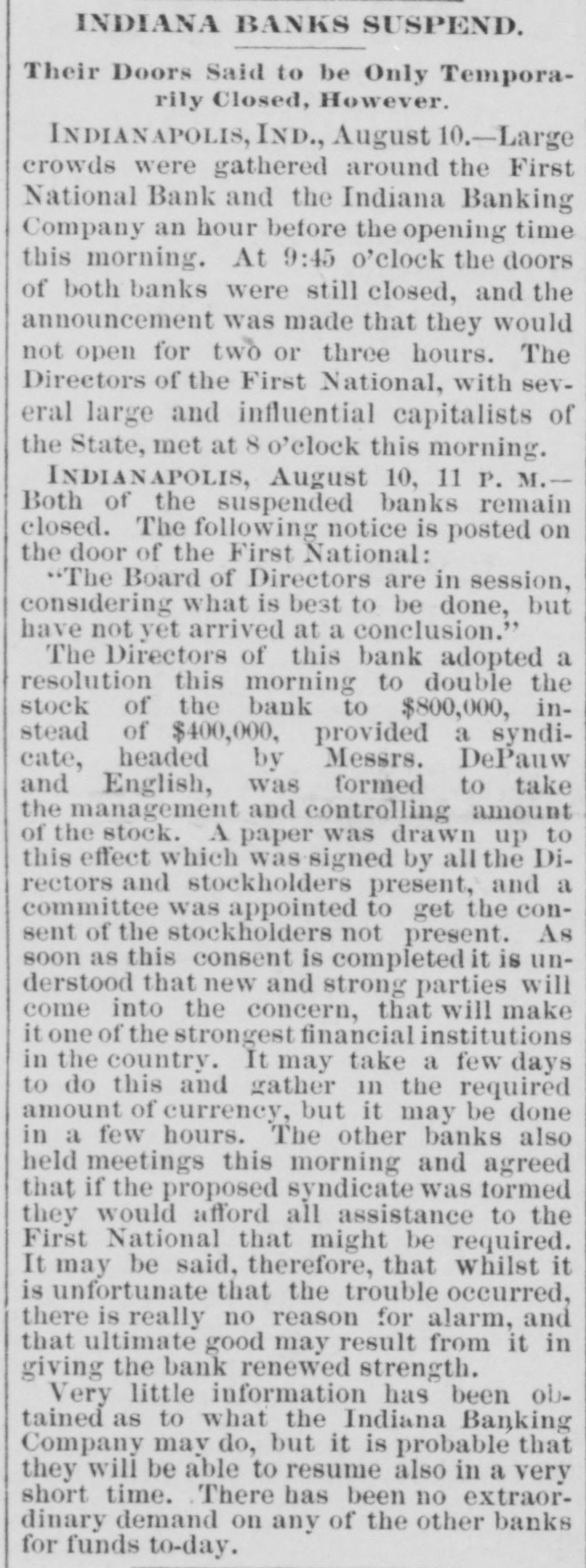
INDIANA BANKS SUSPEND. Their Doors Said to be Only Temporarily Closed, However, INDIANAPOLIS, IND., August 10.-Large crowds were gathered around the First National Bank and the Indiana Banking Company an hour before the opening time this morning. At 9:45 o'clock the doors of both banks were still closed, and the announcement was made that they would not open for two or three hours. The Directors of the First National, with several large and influential capitalists of the State, met at 8 o'clock this morning. INDIANAPOLIS, August 10, 11 P. M.Both of the suspended banks remain closed. The following notice is posted on the door of the First National: "The Board of Directors are in session, considering what is best to be done, but have not yet arrived at a conclusion." The Directors of this bank adopted a resolution this morning to double the stock of the bank to $800,000, instead of $400,000, provided a syndicate, headed by Messrs. DePauw and English, was formed to take the management and controlling amount of the stock. A paper was drawn up to this effect which was signed by all the Directors and stockholders present, and a committee was appointed to get the consent of the stockholders not present. As soon as this consent is completed it is understood that new and strong parties will come into the concern, that will make it one of the strongest financial institutions in the country. It may take a few days to do this and gather in the required amount of currency, but it may be done in a few hours. The other banks also held meetings this morning and agreed that if the proposed syndicate was formed they would afford all assistance to the First National that might be required. It may be said, therefore, that whilst it is unfortunate that the trouble occurred, there is really no reason for alarm, and that ultimate good may result from it in giving the bank renewed strength. Very little information has been obtained as to what the Indiana Banking Company may do, but it is probable that they will be able to resume also in a very short time. There has been no extraordinary demand on any of the other banks for funds to-day.


Article from The Wheeling Daily Intelligencer, August 11, 1883

Click image to open full size in new tab

Article Text

BANKS At Indianapol - the Cause of the Troubie-No Occasion for Alarm, INDIANAPOLIS, IND., August 10.-Large crowds gatbered around the First National Bank and the Indiana Banking Companyan 8 hour before the opening time this morning. At 9:45 the doors of both banks were still closed. The announcement has just been made that they will not open for two or three hours. The directors of the First National, with several large and influential capitalists of the State, met at 8 o'clock this morning, and are still in session, but nothing has been made public as to the result of the conference. The suspended banks remain closed. The following notice was posted on the door of the First National: "The Board of Directors are in session considering what is best to be done, but have not yet arrived at a conclusion." The Board of Directors of the First National Bank adopted a resolution at their meeting this morning to double the stock of the bank, making eight hundred thousand dollars of stock instead of the was to syndicate, four English hundred headed formed thousand by Mr. take dollars, Dapauw the management provided and Mr. and a controlling amount of the stock. A paper was signed by all the Directors and stockholders present, and a committee was appointed to get the consent of the stockholders not present. As soon as their consent is completed it is understood that new and strong parties will come into the concern that will make it one of the strongest fixancial institutions in the country. It may take a few days to do this and gather in the required amount of currency, but it may be done in a few hours. The other bank also held a meeting and proposwas this ed syndicate morning agreed formed that the they if First the Nation- would afford all the assistance to may whilst al be Bank said that that might it be is required unfortunate It that any trouble occurred, there is really no reason for alarm, and that ultimate good may result from it in giving the bank increased strength. Very little information has been obtained as to what the Indiana Banking Company may do, but it is probable they will be able to re. sume also in a very short time. There has been no extraordinary demand on any of the other banks for funds to-day. The conference between the directors of National Bank and the English ended Atten Syndicate this the First P.M. between minutes 2 before and 3 3 o'clock o'clock the doors of the bank were opened, and W. H. English appeared, inviting the depositors to come in and get their money.


Article from National Republican, August 11, 1883

Click image to open full size in new tab

Article Text

TOTTERING BANKS. The Directors of the First National of Indianapolis Trying to Double Their Capital. The Bank Closed and a Large Crowd Awaiting Results-History of the Bank. Special Dispatch. NEW YORK, Aug. Vice President Murray, of the United States National bank here, says: "We have not been advised of the closing of the First National bank of Indianapolis. The demand upon them yesterday must have been sudden, as they have not in. timated to us the want of funds. Their balances are fairly good with us, and they have not called upon us for currency. This bank will not be involved in of their was caused by Their embarrassment any probably troubles. the sudden withdrawal of the state treasurer's funds." By Associated Press. IND., crowds around the First INDIANAPOLIS, gathered Aug. 10.-Large National bank and the Indiana Banking company's office an hour before the opening time this morning. At 9:45 an announcement was made that the directors, who had met at 8 o'clock, were in session, and that the banks would not open for two or three hours at least. Several prominent and influential capitalists were known to be in consultation with the directors, and this fact did much to allay anxiety and excitement, though nothing was made public as to what their plans or hopes, if they had any, might be. Later a notice was posted on the door of the Frst National saying, "The board of director# is in session considering what is best to be done, but have not yet reached a conclusion.' Late in the afternoon it was announced that the directors of the First National had adopted a resolution to double the stock of the bank to $800,000 instead of $400,000, provided the and was to take the syndicate English headed formed by Mr. Depauw management Mr. and controlling amount of the stock. A paper was drawn up to this effect, which was signed by all the directors and stockholders present, and a committee was appointed to get the consent of the stockholders not present. As soon as this consent is completed it is understood that new and strong parties will come into the concern who will make it one of the strongest financial institutions in the country. It may take a few days to do this and gather in the required amount of currency, but it may be done in a few hours. Other banks also held meetings this morning and agreed that if the proposed syndicate was formed they would afford all the assistance to the First National that might be required. It may be said, therefore, that while it is unfortunate that the trouble occurred, there is really no reason for alarm, and that ultimate good may result from it in giving the bank increased strength. Very little information has been obtained as to what the Indiana Banking company may do, but is probable they will be able to resume also in a very short time. There has been no extraordinary demand on any of the other banks for funds to-day. The conference between the directors of the First National bank and the EnglishDepauw syndicate ended at between 2 and o'clock this afternoon. At 2:50 the doors of the bank were thrown open and W. H. English appeared and invited the depositors to draw their money. The crowd outside rushed in, but were checked by policemen, and ladies were given the remained for an or more the all were checks few hour preference. of the presented The after bank promptly closing hour. cashed. open and depositors drew The Indiana larger Banking company their money. has not But resumed. The First National bank of Indianapolis, whose suspension is arinounced was owned Wm. and New for dispatches, John C. many by years. H. in English About the six years ago Mr. New bought the English stock. paying a larie premium for it. This gave him control of the bank in person. Some two years/later rumors got out affecting the financial standing of Wm. H. Morrison. president and principal owner of the Indiana Banking company. The talk became general, and Mr Morrison found it necessary to stop the tangue of gossip. This he did most effectivally for the time by buying Mr. New's interest in the First National paying that gentleman $185,000 in cash for his stock, the price paid being $1.65. This coup d'etat enabled him to pull through, and arrange his affairs to face any storm that might arise. It was inside talk at the time of transfer of Mr. New's stock that Morrison obtained the $485,000 by resorting to extraordinary measures, and predictions were made years age-that both banks would go under. There was flurry in First National stock, and several small holders threw their stock on the market. spicked up by two or three nervy men and a panic was averted. Mr. Morrison, who was reputed to be a two millionaire, but whose property was scattered about in real estate and the like, died about a year ago, and Indiana people in Washington assume that the failure of the bank is due to the discovery that the Morrison estate was found to be practically insolvent when it came to be wound up, WITT WING


Article from The Daily Cairo Bulletin, August 11, 1883

Click image to open full size in new tab

Article Text

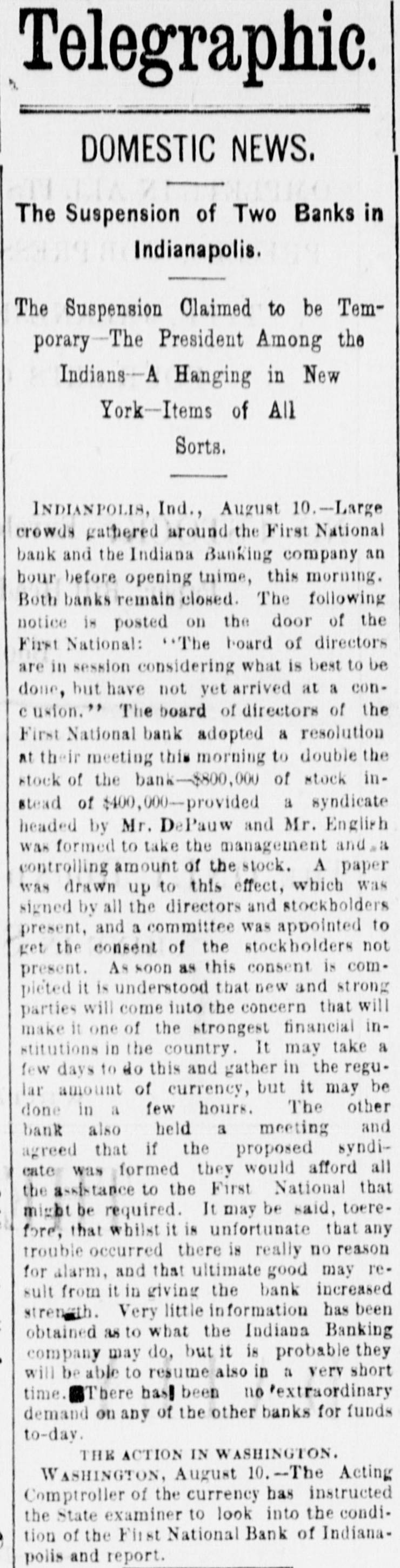
Telegraphic. DOMESTIC NEWS. The Suspension of Two Banks in Indianapolis. The Suspension Claimed to be Temporary-The President Among the Indians-A Hanging in New York-Items of All Sorts. INDIANPOLIS, Ind., August 10.-Large crowds gathered around the First National bank and the Indiana Banking company an bour before opening tnime, this morning. Both banks remain closed. The following notice is posted on the door of the First National: **The board of directors are in session considering what is best to be done, but have not yet arrived at a conusion. The board of directors of the First National bank adopted a resolution at their meeting this morning to double the stock of the bank-$800,000 of stock instead of $400,000-provided a syndicate headed by Mr. DePauw and Mr. English was formed to take the management and a controlling amount of the stock. A paper was drawn up to this effect, which was signed by all the directors and stockholders present, and a committee was appointed to get the consent of the stockholders not present. As soon as this consent is compieted it is understood that new and strong parties will come into the concern that will make it one of the strongest financial institutions in the country. It may take a few days to do this and gather in the regular amount of currency, but it may be done in a few hours. The other bank also held a meeting and agreed that if the proposed syndicate was formed they would afford all the ssistance to the First National that might be required. It may be said, toerefore, that whilst it is unfortunate that any trouble occurred there is really no reason for alarm, and that ultimate good may result from it in giving the bank increased strength. Very little information has been obtained as to what the Indiana Banking company may do, but it is probable they will be able to resume also in a very short time. There basi been no 'extraordinary demand on any of the other banks for funds to-day. THE ACTION IN WASHINGTON. WASHINGTON, August 10.-The Acting Comptroller of the currency has instructed the State examiner to look into the condition of the First National Bank of Indianapolis and report.


Article from Daily Kennebec Journal, August 11, 1883

Click image to open full size in new tab

Article Text

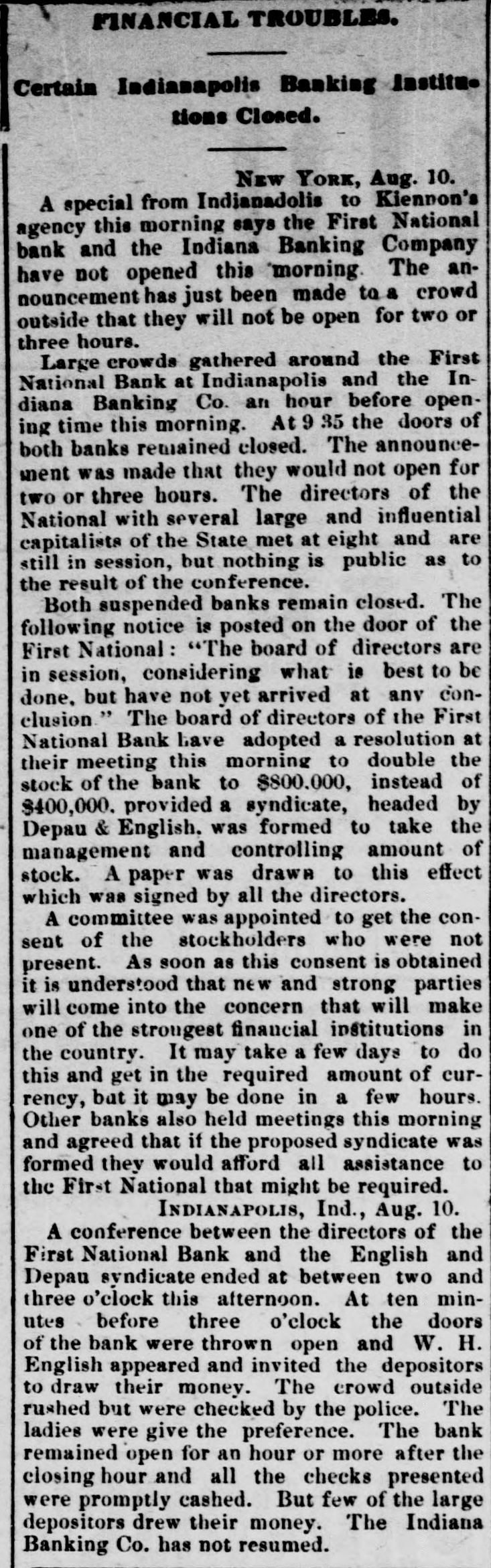
TROUBLES. Certain Indianapolis Banking institu. tions Closed. NEW YORK, Aug. 10. A special from Indianadolis to Kiennon's agency this morning says the First National bank and the Indiana Banking Company have not opened this "morning. The announcement has just been made to a crowd outside that they will not be open for two or three hours. Large crowds gathered around the First National Bank at Indianapolis and the Indiana Banking Co. an hour before opening time this morning. At935 the doors of both banks remained closed. The announcement was made that they would not open for two or three hours. The directors of the National with several large and influential capitalists of the State met at eight and are still in session, but nothing is public as to the result of the conference. Both suspended banks remain closed. The following notice is posted on the door of the First National: "The board of directors are in session, considering what is best to be done. but have not yet arrived at any conclusion." The board of directors of the First National Bank Lave adopted a resolution at their meeting this morning to double the stock of the bank to $800.000, instead of a was $400,000. Depau & English, provided syndicate, formed to headed take the by management and controlling amount of stock. A paper was drawn to this effect which was signed by all the directors. A committee was appointed to get the consent of the stockholders who were not present. As soon as this consent is obtained it is understood that new and strong parties will come into the concern that will make one of the strougest financial institutions in the country. It may take a few days to do this and get in the required amount of currency, bat it may be done in a few hours. Other banks also held meetings this morning and agreed that if the proposed syndicate was formed they would afford all assistance to the First National that might be required. INDIANAPOLIS, Ind., Aug. 10. A conference between the directors of the First National Bank and the English and Depau syndicate ended at between two and three o'clock this afternoon. At ten minutes before three o'clock the doors of the bank were thrown open and W. H. English appeared and invited the depositors to draw their money. The crowd outside rushed but were checked by the police. The ladies were give the preference. The bank remained open for an hour or more after the closing hour and all the checks presented were promptly cashed. But few of the large depositors drew their money. The Indiana Banking Co. has not resumed.


Article from The Indianapolis Journal, August 11, 1883

Click image to open full size in new tab

Article Text

A PROSPECT OF RELIEF. First National and the Indiana Banking Company Suspend Payment, But the Former Resumes, and Is To Be Reorganized, with Increased Capital and W. H. English as President.


Article from Evening Star, August 11, 1883

Click image to open full size in new tab

Article Text

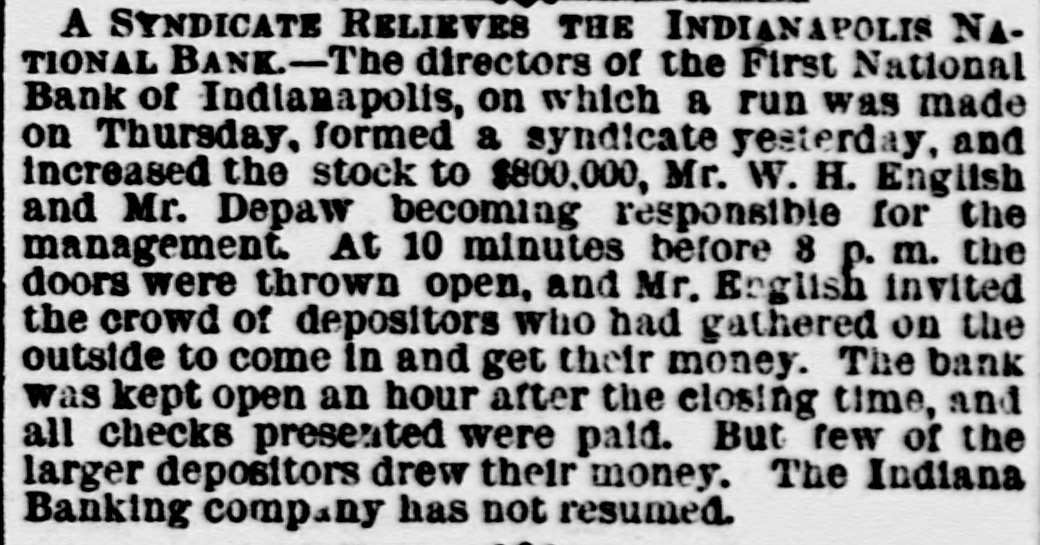
A SYNDICATE RELIEVES THE INDIANAPOLIS NATIONAL BANK-The directors of the First National Bank of Indianapolis, on which a run was made on Thursday, formed a syndicate yesterday, and increased the stock to $800,000, Mr. W. H. English and Mr. Depaw becoming responsible for the management. At 10 minutes before 8 p. m. the doors were thrown open, and Mr. English invited the crowd of depositors who had gathered on the outside to come in and get their money. The bank was kept open an hour after the closing time, and all checks presented were paid. But few of the larger depositors drew their money. The Indiana Banking company has not resumed.


Article from New-York Tribune, August 12, 1883

Click image to open full size in new tab

Article Text

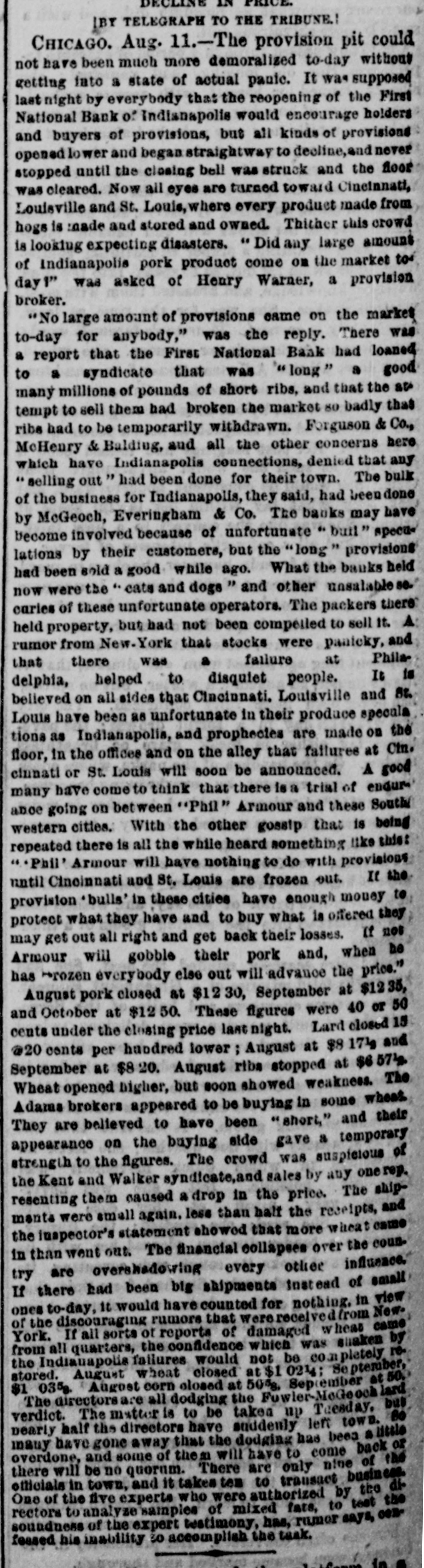
DECLINE IN PRICE. BY TELEGRAPH TO THE TRIBUNE. CHICAGO. Aug. 11.-The provision pit could not have been much more demoralized to-day without getting late a state of actual panic. It was supposed last night by everybody that the reopening of the First National Bank of Indianapolis would encourage holders and buyers of provisions, but all kinds of provisions opened lower and began straightway to decline, and never stopped until the clasing bell was struck and the floor was cleared. Now all eyes are turned toward Cincinnati, Louisville and St. Louis, where every product made from hogs is made and stored and owned. Thither this crowd is looking expecting disasters. Did any large amount of Indianapolis pork product come on the market to day 1" was asked of Henry Warner, a provision broker. "No large amount of provisions came on the market to-day for anybody," was the reply. There was a report that the First National Bank had loaned to a syndicate that was 'long' a good many millions of pounds of short ribs, and that the an tempt to sell them had broken the market 80 badly that ribe had to be temporarily withdrawn. Forguson & Co., McHenry & Balding, and all the other concerns here which have Indianapolis connections, denied that any selling out had been done for their town. The bulk of the business for Indianapolis, they said, had been done by McGeoch, Everingham & Co. The banks may have become involved because of unfortunate buil" speculations by their customers, but the "long" provisions had been sold a good while ago. What the banks held now were the " eats and dogs" and other unsalable se. curies of these unfortunate operators. The packers there A held property, but had not been compelled to sell it. rumor from New-York that stocks were panicky, and Phila at failure a was there that delphia, helped to disquiet people. It is believed on all sides that Cincinnati. Loutsville and St. Louis have been as unfortunate in their produce specula tiona as Indianapolia, and prophecies are made on the floor, in the offices and on the alley that failures at Cin. cinnati or St. Louis will soon be announced. A good many have come to think that there is a trial of endure adoe going on between "Phil" Armour and these South western cities. With the other gossip that is being repeated there is all the while heard something like this: Phil' Armour will have nothing to do with provisions until Cinoinnati and St. Louis are frozen out. If the provision 'bulls' in these cities have enough money to protect what they have and to buy what is offered they may get out all right and get back their losses. If not Armour will gobble their pork and, when be has Prozen everybody else out will advance the price." August pork closed at $1230, September at $12 35, and October at $12 50. These figures were 40 or 50 cents under the closing price last night. Lard closed 15 @20 cents per hundred lower; August at $8 17th and September at $8 20. August ribs stopped at $6 57 2 Wheat opened higher, but soon showed weakness. The Adams brokers appeared to be buying in some wheat They are believed to have been "short," and their appearance on the baying side gave a temporary strength to the figures. The crowd was suspieious of the Kent and Walker syndicate,and sales by any one rep. resenting them caused a drop in the price. The shipments were small again. less than half the receipts, and the inspector's statement showed that more wheat came out. The financial collapses over the are overshadowing every other in try than went influence. small coun. If there had been big shipments instead of ce to-day, It would have counted for nothing. in view of the discouraging rumors that were received rom New. York. If all sorts ot reports of damaged wheat came the confidence which was from all quarters, smaken pletely by rethe Indianapolis failures would not be co. August wheat closed at 024: ptember, corn closed at 50%g. stored. 035g August September Se at lard 50. The directors all dodging the Fuwler-McGooch but verdict. The matter is to be takea up Tuesday. 80 half the directors have suddenly left town. have that the dodging has beea many nearly gone away back a little or overdone, and some of the a will have to come the there will be no quorum. There are only nine of officials in town, and it takes ten to transact business diOne of the five experts who were authorized by the the rectors to analyze samples of mixed fats, to test soundness of the expert testimony, has, rumor says, cen fessed his inability 30 accomplish the tusk. in


Article from The Rock Island Argus, August 13, 1883

Click image to open full size in new tab

Article Text

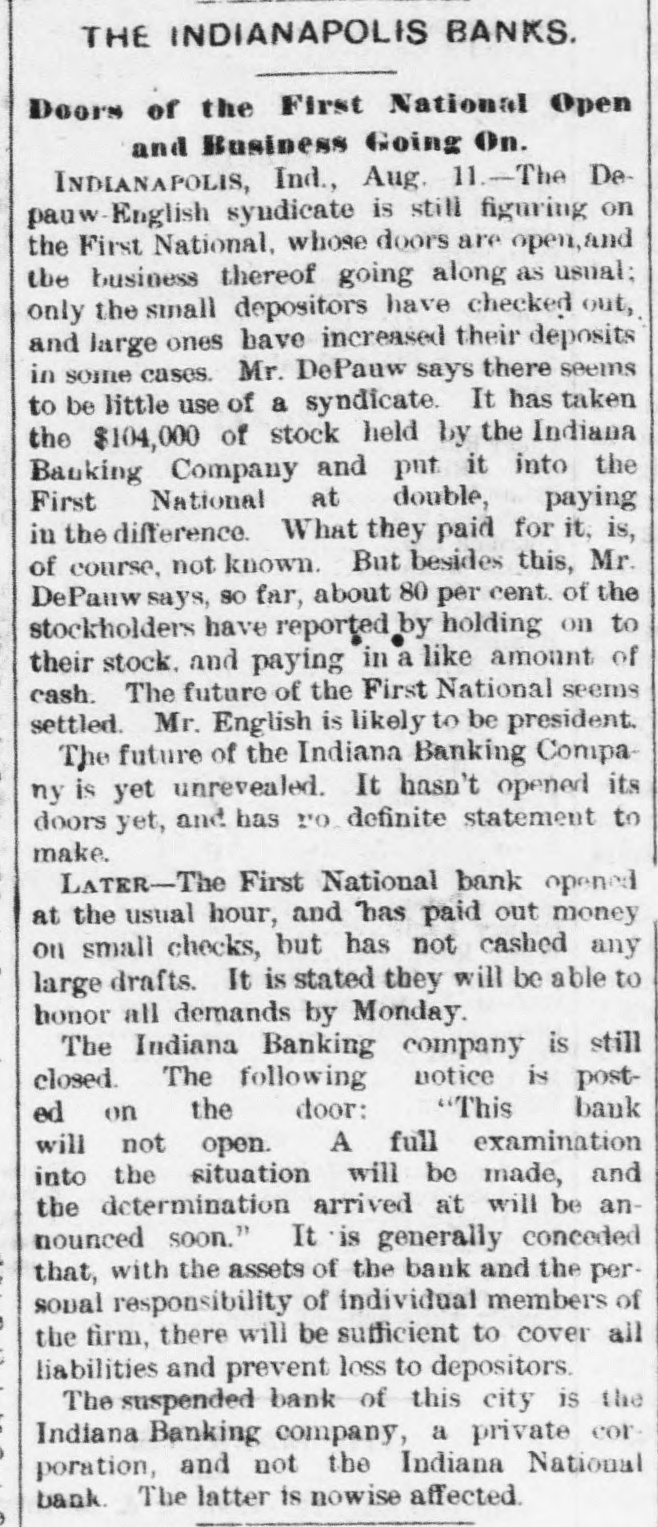
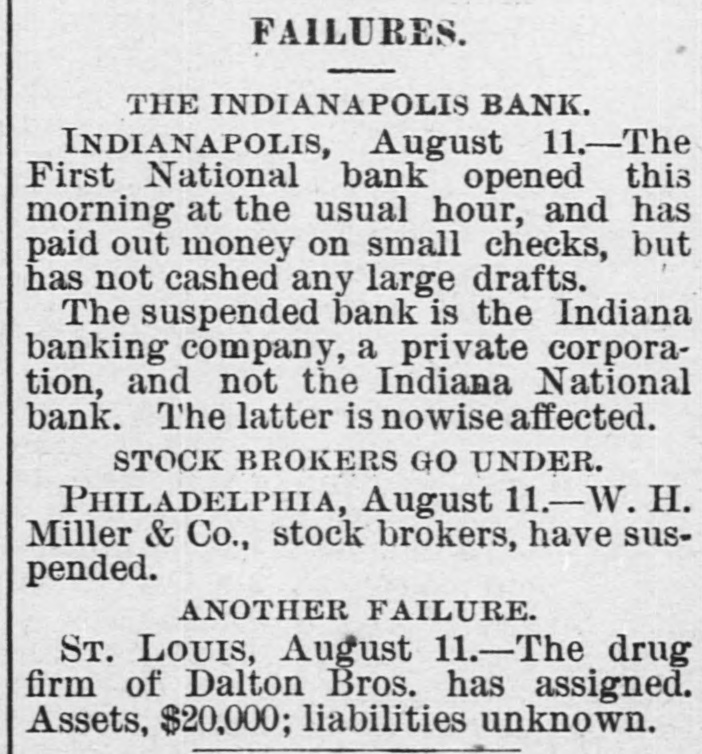
THE INDIANAPOLIS BANKS. Doors of the First National Open and Business Going On. INDIANAPOLIS, Ind., Aug. 11.-The Depauw-English syudicate is still figuring on the First National, whose doors are open,and the business thereof going along as usual; only the small depositors have checked out, and large ones have increased their deposits in some cases. Mr. DePauw says there seems to be little use of a syndicate. It has taken the $104,000 of stock held by the Indiana Banking Company and put it into the First National at double, paying in the difference. What they paid for it. is, of course, not known. But besides this, Mr. DePauw says, so far, about 80 per cent. of the stockholders have reported by holding on to their stock. and paying in a like amount of cash. The future of the First National seems settled. Mr. English is likely to be president. The future of the Indiana Banking Company is yet unrevealed. It hasn't opened its doors yet, and has TO definite statement to make. LATER-The First National bank opened at the usual hour, and has paid out money on small checks, but has not cashed any large drafts. It is stated they will be able to honor all demands by Monday. The Indiana Banking company is still closed. The following notice is posted on the door: "This bank will not open. A full examination into the situation will be made, and the determination arrived at will be announced soon." It is generally conceded that, with the assets of the bank and the persoual responsibility of individual members of the firm, there will be sufficient to cover all liabilities and prevent loss to depositors. The suspended bank of this city is the Indiana Banking company, a private cor poration, and not the Indiana National bank. The latter is nowise affected


Article from National Republican, August 13, 1883

Click image to open full size in new tab

Article Text

# THE MARKETS. A Considerable Decline in Prices Nearly Creates a Panic in Wall Street. A Rally Followed by a Partial Restoration of Confidence-Gossip of the Day. GENERAL GOSSIP. Special Dispatch. NEW YORK, Aug. 11. The telegraphers' brotherhood is excited over defections in their ranks, and the strike is evidently break- ing up and will be ended by next Tuesday. The Baltimore and Ohio, and Western Union companies are each ready to treat with indi- viduals but not with the brotherhood. The failures of the First National bank and the Indiana Banking company, of Indianapolis known here early yesterday, and the reported complications among western roads led to a complete change of sentiment among opera- tors and caused a general decline in prices. The trading was on a large scale and with more spirit than for some time past. The sharp decline brought considerable long stock out, causing a very unsettled feeling. Never- theless some brokers bought freely presumably for the prominent speculators, as important time loans have been effected during the past few days for from four to six months. The crop advices from abroad are unfavora- ble, while reports from the west are more en- couraging than for a long time past. Fur- thermore the railways are beginning to feel the effect of crop freights. GOSSIP. The market opened active and excited, and from to 1 lower. The London bankers are free sellers of Erie, and the buyers were Hen- derson, Brownell, Landon, Gutman, and Harding. In Western Union the buyers were Jameson and Content. The sellers were Durkee, Watts, and Prince & Whiteley. In Reading, Whitfield was a large seller, and the buyers were Von Hoffman, Cohn, and Zerega. In Lake Shore the sellers were Heath, Enos, and Hughes; the buyers were James and Campbell. In St. Paul L. L. White was the principal buyer. Stocks were lending at yes- terday's prices; New York Central at one- sixty-fourth, A Philadelphia dispatch says Mr. Cassatt is reported to have said: "Should I ever return to railway life my services will be first at the command of the Pennsylvania railway." The telegraphers generally expect to re- sume work next week, and their failure they ascribe in part to the lack of support and as- sistance from the Knights of Labor which was promised them. The cause of the inter- ruption to the stock exchange tickers for a few minutes this morning was the malicious cutting of twenty circuits. The London market for American stocks closed unsettled, and with a further decline of to 1 per cent. Chas. Johnes has been buying considerably of Lake Shore, New York Central, and Lack- awanna. Ball bought Central Pacific and Stephens sold it. Alley & Dowd have been large sellers of the general market this morning and yes- terday. Dominick & Dickinson sold consid- erable Jersey this morning and Drake bought. Governments are steady and dull; sterling exchange weak. In Chicago wheat is up for cash. Cotton is 4 to 6 points better. The rumor committee was in full blast last evening, and the bear brokers declared the situation strained, and many long stocks have been sold out. It is claimed the brokers of a prominent operator (not Smith) has thrown over 10,000 shares of Lackawanna and a block of Jersey Central, &c. The room traders have control of the mar- ket excopt the Vanderbilt stocks, New York Central, Lake Shore, St. Paul. Gould stocks are fairly sustained, but yield in sympathy at any moment. Other stocks are standing it on the last available support. It was generally belived that the market would not be further depressed to-day, but the lack of confidence induced the room traders to hammer the prices. At the opening the prices were lower all around, Denver being driven to 33. Heavy blocks of Lackawanna were thrown over but found ready buyers, Union Pacific, Western Union and the Vanderbilts were the best sus- tained. There was an advance of 1 in Northwestern preferred, and the grangers were strong with an upward tendency. On the opening the London bankers were free sellers of Erie. The room traders threw their efforts against Western Union, but the sus- taining orders held the price firm. The traders drove against the Wabashes and other Gould specialties with all possible fury, and for a time the market looked like a veritable panic. There was great activity in Northern Pa- cific preferred, which was sold down 2 by Johnes, and Slayback got after Oregon Trans- continental, which both Johnes and Slayback drove. The market then got into a state of panic between 12 and 1 o'clock, Oregon Transcontinental dropping three points to 674. There was much excitement on the board, and the further fall shook out consid- erable long stock. Lackawanna was pressed down to 1214 on enormous transactions, and while Northwestern Lake Shore, and New York Central were creditably sustained there appeared to be nobody to give the market general support. Cammack, although not in the city, took a hand in by private wire, and sold stocks liberally through Wm. Heath & Co. On the second call there was a rally of to in dividend paying stocks, but the remainder of the market was feverish and ex- cited, with little improvement. The day, as a whole, was the most active of the year. Prince & Whitely and other large shorts were large buyers of the market this after- noon. During the last hour the market was irregular, and a portion of the recovery was lost. Jersey Central lent at of 1 per cent. premium for the use. A large house was reported in trouble to- day, and it is understood that $40,000 was loaned by a syndicate of bull operators, and this rumor helped the decline at noon. # THE FINANCIAL SITUATION. Further important failures in commercial circles have been announced during the past week. All these, together with the suspen- sion of two banks at St. Albans, also of runs by depositors on a bank in New York state, and two in the west, besides rumors affecting several other financial institutions, have served to keep the public mind in a disturbed condition all the week. On the surface the appearance is easily interpreted as indicating quite a general disorder, and parties inter- ested in depressing prices do not hesitate to exaggerate this feature and predict the most disastrous consequences. The stock market is now in a condition of extreme sensitiveness, growing out of the distrust which the large operators have pro- duced by their manipulations. For this reason it is comparatively easy to depress prices, for no story is too absurd not to frighten the timid. One cause why general mercantile trade at the west is somewhat below the usual volume at this season of the year is that the move- ment of wheat is comparatively small. The crop was a partial failure, and the harvest was late, and though the loss will to some ex- tent be made up by an increase of spring wheat, yet this latter kind of wheat does not make its influence felt till much later in the season. The money market continues in a stagnant condition, the rates remaining un- changed at 4 to 5 per cent.


Article from Savannah Morning News, August 14, 1883

Click image to open full size in new tab

Article Text

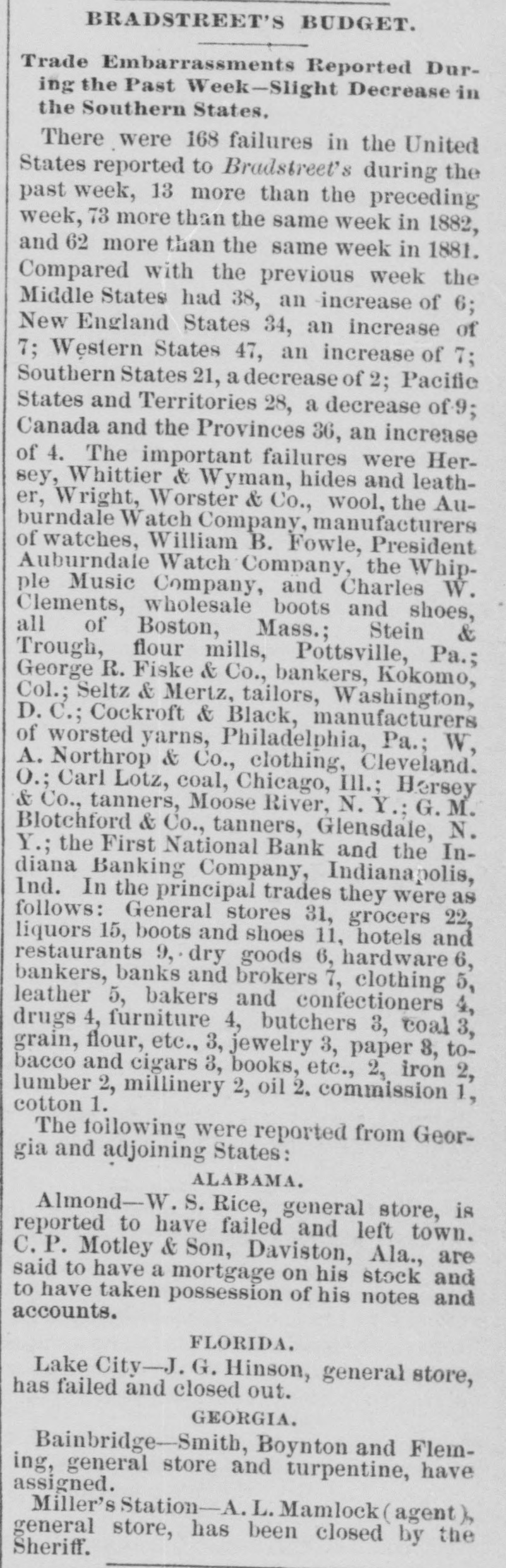
BRADSTREET'S BUDGET. Trade Embarrassments Reported During the Past Week-Slight Decrease in the Southern States. There were 168 failures in the United States reported to Bradstreet's during the past week, 13 more than the preceding week, 73 more than the same week in 1882, and 62 more than the same week in 1881. Compared with the previous week the Middle States had 38, an increase of 6; New England States 34, an increase of 7; Western States 47, an increase of 7; Southern States 21, a decrease of 2; Pacific States and Territories 28, a decrease of 9; Canada and the Provinces 36, an increase of 4. The important failures were Hersey, Whittier & Wyman, hides and leather, Wright, Worster & Co., wool, the Auburndale Watch Company, manufacturers of watches, William B. Fowle, President Auburndale Watch Company, the Whipple Music Company, and Charles W. Clements, wholesale boots and shoes, all of Boston, Mass.; Stein & Trough, flour mills, Pottsville, Pa.; George R. Fiske & Co., bankers, Kokomo, Col.; Seltz & Mertz, tailors, Washington, D.C.; Cockroft & Black, manufacturers of worsted yarns, Philadelphia, Pa.; W, A. Northrop & Co., clothing, Cleveland. O.; Carl Lotz, coal, Chicago, Ill.; Hersey & N. Blotchford Co., tanners, & Co., Moose tanners, River, Glensdale, Y.; G.M. N. Y.; the First National Bank and the Indiana Banking Company, Indianapolis, Ind. In the principal trades they were as follows: General stores 31, grocers 22, liquors 15, boots and shoes 11, hotels and restaurants 9, dry goods 6, hardware 6, bankers, banks and brokers 7, clothing confectioners drugs leather 4, furniture 5, bakers 4, and butchers 3, coal 4, 5, 3, grain, flour, etc., 3, jewelry 3, paper 8, tobacco and cigars 3, books, etc., 2, iron 2, lumber 2, millinery 2, oil 2. commission 1, cotton 1. The following were reported from Georgia and adjoining States: ALABAMA. Almond-W.S.Rice, general store, is reported to have failed and left town. C.P. Motley & Son, Daviston, Ala., are said to have a mortgage on his stock and to have taken possession of his notes and accounts. FLORIDA. Lake City-J. G. Hinson, general store, has failed and closed out. GEORGIA. Bainbridge-Smith, Boynton and Fleming, general store and turpentine, have assigned. Miller's Station-A.l L. Mamlock (agent), general store, has been closed by the Sheriff.
Article from Millheim Journal, August 16, 1883

Click image to open full size in new tab

Article Text

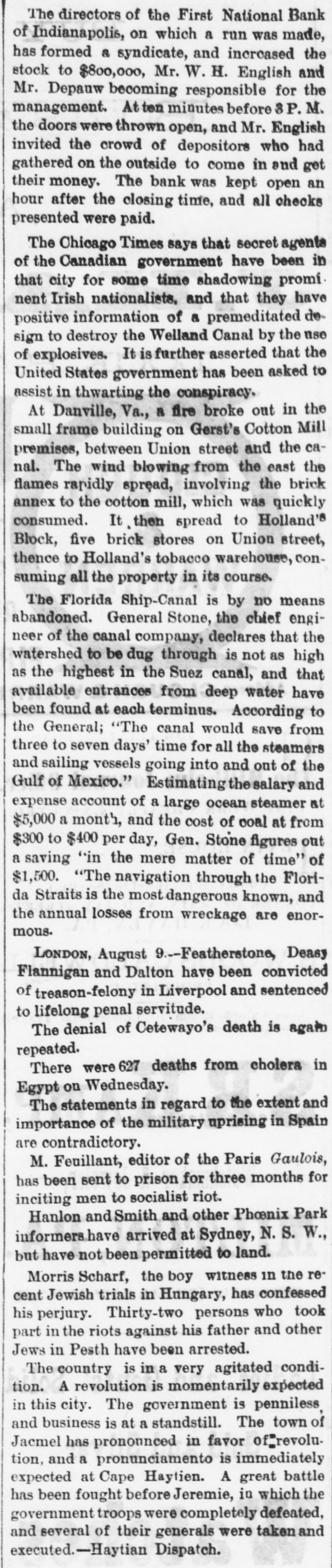
The directors of the First National Bank of Indianapolis, on which a run was made, has formed & syndicate, and increased the stock to $800,000, Mr. W. H. English and Mr. Depauw becoming responsible for the management. At ten minutes before 3 P. M. the doors were thrown open, and Mr. English invited the crowd of depositors who had gathered on the outside to come in and get their money. The bank was kept open an hour after the closing time, and all checks presented were paid. The Chicago Times says that secret agents of the Canadian government have been in that city for some time shadowing promi. nent Irish nationalists, and that they have positive information of a premeditated design to destroy the Welland Canal by the use of explosives. It is further asserted that the United States government has been asked to assist in thwarting the conspiracy. At Danville, Va., a fire broke out in the small frame building on Gerst's Cotton Mill premises, between Union street and the canal. The wind blowing from the east the flames rapidly spread, involving the brick annex to the cotton mill, which was quickly consumed. It then spread to Holland's Block, five brick stores on Union street, thence to Holland's tobacco warehouse, consuming all the property in its course. The Florida Ship-Canal is by no means abandoned. General Stone, the chief engineer of the canal company, declares that the watershed to be dug through is not as high as the highest in the Suez canal, and that available entrances from deep water have been found at each terminus. According to the General; "The canal would save from three to seven days' time for all the steamers and sailing vessels going into and out of the Gulf of Mexico." Estimating the salary and expense account of a large ocean steamer at $5,000 a month, and the cost of coal at from $300 to $400 per day, Gen. Stone figures out a saving "in the mere matter of time" of $1,500. "The navigation through the Florida Straits is the most dangerous known, and the annual losses from wreckage are enormous. LONDON, August 9.-Featherstone, Deasy Flannigan and Dalton have been convicted of treason-felony in Liverpool and sentenced to lifelong penal servitude. The denial of Cetewayo's death is again repeated. There were 627 deaths from cholera in Egypt on Wednesday. The statements in regard to the extent and importance of the military uprising in Spain are contradictory. M. Feuillant, editor of the Paris Gaulois, has been sent to prison for three months for inciting men to socialist riot. Hanlon and Smith and other Phoenix Park informers have arrived at Sydney, N. S. W., but have not been permitted to land. Morris Scharf, the boy witness in the recent Jewish trials in Hungary, has confessed his perjury. Thirty-two persons who took part in the riots against his father and other Jews in Pesth have been arrested. The country is in 8 very agitated condition. A revolution is momentarily expected in this city. The government is penniless and business is at a standstill. The town of Jacmel has pronounced in favor of_revolution, and a pronunciamento is immediately expected at Cape Haytien. A great battle has been fought before Jeremie, in which the government troops were completely defeated, and several of their generals were taken and executed.-Haytian Dispatch.


Article from The Austin Weekly Statesman, August 16, 1883

Click image to open full size in new tab

Article Text

FAILURES. THE INDIANAPOLIS BANK. INDIANAPOLIS, August 11.-The First National bank opened this morning at the usual hour, and has paid out money on small checks, but has not cashed any large drafts. The suspended bank is the Indiana banking company, a private corporation, and not the Indiana National bank. The latter is nowise affected. STOCK BROKERS GO UNDER. PHILADELPHIA, August 11.-W. H. Miller & Co., stock brokers, have suspended. ANOTHER FAILURE. ST. LOUIS, August 11.-The drug firm of Dalton Bros. has assigned. Assets, $20,000; liabilities unknown.


Article from Daily Globe, August 17, 1883

Click image to open full size in new tab

Article Text

UNDER A CLOUD. Ind.. Closes A Stedman Bank at Richmond, Failure in New mi Morse's Assignment. Doors-The York-The Clement-Shaw Failure-SalBANK SUSPENSION. was Ang.16-Itwas reported RICHMOND, Ind., that the Farmers' emyesterday afternoon of this city, promptly was private institution all demands were but hour of up to the the bank not understood its doors to-day, that The and directors it had are open to noon. and it is believed barrassed, a paid was up regular bank. closing. would They done they now not so holding a meeting affairs of the farmers, and wind up principally of full. The by James will be in paid 1877 in E. by Thomas, Stanley & Its depositors are to between depositors ier. will are and was composed established managed the amount principally $40,000 farm- cash- bank hold Co., ers. and $50,000. on which the regarded bank as shaky The bank has and been its suspension comment. at any est. certificates, Deposits time, The depositors mostly paid interfor a long would have caused to no have been bad it. The other suspension time management. is supposed None of the caused banks by are affected FAILURE. by of other STEDMAN story NEW YORK, THE Aug. 16. of -In the newspapers, the Street," in one "Edmund C. Stedparagraph: Co., was visited Cecil, would lose for man "The this them they Ward son." & It Monday, nothing was and the assared dealings of his not reveal the operareason they With this for a the young man. "Of all the Stedman of the firm I went this made tions by Mr. by unpardonable. one writes: did It afternoon named, is true, assertions this to make is text, to most Monday friend with an of the assured investigation, office on taking rest of a the statement is absolutely matter whom whole that The their whole no hurt, false. the I the exposure bottom. affair them me. might be probed to of his counsel, My should son, made at a full the and request frank Ward statement & Co. of his I has with Cecil, impress transactions It bears the to have just received its face, it. and will be given the public." Stedman's by On inquiry at statement the to the would be stock exchange of ascertained truth upon submitted prepared office made governing to-mor- it wub- was his son committee of the would not be he had row morning, and Stedman said $67,000 he lic obtained until afterward. from which Cecil, had Ward been & Co. had deposited been to of securities them by his son, securities but amounting his office. unable with $30,000, to trace which other were missing from of the THE CLEMENT SHOE FAILURE. meeting BOSTON, Aug. 16.-At W. Clement, that Decem- gencreditors said of Charles he started business Shaw in as special ber tleman 1881, His with business Fayette has been relations prosper- with ous, partner. Shaw and but Brothers, for peculiar to-day. he would The have financial a strong of the house liabilities statement and $559,400. solvent There presented books is also shows of an Shaw item advanced Brothers against on Clement on and the merchandise The assets for money te $215,480. rated at notes the stock and salable was MORSE are visory $302,290, amounting committee value. SALMI An investigating appointed. 16. being ASSIGNS. -Salmi Morse ad- its YORK, Aug. George D. Roberts the NEW assignment to the lease of made Albert an G. Eaves for of the production five of and built by him lease is for years theater the Passion at $15,000 play. a year, The with the privilege PRESIDENT. REORGANIZED of renewal. WITH H. ENGLISH 16. The AS reorgan- this INDIANAPOLIS, Aug. bank of ization was of completed the Frst National from this evening. $400,000 The to $800,- stock a list city increased is in capital. W.JH. English, of 'officers and Glaypool, vice has 000 president; been paid E. F. directors: The cashier. following Directors: president, Jno. O. McCutheon, F. Claypool, H. English, W. W. ReyWright, A. B. of New Albany; Simon Gandes, Terre and W. Jno. W. W. nolds, C. Depew, of Robt. Conduit, Browning, Haute; E. letter Jno. to Johnston, the A. pub Jar- J. P. Shipp, W. H. English in a recent trouble in lic says at the time Bank of in the First stock or in it, I had neither no pecuniary interest to arrest what bank and I did what I fearful widespread vies. ever. National a of |could the deposits Indianapolis disinter- what- that camight have been entirely from direclamity and I am urged of the ested motives. did it presidency in every bank imtion to am accept told that the my acceptance doubt is an this reand necessity. with extreme perative and accept great care, worry he necessity knowing the In closing inluctance strain of that position. best to protect the and I shall do my care and promote the says: terest confided to my of banking and It will correct principles the community. bank fairly time to get as well as aid is lic under take prosperity a little way and of forbearance depositors the and the pubon the needed part of and the will be appreciated. AH SIN'S MISTAKE


Article from The Middlebury Register and Addison County Journal, August 17, 1883

Click image to open full size in new tab

Article Text

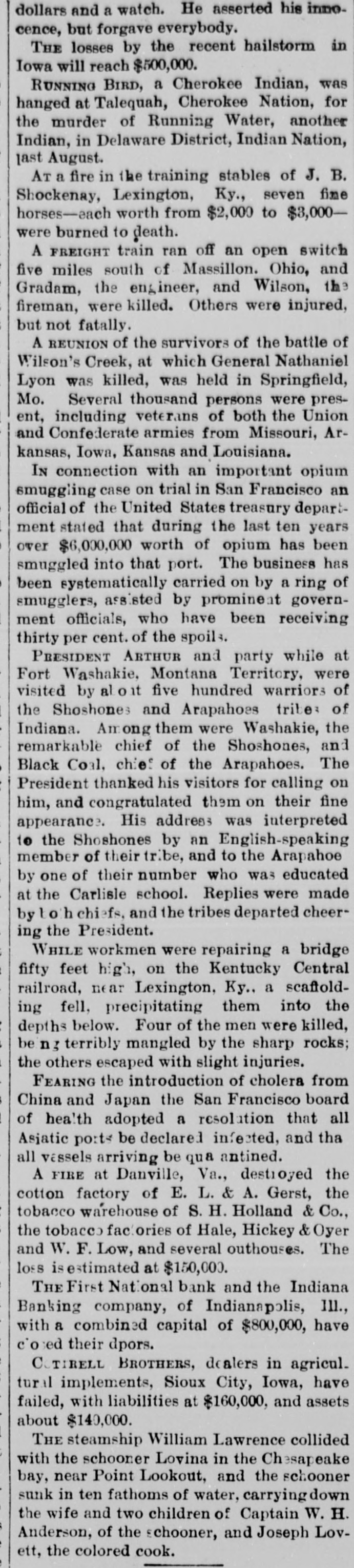
dollars and a watch. He asserted his innocence, but forgave everybody. THE losses by the recent hailstorm in Iowa will reach $500,000. RUNNING BIRD, a Cherokee Indian, was hanged at Talequah, Cherokee Nation, for the murder of Running Water, another Indian, in Delaware District, Indian Nation, 1ast August. AT a fire in the training stables of J. B. Shockenay, Lexington, Ky., seven fine horses-each worth from $2,000 to $3,000were burned to death. A FREIGHT train ran off an open switch five miles south of Massillon. Ohio, and Gradam, the engineer, and Wilson, the fireman, were killed. Others were injured, but not fatally. A REUNION of the survivors of the battle of Wilson's Creek, at which General Nathaniel Lyon was killed, was held in Springfield, Mo. Several thousand persons were present, including veterans of both the Union and Confederate armies from Missouri, Arkansas, Iowa, Kansas and Louisiana. IN connection with an important opium smuggling case on trial in San Francisco an official of the United States treasury department stated that during the last ten years over $6,000,000 worth of opium has been smuggled into that port. The business has been systematically carried on by a ring of smugglers, assisted by prominent government officials, who have been receiving thirty per cent. of the spoils. PRESIDENT ARTHUR and party while at Fort Washakie, Montana Territory, were visited by oit five hundred warriors of the Shoshones and Arapahoes tribes of Indiana. Among them were Washakie, the remarkable chief of the Shoshones, and Black Coal, chief of the Arapahoes. The President thanked his visitors for calling on him, and congratulated them on their fine appearance. His address was interpreted 10 the Shoshones by an English-speaking member of their tribe, and to the Arapahoe by one of their number who was educated at the Carlisle school. Replies were made by o h chiefs, and the tribes departed cheering the President. WHILE workmen were repairing a bridge fifty feet high, on the Kentucky Central railroad, near Lexington, Ky., a scaffolding fell, precipitating them into the depths below. Four of the men were killed, be ng terribly mangled by the sharp rocks; the others escaped with slight injuries. FEARING the introduction of cholera from China and Japan the San Francisco board of health adopted a resolution that all Asiatic ports be declared infected, and tha all vassels arriving be qua antined. A FIRE at Danville, Va., destroyed the cotton factory of E. L. & A. Gerst, the tobacco warehouse of S. H. Holland & Co., the tobacco ories of Hale, Hickey & Oyer and W. F. Low, and several outhouses. The loss is estimated at $150,000. THE First National bank and the Indiana Banking company, of Indianapolis, III., with a combined capital of $800,000, have c'osed their dpors. COTIRELL BROTHERS, dealers in agricul. tural implements, Sioux City, Iowa, have failed, with liabilities at $160,000, and assets about $140,000. THE steamship William Lawrence collided with the schooner Lovina in the Chesapeake bay, near Point Lookout, and the schooner sunk in ten fathoms of water, carryingdown the wife and two children of Captain W. H. Anderson, of the schooner, and Joseph Lovett, the colored cook.


Article from Millheim Journal, September 6, 1883

Click image to open full size in new tab

Article Text

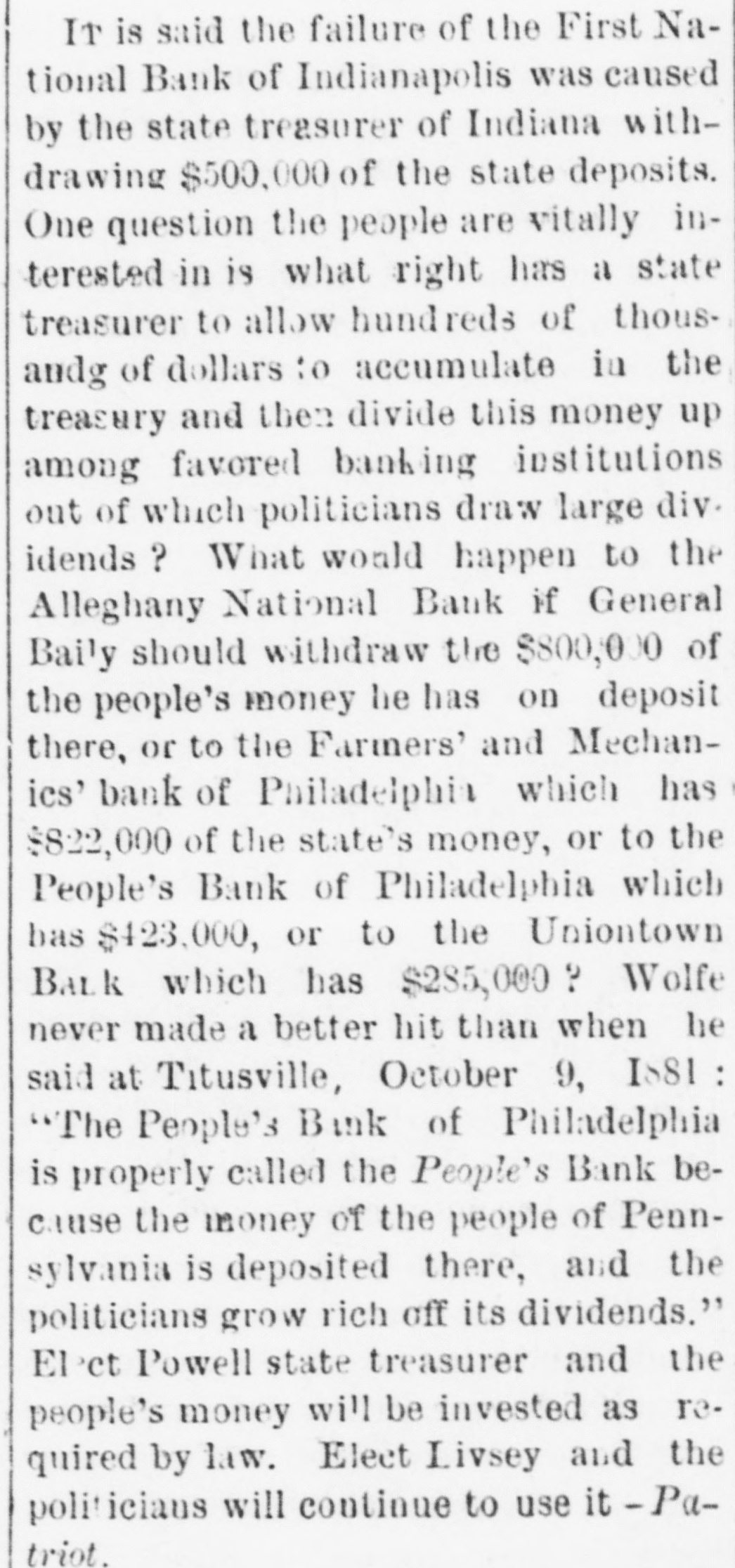
It is said the failure of the First National Bank of Indianapolis was caused by the state treasurer of Indiana withdrawing $500,000 of the state deposits. One question the people are vitally interested in is what right has a state treasurer to allow hundreds of thousands of dollars to accumulate in the treasury and then divide this money up among favored banking institutions out of which politicians draw large dividends? What would happen to the Alleghany National Bank if General Baily should withdraw the $800,000 of the people's money he has on deposit there, or to the Farmers' and Mechanics' bank of Philadelphia which has $822,000 of the state's money, or to the People's Bank of Philadelphia which has $423,000, or to the Uniontown Bank which has $285,000? Wolfe never made a better hit than when he said at Titusville, October 9, 1881: "The People's Bank of Philadelphia is properly called the People's Bank because the money of the people of Pennsylvania is deposited there, and the politicians grow rich off its dividends." Elect Powell state treasurer and the people's money will be invested as required by law. Elect Livsey and the politicians will continue to use it - Patriot.


Article from The Indianapolis Journal, June 2, 1884

Click image to open full size in new tab

Article Text

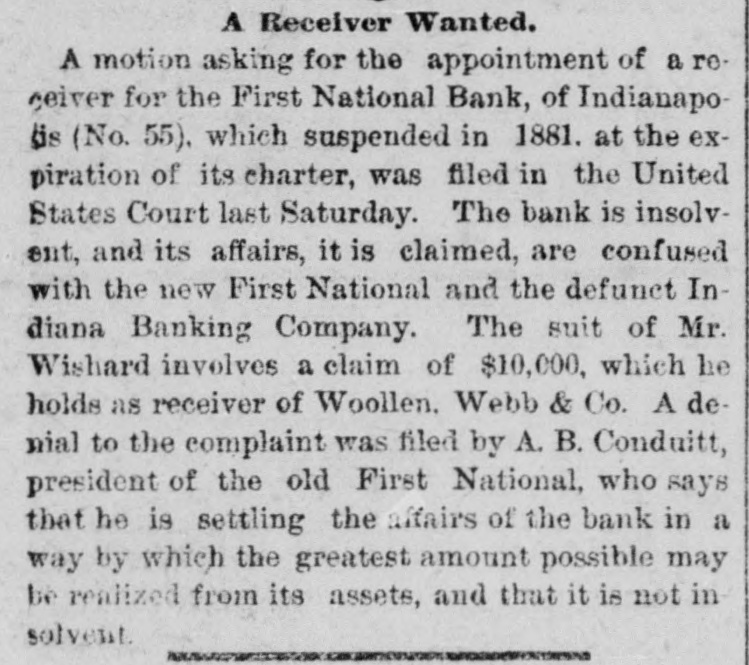
A Receiver Wanted. A motion asking for the appointment of a receiver for the First National Bank, of Indianapois (No. 55), which suspended in 1881. at the expiration of its charter, was filed in the United States Court last Saturday. The bank is insolvent, and its affairs, it is claimed, are confused with the new First National and the defunct Indiana Banking Company. The suit of Mr. Wishard involves a claim of $10,000, which he holds as receiver of Woollen. Webb & Co. A denial to the complaint was filed by A. B. Conduitt, president of the old First National, who says that he is settling the affairs of the bank in a way by which the greatest amount possible may be realized from its assets, and that it is not in solvent


Article from The Indianapolis Journal, May 14, 1885

Click image to open full size in new tab

Article Text

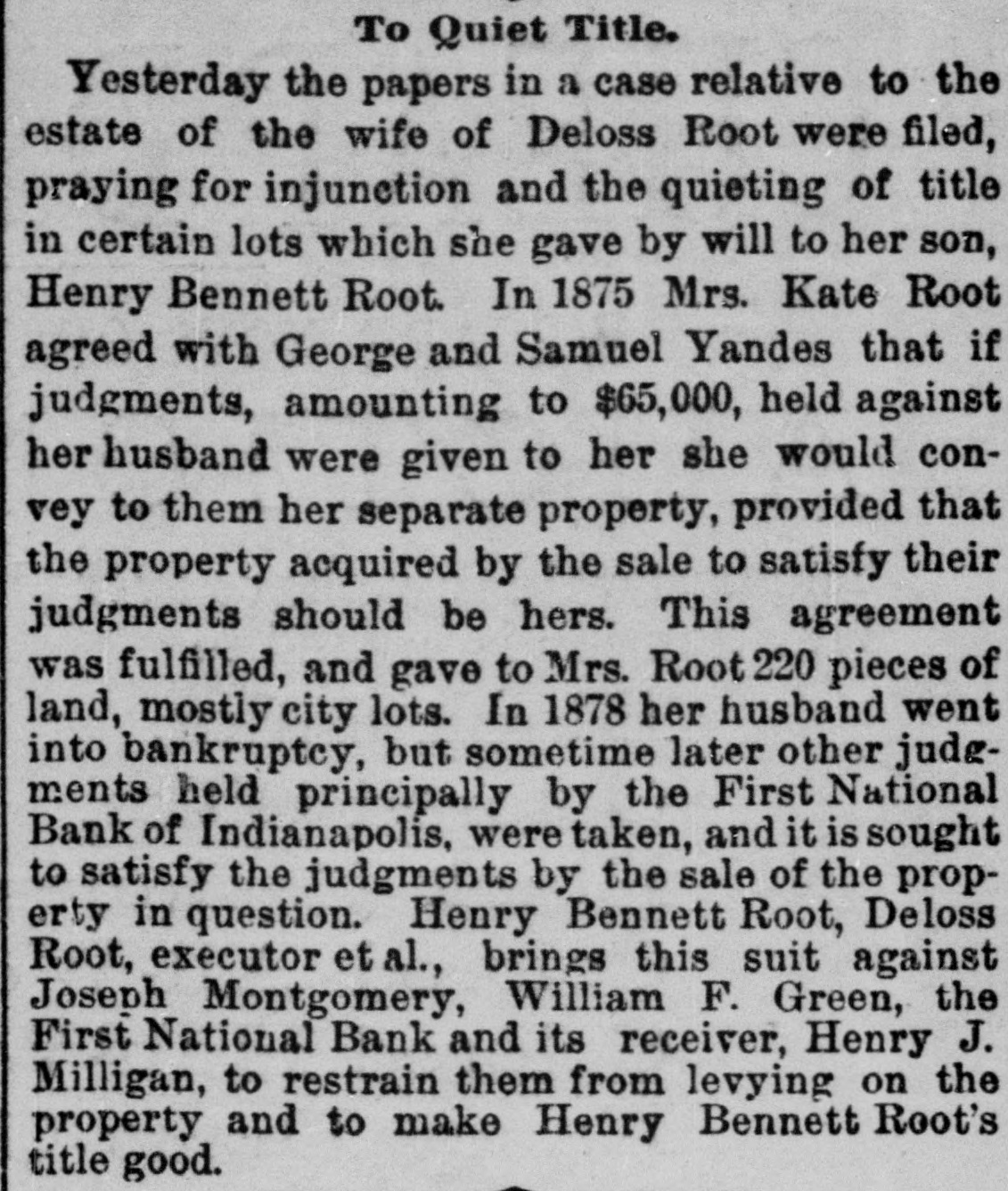
# To Quiet Title. Yesterday the papers in a case relative to the estate of the wife of Deloss Root were filed, praying for injunction and the quieting of title in certain lots which she gave by will to her son, Henry Bennett Root. In 1875 Mrs. Kate Root agreed with George and Samuel Yandes that if judgments, amounting to $65,000, held against her husband were given to her she would convey to them her separate property, provided that the property acquired by the sale to satisfy their judgments should be hers. This agreement was fulfilled, and gave to Mrs. Root 220 pieces of land, mostly city lots. In 1878 her husband went into bankruptcy, but sometime later other judgments held principally by the First National Bank of Indianapolis, were taken, and it is sought to satisfy the judgments by the sale of the property in question. Henry Bennett Root, Deloss Root, executor et al., brings this suit against Joseph Montgomery, William F. Green, the First National Bank and its receiver, Henry J. Milligan, to restrain them from levying on the property and to make Henry Bennett Root's title good.


Article from The Indianapolis Journal, September 2, 1885

Click image to open full size in new tab

Article Text

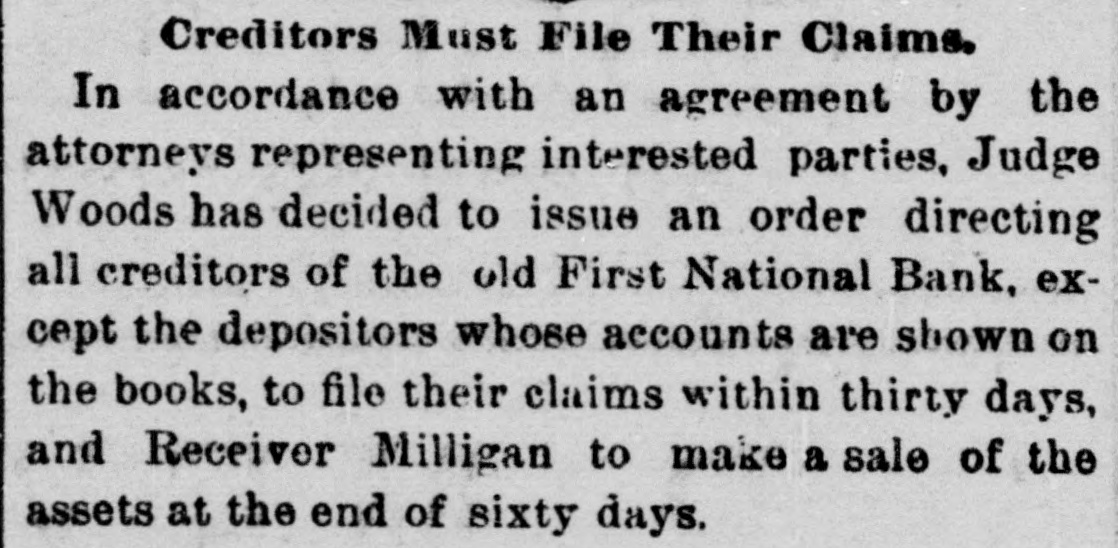
# Creditors Must File Their Claims. In accordance with an agreement by the attorneys representing interested parties, Judge Woods has decided to issue an order directing all creditors of the old First National Bank, except the depositors whose accounts are shown on the books, to file their claims within thirty days, and Receiver Milligan to make a sale of the assets at the end of sixty days.


Article from The Indianapolis Journal, September 9, 1885

Click image to open full size in new tab

Article Text

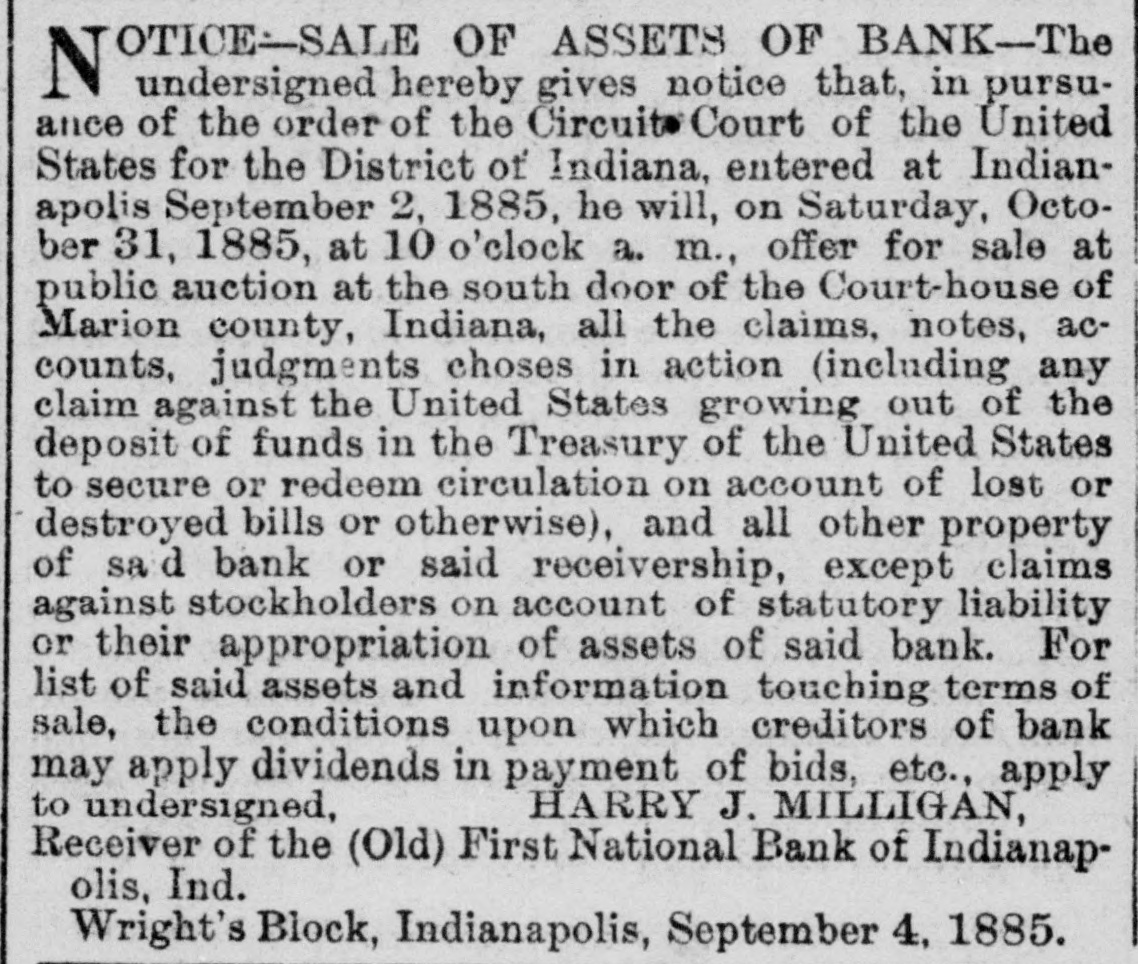
OTICE-SALE OF ASSETS OF BANK-The N undersigned hereby gives notice that, in pursuance of the order of the Circuit Court of the United States for the District of Indiana, entered at Indianapolis September 2, 1885, he will, on Saturday, October 31, 1885, at 10 o'clock a. m., offer for sale at public auction at the south door of the Court-house of Marion county, Indiana, all the claims, notes, accounts, judgments choses in action (including any claim against the United States growing out of the deposit of funds in the Treasury of the United States to secure or redeem circulation on account of lost or destroyed bills or otherwise), and all other property of said bank or said receivership, except claims against stockholders on account of statutory liability or their appropriation of assets of said bank. For list of said assets and information touching terms of sale, the conditions upon which creditors of bank may apply dividends in payment of bids, etc., apply to undersigned, HARRY J. MILLIGAN, Receiver of the (Old) First National Bank of Indianapolis, Ind. Wright's Block, Indianapolis, September 4, 1885.


Article from The Indianapolis Journal, September 10, 1885

Click image to open full size in new tab

Article Text

OTICE-SALE OF ASSETS OF BANK-The N undersigned hereby gives notice that, in pursuance of the order of the Circuit Court of the United States for the District of Indiana, entered at Indianapolis September 2, 1885, he will, on Saturday, Octo. ber 31, 1885, at 10 o'clock a. m., offer for sale at public auction at the south door of the Court-house of Marion county, Indiana, all the claims. notes, accounts, judgments choses in action (including any claim against the United States growing out of the deposit of funds in the Treasury of the United States to secure or redeem circulation on account of lost or destroyed bills or otherwise), and all other property of sa a bank or said receivership, except claims against stockholders on account of statutory liability or their appropriation of assets of said bank. For list of said assets and information touching terms of sale, the conditions upon which creditors of bank may apply dividends in payment of bids, etc., apply to undersigned, HARRY J. MILLIGAN, Receiver of the (Old) First National Bank of Indianapolis, Ind. Wright's Block, Indianapolis, September 4. 1885.