Contemporaneous articles identify it as a state institution and link the suspension to inability to procure cash during the 1907 panic.
Events (3)
1.October 23, 1907Suspension
Cause
Correspondent
Cause Details
Unable to obtain necessary cash/clearings (New Amsterdam National Bank refused to clear), forced suspension amid wider panic.
Newspaper Excerpt
This bank is compelled to suspend payment owing to inability to procure sufficient cash to meet current payments.
Source
newspapers
+1 day
2.October 24, 1907Run
Cause
Local Banks
Cause Details
Panic and runs spreading among local small banks during the 1907 financial crisis led depositors to withdraw from the Twelfth Ward Bank.
Measures
Officials requested depositors sign agreements to leave large deposits on deposit for fixed terms.
Newspaper Excerpt
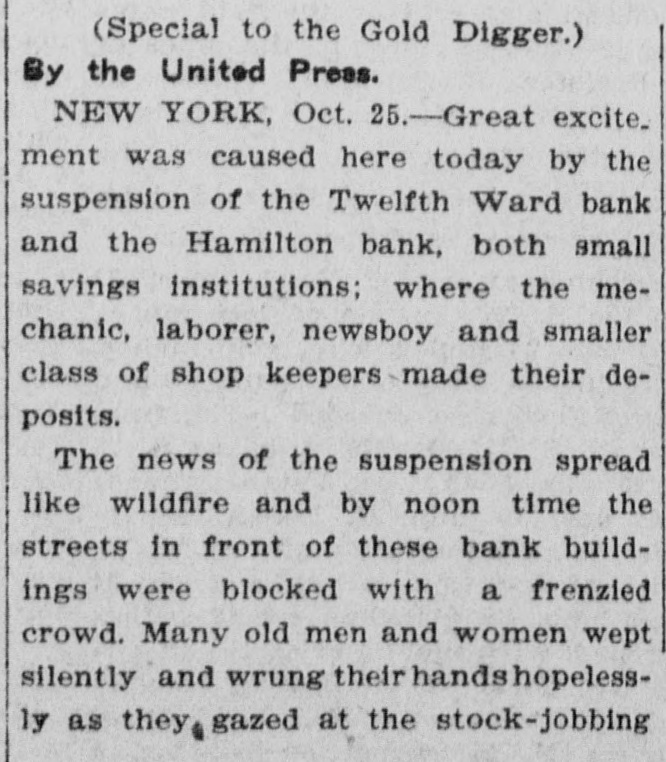
Great excitement was caused here today by the suspension of the Twelfth Ward bank...the streets in front of these bank buildings were blocked with a frenzied crowd.
Source
newspapers
+27 days
3.November 20, 1907Reopening
Newspaper Excerpt
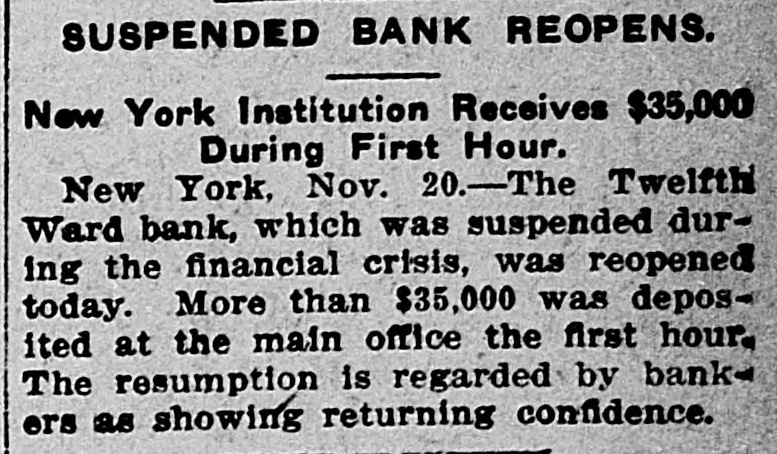
The Twelfth Ward bank, which was suspended during the financial crisis, was reopened today. More than $35,000 was deposited at the main office the first hour.
Source
newspapers
Newspaper Articles (21)
1.October 24, 1907The Daily AlaskanSkagway, AK
Click image to open full size in new tab
Article Text
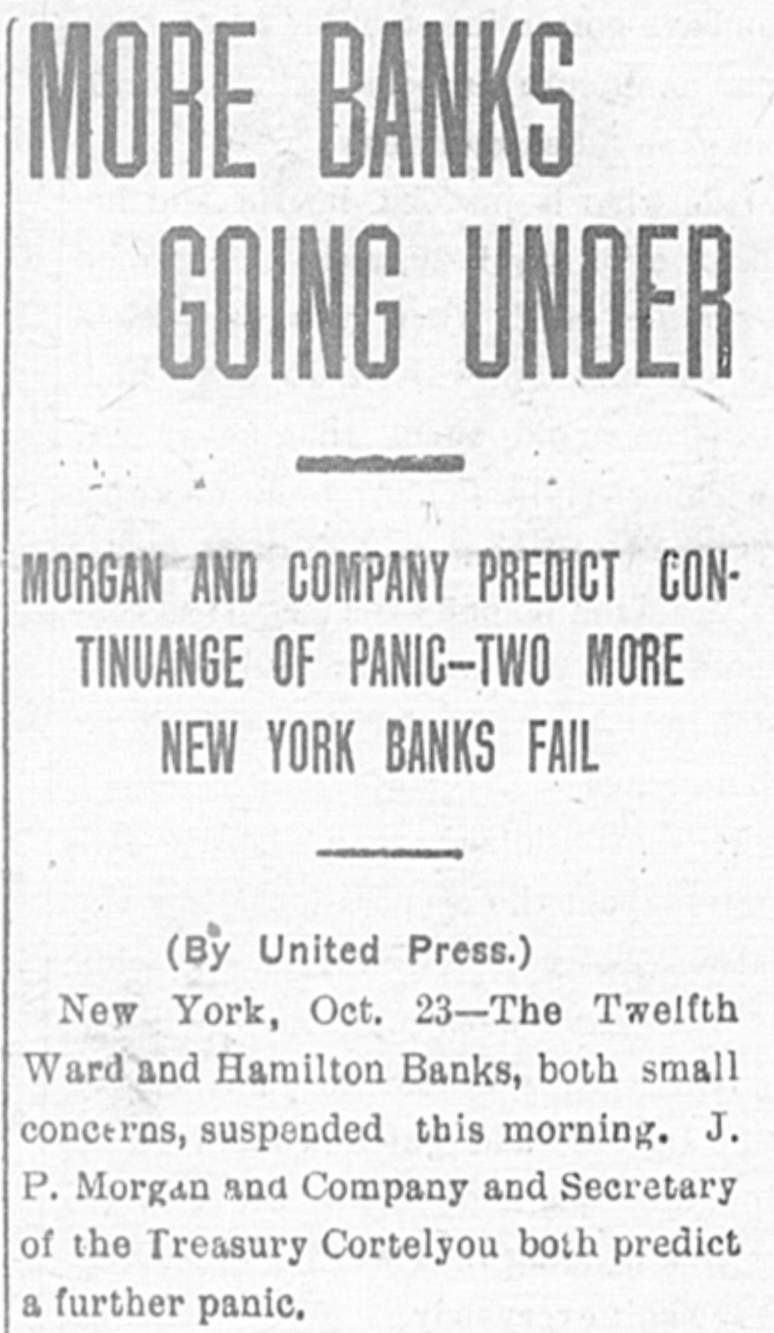
MORE BANKS GOING UNDER MORGAN AND COMPANY PREDICT CONTINUANGE OF PANIC-TWO MORE NEW YORK BANKS FAIL (By United Press.) New York, Oct. 23-The Twelfth Ward and Hamilton Banks, both small concerns, suspended this morning. J. P. Morgan and Company and Secretary of the Treasury Cortelyou both predict a further panic.
2.October 24, 1907Evening StarWashington, DC
Click image to open full size in new tab
Article Text
Takes Thirty Days' Grace
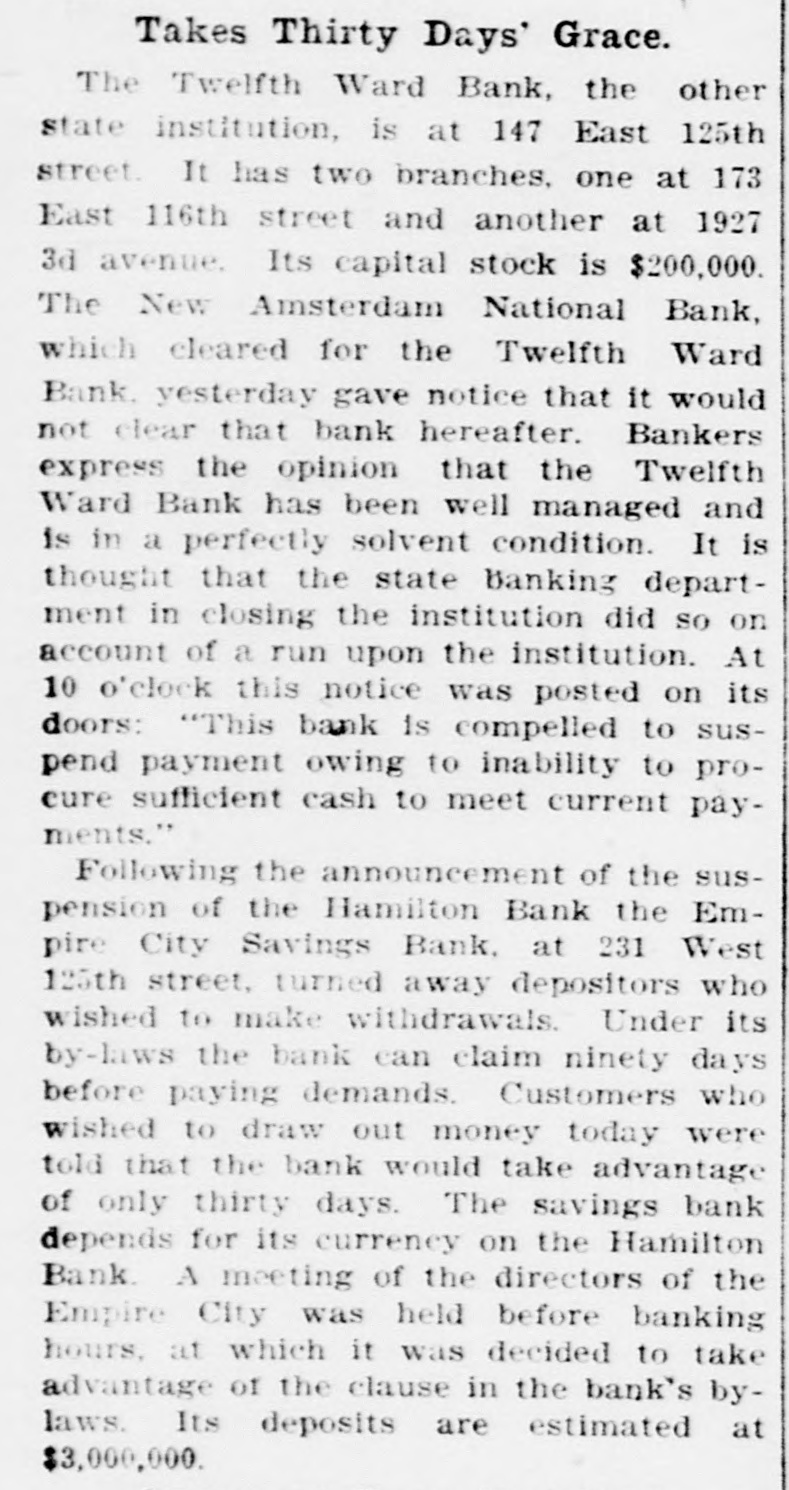
The Twelfth Ward Bank, the other state institution, is at 147 East 125th street It has two branches, one at 173 East 116th street and another at 1927 3d avenue, Its capital stock is $200,000. The New Amsterdam National Bank, which cleared for the Twelfth Ward Bank yesterday gave notice that it would not clear that bank hereafter. Bankers express the opinion that the Twelfth Ward Bank has been well managed and is in a perfectly solvent condition. It is thought that the state Banking department in closing the institution did so on account of a run upon the institution. At 10 o'clock this notice was posted on its doors: "This bank is compelled to suspend payment owing to inability to procure sufficient cash to meet current payments." Following the announcement of the suspension of the Hamilton Bank the Empire City Savings Bank. at 231 West 125th street, turned away depositors who wished to make withdrawals Under its by-laws the bank can claim ninety days before paying demands. Customers who wished to draw out money today were told that the bank would take advantage of only thirty days. The savings bank depends for its currency on the Hamilton Bank A meeting of the directors of the Empire City was held before banking hours, at which it was decided to take advantage of the clause in the bank's bylaws. Its deposits are estimated at $3,000,000.
3.October 24, 1907The Richmond Palladium and Sun-TelegramRichmond, IN
Click image to open full size in new tab
Article Text
OTHER BANKS SUSPEND
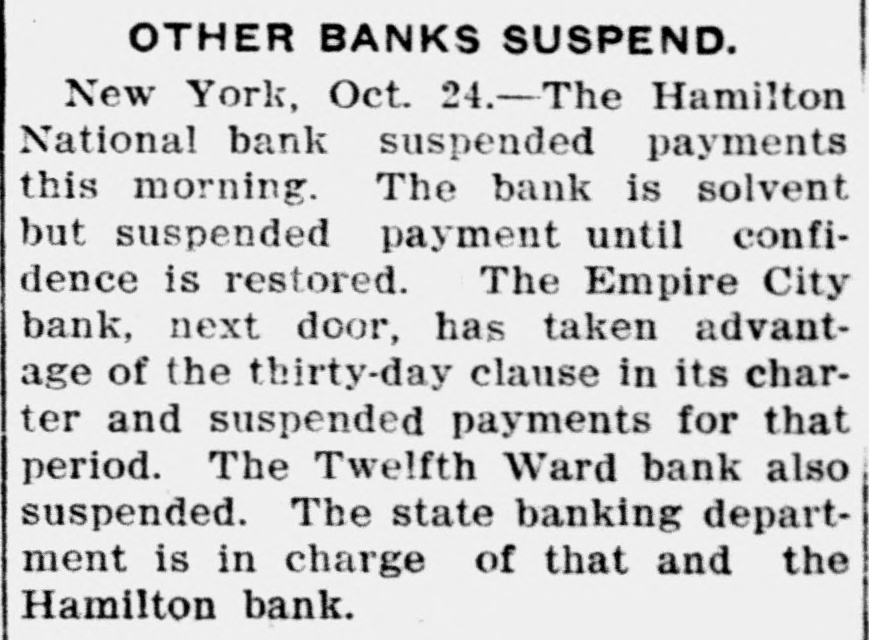
New York, Oct. 24.-The Hamilton National bank suspended payments this morning. The bank is solvent but suspended payment until confidence is restored. The Empire City bank, next door, has taken advantage of the thirty-day clause in its charter and suspended payments for that period. The Twelfth Ward bank also suspended. The state banking department is in charge of that and the Hamilton bank.
4.October 24, 1907The Chickasha Daily ExpressChickasha, OK
Click image to open full size in new tab
Article Text
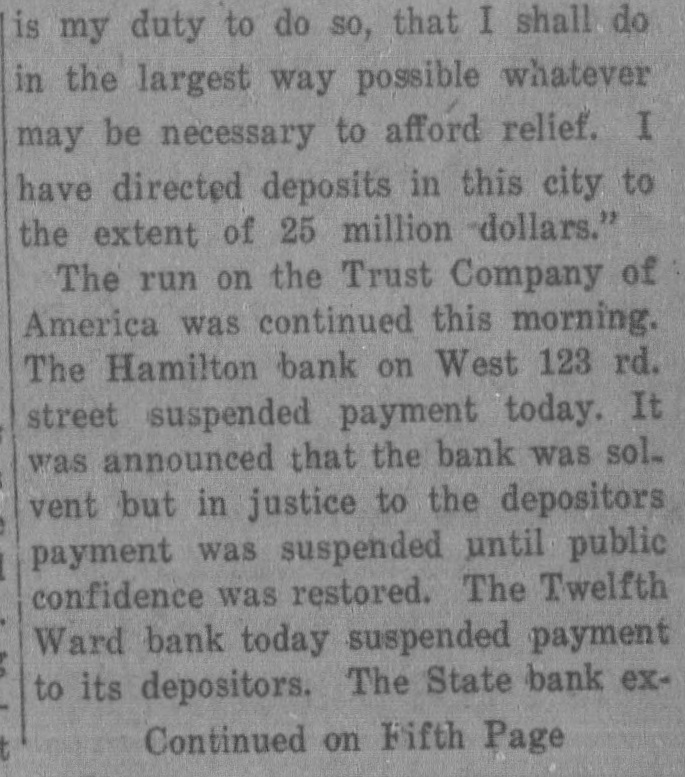
is my duty to do so, that I shall do in the largest way possible whatever may be necessary to afford relief. I have directed deposits in this city to the extent of 25 million dollars." The run on the Trust Company of America was continued this morning. The Hamilton bank on West 123 rd. street suspended payment today. It was announced that the bank was sol. vent but in justice to the depositors payment was suspended until public confidence was restored. The Twelfth Ward bank today suspended payment to its depositors. The State bank exContinued on Fifth Page
5.October 25, 1907The Nome Daily Gold DiggerNome, AK
Click image to open full size in new tab
Article Text
(Special to the Gold Digger
) By the United Press. NEW YORK, Oct. 25.-Great excite. ment was caused here today by the suspension of the Twelfth Ward bank and the Hamilton bank, both small savings institutions; where the mechanic, laborer, newsboy and smaller class of shop keepers - made their deposits. The news of the suspension spread like wildfire and by noon time the streets in front of these bank buildings were blocked with a frenzied crowd. Many old men and women wept silently and wrung theirhandshopelessly as they gazed at the stock-jobbing
6.October 26, 1907Seward Weekly GatewaySeward, AK
Click image to open full size in new tab
Article Text
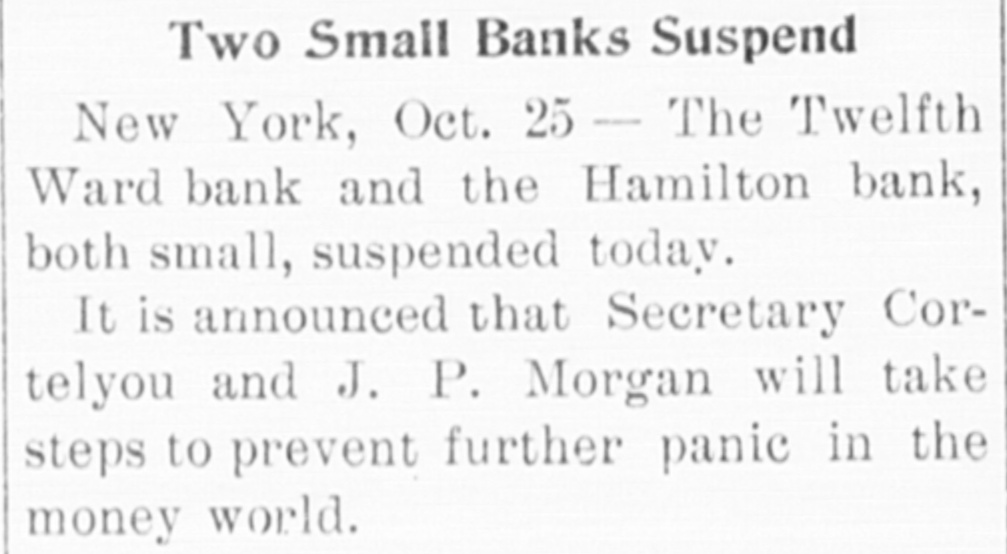
Two Small Banks Suspend New York, Oct. 25 --- The Twelfth Ward bank and the Hamilton bank, both small, suspended today. It is announced that Secretary Cortelyou and J. P. Morgan will take steps to prevent further panic in the money world.
7.October 31, 1907The Kemper HeraldScooba, MS
Click image to open full size in new tab
Article Text
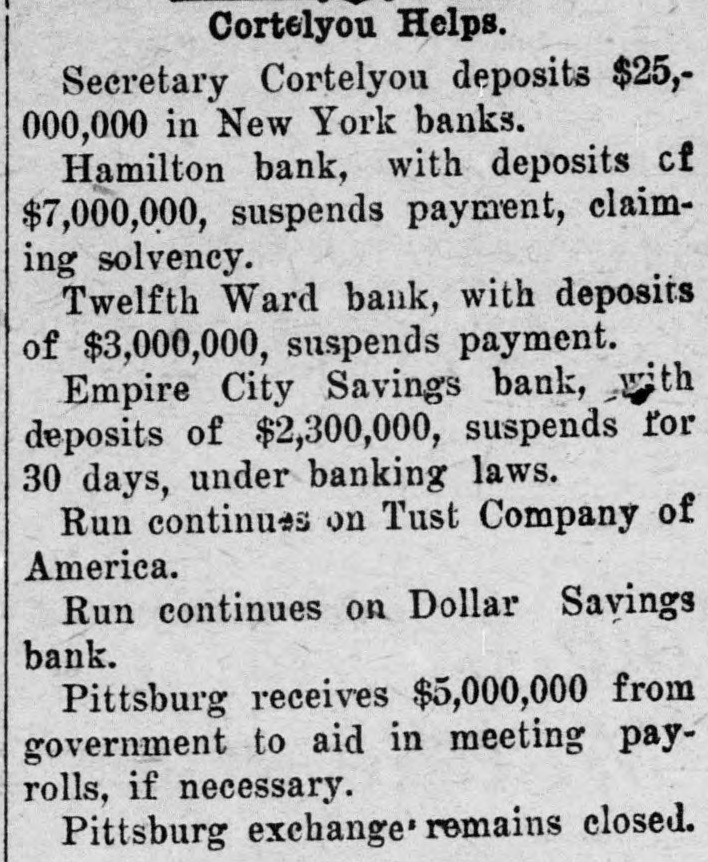
Cortelyou Helps
Secretary Cortelyou deposits $25,000,000 in New York banks. Hamilton bank, with deposits cf $7,000,000, suspends payment, claiming solvency. Twelfth Ward bank, with deposits of $3,000,000, suspends payment. Empire City Savings bank, with deposits of $2,300,000, suspends for 30 days, under banking laws. Run continues on Tust Company of America. Run continues on Dollar Savings bank. Pittsburg receives $5,000,000 from government to aid in meeting payrolls, if necessary. Pittsburg exchange*remains closed.
8.November 1, 1907Greene County HeraldLeakesville, MS
Click image to open full size in new tab
Article Text
Cortelyou Helps
Secretary Cortelyou deposits $25,Q00,000 in New York banks. Hamilton bank, with deposits of $7,000,000, suspends payment, claiming solvency. Twelfth Ward bank, with deposits of $3,000,000, suspends payment. Empire City Savings bank, with deposits of $2,300,000, suspends for 30 days, under banking laws. Run continues on Tust Company of America. Run continues on Dollar Savings bank. Pittsburg receives $5,000,000 from government to aid in meeting payrolls, if necessary. Pittsburg exchange- remains closed.
9.November 4, 1907Santa Fe New MexicanSanta Fe., Santa Fe, NM
Click image to open full size in new tab
Article Text
TALK OF EXTRA SESSION CONGRESS To Provide Needed Currency Re forms IS DIVIDED OPINION Leading Financiers Hold Conference With President Results Unknown. New York, Nov. 4.--Leading financiers of New York today hold opposing views regarding the suggestion that President Roosevelt should call an extra session of Congress at once in order to provide for needed currenreform. Half a dozen members of prominent in 'the oppose it. Representatives, cy Congress, The House finan- of who oppose a special session, favor currency ciers generally session reform, is time but hold that the regular Leslie M. Shaw, former sec of the United States enough. retary immediate treasury is one of those who favor those prominently opsuch a movement are H. action. posing Among and E. Henry Harriman, James Stillman W. Clews. Trust Companies Still Doing Business. The Trust Company of America and the Lincoln Trust Company on which heavy runs were made last week, for business at the usual hour Only a small opened this morning. when the number comof people were in line panies opened for business. The opening of both institutions brought about the a distinct feeling of relief and was and of conferences Saturday at the home of result yesterday J. the P. open- Mor At the Stock Exchange by gan. ing showed early declines, followed off a rally, and then a general falling of prices. Situation Well Under Control. The general financial situation was today but the banks and felt trust still tense companies confident control. that conditions were well under of the Bank of England's rate to 6 per cent, was discount The raising not of unexpected. The engagements in London now total over of which about 000,000. gold $10,000,000 $7,200,000 $30.- will arrive Wednesday and Friday. Crops are short in European bal the first half year showed a trade in favor of the thus creating a United ance of States, $189,000,000 difficult situa- for tion which would make it to withhold its gold even by discount rates. It was high Europe announced been al today that arrangements had made by which the Twelfth closed its ready Ward bank.which doors again sev- for eral days ago, will re-open 11th business on Monday, November Financers Confer With Roosevelt. Washington, Nov. 4.-E. H. Garry, chairman of the United States steel corporation and Henry Phipps, were in with President Roosevelt an hour today, more consultation than the by confer- Secreence being participated in tary of State Elihu Root While no de tails of the meeting were obtainable, to it is understood the meeting related the financial situation. Later, the statement was given out at the White House, that the confer ence dealt solely with the financial sit uation. Aside from that, nothing further could be learned except that the President contemplates making no statement at the present time. Labor Unions Stand By Chicago Banks. Chicago, Nov. 4.-By almost unanimthe Chicago La voted its and ous bor yesterday vote Federation confidence which of that of the Trades' Unions, it represents in the stability of the Chicago banks and their ability to cope with the present financial difficulty same vote the rebecome a party to to fused By the to Federation efforts two embarrass the local banks. Only votes were cast in opposition. Bank of England Advances Discount Rate to Six Per Cent. London, Nov. 4.-The persistent de from America for gold, despite increased of England and mands the of the recently Bank discount in face trans- rate of continued raise in the cable caused the Bank to raise its rate the this fer rate, morning announcement of England from 5 1/2 to 6 per cent. The of the rise occasioned somewhat of a flurry locally. It is considered, howev the in local financial circles to be natural er outcome of the unfavorable bank statement. Since last the United States New Thursday York has drawn sub from the Bank of sums, already stantial daily England aggregating and Egypt has also recomits gold. here now menced cial $57,000,000 circles withdrawing incline suffice to Finan- and be lieve that six per cent will
10.November 4, 1907Evening StarWashington, DC
Click image to open full size in new tab
Article Text
FINANCIERS FEEL CONFIDENT
New York Situation Tense, But Conditions Well Under Control. NEW YORK, November 4.-At the stock exchange the opening showed early declines, followed by a rally, and then a running off of prices. The general financial situation was still tense this morning, but the downtown banks and trust companies felt confident that conditions were well under control. The raising of the Bank of England discount rate to 6 per cent at a special meeting of the board of governors today was not unexpected by those familiar with conditions in Europe, although it was hoped in some quarters that this action of the governors would not be taken until the regular meeting Thursday. The fact that $2,000,000 in gold was purchased in the open market in London during the morning for export to America probably hastened the action of the bank. This brings the total gold engagement up above $30,000,000, of which about $7,200,000 will arrive Wednesday and $10,000,000 Friday. This will go at once into bank reserve, where the engagements have been made by banks, and will be deposited in the banks where the engagements have been made by exchange houses and gold brokers. While there is considerable pressure for capital in Europe it is felt that this country has the advantage in the state of the trade balance. Crops are short in Europe and it is absolutely essential to obtain American wheat and cotton at any reasonable price. These prices are much higher than in 1893, when cotton was at 8 cents against about 11 cents at the present time and wheat was 70 cents against the present price of $1.07, while American steel rails are selling at the record price of $30 per ton. These forces, with the fact that the first half of the year showed an excess of 2 points of $189,000,000, as compared with a balance the other way in 1893 of $68,000.000 create a situation where it will be difficult for the European banks to hold their gold, even by high discount rates. Reports from Buffalo and other points indicate that the blockade in the movement of the crops is being broken and that many hundreds of carloads soon will be on shipboard in New York, against which bills can be drawn on European money markets. It was announced today that arrangements have been made by which it may be possible for the Twelfth Ward Bank, which closed its doors several days ago, to reopen next Monday. Many depositors went to the bank today, at the request of the officials, who asked them to sign an agreement to the effect that on all big deposits in the bank that 75 or 100 per cent of the amount would be left on deposit for a period of four months.
11.November 7, 1907Forest City PressForest City, SD
Click image to open full size in new tab
Article Text
“Nearly Over.”
The engagement for gold made yesterday, the further large imports which it is believed will be made in the next few weeks, the movement of the crops of America to European markets, and the revival of the demand for copper abroad, will give the United States large credits with foreign bankers and these can be availed in bringing gold, it is confidently believed, to the fullest necessary.
It is announced today that several banks have about perfected their plans to reopen for business.
President Montgomery, of the Hamilton bank, the Harlem institution, which closed last week, said today: "This bank will resume business in a few days, not later than Monday next, at any event.
"I understand also that the Twelfth Ward bank will resume in a few days." The runs on the Trust Company of America and the Lincoln Trust company continued today, but in diminished volume. Announcement of the increase in the rate of discount by the Imperial bank of Germany from 5½ to 6½ per cent. was somewhat unfavorable in the effect on the London stock market. Notwithstanding this, however, American securities in London held firm.
12.November 8, 1907New-York TribuneNew York, NY
Click image to open full size in new tab
Article Text
Clearing House certificates will prove adequate in preventing a severe money strain here and that there will be no need for bank scrip." TWELFTH WARD BANK O. K. Mark S. Smith, State Bank Examiner, in his report to the State Superintendent of Banks on the condition of the Twelfth Ward Bank, says, in part: I find the affairs of the Twelfth Ward Bank in excelient condition. The suspension was caused by the bank's inability to procure the necessary cash to meet the demands of its customers, and not because it was insolvent. The general character of the loans is very satisfactory. I find no loans in excess, and most of the larger ones are amply secured. The real estate of the bank is carried at a very low estimate as an asset. The difference between the book value and the actual value would, I believe, more than cover any depreciation in the surplus and undivided profits of the bank, as indicated by its Books. The general character of the management of the bank and the efficiency of its officers and employes are of a high order. Depositors representing fully a million and a quarter of deposits have signified in writing their agreement to let this amount remain on deposit for a term of four months, if the bank will resume business. I believe the bank to be entirely solvent and entitled to resume business when it has provided itself with the requisite cash to meet the immmediate demands of its depositors and made suitable connections for making its clearings.
13.November 19, 1907Santa Fe New MexicanSanta Fe., Santa Fe, NM
Click image to open full size in new tab
Article Text
BANKS ARE STILL IMPORTING GOLD Engagemets toDate Exceed $75,000,000 REFINING PLANTS TO RESCUE These are Working Day and Night in Effort to Relieve Currency Shortage New York, Nov. 19.-The engagements of gold abroad for importation to relieve the financial stringency exceed a total of seventy-five million dollars. Heidlebach, Ickehelmer and Company and the Guaranty Trust Company today concluded negotations for $1,500,000, bringing the total to date to $75,900,000. Guggenheim Lends Assistance. Daniel Guggenheim, president of the American Smelting and Refining Company, in a statement issued here today, said that this company is cooperating with the government to meet the unusual demand for currency. He said the plants were now being operated day and night to expedite the refining of gold and silver. The gold product is daily deposited with the government, no effort being made to obtain any premium on the output. The value of gold and silver produced by this company is running in excess of a hundred million dollars a year. Another Bank to Re-Open. The twelfth ward bank, one of the institutions which suspended payment during the early days of the financial crisis, will re-open for busic ness tomorrow. The premium on currency which has been maintained at about 3 per cent since the hoarding of money began a few weeks ago, has begun to diminish. Large loans of currency were made today at rates ranging as low as 1 1-2 per cent. Bankers report that the premium in a number of interior cities is either much reduced or has disappeared. The result was attributed chiefly to the arrangements for issuing treasury certificates and canal bonds. Special Session of California Legislalature Convenes Sacramento, Calif, Nov. 19.-The special session of the California legislature called by Governor Gillett, conThe vened today. governor's is mes- consage says that the session vened to enact legislation, believed to be imperative because of the financial stringency brought about by conditions in the east, although the country is prosperous and legitimate business was never better. The present state of affairs is attributed to extravagant living, wild speculation and frenzied finance of the stock and bond manipulators of Wall street. The executive thinks the banking laws need to be amended so as to afford better protection to the depositors, the trust companies and corporations doing an interstate business should be placed under federal laws, and a committee should be appointed to investigate the methods of the banks doing business in this state.
14.November 19, 1907Lewiston Evening TellerLewiston, ID
Click image to open full size in new tab
Article Text
SUSPENDED BANK OPENSTOMORROW NEW Nov
YORK, 19.-The Twelfth Ward bank, which suspended payment in the early days of the financial crisis, will reopen tomorrow. The premium on currency which began a few weeks ago is gradually diminishing. Loans today were made as low as 1 1/2 per cent.
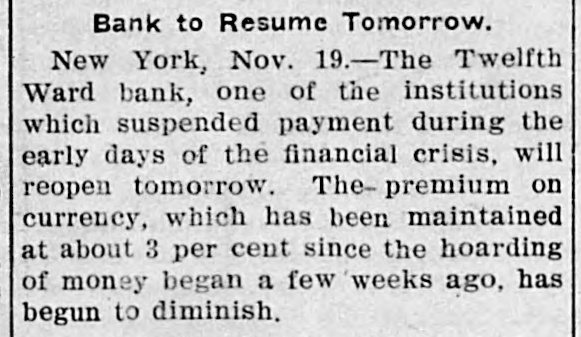
New York, Nov. 19.-The Twelfth Ward bank, one of the institutions which suspended payment during the early days of the financial crisis, will reopen tomorrow. The-premium on currency, which has been maintained at about 3 per cent since the hoarding of money began a few weeks ago, has begun to diminish.
16.November 20, 1907The Abbeville Press and BannerAbbeville, SC
Click image to open full size in new tab
Article Text
FINANCIAL SITUATION IN SYNOPSIS.
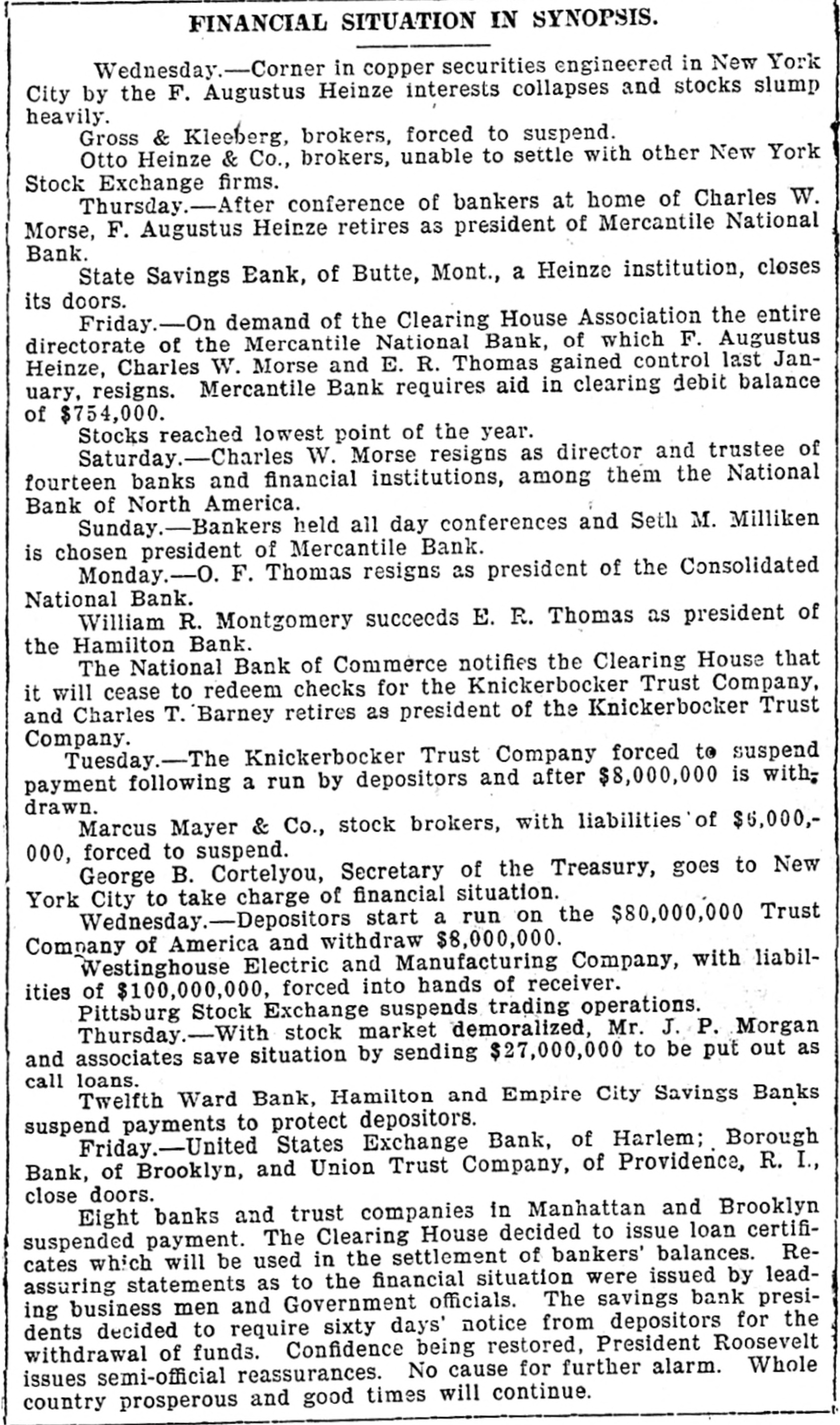
Wednesday.- Corner in copper securities engineered in New York City by the F. Augustus Heinze interests collapses and stocks slump heavily. Gross & Kleeberg, brokers, forced to suspend. Otto Heinze & Co., brokers, unable to settle with other New York Stock Exchange firms. Thursday.- After conference of bankers at home of Charles W. Morse, F. Augustus Heinze retires as president of Mercantile National Bank. State Savings Bank, of Butte, Mont., a Heinze institution, closes its doors. Friday.- On demand of the Clearing House Association the entire directorate of the Mercantile National Bank, of which F. Augustus Heinze, Charles W. Morse and E. R. Thomas gained control last January, resigns. Mercantile Bank requires aid in clearing debit balance of $754,000. Stocks reached lowest point of the year. Saturday.- Charles W. Morse resigns as director and trustee of fourteen banks and financial institutions, among them the National Bank of North America. Sunday.- Bankers held all day conferences and Seth M. Milliken is chosen president of Mercantile Bank. Monday.- O. F. Thomas resigns as president of the Consolidated National Bank. William R. Montgomery succeeds E. R. Thomas as president of the Hamilton Bank. The National Bank of Commerce notifies the Clearing House that it will cease to redeem checks for the Knickerbocker Trust Company, and Charles T. Barney retires as president of the Knickerbocker Trust Company. Tuesday.- The Knickerbocker Trust Company forced to suspend payment following a run by depositors and after $8,000,000 is withdrawn. Marcus Mayer & Co., stock brokers, with liabilities of $5,000,000, forced to suspend. George B. Cortelyou, Secretary of the Treasury, goes to New York City to take charge of financial situation. Wednesday.- Depositors start a run on the $80,000,000 Trust Company of America and withdraw $8,000,000. Westinghouse Electric and Manufacturing Company, with liabilities of $100,000,000, forced into hands of receiver. Pittsburg Stock Exchange suspends trading operations. Thursday.- With stock market demoralized, Mr. J. P. Morgan and associates save situation by sending $27,000,000 to be put out as call loans. Twelfth Ward Bank, Hamilton and Empire City Savings Banks suspend payments to protect depositors. Friday.- United States Exchange Bank, of Harlem; Borough Bank, of Brooklyn, and Union Trust Company, of Providence, R. I., close doors. Eight banks and trust companies in Manhattan and Brooklyn suspended payment. The Clearing House decided to issue loan certificates which will be used in the settlement of bankers' balances. Reassuring statements as to the financial situation were issued by leading business men and Government officials. The savings bank presidents decided to require sixty days' notice from depositors for the withdrawal of funds. Confidence being restored, President Roosevelt issues semi-official reassurances. No cause for further alarm. Whole country prosperous and good times will continue.
17.November 20, 1907Evening Times-RepublicanMarshalltown, IA
Click image to open full size in new tab
Article Text
SUSPENDED BANK REOPENS
New York Institution Receives $35,000 During First Hour. New York, Nov. 20.-The Twelfth Ward bank, which was suspended during the financial crisis, was reopened today. More than $35,000 was deposited at the main office the first hour. The resumption is regarded by bankers as showing returning confidence.
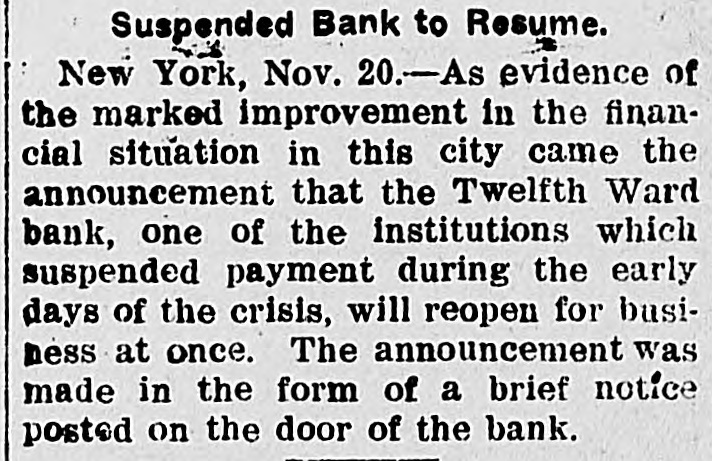
New York, Nov. 20.-As evidence of the marked improvement in the financial situation in this city came the announcement that the Twelfth Ward bank, one of the institutions which suspended payment during the early days of the crisis, will reopen for business at once. The announcement was made in the form of a brief notice posted on the door of the bank.
19.November 22, 1907The Ely MinerEly, MN
Click image to open full size in new tab
Article Text
Bank Reopens
New York, Nov. 20.-As evidence of the marked improvement in the financial situation in this city comes the announcement that the Twelfth Ward bank one of the old institutions which suspended payment during the early days of the crisis, will re-open for business to-day.
20.November 29, 1907Greene County HeraldLeakesville, MS
Click image to open full size in new tab
Article Text
As evidence of the marked improvement 'in the financial situation in New York City, came the announcement that the Twelfth Ward bank, one of the institutions which suspended payment during the early days of the crisis, will reopen for business.
21.February 6, 1908New-York TribuneNew York, NY
Click image to open full size in new tab
Article Text
VAN NORDEN IN TWELFTH WARD BANK
At a meeting of the directors of the Twelfth Ward Bank yesterday Warner M. Van Norden, president of the Van Norden Trust Company, was elected a member of the board. Mr. Van Norden advanced the bank $600,000 with which to pay depositors after the October crisis, and it was due to this that its early resumption was made possible. Mr. Van Norden said yesterday that the bank had repaid him all the money he had advanced, and that, in addition. it had a substantial reserve above legal requirements. It was the first institution to reopen after the panic.
Bank runs are almost always and everywhere a deterioration of bank fundamentals.
But not for you.
You are the measure-zero exception: great fundamentals, solid bank, and yet the Diamond Dybvig fairy spread its rumor. Depositors woke up. Your collateral was not prepositioned. The Clearinghouse had it for you.
Do not pass Go. Do not collect $200. Go directly to jail… or worse.