Enterprise National Bank (Pittsburg, PA)

Episode Information

Episode UID
499101270
Episode Type
Suspension β†’ Closure
Bank Type
national
Bank ID
49910 national
Charter Number
4991
Start Date
October 19, 1905
Location
Pittsburg, Pennsylvania (40.441, -79.996)

Metadata

Model
gpt-5-mini (chosen from majority vote of a three-model LLM ensemble)
Short Digest
e50ee012e9c0b891

Response Measures

None

Receivership Details

Depositor recovery rate
35.6%
Date receivership started
1905-10-18
Date receivership terminated
1916-10-31
OCC cause of failure
Fraud
Share of assets assessed as good
39.8%
Share of assets assessed as doubtful
54.1%
Share of assets assessed as worthless
6.1%

Description

Receivership and criminal prosecutions followed the October 1905 closing; permanent closure evident.

Events (6)

1. April 4, 1895 Chartered
Source
historical_nic
2. October 18, 1905 Receivership
Source
historical_nic
3. October 19, 1905 Receivership
Newspaper Excerpt
John B. Cunningham ... was appointed receiver of the Institution pending his investigation
Source
newspapers
4. October 19, 1905 Run
Cause
Bank Specific Adverse Info
Cause Details
Large embezzlement/defalcations by Cashier T. Lee Clark (suicide) and heavy withdrawals by depositors after revelations.
Measures
Examiner Cunningham put notes and discounted paper in charge of the Bank of Pittsburg; doors later barred by receiver.
Newspaper Excerpt
the tragedy and closing of the bank have been startling ... the closing of the bank
Source
newspapers
5. October 19, 1905 Suspension
Cause
Bank Specific Adverse Info
Cause Details
Discovery of massive shortage/defalcations by cashier T. Lee Clark, leading to immediate closing and appointment of receiver John B. Cunningham.
Newspaper Excerpt
the closing of the Enterprise National bank ... the cashier committed suicide
Source
newspapers
6. November 4, 1905 Other
Newspaper Excerpt
A swarm of women, mostly school teachers, attempted to storm the Enterprise National bank. Receiver Cunningham ordered the doors barred (report).
Source
newspapers

Newspaper Articles (24)

Article from Albuquerque Morning Journal, October 20, 1905

Click image to open full size in new tab

Article Text

UNQUALIFIED FALSEHOOD SAYSCASTLE Offers to Prove Andrews Borrowed $200,000. SANTA FE CENTRAL SAYS IT HAS NO NOTES OUT Officials Declare Road Was Never in Better Shape and Busi ness Is Rapidly Increasing. By Associated Press Pittsburg. Pa., Oct. 19 The investigation of the affairs of the Enterprise National bank, Alleghany City, Pa. is making good progress. Far into last night and the early hours of today John B. Cunningham. national bank examiner who was appointed ceiver of the Institution pending his investigation assisted by large clerle cal force, labored steadily in an effort to unravel the extent of the bank financial embarrassment The devel opments following the tragedy and closing of the bank have been startling. involving as they the names of several prominent citizens who, have been active in state politics According to President Gwinner the bank. through Cashier Clark, has fur nished most of the funds used to float the Santa Fe Central railroad and the Pennsylvania Development Co. which former State Senators W H Andrews and Arthur Kennedy and inFrancis J Torrance were deeply terested together with Cashier Clark ones The two projects are allied Former Senator Arthur Kennedy and president of the Development Co. former Senator W. H. Andrews president of the other Francis Torrance is heavily interested in both concerns and his confidential man. W C. Hagan, is secretary of both companies. of Lee Clark, the dead cashier the Enterprise was treasurer of both companies. and the bank was the custodian of their bonds which were held as security for the loans Persona renotes of the promoters are also ported to be among securities furnished the bank. Former Senator Andrews denies the statement of President Gwinner and says he never got a cent from the bank Mr Torrance is HE and Secretary Hagan speaking for him. also denied that he had been a borrower ForSenator Kennedy is en route to mer this city and is expected some time today Upon reaching here a meeting it the directors will be called, and said a complete statement of the condition of the companies conne with the bank will be made Since closing of the bank it has develope that the United States government Pittsburg state officers have been in and particularly it was said, to make an investigation of the statement cently made by Homer L. Castle. prohibition candidate for supreme judge relative to the accepting of money from the state with the understanding have that certain politicians would the benefit of the loans Clark Worth $300,000. into An inquiry is being made Cashier Clark's affairs. He was mated to have been worth $300,000 his friends say that he sank all his assets but in an attempt to reimburse the bank and that his suicide followed his failure to stem the tide declare he was ruined by bus. be iness They associates and that it will found that he is not defaulter The Company 8 Statement conclusion of a special meet At the Santa Fe this afternoon of the of Central ing Railway Co. and the Penn sylvania Development Co. on behalf which concerns the late Lee Clark the is said to have negotiated loans, officials gave out the following state ment: "The Santa Fe Central Railway Co built by the Pennsylvania Devel opment was Co. and completed about two years ago. This road is in good con dition and earning much more than operating expenses and the earning are steadily increasing "The allroad company has no notes out We are not aware of any notes of the Pennsylvania Develop ment Co. in the Enterprise National D bank and the company has no recor such. If, however, Mr Clark used any of notes of this company in his bank they will be paid. According to Mr. Cunningham the books are in a badly muddled shap and it will take some time before public statement can be given to the as will take days of work on th books before they can be straightened d out Accuses Andrews of Falsehood de Commenting upon Mr Andrew nial that he had received any of the bank's money, Homer L. Castle prohi bition candidate for superior judge said If William H. Andrews asserts tha the never received a penny from the defunet Enterprise National bank an that his name does not appear on pa per for a loan secured from that in stitution, he Is guilty of an unqualified Milsehood I can furnish convincing proof, If required. that Mr. Andrew has received money from not onl; this Institution, but from other bank I cannot say that his loans aggregated such large sum as has been reported but do know and am prepared prove, that his name is on a note the Enterprise bank for $200,000. Th note was indorsed by Francis J. Tor rance and Arthur Kennedy, and th rn loan was gained through Mr. Andrew s- pull, which Insured the bank a stat ng deposit." is Continuing hΓ© said "I believe tha at have Information sufficient to sho is that certain state officers lent dire (Continued on Page 2. Column 3.)


Article from New-York Tribune, October 21, 1905

Click image to open full size in new tab

Article Text

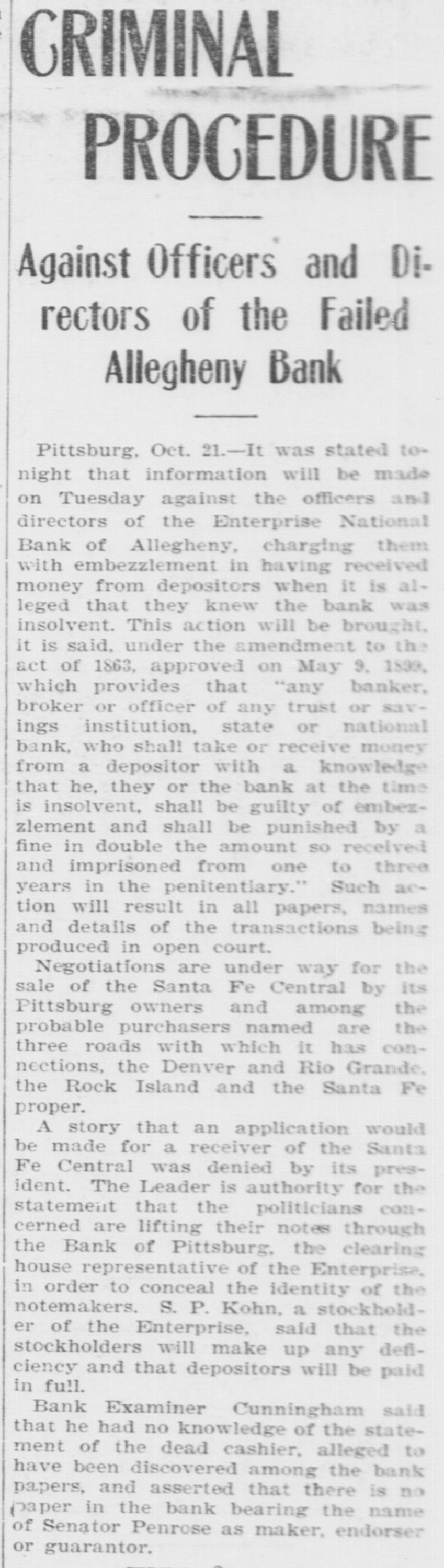
CLARK BLAMES ANDREWS? A CONFESSION FOUND. Politicians Signed Notes, Says Grinner-Penrose Got No Loans. Pittsburg, Oct. 20.-The sensation to-day in the investigation of the affairs of the suspended Enterprise National Bank, of Allegheny, was the report that among the dead cashier's papers was found a confession. giving in detail the operations which culminated in his death and the closing of the bank. The confession, or statement, it is learned from the best of authority consists of a short paper. written with a lead pencil, declaring that W. H. Andrews is responsible for the whole trouble. Details of the statement are not known, but Andrews is the only man mentioned. The paper was found among Clark's private papers. Fred Gwinner, sr., president of the bank, stated positively that notes for large amounts were in possession of the bank which bear the names of W. H. Andrews, F. J. Torrance and other politicians. Vice-President Bradberry said to-day that the directors of the bank had opened Mr. Clark's desk on Thursday and had turned over his private papers to Inspector Cunningham. The dlrectors were not cognizant of the contents of the papers. Late to-night it is reported that a secret conference of Mr. Clark's lawyer, the directors of the bank and their attorney is being held. What is being discussed cannot be found out. Late developments show that the shortage will aggregate $1 200,000. This includes the Pennsylvania Development Company's paper. The directors of the latter concern have issued a public statement to the effect that they will pay every dollar of their paper that Clark placed in the institution. This will reduce the losses to the amount of securities belonging to this concern. It has been reported that $200,000 of the Pennsylvania Development Company's securities were in the bank. In the mean time, the Pennsylvania Development Company is negotiating with New-York capitalists to have them take the Santa Fe Central Railroad off its hands, so it can cash cut. The bank was capitalized at $200,000, $200,000 surplus and $82,000 undivided profits. This total of $482,000 has been wiped out. The directors propose assessing the stockholders $200,000 additional and the directors will make up the difference.


Article from New-York Tribune, October 22, 1905

Click image to open full size in new tab

Article Text

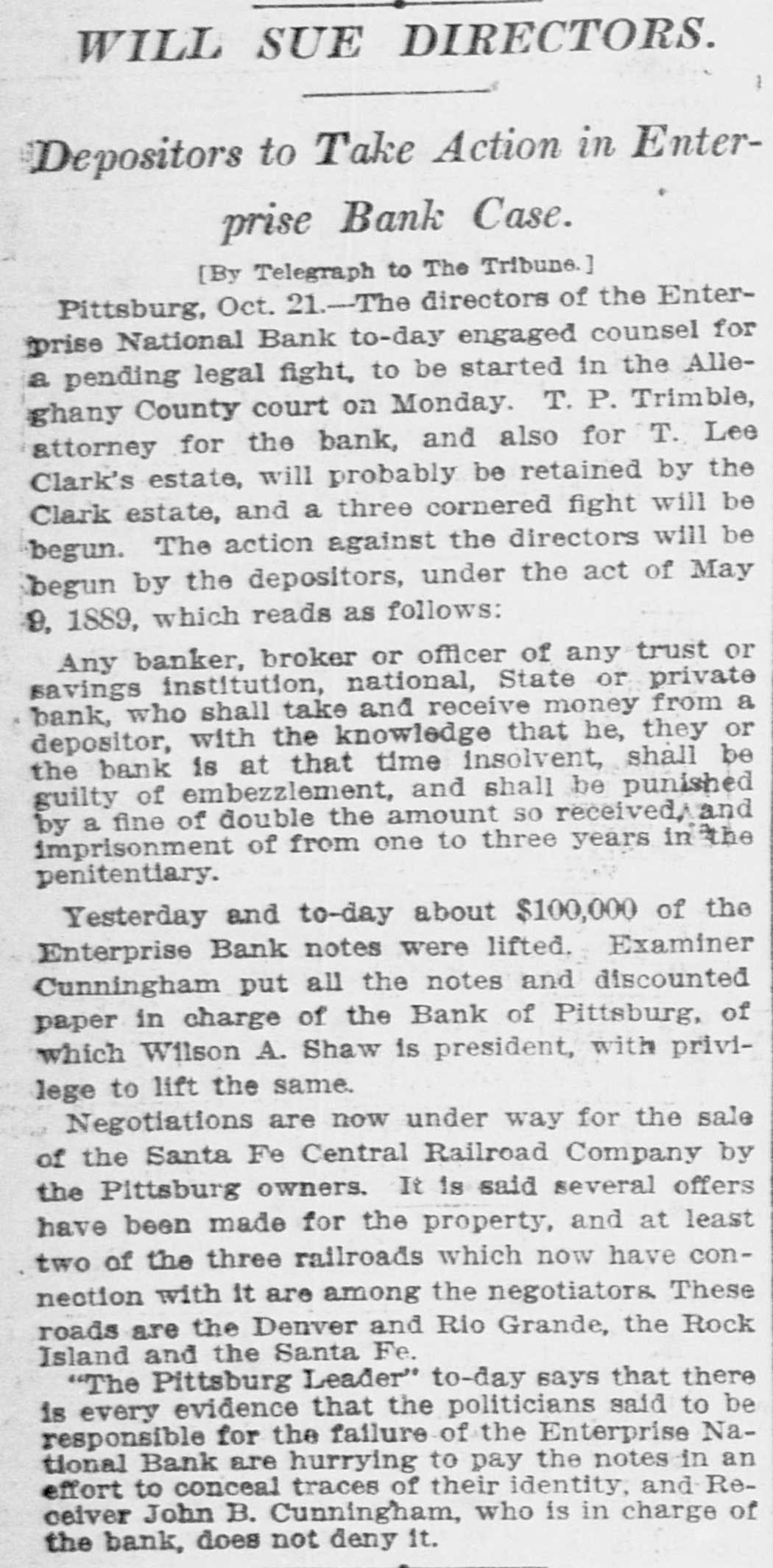
WILL SUE DIRECTORS. Depositors to Take Action in Enterprise Bank Case. [By Telegraph to The Tribune.] Pittsburg, Oct. 21.-The directors of the Enterprise National Bank to-day engaged counsel for a pending legal fight, to be started in the Alleghany County court on Monday. T. P. Trimble, attorney for the bank, and also for T. Lee Clark's estate, will probably be retained by the Clark estate, and a three cornered fight will be begun. The action against the directors will be begun by the depositors, under the act of May 9, 1889, which reads as follows: Any banker, broker or officer of any trust or savings institution, national, State or private bank, who shall take and receive money from a depositor, with the knowledge that he, they or the bank is at that time insolvent, shall be guilty of embezzlement, and shall be punished by a fine of double the amount so received and imprisonment of from one to three years in the penitentiary. Yesterday and to-day about $100,000 of the Enterprise Bank notes were lifted. Examiner Cunningham put all the notes and discounted paper in charge of the Bank of Pittsburg, of which Wilson A. Shaw is president, with privilege to lift the same. Negotiations are now under way for the sale of the Santa Fe Central Railroad Company by the Pittsburg owners. It is said several offers have been made for the property, and at least two of the three railroads which now have connection with It are among the negotiators. These roads are the Denver and Rio Grande, the Rock Island and the Santa Fe. "The Pittsburg Leader" to-day says that there is every evidence that the politicians said to be responsible for the failure of the Enterprise National Bank are hurrying to pay the notes in an effort to conceal traces of their identity, and Receiver John B. Cunningham, who is in charge of the bank, does not deny 1t.


Article from Durango Semi-Weekly Herald, October 23, 1905

Click image to open full size in new tab

Article Text

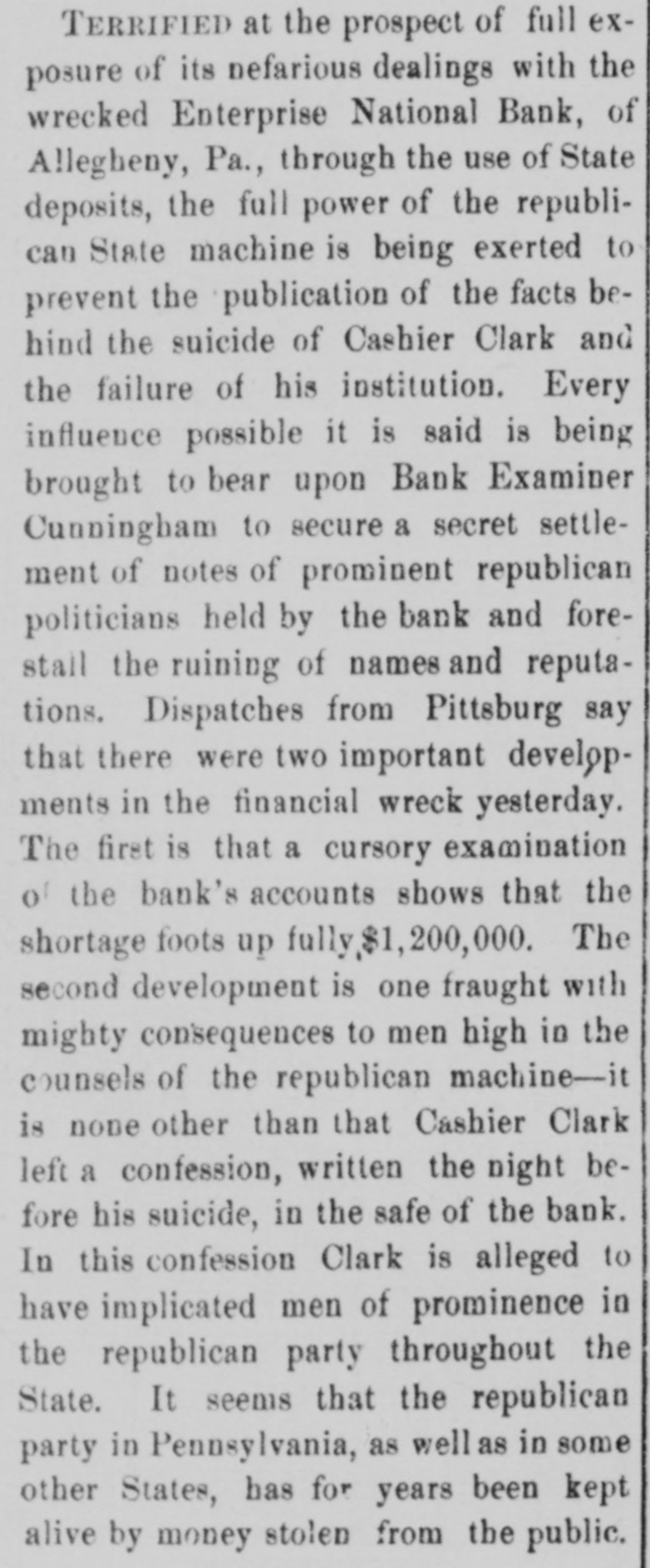
comes up. Jim Walsh bested Peter Stanley of London in a fifteen round bout at Boston last night. The Grand Junction sugar factory made a record run the other day, handling 470 tons of beets. The Denver Republican is running a serial story in the shape of annual tax sale. Occupies twelve pages. The Denver university football team is playing the football team of the Utah university at Salt Lake City this afternoon. Four women returning from a the ater party in Pittsburg were run into by a racing automobile and all were injured, one possibly fatally. The town hall and twelve other buildings of the town of Alma, Colo., were burned Wednesday night. Dyna0 mite was used to save the town from 1 being wiped out. t S The Enterprise bank of Allegheny City, that loaned money on straw se. curity to politicians, will be short g something like $1,200,000, according to y the present outlook. d e a The Denver fire and police board, I Patterson machine, has defied Judge Johnson in his order putting the lid on in Denver. But the court has the best of the deal and the law violators are hiding out. d k The Treasury mine and mill at Red : Mountain, near Ouray, were closed on k Thursday for an indefinite period. The e only reason assigned for the shutI down is for the purpose of reorganize ing the board of directors. g 1George Simmons, the 18-year-old son l of George R. Simmons, assistant gene eral manager of the Moffat road, was eslightly injured in a football game ten it days ago; and Thursday blood poison r'set in and he is not expected to live. r al Walter Ritesman, of Fort Collins, r who on Tuesday pleaded guilty to the et charge of violating the age of consent o law. was sentenced Thursday to a g term of not less than five nor more d than ten years at hard labor in the of penitentiary. of S recivered $90,000 of the $101,000 stold. en by Clerk Cunliffe and will probably d secure the balance. Cunliffe has been n taken back to Pittsburg, where he will re have to stand trial and do penance in nt some prison for a term of years. a in It is reported at the state house r that a number of the subsidiary comte panies to corporations have notified Id the state board of equalization that n unless the $70,500 valuation is reinnstated against the Santa Fe Refrigere ator Dispatch company they will appear before the supreme court and d mandamus the board to rescind the g valuations placed against their ed panies. Among those interested in e this are said to be the Globe Express ficompany, owned by the D. & R. G., e and a number of similar companies. n


Article from Omaha Daily Bee, October 23, 1905

Click image to open full size in new tab

Article Text

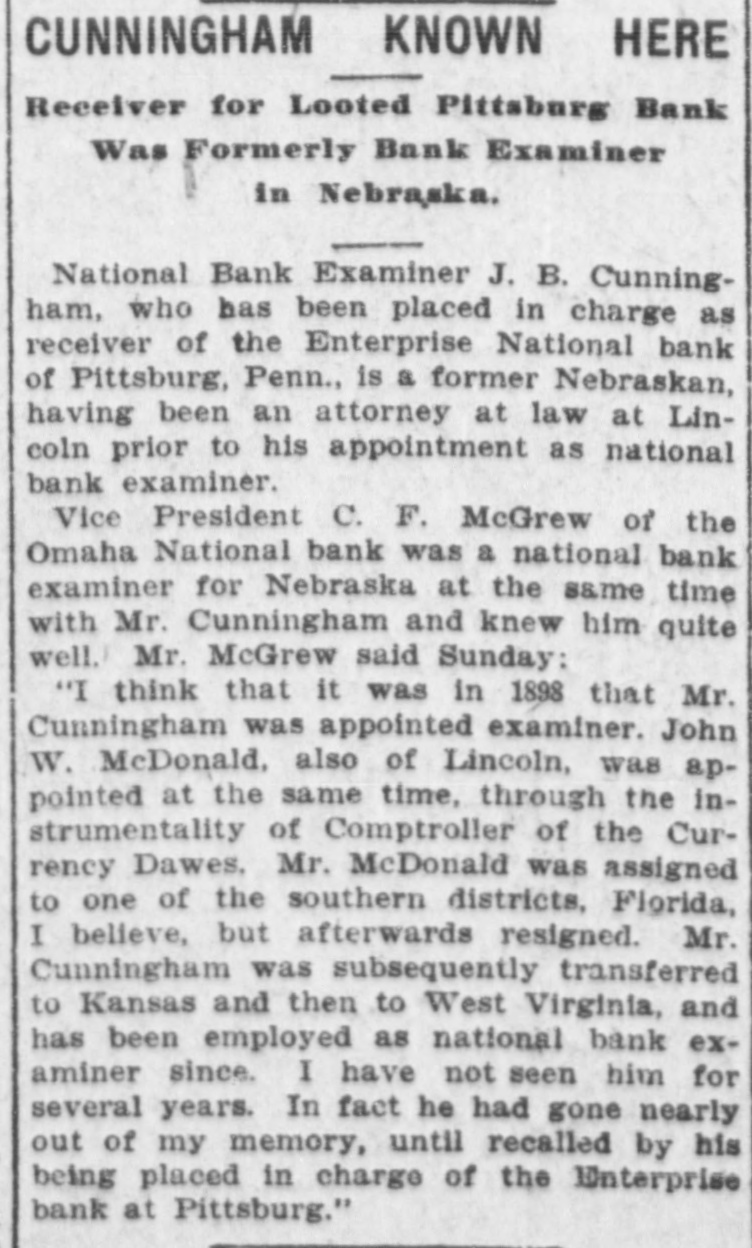
# CUNNINGHAM KNOWN HERE Receiver for Looted Pittsburg Bank Was Formerly Bank Examiner in Nebraska. National Bank Examiner J. B. Cunningham, who has been placed in charge as receiver of the Enterprise National bank of Pittsburg, Penn., is a former Nebraskan, having been an attorney at law at Lincoln prior to his appointment as national bank examiner. Vice President C. F. McGrew of the Omaha National bank was a national bank examiner for Nebraska at the same time with Mr. Cunningham and knew him quite well. Mr. McGrew said Sunday: "I think that it was in 1898 that Mr. Cunningham was appointed examiner. John W. McDonald, also of Lincoln, was appointed at the same time, through the instrumentality of Comptroller of the Currency Dawes. Mr. McDonald was assigned to one of the southern districts, Florida, I believe, but afterwards resigned. Mr. Cunningham was subsequently transferred to Kansas and then to West Virginia, and has been employed as national bank examiner since. I have not seen him for several years. In fact he had gone nearly out of my memory, until recalled by his being placed in charge of the Enterprise bank at Pittsburg."


Article from Omaha Daily Bee, October 24, 1905

Click image to open full size in new tab

Article Text

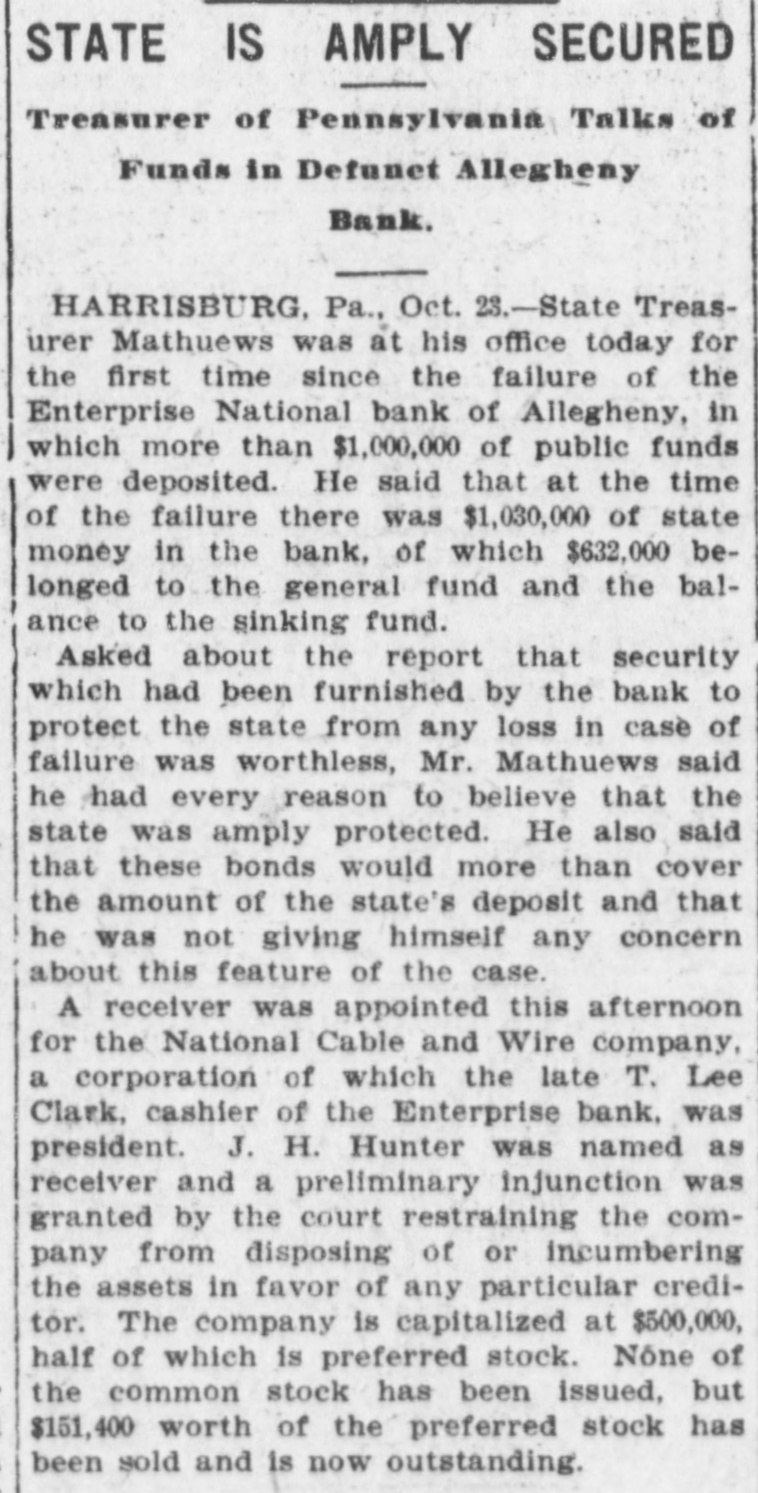
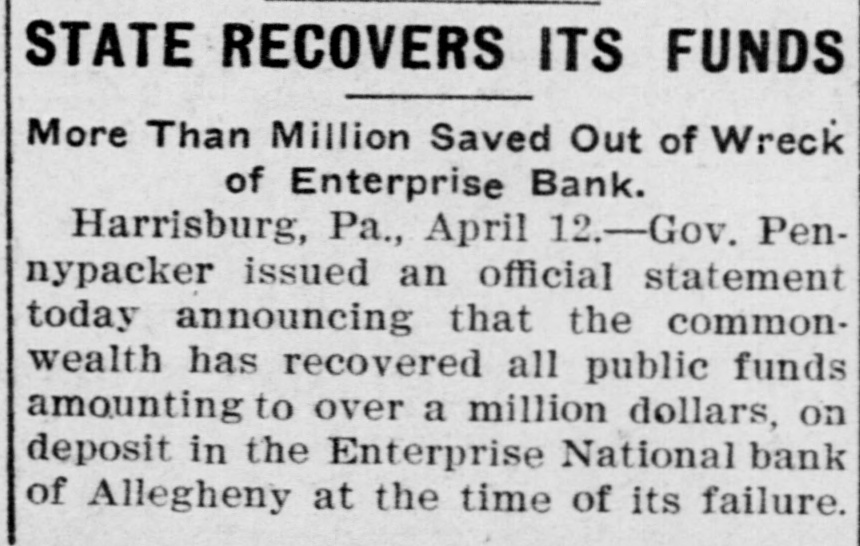
STATE IS AMPLY SECURED Treasurer of Pennsylvania Talks of Funds in Defunet Allegheny Bank. HARRISBURG, Pa., Oct. 23.-State Treasurer Mathuews was at his office today for the first time since the failure of the Enterprise National bank of Allegheny, in which more than $1,000,000 of public funds were deposited. He said that at the time of the failure there was $1,030,000 of state money in the bank, of which $632,000 belonged to the general fund and the balance to the sinking fund. Asked about the report that security which had been furnished by the bank to protect the state from any loss in case of failure was worthless, Mr. Mathuews said he had every reason to believe that the state was amply protected. He also said that these bonds would more than cover the amount of the state's deposit and that he was not giving himself any concern about this feature of the case. A receiver was appointed this afternoon for the National Cable and Wire company, a corporation of which the late T. Lee Clark, cashier of the Enterprise bank, was president. J. H. Hunter was named as receiver and a preliminary injunction was granted by the court restraining the company from disposing of or incumbering the assets in favor of any particular creditor. The company is capitalized at $500,000, half of which is preferred stock. None of the common stock has been issued, but $151,400 worth of the preferred stock has been sold and is now outstanding.


Article from The Manitowoc Pilot, October 26, 1905

Click image to open full size in new tab

Article Text

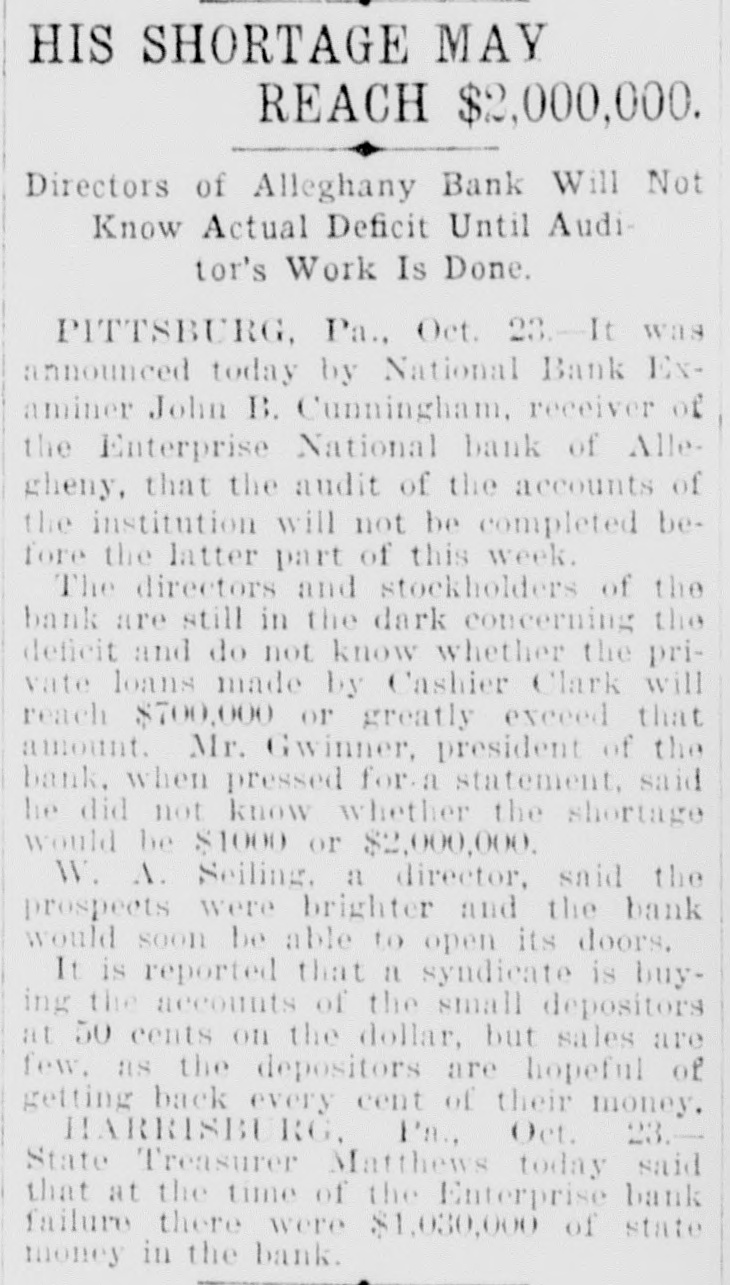
HIS SHORTAGE MAY REACH $2,000,000. Directors of Alleghany Bank Will Not Know Actual Deficit Until Auditor's Work Is Done. PITTSBURG, Pa., Oct. 23.-It was announced today by National Bank Examiner John B. Cunningham, receiver of the Enterprise National bank of Allegheny, that the audit of the accounts of the institution will not be completed before the latter part of this week. The directors and stockholders of the bank are still in the dark concerning the deficit and do not know whether the private loans made by Cashier Clark will reach $700,000 or greatly exceed that amount. Mr. Gwinner, president of the bank. when pressed for-a statement, said he did not know whether the shortage would be $1000 or $2,000,000. W. A. Seiling. a director, said the prospects were brighter and the bank would soon be able to open its doors. It is reported that 11 syndicate is buying the accounts of the small depositors at 50 cents on the dollar, but sales are few. as the depositors are hopeful of getting back every cent of their money. HARRISBURG, Pa., Oct. 23.State Treasurer Matthews today said that at the time of the Enterprise bank failure there were $1,030,000 of state money in the bank.


Article from The Morris County Chronicle, October 31, 1905

Click image to open full size in new tab

Article Text

DOMESTIC. A step in the dark plunged Bruno A. Bahr, a messenger boy, eleven stories down a ventilating shaft at Chicago, III., killing him. An association was formed of Mutual Life policyholders in Minnesota to oust the McCurdys from the company. John F. Stevens, chief engineer of the Panama Canal, denied a rumor that he would resign. Upward of 500 delegates are expected at Chattanooga, Tenn., for the Southern immigration and quarantine conference, November 9 and 10. After a week's trial the charge against Charles M. Chamberlain of wrecking the Chamberlain Bank, at Tecumseh, Neb., has been dismissed. The President of the wrecked Enterprise National Bank. at Pittsburg, Pa., says the shortage will reach $1,500,000. David S. Scott, who forged his wife's name to obtain funds, requested a Pittsburg (Pa.) judge to send him to prison. New indictments have been found at Cleveland, Ohio, against O. L. Hays and Edward Flickinger, charged with violating the National banking laws. Sequoia trees have been sent from the National parks in California to the Yellowstone Park and promise to thrive there. Three hundred Syrians rioted at Liberty and Church streets, New York City. Daggers and pistols were drawn and a dozen men were wounded. Herman Schultz knelt at the coffin of his sucide son at their home in New York City, and sent a bullet through his own brain. Five miners were killed by the cavein of a slope in a Utah copper mine. Receivers took charge of the Tubular Dispatch and New York Mail and Transportation Companies and the pneumatic mail tube service in Manhattan (New York City) was stopped. In ten factories in the mountain distriet 1500 men of the Amalgamated Window Glass Workers of America will go to work at once. Beef Trust men indicted in Chicago, 11., filed a special plea, contending that estimony given by them in the Governnent beef inquiry had been used in obtaining their indictment, and therefore they could not be prosecuted on that finding.


Article from Willmar Tribune, November 1, 1905

Click image to open full size in new tab

Article Text

# MISCELLANEOUS. The railroad system of Russia is almost completely tied up and socialists say, since troops cannot be transported, the government is at their mercy. Fifteen were killed in conflict at Ekaterinoslav and massacres took place in many cities in Russia. Secretary Shaw told Nebraska bankers that there will be no financial legislation until the nonelasticity of our currency causes a panic, which may be soon. The Norwegian government asks the storthing for complete power to negotiate with Charles of Denmark relative to taking Norway's throne. The census bureau issued a report placing the number of bales of cotton ginned this year at a figure in excess of 4,000,000. A St. Louis woman gave out plans for a new $1,000,000 university for study of the occult. An American collector of customs was wounded and his native assistant killed in the Santo Domingo riots. It is feared that the bloodshed will fan the latent revolution. A Pittsburg lawyer says that of the $2,500,000 resources of the failed Enterprise national bank of Allegheny only $40,000 was on hand when the institution was closed, and that collateral deposited to secure loans were rehypothecated. Secretary Taft announces his cabinet position suits him and that he will not be a candidate for president. Papers have been served on a woman Spiritualist to recover $1,000,000 which she is alleged to have obtained from Pierre Lorillard Ronalds, the dead New York clubman. The headless body of a woman found in the Bronx river was identified by a New York merchant as his missing wife. The semi-annual conference of the college of bishops of the Methodist Episcopal church, comprising the governing body of that denomination, began in Washington. Sereno T. Merrill died in Beloit, Wis., aged 90 years. He came to Beloit in 1846, and was the first teacher in Beloit college. By the caving in of a slope in the Highland Boy copper mine at Bingham, Utah, five men were instantly killed. A new party in Canada to be known as the national, proposes to treat Great Britain as a brother, not as a parent. A bride of two months was found dead in Chicago, with her husband, evidently her murderer, fatally shot beside her. Admiral Togo made a triumphant entry into Tokio and, cheered by thousands, drove to emperor's palace to report officially the return of his victorious warships. The Pennsylvania's new car order brings that road's expediture for equipment for the year up to $26,000,000. The New York police have been ordered to arrest all women who appear unescorted on the streets of the tenderloin after ten o'clock at night. Gov. Folk, of Missouri, commuted the sentence of Edgar G. Bailey, who was to have been hanged at Kansas City for murder, to imprisonment for 99 years.


Article from New-York Tribune, November 5, 1905

Click image to open full size in new tab

Article Text

CREEDMOOR QUALIFICATIONS. 7TH REGIMENT, N. G. N. Y., SEASON 1905. Distinguished MarksSharpexperts. shooters. men. Experts. 2 11 17 29 F. S. & N. a S 2 11 10 68 Company A 16 27 48 95 Company B. 16 48 75 96 Company a 7 26 42 92 Company D 9 29 88 41 Company E 6 19 28 95 Company F 5 24 81 88 Company G 8 38 49 06 Company H 14 51 106 64 Company I 14 34 49 105 Company K 99 818 458 .058 Totals 46 176 382 957 Totals 1904 BANK EXAMINER REMOVED. Action in Case of R. H. Mattern, Who Failed to Discover Enterprise Bank's Condition. Washington, Nov. 4.-Controller of the Currency Ridgely to-day removed from the service Bank Examiner R H. Mattern, of the Western Pennsylvania examiners' district, on account of his failure to discover the conditions existing in the Enterprise National Bank of Allegheny City. The investigation showed that the conditions leading to the failure of that bank had existed for some time, and that they should have been earlier discovered by the bank examiner. Mattern's case has been carefully investigated, and he has had a full opportunity to be heard in his own defence. According to & statement issued by Mr. Ridgely, there is not the slightest ground for suspicion of any criminal intent on the part of Mr. Mattern or any corrupt collusion with the officers of the bank. He was, however, it is claimed, entirely too credulous in his acceptance of their statements, and careless and inefficient in his examinations. The Controller has assigned to the district made vacant by Mr. Mattern's removal Owen T. Reeves, jr. Mr. Reeves was formerly an employee of the Controller's office, and at one time was acting chief of the reports division. He has had several years' experience as assistant bank examiner in NewYork City and as a bank examiner in Maryland, New-York, Pennsylvania and in other States on special work. He has been detailed to the Department of Justice in many important criminal cases, notably those at Medina, Fredonia and Syracuse, N. Y.


Article from Daily Kennebec Journal, November 7, 1905

Click image to open full size in new tab

Article Text

Eighty thousand dollars worth of bonds of the Santa Fe Central Railroad, of which the late Cashier T. Lee Clark of the Enterprise National Bank, Pittsburg, was treasurer, are reported missing. Receiver Cunningham, of the defunct Enterprise Bank, has not been able to find them.


Article from Watertown Republican, November 8, 1905

Click image to open full size in new tab

Article Text

BANK EXAMINER IS DISCHARGED. COMPTROLLER OF CURRENCY TAKES FIRM STAND IN CASHIER CLARK'S CASE. Failure to Discover Conditions in Enterprise National at Allegheny (Pa.) Subject for Action. WASHINGTON, D. C., Nov. 4.The comptroller of the currency today removed from service Bank Examiner R. H. Mattern, on account of his failure to discover the conditions existing in the Enterprise National bank of Allegheny City, Pa. Owen P. Reeves, Jr., has been appointed to fill the vacancy. Mr. Reeves has been an assistant bank examiner in New York city. No Suspicion on Examiner. The case of Examiner Mattern has been carefully investigated and he has been given a full opportunity to be heard in his own defense. According to a statement issued by Comptroller Ridgely there is not the slightest ground for suspicion of any criminal intent on the part of Mr. Mattern or any corrupt collusion with the officers of the bank. He was, however, it is claimed, entirely too credulous in his acceptance of their statements, and careless and inefficient in his examinations. Schoolma'ams Storm Bank. PITTSBURG, Pa., Nov .4.-A swarm of women, mostly school teachers, attempted to storm the Enterprise National bank. Rumors became current that some depositors were to be paid off. Receiver Cunningham ordered the doors barred. It is reported that Receiver Cunningham has made the former employes of the bank sign over their properties to him. He has learned, it is said, that the tellers. bookkeepers and assistants knew of the bank's condition; that he made each one confess that the handwriting on the books was theirs, but that the cash and securities were not as they represented in the accounts; and that they said Cashier Clark compelled them to make false entries under threat of dismissal. Depositors May Get 25 Per Cent. Receiver Cunningham intimates that a final settlement may result in the payment of 25 per cent. to the depositors. The bank directors will make a legal battle on any judgments filed against them. Clark's Books Are Opened. The personal books and papers of Cashier Clark of the Enterprise National Bank of Allegheny, which were found in the dead cashier's desk, were taken up by the examiner today for the first time. It is hoped that in these personal or private books will be found some trace of the missing funds of the institution. Churchman-Banker Confesses. DES MOINES, Nov. 4.-C. H. Dye, vice president of the Tabor State bank at Tabor, treasurer of Tabor college, a trustee of the Congregational church there and treasurer of the local school district, confessed that he had forged notes amounting to between $50,000 and $75,000, which had been discounted by the bank. The bank was closed and the auditor of state immediately dispatched an examiner. The officers claim it is solvent despite the loss. The bank has a capital of $25,000 and deposits amounting to $165,000. He Floated Oil Schemes. Dye declares he abstracted the money from the bank to float oil schemes in Kansas in competition with the Standard Oil company. He also had been operating through the Chicago board of trade and sought to corner the stock of several large mining properties in the west. He took chances on the board and in mines to recoup himself for the oil losses. His father may make good for him. There is no disposition to prosecute the son if the losses are made good. The young man has lived in Tabor twelve years, serving as cashier of the bank for ten years. It was not until he was made a vice president that he attempted to get rich quickly.


Article from Willmar Tribune, November 8, 1905

Click image to open full size in new tab

Article Text

MISCELLANEOUS. Prince Louis of Battenberg and a British fleet arrived at Annapolis. He was royally welcomed by American officers. A statement by T. Lee Clark, cashier of the defunct Allegheny bank, written a few hours before his suicide, charges W. H. Andrews with causing his ruin. Dr. C. H. French, president of Huron (S. D.) college, announced that Ralph Voorhees, of New Jersey had given the college $100,000. The corn crop in the southwestern portions of the belt is badly damaged by heavy rains, wet weather causing mold and decay. Mrs. Henry T. Evans, wife of a director in the National Biscuit company, committed suicide in Chicago by hanging. The boom of Speaker Cannon for the presidency was launched by Senator Hopkins at a Hoopeston (III.) banquet. New treaty with China designed to end the hardships and abuses prevalent at present by providing for the examination of prospective immigrants at the port of departure abroad, instead of at the port of arrival, is sought by President Roosevelt, Secretary Metcalf and Commissioner of Immigration Sargent. Constantine Andrew was crushed to death under a fall of rock in the mine of the Gallatin Coal company near Nashville, III. The old union flag was struck throughout Sweden and the new Swedish ensign was hoisted to accompaniment of salutes, the ringing of church bells and parades of troops. Five American missionaries have been murdered at Lienchow, China. Direct charge of fraud is made by the receiver of the Enterprise national bank of Allegheny against W. H. Andrews, republican machine leader, in a suit to recover $55,000. Former President Cleveland eulogized J. Sterling Morton at the unveiling of a statue at Nebraska City, Neb. Proceedings to oust the Mutual and New York Life companies from Ohio were begun at Akron. Two men were killed and others are buried under the wreckage caused by a head-on collision on the Shenandoah division of the Norfolk & Western railroad near Nace, Va. Rival interstate commerce law conventions in Chicago adopted resolutions on the question of railway rate regulation and provided for lobbies to attend before congress in behalf of their views. Secretary Hitchcock is hot on the trail of land grabbers throughout the country. Booker T. Washington declares President Roosevelt's southern trip has relieved the race issue. Five women were badly burned, two of them probably fatally, in a fire which destroyed the hardware factory of M. Gould Sons & Co. at Newark, N. J. Loss, $60,000.


Article from Wood County Reporter, November 10, 1905

Click image to open full size in new tab

Article Text

BANK EXAMINER IS DISCHARGED. COMPTROLLER OF CURRENCY TAKES FIRM STAND IN CASHIER CLARK'S CASE. Failure to Discover Conditions in Enterprise National at Allegheny (Pa.) Subject for Action. WASHINGTON, D. C., Nov. 4.The comptroller of the currency today removed from service Bank Examiner R. H. Mattern, on account of his failure to discover the conditions existing In the Enterprise National bank of Allegheny City, Pa. Owen P. Reeves, Jr., has been appointed to fill the vacancy. Mr. Reeves has been an assistant bank examiner in New York city. No Suspicion on Examiner. The case of Examiner Mattern has been carefully investigated and he has been given a full opportunity to be heard In his own defense. According to a statement issued by Comptroller Ridgely there is not the slightest ground for suspicion of any criminal intent on the part of Mr. Mattern or any corrupt collusion with the officers of the bank. He was, however, it is claimed, entirely too credulous in his acceptance of their statements, and careless and inefficient In his examinations. Schoolma'ams Storm Bank. PITTSBURG, Pa., Nov .4.-A swarm of women, mostly school teachers, attempted to storm the Enterprise National bank. Rumors became current that some depositors were to be paid off. Receiver Cunningham ordered the doors barred. It is reported that Receiver Cunningham has made the former employes of the bank sign over their properties to him. He has learned, it is said, that the tellers, bookkeepers and assistants knew of the bank's condition; that he made each one confess that the handwriting on the books was theirs, but that the cash and securities were not as they represented in the accounts; and that they said Cashier Clark compelled them to make false entries under threat of dismissal. Depositors May Get 25 Per Cent. Receiver Cunningham intimates that a final settlement may result in the payment of 25 per cent. to the depositors. The bank directors will make a legal battle on any judgments filed against them. Clark's Books Are Opened. The personal books and papers of Cashier Clark of the Enterprise National Bank of Allegheny, which were found in the dead cashier's desk, were taken up by the examiner today for the first time. It is hoped that in these personal or private books will be found some trace of the missing funds of the institution. Churchman-Banker Confesses. DES MOINES, Nov. 4.-C. H. Dye, vice president of the Tabor State bank at Tabor, treasurer of Tabor college, a trustee of the Congregational church there and treasurer of the local school district, confessed that he had forged notes amounting to between $50,000 and $75,000, which had been discounted by the bank. The bank was closed and the auditor of state immediately dispatched an examiner. The officers claim it is solvent despite the loss. The bank has a capital of $25,000 and deposits amounting to $165,000. He Floated Oil Schemes. Dye declares he abstracted the money from the bank to float oil schemes in Kansas in competition with the Standard Oil company. He also had been operating through the Chicago board of trade and sought to corner the stock of several large mining properties in the west. He took chances on the board and in mines to recoup himself for the oil losses. His father may make good for him. There is no disposition to prosecute the son if the losses are made good. The young man has lived in Tabor twelve years, serving as cashier of the bank for ten years. It was not until he was made a vice president that he attempted to get rich quickly.


Article from Evening Journal, November 16, 1905

Click image to open full size in new tab

Article Text

THE WORLD'SNEWS PERSONAL AND SOCIAL Mrs. Harriet Miss Susan Upton B. Anthony, Mrs. Hu-ted Taylor and Ida Harper made a plea to the President 111 behalf of Leman suffrage. Mrs. Isabella S. McSparren was award. er $18,000 the Intrad and Gripper en verdect against Washington Phila- Tidlroad for received in in wreck at Chadd's Ford Junction, in 1904. WASHING CON. of the will a strong effort to Remake Supporters Administration capture the publican organization in Ohio. Shaw. who is to address Secretary before make an the branch the Retirement to emCivil submitted Service Treasury treasury Department Association. of has ployes questions relating to their financial condition. President Roosevelt in addressing a delmen, gave a egation of leather scathing rebuke to Henry M. Whitney, recent candidate for ernor whom Democratic of of Massachusetts, L'eutenant he accused Govmisquoting him in campaign will The Administration disapprove speeches. the movement on the Isle of Pines for secession from Cuba and annexation to the United States. The real reason for Representative Burton's for the is campaign Speakership, it said. is his desire for the floor leadership of the House. PENNSYLVANIA. Three men were killed and were injured by an of on explosion dynamite seven railroad construction work near Safe Harbor. A receiver for the Henry Roever Company, of Chester, was appointed at Media on application of Senator Sproul. men were killed an of gas a new mine shaft at Eight in by Bentleys- explosion ville. FOREIGN Ambassadors of the Powers at Constantinople presented to the Porte an ultidemands with is and all matum Macedonia. making Refusal expected. respect to save Germany are preparing to send warships to Piraeus, SPORTING. Swarthmore defeated Lafayette in annual football game by the score of 27 to o. over Haverford triumphed Jefferson Medical College 29 to 5. Carlisle Indians lost to Massillon team 8 to 4. Marshall P. Reynolds, Pennsylvania's great fullback, was not allowed to matriculate in the Law Department at the University. MISCELLANEOUS United States Circuit Judge Van Devanter overruled the demurrer to the third of Senator atindictment Burton, whose torneys filed a plea in bar to prosecution. The crew of the Fall River schooner James F. Parker was rescued by a tugboat and the United States with the tied Dahlgren, captain torpeodboat to the wheel and his wife and two to avoid outward deckhouse, being swept men to the by immense waves. States Telephone has a franchise The United Company acquired Independent granted to the old Mercantile Electric in New York and will Company endeavor to conduct a general telephone business in New York city under it. in New York met Ballot reformers city and approved the adoption of the Australian in chusetts ballot, which Massa- party columns are abolished and names of candidates are arranged in alphabetical order. Receiver Cunningham of the of National Bank, Alleghany, Enterprise began another suit against W. H. Andrews for to be due on one of $90,000. which alleged notes, was indorsed by the dead cashier, T. Lee Clark. James H. Hyde, before the Insurance Investigating Committee, told of four that of Ryan for the able offers stock. besides EquitThey were made, said Mr. Frick and Mr. by by Gage E. Hyde, George by Gould, Mr. Tarbell, Harriman, representing a syndicate, and by these offers were Young. All verbal George and W. that of Mr. Young, the largest, was for $7,000,000. E. H. Harriman made a series of denials of made Mr. on Mr. Harriman Tuesday. the charges After by had Hyde testified Mr. Hyde was recalled, and reaffirmMr. myer was to ed his previous refused testimony. permission cross-ex- Unteramine Mr. Harriman. B. B. Odell Former Governor requested Chairman Armstrong to call him before the to give him an to testify committee under opportunity oath in reply to Hyde. R. Hearst court concerning method of William the obtained orders counting of and the production of tally sheets for his the latter offer election McClellan, contest. through To Mayor Judge Parker, said that he had no opposition to offer.


Article from Chicago Eagle, November 18, 1905

Click image to open full size in new tab

Article Text

# Duplicate Set of Books. Receiver Cunningham, of the failed Enterprise National Bank of Allegheny, Pa., is reported to have come into possession of a duplicate set of bank books kept by persons in the bank between the time of the last Federal examination and the date of the failure of the bank.


Article from Bismarck Daily Tribune, November 20, 1905

Click image to open full size in new tab

Article Text

# STATEHOOD LEGISLATION would be bright prospects for the enactment of statehood legislation were it not for the fact that the statehood advocates cannot agree among themselves. Especially in the eastern pair of territoriesβ€”Oklahoma and Indian Territoryβ€”is there bitter factional strife. One party wants the territories made into one big state and the other demands separate statehood, at least for Oklahoma. There is not serious agitation for separate statehood for the Indian Territory, because such a thing is recognized as out of the question. Advocates of joint statehood appear just now to be the stronger, especially since they have enlisted President Roosevelt in their ranks. He told a delegation from Oklahoma the other day that he would recommend in his message that the two territories be admitted as one state. Not much is being heard from New Mexico and Arizona as yet, but their boomers will be on hand when the time comes. "Bull" Andrews, the delegate in congress from New Mexico, is too busy just now extricating himself from the affairs of the failed Enterprise National Bank of Allegheny City to give much attention to the question of statehood. President Roosevelt has demonstrated that while he may be impulsive he is not vindictive. Walter S. Elvidge, the chauffeur who was summarily dismissed from the government service because he allowed his machine to interfere with the president's carriage, will be reinstated, after a suspension of sixty days. When Mr. Roosevelt had time to think it over, he didn't want to deprive the man of his means of livelihood. There is no admission, however, that the president was wrong in ordering his dismissal. It is made plain that the reinstatement is an act of clemency, not of justice. "Uncle Joe" Cannon, who will be the speaker of the 59th congress, arrived in town this week, sun-burned and ruddy and looking the picture of rugged health. He said his early arrival was in order that he might open up his house and "get a line on things," preparatory to the winter's work. Now that the speaker is here, members will arrive on every train. The make-up of the house committees for the new congress is a burning question and many anxious members will feel it incumbent upon them to have personal interviews with the speaker. There are a number of vacant chairmanships, chief of which is that of appropriations, and the scramble promises to be a lively one. As yet, the speaker is mum as an oyster on the committee question. He would have you believe that not a thought had he given the subject all summer long. Were the speaker to make the declaration outright we would have to accept it as true, of course; but it is mighty certain that other members of the house have thought hard and long and prayerfully on the question of committee places.


Article from New-York Tribune, December 7, 1905

Click image to open full size in new tab

Article Text

SELL TO PAY ENTERPRISE BANK. # Proceeds of Street Railway to Apply on $500,000 Debt. [By Telegraph to The Tribune.] Pittsburg, Dec. 6.-A deal was completed in this city to-day whereby the Pittsburg Railways Company obtains possession of the Washington, Pennsylvania and Canonsburg Electric Street Railway, for $475,000 in cash and $600,000 in bonds. The road was owned by Francis J. Torrance, Arthur Kennedy, W. H. Andrews, James Hagan and other members of the Pennsylvania Development Company. The proceeds of the sale will go toward liquidating the indebtedness of the Pennsylvania Development Company to the wrecked Enterprise National Bank. According to a statement made by former Receiver Cunningham, this indebtedness amounts to $500,000. Walter Lyon, attorney for the Pennsylvania Development Company, admitted that the deal had been closed.


Article from Arizona Silver Belt, December 7, 1905

Click image to open full size in new tab

Article Text

The failure of the Enterprise National Bank of Allegheny, Pa., has precipitated a receivership for the Santa Fe Central and it is rumored that an offer has been made for the property by the Gould people who propose to extend it to a connection with the Texas Pacific at El Paso. This would give the Rio Grande an outlet to the Gulf of Mexico, long sought for by its management.


Article from The St. Louis Republic, December 20, 1905

Click image to open full size in new tab

Article Text

CLARK'S ASSOCIATE FAILS. Joseph Hastings Assigns Because Allegheny Bank Failed. Pittsburg. Pa., Dec. 19.-Joseph Hastings, for years associated in business with the late Cashier Clark of the defunct Enterprise Bank of Allegheny. made an assignment yesterday. The amount of the assignment will be possibly $500,000. The Union Trust Company of Pittsburg was made receiver. Counsel for Mr. Hastings Issued a statement last night saying that his client had been nulled down through trying to take care of bills of Clark. Mr. Hastings was president of the Ohio Valley Water Company, and was connected with many other large enterprises. both in Pennsylvania and other States. He was the owner of an immense stock farm in Kentucky.


Article from The Sun, March 4, 1906

Click image to open full size in new tab

Article Text

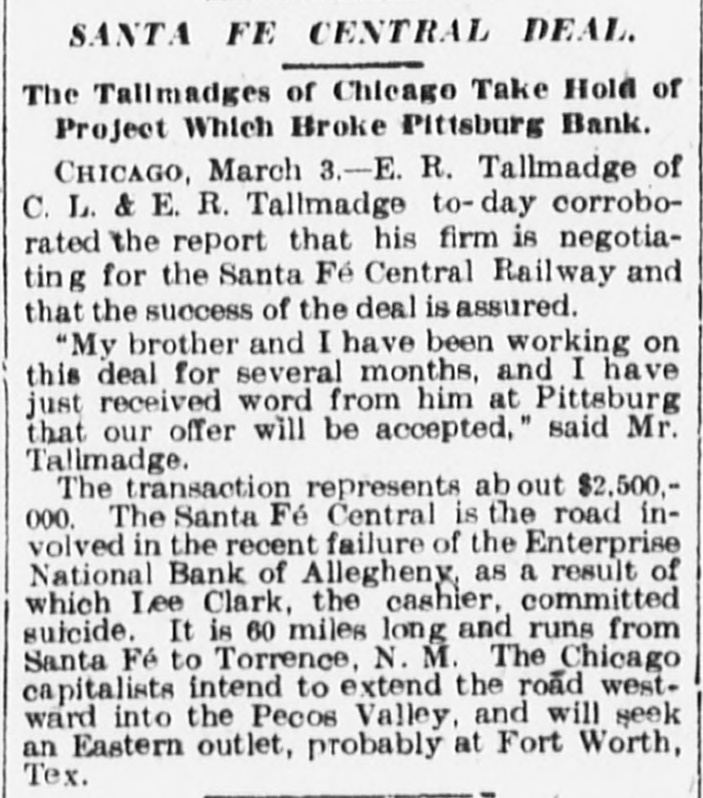
# SANTA FE CENTRAL DEAL. The Tallmadges of Chicago Take Hold of Project Which Broke Pittsburg Bank. CHICAGO, March 3.-E. R. Tallmadge of C. L. & E. R. Tallmadge to-day corroborated the report that his firm is negotiating for the Santa FΓ© Central Railway and that the success of the deal is assured. "My brother and I have been working on this deal for several months, and I have just received word from him at Pittsburg that our offer will be accepted," said Mr. Tallmadge. The transaction represents about $2,500,000. The Santa FΓ© Central is the road involved in the recent failure of the Enterprise National Bank of Allegheny, as a result of which Lee Clark, the cashier, committed suicide. It is 60 miles long and runs from Santa FΓ© to Torrence, N. M. The Chicago capitalists intend to extend the road westward into the Pecos Valley, and will seek an Eastern outlet, probably at Fort Worth, Tex.


Article from The Daily Morning Journal and Courier, March 27, 1906

Click image to open full size in new tab

Article Text

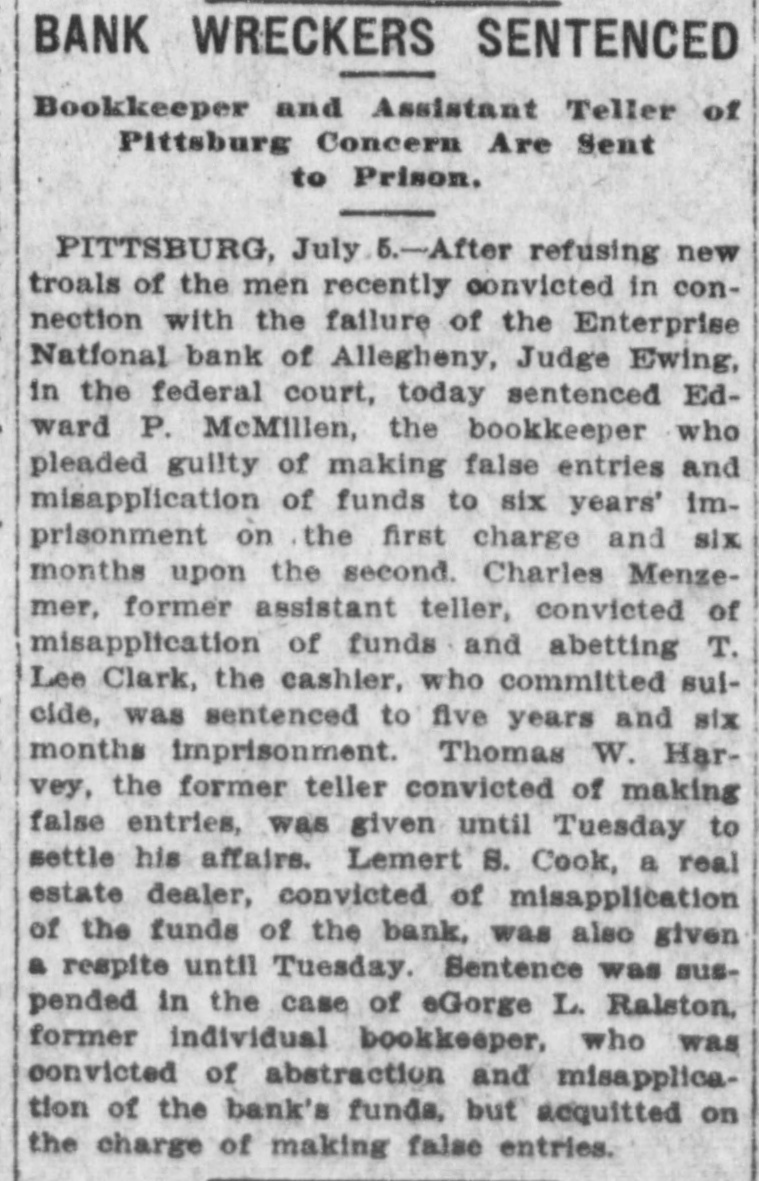
FIVE ARRESTS MADE IN ENTERPRISE BANK CASE AFTERCLAP IN SENSATIONAL FAILURE OF ALLEGHENY INSTITUTION. Three Clerks and Forest B. Nichols, Private Secretary to William H. Andrews, and George E. Cooke, an Alleged Partner of Cashier Clark, Who Committed Suicide, the Men Taken Into Custody - Arraigned Before United States Commissioner and Released on Bonds of $5,000 Each. Pittsburg, March 26.-Five arrests were made to-day as a result of the affair of the Enterprise National bank of Alleghany, which suddenly closed its doors last October following the sensational suicide of its cashier, T. Lee Clark. Deputy United States marshals took into custody Forest B. Nichols, private secretary to William H. Andrews; Charles Menzemer, George R. Ralston and Edward P. McMillan, employes of the Enterprise bank and George E. Cooke, an alleged partner of Cashier Clark, in several real estate deals. The charge against Menzemer is that as clerk of the bank he certified checks drawn upon the bank by persons who had not sufficient funds on deposit to meet the checks drawn and so certified, this constituting a false certification. Nichols is charged with conspiring with an officer of the bank who is not named to abstract and wilfully apply unlawfully monies, funds and credits of the bank. Ralston and McMillan, who were clerks in the bank, are charged with making false entries in the books to defraud the bank, while Cook is charged with conspiring to defraud the bank by getting false credits. The charges were formulated some time ago but the warrants were not issued because the officials desired to secure evidence that was being taken in certain civil proceedings. The men were arraigned before a United States commissioner and furnished bonds in $5,000 each. The arrests are a climax in a most sensational financial collapse and are the result of the investigation made by Bank Examiner Edward P. Moxey, who furnished the information to United' States Commissioner William T. Lindsley. The information was baseed of to the use the funds alleged of conspiracy Enterprise of bank Nichols in the interest of the Santa Fe Central Railroad company and the Pennsylvania Construction company. of the ibank is one The story failure of of the tragedy EnOne was throughout. last terprise the community morning startled in October by the Cashier Clark shooting at news ted suicide that by Simultaneously had bis residence commita suburb. of the bank was the in Bellevue, closing announced. among excitement was caused and the Great many depositors started. rumors The ot' heavy defalcations were of the bank later funds of the directors that the bank had admitted been but it was many bestatus of the bank's misused, fore the weeks affairs beknown. Even at this date no statement of the came definite probable receive div- has idend that the creditors will been made although partial reports have been made to the comptroller of the currency, A warrant was also issued for Thomformer paying teller of the but he has not yet bank, as Harvey, been be found. placed under arrest, as the could not there are In add sixty-eight Twenty-two counts are against the six men. Nichols, six against against Ralston, seventeen Menzemer, against eleven Cook, against McMillan, eleven against and one against Harvey, All the charges are for acts alleged to have been done between June, 1903, and the date of the closing of the bank,


Article from The Roswell Daily Record, October 1, 1906

Click image to open full size in new tab

Article Text

Andrews is Sued. From Albuquerque Journal. Washington, D. C., Sept. 29.-William H. Andrews, territorial delegate to congress from New Mexico, and brother of Republican State Chairman W. R. Andrews, of Pennsylvania;; State Senator Arthur Kennedy and Francis J. Torrance, president of the Allegheny select council, have been sued at Pittsburg on notes and drafts aggregating $437,455. These men were officers of the Pa. Development Company, which constructed the Santa Fe Central railroad in New Mexico. Interested with them was T. Lee Clark, cashier of the Enterprise National Bank of Allegheny, who committeed suicide the day the band closed its doors. The suit is brought by Thomas Rinaker, receiver of the bank. It is cited in the bill that the development company was organized for the promoting of coal and timber lands and building railroads in New Mexico. It is alleged its normal capital of $10,000 was known to be wholly inadequate for its purposes, and it was agreed to raise the necessary funds by the indorsement of promissory notes. In order to get the necessary ready money in the bank with which to meet their notes, according to their statement filed in the suit, they adopt ed, the statement says, "various means known to be used in the past by enterprising politicians in Pennsylvania and procured the treasurer of Pennsylvania to deposit large sums of money in the Enterprise bank." It is alleged T. L. Clark discounted the notes as cashier of the bank, and as treasurer of the development com-


Article from Wausau Pilot, September 22, 1908

Click image to open full size in new tab

Article Text

like $7,500,000 has been stolen by dishonest bank employes in that city. The banks have concluded that the best course before them-while not wisbing to east suspicion upon anyone is to photograph every one of their employes and take their measurements by the Bertillon system, SO that, when a next defalcation may occur, the police authorities all over the world will have the last embezzler marked down as minutely as though he were the most elusive Max Shinburn who ever alternated between safe-cracking and jail service. If there was one bank officer who would have surrendered his complete control of millions rather th submit to being "mugged" by the police, it was William Montgomery, cashier of the Allegheny National, under arrest in connection with the disappearance of $839,000 of deposits and the entire $500,000 worth of capital stock. He was the intimate friend and confidant of Senator Quay. the man who placed Quay's bets during the Harrison campaign, when Quay won $250,000, and the trusted handler of the moneys of the political machine in that section of the State. When the Allegheny National went down-or up- -the State was backing it with $532,000 of deposits and the city of Pittsburg with $1,532,000. Private depositors were SO wary that they let it have little. When the crash came, after a series of speculations in stocks, the police reported the discovery of no photograph of Montgomery, even during their investigations of the suddenlyacquired fortune of a Pittsburg widow whose wealth leaped in eight years from $10,000 to $333,000. and of other women in Pittsburg and neighboring cities, whose real estate investments had increased with remarkable facility. While the fate of the Allegheny National's money still hung in the balance. pending the decision of Montgomery's allies as to restitution of the million that had gone, a man returned to Pittsburg who for nearly three years had left the police bitterly regretful that the Bertillon system was not compulsory there before the Enterprise National of Allegheny co!lapsed in October. 1905. He was Thomas W. Harvey, teller of the Enterprise. who, in the vain hope of escaping the penalty for his share in the crime, had given up his identity and his home, to wander amid agonies of dread until his fearful spirit could no longer bear the strain. He surrendered himself to the Federal authorities, and on the same day was sentenced to seven years in the penitentiary-and that with no more notoriety than if he were a purse snatcher. Pittsburg was learning to wash its dirty linen with neatness, silence and dispatch. Yet the Enterprise embezzlements were among the most sensational ever known in the State of Pennsylvania. The losses amounted to $1,500,000. It was a "political" bank, like the Allegheny National, and hundreds of thousands of its deposits had gone out to politicians on notes which, unsecured at best, had disappeared when the cashier, T. Lee Clark, both poisoned and shot himself, to make sure of death. Speculation, women and gambling was the way the stolen millions went When the Union Trust Company of Pittsburg discovered its loss of $385,000 in 1906, almost on the anniversary of the Enterprise run. the thieves proved to be a couple of mild young persons, Clinton B. Wray, the teller, and C. S. Hixton, the individual bookkeeper. The gambling crooks took it off these two marks in large chunks Both received ten years apiece when their defalcations were discovered. While the gamblers were enjoying the Union Trust Company's cash, the bucket shops were getting during the year between March, 1907, and March of this year $520,000 taken from the Farmers' Deposit National Bank by Henry Reiber, the paying teller, and John Young. the auditor. They proved themselves fools as simple over wildcat curb adventures as the boys of the Union Trust did over crooked cards. For ten years those two presumably experienced financiers had been stealing $1,105,000 from the Farmers' Deposit Bank. and no one, among either officers or directors. had suspected them. They, too, have been sentenced to ten years each. Pittsburg's example has given the State of Pennsylvania a record that puts the dashing depredations of bank robbers in the Southwest, with their masks and their revolvers, to the blush of poignant shame. SHORT NEWS NOTES. Fire in the lumber yards of the Lake