Commercial Bank (New York, NY)

Episode Information

Episode UID
4978963391124
Episode Type
Run β†’ Suspension β†’ Closure
Bank Type
trust
Bank ID
497896339 hash
Start Date
August 12, 1893
Location
New York, New York (40.714, -74.006)

Metadata

Model
gpt-5-mini (chosen from majority vote of a three-model LLM ensemble)
Short Digest
e805c2b6f61f3d6d

Response Measures

None

Description

Articles identify the bank as the Commercial Bank of Brooklyn (not Manhattan); corrected city accordingly.

Events (3)

1. August 12, 1893 Run
Cause
Bank Specific Adverse Info
Cause Details
Large unexpected withdrawals (including a reported $100,000 withdrawal) after discovery of impaired/slow assets and past overdrafts reduced reserves and triggered depositor panic
Measures
Directors closed the bank and public statements were made assuring depositors; Bank Examiner A. C. Judson took possession to examine books
Newspaper Excerpt
there was consequently a small army of depositors around the bank doors at the accustomed hour of opening
Source
newspapers
2. August 12, 1893 Suspension
Cause
Bank Specific Adverse Info
Cause Details
Directors closed the bank because deposits had decreased greatly and assets were slow/illiquid; Clearing house correspondent refused to clear for the bank
Newspaper Excerpt
This bank having closed its doors, I have taken possession of its affairs and commenced an examination into its condition. CHARLES M. PRESTON, Superintendent of Banks.
Source
newspapers
3. August 31, 1893 Receivership
Newspaper Excerpt
The appointment of a receiver for the suspended Commercial Bank of Brooklyn ... William N. Dykman ... was named upon the application of Deputy-Attorney General Hogan.
Source
newspapers

Newspaper Articles (23)

Article from The Sun, August 13, 1893

Click image to open full size in new tab

Article Text

This Bank is Closed Temporarily J.J. VAIL, Cashier. There had not been the slightest rumor that the bank was in any financial strait. and even until the closing hours on Friday depositors kept putting in their money. The people who mainly do business with the Commercial are builders. contractors. and boss mechanics. and the closing of the bank on Saturday was a source of special inconvenionce to them. as the money to pay their employees is usually drawn out upon that day. There was consequentiy a small army of depositors around the bank doors at the accustomed hour of opening. and they indulged in varied adjectives on reading the announcement of temporary suspension. Inasmuch as the institution was regarded as one of the most solid in the State. the surprise extended be. yond those directly interested and caused a brief panic among the customers of the other banks. This quickly subsided. however. when it became known that no other local bank was in any way affected by the Commercial's trouble. The action of the directors was se sudden that even W. M. Dykman. counsel of the bank. was not consulted about the matter until resterday morning. He said: "This has been a complete surprise to me. as I knew nothing about it. and. for that mattor. nobody did until the exchanges had been made this morning. Then it was found that there was not enough money to transact the day's business." Mr. Dykman assured the anxious depositors that he was confldent the emburrassment would only be for a short time and that they would all get their money in full. t 11:45 o'clock this official statement was given out by David A. Barnett. who is law counsel for the bank: At the close of banking hours yesterday the National Bank of New York, National Banking Association, through which the Commercial Bank has heretofore transacted its business with the New York Clearing House, refused to act for the Commercial Bank after to-day The deposits at the Commercial Bank have decreased very largely for the last month. This decrease of deposits. with other causes. determined the directors 10 close the bank this morning About three years when Mr. Keeney became President. there were large overdrafts, which the previous administration of the aftairs of the bank had permitted to be made. These have been decreased. and the directors of the bank. under the lead of Mr. Keeney. made good the losses. Since Mr. Keeney became President the bank has lost considerably less than $10,000. The President and directors have been constdent of their ability to make the bank a success and have been prevented only by the unexpected with. drawal of deposits. There should be enough to pay ail depositors and shareholders. This was quickly followed by the posting of the following notice by Chief Bank Examiner A. C. Judson: This bank having closed its doors, I have takes possession of its affairs and commenced an examination into Its condition. CHARLES M. PRESTON, Superintendent of Banks. Mr. Judson told the reporters that his assistants were at work on the books but that he would not be able to make a detailed statement for at least four or five days. The overdrafts referred to were made about four years ago by ex-Alderman Paul C. Grening. an extensive real estate speculator and at present the proprietor of a hotel in Saratoga. and by G. L. Hassell. a teller in the New York Clearing House. When Mr. Seth L. Keeney became President three years ago ho and his fellow directors put up $80,000 to meet the notes. but just what loss they sustained by the overdraits has not been ascertained. Mr. Grening gave the bank as collateral $100,000 in mortgage. on all his property to secure the directors. It is said that it was not until yesterday morning that Mr. Keeney despaired of bridging over the present difficulties. He found that money could only be secured at a big premium. and that he could not dispose of his own valuable securities except at a low figure. This he did not think he could be fairly called up in to do This is the last quarterly statement of the bank. made June 1:
Article from The Sun, August 13, 1893

Click image to open full size in new tab

Article Text

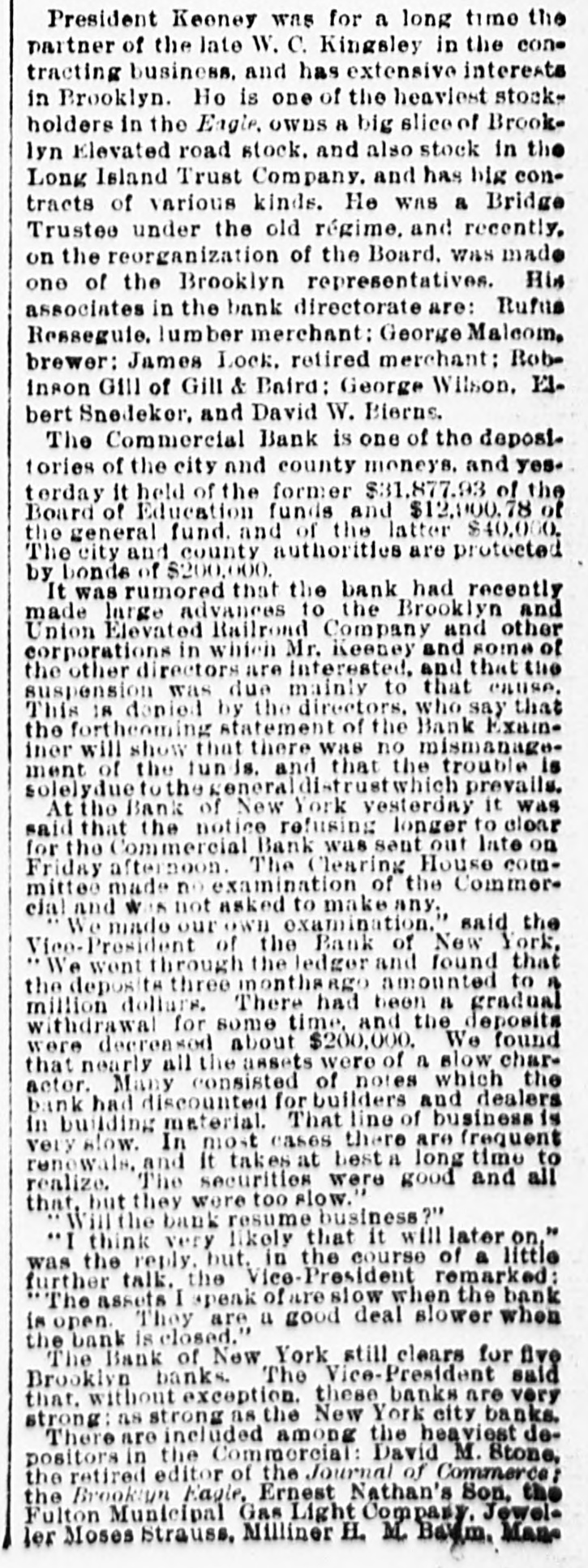
President Keeney was for a long time the partner of the late W. C. Kingsley in the contracting business. and has extensive interests in Brooklyn. Ho is one of the heavlest stockholders in the Eagle, owns a big slice of Brooklyn Elevated road stock. and also stock in the Long Island Trust Company. and has hig contracts of various kinds. He was a Bridge Trustee under the old rΓ©gime, and recently. on the reorganization of the Board. was made one of the Brooklyn representatives. His associates in the bank directorate are: Rufus Resseguie. lumber merchant: George Malcom. brewer: James Lock. retired merchant: Robinson Gill of Gill & Baird: George Wilson. Elbert Snedeker, and David W. Bierns. The Commercial Bank is one of the depositories of the city and county moneys. and yesterday it held of the former $31,877.93 of the Board of Education funds and $12,900.78 of the general fund. and of the latter $40,000. The city and county authorities are protected by bonds of $200,000. It was rumored that the bank had recently made large advances to the Brooklyn and Union Elevated Railrond Company and other corporations in which Mr. Keeney and some of the other directors are interested, and that the suspension was due mainly to that cause. This 18 denied by the directors, who say that the fortheoming statement of the Bank Examiner will show that there was no mismanagement of the tunis. and that the trouble is solelydue to the general which prevails. At the Bank of New York vesterday it was said that the notice refusing longer to clear for the Commercial Bank was sent out late on Friday afternoon. The Clearing House committee made no examination of the Commercial and was not asked to make any. We made our own examination." said the -President of the Bank of New York, We went through the ledger and found that the deposits three monthaago amounted to n million dollars. There had been a gradual withdrawal for some time, and the deposits were decreased about $200,000. We found that nearly all the assets were of a slow charactor. Many consisted of notes which the bank had discounted for builders and dealers in building material. That line of business is very slow. In most cases there are frequent renowals. and It takes at best a long time to realize. The securities were good and all that, but they were too slow." Will the bank resume business?" "I think very likely that it will later on," was the reply. but. in the course of a little further talk. the Vice-President remarked: "The assets I speak of are slow when the bank is open. They are a good deal slower when the bank is closed." The Bank of New York still clears for five Brooklyn banks. The Vice-President said that. without exception. these banks are very strong: as strong as the New York city banks. There are included among the heaviest depositors in the Commercial: David M. Stone, the retired editor of the Journal of Commerce: the Brooklyn Ragle, Ernest Nathan's Son, the Fulton Municipal Gas Light Company, Jeweller Moses Strauss. Milliner H. M. Baum. Mane


Article from New-York Tribune, August 13, 1893

Click image to open full size in new tab

Article Text

SCENE OUTSIDE COMMERCIAL BANK, BROOKLYN. gressive and it looked at one time as though there would be serious trouble. The police were finally called in to restore order. The remote cause of the bank's suspension was the overdrawing of two accounts previous to the presidency of Seth L. Keeney, the present head of the institution. The men who were allowed to overdraw were Paul C. Grening. the well-known realestate man, and G. L. Hassell, of No. 93 Saratoga-ave., Brooklyn. This occurred when Thomas D. Hudson was president of the bank. When Mr. Keeney became president he found the capital had been impaired and called a conference of the directors. They decided to contribute their individual notes for $10,000 each. making a total of $80,000. It was thought that this sum was sufficient to keep the bank solvent. Mr. Grening's overdrafts are secured by judgments on his property, but Hassell had no property and his notes were renewed from time to time. At 11 o'clock yesterday morning David A. Barnett, one of the counsel for the bank, gave out the following statement: "At the close of banking hours Friday the Bank of New-York, through which the Commercial Bank has heretofore transacted its business with the New-York Clearing House, refused to act for the Commercial Bank after to-day. The deposits at the Commercial Bank have decreased very largely for the last month. This decrease of deposits with other causes, determine the directors to close the bank this morning. "About three years ago, when Mr. Keeney became president. there were large overdrafts, which the previous administration of the affairs of the bank had permitted to be made. These have been decreased. and the directors of the bank, under the lead of Mr. Keeney, made good the losses, "Since Mr. Keeney became president the bank has lost considerably less than $10,000. The president and directors have been confident of their ability to make the bank a success, and have been prevented only by the unexpected withdrawal of deposits. There should be enough to pay all depositors and shareholders." It was learned yesterday that one depositor had withdrawn $100,000 in the last few days, and that this was the immediate cause of the bank's suspension. Bank-Examiner Judson arrived at the bank about 11 a. m., and immediately began an investigation, but it will be several days before he can make a statement. Of the city of Brooklyn's money $12,900.78 of the General Fund. and $31,877.93 of the Board of Education Fund is deposited with this bank. Mr. Barnett said that all the depositors would receive their money, but expressed some doubt that the stockholders would come out without loss. The capital of the bank was $108,000, and interest at the rate of 2 per cent was paid on educational money and 1Β½ per cent on other city money held. About $40,000 of the Kings County funds are deposited in the bank. The Bank of New-York, which cleared for the Commercial Bank, will not be affected by the failure. The stock of the Commercial when Mr. Keeney became president sold at 150, and its financial condition has generally been considered sound. Mr. Grening and Mr. Hassell are in Saratoga. All the directors also are out of town. They are Seth L. Keeney, Rufus Resseguie, George Malcom, James Locke, George Wilson, Gilbert Snedeker, David W. Binns, John H. Rowland and Robinson Gill. The last quarterly statement of the Commercial Bank, made June 1, was as follows: RESOURCES.


Article from Grand Rapids Herald, August 14, 1893

Click image to open full size in new tab

Article Text

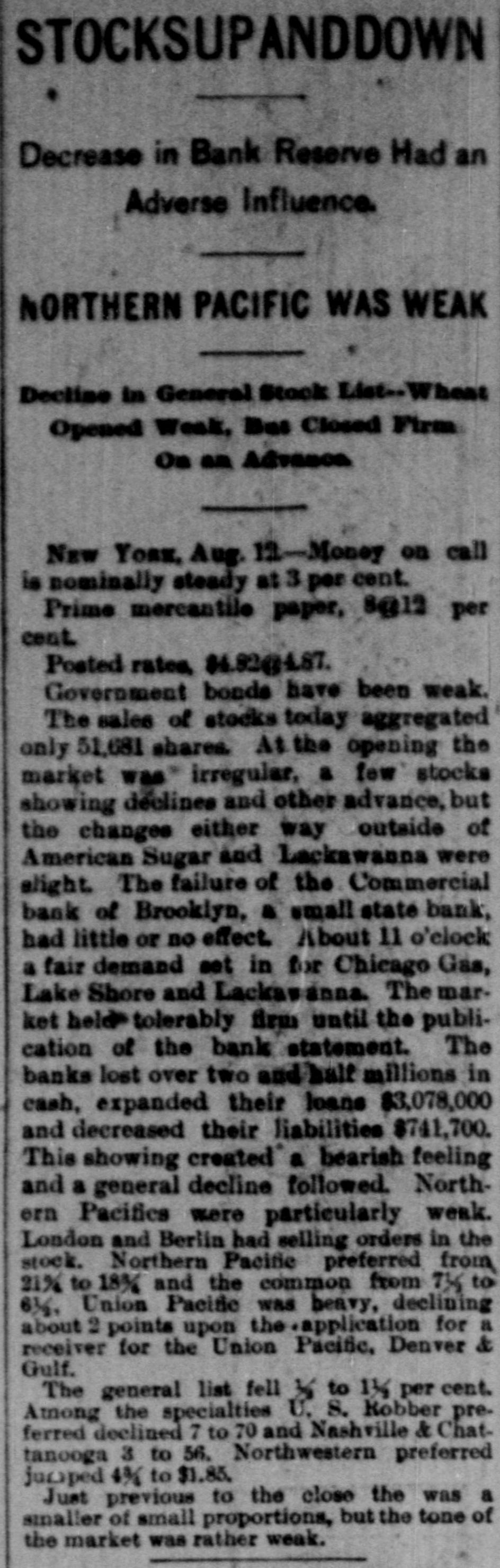
STOCKSUPANDDOWN Decrease in Bank Reserve Had an Adverse Influence. NORTHERN PACIFIC WAS WEAK Decline in General Stock List--Wheat Opened Weak, But Closed Firm On an Advance New York, Aug. 12-Money on call is nominally steady at 3 per cent. Prime mercantile paper, 8@12 per cent. Posted rates, $4.82@4.87. Government bonds have been weak. The sales of stocks today aggregated only 51,681 shares. At the opening the market was irregular, a few stocks showing declines and other advance, but the changes either way outside of American Sugar and Lackawanna were elight. The failure of the Commercial bank of Brooklyn, a small state bank, had little or no effect. About 11 o'clock a fair demand set in for Chicago Gas, Lake Shore and Lackavanna. The market held* tolerably firm until the publication of the bank statement. The banks lost over two and half millions in cash, expanded their loans $3,078,000 and decreased their liabilities $741,700. This showing created hearish feeling and a general decline followed. Northern Pacifics were particularly weak. London and Berlin had selling orders in the stock. Northern Pacific preferred from 21% to 18% and the common from 73/2 to 6Β½, Union Pacific was heavy, declining about 2 points upon the application for a receiver for the Union Pacific, Denver & Gulf. The general list fell X to 1Β½ per cent. Among the specialties U. S. Robber preferred declined 7 to 70 and Nashville & Chattanooga 3 to 56, Northwestern preferred juriped 4% to $1.85. Just previous to the close the was a smaller of small proportions, but the tone of the market was rather weak.


Article from New-York Tribune, August 31, 1893

Click image to open full size in new tab

Article Text

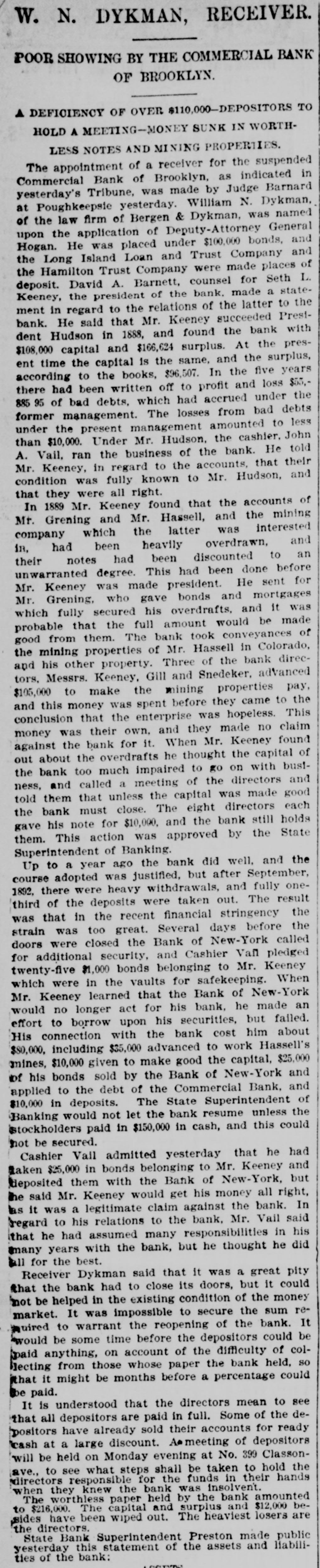
W. N. DYKMAN, RECEIVER POOR SHOWING BY THE COMMERCIAL BANK OF BROOKLYN. DEFICIENCY OF OVER $110,000-DEPOSITORS TO HOLD A meeting-money SUNK IN WORTHLESS NOTES AND MINING PROPERTIES. The appointment of a receiver for the suspended Commercial Bank of Brooklyn, as indicated in yesterday's Tribune, was made by Judge Barnard at Poughkeepsie yesterday. William N. Dykman of the law firm of Bergen & Dykman, was named upon the application of Deputy-Attorney General Hogan. He was placed under $100,000 bonds, and the Long Island Loan and Trust Company and the Hamilton Trust Company were made places of deposit. David A. Barnett, counsel for Seth L Keeney, the president of the bank. made a state ment in regard to the relations of the latter to the bank. He said that Mr. Keeney succeeded President Hudson in 1888, and found the bank with $108,000 capital and $166,624 surplus. At the present time the capital is the same, and the surplus, according to the books, $96,507. In the five years there had been written off to profit and loss $55,95 of bad debts, which had accrued under the former management. The losses from bad debts under the present management amounted to less than $10,000. Under Mr. Hudson, the cashier, John A. Vail, ran the business of the bank. He told Mr. Keeney, in regard to the accounts, that their condition was fully known to Mr. Hudson, and that they were all right. In 1889 Mr. Keeney found that the accounts of Mr. Grening and Mr. Hassell, and the mining company which the latter was interested in, had been heavily overdrawn, and their notes had been discounted to an unwarranted degree. This had been done before Mr. Keeney was made president. He sent for Mr. Grening, who gave bonds and mortgages which fully secured his overdrafts, and it was probable that the full amount would be made good from them. The bank took conveyances of the mining properties of Mr. Hassell in Colorado, and his other property. Three of the bank directors, Messrs. Keeney, Gill and Snedeker, advanced $105,000 to make the mining properties pay, and this money was spent before they came to the conclusion that the enterprise was hopeless. This money was their own, and they made no claim against the bank for it. When Mr. Keeney found out about the overdrafts he thought the capital of the bank too much impaired to go on with bustness, and called a meeting of the directors and told them that unless the capital was made good the bank must close. The eight directors each gave his note for $10,000, and the bank still holds them. This action was approved by the State Superintendent of Banking. Up to a year ago the bank did well, and the course adopted was justified, but after September, 1892, there were heavy withdrawals, and fully onethird of the deposits were taken out. The result was that in the recent financial stringency the strain was too great. Several days before the doors were closed the Bank of New-York called for additional security, and Cashier Vafl pledged twenty-five $1,000 bonds belonging to Mr. Keeney which were in the vaults for safekeeping. When Mr. Keeney learned that the Bank of New-York would no longer act for his bank, he made an effort to borrow upon his securities, but failed. His connection with the bank cost him about $80,000, including $35,000 advanced to work Hassell's mines, $10,000 given to make good the capital, $25,000 of his bonds sold by the Bank of New-York and applied to the debt of the Commercial Bank, and $10,000 in deposits. The State Superintendent of Banking would not let the bank resume unless the stockholders paid in $150,000 in cash, and this could


Article from New-York Tribune, September 3, 1893

Click image to open full size in new tab

Article Text

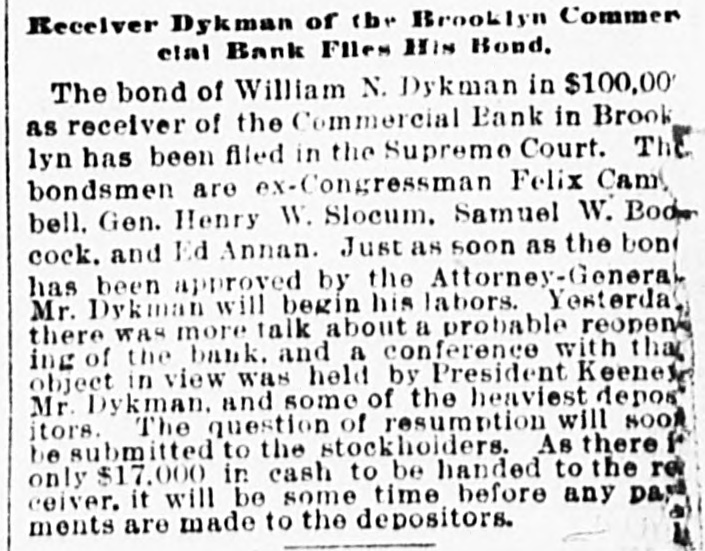
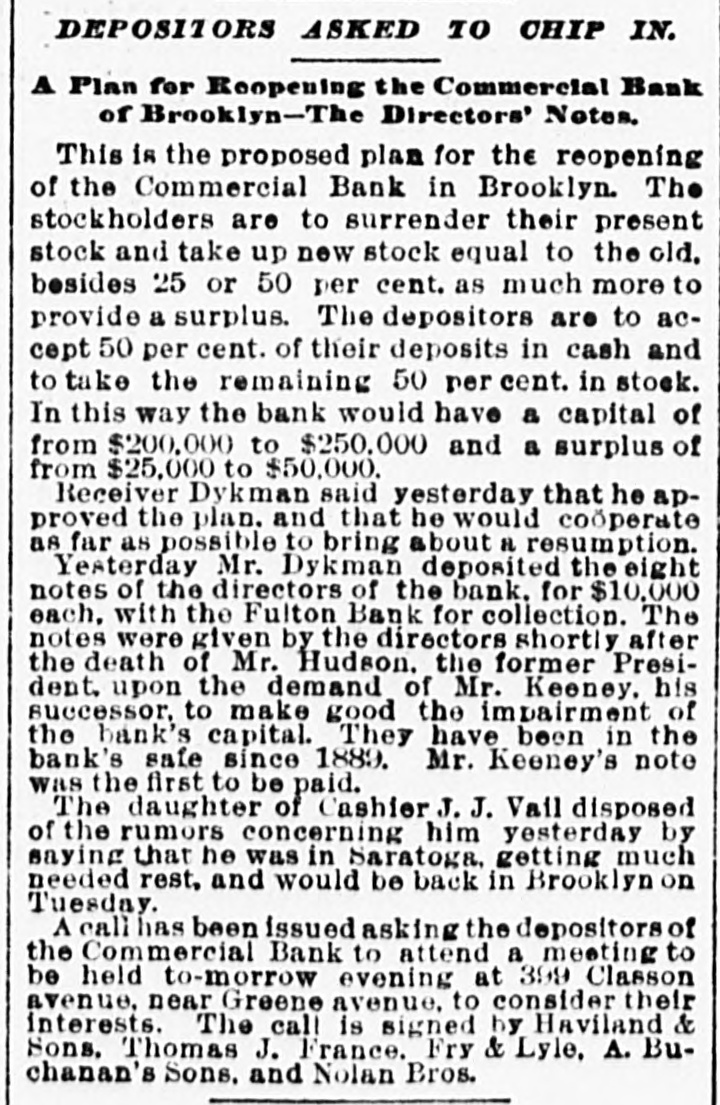
TRYING TO START THE BANK AGAIN. A PLAN FOR THE RESUMPTION OF THE COMMERCIAL-HOPE OF ITS SUCCESS. A plan for resumption has been formulated for the Commercial Bank since Receiver W. N. Dykman took charge of it. He- deposited the notes of the eight directors for $10,000 each with the Fulton Bank for collection yesterday. These notes were given four years ago to make good the impairment of the bank's capital caused by overdrafts. President Seth L. Keeney Have his certified check for $10,000 to cash his note yesterday. David Barnett, counsel for the bank, said that it was proposed to increase the capital of the bank to $200,000 or $250,000, and 10 get the stockholders and depositors to take stocks for half the amount due them over $200. This will give them a chance to get half their money at once, and will give the depositors a voice in the management of the bank. If the receiver should wind up the bank's a:fairs the stockholders would not only lose their stock but would be called upon for an amount almost equal to its par value to pay off depositors. The latter would not get their money for a long time if the bank should now be wound up. Mr. Barnett thought that enough of the stockholders and depositors would accept the proposition to carry it into effect. Receiver Dykman said yesterday: "I am hearthy in sympathy with the efforts of the directors to reopen the bank, and anything 1. can do to further their efforts will be done. I am engaged in taking account of the securities of the bank, and collection." have sent out the notes of the directors for John J. Vall, the cashier of the bank, went to Saratoga for a rest as soon as the receiver was appointed. His friends say there is no foundation for the report that he had absconded, and that he will be back in a few days The following notice has been sent to depositors of the bank: "Depositors of the Commercial Bank (who are not also stockholders) are respectfully invited to attend a meeting to be held at Haviland Hall, No. 399 Classon-ave., near Greene-ave,, Monday evening, September 4, 1893, at 8 o'clock, to adopt measures


Article from The Sun, September 6, 1893

Click image to open full size in new tab

Article Text

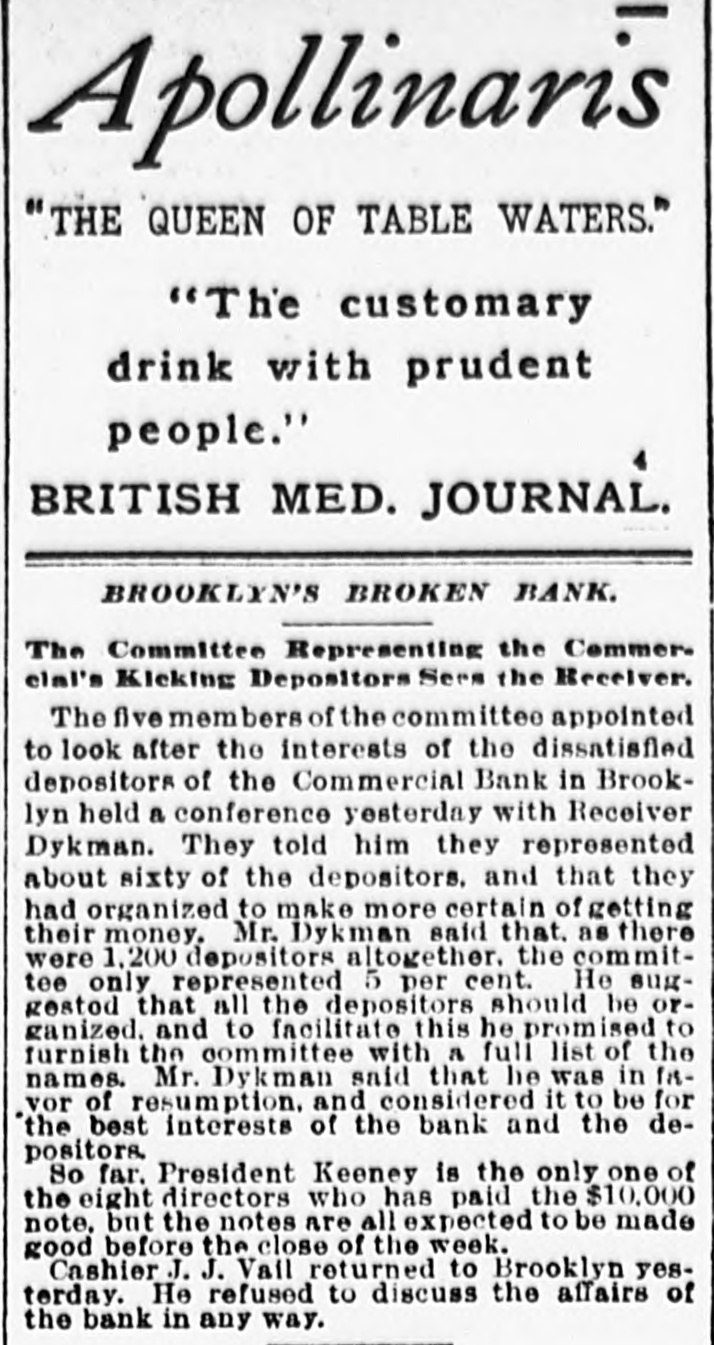
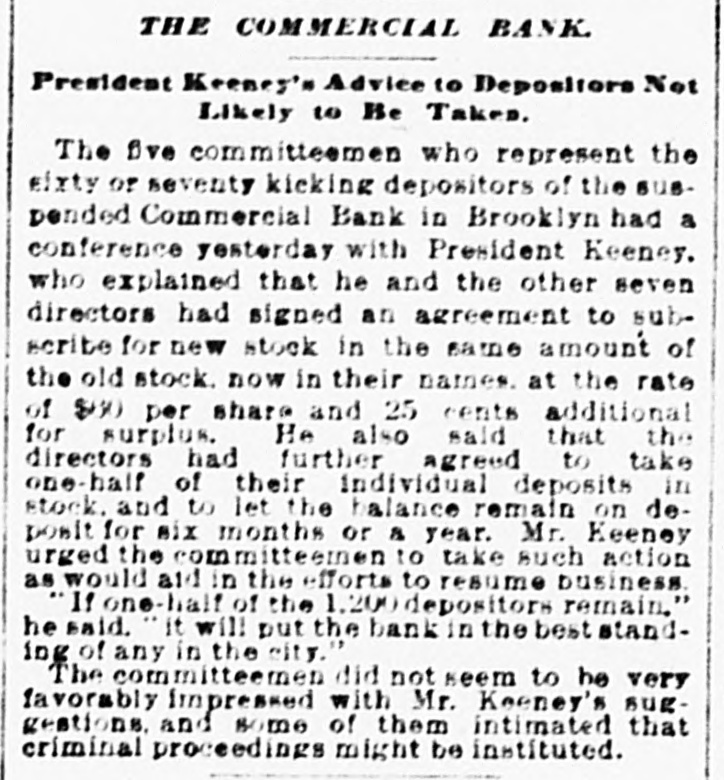
Apollinaris "THE QUEEN OF TABLE WATERS." "The customary drink with prudent people." 4 BRITISH MED. JOURNAL. BROOKLYN'S BROKEN BANK. The Committee Representing the Commerclai's Kleking Depositors Sers the Receiver. The five members of the committee appointed to look after the interests of the dissatisfled depositors of the Commercial Bank in Brooklyn held a conference yesterday with Receiver Dykman. They told him they represented about sixty of the depositors. and that they had organized to make more certain of getting their money. Mr. Dykman said that. as there were 1,200 depositors altogether. the committee only represented 5 per cent. He suggested that all the depositors should be organized. and to facilitate this he promised to furnish the committee with a full list of the names. Mr. Dykman said that he was in firvor of resumption. and considered it to be for the best interests of the bank and the depositors. So far. President Keeney is the only one of the eight directors who has paid the $10,000 note. but the notes are all expected to be made good before the close of the week. Cashier J. J. Vail returned to Brooklyn yesterday. He refused to discuss the affairs of the bank in any way.


Article from New-York Tribune, September 10, 1893

Click image to open full size in new tab

Article Text

COMMERCIAL BANK DIRECTORS MEET. AN ADDRESS TO BE SENT TO STOCKHOLDERSRECEIVER DYKMAN DEMANDS PAYMENT ON DIRECTORS' NOTES. The directors of the suspended Commerctal Bank, of Brooklyn, met yesterday and formulated their plan for securing the money needed to resume business and dispense with the receiver recently appointed. The meeting was held in the office of David Barnett, counsel for the bank, and resulted in the adoption of an address to the stockholders. It set forth that the action begun on August 30 to declare the bank insolvent required an answer in twenty days, and the only effectual answer would be a denial of the insolvency. To do this the shareholders, either with or without the co-operation of the depositors, must make the bank solvent. There was a deficiency of $2,000 beyond the capital stock of $108,000, and this would be increased by the failure of debtors to the bank to pay up in view of the stringency of the money market. If the bank was declared insolvent there would be a large amount to be paid. But If it resumed the shrinkage of assets would be reduced and the expenses would be nominal. If the shareholders would pay in 25 per cent of the par value of the shares ($60 each), to make good the losses of depositors, and then pay an amount equal to the par value of the shares, the bank would be solvent, and if the depositors co-operated a career of prosperity could be enjoyed. Many of the depositors whose accounts were the most profitable had agreed to remain with the bank. Receiver Dykman was at the meeting, and informed the directors that each must pay his note of $10,000 given three years ago to make good the impairment of the capital of the bank. Mr. Keeney Is the only one who has paid up, but the others agreed to do so before the close of the week. Cashier Vail has also been informed that he must make good his notes for $4,000. The receiver intends to push things so that there will be no ground


Article from New-York Tribune, September 14, 1893

Click image to open full size in new tab

Article Text

HARD WORDS FOR STATE OFFICIALS. THE DEPOSITORS OF THE COMMERCIAL BANK STRONGLY CONDEMN THE SUPERIN TENDENT AND SEEK AID FROM GOVERNOR FLOWER. Another meeting of the depositors of the suspended Commercial Bank of Brooklyn was held last evening at Haviland Hall. in Classon-ave and action was taken in the matter of laying before the Governor the facts, and asking for an investigation of the affairs of the bank and for the removal of the State officials charged with being responsible for the present condition. C. A. Haviland presided. He said: "We know that a Bank Superintendent has been a stupid blunderer. or something worse, and that the Banking Department of the State, in which we reposed confidence, is no longer the safeguard of the people. We know that he who has been appointed receiver is the attorney of the bank's president. and as the attorney called upon on that Black Friday to advise bank officials who betrayed us, will oppose the appointment of an associate receiver, for he has told us so. We must have an associate receiver appointed at once. For four weeks. David Barnett. as attorney of the bank. stood idling his time for delay: and he hoodwinked depositors. In the mean time his receiver, who is under no obligation to serve depositors as he is to serve clients, will be made permanent receiver, and we shall be the dupes of bank attorneys. I ask you to secure the appointment of a receiver if the Attorney-General fails to move in the matter. and to present the Bank Superintendent to the Governor as one who has, purposely or through ignorance, betrayed the people of the State, Mr. Haviland said that he had telegraphed to the Attorney-General, who replied that he would be glad to see a committee on Friday. A resolution was then adopted condemning the State Bank officials, and directing the Executive Committee to wait upon Governor Flower and demand an investigation Richard Drant presented figures to show that the bank could not resume business The liabilities were $790,000 and the assets only $660,000. Louis Wanke was placed on the Executive Committee in place of John Schillins


Article from The Sun, September 15, 1893

Click image to open full size in new tab

Article Text

To Appeal to Gov. Flower To-day. A delegation from the depositors of the suspended Commercial Bank of Brooklyn. who are at war with the receiver. will go to Albany to-day and lay their grievances before Gov. Flower and Attorney-General Rosendale. If they do not succeed in having an associate receiver appointed an appeal will be made to the courts.


Article from The Evening World, September 19, 1893

Click image to open full size in new tab

Article Text

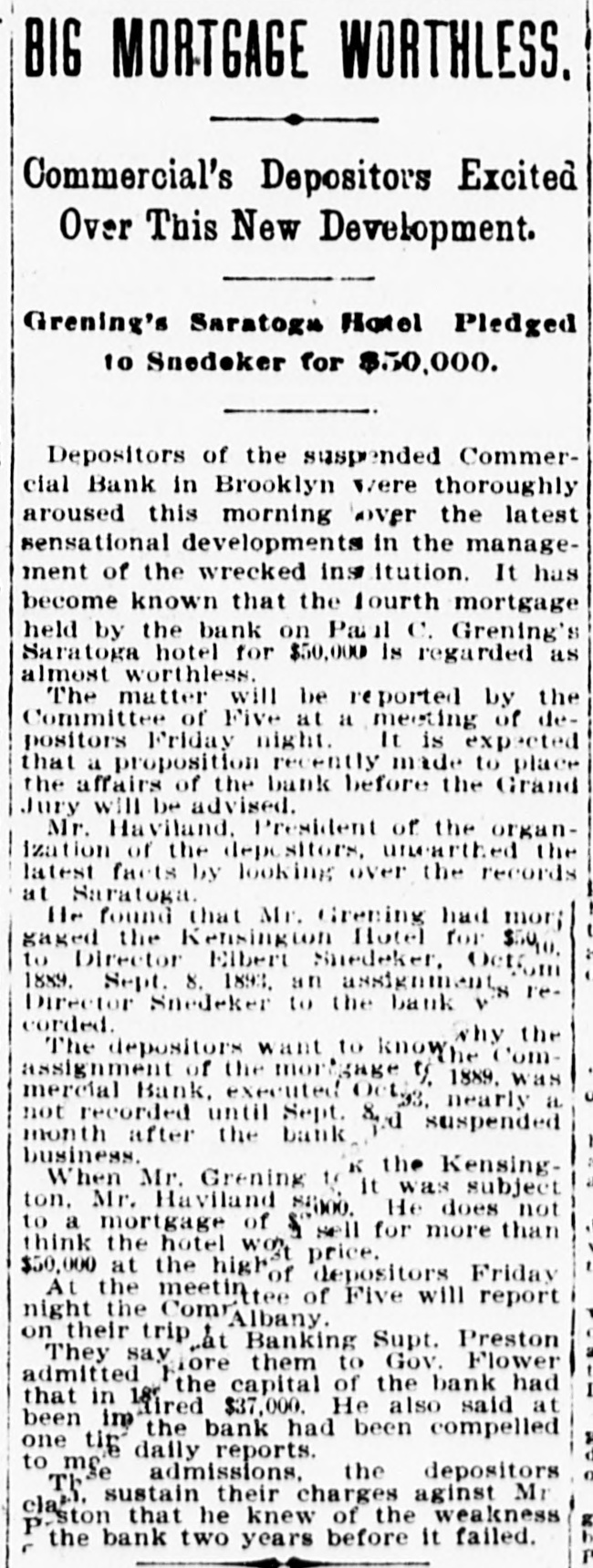
# BIG MORTGAGE WORTHLESS. Commercial's Depositors Excited Over This New Development. Grening's Saratoga Hotel Pledged to Snedeker for $50,000. Depositors of the suspended Commercial Bank in Brooklyn were thoroughly aroused this morning over the latest sensational developments in the management of the wrecked institution. It has become known that the fourth mortgage held by the bank on Paul C. Grening's Saratoga hotel for $50,000 is regarded as almost worthless. The matter will be reported by the Committee of Five at a meeting of depositors Friday night. It is expected that a proposition recently made to place the affairs of the bank before the Grand Jury will be advised. Mr. Haviland, President of the organization of the depositors, unearthed the latest facts by looking over the records at Saratoga. He found that Mr. Grening had mortgaged the Kensington Hotel for $500 to Director Elbert Snedeker, October 1889. Sept. 8, 1893, an assignment is recorded. Director Snedeker to the bank. The depositors want to know why the assignment of the mortgage to the Commercial Bank, executed October 1889, was not recorded until Sept. 8, and suspended a month after the bank's business. When Mr. Grening took the Kensington, Mr. Haviland $8000. It was subject to a mortgage of. He does not think the hotel would sell for more than $50,000 at the highest price. At the meeting of depositors Friday night the Committee of Five will report on their trip to Albany. They say more to Gov. Flower admitted that the capital of the bank had that in aired $37,000. He also said at one time the bank had been compelled to make daily reports. These admissions, the depositors claim, sustain their charges against Mr. Preston that he knew of the weakness of the bank two years before it failed.


Article from The Evening World, September 22, 1893

Click image to open full size in new tab

Article Text

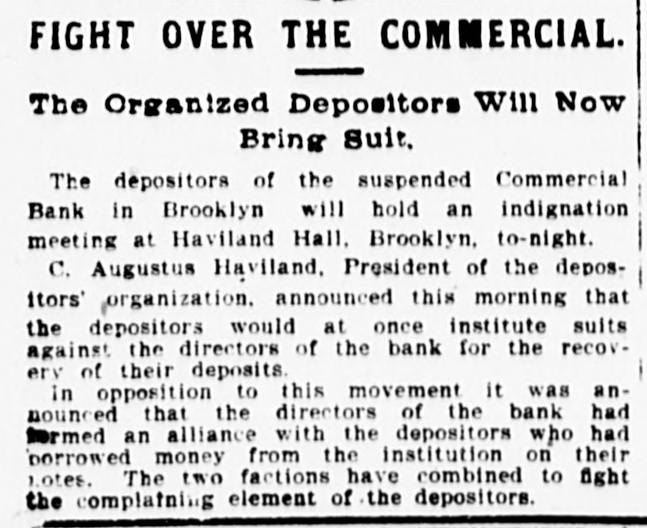
# FIGHT OVER THE COMMERCIAL. The Organized Depositors Will Now Bring Suit. The depositors of the suspended Commercial Bank in Brooklyn will hold an indignation meeting at Haviland Hall, Brooklyn, to-night. C. Augustus Haviland, President of the depositors' organization, announced this morning that the depositors would at once institute suits against the directors of the bank for the recovery of their deposits. In opposition to this movement it was announced that the directors of the bank had formed an alliance with the depositors who had borrowed money from the institution on their notes. The two factions have combined to fight the complaining element of the depositors.


Article from New-York Tribune, October 1, 1893

Click image to open full size in new tab

Article Text

NO PERMANENT RECEIVER YET. THE APPOINTMENT POSTPONED IN HOPE OF AN AGREEMENT BY THOSE INTERESTED IN THE COMMERCIAL BANK. The appointment of a permanent receiver for the suspended Commercial Bank was postponed for thirty days yesterday by Judge Pratt, in the Supreme Court, in the hope that the directors, stockholders and depositors may agree upon a plan for resumption of business. Meanwhile W. N. Dykman will continue to serve as temporary receiver. An application for an associate receiver was made in behalf of some of the depositors, but decision regarding it was reserved. Deputy Attorney-General Hogan applied for the appointment of a permanent receiver. Horace Graves, for the organized depositors, presented an affidavit setting forth that the deponents, the committee of the depositors, represented $300,000. They desired an immediate winding up of the affairs of the bank, and expressed fear lest Receiver Dykman should not be impartial, by reason of his former intimate relations with the bank officials. A summary of the affairs of the bank was presented, setting forth that the deficit to be made good would be $350,000, instead of $110,695 65, as figured by the directors, and that the bank had been insolvent for four years, while the directors had knowingly made false reports and had manipulated the assets of the bank in a suspicious manner. Counsel for the receiver denied the allegations of Mr. Graves. David Barnett, who appeared for the directors, wanted the matter adjourned for six weeks, so that the bank could be put on its feet. The Deputy Attorney-General said that if a plan of resumption could be formulated it would be a good thing, and he did not oppose the application for adjournment.


Article from The Evening World, October 16, 1893

Click image to open full size in new tab

Article Text

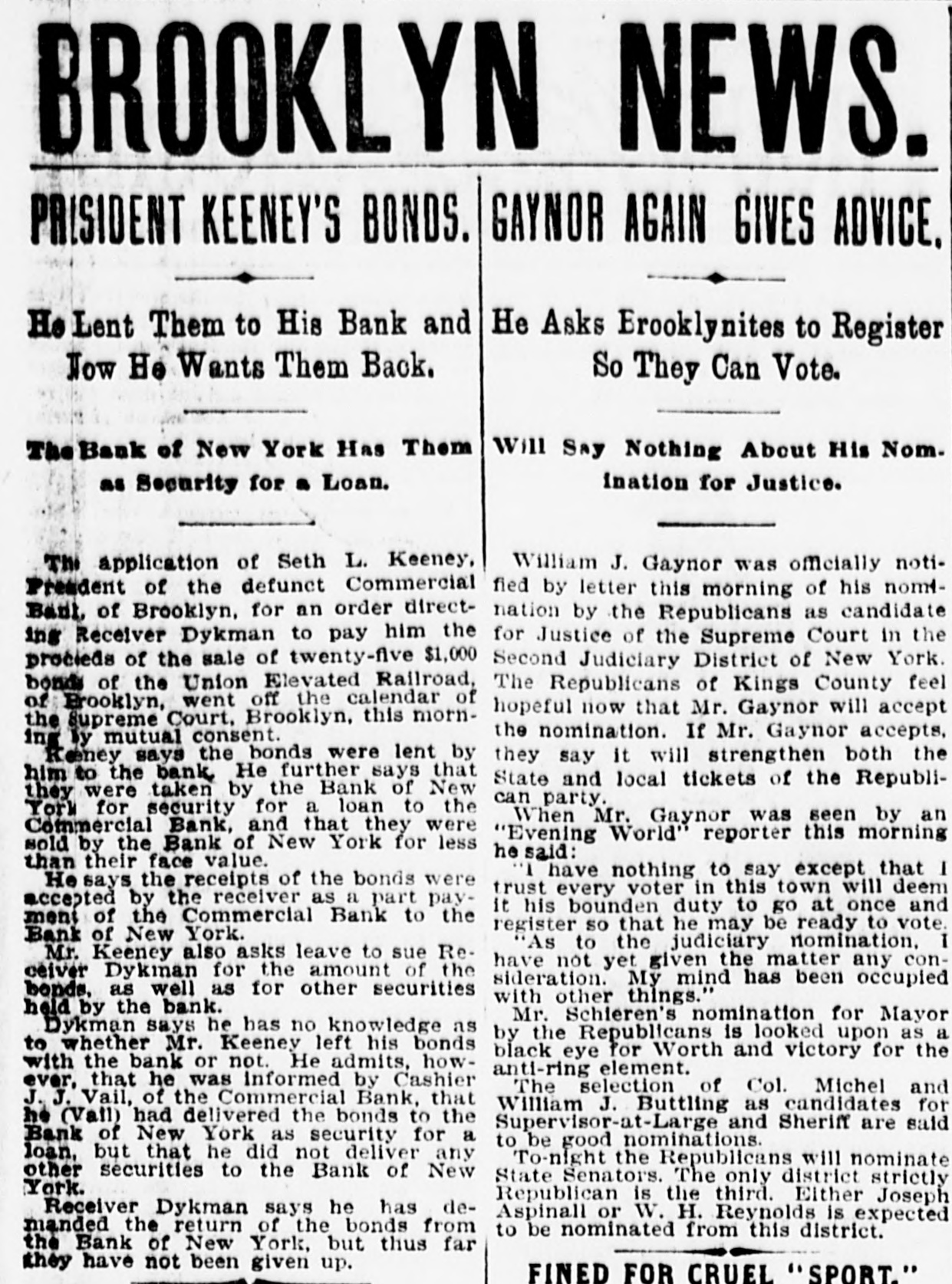
# BROOKLYN NEWS. # PRISIDENT KEENEY'S BONDS. GAYNOR AGAIN GIVES ADVICE. He Lent Them to His Bank and He Asks Erooklynites to Register How He Wants Them Back. So They Can Vote. The Bank of New York Has Them Will Say Nothing About His Nom- as Security for a Loan. ination for Justice. The application of Seth L. Keeney, William J. Gaynor was officially noti- President of the defunct Commercial fied by letter this morning of his nomi- Bank, of Brooklyn, for an order direct- nation by the Republicans as candidate ing Receiver Dykman to pay him the for Justice of the Supreme Court in the proceeds of the sale of twenty-five $1,000 Second Judiciary District of New York. bonds of the Union Elevated Railroad, The Republicans of Kings County feel of Brooklyn, went off the calendar of hopeful now that Mr. Gaynor will accept the Supreme Court, Brooklyn, this morn- the nomination. If Mr. Gaynor accepts, ing by mutual consent. they say it will strengthen both the Keeney says the bonds were lent by State and local tickets of the Republi- him to the bank. He further says that can party. they were taken by the Bank of New When Mr. Gaynor was seen by an York for security for a loan to the "Evening World" reporter this morning Commercial Bank, and that they were he said: sold by the Bank of New York for less "I have nothing to say except that I than their face value. trust every voter in this town will deem He says the receipts of the bonds were it his bounden duty to go at once and accepted by the receiver as a part pay- register so that he may be ready to vote. ment of the Commercial Bank to the "As to the judiciary nomination, I Bank of New York. have not yet given the matter any con- Mr. Keeney also asks leave to sue Re- sideration. My mind has been occupied ceiver Dykman for the amount of the with other things." bonds, as well as for other securities Mr. Schieren's nomination for Mayor held by the bank. by the Republicans is looked upon as a Dykman says he has no knowledge as black eye for Worth and victory for the to whether Mr. Keeney left his bonds anti-ring element. with the bank or not. He admits, how- The selection of Col. Michel and ever, that he was informed by Cashier William J. Buttling as candidates for J. J. Vail, of the Commercial Bank, that Supervisor-at-Large and Sheriff are said he (Vail) had delivered the bonds to the to be good nominations. Bank of New York as security for a To-night the Republicans will nominate loan, but that he did not deliver any State Senators. The only district strictly other securities to the Bank of New Republican is the third. Either Joseph York. Aspinall or W. H. Reynolds is expected Receiver Dykman says he has de- to be nominated from this district. manded the return of the bonds from the Bank of New York, but thus far they have not been given up. FINED FOR CRUEL "SPORT."


Article from The Evening World, November 22, 1893

Click image to open full size in new tab

Article Text

# DIRECTORS MAY BE LIABLE. Commercial Bank Officers to Be Held for Deposits. The investigating committee appointed by the organization of depositors of the suspended Commercial Bank, of Brooklyn, will make known the result of the inquiries at a meeting of the organization at Haviland Hall, Fulton street and Grand avenue, on Thursday of next week. President C. Augustus Haviland thinks that the facts which have been learned by the Committee will be sufficient to hold the directors responsible for every dollar of the depositors' money, something over $700,000. He stated to-day that the George L. Hassell account was carried for years when it was known to be worthless. He also alleges that officers of the bank invested in Hassell's mine and then took stock in the St. Kevin Mining Company as collateral for loans. The total unpaid accounts of Hassell and the St. Kevin Mining Company amount, it is stated, to $166,283.09. A resolution from a meeting of the Board of Directors on Dec. 18, 1888, is quoted, in which it was ordered that no more notes be discounted or renewed without the sanction of the Board, the President or one of the Discount Committee.


Article from Richmond Dispatch, December 22, 1893

Click image to open full size in new tab

Article Text

Telegrams Boiled Down. All the mills in Olneyville, R. I., started up yesterday morning. The Memphis (Tenn.) Public Ledger, an afternoon paper, has suspended. Billy Thompson, Mitchell's manager, has arrived at Jacksonville, and states that Mitchell is confident of winning, and is in most excellent condition. New York State-Bank-Superintendent Preston has taken charge of the St. Nicholas Bank, New York city, and pending examination the bank will be closed. The United States grand jury, at Indianapolis, yesterday returned eleven indictments against alleged wreckers of the Indianapolis National Bank. On account of certain personal remarks in the Italian Chamber of Deputies yesterday it is probable that there will be a duel between Minister Ferrari and Signor Cavalotti, the Radical leader. Assistant Attorney-General Thomas, of the Post-Office Department, has decided that the Atianta Investment Company, Atlanta, Ga., is not entitled to the use of the mails, being regarded by Mr. Thomas as a lottery. Hon. Charles T. Mezreve, superintendent of the United States Industrial School at Lawrence, Kan., has forwarded his resignation to the President Cleveland, and will accept the presidency of the Shaw University, at Raleigh, N. C. Judge Barrett yesterday afternoon formally dismissed the jury in the Meyer murder case, New York, on account of the Insanity of Juror Low. stating that he did SO with the greatest regret, but that it was the only course open to him. Secretary Herbert has given out his decision in the case of Commodore Stanton. detached from command of the South Atlantic station for saluting Mello in the harbor of Rio, restoring Stanton to duty, and assigning to the command of the North Atlantic squadron. Cashier John E. Vall, of the Commercial Bank, Brooklyn, N. Y., was arrested yesterday charged with perjury in connection with the wrecking of the bank, and application for bail being refused until the judge could examine the papers, Vall went to the county jail. F. J. Pinton, a stockman. brings news to San Antonio of the murder of Frank Gordon, of Chicago, by Mexican robbers on the Mexican side of the Rio Grande, a few miles south of Pinton's ranch, the murdered man having gone to Mexico three weeks ago on a hunting expedition. The merchant vessels lying in the regular anchorage for trading vessels at Rio de Janeiro have been asked by the government to leave the vicinity in order that the government forces may fire on the insurgents without running the risk of striking the merchant vessels. The new short line between New York, Washington, Jacksonville, and Tampa, Fla., by way of the Richmond and Danville railroad. will be opened for business December 24th, and vestibuled, limited trains will be operated between the points mentioned from and after the date named. The United Press correspo dent at Honolulu, writing under date of December 14th, says Minister Willis's obvious avoidance of any expression tending towards a disavowal of the extremely hostile intentions commonly attributed to him, gives to the government an unfavorable impression, and enhances the hopes of the Royalists. In the British House of Commons yesterday, Prime Minister Gladstone stated that Duke Alfred, of Saxe-Coburg-Gotha (the Duke of Edinburgh), being anxious to anticipate the wish of Parliament, had arranged to renounce Β£15,000 yearly received from England, but would continue to enjoy the Β£10,000 granted to him under the royal-marriage act. A meeting of the Populist leaders of Alabama was held in Birmingham yesterday. It was secret, and for that reason all that was done or said could not be learned, but it leaked out last evening that they considered the matter of Captain Kolb's receiving the support of the Populist party, and that they disclaimed the right of any one man or men to pledge the party's support to any individual. The Provisional Government of Hawaii has framed an ultimatum in which it declines to negotiate for the restoration of the crown. and declares that it will resist with military force each and every attempt to overthrow the Provisional Government, and this ultimatum is held ready to be sent to Minister Willis should he enter upon the fulfilment of his instructions. The feeling of the adherents of the Provisional Government is one of positive determination, so much so as to be generally accepted as a conclusive sign that monarchy in Hawaii is a thing of the past.


Article from The Indianapolis Journal, March 11, 1894

Click image to open full size in new tab

Article Text

Business Embarrassments. NEW YORK, March 10.-The directors of the defunct Commercial Bank, of Brooklyn, some of whom are under indictment, may not be prosecuted, owing to the fact that they have agreed to buy the worthless mortgages held by the institution and to pay the depositors every dollar due them. There were about 150 depositors, and they were to bring civil suits, SO the directors were forced to take the course they have. If it can be shown that some of the mortgages were not valueless Cashier John T. Vail will be relieved of some of the blame put upon him. PHILADELPHIA, March 10.-Justice Cox, jr., iron and steel merchant and broker, at No. 118 South Fourth street, failed today. The failure is attributed to the depressed condition of the iron and steel industries. The amount of assets and liabilities are not given. CEDAR RAPIDS, Ia., March 10.-The J. R. Morin Company, with a capital stock of $90,000, extensive egg dealers and owners of six creameries near here, failed today, a local bank securing an attachment for $8,000. The total liabilities are $14,000 and assets $65,000. NEW YORK, March 10.-A sign announcing the discontinuance of the New York office hangs on the door of Lamprecht Bros. & Co., bankers, of New York, Cleveland and Boston. The sign requests also that mail matter be sent to the Cleveland office. BOSTON, March 10.-Morse, Smith & Co., produce merchants, who have done business in Boston for twenty years, assigned at noon to-day with liabilities of $200.000. The firm is involved in the failure of J. R. Morin & Co., of Cedar Rapids, Ia.


Article from Morning Journal and Courier, April 2, 1894

Click image to open full size in new tab

Article Text

the most popular fire company: West Haven Engine company 40, Hook and Ladder company 1, J. J. Dayton 2. For the most popular company officer: A. B. Wilkinson 251, Henry Splegel 8. For the most popular musician Miss Kellogg has three votes. For the most popular fireman: James Fenwick 781, Charles Cameron 10, M. Dingwall 1. Chief Thompson 21. A silk hat and cane is to be awarded to the most popular sporting man. The candidates are thus far, Robert Green 89, Louis Turgeon 26, J. D. Prime 3. The elegant writing desk for the most popular young lady, Eva Fenwick 6, Jennie Curran 5, Berths Coegrove 4, Lillie French 81t, Tillie Lucas, Fair Haven, 5. For the most popular married couple a new style baby carriage is offered. Mr. and Mrs. E. P. Thomas led with 10 votes and Mr. and Mrs. B. Hinze have 1 vote. For the most popular builder, C. T. Sherman has 4, Joseph Andrews 7, and C. E. Humphrey 1. For the most popular railroad man Joe Prime leads with 781 votes, Fred Olive has 81, and Frank Harson 2. A march, composed and dedicated by O. F. Robbins for the "Hooks," was played on Saturday night by the author. HAS GONE TO NEW YORK. Rev. Hobart Whitney, until recently rector of Christ church, West Haven, left Saturday for New York, where he has accepted a call to become rector of the Church of the Mission of St. James. His many friends will wish him no end of success in his new field of labor. SUED FOR $2,872. Deputy Sheriff Brockett served the papers in a suit brought by W. H. Dykman, receiver of the defunct Commercial bank of Brooklyn to recover $2,372.14 from H. E. Townsend of West Haven. The suit is returnable to the superior court.


Article from New-York Tribune, May 1, 1894

Click image to open full size in new tab

Article Text

GATHERED ABOUT THE TOWN. Dr. Charles M. Bellows, who is attending Judge Pratt, said yesterday that his patient was resting comfortably. He felt positive that Judge Pratt would recover, but he would not be able to resume his seat on the bench for a month. Upon the application of Edward P. Morse, who is associated with James McCaldin and Robert McCaldin in the Morse Iron Works Company, at Twenty-sixth-st. and the Bay, John B. Shanahan was appointed receiver of the company by Judge Gaynor in the Supreme Court yesterday. Morse avers that he has lost confidence in the honesty of his partners, and cannot remain in business with them. According to his statement, the liabilities of the company are $35,234, and the assets $8,000. The Grand Jury has been investigating the charges against the managing directors of the wrecked Commercial Bank, and is expected to present Indictments on Thursday for violations of the penal code. The examination of John R. Agnew, of No. 198 Lynch-st., upon the charge of managing policy shops, was deferred yesterday by Police Justice Walsh until Friday. He was held in $1,500 ball on complaint of W. D. Bergmann, of No. 152 Lynch-st. Detective-Sergeant Mahoney, of the Central Office squad, applied yesterday for permission to retire on half-pay. He has been on the police force for twenty years and seven months. The Supervisors agreed yesterday to permit the Board of Education to use the old 32d Regiment Armory for school purposes. Judge Cullen granted a mandamus yesterday to compel Dr. Emery, Health Commissioner, to reinstate Jonas Litt as a meat inspector. Litt was required by Dr. Emery to sign a blank resignation on condition of summary removal on February 15, and on March 24 this resignation was accepted. Judge Cullen holds that this was not a resignation except in form, and was given for the purpose of retaining the place, as Litt knew If It were not given he could be removed summarily. The decision says that the action was wholly illegal. "Bermuda, the Land of the Lily and the Rose." will be the subject of the lecture by Dr. J. B. Mattison in the Central Presbyterian Church, Tompkins and Willoughby aves., this evening. The lecture will be illustrated by sixty attractive views. Admission is free. There was a hearing before Mayor Schieren yesterday upon the resolutions passed by the Aldermen last week granting a franchise to the South Brooklyn Terminal and Railroad Company for constructing its road in the Twenty-sixth Ward. On the part of the protestants, D. P. Darling argued that the franchise as passed should be vetoed. Sanders Shanks presented a protest on the part of the Twenty-sixth Ward Property Owners' Association. A concert and reading were given for charity under the auspices of the Civitas Club in Memorial Hall last evening. The Brooklyn Amateur Musical Association presented several selections, and George W. Cable, the well-known novelist, read incidents


Article from The Evening World, June 22, 1894

Click image to open full size in new tab

Article Text

# RECEIVER DYKMAN WINS. Hunt Must Pay the Amount Due the Commercial Bank. Receiver William N. Dykman, of the Commercial Bank, Brooklyn, entered suit against Charles F. Hunt in the Circuit Court, before Justice Gaynor, in Brooklyn, this morning to recover $235.29, the amount due on a note held by the bank against him. Hunt wanted to partially offset it with the account of A. Buchanan & Sons, who had a deposit of $188 in the bank when it failed. Justice Gaynor directed a verdict for the bank.


Article from The Penn's Grove Record, December 20, 1895

Click image to open full size in new tab

Article Text

NEWS OF THE WEEK, The Cleveland Chamber of Commerce decided to erect a $500,000 building. For $125,000 Benjamin H. Morgan of London, England, has bought 15 gold mines near Colorado Springs. On his own veranda, Deputy Sheriff J. M. Brookin, of Monticello, Fla., was shot dead by an unknown assassin. Ex-Congressman H. S. Bundy, of Jackson, 0., (father-in-law of ex-Governor Foraker), is dangerously ill. The dynamite gun tests at the Golden Gate, Cal., were very satisfactory, one shell shattering the side of a mountain. By the death of his uncle, John Michaels, at New Orleans, Henry Ramp, a Waterbury (Conn.) butcher, inherits $100,000. After kissing his wife good bye, Henry Brown, a New York weaver, who had long been ill. shot himself in his room. In a fit of jealousy Michael Lennihan, a paper mill employe at Orono, Me., wounded Grace Griffin and then shot himself fatally. A pardon was granted by Governor Brown, of Kentucky, to Hume Clay, the forger, who forged bis grandfather's name for $80,000. While one masked robber held up J. J. Bachar, a Carey (0.) jeweler, three others robbed his store, securing $1800 in money and jewelry. Ghoulish students of the Kansas College, at Topeka, stole the body of Mrs. J. O. Van Fleet from the coffin, S. A. Johnson is under arrest for the crime. In trying to make peace between Lucy Cook and Annie Devine in a quarrel over lovers at Ballston Spa, N. Y., Lily Vickerage was slightly wounded in the head by a bullet from 3 Miss Cook's pistol. A million dollars in gold was ordered for L. Von Hoffman & Co., for export. The Michigan State Grange Execu tive Committee asks for the free coinage of silver. A cotton exposition at Chicago next year, under the auspices of the Southern States, is probable. Because of heavy losses in speculation U. S. Brock, of Omaha, turned the gas on in his room and died. Little Hammock Island, off South Norwalk, Conn., is being rapidly eaten away and is likely to be gone by spring By the explosion of a boiler at the Pitts Agricultural Works, Buffalo, George O'Connell, fireman, was fatally hurt. While Walter Russell was robbing a Chicago saloon, & bulldog chased him up on an icebox and kept him a pris. oner. The Netherlands-American Line steamship Rotterdam has been rechristened Edam, a name borne by two previous ships of the line. W. H. Lants, a traveling man for the Genoa Electric Company, of Bufr falo, N. Y., committed suicide by poison in & hotel at Fort Wayne, Ind. Because the contractor charged for the coal used in warming them, 35 employes grading the Lima Northern Bailroad tracks, at Lima, O., strack. Governor Morton, of New York, has exonerated State Supsrintendent of Bank Presidents of negligence in conn ection with the failed Commercial 4 Bank of Brooklyn. Revenue officers raided Ed. Thomas' , illicit still in Hardin county, Tenn., and shot him dead when he resisted. By an explosion in a Rich Hill (Mo.) mine the entrance was blocked, en. 8. tombing Dick Towes, James Donaldson and Owen Meals. While riding home on a bicycle, John L. Wright, a Des Moinea,business man, was struck and run over by a carriage, receiving fatal hurts. Henry Bell shot and killed Charles its Maynard in Floyd county, Kentucky, through jealousy ofMaynard's attentions to Miss Belle Starkey. John Barker, a veteran, was drowned near the Soldiers' Home, at Leavenworth, Kan., while John Van Dyne stabbed himself in the Ohio Soldiers' 5 Home, at Dayton. Six section men employed by the Virginia Coal and Iron Company were killed by a fall of a rock from the side ef a cliff, near Big Stone Gap, Kentucky. An express train on the Union Pacific, Denver and Gulf Railroad ran into a trolley car in Denver. Both the train and- car were wrecked, and the motorman, Curtis J. Wilbur, was killed. The trolley conductor and the engineer, fireman, conductor and brakeman of the train were seriously injured. The steamer Ranney, from Chicago to Buffalo, with corn, was cut down by the ice and sunk, a few miles southeast of the Dummy Light, in Lake Erie, near Amberstburg. Bridget Monahan, aged 22 years, was fatally burned at her home ia Lonaconing, Maryland, while trying to rescue other members of the family from the burning house. The Boston Clothing House, Beeier & Bennett's grocery store and the cafe of W. D. Welson, at Hagerstown, Maryland, were destroyed by fire. The


Article from The Sun, December 25, 1897

Click image to open full size in new tab

Article Text

# Directors Keeney and Snedeker to Be Sued. The Executive Committee of the depositors' organization of the defunct Commercial Bank of Brooklyn has directed its counsel to bring an action at once against Directors Soth L. Keeney and Elbert Snedeker to recover the amount lost through the failure. The committee contends that the directors were "directly responsible for the employment of a dishonest cashier and the commission of illegal acts that caused the downfall of the bank." Receiver William N. Dykman has paid 88 per cent. to the depositors up to date.


Article from New-York Tribune, December 15, 1899

Click image to open full size in new tab

Article Text

# TO REVIVE A COMMERCIAL BANK SUIT. Another lawsuit growing out of the failure of the Commercial Bank several years ago was brought to notice yesterday morning when C. Augustus Haviland, representing four of the bank's creditors, claiming in the aggregate $4,318 52, applied to Justice Gaynor, of the Supreme Court, for leave to revive the action of "the Citizens' Electric Illuminating Company for itself and in behalf of all the creditors of the Commercial Bank who desire to come in and join in the action against Receiver Dykeman and others." Counsel asked the Court that the order of discontinuance entered in the action be vacated so as to allow the many creditors of the bank an opportunity to present their claims against the bank. Frank Harvey Field, on behalf of the Electric Illuminating Company, stated that the claim of the company had been paid, and as no other party had come in to share the expenses of the action the company had the right to discontinue the action on its own motion. Mr. Haviland said that among the creditors who never appeared in the suit were the city of Brooklyn, for $5,446 81, and the county of Kings, for $5,066 06. Justice Gaynor took the papers and reserved his decision.