Commercial Bank (New York, NY)

Episode Information

Episode Type
Suspension β†’ Closure
Start Date
October 19, 1841
Location
New York, New York (40.714, -74.006)
Bank Type
trust

Metadata

Notes

Closed by injunction of the Bank Commissioners and placed in receivership after cashier deficiency/defalcation.

Events (5)

1. October 19, 1841 Receivership
Newspaper Excerpt
The affairs of the Commercial Bank, it will he remembered, are now in the hands of a Receiver. The Receiver of the Commercial Bank has removed the Bank to No. 1 Hanover street... R. M. BLATCHFORD. R. W. BLATCHFORD. (receiver notices and removal.)
Source
newspapers
2. October 19, 1841 Other
Newspaper Excerpt
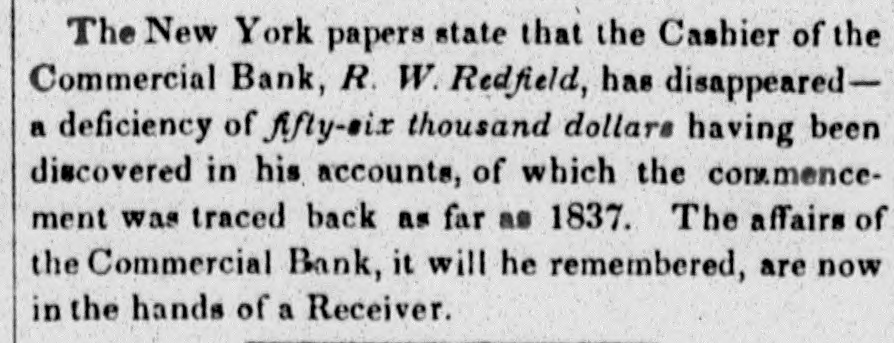
The New York papers state that the Cashier of the Commercial Bank, R. W. Redfield, has disappeared β€” a deficiency of fifty-six thousand dollars having been discovered in his accounts, of which the commencement was traced back as far as 1837.
Source
newspapers
3. October 25, 1841 Suspension
Cause
Government Action
Cause Details
Injunction served by the Bank Commissioners leading to the bank's doors being closed.
Newspaper Excerpt
The doors of the Bank were closed on the 25th for all business. An injunction has been served upon the Commercial Bank, of the city of New York, under the authority of the Bank Commissioners.
Source
newspapers
4. July 7, 1843 Other
Newspaper Excerpt
The Receiver of the late Commercial Bank of New-York, will pay to the creditors of the Bank a farther dividend of twenty-two per cent. on Friday, the seventh day of July next, at his office above named. R. M. BLATCHFORD, Receiver.
Source
newspapers
5. February 12, 1844 Other
Newspaper Excerpt
To-day ... will be exposed for sale, by auction, in the Merchants' Exchange, the skeleton of the late Commercial Bank ... SALE OF COMMERCIAL BANK ASSETS.
Source
newspapers

Newspaper Articles (14)

Article from Richmond Enquirer, October 1, 1841

Click image to open full size in new tab

Article Text

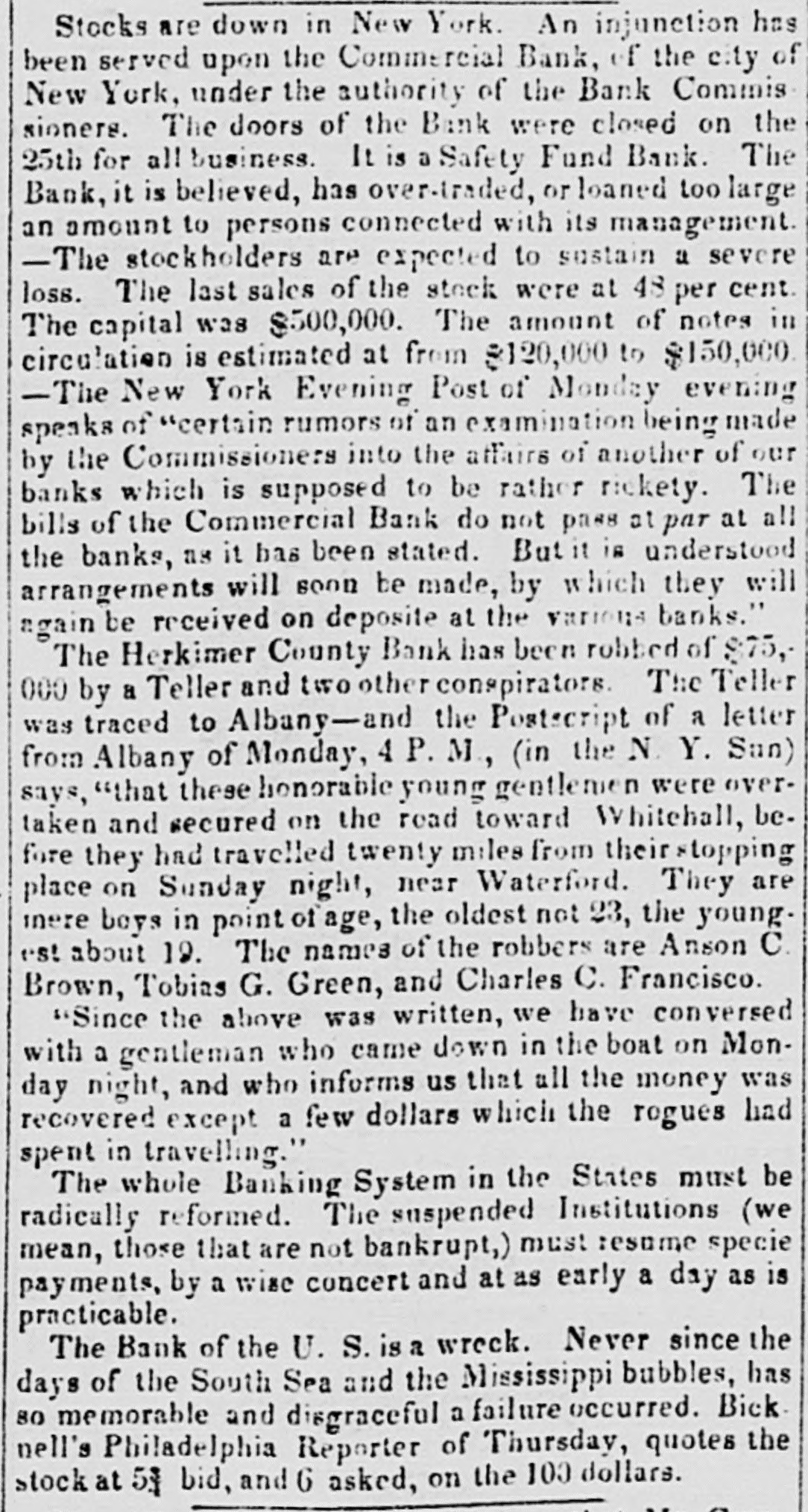
Stocks are down in New York. An injunction has been served upon the Commercial Bank, of the city of New York, under the authority of the Bank Commis sioners. The doors of the Bank were closed on the 25th for all business. It is a Safety Fund Bank. The Bank, it is believed, has over-traded, or loaned too large an amount to persons connected with its management. - The stockholders are expected to sustain a severe loss. The last sales of the stock were at 48 per cent. The capital was $500,000. The amount of notes in circulation is estimated at from $120,000 to $150,000 -The New York Evening Post of Monday evening speaks of "certain rumors of an examination being made by the Commissioners into the affairs of another of our banks which is supposed to be rather rickety. The bills of the Commercial Bank do not pass at par at all the banks, as it has been stated. But it is understood arrangements will soon be made, by which they will again be received on deposite at the VATIONS banks. The Herkimer County Bank has been robbed of $75, 000 by a Teller and two other conspirators. The Teller was traced to Albany-and the Postscript of a letter from Albany of Monday, 4 P. M., (in the N. Y. San) says, "that these honorable young gentlemen were overtaken and secured on the read toward Whitehall, before they had travelled twenty miles from their stopping place on Sunday night, near Waterford. They are inere boys in point of age, the oldest not 23, the young est about 19. The names of the robbers are Anson C Brown, Tobias G. Green, and Charles C. Francisco. "Since the above was written, we have conversed with a gentleman who came down in the boat on Monday night, and who informs us that all the money was recovered except a few dollars which the rogues had spent in travelling." The whole Banking System in the States must be radically reformed. The suspended Institutions (we mean, those that are not bankrupt,) must resume specie payments, by a wise concert and at as early a day as is practicable. The Bank of the U. S. is a wreck. Never since the days of the South Sea and the Mississippi bubbles, has 80 memorable and disgraceful a failure occurred. Bick nell's Philadelphia Reporter of Thursday, quotes the stock at 5 bid, and 6 asked, on the 103 dollars.

Article from Lynchburg Virginian, October 7, 1841

Click image to open full size in new tab

Article Text

Speck of War

-The Chatauque N. Y. Standard, statesthat the new British War steamer was disc. ered by Captaio Koapp, officer of the U.S. Army at Cleaveland, taking soundings and surveying the pasHe hailed her, but receiving no reply. he fired a gun over her stern and another over he, bow, hailing her each time, but still receiving no reply he fired another into her hull, whereupon she puton steam and departed. British Steamships on the Lakes.- The New York Express remarks that a good deal of solicitude has been produced on the frontier by the British Gov ernient building several armed steamships on the Lakes, and the optation prevails 1 th I " has been done III violation of the mealy between Great Britain and this country. which limits each to one vessel on Lake Ontario not exceeding 100 tons burden, with an 18 pound Ca n II on the upper Likes a vessel under s milar Immitations. and also one on Lake Champlain under like restrictions. Six months notice train either side is requisite to noul the treas y Commodore THOMAS Ap CATESDY JONES was appointed on the 23d ultimo to the command of the United Sintes equadron in the Pacific ocean, and will hoist his broad peunant on board the frigate United States at Norfolk. The Lexio_ton (Ky.) Observer of the 25th ult. saye: The Hon. Henry Clay arrived at his residence near Lexin_ton on Wednesday night last, the 22 Instant. Mr. Speaker White,the Hon. Josept R. Underwood, and the Hon. Willis Green arrived at the same time on their way to their sever. al homes." Ohio River.- Exir ct of a letter dated Wheeling, Sept. 29, A. M. The river rose rapidly through the course of the last night, and continues rising-4 b ats leave 10-day for Cinci oat." Robbers caught and caged.- robbery was committed. few days ago. upon the Herkumer County Bank (New York) to the amount of more than seventy thousand dollars. The robbery was diecovered and the chieves pursued much sooner than they anticipated. They were overtaken at Sandy Hill, on their way to Canada, and the whole of the money, except five or SIX hundred dollars, recovered. Wingate the Defaulter.-The Raleigh Star says that this man, who was cashier of the Raleigh Branch of the Bank of Cape Fear. is actually a defaulter. The amount of the d 6 tency is between 13 and 14,000 dollars. for which the four securities the official bonds are amply responsible, so that the Bank will lose nothing. Mr. Wingate has been amost respectable man, and is connected with many I the most respeciable families in Wilmington. is said that he is a victim to that most fatal vice, gambling. James Dunn and Charlie Greenwood, two young men who had defrauded Mr. R. D. Borns of Baltimore of $1300. have been arrested in Charleston (S. C.) Dunn seemed impressed with his guilt and conlessed every thing. Greenwood was indifferent.Dama 11 appears was Mr. Burns's Clerk, and was persuaded by Greenwood to run off with the money he had drawn from Bank with Mr. B'scheck. A Snaky Monomaniae. An elderly man, named Beat, living in Milton, Mass. is under the ballucination that he bas in his stomach a live rattlesnake. Heimagines that he will never die as long as the snake remains III him. The trial of Coll.-The N. Y. Tribune says: The Grand Jury of the Court of Oyer and Terminet having found a true bill against JOHN C. COLT for the murder of Samuel Adams, the accused was yesterday taken from the City Prison and brought, heavily ironed. into the chamber of the Assistant Aldermen. Hisirons were here taken off, and he was conducted into Court, before Judge Kent and Aldermen Woodball and Leonard, to plead to the indictment. His Counsel however moved the Court for a postponement of the plea until Wednes day (this) morning, when he will be called upon to plead guilty or not guilty 10 the indictment. At the request of Counsel, a copy of the indictiment was or dered to be furnished their. Colt was then remanded. his irons again put upon him, and he conduct ed to prison.- appearance is that of a man strug gling with intense energy to stifle the terrible feel logsthat seem to vex his soul; and this continued CO test with his own heart has already given to his countenance a baggard and most repulsive aspect. He is continually attempting to converse with his juler about the murder, and has been repeatedly checked by him when apparently on the point of making disclosures " which would be greatly against him on his mal. FAILURE OF THE COMMERCIAL BANK IN NEW YORK.- Ao injunction was served Monday morning the Commercial Bank at the instance of the Bank Commissioners. Its affairs have been for some time indifficulty, keeping it a debtor to the other City Banksconstantly to the amount of $60,000 TO $90.000.-1 is under stood that the assets I the Bank are now sufficient to render its debts safe, butnot to leave much for the stockholders. It was a safety fund institution, with hall a million capital. Its cir. culation, 1st January last, amounted to $121,370 A borrid case of murder and suicide recently occurred at Delaware, Ohio. A German named Girleih Keen. d railor by trade. shot his son in the most deliberate manner. making bin stand up and placing the muzzle of the gun close to his breast. He then releaded his gun and d scharged 11 against his own bosem by meaus of the ram-rod. An awful murder was also perpetrated at Maysville, Ky. by a man na ed Moses Keao. a shoema. ker. With a razor he cut and mangled his wife's throat in such a manner as to produce her instant death, and then made an attempt to cut his own throat with a shoe knife, but did not succeed. A man named Glowrie was mortally wounded in an affrity at Montgomery, Ala.. on the 8th ult.The wound was a slight puncture 10 the lower part of the thighes penetrating the femoral artery, made


Article from Sunbury American and Shamokin Journal, October 16, 1841

Click image to open full size in new tab

Article Text

Editorial Miscellany

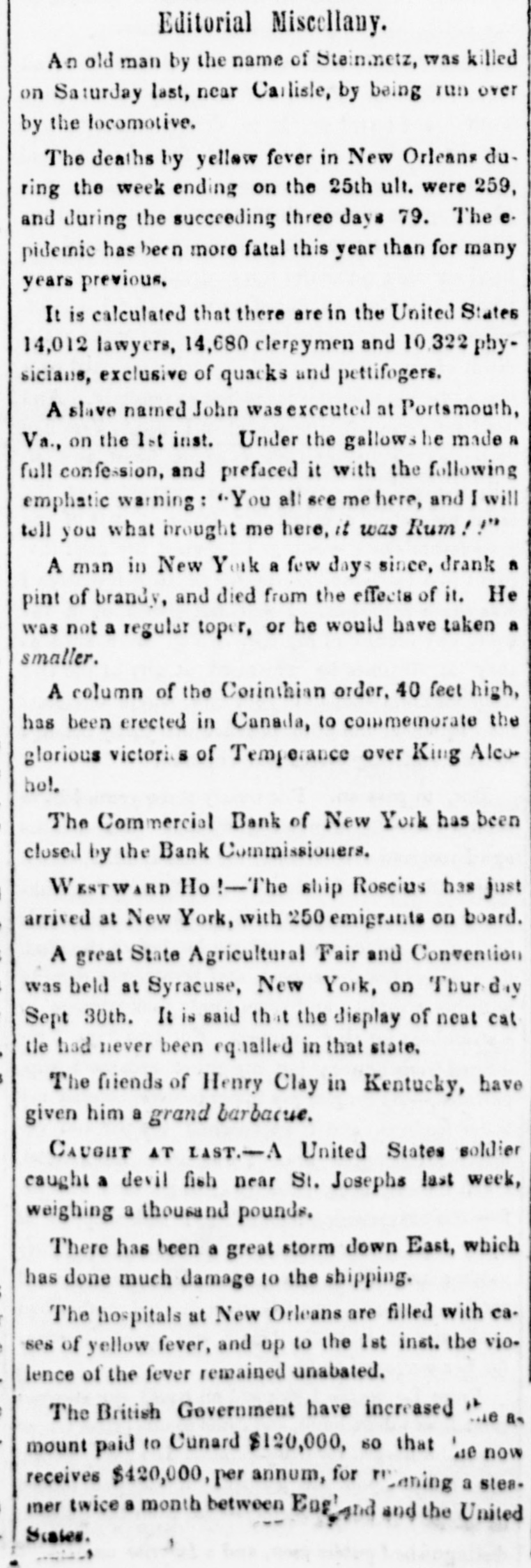
An old man by the name of Stain.netz, was killed on Saturday last, near Carlisle, by being run over by the locomotive. The deaths by yellow fever in New Orleans during the week ending on the 25th ult. were 259, and during the succeeding three day 79. The e. pidemic has been more fatal this year than for many years previous. It is calculated that there are in the United States 14,012 lawyers, 14,680 clergymen and 10.322 physicians, exclusive of quacks and pettifogers. A slave named John was executed at Portsmouth, Va., on the 1st inst. Under the gallows he made a full confession, and prefaced it with the following emphatic warning: "You all see me here, and I will tell you what brought me here, it was Rum!!" A man in New York a few days since, drank a pint of brandy, and died from the effects of it. He was not a regular toper, or he would have taken a smaller. A column of the Corinthian order, 40 feet high, has been erected in Canada, to commemorate the glorious victorias of Temperance over King Alew hol. The Commercial Bank of New York has been closed by the Bank Commissioners. WESTWARD Ho -The ship Roscius has just arrived at New York, with 250 emigrants on board. A great State Agricultural Fair and Convention was held at Syracuse, New York, on Thur day Sept 30th. It is said that the display of neat cat the had never been equalled in that state, The friends of Henry Clay in Kentucky, have given him a grand barbacue. CAUGHT AT LAST.-A United States soldier caught a devil fish near St. Josephs last week, weighing a thousand pounds. There has been a great storm down East, which has done much damage to the shipping. The hospitals at New Orleans are filled with cases of yellow fever, and up to the 1st inst. the violence of the fever remained unabated. The British Government have increased it e as mount paid to Cunard $120,000, so that 'so now receives $420,000, per annum, for Laning a stea. mer twice a month between Eng and and the United States. ...


Article from The Madisonian, October 19, 1841

Click image to open full size in new tab

Article Text

The New York papers state that the Cashier of the Commercial Bank, R. W. Redfield, has disappeareda deficiency of fifty-six thousand dollars having been discovered in his accounts, of which the commencement was traced back as far as 1837. The affairs of the Commercial Bank, it will he remembered, are now in the hands of a Receiver.


Article from New-York Tribune, October 20, 1841

Click image to open full size in new tab

Article Text

BANK-The - Receiver of the Commercial Bank has removed the Bank to No. 1 Hamover street, second story, two doors from Wallstreet. R W. BLATCHFORD. TO LET. until the first day of May next, the rocinNo. 27 Will street, lately occupied by the Commercial Bank. They are well fitces for an Insurance Company. 620 4tis Apply as above.


Article from New-York Tribune, October 22, 1841

Click image to open full size in new tab

Article Text

COMMERCIAL BANK

The Receiver of the Commercial Bank has removed the Bank to No. 1 Hanover street, second story, two doors from Wall street. R. W. BLATCHFORD.

TO LET, until the first day of May next, the rooms No. 27 Wall street, lately occupied by the Commercial Bank. They are well fitted for an Insurance Company. Apply as above. 620 4tis


Article from New-York Tribune, October 23, 1841

Click image to open full size in new tab

Article Text

COMMERCIAL BANKβ€”The Receiver of the Commercial Bank has removed the Bank to No. 1 Hanover street, second story, two doors from Wall street.

R. w. BLATCHFORD.

TO LET, until the first day of May next, the rooms No. 27 Wall street, lately accupied by the Commercial Bank. They are well fitted for an Insurance Company. Apply as above. 020 4tis


Article from The Madisonian, October 23, 1841

Click image to open full size in new tab

Article Text

The New York papers state that the Cashier of the Commercial Bank, R. W. Redfield, has disappeareda deficiency of fifty-six thousand dollars having been discovered in his accounts, of which the commencement was traced back as far as 1837. The affairs of the Commercial Bank, it will he remembered, are now in the hands of a Receiver.


Article from Richmond Enquirer, March 1, 1842

Click image to open full size in new tab

Article Text

Esq

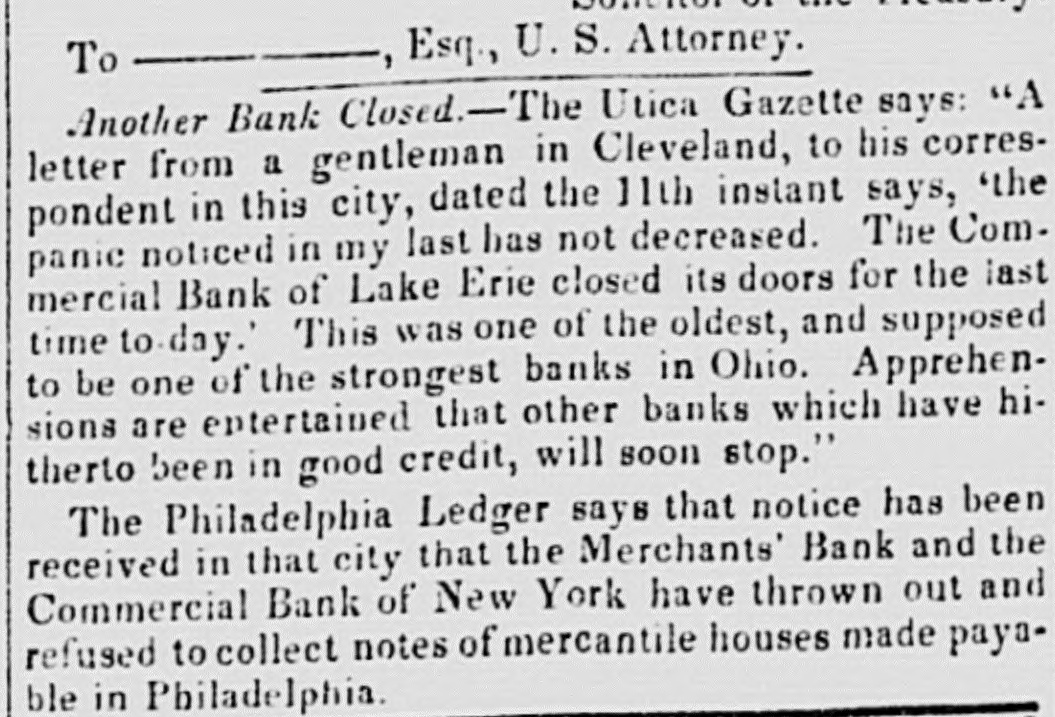
, U. S. Attorney. To Another Bank Closed.-The Utica Gazette says: "A letter from a gentleman in Cleveland, to his correspondent in this city, dated the 11th instant says, 'the panic noticed in my last has not decreased. The Com. mercial Bank of Lake Erie closed its doors for the last time to day.' This was one of the oldest, and supposed to be one of the strongest banks in Ohio. Apprehensions are entertained that other banks which have hitherto been in good credit, will soon stop." The Philadelphia Ledger says that notice has been received in that city that the Merchants' Bank and the Commercial Bank of New York have thrown out and refused to collect notes of mercantile houses made payable in Philadelphia.


Article from The New York Herald, January 27, 1843

Click image to open full size in new tab

Article Text

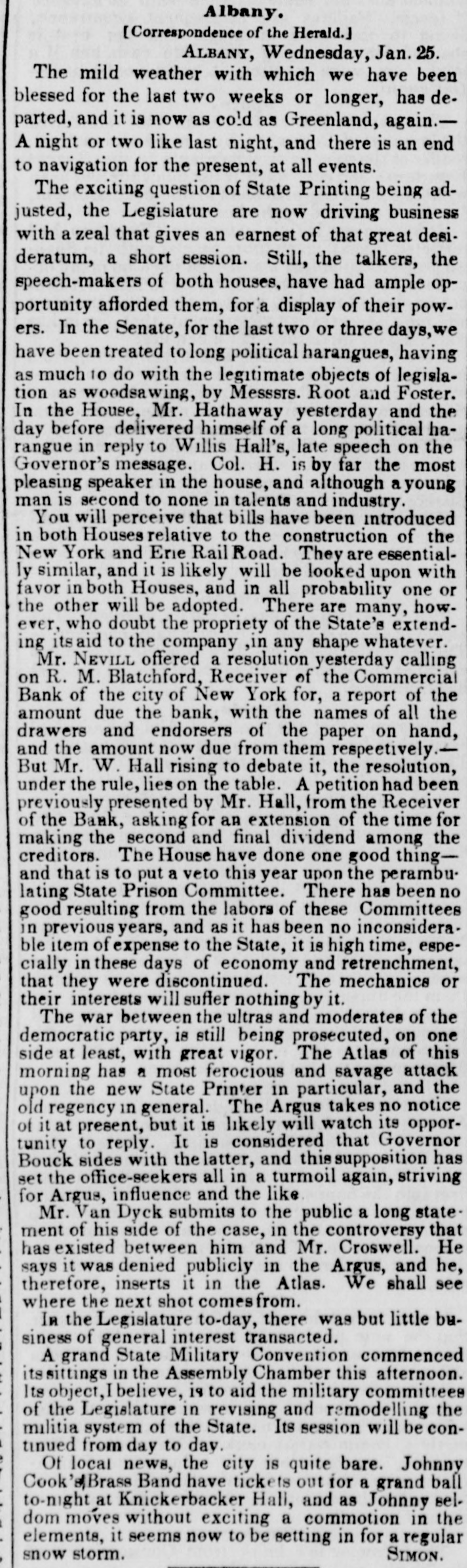
Albany. [Correspondence of the Herald.] ALBANY, Wednesday, Jan. 25. The mild weather with which we have been blessed for the last two weeks or longer, has departed, and it is now as cold as Greenland, again. A night or two like last night, and there is an end to navigation for the present, at all events. The exciting question of State Printing being adjusted, the Legislature are now driving business with a zeal that gives an earnest of that great desideratum, a short session. Still, the talkers, the speech-makers of both houses, have had ample opportunity afforded them, for a display of their powers. In the Senate, for the last two or three days, we have been treated to long political harangues, having as much to do with the legitimate objects of legislation as woodsawing, by Messsrs. Root and Foster. In the House, Mr. Hathaway yesterday and the day before delivered himself of a long political harangue in reply to Willis Hall's, late speech on the Governor's message. Col. H. is by far the most pleasing speaker in the house, and although a young man is second to none in talents and industry. You will perceive that bills have been introduced in both Houses relative to the construction of the New York and Erie Rail Road. They are essentially similar, and it is likely will be looked upon with favor in both Houses, and in all probability one or the other will be adopted. There are many, however, who doubt the propriety of the State's extending its aid to the company, in any shape whatever. Mr. NEVILL offered a resolution yesterday calling on R. M. Blatchford, Receiver of the Commercial Bank of the city of New York for, a report of the amount due the bank, with the names of all the drawers and endorsers of the paper on hand, and the amount now due from them respectively. But Mr. W. Hall rising to debate it, the resolution, under the rule, lies on the table. A petition had been previously presented by Mr. Hall, from the Receiver of the Bank, asking for an extension of the time for making the second and final dividend among the creditors. The House have done one good thingβ€”and that is to put a veto this year upon the perambulating State Prison Committee. There has been no good resulting from the labors of these Committees in previous years, and as it has been no inconsiderable item of expense to the State, it is high time, especially in these days of economy and retrenchment, that they were discontinued. The mechanics or their interests will suffer nothing by it. The war between the ultras and moderates of the democratic party, is still being prosecuted, on one side at least, with great vigor. The Atlas of this morning has a most ferocious and savage attack upon the new State Printer in particular, and the old regency in general. The Argus takes no notice of it at present, but it is likely will watch its opportunity to reply. It is considered that Governor Bouck sides with the latter, and this supposition has set the office-seekers all in a turmoil again, striving for Argus, influence and the like Mr. Van Dyck submits to the public a long statement of his side of the case, in the controversy that has existed between him and Mr. Croswell. He says it was denied publicly in the Argus, and he, therefore, inserts it in the Atlas. We shall see where the next shot comes from.

In the Legislature to-day, there was but little business of general interest transacted.

A GRAND STATE MILITARY CONVENTION

A grand State Military Convention commenced its sittings in the Assembly Chamber this afternoon. Its object, I believe, is to aid the military committees of the Legislature in revising and remodelling the militia system of the State. Its session will be continued from day to day. Of local news, the city is quite bare. Johnny Cook's Brass Band have tickets out for a grand ball to-night at Knickerbacker Hall, and as Johnny seldom moves without exciting a commotion in the elements, it seems now to be setting in for a regular snow storm. SIMON.


Article from New-York Daily Tribune, July 11, 1843

Click image to open full size in new tab

Article Text

late Fair in this city. Measures taken, and orders promptly executed. je29 3m

CONGRESS MUSTARD

This mustard is warranted to be superior to any other, it being manufactured from the Durham Black Seeds, by Wm. F. Alcorn, 141 15th street, between 7th and 8th avenues. Merchants and landlords are solicited to try this article before purchasing elsewhere. jy3 1m*

RECEIVER'S OFFICE

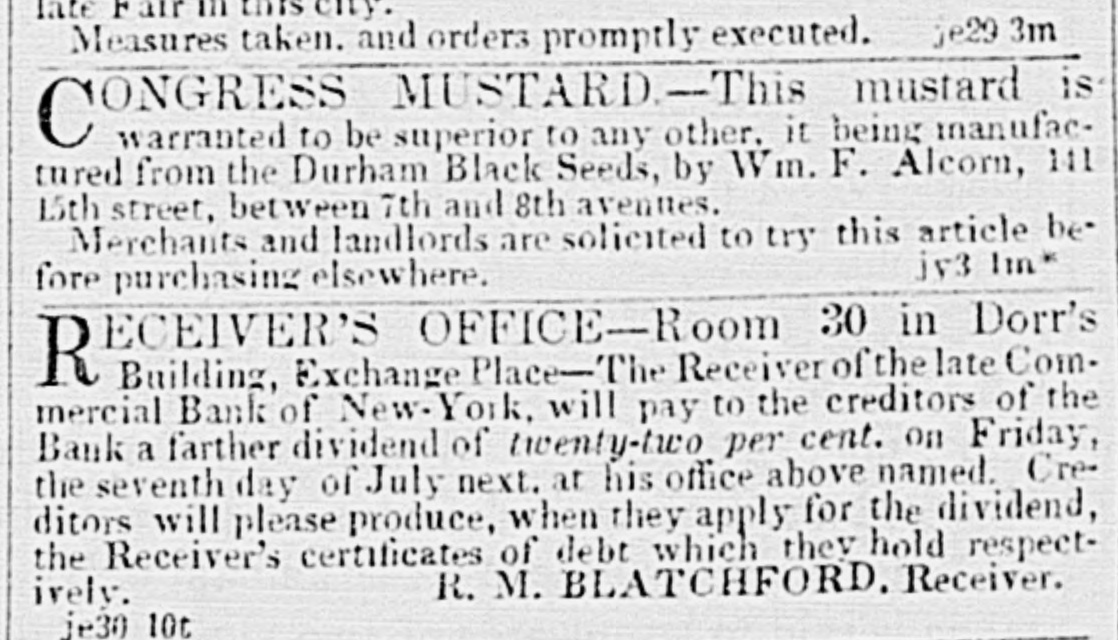
Room 30 in Dorr's Building, Exchange Place-The Receiver of the late Commercial Bank of New-York, will pay to the creditors of the Bank a farther dividend of twenty-two per cent. on Friday, the seventh day of July next, at his office above named. Creditors will please produce, when they apply for the dividend, the Receiver's certificates of debt which they hold respect-ively. R. M. BLATCHFORD, Receiver. je30 10t


Article from The New York Herald, February 9, 1844

Click image to open full size in new tab

Article Text

DEPARTED WESTWARD.

Groceries, pounds.349,876 Hides pounds. 41,050 Merchandise, do .585,246 Oils, gallons... 4,537

Number of cars cleared, 1816. Amount of tolls received, $10,535 27.

This railroad will in a short time be materially injured by the efforts made to attract freight down the canal to Havre de Grace. Merchandise, coming over the Columbian Railroad, on its way from the west, leaves the canal at Columbia, instead of continuing down to Havre de Grace. The enterprising citizens of Havre de Grace are about removing the bar at the entrance of their harbor, that now obstructs navigation, and contemplate building a line of vessels to run between their port, New York and Boston, on the Ericcson-propeller principle, to ensure the rapid transportation of produce to all parts of the Atlantic coast. By perfecting these arrangements, a great deal of the western produce that now finds its way to other markets through Philadelphia, over the Columbian Railroad will be diverted to the port of Havre de Grace.

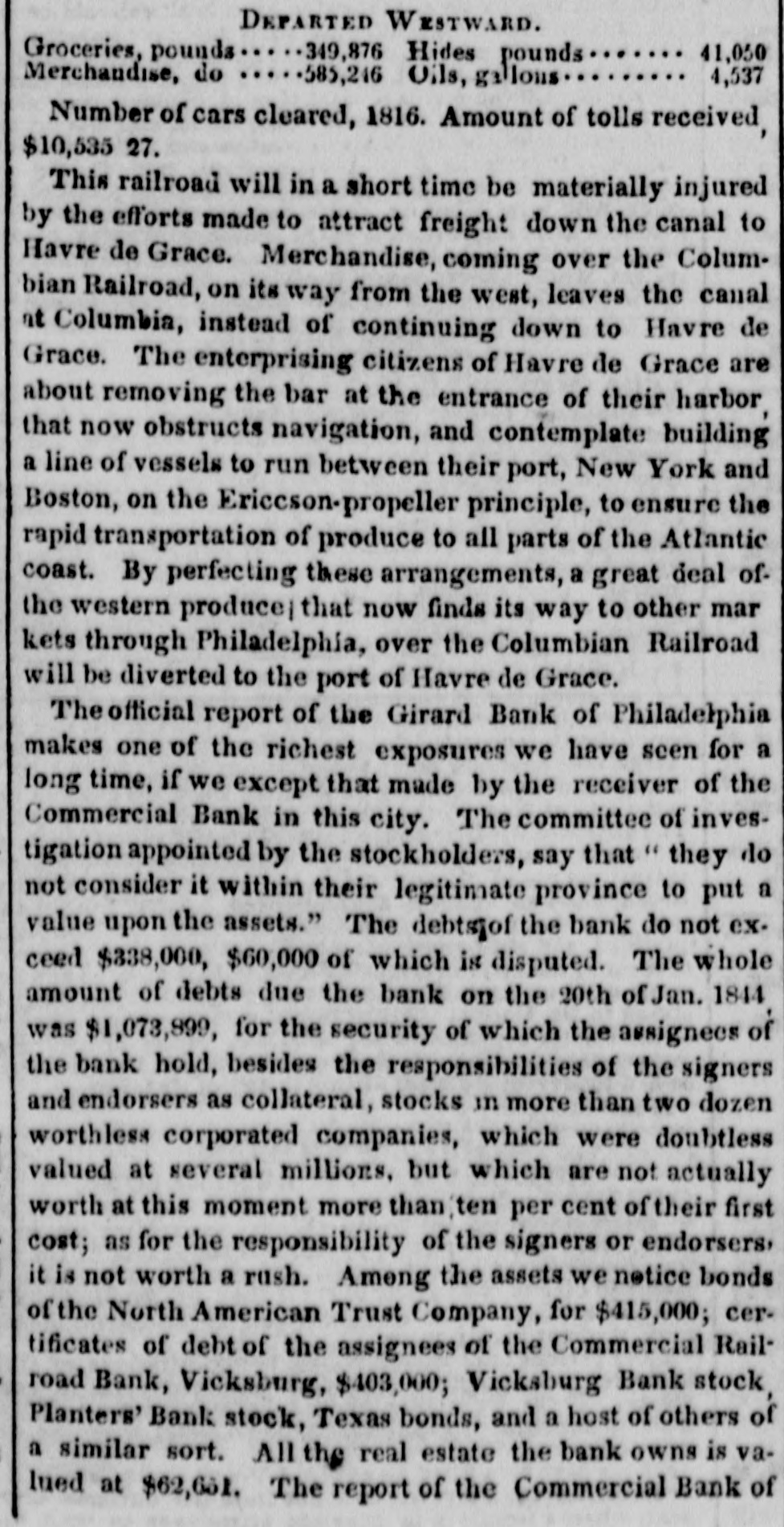
The official report of the Girard Bank of Philadelphia makes one of the richest exposures we have seen for a long time, if we except that made by the receiver of the Commercial Bank in this city. The committee of investigation appointed by the stockholders, say that "they do not consider it within their legitimate province to put a value upon the assets." The debts of the bank do not exceed $338,000, $60,000 of which is disputed. The whole amount of debts due the bank on the 20th of Jan. 1844, was $1,073,999, for the security of which the assignees of the bank hold, besides the responsibilities of the signers and endorsers as collateral, stocks in more than two dozen worthless corporated companies, which were doubtless valued at several millions, but which are not actually worth at this moment more than ten per cent of their first cost; as for the responsibility of the signers or endorsers, it is not worth a rush. Among the assets we notice bonds of the North American Trust Company, for $415,000; certificates of debt of the assignees of the Commercial Railroad Bank, Vicksburg, $403,000; Vicksburg Bank stock, Planters' Bank stock, Texas bonds, and a host of others of a similar sort. All the real estate the bank owns is valued at $62,601. The report of the Commercial Bank of


Article from The New York Herald, February 12, 1844

Click image to open full size in new tab

Article Text

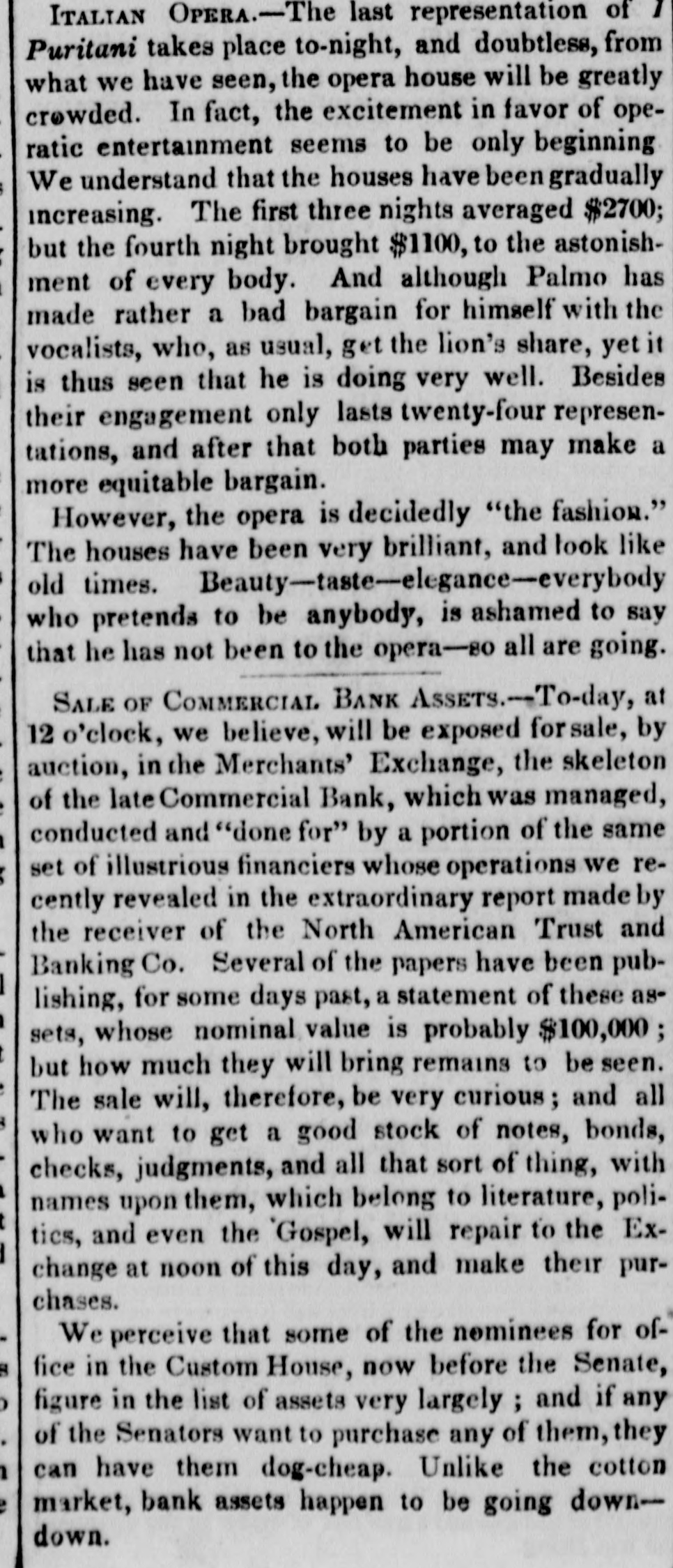
ITALIAN OPERA.

The last representation of I Puritani takes place to-night, and doubtless, from what we have seen, the opera house will be greatly crowded. In fact, the excitement in favor of operatic entertainment seems to be only beginning We understand that the houses have been gradually increasing. The first three nights averaged $2700; but the fourth night brought $1100, to the astonishment of every body. And although Palmo has made rather a bad bargain for himself with the vocalists, who, as usual, get the lion's share, yet it is thus seen that he is doing very well. Besides their engagement only lasts twenty-four representations, and after that both parties may make a more equitable bargain.

However, the opera is decidedly "the fashion." The houses have been very brilliant, and look like old times. Beauty-taste-elegance-everybody who pretends to be anybody, is ashamed to say that he has not been to the opera-so all are going.

SALE OF COMMERCIAL BANK ASSETS.

To-day, at 12 o'clock, we believe, will be exposed for sale, by auction, in the Merchants' Exchange, the skeleton of the late Commercial Bank, which was managed, conducted and "done for" by a portion of the same set of illustrious financiers whose operations we recently revealed in the extraordinary report made by the receiver of the North American Trust and Banking Co. Several of the papers have been publishing, for some days past, a statement of these assets, whose nominal value is probably $100,000; but how much they will bring remains to be seen. The sale will, therefore, be very curious; and all who want to get a good stock of notes, bonds, checks, judgments, and all that sort of thing, with names upon them, which belong to literature, politics, and even the 'Gospel, will repair to the Exchange at noon of this day, and make their purchases.

We perceive that some of the nominees for office in the Custom House, now before the Senate, figure in the list of assets very largely ; and if any of the Senators want to purchase any of them, they can have them dog-cheap. Unlike the cotton market, bank assets happen to be going down-down.


Article from The New York Herald, May 27, 1846

Click image to open full size in new tab

Article Text

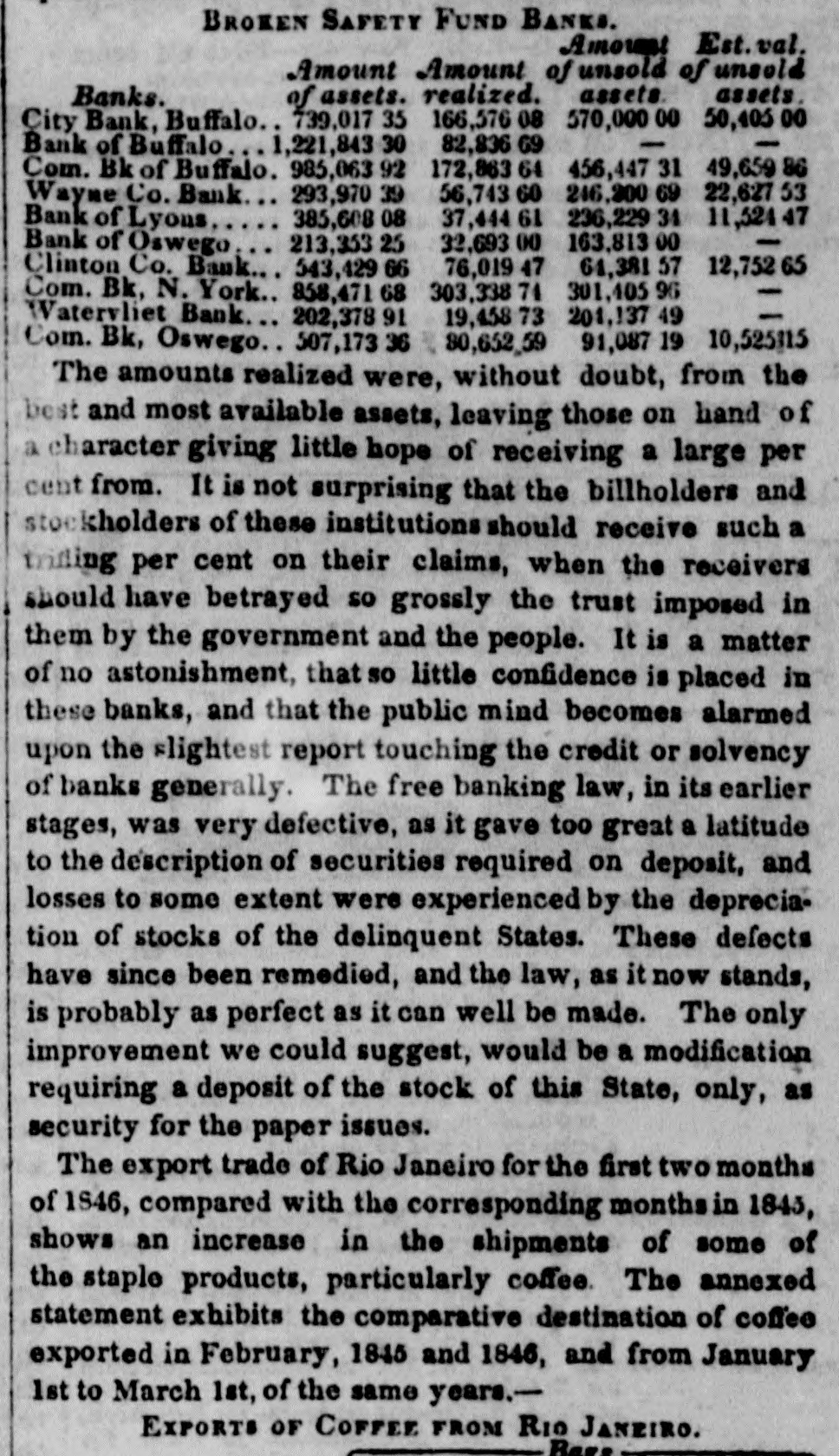
BROKEN SAFETY FUND BANKS.

| Banks. | Amount of assets. | Amount realized. | Amount of unsold assets. | Est.val. of unsold assets. | | | | | | | | City Bank, Buffalo.. | 739,017 35 | 166,576 08 | 570,000 00 | 50,405 00 | | Bank of Buffalo... | 1,221,843 30 | 82,836 69 | | | | Com. Bk of Buffalo. | 985,063 92 | 172,863 64 | 456,447 31 | 49,659 86 | | Wayne Co. Bank... | 293,970 39 | 56,743 60 | 246,200 69 | 22,627 53 | | Bank of Lyons. | 385,608 08 | 37,444 61 | 236,229 34 | 11,524 47 | | Bank of Oswego... | 213,353 25 | 32,693 00 | 163,813 00 | | | Clinton Co. Bank... | 543,429 66 | 76,019 47 | 64,381 57 | 12,752 65 | | Com. Bk, N. York.. | 858,471 68 | 303,338 74 | 301,405 96 | | | Watervliet Bank... | 202,378 91 | 19,458 73 | 201,137 49 | | | Com. Bk, Oswego.. | 507,173 36 | 80,652.59 | 91,087 19 | 10,525315 |

The amounts realized were, without doubt, from the best and most available assets, leaving those on hand of a character giving little hope of receiving a large per cent from. It is not surprising that the billholders and stockholders of these institutions should receive such a trifling per cent on their claims, when the receivers should have betrayed so grossly the trust imposed in them by the government and the people. It is a matter of no astonishment, that so little confidence is placed in these banks, and that the public mind becomes alarmed upon the slightest report touching the credit or solvency of banks generally. The free banking law, in its earlier stages, was very defective, as it gave too great a latitude to the description of securities required on deposit, and losses to some extent were experienced by the deprecia-tion of stocks of the delinquent States. These defects have since been remedied, and the law, as it now stands, is probably as perfect as it can well be made. The only improvement we could suggest, would be a modification requiring a deposit of the stock of this State, only, as security for the paper issues.

The export trade of Rio Janeiro for the first two months of 1846, compared with the corresponding months in 1845, shows an increase in the shipments of some of the staple products, particularly coffee. The annexed statement exhibits the comparative destination of coffee exported in February, 1845 and 1846, and from January 1st to March 1st, of the same years.

EXPORTS OF COFFEE FROM RIO JANEIRO. Rare