Article Text
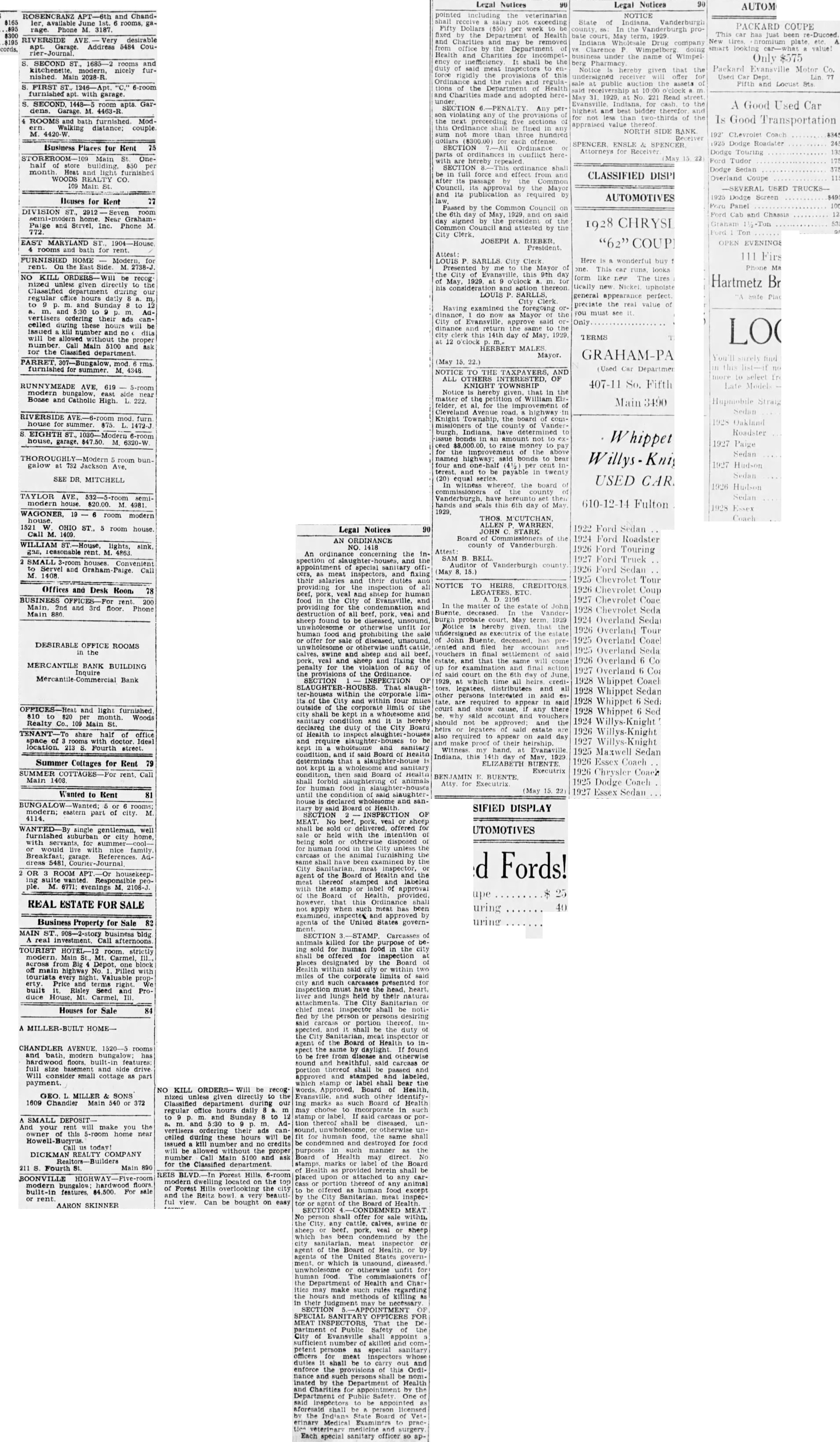
$165 Legal Legal Notices 90 pointed the veterinarian NOTICE not exceeding State of Vanderburgh Fifty the prothe Department Health May 1929 and Charities and may be removed Indiana Drug company from office the Clarence Health and Charities for incompet- the under name of ency inefficiency Pharmacy of said meat inspectors hereby given that the rigidly undersigned receiver offer for Ordinance and the rules and regula- the assets public the Department Health o'clock and hereMay No. 221 Read SECTION Any perhighest best bidder son violating any not of the sections appraised value thereof this NORTH SIDE BANK more than dollars each offense SPENCER ENSLE SPENCER SECTION Ordinance Attorneys for Receiver parts ordinances conflict here(May Used Fifth and SECTION ordinance shall full force and effect after its passage the the and its publication required by Passed by the Common Council on the 6th of May, 1929. on said day signed by the president and attested by the City NO KILL ORDERS- Will be recog given directly Classified regular to 5:30 to Adordering their can celled issued credits the proper number Main 5100 and ask for the Classified REIS Forest Hills. 6-room modern located the of Forest Hills overlooking the and the ful view. Can be bought on easy Legal Notices 90 AN ORDINANCE An the inspection and the appointment special meat inspectors, and their salaries and their duties of beef, veal sheep the City of Evansville, providing for the condemnation destruction all beef, pork, and sheep found diseased, otherwise unfit human food and prohibiting the sale sale diseased, unwholesome otherwise swine and and the penalty for the any the of the SECTION INSPECTION HOUSES That ter-houses the the four outside the corporate limit or the kept and sanitary condition and hereby declared the duty City Board Health houses require wholesome sanitary condition, and said Board Health that house kept and sanitary said Health shall forbid slaughtering animals for the declared and sansaid Board Health SECTION INSPECTION OF MEAT. No beef, pork, sheep be sold offered sale held the intention being sold disposed human food the City unless carcass of the furnishing shall by the City agent the Board Health and the meat thereof stamped and labeled with the stamp of approval the that this not apply when meat has agents the United States governSECTION Carcasses animals killed for be. sold for food the shall offered for inspection places designated the Board within the corporate said city inspection must have the head, lungs held their natural City shall the person carcass portion thereof. and the duty City the Board of the same daylight found free from disease and otherwise sound healthful said carcass or portion shall approved stamped labeled. stamp label bear the Board of Health, Evansville and identifymarks such Board of Health label. said carcass tion thereof shall diseased, for human the same shall and for food purposes manner Board of Health stamps, marks label of the Board placed upon attached any carthereof any offered human food except the Sanitarian inspecthe MEAT No person offer within City. cattle. calves, swine beef. pork, veal or sheep by meat agent the Health agents of the States governwhich unsound, unwholesome otherwise unfit The the Health and Charmay make such rules regarding the hours and methods killing judgment necessary SPECIAL SANITARY OFFICERS MEAT That the partment Public Safety the Evansville shall appoint petent special sanitary officers inspectors whose duties shall out and enforce the provisions this Ordinance persons inated the Department Health and Charities for appointment by Department One inspectors appointed shall person the Indiana Board of erinary Medical Examiners pracveterinary medicine surgery Each special sanitary officer 80 Attest: LOUIS SARLLS City Clerk Presented the City 9th day May, 1929, at o'clock for his consideration and action thereon LOUIS Clerk Having examined the foregoing dinance, do Mayor the City of approve said the city 14th day of May. 1929 at 12 o'clock HERBERT MALES Mayor. (May (Used TAXPAYERS, AND ALL OTHERS INTERESTED, OF KNIGHT TOWNSHIP Notice hereby given, that in the of the petition William Main felder, the improvement of Avenue highway Knight the comcounty Vanderburgh, Indiana, have bonds an amount not to Whippet ceed money improvement above named said bonds bear four and per payable in twenty (20) equal USED CARS witness the board this 6th day of May Attest: SAM BELL Auditor of Vanderburgh county (May NOTICE CREDITORS 1926 Chevrolet Coupe LEGATEES. 2196 1927 Chevrolet Coach In the matter the estate of John 1928 Chevrolet Sedan deceased. burgh May 1929 1924 Overland Sedan Notice hereby that 1926 Overland Touring the 1925 Overland Coach sented and filed her account 1925 Overland Sedan final of estate, that the 1926 Overland Coupe for examination and final 1927 Overland 6 Coach said court the 6th day 1929, which time all heirs credi- 1928 Whippet Coach legatees, distributees and 1928 Whippet Sedan other persons said 1928 Whippet Sedan court and show any 1928 Whippet 6 Sedan why said and vouchers should 1924 Tr not and the heirs of estate 1926 Sd. also appear said day 1927 Sd. Witness hand. Evansville 1925 Maxwell Sedan this day 1929 1926 Essex Coach ELIZABETH BUENTE Executrix 1926 Chrysler Coach BENJAMIN BUENTE 1925 Dodge Coach Atty. Executrix (May 1927 Essex Sedan PACKARD COUPE This re-Ducoed New looking car-what Only $575 Packard Evansville Motor Co. Locust Sts $495 100 125 535 95