American Savings Bank (Washington, DC)

Episode Information

Episode UID
4894801391221
Episode Type
Run β†’ Suspension β†’ Closure
Bank Type
savings
Bank ID
489480139 hash
Start Date
September 23, 1901
Location
Washington, District of Columbia (38.895, -77.036)

Metadata

Model
gpt-5-mini (chosen from majority vote of a three-model LLM ensemble)
Short Digest
67eb99dc71abbc30

Response Measures

None

Description

Receivers were appointed by court days after the suspension amid allegations of mismanagement and improper asset transfers.

Events (3)

1. September 23, 1901 Run
Cause
Bank Specific Adverse Info
Cause Details
Heavy withdrawals and loss of confidence tied to large discounts, questionable transactions involving officers and the Union Surety Company.
Measures
Bank required sixty days' written notice for withdrawals (invoked by by-laws).
Newspaper Excerpt
Anxious depositors. There was a line of depositors before the paying teller's window, mostly women, and anxiety was written in unmistakable lines on their faces.
Source
newspapers
2. September 24, 1901 Suspension
Cause
Bank Specific Adverse Info
Cause Details
Bank invoked by-law to suspend payments citing large discounts and unexpected heavy withdrawals leading to cash embarrassment.
Newspaper Excerpt
By reason of large discounts made by this bank and an unexpected withdrawal of deposits, the Executive Committee... hereby require that sixty days' notice in writing be given the bank by every depositor before the payment by the bank of any check or order drawn hereon.
Source
newspapers
3. September 27, 1901 Receivership
Newspaper Excerpt
Tracy L. Jeffords and Conrad H. Syme were today appointed receivers of the American Savings Bank by Chief Justice Bingham... The doors of the American Savings Bank... were closed yesterday by Tracy L. Jeffords and Conrad H. Syme, receivers appointed early in the day by Chief Justice Bingham to take charge of its affairs. (articles dated Sept. 27-28, 1901).
Source
newspapers

Newspaper Articles (22)

Article from Evening Star, September 24, 1901

Click image to open full size in new tab

Article Text

DEPOSITORS GIVEN NOTICE AMERICAN SAVINGS BANK SUSPENDS PAYMENTS. Announcement Declares Over Discount Caused EmbarrassmentEarly Resumption Promised. The American Savings Bank, located at 1007 G street northwest, has suspended paynient. The following notice has been sent out to depositors: "By reason of large discounts made by bank and an unexpected withdrawal of this deposits, the executive committee finds itself compelled to exercise discretion 16 vested in it by section 3 of article of the by-laws of this corporation, contained in each pass book and assented to by each depositor, and hereby require that the sixty days' notice in writing be given bank by every depositor before the payment by the bank of any check or order drawn hereon by such depositor. "This bank will consider the presentaof all such orders or checks as such the notice tion as to such orders or checks, and same will be duly paid within sixty days from the day of presentation.' The section of the by-laws referred to, section 3, article 16, "Rules and regulations for depositors," is as follows: "No depositor shall have the right with- to draw money from this corporation out the production of his or her pass book, and all payments made to the per- dethe pass book of a shall be valid payment this of all whose pass for the amount so or order of the The charge the son positor been depositor producing check produced corporation book depositor, liability the has to same paid. thus dis- or to person duly authorized to draw will of attorney duly executed, This corporation reserves the right to be pressly by required. power require hereby depositor sixty exdays' notice in writing from any before making payment of any check or order drawn thereon by such depositor. Payment of checks of depositors will be made ordinarily on demand unless it should in the discretion of the committee, to exercise executive become necessary, the the right time herein expressly reserved as to when such payment must be made. The bank was established and began busiin November, 1898. Its officers, who ness have served since then, are William Oscar Roome, president; Edgar H. Stocking and and Charles N. Wake, vice presidents, Charles W. Powers, cashier. President Roome's Statement. In response to a Star reporter's questions, President Roome said this morning that he was confident the bank would shortly resume payments. The depositors, he stated, numbered about 400 or 500, and the total sum of their deposits was $269,000. "Our assets are $317,000," he remarked. "What do they consist of?" inquired the reporter. "Good paper; good notes," was the re"As soon as collections can be made all ply. upon these notes everything will be right. While Mr. Roome and the reporter were talking the paying teller brought the former a check. After scrutinizing it Mr. Roome said: "I think he left a special deposit here to protect this check. Ascertain if is the case, and if so pay a perfect right to that," yesterday "We such have it.' do said Mr. Roome in an explanatory tone to the reporter. Anxious Depositors. There was a line of depositors before the paying teller's window, mostly women, and anxiety was written in unmistakable lines on their faces. From what the reporter overheard, few of them had received the notice published above, and were informed by the paying teller that they were sent out last night. Mr. Roome told The Star reporter they were sent out yesterday morning. Some of the depositors had given checks to merchants and others Saturday, and the latter had, in the course of business, sent these checks to the banks with which they do business. Many such checks were brought by bank runners to the embarrassed institution today, but none was paid unless depositors had made special dedeposits to meet it. Nearly every positor who came while The Star reporter was there gave notice under the article above quoted of withdrawing deposits, and it was evident that many of the women had all their ready money in the bank and were very much embarrassed thereby. be All were assured that the bank would in a position in a few days to meet all demands.

Article from The Washington Times, September 24, 1901

Click image to open full size in new tab

Article Text

# DEPOSITORS MUST WAIT. American Savings Bank Demands Sixty Days' Notice. Institution's Doors Not Closed and Officers Say That It Is Solvent- Large Discounts and Heavy With- drawals Cause the Suspension. The American Savings Bank yesterday suspended payment. A notice was sent to all depositors stating that by reason of large discounts made by the bank and an unexpectedly large withdrawal of deposits during the past few days, it had been found necessary to resort to the expedient of requiring sixty days' notice on all further withdrawals, a step which is allowed by the by-laws of the institution. The bank did not close its doors yesterday, and the statement is made by its officers that there is no intention of doing so. It is said by them that the order suspending payment will be withdrawn as soon as possible and that there is every reason to hope that this will be in the near future. The bank is stated to be solvent, with a good excess of assets over liabilities. According to its officers it has been doing a profitable business and its difficulties extend no further than an embarrassment for ready cash at the moment. The deposits of the bank at the close of business Saturday night were $269,000. The bank made no payments yesterday, its order going into effect at the opening of business. The following is the notice to depositors which was sent out immediately: "By reason of large discounts made by this bank and an unexpected withdrawal of deposits, the Executive Committee finds itself compelled to exercise discretion vested in it by section 3 of article 16 of the by-laws of this corporation, contained in each pass book and assented to by each depositor, and hereby require that sixty days' notice in writing be given the bank by every depositor before the payment by the bank of any check or order drawn hereon by such depositor. "This bank will consider the presentation of all such orders or checks as such notice as to such orders or checks, and the same will be duly paid within sixty days from the day of presentation." The section of the by-laws referred to section 3, article 16, "Rules and regulations for depositors," is as follows: "No depositor shall have the right to draw money from this corporation without the production of his or her pass book, and all payments made to the person producing the pass book of a depositor shall be valid payment to discharge this corporation of all liability to the depositor whose pass book has thus been produced for the amount so paid. The check or order of the depositor, or person duly authorized to draw the same by power of attorney duly executed, will be required. This corporation hereby expressly reserves the right to require sixty days' notice in writing from any depositor before making payment of any check or order drawn thereon by such depositor. Payment of checks of depositors will be made ordinarily on demand unless it should become necessary, in the discretion of the Executive Committee, to exercise the right herein expressly reserved as to the time when such payment must be made." President William Oscar Roome was seen yesterday afternoon regarding the step taken by the bank. He said: "The notice sent out to depositors states the matter fully and there is very little to add to it. I am unable to account for the large withdrawals of deposits recently. You may state positively that the bank is solvent and that it intends to continue in business. We hope to withdraw the sixty days' notice to depositors in a few days. "I am very much gratified to announce that at least $200,000 of the $269,000 deposits of the bank are in the hands of the people who are most friendly to us. This I have learned today from personal assurances from them. Nearly all if not all, of our large depositors have been so kind as to come to the bank today with such assurance. A great many of these depositors have made additional deposits also as a further evidence of their confidence." There was an unusually large number of depositors in the bank yesterday at times owing to the notice sent out, but littie excitement was shown by them. The American Savings Bank has been established nearly three years, having begun business in November, 1898. The present management has been in charge of its affairs from the beginning. Its officers are: William Oscar Roome, President; Edgar B. Stocking, Vice President; Charles N. Wake, Vice President, and Charles W. Powers, Cashier. The bank is located at 1007 G Street northwest.


Article from Evening Star, September 25, 1901

Click image to open full size in new tab

Article Text

AMERICAN SAVINGS BANK. President Says Prospects for Resuming Business Are Brighter. The condition of the American Savings Bank, which has suspended payments to depositors, was said today by William Oscar Roome, its president, to be "in statuo quo." "What are the prospects for a resumption of payments?" inquired a reporter for The Evening Star. "Brighter," responded Mr. Roome. "Two of our friends have offered propositions to help us out, which we are now considering with a view of obtaining, if possible, some modification in them." "Do you anticipate that a demand will be made to have a receiver appointed to take charge of the affairs of the bank?" queried the reporter. "Not at all," was the reply. "The great majority of the depositors, nearly all of them, in fact, are friendly to us."


Article from The Evening Times, September 27, 1901

Click image to open full size in new tab

Article Text

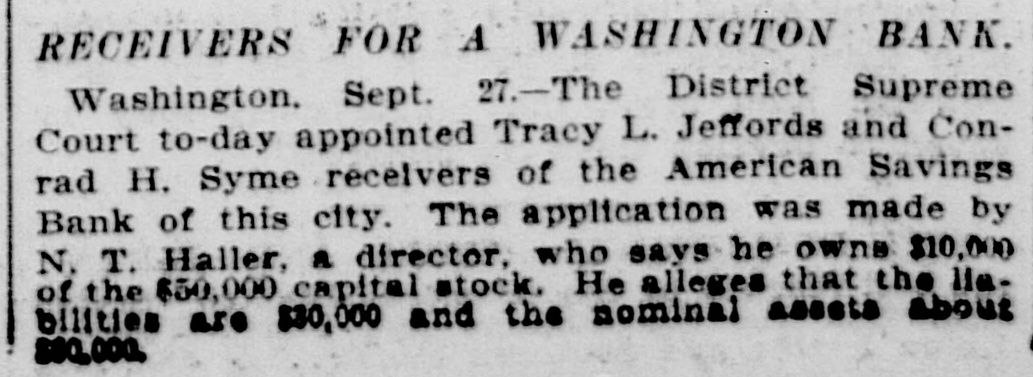
PRICE ONE CENT. RECEIVERS FOR THE BANK. American Savings Institution in the Hands of the Court. Today's Application of Nicholas T. Haller, Stockholder and Depositor, Results in the Appointment of T. L. Jeffords and €. H. Syme. Tracy L. Jeffords and Conrad H. Syme were today appointed receivers of the American Savings Bank by Chief Justice Bingham,of the Supreme Court of the District. The receivers are required to give bond in the sum of $75,000 for the performance of their duties. The condition of the affairs of the bank was called to the attention of the court in a petition filed today by Nicholas T. Haller, who asked for the appointment of a receiver to conduct the business of the institution. Mr. Haller states that he is owner of $10,000 worth of the capital stock of the American Savings Bank and is also a depositor. The capital stock of the bank, he states, is $50,000. As part of his petition Mr. Haller incorporates the circular letter sent out by the bank on Monday last, in which it is stated that on account of large discounts made by the bank, it would require sixty days' notice to be given by depositors of their intention to withdraw their deposits. Continuing, Mr. Haller states that since Monday the bank has kept its doors open and has apparently been transacting its usual business, except the payment of checks Many checks have been presented for payment, it is stated, and payment refused, while other checks have been presented and been paid promptly by the bank officiais. It is further stated that this condition of affairs at this time of year has resulted and will result in detroying the confidence of the public and of its depositors, who will demand the money at the expiration of sixty days. It is stated the assets of the bank will be exhausted in paying same and will be insufficient to meet all demands and in addition the bank will be burdened with its expenses for sixty days, thereby making a further deficit. While the bank is refusing to honor the checks of certain depositors, it is alleged, it is honoring those of others and accepting them in some instances, in payment of promissory notes held by the bank against such depositors. In this and other ways it is claimed the bank is discriminating against certain depositors and against the petitioner, and disposing of some of its assets to the prejudice of the depositors. It is contended that the present business operations of the bank and its continued unbusiness-like and alleged unlawful actions will waste and diminish the assets of the corporation and will add unnecessary expense to its management. It is further stated that the liablities of the American Savings Bank are about $30,000, while the assets-not all of which are good-amount to about twice that sum. T. L. Jeffords is named as counsel for the petitioner. The appointment of the receivers for the bank has broken into the plans of President Roome and the other officers looking to its resumption of business As stated several days ago in The Times the officers of the bank began immediately after it suspended payment to make arrangements to resume. A considerable portion of its liabilities were cancelled with moneys collected, and it was hoped this morning that its affairs would be in condition for a complete resumption by next Monday. A meeting of the stockholders of the bank was to be held this afternoon at 1 o*clock, and President Roome stated this morning that he believed this meeting would decide on some plan for wiping out the other liabilities as far as necessary. Nothing was known by President Roome or the other officers of the institution regarding the intention of Mr. Haller to apply for a receiver Mr. Syme. one of the receivers appointed by the court, is the attorney for the bank. Mr. Jeffords is the choice of Mr. Haller. It is not known whether the receivers will take up the plans of President Roome and the other stockholders or not. but it is supposed that the appointment of the receivers will prevent the immediate resumption contemplated by the officers.


Article from Alexandria Gazette, September 28, 1901

Click image to open full size in new tab

Article Text

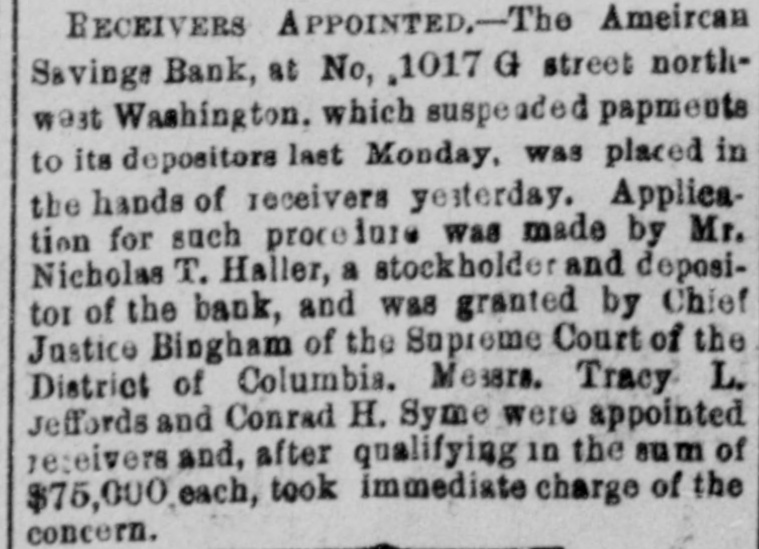
RECEIVERS APPOINTED.-The Ameircan Savings Bank, at No, 1017 G street northwest Washington. which suspended papments to its depositors last Monday, was placed in the hands of receivers yesterday. Application for such procedure was made by Mr. Nicholas T. Haller, a stockholderand depositor of the bank, and was granted by Chief Justice Bingham of the Supreme Court of the District of Columbia. Messrs. Tracy L. Jeffords and Conrad H. Syme were appointed receivers and, after qualifying in the sum of $75,000 each, took immediate charge of the concern.


Article from The Washington Times, September 28, 1901

Click image to open full size in new tab

Article Text

RECEIVERS TAKE CHARGE. The American Savings Bank Closed Pending Investigation. Tracy L. Jeffords and Conrad H. Syme Appointed by Justice Bingham to Look After Institution's Affairs-Depositors to Share Alike. The doors of the American Savings Bank, which suspended payment on Monday last, were closed yesterday by Tracy L. Jeffords and Conrad H. Syme, receivers appointed early in the day by Chief Justice Bingham to take charge of its affairs. When the bank suspended payment to depositors on Monday it still continued to receive deposits. On the petition of Nicholas T. Haller, who owns stock to the amount of $10,000, and who is also a depositor, the court yesterday named Jeffords and Syme as receivers, requiring a bond of $75,000 for faithful performance of duty. It is understood that Mr. Jeffords represents the depositors, including Mr. Hal1er, and Mr. Syme represents the officers of the American Savings Bank, SO that, in the naming of the receivers, both interests are recognized and cared for by the court. In speaking of the condition of affairs at the bany yesterday afternoon, Mr. Jeffords stated that a call will be sent to all persons indebted to the bank to settle their indebtedness. In ten days, he said, the receivers will make a report to the court concerning the condition of affairs, and some step will no doubt then be taken to effect a final adjustment. In the meantime, however, any plans which the bank officials may have had in view will have to remain at a standstill. The condition of the affairs of the bank was called to the attention of the court in a petition filed yesterday by Nicholas T. Haller, who asked for the appointment of a receiver to conduct the business of the Institution. Mr. Haller states that he is owner of $10,000 worth of the capital stock of the American Savings Bank and is also a depositor. The capital stock of the bank, he states, is $50,000. As part of his petition Mr. Haller incorporates the circular letter sent out by the bank on Monday last, in which It is stated that on account of large discounts made by the bank, it would require sixty days' notice to be given by depositors of their intention to withdraw their deposits. Continuing. Mr. Haller states that since Monday the bank has kept Its doors open and has apparently been transacting its usual business, except the payment of checks. Many checks have been presented for payment, it is stated, and payment refused, while other checks have been presented and been paid promptly by the bank officials. It is further stated that this condition of affairs at this time of year has resulted and will result in detraying the confidence of the public and


Article from Sunday Morning Globe, September 29, 1901

Click image to open full size in new tab

Article Text

IS BUSTED? The American Savings Bank, Its Depositors and Standing. CHAPTER OF REVELATIONS In Which the President of the Bank Turns 0 to be the Vice-President of the Philadelphia Union Surety and Guarantee Company, with Mr. Parker as Special Agent-The Hobson I Contract and the Discounting of the Bills. That the American Savings Bank, was to past no surprise to The pend 1007 G payments street N. the W. Sunday forced week Globe. was sus- The run on the bank was caused by people who have had business transactions with either the president of the bank, William O. Roome, as the vice-president of the Union Surety Company of Philadelphia, or Mr. George T. Parker a special agent of the surety company, who has offices in and is in close touch with the American Savings Bnak For some time The Globe has been receiving letters and complaints of and concerning the bank and the methods pursued by Messrs. Roome and Parker, as representatives of the Union Surety Company and therefore we anticipated trouble to the concern because of the revelations made in these communica tions. One case in point will illustrate the many grievances against Messrs Roome and Parker. It will be recalled that the Government contractor, J. H. Hobson, who confessed to bribing Capt. King, the army officer, was compelled to turn over his interests to the surety company, which was on his bond. Through Messrs. Roome and Parker it was accomplished in this way. Hobson needed $20,000 more to complete his contract. This the American bank advanced on a guarantee of $15,000 profit on the work. The Messrs. Roome and Parker substituted their friends and relatives for the employes of Hobson, giving the substitutes large increase of salaries. For instance, Mr Parker placed his nephew as time keeper on the works at a salary of $18 per week, which he soon advanced to $25. The original timekeeper, under Hobson, was receiving only $9 per week. Mr. Roome's son-in-law received a salary of $200 per month, although he was entirely ignorant of the work in hand he was placed in full charge. Mr. Nick Haller, the archi tect, was hired at $10 per diem and ex penses; his brother was put on the job at $4 per day, and Bud Thomas was discharged, who had a written agreement with Mr. Hobson. When Mr. Hobson took the bank in with him he guaranteed them $15,000 profit for the $20,000 advanced. A safe estimate of Hobson's profit on the contract placed the figure at $30,000. but the bank and Messrs. Roome and Parker soon froze Hobson out, and by representations to the Government they secured entire and undivided control of the contract. Hobson's securities guar anteeing $15,000 profit are still held to their guarantee by Messrs. Roome and Parker, despite of the fact that all the profits are eaten up by the in 'creased salaries paid the relatives and friends of these gentlemen who were substituted for Hobson's competent and lower paid employes. There were, naturally, a great many bills against Hobson, which the $20. 000 supposedly advanced by the bank and to his credit was held to liquidate When the surety company's representatives, Messrs. Roome and Parker, took firm hold, however, these bills could not or would not be cashed by Mr. Roome immediately. The creditor was put off with one excuse or another until he learned that by discounting the bill with Mr. Parker he could speedily obtain his money. The Globe has a number of complaints on this score, and has been furnished the names of merchants and other creditors of Hobson who had thus to discount their bills. We give only a few: Mr. J. B. Lambie the hardware merchant, was one, however, who would not dis count. and has sued the Hobson contract for $3,500; J. .T. Walker Sons, builders' supplies, Tenth street, how ever, discounted his bill, after trying it more than twenty times to collect He accepted $270 for $300; Mr. Harris discounted the bill of G. W. Thomas, giving him $70 for his bill of $79; James McUen, the stone contractor of Alexandria, Va., had his bill of $600 discounted, after vain efforts to col fi lect it; Mr. Charles Powers, cashier of the bank, discounted some bills bed cause, it is alleged, Mr. Parker, as agent of the surety company was discounting too many, and the home of fice in Philadelphia might become curious or suspicious. Mr. Powers is a partner of the firm of G. E. McKnew & Co., stationers, Ninth street, near F The whole nub of this matter lies in the fact that money to pay these bills d was on deposit in the American bank, Mr. of which Mr. Roome is president; Powers cashier, and Mr. Parker the fl special agent, with offices in the bank of the surety company of which Mr. Roome is vice-president. These things being all well understood, it is quite easy to see that this system of surety company and bank of deposit working hand in hand, with a special agent handy to discount honest bills, that enI emies cropped up and multiplied every to time a squeeze or a discount was effected. Of course, people will talk, C and especially people who have had the C juice or the profit on their bills squeez-


Article from Sunday Morning Globe, October 6, 1901

Click image to open full size in new tab

Article Text

$ n GREAT HEADS Have V. P. Roome and Special Agent Parker. THE AMERICAN SAVINGS BANK Another Interesting Chapter on Surety and Guarantee Companies and on How to Do Up Rival-The New Receivers for the Bank Some Prospects of a "Divy" for DepositorsAdvised Not to Expect Too Much. The article in these columns Sunday last, on the American Savings Bank suspension, caused two additional receivers to be appointed by the court. This action was timely and will, it is to be hoped, save the smaller depositors from entire loss. As stated, for weeks The Sunday Globe was in possession of facts which, if published, would undoubtedly have caused a run on the bank, and while such publicity might have saved a few of the later depositors, we did not feel like assuming the responsibility of the possible injury of a financial institution. That we were on the inside may be gleaned from the fact that one of our informants served as confidential secretary and typewriter to Mr. George T. Parker. Washington agent of the Union Surety Company of Philadelphia, and whose office and connections with Mr. William O. Roome, president of the bank and vice-president of the Union Surety Company, were dwelt upon last Sunday as being close and semi-identical. This young gentleman, to whom we now refer as one of our informants o served as bookkeeper to the Hobson o contract until it passed into the hands f of the bank and Mr. Parker. He is of unimpeachable character and integrity, and has occupied responsible mercanu tile positions in this city. After the Hobson contract had been gobbled up and its profits absorbed with the high 0, salaries paid the employes who were substituted for Hobson's, this young r gentleman continued in the semi-emi ployment of Mr. Parker and associates, while his remuneration has not been according to the promises held out to d him by Mr. Parker. he has no financial claim against that gentleman. He has neither grieyance nor bill to air or present. and tells a perfectly straight 1. forward tale of this most extraordiy nary conjunction of a savings bank, surety company, a weekly publication, and fat contracts. For instance, Mr it Parker drew a salary of $25 per week for the trouble of making out checks on the Hobson contract. This was a t nice salary for light. congenial work but when it is recalled that these checks could not or would not be cashIf ed by the American Savings Bank when presented, the salary seems to e have been "a superfluous sinecure. if 'Appears to have been' is the proper expression, for be it remembered that the checks could be and were cashed d by accommodating discounters. among whom were Mr. Parker himself, Mr. Harris, Mr. Powers (the cashier of the e bank), and others in the "swim." And g all this time the Hobson contract had $20,000 to its credit in Mr. Roome's bank! The $15,000 profit guaranteed and bonded to the American Savings d Bank for this loan will come up later on. and there will be music, inasmuch as the extraordinary salaries paid Mr. u Roome's relatives and friends and Mr. Parker, his relatives and friends, and d Mr. Nick Haller, as architect, eat up It these profits which would otherwise aca crue. This morning, however, The Globe K has a new and unique chapter to add y to the enterprise of Mr. Parker, whose sagacity and superior business qualifications have enabled him to lift monthly income of from $800 to $1. 000. It appears that Forrest T. Vrooman, who was manager here for the National Surety Company of New York, lost his position with that concern. Mr. Parker speedily demonstrated to Mr. Vrooman that he could make himself t quite valuable to the concern of which he (Parker) is the special agent and n Mr. Roome is the vice-president. Vrooman had a list containing the names of the distillers which the National Sure. ty Company bonded. These bonds netted the National Surety Company from a minimum of $10 to a maximum of $100 each distiller. The National Surety Company had. it is estimated, two thousand of these valuable customers. This sum annually from the distillers was not to be sneezed at. It amounted to a pretty figure, and Mr. Parker, as special agent, and Mr. Roome as vicepresident of a rival surety company, were naturally anxious to secure it. Hence, Mr. Vrooman's lists of over two thousand names were secured, under a the promise that any customers secured by Mr. Parker from the lists should be paid for in a reasonable or fixed sum. Mr. Parker thereupon jollied Hobson's bookkeeper (our informant) into running his typewriter every evening for almost a month until 10 P. M. or thereabouts, writing a circular letter to these distillers in Vrooman's name and over Vrooman's signature. The letter, in substance, stated: "Having severed my connection with a the National Surety Company. I am pleased to announce my connection with the Union Surety and Guaranty Company of Philadelphia, Pa., office, 1007 G street N. W. Our rate for each


Article from Evening Star, October 8, 1901

Click image to open full size in new tab

Article Text

Court Gives Authority. An order was signed by Justice Hagner this morning directing the receivers of the American Savings Bank to deliver to F. Duncan Jaudon the contents of a certain safe deposit box containing $2,000 in stock of the St. Andrew's Church in this city, $100 Scottish Rite stock, some mortgages and other valuables.


Article from The Evening Times, October 8, 1901

Click image to open full size in new tab

Article Text

GIVEN A SAFE DEPOSIT BOX. Its Owner Secures Its Possession Through a Court Order. In connection with the suit of Nicholas T. Haller against the American Savings Bank, for the appointment of a receiver, F. Duncan Jaudon, filed a petition today asking for the possession of a safe deposit box, he had placed in the custody of the bank. It having been stated to the court that Mr. Jaudon identified the property as his own, and the receivers raising no objection, Justice Hagner signed an order turning over the deposit box to the claimant. The box contained $2,000 of the bonds of St. Andrew's Church, $100 Scottish Rite bonds, and some mortgages and insurance policies..


Article from The Evening Times, October 9, 1901

Click image to open full size in new tab

Article Text

EXPERT ACCOUNTANT NAMED. James E. Bates Appointed to Compile Report of a Bank's Affairs. A petition was filed in the equity division of the Supreme Court of the District today asking that the receivers of the American Savings Bank be allowed to employ an expert accountant to compile a report of the affairs of the bank. The petition was granted and James E. Bates was named. With the view of reducing expenses the court was also asked to allow the receivers to remove the assets of the bank to the Jennifer Building. The receivers, under ordinary circumstances, would be expected to make a report to the court on Friday. Owing to the great amount of work ahead of them it is not probable that they will do so. A partial report, showing the work done since they have taken charge of the bank, will, however, be submitted.


Article from The Washington Times, October 12, 1901

Click image to open full size in new tab

Article Text

# A FINANCIAL TANGLE. # Owner of Collateral Sues to Have Sale Declared Void. Jules W. Leroux, of Baltimore, Md., yesterday filed suit in the Supreme Court of the District against Oliver R. Harr and others, in which the court is asked to declare valid a certain sale of securities alleged to have been made by Harr to himself. The other parties named as defendants are: The American Savings Bank, and Tracey L. Jeffords, Conrad H. Syme, Charles F. Carusi, and Alexander Wolfe, receivers, appointed by the court to take charge of the assets and manage the affairs of the bank. It is explained that on June 7 last Leroux made a promissory note, payable to the order of the American Savings Bank four months after date, for the sum of $6,000. To secure the payment of the note, he states, he deposited with the bank fifty shares of preferred stock of the Structural Iron and Steel Company of Baltimore, Md., and forty-eight shares of the common stock of the same corporation. Shortly prior to the maturity of the note Leroux states, Harr presented the note, and his collateral to him and proposed that he (Leroux) pay the note at a considerable discount. At that time, Leroux states, the note bore what purported to be the endorsement of the cashier of the American Savings Bank. About the same time, Leroux declares, he was notified by the defendant receivers for the bank that the note was not the property of Harr, but of themselves as receivers of the American Savings Bank, and notified him not to pay the principal or interest to Harr or any other person. Leroux states he informed Harr of this fact. On October 9, Leroux states he was informed by Harr that he had sold the collateral deposited as security for the payment of the note and purchased them himself for $3,000. This sale, Leroux claims, was contrary to terms upon which the securities were deposited as collateral. Leroux asks the court to restrain Harr from disposing of in any way the securities referred to, except under order of the court. Ashley M. Gould is named as counsel for the complainant. Leroux also declares that he is threatened with suit in connection with the transaction, both by Harr and the receivers of the American Savings Bank.


Article from Evening Star, October 14, 1901

Click image to open full size in new tab

Article Text

Receivers Directed to Show Cause. Justice Bradley, in Equity Court No. 2, this afternoon signed an order directing the receivers of the American Savings Bank to show cause why petitions filed today by the Western Industrial Association and Samuel J. Masters, through Attorney E. L. Gies, should not be granted. The Western Industrial Association asks that the receivers be directed to pay it $41.01, and Mr. Masters that they pay him $381.28 out of any assets of the bank in their hands. The association explains that the amount due it was a special deposit placed to meet outstanding checks, while Mr. Masters says the amount he mentions is due him on notes deposited for collection. It is pointed out by the petitioners that the amounts mentioned were not deposited for the use of the bank, and, therefore, they are entitled to the immediate return of the same.


Article from The Evening Times, October 14, 1901

Click image to open full size in new tab

Article Text

# RULE AGAINST RECEIVERS. Proceedings Involving American Savings Bank Transactions. Justice Bradley today, in connection with the suit of Nicholas T. Haller against the American Savings Bank, issued a rule against the receivers appointed by the court, requiring them to show cause on October 22 why they should not pay to the Western Industrial Association $41.01 and to Samuel J. Masters $381.28 out of the assets of the bank. It is set forth in the petition that the amounts claimed are due, that to the Western Industrial Association as a balance on funds deposited to meet the payment of certain unpaid checks, and that in the case of Masters as a balance on notes placed with the American Savings Bank for collection. It is stated that the $40.01 is a balance of a deposit placed with the bank after it had suspended payment on September 21 last. Edward L. Gies is named as counsel for the petitioners.


Article from The Washington Times, October 17, 1901

Click image to open full size in new tab

Article Text

Not a Bank Asset. A petition was filed in the Supreme Court of the District yesterday by William C. Wallis, as an interpleader, in the case of Nicholas T. Haller against the American Savings Bank, asking that a $100 United States bond, which he deposited in the bank for safe-keeping, be returned to him. Upon the presentation of the petition to Justice Hagner, he signed an order instructing the receivers appointed by the court to take charge of the funds of the bank to turn the bond over to Mr. Wallis, in the event that it proved to be his property.


Article from Evening Star, October 26, 1901

Click image to open full size in new tab

Article Text

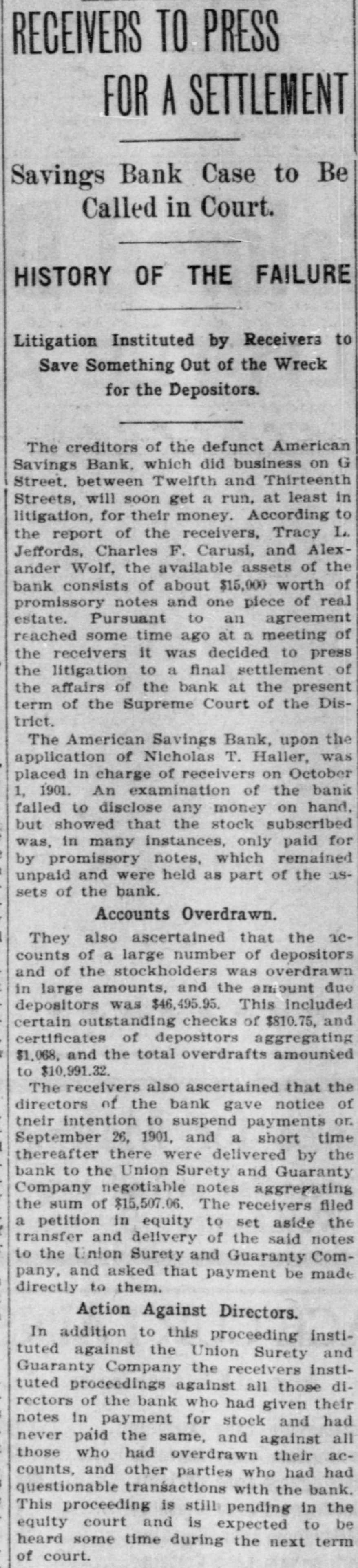
RECEIVERS FILE REPORT STATEMENT RESPECTING AFFAIRS OF AMERICAN SAVINGS BANK. Gross Amount Due the Depositors Examination of Books Not Fully Completed. The receivers of the American Savings Bank today submitted to the court a report based upon a partial report submitted to them by the public accountant they have employed in the case. It is set forth that the total gross amount due to the depositors of the American Savings Bank is $46,495.95, in which sum is included a certified check outstanding of $810.75 and certificate of deposit aggregating $1,068. Continuing the receivers say: "The accounts of a large number of depositors of the bank appear to be overdrawn, such overdrawn accounts amounting to $10,991.32. "The Union Surety and Guaranty Company had its local office in the rear of the bank and William Oscar Roome, the president of the bank, was the local vice president of the Union Surety and Guaranty Company. "The American Savings Bank suspended payment September 23 and notified their depositors by circular. "From the books of the bank It appears that the Union Surety and Guaranty Company had a number of accounts with the bank. On September 24 four of the deposit accounts show a balance in favor of the Union Surety and Guaranty Company of $15,927.40, and two of their deposit accounts appear to have been overdrawn to the sum of $420.34, leaving a balance to their credit, as appears from the books of the bank on the day of suspension, of $15,507.06. "From the books of the bank it appears that September 24 notes aggregating the sum of $15,507.06 were delivered to the Union Surety and Guaranty Company, under an agreement purporting to have been made by the American Savings Bank, by William Oscar Roome, Its president, apparently in settlement of the accounts set forth in the previous paragraph and In accordance with the agreement in writing entered into between the bank, by Its prestdent. William Oscar Roome, and the Union Surety and Guaranty Company, by its president. A. Marcus. And in addition to the delivery of the notes to the Union Surety and Guaranty Company, Roome made and delivered a certain declaration of trust to the Union Surety and Guaranty Company. The total amount of the notesthe sum of $15,507.06-includes the note of $2,338.62 of William Oscar Roome." The receivers call attention "to notes aggregating $990 delivered to Wolf and Cohen. A large number of notes were accompanied with collateral security, the exact nature of which the receivers at this time are unable to report with any certainty." Messrs. Tracy L. Jeffords, Conrad H. Syme, Charles F. Carusi and Alexander Wolf. the receivers, are unable to state at this time, SO they say, with any degree of certainty all other notes and securities which have been disposed of by the bank or the officers thereof, on account of the fact that the examination of the books of the bank has not been fully completed. and they have received but a partial report from the accountant. In conclusion the receivers ask instructions to protect the interests of all concerned


Article from The Washington Times, October 27, 1901

Click image to open full size in new tab

Article Text

# MANY ACCOUNTS OVERDRAWN. A Report of the Receivers of the American Savings Bank. In connection with the suit of Nicholas T. Haller against the American Savings Bank, for the appointment of receivers to take charge of and manage its affairs, the receivers yesterday filed a supplemental report. This report is based upon the re- sult of the investigations made by the ex- pert accountant, James E. Bates, who was employed by the receivers to make an examination of the affairs of the bank. The report sets forth that the total amount due to the depositors of the American Savings Bank is $46,495.95. In this amount is included, it is said, a cer- tified check, outstanding, for $810.75, and a certificate of deposit of $1,068. It is further said that the accounts of a large number of depositors appear to be overdrawn, and the overdrawn ac- counts aggregate $10,991.32. An itemized list of these accounts is filed as a part of the report. It is stated that the Union Surety and Guaranty Company had its local offices in the rear of the building in which the American Savings Bank conducted its business and that William Oscar Roome, the president of the bank, was also the local vice president of the Surety Com- pany. It is also stated that from the books of the bank it appears that the Union Surety and Guaranty Company had a number of accounts with the American Savings Bank, and on September 25, two days after the American Savings Bank suspended payment, four of the deposit accounts show a balance in favor of the Union Surety Company of $15,927.40, and two of their deposit accounts appear to have been overdrawn to the amount of $420.34, leaving a balance to their credit of $15,507.06 on the day the bank suspend- ed payment. The report goes on to state that "from the books of the bank it appears that on September 24 notes, aggregating the sum of $15,507.06, were delivered to the Union Surety and Guaranty Company, under an agreement purporting to have been made by the American Savings Bank, by Wil- liam Oscar Roome apparently in settle- ment of the accounts set forth above and in accordance with the agreement in writ- ing entered into between the defendant bank by its president, and the Union Surety and Guaranty Company by its president, A. Marcus." It is also stated in the report: "And in addition to the delivery of the said notes to the said Union Surety and Guaranty Company, the said Roome made and de- livered a certain declaration of trust to the said Union Surety and Guaranty Com- pany, copies of the agreement and the declaration of trust being attached and marked," as an exhibit. A list of the notes delivered to the Union Surety and Guaranty Company are also filed as ex- hibits. The receivers, T. L. Jeffords, Conrad H. Syme, Alexander Wolf, and Charles Fran- cis Carusi, state that at the present time they are unable to speak with certainty as to the number of other notes and se- curities which have been disposed of by the bank.


Article from Evening Star, November 1, 1901

Click image to open full size in new tab

Article Text

THE COURTS. Equity Court No. 1-Justice Hagner. Hough agt. Hough; return of commission for further proof ordered. Cherokee Nation agt. Secretary of the Interior; hearing continued till November 5, 1901. Equity Court No. 2-Justice Bradley. Mueller et al. agt. Burgdorf et al.; confirmation of sale nisi. Fullalove agt. Buzzard's heirs; pro confesso against defendants. Haller agt. the American Savings Bank; receivers authorized to employ counsel, do.: rule against receivers, returnable November 6, 1901. Jones et al. agt. Jones et al.; rule against purchaser, returnable November 4, 1901. Holtman agt. Stelleman et al.; decree vesting title by adverse possession Donovan agt. Donovan; proof before Alex. H. Galt, examiner, ordered taken. Circuit Court No. 2-Justice Clabaugh. Darlington agt. Wylie and others, two cases; judgment on verdict for defendants. Singleton agt. Kann; commission ordered to issue to C. S. Loder to take testimony of Wm. H. Shrader of New York city, upon interrogatories, with leave to defendant to cross-examine orally. Landvoigt agt. Paul; plaintiff granted leave to amend declaration; Huffney et al. agt. Williams; demurrer sustained, with leave to amend within ten days. Criminal Court No. 1-Justice Anderson. United States agt. Charles Doyle, murder; verdict of guilty of manslaughter. United States agt. Richard Jackson, housebreaking; sentence suspended. United States agt. Albert King; order for removal of defendant to southern district of Iowa. United


Article from Sunday Morning Globe, November 17, 1901

Click image to open full size in new tab

Article Text

tion, and to pledge the securities and other propreties of the bank as he might deem advisable. On the day preceding the adoption of the resolution, the balance to Roome's credit was $245.26. and on that day he drew out $2,013.60. overdrawing his apparent balance $1,768.34. From that time he continued to increase this overdraft by drawing out the depositors money, as follows: Aug. ust 7. $700 August 19, $2,150; August 26, $1,000; August 28, $1,000; August 29, $1,000; September 6, $1,000. and September 11, $2,000, all aggregating $8,850. "During the entire period of these overdrafts," continues the petitioner, "the said Roome well knew that said was bank amount due insolvent the depositors and without in funds said or real assets with which to pay the bank.' Right here The Globe would gently observe that this is charging William Oscar Roome with a penitentiary of fense. We know. you know, for we have been acquainted with "bankers' in stripes for this very particular thing. Again we proceed. "Shortly after the American Sav ings Bank had suspended payment on September 23 last, certain of ficers of the Union Surety and Guaranty Company on notice from its Washington attorney, who was also the attorney for the defendant bank, came at once to Washington and demanded of William Oscar Roome that the balance due the surety company should be turned over to them or that the disappearance of the said balance be satisfactorily accounted for to them. The result of the pressure brought to bear upon the said William Oscar Roome, as president of the said bank and as vice-president and attorney, in part, of the surety company, was the surrender by Roome to his fellow officers of the surety company of practically the sole remaining assets of the bank, consisting of notes aggregating $15,507.06. What? The entire assets in one fell swoop? Great Scott! But hearken ye depositors to this "Atthe time the said noteswe hand ed over to Like said officers of the defendant surety company certain of ...e accounts of the latter showed an overdraft in one case of $400.09; in anotner of $20.25. and in a third of 17.71. And here is the bargain Roome then made with his "adjunct," the Union Surety Company, of which he was vice-president "After the delivery of the notes by Roome, purporting to act as president of the American Savings Bank, he executed a certain written agreement, in which the notes of the bank were to be taken in payment by the Union Surety Company to the extent only to which they might prove finally collectable, and, in the event that they should not, the surety company should preserve all the right which it should have for the collection and enforcement of its debt against the American Savings Bank. William Oscar was evidently determined to see that tht Union Surety Company, of which he is the vice-president did not suffer whatever might become of the too confiding depositors of the American Savings Bank. Here is the charge reiterated, which if estab. lished by testimony in a court of justice, will make it very interesting for William Oscar et al. "It is further stated that at the time of its organization the American Savings Bank was insolvent and that Roome, as chairman of the board of directors, and as president of the bank. was at all times fully aware of the insolvency and that the Union Surety and Guaranty Company was also aware of the insolvent condition of the American Saving Bank." And finally the court is asked to restrain the Union Surety and Guaranyt Association, its attorneys, officers and trutees during the pendency of these procedings, from selling, assigning, transferring or in anywise disposing of the promissory notes and due bills received from W. Oscar Roome on September 23 last, except to the makers or endorsers, upon payment of the full amount due. The proceedingswere instituted by Charles Francis Carusi. Alexander Wolfe, and Tracy L. Jeffords, receivers of the American Savings Bank, against the Union Surety and Guaranty Company and W. Oscar Roome, defendants. Sic Gloria Mundi. The Globe might have saved some, at least, of the depositors of the American Savings Bang by an earlier publication of the facts in our possession, but that we did not care to accept the responsibility of a "run" on that institution, and because we hoped that things were not as bad as reported. Banks are delicate enterprises to subject to unecessary publicity, and hence both in the case of the American Savings bank which "busted" SO badly, and touching some information about the Central National Bank recently given. We prefer silence until publicity becomes peremptorely necessary Resigned to Enter Business.


Article from The Evening Times, June 12, 1902

Click image to open full size in new tab

Article Text

Receivership Hearing Postponed. The hearing in the American Savings Bank receivership case, which was to have come on for hearing today before Justice Hagner, was postponed until Monday next.


Article from The Washington Times, July 3, 1902

Click image to open full size in new tab

Article Text

# SUE FOR ASSETS OF # THE AMERICAN BANK Receivers Ask Accounting of President Roome and Others. VOLUMINOUS PETITION FILED Receivers Allege That Bank Capital Was Mainly Paper and Go Into Details of Many Transactionsβ€”Ask for Restraining Order. The receivers of the American Savings Bank, Messrs. Charles F. Carusi, Alexander Wolf, and Tracy L. Jeffords, appointed by the court some time ago, yesterday began suit against Mr. William Oscar Roome, president of the bank, and twelve others, asking for an accounting, and also asked for an order restraining them from in any way disposing of certain assets which, it is claimed, properly belong to the bank. The others named as defendants are Nicholas T. Haller, at whose instance be made subject to the payment of claims and debts of Mr. Roome arising out of his conduct of the affairs of the bank. It is also asked that the defendant Roome be restrained from transferring, pledging or making away with certain bonds of the Ancient and Accepted Order of Scottish Rite Masons, valued at $20,000. It is also asked "that premises known as sublot sixty-seven in square 204 in the city of Washington, D. C., be declared and decreed to be held by the defendant Nicholas T. Haller for and in trust for the defendant Nicholas T. Haller, in fraud of the creditors of the said Nicholas T. Haller and of the depositors of the American Savings Bank and in fraud of the rights of the said depositors as creditors of the said Nicholas T. Haller by reason of his conduct and managements of and interest and participation in the affairs of the American Savings Bank as here-inbefore set forth; and that said Nicholas T. Haller and Jacob D. Haller be enjoined and restrained from assigning, transferring, conveying, selling, incumbering or in any way disposing of the said land and premises or any interest therein; that said land and premises may be decreed to be subject to the claims and debts of the said depositors, creditors as aforesaid." H. H. Glassie and D. W. Baker are named as counsel for the receivers.


Article from Evening Star, July 3, 1902

Click image to open full size in new tab

Article Text

# MEETING OF DEPOSITORS. Receivers to Report Progress in Affairs of American Savings Bank. In connection with the proceedings in equity for an injunction and an account-ing instituted late yesterday by the re-ceivers of the American Savings Bank against William Oscar Roome and others, it is the expressed intention of the re-ceivers to call a meeting about the 15th instant of the depositors in the bank to report to them the progress that has been made in the collection of assets and as to the condition of affairs. By the proceedings instituted yesterday, as stated in The Star, it is sought to en-join the disposal of certain promissory notes of the value of about $10,000, and to compel Roome and others to pay over to the receivers whatever sum is necessary to meet the proper demands of the deposi-tors.