Neal Loan & Banking Company (Atlanta, GA)

Episode Information

Episode UID
4837098791296
Episode Type
Run β†’ Suspension β†’ Closure
Bank Type
state
Bank ID
483709879 hash
Start Date
December 21, 1907
Location
Atlanta, Georgia (33.749, -84.388)

Metadata

Model
gpt-5-mini (chosen from majority vote of a three-model LLM ensemble)
Short Digest
cd96b32c8ff13788

Response Measures

None

Events (3)

1. December 21, 1907 Run
Cause
Rumor Or Misinformation
Cause Details
Unexpected withdrawals triggered by circulating rumors about the bank's solvency
Measures
Officers requested Atlanta Clearing House Association to examine books; paid checks presented on Saturday until cash depleted
Newspaper Excerpt
the Neal Loan and Banking Company ... is being examined to-night by the Atlanta Clearing House Association and it is probable that it may not reopen on Monday. ... The doors were shut to-day owing to a run caused by rumors affecting the bank's solvency.
Source
newspapers
2. December 22, 1907 Suspension
Cause
Government Action
Cause Details
Placed in the hands of the state bank examiner following Clearing House investigation and decision not to extend aid
Newspaper Excerpt
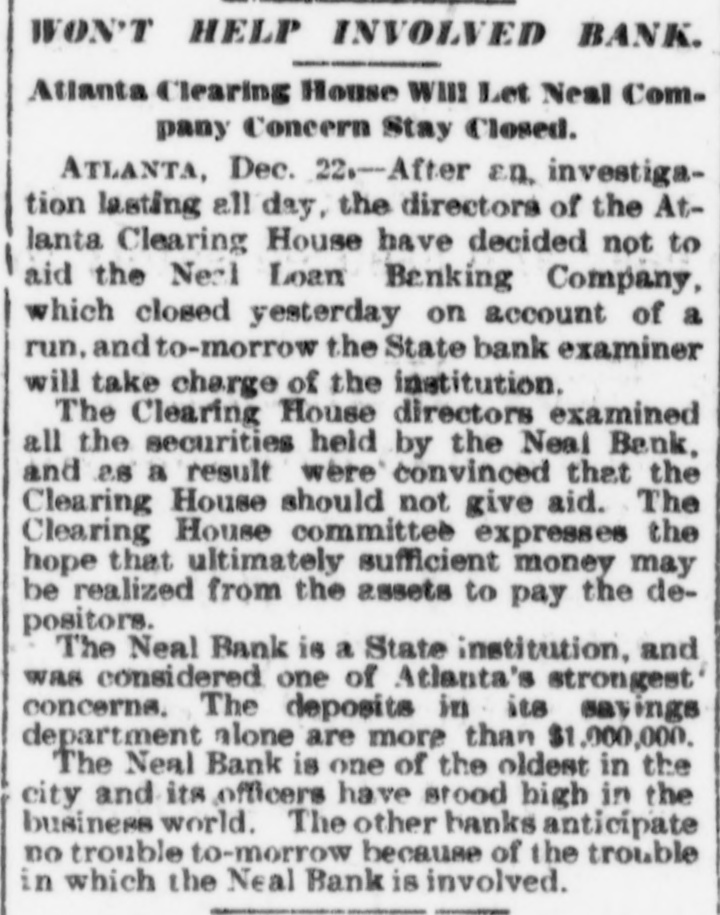
After an investigation lasting all day, the directors of the Atlanta Clearing House have decided not to aid the Neal Loan and Banking Company, which closed yesterday on account of a run, and to-morrow the State bank examiner will take charge of the institution.
Source
newspapers
3. December 24, 1907 Receivership
Newspaper Excerpt
The Central Bank and Trust Corporation ... was, late today, appointed receiver for the Neal Bank, which failed to open its doors for business last Monday. The Central Bank will take immediate charge of the affairs of the failed bank and liquidate its business as soon as possible.
Source
newspapers

Newspaper Articles (22)

Article from The Sun, December 22, 1907

Click image to open full size in new tab

Article Text

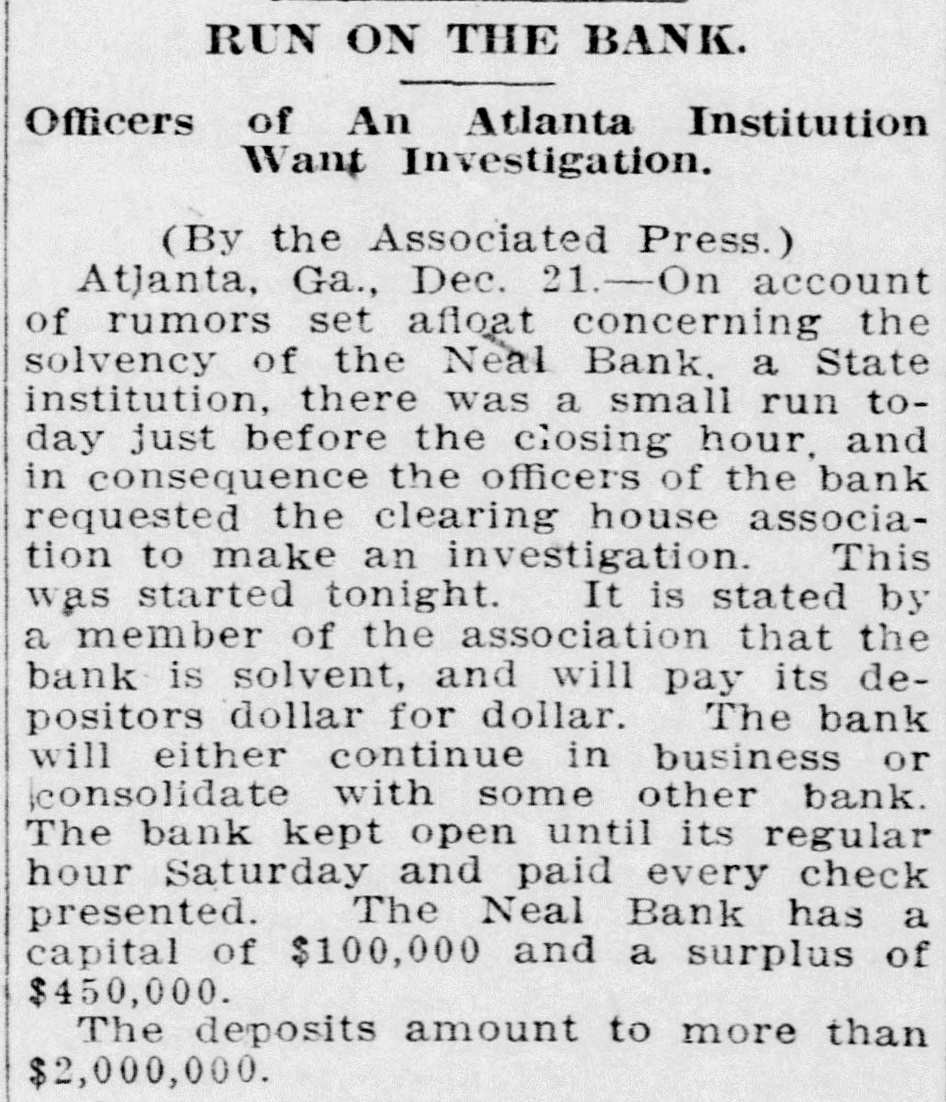
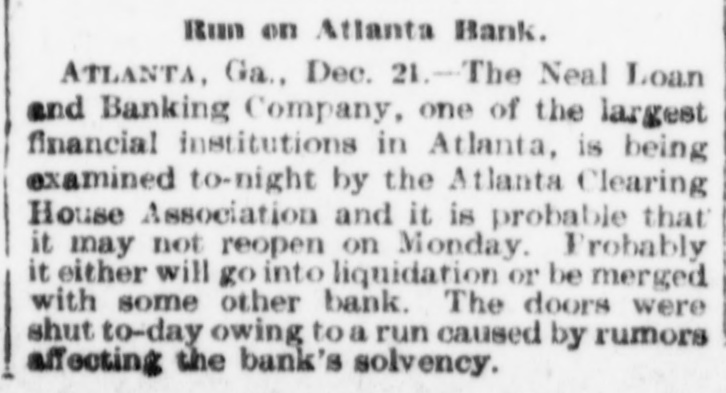
Run on Atlanta Bank. ATLANTA, Ga., Dec. 21.-The Neal Loan and Banking Company, one of the largest financial institutions in Atlanta, is being examined to-night by the Atlanta Clearing House Association and it is probable that it may not reopen on Monday. Probably it either will go into liquidation or be merged with some other bank. The doors were shut to-day owing to a run caused by rumors affecting the bank's solvency.


Article from The Montgomery Advertiser, December 22, 1907

Click image to open full size in new tab

Article Text

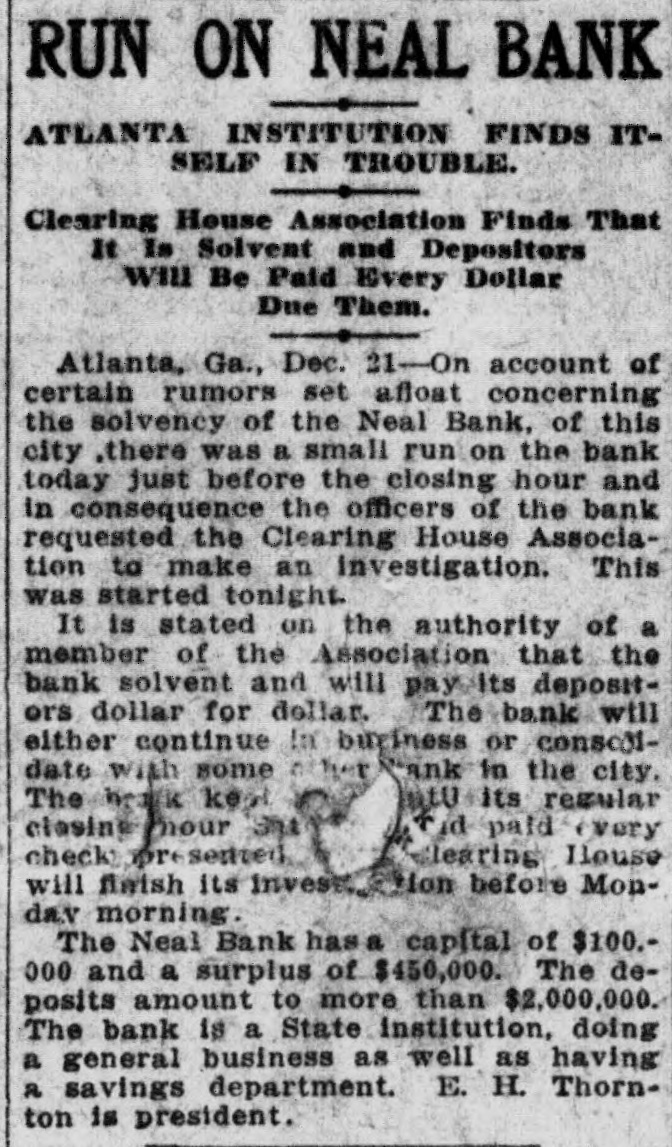
RUN ON NEAL BANK ATLANTA INSTITUTION FINDS ITSELF IN TROUBLE. Clearing House Association Finds That It Is Solvent and Depositors will Be Paid Every Dollar Due Them. Atlanta, Ga., Dec. 21-On account of certain rumors set afloat concerning the solvency of the Neal Bank, of this city there was a small run on the bank today just before the closing hour and in consequence the officers of the bank requested the Clearing House Association to make an Investigation. This was started tonight. It is stated on the authority of a member of the Association that the bank solvent and will pay its depositors dollar for dollar. The bank will either continue In buriness or conscridate with some 0 her Prank in the city. The heark ke atu its regular clasing hour 304 Td paid every check pre sented learing House will finish its invest ion before Monday morning. The Neal Bank has a capital of $100.000 and a surplus of $450,000. The deposits amount to more than $2,000,000. The bank is a State institution, doing a general business as well as having a savings department. E. H. Thornton is president.


Article from The Birmingham Age-Herald, December 22, 1907

Click image to open full size in new tab

Article Text

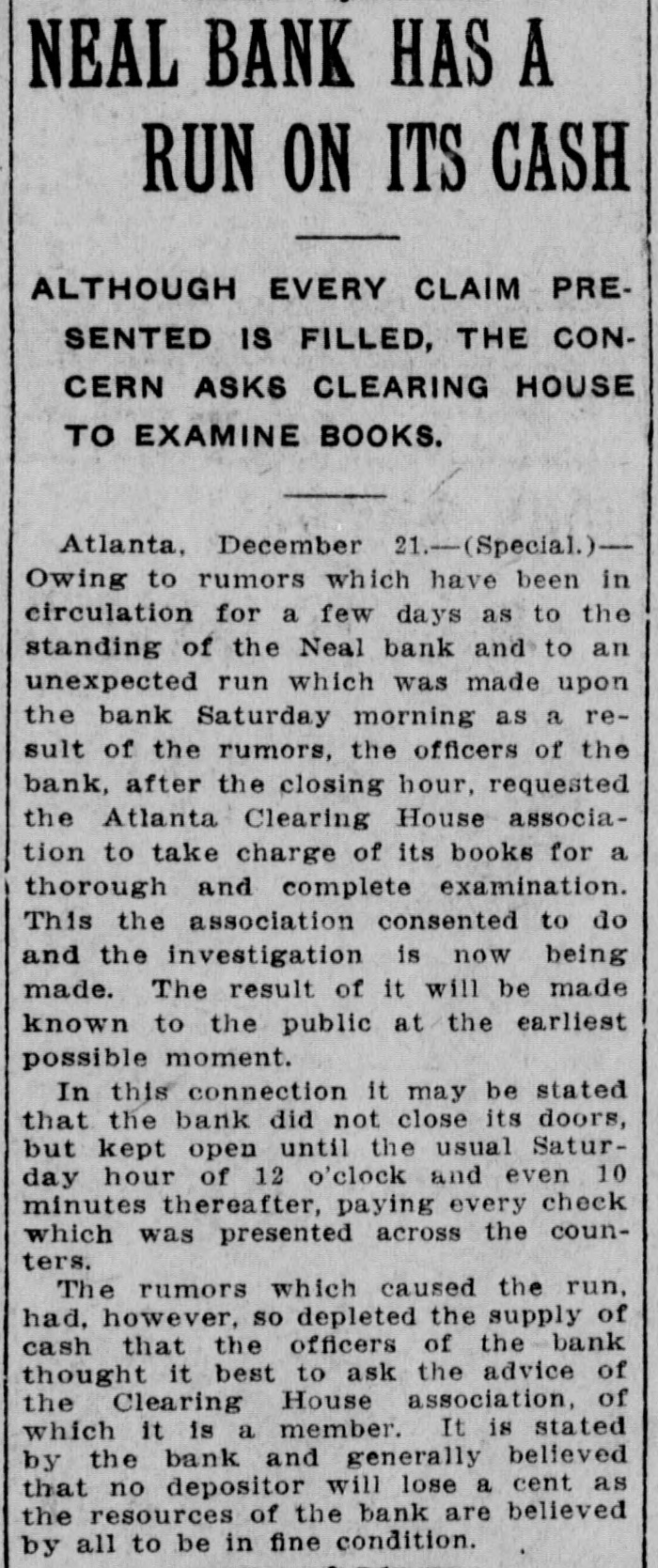
NEAL BANK HAS A RUN ON ITS CASH ALTHOUGH EVERY CLAIM PRESENTED IS FILLED, THE CONCERN ASKS CLEARING HOUSE TO EXAMINE BOOKS. Atlanta, December 21.-(Special.)Owing to rumors which have been in circulation for a few days as to the standing of the Neal bank and to an unexpected run which was made upon the bank Saturday morning as a result of the rumors, the officers of the bank, after the closing hour, requested the Atlanta Clearing House association to take charge of its books for a thorough and complete examination. This the association consented to do and the investigation is now being made. The result of it will be made known to the public at the earliest possible moment. In this connection it may be stated that the bank did not close its doors, but kept open until the usual Saturday hour of 12 o'clock and even 10 minutes thereafter, paying every check which was presented across the counters. The rumors which caused the run, had, however, so depleted the supply of cash that the officers of the bank thought it best to ask the advice of the Clearing House association, of which it is a member. It is stated by the bank and generally believed that no depositor will lose a cent as the resources of the bank are believed by all to be in fine condition.


Article from The Sun, December 23, 1907

Click image to open full size in new tab

Article Text

WON'T HELP INVOLVED BANK. Atlanta Clearing House WIII Let Neal Company Concern Stay Closed. ATLANTA, Dec. 22.-After an investigation lasting all day, the directors of the Atlanta Clearing House have decided not to aid the Nezl Loan Benking Company, which closed yesterday on account of a run, and to-morrow the State bank examiner will take charge of the institution. The Clearing House directors examined all the securities held by the Neal Bank, and as a result were' convinced that the Clearing House should not give aid. The Clearing House committee expresses the hope that ultimately sufficient money may be realized from the assets to pay the depositors. The Neal Bank is a State institution, and was considered one of Atlanta's strongest concerns. The deposits in its savings department alone are more than $1,000,000. The Neal Bank is one of the oldest in the city and its officers have stood high in the business world. The other banks anticipate no trouble to-morrow because of the trouble in which the Neal Bank is involved.


Article from The Montgomery Advertiser, December 23, 1907

Click image to open full size in new tab

Article Text

Clearing souse Declines Aid. 4 STATE EXAMINERS IN CHARGE Neal Bank, State Depository, Has Depreciated Securities. Governor Smith Denies That He Has Reen Requested to Declare a Week's Holiday To Prevent Other Runs. Ga., Dec. 22-Following affairs of Atlanta, investigation of the largest State two Neal days Bank, one of the was decided the in Georgia, it the instidepositories to put the affairs of State Bank tonight the hands bt the Assotution in The Clearing House ciation Examiner. issued this notice: To the Public: duly considering the of character the Neal of "After the and assets investigating and resources its affairs of ex- as Bank. possible. for the purpose its confar as to it such assistance regret as that the investments and that in bank are be feel dition we tending this find would they warrant, of such cannot character we loans readily of our converted, opinion and in rendering therefore we the do assistance not warranted that its present necessities require. Interest of Depositors. believe that the interests be of best the "We and creditors will bank to condepositors by allowing the State officonserved assets through the We hope that cials vert its as provided by law. this course, creditors by the and adoption depositors of will ultimately be paid, (Signed) "The Atlanta Atlanta National Clearing House Association: National Bank. Fourth BankBank, Lowry Bank, Maddox-Rucker Bank. National Company. Third National Corporation. Central ing Bank issuance and Trust of the notice Thornton. the With the of the bank. E. H. orderdirectors W. F. Maury and H. on C. Caldwell, the bank doors that it was ed a notice in posted the hands of the State Bank Examiner. at the meetThe banks represented Atlanta National, Lowry Naing were the Fourth National. Third ComNational, Maddox-Rucker Banking and Trust pany tional, and the Central Bank the Corporation hoped, after the result House of AsIt was of the Clearing became sociation deliberation on Saturday, Bank when was It in trou- the that the Neal devised at known would be that would ble, a adjourned to Monday. meeting the bank to open enable plan Depreciated. today of Securities to the examination clearing house the According completed by the assets exceed bank the nominal but it by extensive loans the late liabilities today. ascertained Alabama about that $600,000, properties these had was Cuban and to bring on so far depreciated to a low as figure. were A num- also assets of down uncollectable notes number of a ber The aggregate which did business, depositors discovered. savings, as is in well 9,000 the an as aggregate bank savings a regular check depositors of banking $723. was alone, 000. Subject having otherwise the demand to and $48,000- time $896,000. certificate while deposits aggregate a It total is of the $2,067,000. geenral the depositors belief. expressed will was be by bankers that time. The bank full in considpaid in at $100,000. and was in Atlanta. capitalized one of the strongest bank for a deposit ered The $100,000, State used but the is protected to the by condi- bond. of No official statement institution as was issued none by tion of the Examiners tonight their and work the will State be issued its until affairs after is completed. in going over small Depositors. small In the Many Neal and Bank it was were they many who Saturday gathdepositors the institution that the ered when about a report was What spread started vari- this bank was insolvent. matter of speculation. the rerun is a being afloat as to it was fusal ous stories to pay a check difficulty because in cashing reirregular and of run a immediately determiexchange. the The bank's officers affairs and sulted in investigate its from the nation this directors was to followed for the by a State request to take that charge. The report was would spread be asked tonight to declare of Governor cipitate the a fear legal other Smith that holiday runs. the to trouble of This the a week was might Associated because denied every preby the Governor He declared that Press bank in tonight. Atlanta was solid.


Article from The Birmingham Age-Herald, December 23, 1907

Click image to open full size in new tab

Article Text

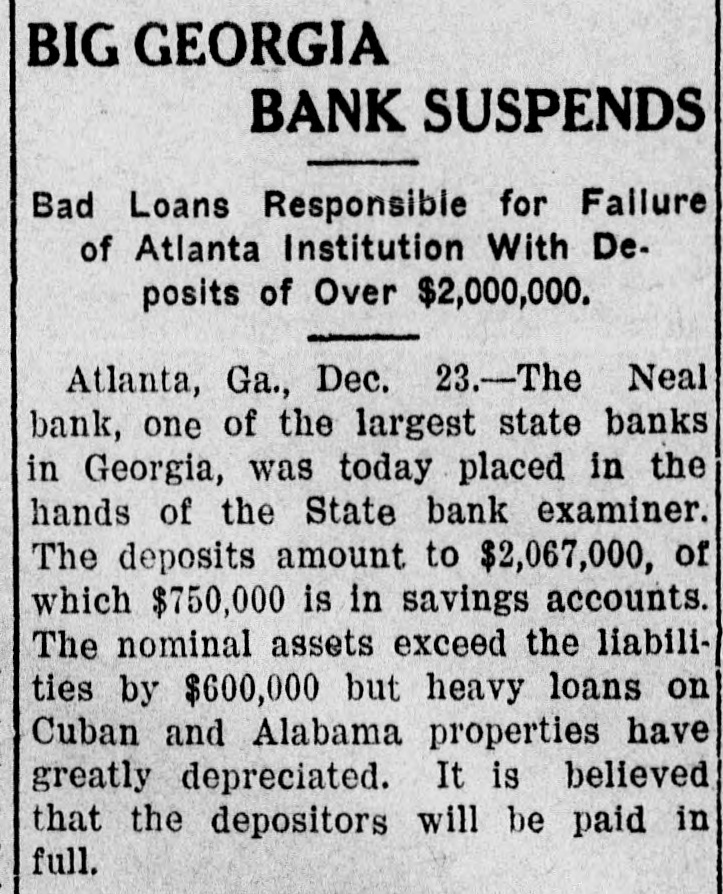
ATLANTA BANK IS OUT OF BUSINESS State Bank Examiner Will Be Put In Charge ASSETS NOT IN GOOD SHAPE Clearing House Association Gives Out Statement Saying Bank Will Pay Out, But It Will Take Time to Settle Affairs. Atlanta, December -Following two days' investigation of the affairs of the Neal bank, one of the largest state depositories in Georgia, it was decided tonight to put the affairs of the institution in the hands of the state bank examiner. The Clearing House association issued this notice: "To the Public-After duly considering the character of the assets and resources of the Neal bank, and investigating its affairs as far as possible, for the purpose of extending to it such assistance as its condition would warrant, we regret that we find the investments and loans of this bank are of such character that in our opinion they cannot be readily converted, and therefore we do not feel warranted in rendering the assistance that its present necessities require. "We believe that the interests of the depositors and creditors will be best conserved by allowing the bank to convert its assets through the state officials as provided by law. We hope that by the adoption of this course creditors and depositors will ultimately be paid. "The Atlanta Clearing House association. "Atlanta National bank. "Lowry National bank. 'Fourth National bank. "Mabbox-Rucker Banking company. "Third National bank. "Central Bank and Trust corporation." With the issuance of the notice the directors of the bank, E. H. Thornton, W. F. Maury and H. C. Caldwell, ordered a notice posted on the bank doors that it was in the hands of the state bank examiner. The banks represented at the meet. ing were the Atlanta National, Lowry National, Fourth National, Third National, Maddox-Rucker Banking company and the Central Bank and Trust corporation. It was hoped, after the result of the deliberation of the Clearing House association on Saturday, when it became known that the Neal bank was in trouble, a plan would be devised at the meeting adjourned to today that would enable the bank to open by Monday. According to the examination of the bank completed by the clearing house late today, the nominal assets exceed the liabilities by $600,000, but it was ascertained that extensive loans in Cuban and Alabama properties had so far depreciated as to bring these assets down to a low figure. A number of uncollectable notes were also disThe number of dethe bank well as a regular ness positors covered. ings as is 9000, in aggregate savings which depositors banking did a alone busi- savhaving an aggregate of $723,000. Subfect otherwise to check was $896,000. while the demand and time certificate deposits aggregate $48,000- a total of $2,067,000. It is the general belief expressed by bankers that the depositors will be paid in full in time. The bank was capitalized at $100,000 considered one of the strongThe state of $100,000 bond. No est and for tected in a was Atlanta. deposit official used but statement the is bank procondition of the state as was to issued the by by the examiner issued institution until toand none will be work in going over In night after fairs is their completed. the Neal and its it bank was afsmall gathered about when a bank was they were tion Saturday many who the depositors, report insolvent. the was institu- spread What run is a matter stories being as to that tion, started various this check affoat of because speculato a it and of a exchange. The run cashing was the refusal irregular pay difficulty officers' immediate- de- in in the bank's to investigate was followed by a termination iy and resulted this its request affairs from the directors for the state to take charge. The report was spread tonight that Governor Smith would be asked to declare a legal holiday of a week be cause of the fear that the trouble might precipitate other runs. This was the governor to AssoPress tonight. He that ciated denied by declared solid. the every bank in Atlanta was


Article from The Washington Herald, December 23, 1907

Click image to open full size in new tab

Article Text

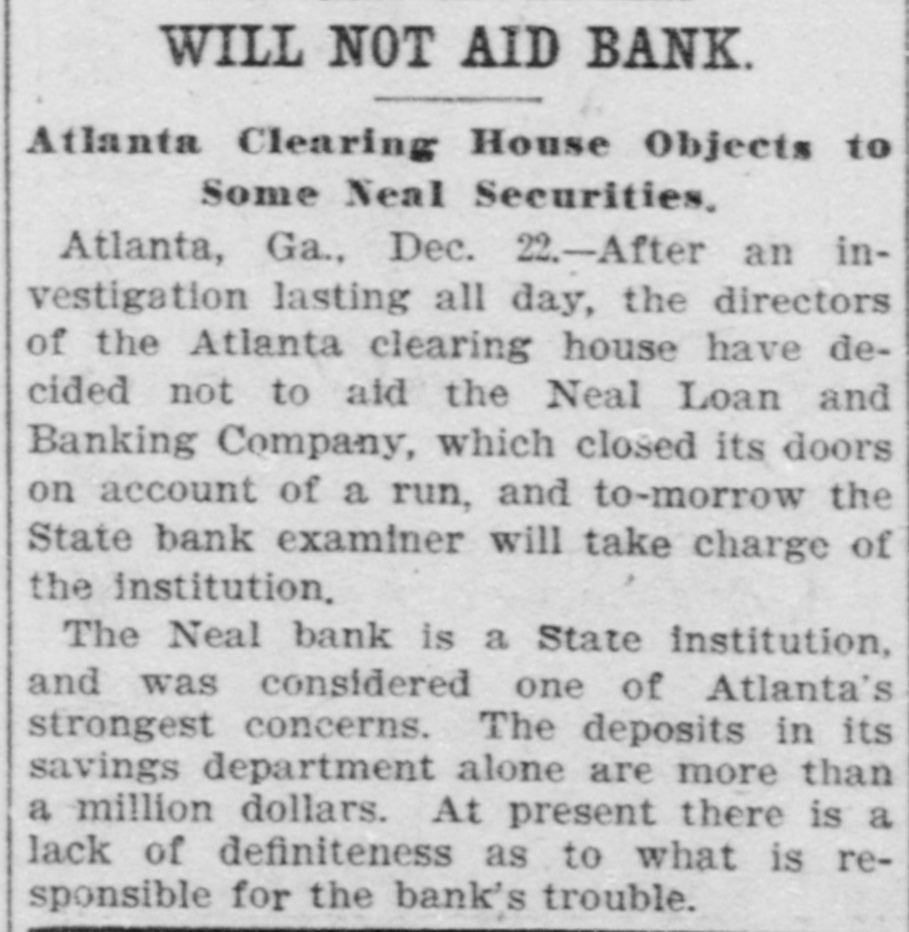
WILL NOT AID BANK. Atlanta Clearing House Objects to Some Neal Securities, Atlanta, Ga., Dec. 22.-After an investigation lasting all day, the directors of the Atlanta clearing house have decided not to aid the Neal Loan and Banking Company, which closed its doors on account of a run, and to-morrow the State bank examiner will take charge of the institution, The Neal bank is a State institution, and was considered one of Atlanta's strongest concerns. The deposits in its savings department alone are more than a million dollars. At present there is a lack of definiteness as to what is responsible for the bank's trouble.


Article from The Montgomery Advertiser, December 25, 1907

Click image to open full size in new tab

Article Text

CENTRAL BANK AND TRUST CORPORATION TAKE CHARGE Neal Bank Now in the Hands of One of Atlanta's Strongest Financial Institutions. Atlanta, Ga., Dec. 24-The Central Bank and Trust Corporation, of which Asa G. Candler is president, was, late today. appointed receiver for the Neal Bank, which failed to open its doors for business last Monday. The Central Bank will take immediate charge of the affairs of the failed bank and 11quidate its business as soon as possible. It is generally believed that depositors will be paid dollar for dollar in the end. Governor Smith today said: "The Attorney General and myself are doing everything in our power to safeguard the depositors of the Neal Bank. I want the depositors to understand that their interests will be considered to the very best of our ability."


Article from Gainesville Daily Sun, December 25, 1907

Click image to open full size in new tab

Article Text

Leading Atlanta Institution Is Forced to Suspend. NOW IN EXAMINER'S HANDS Immediate Cause of the Closing Was an Unexpected Run Which Was Made on the Bank Saturday by Depositors. Atlanta, Ga., Dec. 24.-The Neal bank, for 20 years one of the leading banking institutions in Atlanta, at one minute after 12 o'clock Monday morntug was placed by three of its directors, as required by law, in the hands of the state bank examiner. The following notice was placed upon the doors of the bank: "This bank is in the hands of state bank examiner. E. H. Thornton, W. F. Manry, H. C. Caldwell, directors." This action was taken after an inwestigation into the affairs of the bank by the Atlanta Clearing House asso. clation and a recommendation by the association, that this course to be followed. The imediate cause of the closing of the Neal bank was an unexpected run made on the bank Saturday morn4ng, the result in the opinion of its officers, of rumors which had been circulated for some time as to the solvency of the institution. The bank, however, did not close Its doors on Saturday morning but continued to honor all demands until the closing hour, 12 o'clock. It was then discovered by the officers that the run of the morning had so depleted the supply of cash, that it was determined to ask the clearing house association, of which the Dunk is a member, to take charge of its books and make a thorough investigation of its condition. Having decided to do this. the bank did not rereive savings deposits Saturday afternoon as usual, but closed all the doors. It was the intention of the clearfing house banks to assist the Neal bank, but It was found that the asEets of the distressed bank consisted In large part of investment and loans which were not of & readily convertable or liquid charcater, and. therefore. anbankable, and the conclusion was reached that the clearing house could not render the assistance which the necessities of the situation required. It was, therefore, recommended that the bank place its affairs In the hands of the state authorities, and this was done.


Article from The Times Dispatch, December 27, 1907

Click image to open full size in new tab

Article Text

Receiver Files Big Bond. ATLANTA, GA.. December 26.-The Central Bank and Trust Corporation to-day filed a bond of $100,000 as receiver for the Neal Bank, which recently closed its doors. The receiver will proceed immediately to wind up the affairs of the Neal Bank, and will endavor to pay the depositors dollar for dollar.


Article from The Washburn Leader, December 27, 1907

Click image to open full size in new tab

Article Text

FINANCIAL AND INDUSTRIAL The Diamond Jo line of steamers, running between St. Louis and St. Paul, has been sold to a wealthy syndicate of men, who will improve the present fleet of passenger and freight boats and increase its carrying capacity very materially. Following an investigation of the affairs of the Neal bank of Atlanta, one of the largest state depositories in Georgia, it was decided to put the affairs of the institution in the hands of the state bank examiner. The Union Avenue Bank of Commerce, one of the small banks affiliated with the National Bank of Commerce of Kansas. City, which closed when the parent institution failed, has resumed business. William P. Knight has been appointed receiver of the National Glass company by Judge Nathaniel Ewing of the United States circuit court, sitting in Pittsburg. The Smelter City bank of Durango, Colo., a state institution, capitalized at $30,000, has suspended.


Article from The Birmingham Age-Herald, January 22, 1908

Click image to open full size in new tab

Article Text

TRAINT UPON VERNOR'S PLANS Watson Has Hand Upon Senatorial Question OGES NOT CARRIED OUT less Is Said To Have Sprung Up tween Governor Smith and Some of His Friends Relative To Senatorship. tlanta, January 21.-(Special.)-Politigossip has it that the three restrain5 influences upon Gov. Hoke Smith's natorial aspirants have been Thomas Watson, the Atlanta Journal with imes R. Gray at its head, and Conressman T. W. Hardwick of the Tenth. Notwithstanding which it appears that he governor's desire to get into the race as not abated one whit, and it is accepted among his close political friends that if he can find a way he is going to do it. Mr. Watson's reasons have been gathered from his publications in which he warned the governor that the people of Georgia would not send him to the Senate until he carried out his campaign pledges, some of which remain, as yet, unfulfilled and are awaiting the action of the general assembly this summer. Mr. Gray's reasons in the Journal were quite similar, though more gently put. He simply suggested that the governor would not think of running for the Senate until all the pledges of the Macon platform had been enacted into law. What Congressman Hardwick's reasons are, other than these, has not been made apparent. It is reported in capitol circles that a coolness has sprung up between the governor and Mr. Gray, though, of course, there has been nothing like an open breach, and it is not expected there will be. Just what the first cause of it was has not been made apparent, but it is said it was accentuated by the failure of Mr. Gray to secure the appointment as receiver of the defunct Neal bank, a position which he very much desired. It is well known that the court, presumably at the suggestion which originiated with the governor, appointed the Central Bank and Trust corporation to wind up the Neal bank's affairs. But to get back to the original proposition. A well-known Georgia politician, who stands quite close to the governor, said today: "I am confident that Governor Smith is anxious to make the race for the Senate, and while I know nothing definite, it is my belief, from all that I have heard. that he will do so. You know if a man like Governor Smith wants to do a thing he generally finds a way of doing it to his own satisfaction, and I believe the governor is going to find a way in this instance. There is a question as to whether he would get the support for the Senate of the Journal and of Mr. Watson, but there is also some question as to whether he needs it. From the way things are looking now I would not be surprised to see the Georgian become the mouthpiece of the administration at no distant date. You cannot tell.'


Article from The Birmingham Age-Herald, February 10, 1908

Click image to open full size in new tab

Article Text

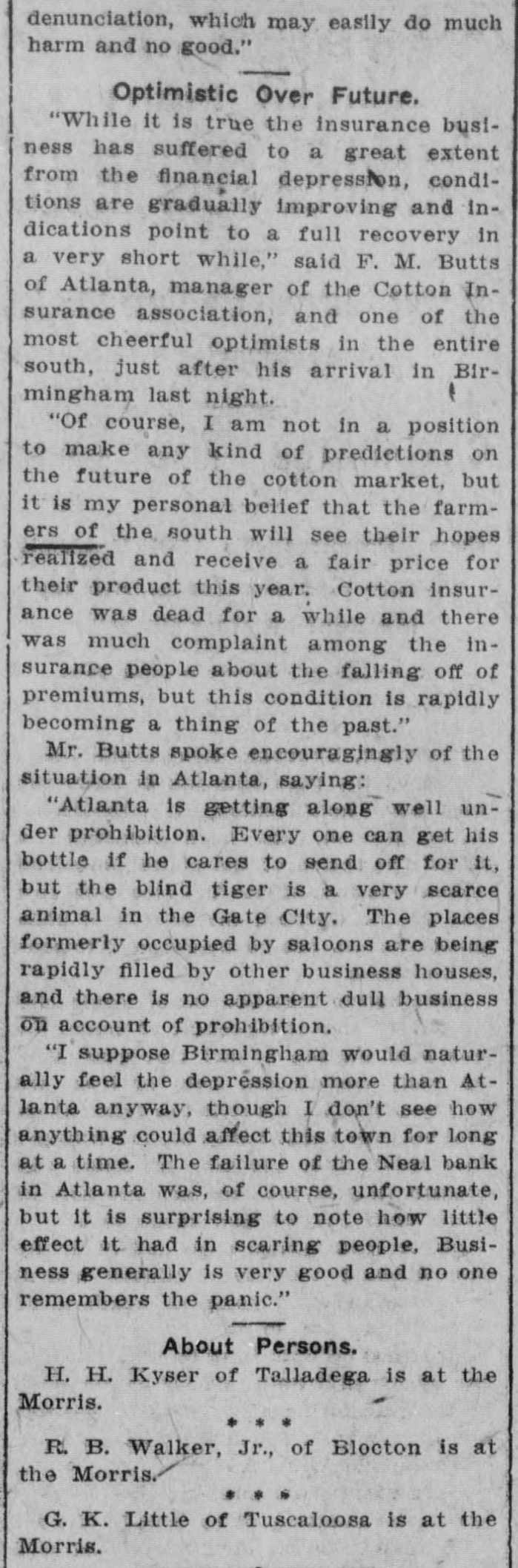
denunciation, which may easily do much harm and no good." 1 Optimistic Over Future. "While it is true the insurance business has suffered to a great extent from the financial depression, conditions are gradually improving and indications point to a full recovery in a very short while," said F. M. Butts of Atlanta, manager of the Cotton Insurance association, and one of the most cheerful optimists in the entire south, just after his arrival in Bir( mingham last night. "Of course, I am not in a position to make any kind of predictions on the future of the cotton market, but it is my personal belief that the farmers of the south will see their hopes realized and receive a fair price for their product this year. Cotton insurance was dead for a while and there was much complaint among the insurance people about the falling off of premiums, but this condition is rapidly becoming a thing of the past." Mr. Butts spoke encouragingly of the situation in Atlanta, saying: "Atlanta is getting along well under prohibition. Every one can get his bottle if he cares to send off for it, but the blind tiger is a very scarce animal in the Gate City. The places formerly occupied by saloons are being rapidly filled by other business houses, and there is no apparent dull business on account of prohibition. "I suppose Birmingham would naturally feel the depression more than Atlanta anyway, though I don't see how anything could affect this town for long at a time. The failure of the Neal bank in Atlanta was, of course, unfortunate, but it is surprising to note how little effect it had in scaring people, Business generally is very good and no one remembers the panic." About Persons. H. H. Kyser of Talladega is at the Morris. R. B. Walker, Jr., of Blocton is at the Morris. G. K. Little of Tuscaloosa is at the Morris.


Article from The Birmingham Age-Herald, March 15, 1908

Click image to open full size in new tab

Article Text

BANK DEPOSITORS WILL GET MONEY Atlanta, March 14.-(Special.)-Depositors of the defunct Neal bank will get their first dividend in next Friday morning's mail. Seven thousand of them will participate in this dividend, which amounts to 20 per cent. The Neal bank had altogether 9000* depositors, but there were more than 2000 of them who had less than $2.50 on deposit, and at least 20 who had to their credit 2 cents or less. These will be paid nothing at present, and the probabilities are they are not seriously worrying over it. Checks for one-fifth of the amount due 7000 depositors are now being drawn in the offices of the receiver, the Central Bank and Trust corporation, and will be mailed Thursday night, March 19, reaching the depositors on the 20th, the date fixed by the court for payment. The aggregate payment to be made to these depositors will be $375,000. It will probably be three or four months before another dividend is paid, and the final settlement will hardly be made under two years from the date of the bank's failure.


Article from The Chickasha Daily Express, March 20, 1908

Click image to open full size in new tab

Article Text

Neal bank after its indebtedness to the Fourth National Bank of New York, the bank of Manhattan company of New York, the Atlanta Clearing House association and the state of Georgia has been deducted. To these creditors no dividend will be paid. The receiver has approximately $450,000 cash on hand.


Article from Gainesville Daily Sun, March 25, 1908

Click image to open full size in new tab

Article Text

STATE IS NOW PAID IN FULL. Receiver for Neal Bank Gave Check for Balance Saturday. Atlanta, March 24.-State Treasuror R. E. Park, Saturday received from the Central Bank and Trust Cor. poration, receiver for the defunct Neal Bank, a check for $65,529.90. being the balance due on the state's deposits with that institution. The state treasurer was paid $125,B00 some dmys'ago. and the court ordered that the balance be paid within twenty days. The depositors who fought the state's claim to a prior Men on the smets of the Neal bank did not give the required bond to prevent the pay. ment of these funds to the state, though they have already appealed from Judge Ellis' docision to the sexpreme court.


Article from The Dawson News, May 20, 1908

Click image to open full size in new tab

Article Text

# CHICKENS COME TO ROOST J. R. Gray, Caught in Crash, Could Not Borrow Money Because of War on Capital in Georgia. From the Gainesville News. Inman & Co., a firm composed of James F. McGowan, of Augusta, and James R. Gray, of Atlanta, one of the largest cotton firms in the South, have failed for over one and a quarter million dollars, and have been placed in bankruptcy. Mr. James R. Gray, who is the editor of the Atlanta Journal, the leading Hoke Smith organ of the state, gives as a reason leading up to this failure that it has been caused by the long and continued depression in the cotton market. But, it is as true as the law of the Medes and Persians that one business cannot fail without affecting others, and that the war upon capital has brought about a chain of disasters. When the Pins Began to Fall. When the Seaboard Air Line went into the hands of a receiver the Hoke Smith boomers said it was already broke, and that it was placed in the hands of a receiver for political effect. When the Tallulah Falls Railway failed and went into the hands of a receiver they said it was politics. When the Elberton Air Line Railroad, between Toccoa and Elberton, failed they said it was politics. When two or three big cotton mills in middle Georgia failed they said it was politics. When the Neal Bank of Atlanta failed they said it was bad investments. When saw mill after saw mill and several brickyards shut down they said it was politics. Told Gray They Wouldn't Lend Money While Smith Was Governor. We understand that Mr. Gray visited New York about two weeks ago and made every effort to raise money, but received in reply the statement that just so long as Hoke Smith continued his war on capital in Georgia just so long would they refuse to advance one single dollar for any enterprise whatever in the State, and failing to raise the money there was nothing to do but to go into bankruptcy. It is stated that the estate of Walker P. Inman is involved as endorser to the extent of $450,000. The assets are represented almost by cotton and futures. Much of them were bought at prices far higher than those prevailing now. The failure is admitted to be the severest blow that has struck the Southern cotton industry in a decade, as it was the biggest Southern firm and probably the world's greatest exporting concern.


Article from Americus Times-Recorder, June 2, 1908

Click image to open full size in new tab

Article Text

# Some Historic Facts and Timely Words of Caution Given by Robert E. Park, State Treasurer. ATLANTA, GA., May 28, 1908. To the People of Georgia: Certain Georgia bankers have recently stated that my opponent has made promises in the event of his election to "distribute the State's money among the smaller depositories throughout the State," and I note that almost this exact language is used in his recent card of errors. These bankers expressed the opinion that this was intended as a tempting bait or bribe to them to withdraw their allegiance from myself. If Mr. Speer was connected with the State Treasury as Clerk and Assistant Bank Examiner so many years, as he claims, and was posted about the duties, he ought to know that tax-collectors and others who deposit taxes are required by the depository law to place the money of certain counties assigned to them in the banks selected for that purpose by the Governor, who alone has the right to designate such banks. To do otherwise, he should know, would violate the law. I am a stickler for obeying the law (perhaps I am old-fashioned in this respect), but I believe in a strict observance of the Code of Georgia and of the Acts of the Legislature relating to the State Treasury and State Banking Departments. Pardon a recital of some historic facts connected with State Treasurers of several Southern States who have held office during the past thirty years, and who, by violating the letter and the spirit of the law, have caused financial loss to their States, and have suffered personal and official disgrace: A treasurer of Kentucky was a defaulter to his State; a treasurer of Tennessee was punished for abstracting the State, funds; a treasurer of Alabama was convicted of making way with more than $3,000.00 of that State's funds; a treasurer of Mississippi spent four years in the penitentiary for similar conduct; a treasurer of Louisiana is now a refugee from justice in South America; a treasurer of Arkansas was convicted of misappropriation of the State's funds. this is a mortifying exhibit. Let us hope that Georgia will never entrust the management of her finances to any but men of high ideals, who are of iron integrity, and of stainless reputation in social and political life. With such men all shame in the history of our State will be avoided. My opponent brazenly stated that no depositor during his long connection with the State Treasury ever lost a dollar. This can not be a truthful statement in view of the fact that W. C. Hale, President of the State Savings Bank and Union Trust Company of Atlanta, failed utterly to meet the obligations to depositors and creditors of those two institutions, and incontinently fled the State and is now a refugee from justice. This event occurred during Mr. Speer's connection with the Treasury Department. His poor memory has also made him forget the Home Bank and the Merchants Bank of Atlanta, and I might also mention others, notably, the failure in Athens which caused the disappearance of its most trusted officer. I have painful memories myself of my inheritance from Mr. Speer of certain banks which I might mention, the condition of which, to quote his classic language, was "rotten." He has the effrontery to charge my administration with having permitted the Neal Bank to fail. Yet, in the opinion of Attorney-General Hart, and by the decision of Judge Ellis, as well as the freely-expressed views of many of our most intelligent bankers, and of numerous fair-minded people throughout the State, the official acts of myself and assistant in connection with this bank have been approved, and we have been fully absolved from any blame in this affair, now being revamped and rehashed for purely personal and political reasons by this desperate candidate. The high-minded and noble bankers and other citizens of Georgia will resent the suggestions and statements made by W. J. Speer. I repeat, that no treasurer has a right under the law to "distribute the State's money among the smaller depositories throughout the State." At one time, in 1906, there was only $3,500.00 of the State's money in all the depositories, very little to "distribute." I shall continue to be fair to all banks and persons of Georgia. The Governor designates the depositories and the law does not permit the Treasurer to discontinue them or to move deposits from one bank to another except, possibly, under order of the governor. The State of Georgia and its officers can not be directors of the conduct of the financial operations of the 465 State banks. The law directs, and it has been my pleasure to warn, to caution, to guide and to save banks and bankers that are in trouble. Only two chartered banks in Georgia have suspended during the present year, and those two, I am happy to say, have been restored to their former position as active banks. So I am still able to repeat what I stated in my annual report, that only five banks have failed during the past eight years. No other State in the Union can show a better record. I respectfully ask consideration of the above historic facts and these words of well-meant caution, believing that a generous patriotic and thoughtful people, realizing the important trust and responsibilities of the office of State Treasurer, are amply satisfied with my record, and the security of the State's funds while committed to my care.


Article from The Brunswick News, June 13, 1908

Click image to open full size in new tab

Article Text

HILLYER MADE A GOOD REPORT CALLED ATTENTION TO PROSPER OUS CONDITION OF BANKS IN GEORGIA. Secretary L. P. Hillyer, of the Georgia Bankers' Association, made the following interesting report at the meeting here Thursday: Mr. President and Gentlemen of the Georgia Bankers' Association: It gives me much pleasure to report to you that our association is flourishing in spite of the late depression, and that our membership is larger than ever. The recent group meetings were largely attended and were very enjoyable as well as beneficial. The panic of 1907. the worst in some particulars this country has ever seen, affected our Georgia banks as lightly, perhaps, as the banks of any state in the union. The state treasurer reports only two failures of state banks in Georgia for the year 1907. ThΓ©se fail. ures were the Neal Bank of Atlanta and the Exchange Bank of Macon. The Exchange Bank closed its doors some time before the panic, the Neal Bank was the sole weak spot in our 600 odd banks developed by the panic of 1907. In order that an accurate report might be made, I wrote to the comptroller of the currency at Washington, asking him to give the name of the National Banks which failed in Georgia since June 1st, 1907, as well as the full particulars concerning them. He replied as follows: "Washington, June 6th, 1908. Mr. L. P. Hillyer, secretary Georgia Bankers' Association, Macon, Ga. Sir: In reply to your letter of the 3d instant, you are respectfully informed that there have been no failures of National banks in the state of Georgia subsequent to May 15th, 1904. The First National. Bank of Macon suspended payment on that date, and its affairs were finally closed May 12th, 1906, the claims of creditors having been paid in full wth interest. T. P. Kane, Respectfully, Our record is a magnificent one, and none of us can estimate how much of it is due to the educational and moral influence of this association. Our members frequently, without knowing it, acquire valuable knowledge through social contact, and hints suggested at group meetings and annual conventions often enables us to avoid the treacherous pitfalls of banking. The program committee, of which your secretary is a member, has secured speakers for this convention whose addresses will furnish food for thought, and who will, no doubt, suggest important work for our association to accomplish. I beg of you to give them careful attention. and let us make this the greatest convention 'ever held since our organization. L. P. Hillyer, Respectfully, Secretary.


Article from The Lee County Journal, June 19, 1908

Click image to open full size in new tab

Article Text

STATE GLEANINGS. Demurrers were fixed in the superior court to the indictments against H. T. Thornton and W. F. Manry, president and vice president of the failed Neal bank of Atlanta, charging violation of the state bankink laws. The annual tax returns of the Atlanta, Birmingham and Atlantic railway, made to Comptroller General W. A. Wright, shows an increase of nearly $1,200,000 over those of 1907. Robert E. Davison of Athens, who received the second largest vote for prison commissioner in the recent election, has withdrawn from the second primary, thus leaving the field open to Wiley Williams who received the greatest number of votes. The Commercial Telegraphers' union of America, which has just closed its convention in Milwaukee selected Atlanta for their next meeting place. The Rockmart Hosiery mills resumed operations and will employ about thirty operatives. The mill has been shut down for several months. The supreme court has reversed the election held in Lafayette some time ago in which bonds were voted for the establishment of an electric plant and water works system. The leading railway lines of the Southeastern Tariff association filed a bond amounting to $600,000 and will go to the higher courts with the latest issue in the famous Tift lumber rate case at Macon. The farmers' co-operative demonstration work under the supervision of Dr. S. A. Knaff, of the department of agriculture of Washington, is meeting with much favor in Floyd and adjoining counties. Work of actual construction has been begun upon the fertilizer plant to be built by the Germofert Manufacturing company of Charleston, at the cost of $250,000 near Atlanta. When completed, early in September, this will be the largest factory for the manufacture of fertilizers in the south. Attorney John R. Cooper of Macon, has entered a fight in the state courts again to keep Jim Yeates from going to the state penitentiary for life for killing of the town marshal at Donaldsonville several years ago. Captain Archibald W. Butt, who has recently been detailed as aide to President Roosevelt, is a native Georgian, being from Augusta, and appointed into the service from there in January. The following officers were elected by the Georgia Bankers' association at the annual meeting in Savannah. Forest H. Crane, Savannah, president; E. D. Walter, Brunswick, first vice president; L. P. Hillyer, Macon, secretary. The steamship Merrimack, Captain Pratt, which arrived at Savannah, brought in the survivors of the crew of the British steamship Caribbee, Captain Ellis, which was lost in the gulf stream. At the last meeting of the city council a license of $1,000 was placed on the sale of near beer in the city of Tifton. Georgia's horticultural and agriculral products for 1908 will be worth about $200,000,000, according to the estimate of T.G. Hudson, commissioner of agriculture, who has compiled a report from information received in response to 1,000 letters sent out to reliable persons in all parts of the state. A terrible death was that suffered by J. E. Rodgers of Ellijay, Ga., at a saw mill plant in Murray county. Mr. Rodgers was operating the mill, when he was caught in some of the flying gear and was almost torn to pieces before the machinery could be stopped. Bob Tuggle, a meat cutter at a Cedartown market, was run down and killed by a Central switch engine. Tuggle was walking close beside the track reading a letter, and the engine came up from behind with a string of cars and struck him. Unexpected activity developed in Augusta cotton circles as the result of the purchase by Augusta mills of 1,164 bales, bought on the local market and sent direct to the warehouses of the local manufacturing concerns. Governor Smith has offered a reward of $200 for the arrest and evidence to prosecute the unknown person who burned the gin house and grist mill of Angus Morrison and also the school house in Morven district, Brooks county. Work has been begun at Covington on the new cotton seed oil mill. The company has bought the old machine works on the Georgia railroad, and the manager is on the ground getting it equipped.


Article from The Jeffersonian, January 20, 1910

Click image to open full size in new tab

Article Text

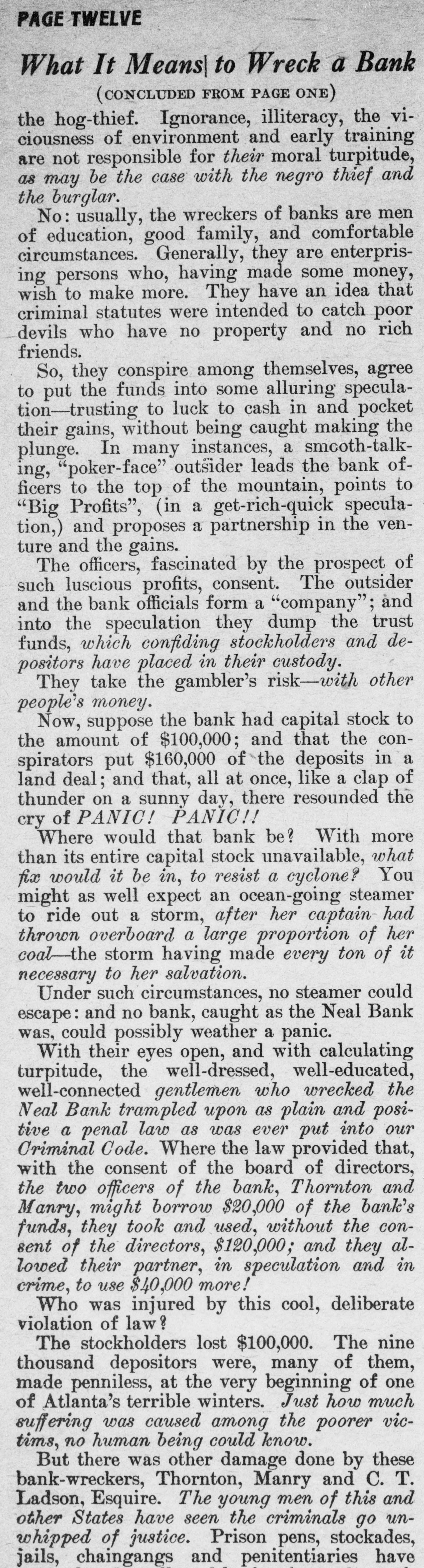
PAGE TWELVE What It Means| to Wreck a Bank (CONCLUDED FROM PAGE ONE) the hog-thief. Ignorance, illiteracy, the viciousness of environment and early training are not responsible for their moral turpitude, as may be the case with the negro thief and the burglar. No: usually, the wreckers of banks are men of education, good family, and comfortable circumstances. Generally, they are enterprising persons who, having made some money, wish to make more. They have an idea that criminal statutes were intended to catch poor devils who have no property and no rich friends. So, they conspire among themselves, agree to put the funds into some alluring speculation-trusting to luck to cash in and pocket their gains, without being caught making the plunge. In many instances, a smcoth-talking, "poker-face" outsider leads the bank officers to the top of the mountain, points to "Big Profits", (in a get-rich-quick speculation,) and proposes a partnership in the venture and the gains. The officers, fascinated by the prospect of such luscious profits, consent. The outsider and the bank officials form a "company"; and into the speculation they dump the trust funds, which confiding stockholders and depositors have placed in their custody. They take the gambler's risk-with other people's money. Now, suppose the bank had capital stock to the amount of $100,000; and that the conspirators put $160,000 of the deposits in a land deal; and that, all at once, like a clap of thunder on a sunny day, there resounded the cry of PANIC! PANIC!! Where would that bank be? With more than its entire capital stock unavailable, what fix would it be in, to resist a cyclone? You might as well expect an ocean-going steamer to ride out a storm, after her captain- had thrown overboard a large proportion of her coal-the storm having made every ton of it necessary to her salvation. Under such circumstances, no steamer could escape: and no bank, caught as the Neal Bank was, could possibly weather a panic. With their eyes open, and with calculating turpitude, the well-dressed, well-educated, well-connected gentlemen who wrecked the Neal Bank trampled upon as plain and positive a penal law as was ever put into our Criminal Code. Where the law provided that, with the consent of the board of directors, the two officers of the bank, Thornton and Manry, might borrow $20,000 of the bank's funds, they took and used, without the consent of the directors, $120,000; and they allowed their partner, in speculation and in crime, to use $40,000 more! Who was injured by this cool, deliberate violation of law? The stockholders lost $100,000. The nine thousand depositors were, many of them, made penniless, at the very beginning of one of Atlanta's terrible winters. Just how much suffering was caused among the poorer victims, no human being could know. But there was other damage done by these bank-wreckers, Thornton, Manry and C. T. Ladson, Esquire. The young men of this and other States have seen the criminals go unwhipped of justice. Prison pens, stockades, jails, chaingangs and penitentiaries have
Article from Atlanta Semi-Weekly Journal, April 29, 1910

Click image to open full size in new tab

Article Text

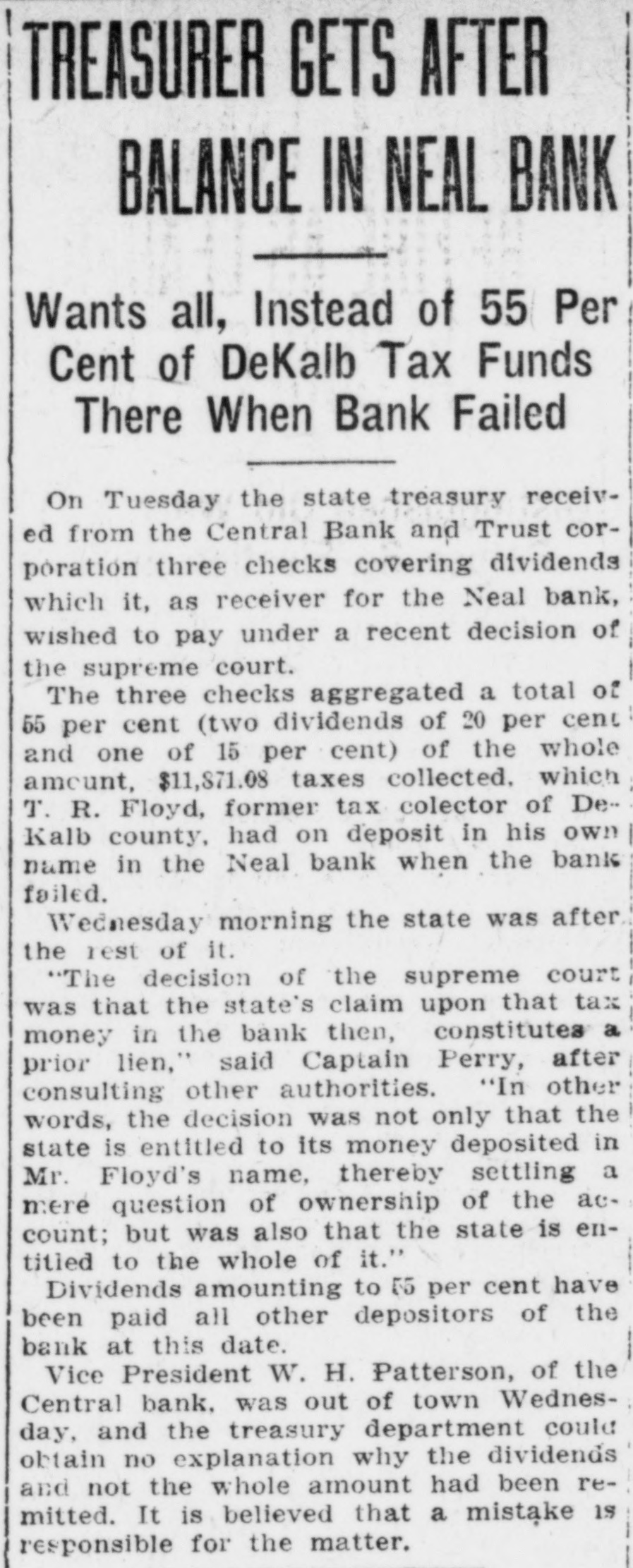
# TREASURER GETS AFTER # BALANCE IN NEAL BANK Wants all, Instead of 55 Per Cent of DeKalb Tax Funds There When Bank Failed On Tuesday the state treasury received from the Central Bank and Trust corporation three checks covering dividends which it, as receiver for the Neal bank, wished to pay under a recent decision of the supreme court. The three checks aggregated a total of 55 per cent (two dividends of 20 per cent and one of 15 per cent) of the whole amount, $11,871.08 taxes collected, which T. R. Floyd, former tax colector of DeKalb county, had on deposit in his own name in the Neal bank when the bank failed. Wednesday morning the state was after the rest of it. "The decision of the supreme court was that the state's claim upon that tax money in the bank then, constitutes a prior lien," said Captain Perry, after consulting other authorities. "In other words, the decision was not only that the state is entitled to its money deposited in Mr. Floyd's name, thereby settling a mere question of ownership of the account; but was also that the state is entitled to the whole of it." Dividends amounting to 5 per cent have been paid all other depositors of the bank at this date. Vice President W. H. Patterson, of the Central bank, was out of town Wednesday, and the treasury department could obtain no explanation why the dividends and not the whole amount had been remitted. It is believed that a mistake is responsible for the matter.