Article Text
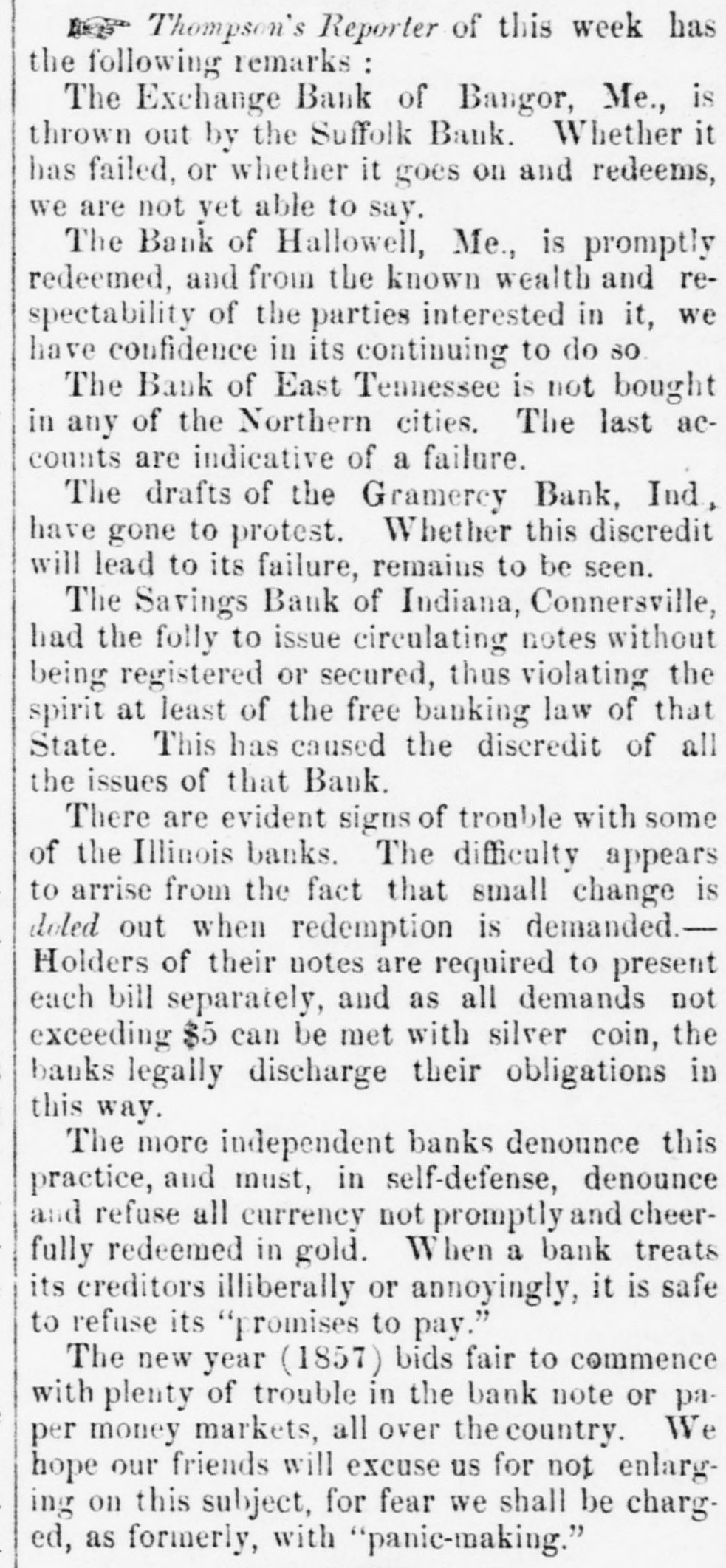
This link gives the Michigan Southern Road its fair proportion of the business between Chicago and Detroit and also of the Eastern business which takes the Canada and Suspension Bridge route, and from which it has been heretofore entirely cut off. It will also give Cleveland a railroad connection, by the Cleveland and Toledo road, with Detroit after the closing of navigation, and accomodate in Summer the passengers between Detroit and Cleveland who wish to avoid the lakes. It also gives St. Louis a short route to Detroit by the Wabash Valley road. It is a much needed link in the chain of Western roads. The loss of the ship Adriatic, belonging to Zerega & Co., falls heavily upon the underwriters, and is a discouraging commencement of the Winter. The ship is new, and this is her first return passage. The money market among the stock houses is decidedly easier on call, although the Banks generally are not free lenders. Paper goes at 8@10 cent for first class, which is scarce, but inferior grades are plenty. The demand for gold by Southern banks has decreased, and as the foreign drain is quite small there is an impression that we shall be able to hold on to most of the next California arrival. There is no foreign steamer until Wednesday from Boston, which will not probably take gold, excepting Belmont's remittances. The receipts of the Northern Illinois and Wisconsin Railroads will be comparatively light in the present month, in consequence of the heavy snows which have fallen there and blocked up the tracks, so as to render them absolutely impassable. The Chicago Press of the 22d announces the arrival of the first mail from Galena over the Galena and Chicago Road which had been received in a week. A letter from Chicago states that the Illinois Central and Rock Island Roads had been much embarrassed, and that the Fond du Lac Road had not passed a train over their line in ten days. On the Milwaukee and Mississippi Road a few passenger trains had been running slowly, but no freight trains. On the whole, it has been a very bad month for railroads in that section of the country, and this fact has, of course, had its influence upon the connecting roads this side. Thompson's Reporter of this week has the following remarks: The Exchange Bank of Bangor, Me., is thrown out by the Suffolk Bank. Whether it has failed, or whether it goes on and redeems, we are not yet able to say. The Bank of Hallowell, Me., is promptly redeemed, and from the known wealth and respectability of the parties interested in it, we have confidence in its continuing to do so. The Bank of East Tennessee is not bought in any of the Northern cities. The last accounts are indicative of a failure. The drafts of the Gramercy Bank, Ind., have gone to protest. Whether this discredit will lead to its failure, remains to be seen. The Savings Bank of Indiana, Connersville, had the folly to issue circulating notes without being registered or secured, thus violating the spirit at least of the free banking law of that State. This has caused the discredit of all the issues of that Bank. There are evident signs of trouble with some of the Illinois banks. The difficulty appears to arise from the fact that small change is doled out when redemption is demanded. Holders of their notes are required to present each bill separately, and as all demands not exceeding $5 can be met with silver coin, the banks legally discharge their obligations in this way. The more independent banks denounce this practice, and must, in self-defense, denounce and refuse all currency not promptly and cheerfully redeemed in gold. When a bank treats its creditors liberally or annoyingly, it is safe to refuse its "promises to pay." The new year (1857) bids fair to commence with plenty of trouble in the bank note or paper money markets, all over the country. We hope our friends will excuse us in not enlarging on this subject, for fear we shall be charged, as formerly, with "panic-making." The foreign letters received by the banking-houses, per the Canada, express great confidence in a return to an easy Money market, and that all danger of a financial crisis on the continent has passed away. The advices in regard to Breadstuffs have had an unfavorable influence on the market here. Flour is lower and dull. Wheat is held firmly, but the transactions are limited. Holders of Cotton are asking higher prices, which checks business. Pork and Beef are firm and in fair demand. Groceries are dull and rather heavy, with the exception of Coffee, which is held more firmly. In relation to American stocks, the circular of Mr. Satterthwaite, received by the Canada, says: Since our advices of the 28th ult., we have had a continuation of the steady feeling in monetary circles, with a disposition to operate, in view of a lower rate of interest. During the week we have to note a gradual rise in French rentes and railroad securities, and an increased confidence in the future on the Paris Bourse, a lower rate of interest in the various Continental markets than our own rate, and a reduction of 1d. per rupee in the East India Company's rate of Exchange. The Bank of England has, under these circumstances, reduced the rate of discount to 64 per cent on bills having 95 days to run, and on stocks till the payment of the dividende. Consols have been firm during the week, and reached 941 for money, closing at 944@95 for money, and 954@95% for account; Consols will be quoted ex-dividend to-morrow, the 6th inst. The market for English railroad securities has been buoyant, in anticipation of favorable results for the half year about ending, and of an easier Money market. There has been a quick demand for American railroad bonds at a slight advance, and we note considerable transactions in Illinois Construction Bonds, Erie 1883, 1862 and 1871 bonds, and in Michigan Central and New-York Central Bonds; a few lots of Illinois shares have changed hands at 134@14, closing free sellers at the latter figure. GOVERNMENT SECURITIES. U. S. 6s, 1868..105 @106 U. S. 6s, Coup. 1868..105 @106 Canadas 6s, sterling..1134@114 STATE SECURITIES. Pennsylvania 5s 74 @ 76 Penna. 5s, Coup., '77. 79 @ 81 Virginia 6s, 1886 83 @ 85 Virginia 5s, '88, sterl. 84 @ 86 CITY SECURITIES. N. Orleans 6s, '92-93. @ 75 RAILROAD BONDS. Belvidere, Del., 1877 88 & int. C., Ham.& Dayt. '30 - @ 80 Erie, 1883... 84 @ 86 Erie, 1871. 80 @ 82 Erie, 1862. 82 @ 84 Erie 1875 83 @ 85 RAILROAD BONDS. G'd Trunk, Can...78@80 & int. G't West'n, Can., '76 117@122 G't West'n, Can., '73 109@111 Illinois Central, 1875. 84 @ 85 Illinois Central, 1875. 80 @ 82 Illinois Central, 1860. 95 @ 96 Illinois Cent., sh's. 13@14 prm. Jol'et and N. Ind. 74 86@88 Mich. Central, 1860.. 90 @ 92 Mich. Central, 1869.. 93@ 94 Michigan Southern.. 75 @ 77 Mich. South., shares. 80 @ 82 N. Y. Central, 180.. 80 @ 82 N. Y. Cen., Conv., '64 90 @ 92x Ohio & Penna., 1872. 69 @ 71 Pennsylvania, 1389. 90@ 92 Penna, sterl's, 1874. 92 @ 94